
USP 788 is the United States Pharmacopeia chapter that sets the test methods and acceptance limits for subvisible particles in injections and parenteral infusions, counting particles of 10 µm and larger and 25 µm and larger by light obscuration or by microscope.
This guide pairs the chapter with Atlas data that other pages on USP 788 do not have: how often FDA investigators cited sterile manufacturing at Part 211 drug inspections from January 2025 to September 2026, what share of those inspections ended Official Action Indicated (OAI), and the 2026 warning letters that cited visual inspection for particles.
Key facts:
- USP 788 has two methods: Method 1, light obscuration, is the preferred test, and Method 2, a microscopic count, is used when Method 1 cannot be applied or the product exceeds the Method 1 limits.
- Under Method 1, an injection over 100 mL may contain no more than 25 particles per mL at 10 µm or larger and 3 per mL at 25 µm or larger.
- Under Method 1, an injection of 100 mL or less may contain no more than 6,000 particles per container at 10 µm or larger and 600 at 25 µm or larger.
- USP 788 is harmonized with Ph. Eur. 2.9.19 and JP 6.07, and USP lists a revised version as official on August 1, 2026.
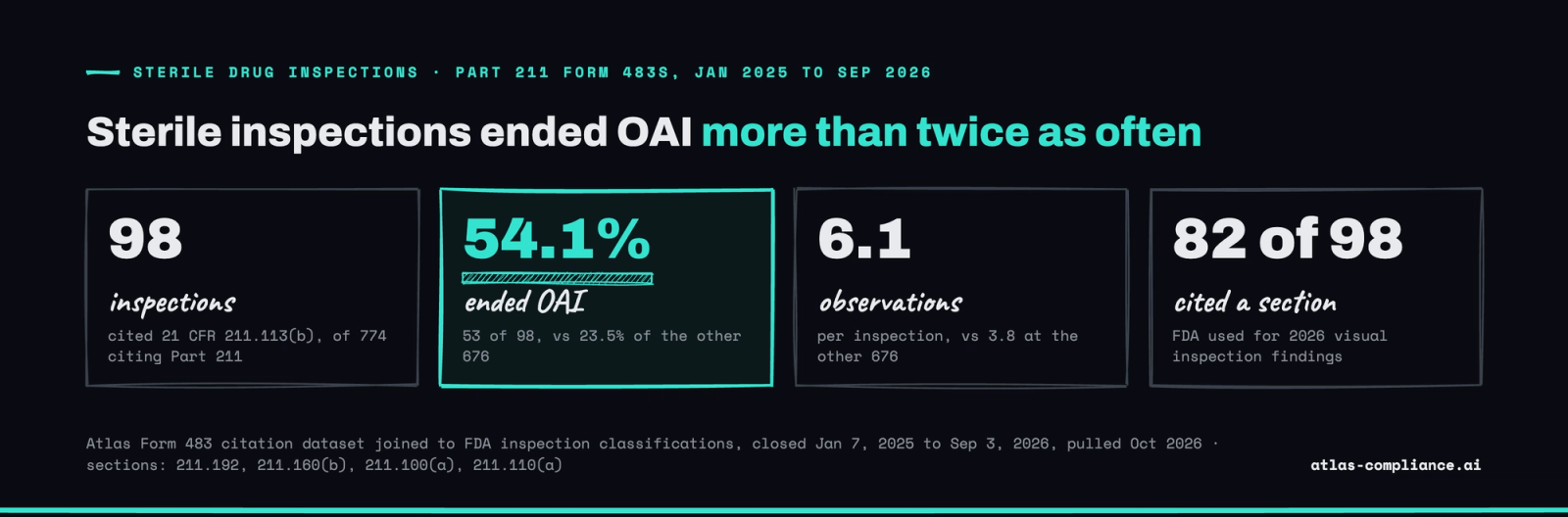
- In the Atlas Form 483 citation dataset, 98 of 774 Part 211 drug inspections cited the sterile drug section 21 CFR 211.113(b), and 54.1% of those 98 ended OAI, against 23.5% of the other 676.
What is USP 788?
USP 788, "Particulate Matter in Injections", is the compendial test for mobile, undissolved particles other than gas bubbles that are unintentionally present in injectable solutions. USP 788 covers subvisible particles only, the ones too small to see during visual inspection, and reports them in two size classes: 10 µm or larger and 25 µm or larger.
The chapter applies to injections and parenteral infusions, and its text states that solutions given by the intramuscular or subcutaneous route must meet the requirements too. Three groups are exempt: products packaged and labeled only as irrigating solutions, radiopharmaceutical preparations, and products whose labeling calls for a final filter, if scientific data justify the exemption.
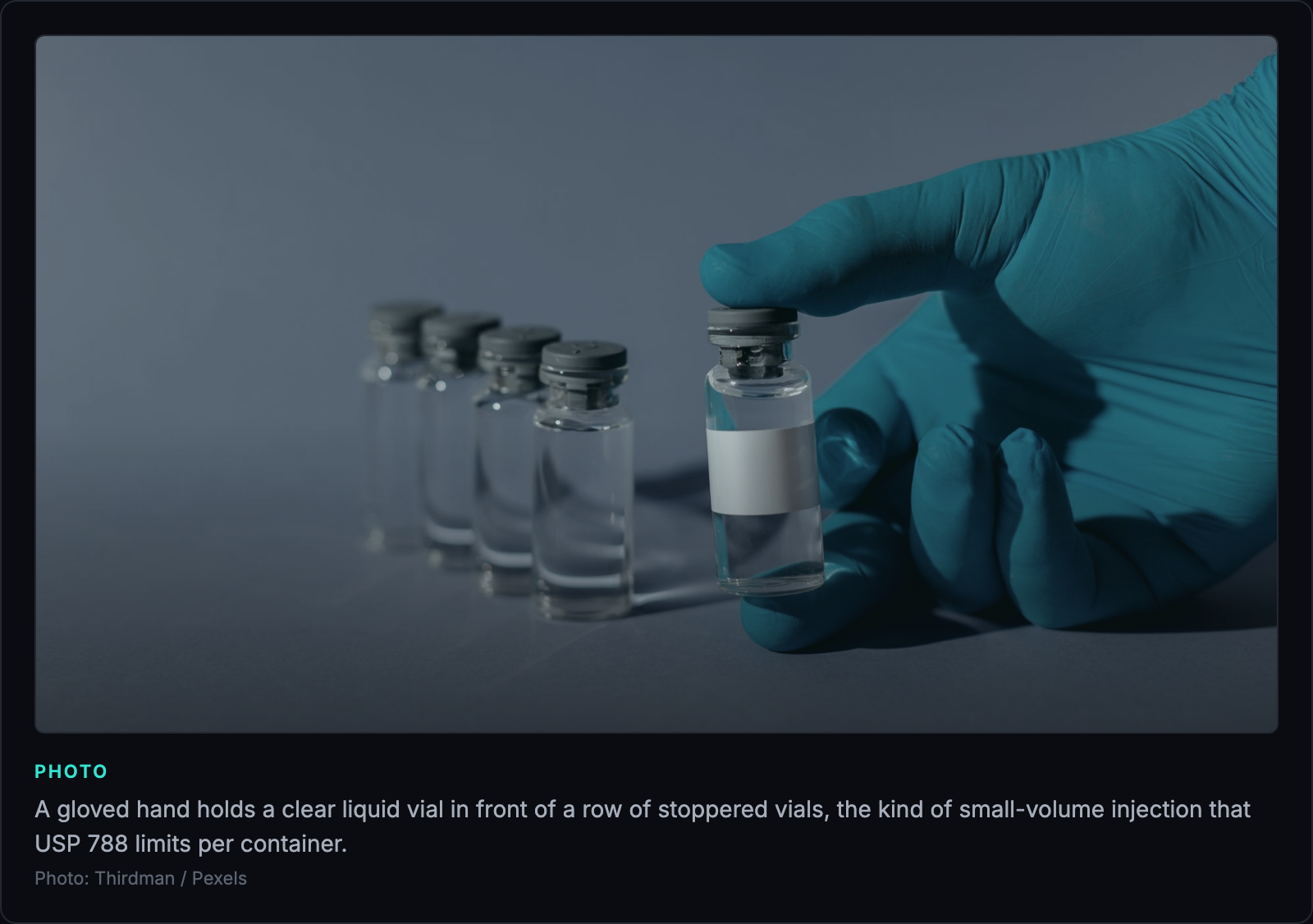
USP 788 is one of the chapters harmonized through the Pharmacopoeial Discussion Group, so the same text sits in the European Pharmacopoeia as 2.9.19 and in the Japanese Pharmacopoeia as 6.07, and ICH Q4B Annex 3 recognizes the three as interchangeable for the ICH regions. USP has also proposed renaming the chapter "Subvisible Particulate Matter in Injections", based on the version official from August 1, 2026. Check the current official text before you change a specification.
What are the USP 788 limits for particulate matter in injections?
The USP 788 limits depend on the method and the nominal volume of the container. For injections over 100 mL the limits are per mL; for injections of 100 mL or less they are per container. Method 2 limits are about half the Method 1 limits.
| Method | Nominal volume | 10 µm or larger | 25 µm or larger |
|---|---|---|---|
| Method 1, light obscuration | More than 100 mL | 25 per mL | 3 per mL |
| Method 1, light obscuration | 100 mL or less | 6,000 per container | 600 per container |
| Method 2, microscopic count | More than 100 mL | 12 per mL | 2 per mL |
| Method 2, microscopic count | 100 mL or less | 3,000 per container | 300 per container |
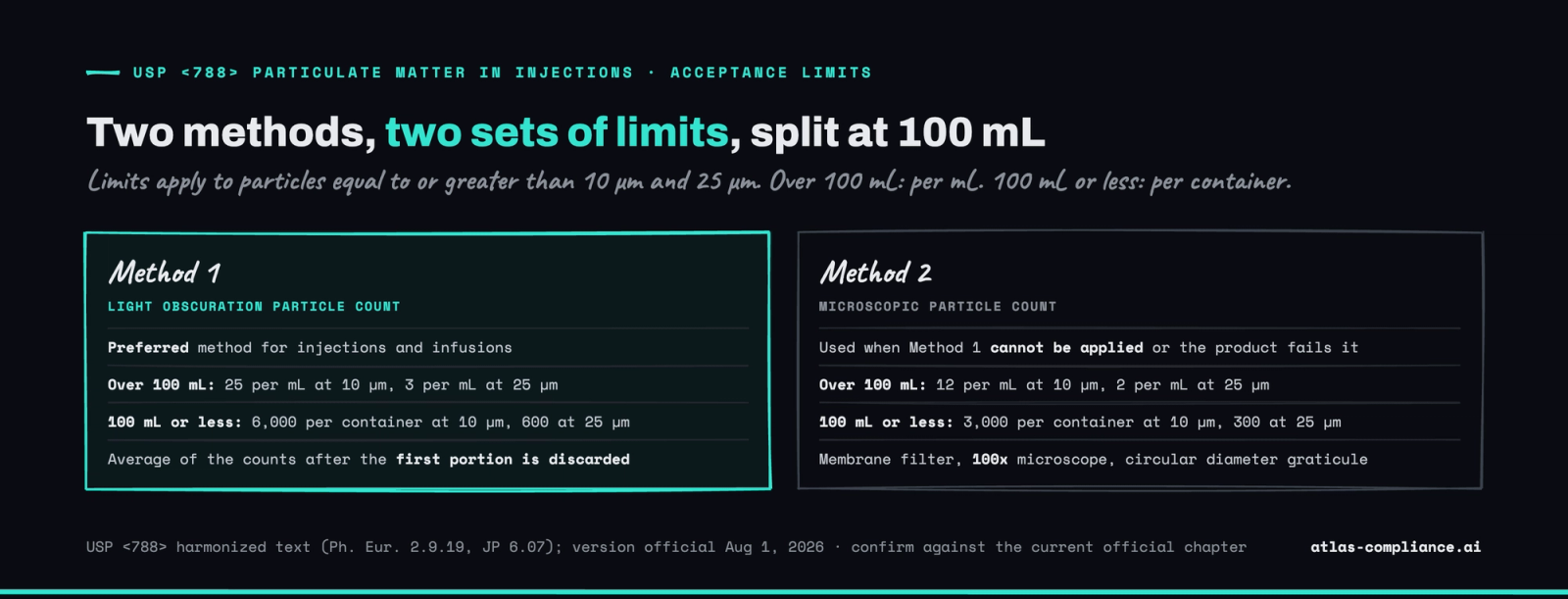
In common usage, the over-100 mL row covers large volume parenterals and the 100 mL or less row covers small volume parenterals. A 100 mL bag falls under the per-container limits.
Light obscuration vs microscopic count: when is Method 2 used?
Method 2 in USP 788 is used when a product cannot be tested by light obscuration, or when a product exceeds the light obscuration limits. The chapter names reduced clarity and increased viscosity as examples. The two methods are not interchangeable: each has its own limits.
Method 1 passes the solution through a sensor that sizes each particle by the light it blocks. The instrument is calibrated with spherical particles of known size between 10 µm and 25 µm. Method 2 filters the sample through a membrane and counts the particles on it at 100 ± 10 magnification, using a circular diameter graticule to size them. Both are run under conditions that limit particle contamination, preferably in a laminar flow cabinet.
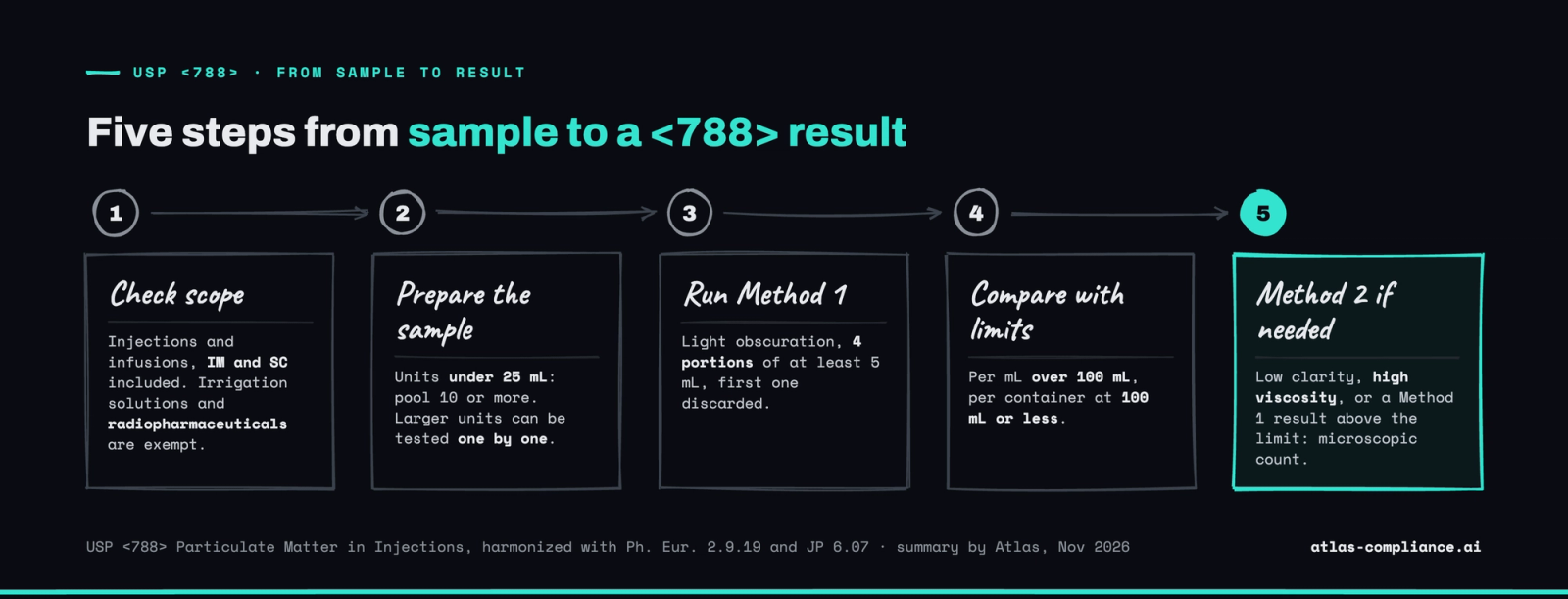
The test path in the chapter runs in five steps:
- Confirm the product is in scope and not exempt.
- Prepare the sample: pool the contents of 10 or more units for containers under 25 mL; units of 25 mL or more can be tested one by one.
- Run Method 1: take four portions of at least 5 mL each, discard the result from the first portion, and average the rest.
- Compare the average with the per mL or per container limit.
- If the product exceeds the Method 1 limits, or Method 1 cannot be applied, run Method 2.
Fewer than 10 units can be tested for large volume products or units of 25 mL or more, if an appropriate sampling plan supports it. Particle counting is one test in the release testing panel for a parenteral, run alongside sterility and endotoxin.
How does USP 788 relate to USP 790 and USP 1790?
USP 788 counts subvisible particles; USP 790 and USP 1790 cover visible ones. USP 790, "Visible Particulates in Injections", is the official chapter that expects every unit of an injection to be inspected and the batch to be essentially free of visible particulates. USP 1790, "Visual Inspection of Injections", is the informational chapter that explains how to design and qualify that inspection program.
| Chapter | Title | What it covers | Status |
|---|---|---|---|
| USP 788 | Particulate Matter in Injections | Subvisible particles, 10 µm and 25 µm size classes | Official test with limits |
| USP 787 | Subvisible Particulate Matter in Therapeutic Protein Injections | Subvisible particles in protein products | Official test |
| USP 790 | Visible Particulates in Injections | 100% inspection of units for visible particles | Official requirement |
| USP 1790 | Visual Inspection of Injections | Inspection methods, qualification, defect classes | Informational guidance |
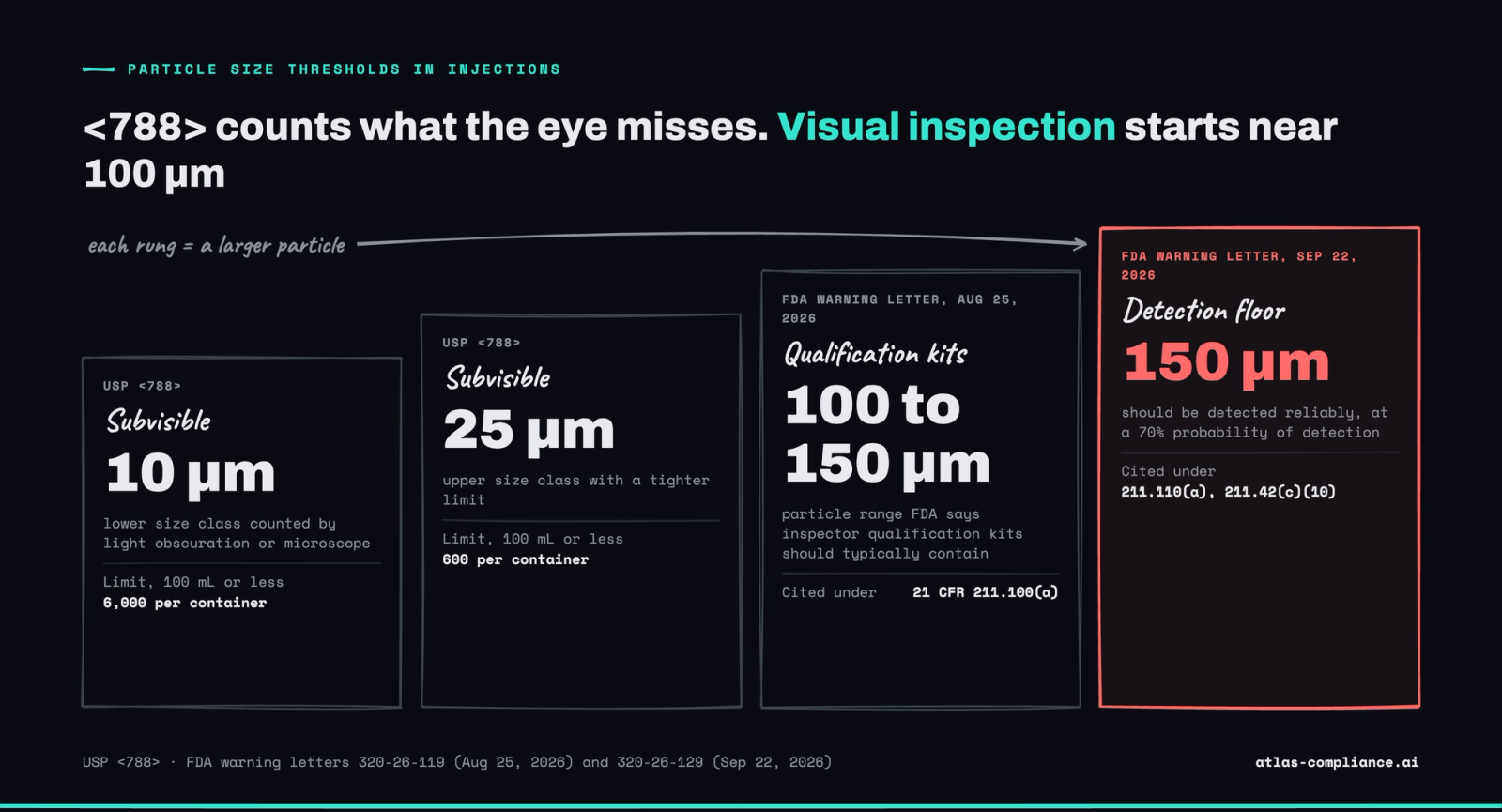
USP 790 inspects units against black and white backgrounds without magnification, and FDA's draft guidance "Inspection of Injectable Products for Visible Particulates" (December 2021) refers to both USP 790 and USP 1790. The size gap between the chapters matters in practice: USP 788 stops at 25 µm, while FDA's 2026 warning letters expect manual inspectors to be qualified on particles in the range of 100 to 150 µm.
How often does FDA cite particulate and visual inspection problems on Form 483s?
FDA does not cite USP 788 or USP 790 by number on a Form 483. Investigators cite the CGMP sections behind the finding, and the public Form 483 citation data uses FDA's standard section wording, so a particle problem appears as an investigation, laboratory control or production control citation. Of 22,208 citations in the dataset, none of the drug citations under 211.192, 211.160 or 211.165 names particles in its standard text.
The closest measurable group is sterile manufacturing. In the Atlas Form 483 citation dataset (774 drug inspections citing 21 CFR Part 211 that closed January 7, 2025 to September 3, 2026, pulled October 2026 and joined to FDA's inspection classifications), 98 inspections cited 21 CFR 211.113(b), the section for procedures that prevent microbial contamination of sterile drugs.
Those 98 sterile inspections were heavier than the rest:
- 53 of 98 (54.1%) ended OAI, against 159 of the other 676 Part 211 drug inspections (23.5%).
- They averaged 6.1 Part 211 observations each, against 3.8 for the other 676.
- 82 of the 98 also cited at least one of the four sections FDA used for the 2026 visual inspection findings below: 211.192, 211.160(b), 211.100(a) or 211.110(a). Those 82 ended OAI 61.0% of the time.
- 69 of the 98 were at US facilities, 10 in India and 5 in Japan.
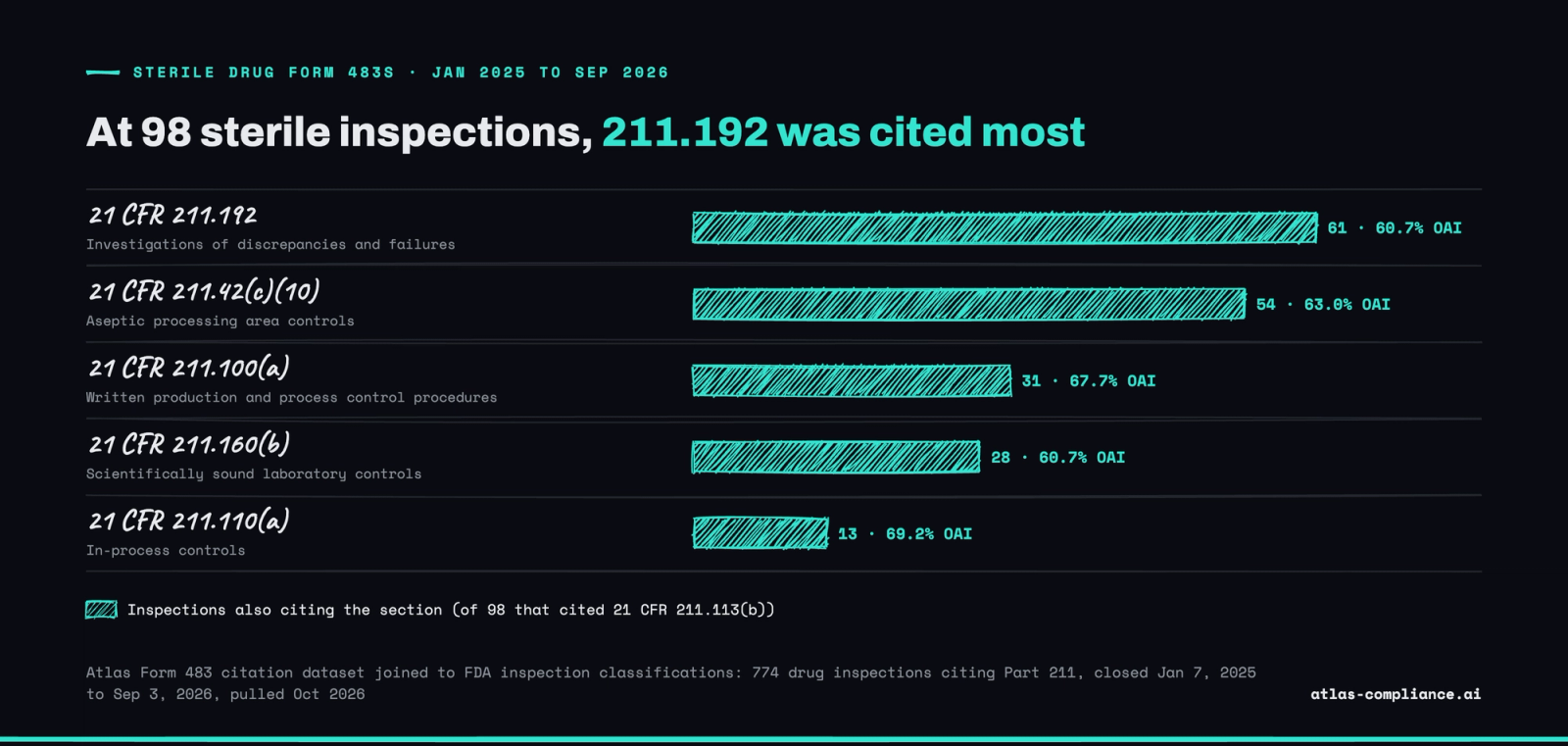
21 CFR 211.192, production record review and investigations, was the most common companion, at 61 of the 98. A unit that fails 100% visual inspection, or a particle count above the limit, is a discrepancy that 211.192 requires the firm to investigate, and that requirement extends to other batches that may be affected.
Which Form 483s and warning letters show the pattern?
Four 2026 warning letters to makers of sterile drugs cited visual inspection for particles, and each one used a Part 211 section rather than a USP chapter. FDA cites these letters by reference number and date; the summaries below come from the letters themselves.
| Facility | Warning letter | Section cited | What FDA found |
|---|---|---|---|
| Fresenius Medical Care, Ogden, UT | 320-26-119, Aug 25, 2026 | 211.100(a) | Qualification kit for inspectors lacked representative particle sizes; FDA says kits should typically contain particles of 100 to 150 µm |
| Fresenius Kabi, Melrose Park, IL | 320-26-129, Sep 22, 2026 | 211.110(a), 211.42(c)(10) | All non-glass particulate, including hair, classed as a major defect; FDA expects 150 µm particles detected at a 70% probability of detection |
| Baxter, Round Lake, IL | 320-26-132, Sep 29, 2026 | 211.160(b) | Manual inspection could not reliably detect defects; a returned cefazolin unit held a particle consistent with cardboard |
| Rohto-Mentholatum (Vietnam), Ho Chi Minh City | 320-27-06, Oct 14, 2026 | 211.192 | Out-of-limit 100% visual inspection findings for two batches not adequately investigated; both batches shipped to the US |
The Ogden letter traces back to a two-observation Form 483 dated March 6, 2026 under 211.100(a) and 211.192. The Round Lake letter followed a nine-observation Form 483 dated April 2, 2026. Our breakdowns of the Baxter warning letter and the two Fresenius warning letters cover the remediation FDA asked for, including an independent review of every lot in distribution at Round Lake for visible particles.
Sterile Form 483s from the same period show the companion sections at other facilities. These forms cite 211.113(b) with 211.192 and a production or laboratory control section; the public citation data does not say whether particles were the subject:
| Form 483 | Inspection ended | Sections cited with 211.113(b) | Classification |
|---|---|---|---|
| K.C. Pharmaceuticals, Pomona, CA | Feb 13, 2026 | 211.110(a), 211.160(b), 211.165(e), 211.192, 211.42(c)(10) and 7 more | OAI |
| Jubilant HollisterStier, Kirkland, Canada | Nov 3, 2025 | 211.100(a), 211.160(b), 211.192, 211.22(d), 211.42(c)(10) and 2 more | OAI |
| Par Health, Rochester, MI | Oct 20, 2025 | 211.110(a), 211.192, 211.63 | OAI |
| Hospira, McPherson, KS | Jan 17, 2025 | 211.110(a), 211.192 | VAI |
Every form in the table can be opened in the FDA Form 483 database, with the investigators who wrote it and the facility's earlier inspections. If a sterile inspection is on your calendar, the investigator's past forms show which of these sections they have written before.
 Atlas
See what the FDA knows about your next investigator.
30 minutes with the founder. No pitch deck.
What should a particulate control program show an investigator?
A particulate control program should show an investigator that subvisible counts, visible inspection and investigations are tied together. The 2026 letters cited gaps at each link: inspector qualification, defect classification, detection rates and the investigation of out-of-limit batches.
- A USP 788 method for each product, with the method choice justified and Method 2 ready for products that light obscuration cannot test.
- Particle count results trended across batches, so a rising count is visible before it reaches the limit.
- A USP 790 inspection procedure with defined lighting, backgrounds and inspection time per unit.
- Inspector qualification kits that include particles near the lower end of the visible range; FDA's Ogden letter puts that at 100 to 150 µm.
- Defect classes that match patient risk; FDA's Melrose Park letter objected to classing all non-glass particulate, hair included, as a major defect.
- A reject limit for 100% inspection, with every out-of-limit batch investigated under 211.192 before release, and particles identified where the batch allows.
The same aseptic controls that keep microorganisms out keep many particles out too, so the aseptic processing guide and its section on 211.42(c)(10) area controls apply here as well.
Atlas tracks new Form 483s and warning letters as FDA releases them, including the sterile and visual inspection citations covered here.
AtlasFDA Inspection Intelligence Digest
We track every 483, EIR, and warning letter the moment it happens. Get the signals before they hit the FDA website.
Frequently asked questions
Yes. USP 788 states that solutions for injection given by the intramuscular or subcutaneous route must meet its requirements, the same as intravenous products. The exemptions are narrow: products labeled only as irrigating solutions, radiopharmaceutical preparations, and products whose labeling requires a final filter, when scientific data justify the exemption. A product that fits none of these needs a USP 788 result.

Written by
Bhavish Agarwal
Founder, Atlas
Bhavish Agarwal is the founder of Atlas and previously worked at Google and Microsoft. He has spent the past several years building regulatory data infrastructure for the pharmaceutical industry.