
Import Alert 66-40 is an FDA import alert that lets FDA detain, without physical examination, drugs from foreign firms that do not appear to meet current good manufacturing practice (CGMP). FDA titles it "Detention Without Physical Examination of Drugs From Firms Which Have Not Met Drug GMPs." This guide counts every firm on the alert as of November 2026, by country, and traces two October 2026 warning letters back to the listing that came first.
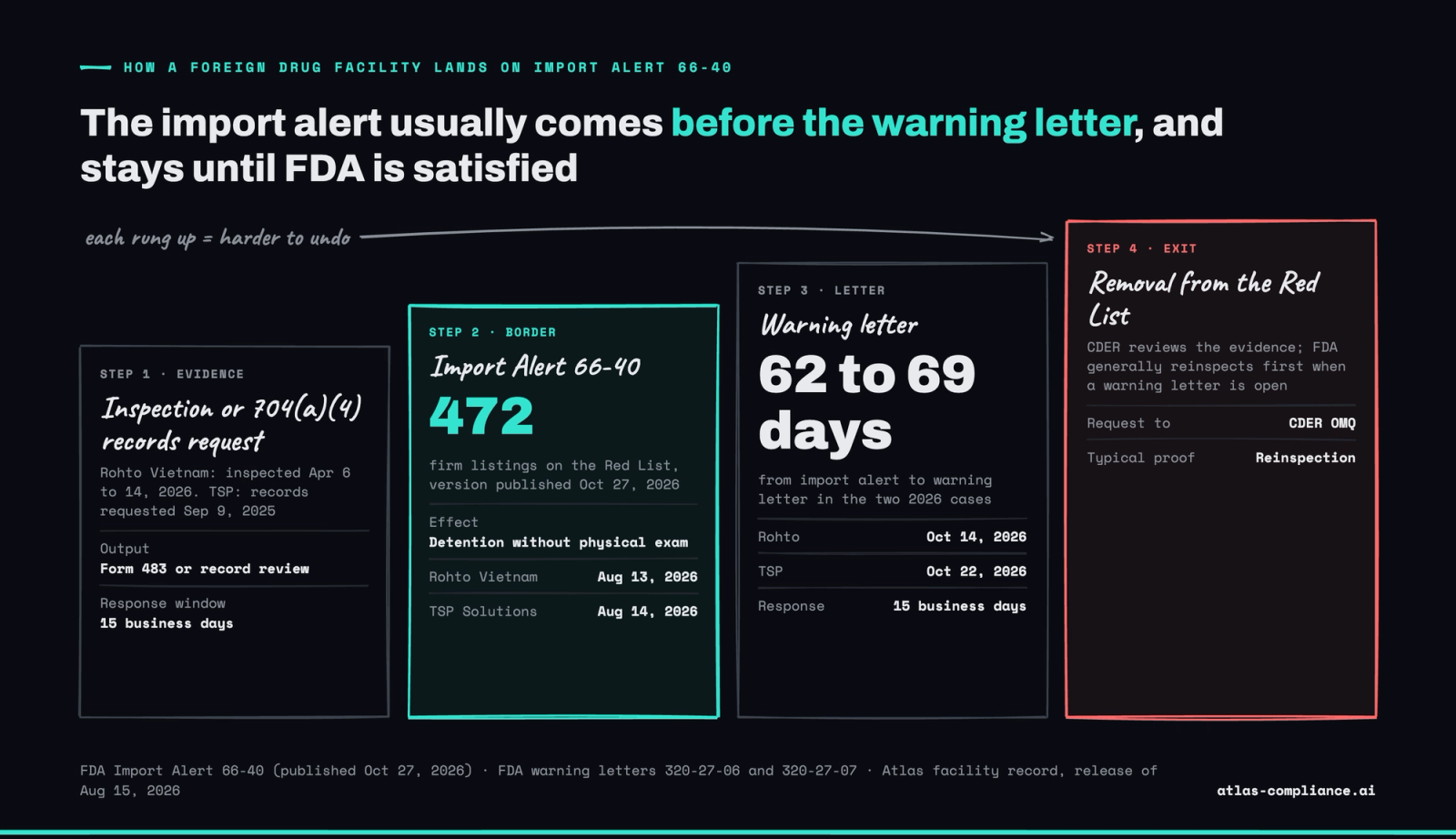
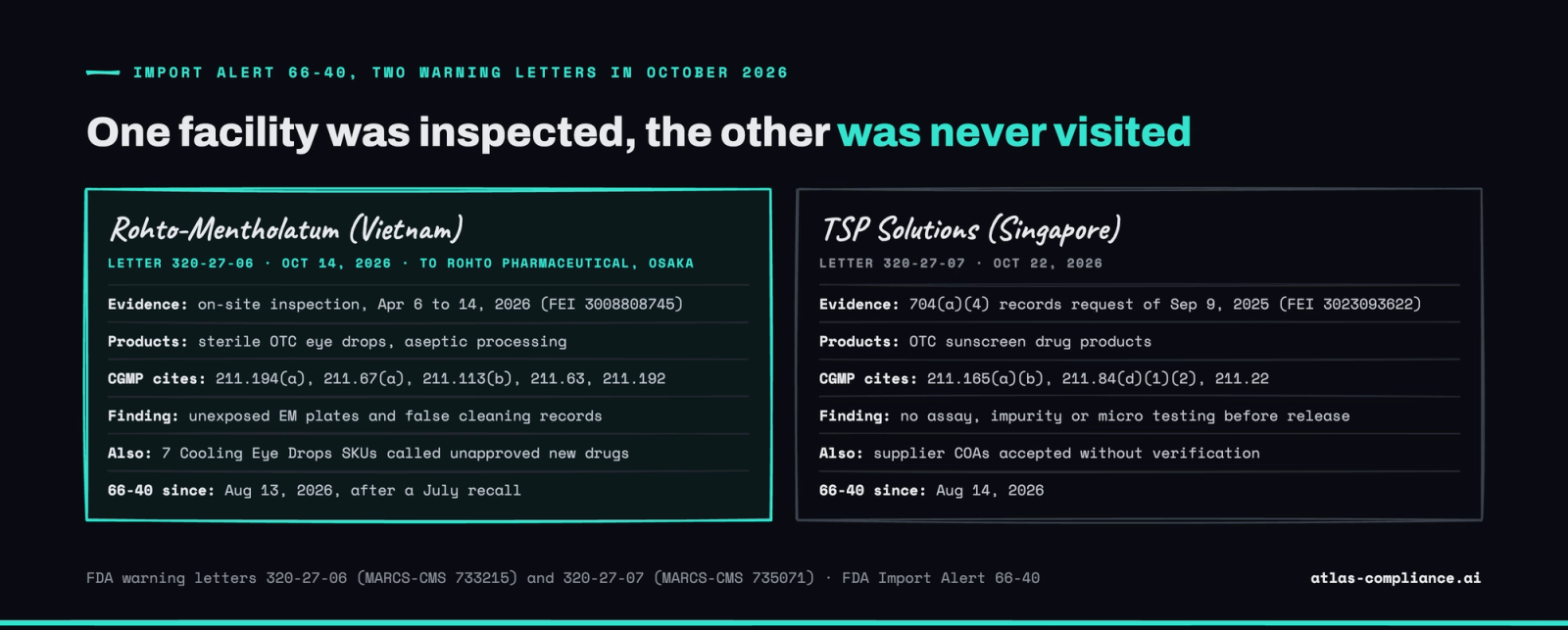
The two firms in this autumn's letters followed the same order: FDA collected evidence, listed the firm on 66-40 in mid August, then issued the warning letter 62 to 69 days later. The evidence came from different places. FDA inspected the Rohto-Mentholatum facility in Vietnam on site. For TSP Solutions in Singapore, FDA asked for records and never sent an investigator.
Key facts:
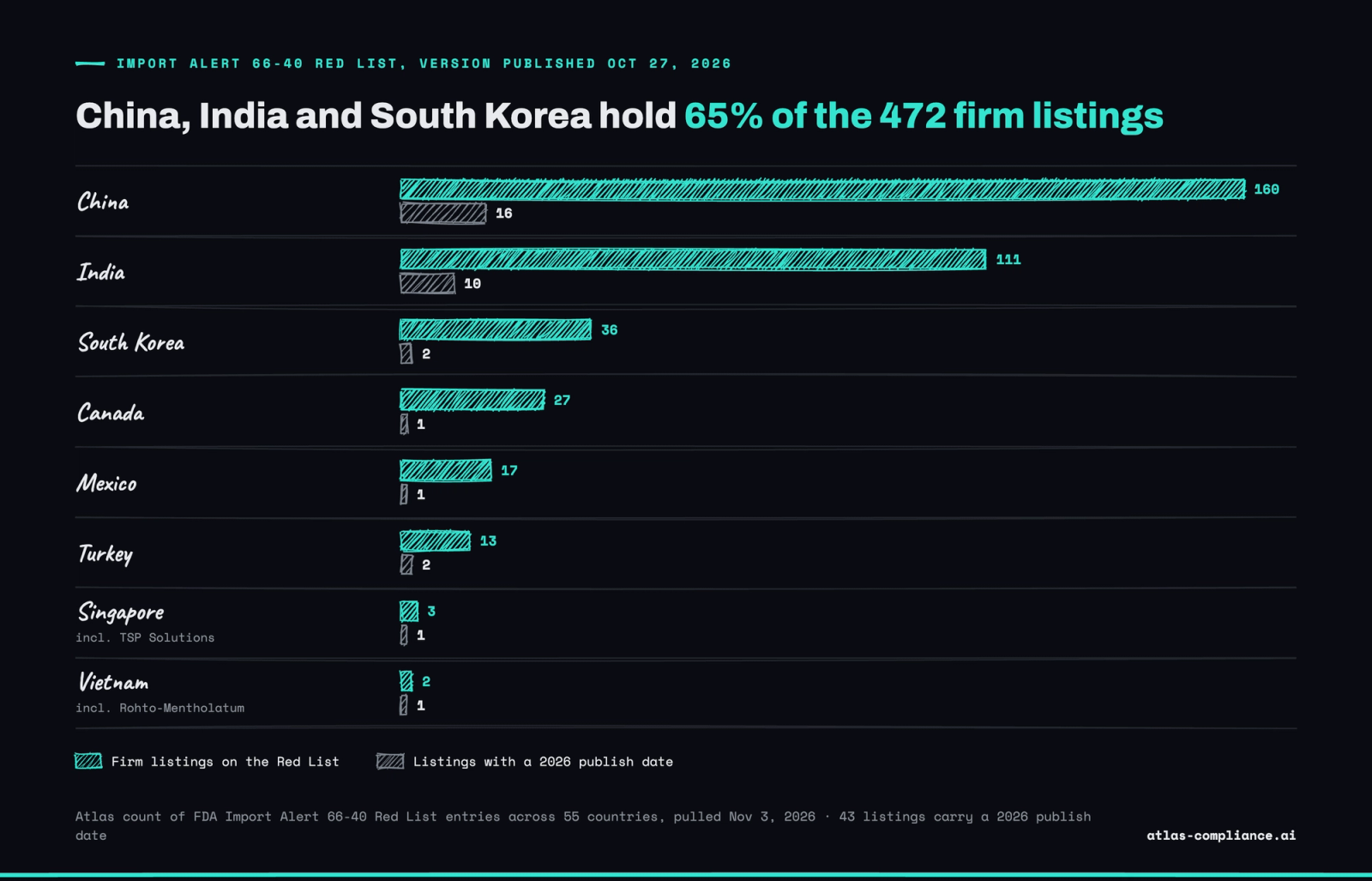
- The current version of Import Alert 66-40 carries a published date of October 27, 2026, and its Red List holds 472 firm listings across 55 countries (Atlas count, pulled November 3, 2026).
- China (160), India (111) and South Korea (36) account for 65% of those listings.
- FDA placed Rohto-Mentholatum (Vietnam) Co., Ltd. on 66-40 on August 13, 2026 and sent warning letter 320-27-06 to its parent, Rohto Pharmaceutical Co., Ltd., on October 14, 2026.
- FDA placed TSP Solutions Pte. Ltd. on 66-40 on August 14, 2026 and sent warning letter 320-27-07 on October 22, 2026, based on records requested under section 704(a)(4) of the FD&C Act.
- A warning letter asks for a written response within 15 business days; removal from the Red List has no deadline and, when a warning letter is open, FDA generally reinspects first.
What is Import Alert 66-40?
Import Alert 66-40 is FDA's standing instruction to its import divisions to detain drugs and drug products from listed foreign establishments without examining them, because the firm's methods or controls do not appear to conform to CGMP. The charge is section 801(a)(3) of the FD&C Act, read with the adulteration provision in section 501(a)(2)(B).
The alert has two parts. The text explains the policy. The Red List names each firm, its address, the product codes covered and the date FDA published the listing. A shipment from a Red List firm is detained on arrival; the importer then has to show FDA that the CGMP problem has been corrected before CDER will release that entry.
FDA revised the alert text on July 15, 2025 to state that the evidence can come from an FDA inspection, a remote regulatory assessment, or an inspection by a foreign authority working under a memorandum of understanding. CDER (human drugs) or CVM (animal drugs) evaluates each case. For how import alerts work in general, including petitions and the Green List, see our guide to what manufacturers should know about import alerts.
How does a facility end up on Import Alert 66-40?
A facility ends up on Import Alert 66-40 after FDA gathers CGMP evidence, through an inspection or a records request, and CDER decides the firm's products should be stopped at the border. The warning letter often comes later, which surprises firms that expect the letter to be the first formal step.
The usual sequence:
- Evidence. An FDA investigator inspects and issues a Form 483, or FDA requests records in advance of or instead of an inspection under section 704(a)(4). The firm has 15 business days to respond to a 483.
- Import alert. CDER recommends a listing, and the firm appears on the 66-40 Red List. Shipments are detained from that day.
- Warning letter. CDER issues a warning letter that lists the CGMP violations and states the date the firm went on 66-40. The firm has 15 business days to respond.
- Removal. The firm sends evidence of correction to CDER's Office of Manufacturing Quality. FDA removes it from the Red List once it is confident future shipments will comply, which usually means a reinspection.
The order can compress. Mylan Laboratories' Indore facility at Pithampur, India received its warning letter and its 66-40 listing on the same day, December 19, 2024. That listing is still on the Red List; our Mylan and Viatris India inspection history covers the facility's record.
Import alert vs warning letter: what is the difference?
An import alert stops product at the US border, while a warning letter is a formal notice of violations that asks for a response. A firm can be on an import alert without a warning letter, and a domestic firm can receive a warning letter with no import alert at all.
| Import Alert 66-40 | Warning letter | |
|---|---|---|
| What it does | Lets FDA detain shipments without physical examination | Notifies the firm of significant violations |
| Legal basis | FD&C Act 801(a)(3), with 501(a)(2)(B) | Advisory; cites 501(a)(2)(B) and 21 CFR parts 210 and 211 |
| Who it reaches | Importers and consignees at the border | The firm's senior management |
| Effect on shipments | Immediate detention of listed products | None by itself; often states an import alert is in place |
| Response | No deadline; evidence of correction to CDER | Written response in 15 business days |
| How it ends | Removal from the Red List, often after reinspection | Closeout letter after FDA verifies corrections |
| Public | Red List posted on FDA's import alert page | Posted on FDA's warning letter page |
Our explainer on how warning letters affect inspection outcomes covers what happens at the next inspection after a letter.
Rohto-Mentholatum (Vietnam): what the October 14, 2026 letter cites
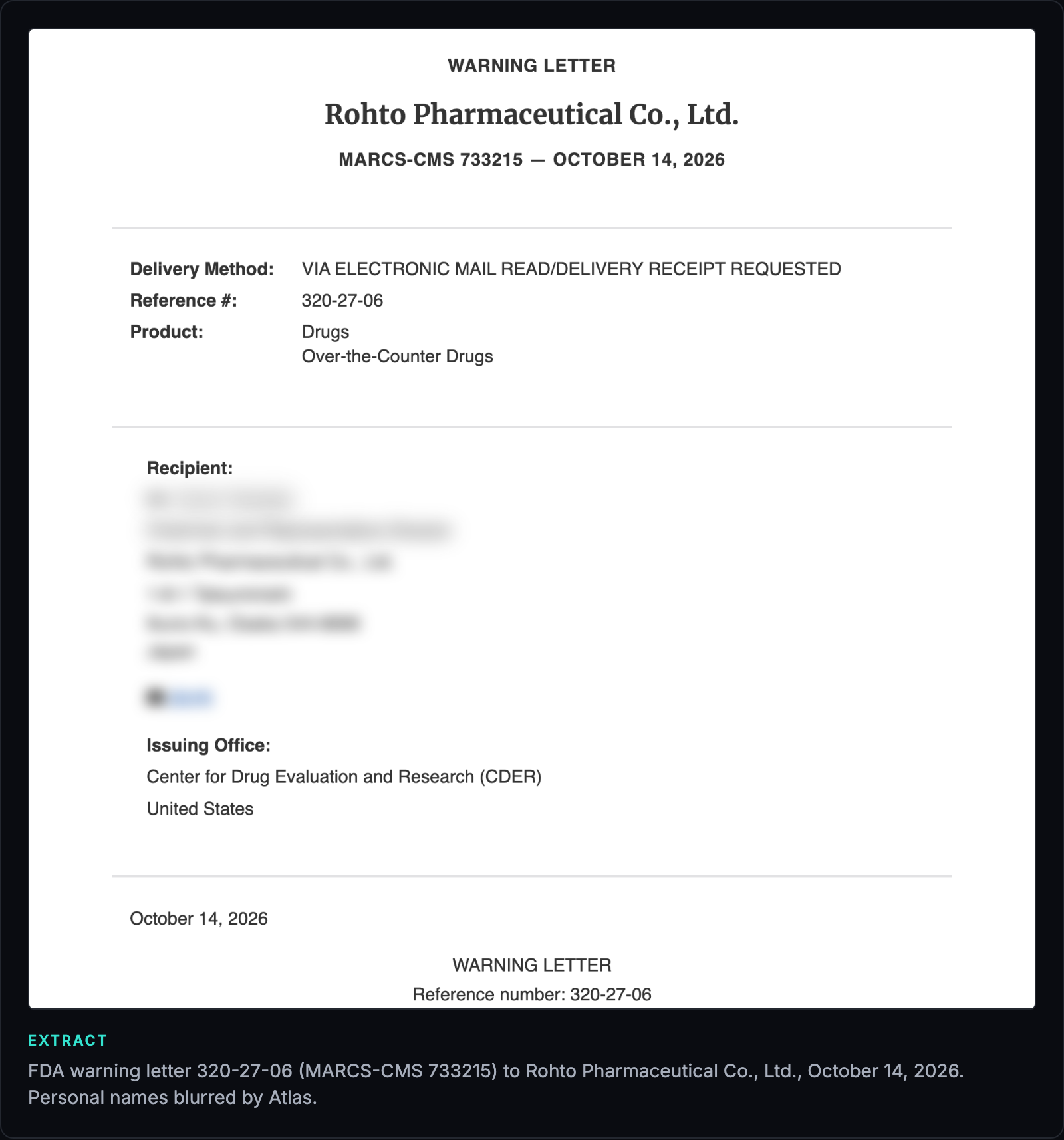
FDA warning letter 320-27-06 (MARCS-CMS 733215), dated October 14, 2026, went to Rohto Pharmaceutical Co., Ltd. in Osaka, Japan. The violations come from an inspection of its subsidiary facility, Rohto-Mentholatum (Vietnam) Co., Ltd., FEI 3008808745, at the Vietnam-Singapore Industrial Park in Ho Chi Minh City, from April 6 to 14, 2026. The facility makes sterile over-the-counter eye drops by aseptic processing.
FDA cites three CGMP violations:
- 21 CFR 211.194(a) and 211.67(a): falsified environmental monitoring, personnel monitoring and cleaning records. Staff sent unexposed plates to the laboratory in place of real samples, and cleaning records for January 23, January 30, March 10 and March 21, 2026 described work that management confirmed was never done.
- 21 CFR 211.113(b) and 211.63: poor aseptic practice in the ISO 5 area and equipment that blocked unidirectional airflow.
- 21 CFR 211.192: two batches that exceeded the visual inspection reject limit were released to the US without identifying the particles.
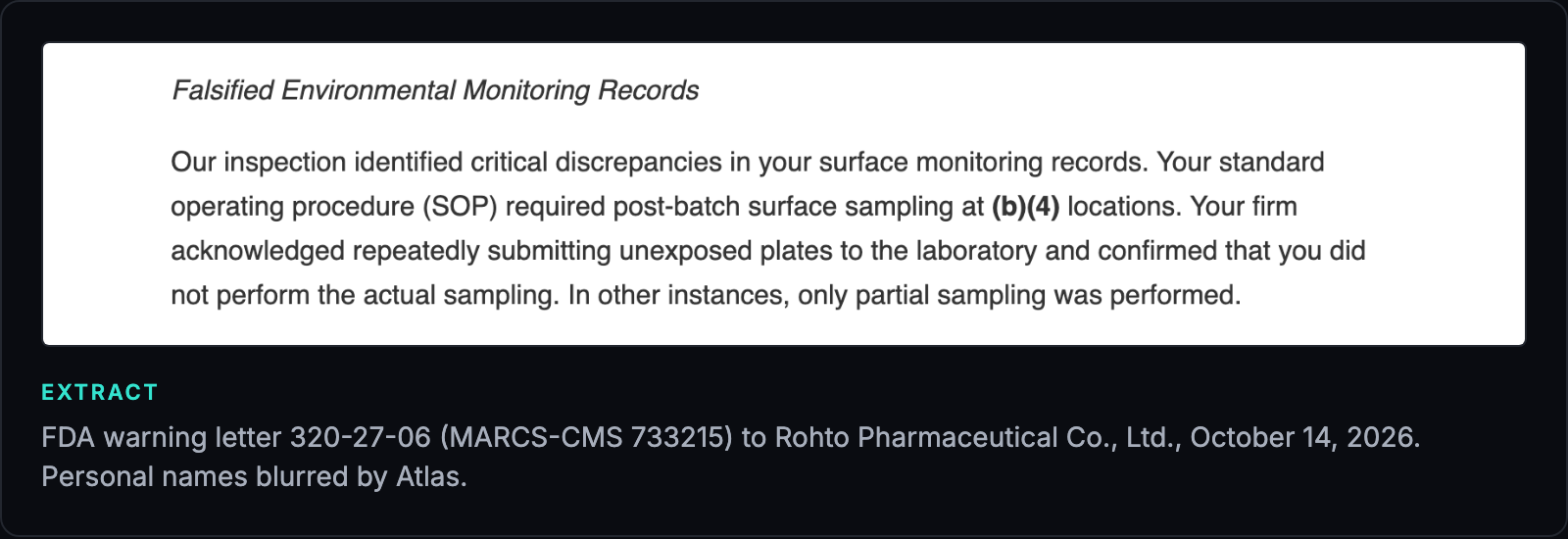
The numbers in the letter explain why FDA moved fast. The facility had reported zero colony-forming units across its monitoring, apart from one water leak. When investigators read plates themselves between April 10 and 14, they found growth on numerous samples, including about 25 ISO 5 excursions. FDA held a teleconference on July 7, 2026, Rohto agreed to recall on July 8, and the recall of all US lots started on July 14. The 66-40 listing followed on August 13.
The letter also finds seven "ROHTO Cooling Eye Drops" products to be unapproved new drugs and misbranded, because claims such as "cooling" and "soothes up to 8 hrs." fall outside OTC Monograph M018, and because the website implied FDA endorsement.
The Atlas record for Rohto-Mentholatum (Vietnam) Co., Ltd. (release of August 15, 2026) shows five FDA inspections, in 2012, 2015, 2018, 2019 and 2026, and every one ended with a Form 483. The April 2026 form carries eight 21 CFR citations, among them 211.42(c)(10)(iv) for the environmental monitoring system and 211.42(c)(10)(v) for the cleaning system. Two investigators are tied to it: Justin A Boyd, with 279 inspections and 1,374 observations on record since 2008, and Hung H Do, with 42 inspections and 164 observations since 2021.
TSP Solutions (Singapore): a warning letter without an inspection
FDA warning letter 320-27-07 (MARCS-CMS 735071), dated October 22, 2026, went to TSP Solutions Pte. Ltd. in Toa Payoh North, Singapore, FEI 3023093622, a registered manufacturer of OTC sunscreen drug products. FDA wrote it from records the firm sent in response to a section 704(a)(4) request dated September 9, 2025.
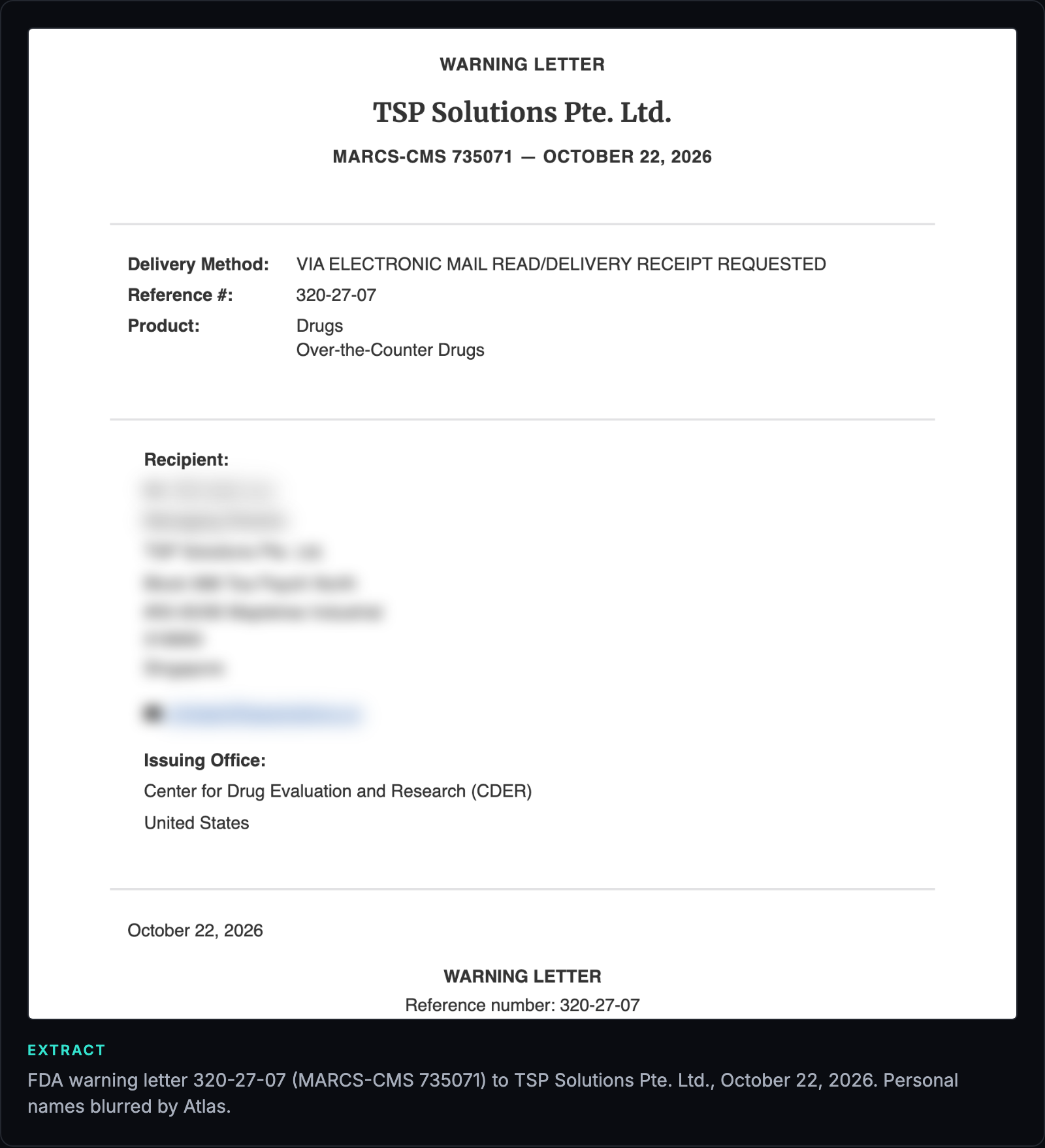
The letter cites three violations:
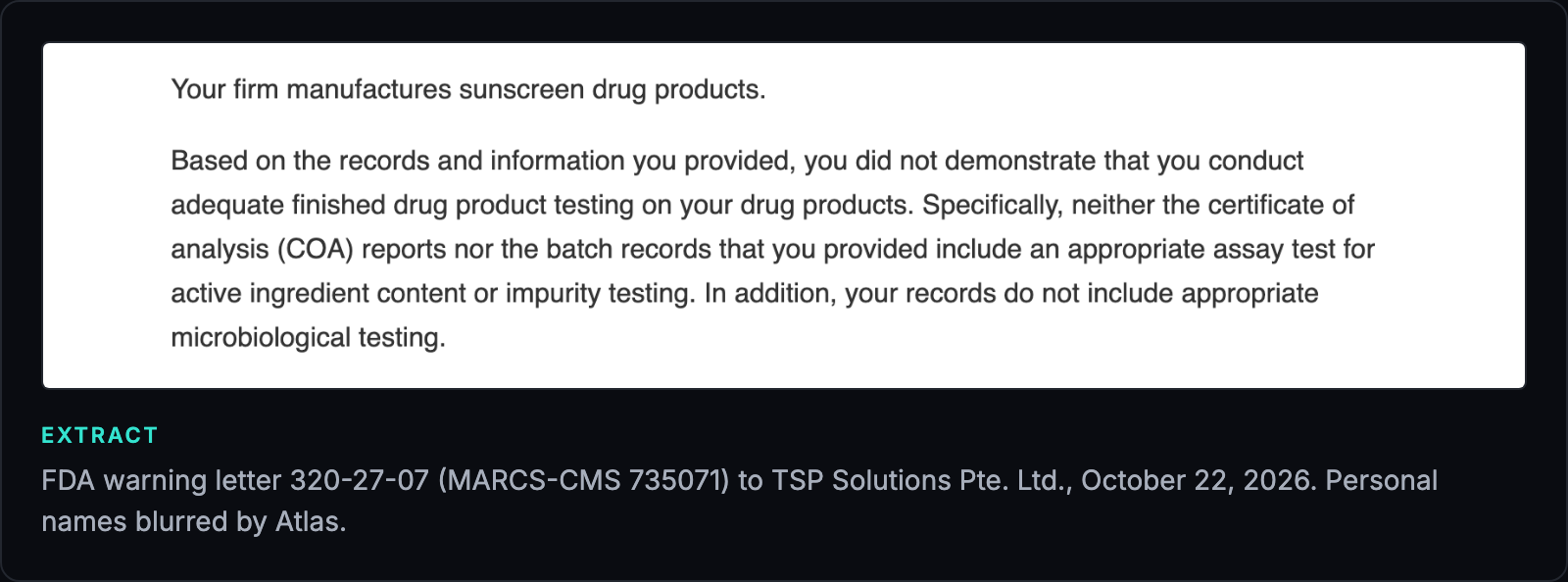
- 21 CFR 211.165(a) and (b): no assay for active ingredient content, no impurity testing and no microbiological testing before release.
- 21 CFR 211.84(d)(1) and (d)(2): no identity test on incoming components, and supplier certificates of analysis accepted without ever verifying them.
- 21 CFR 211.22: a quality unit that did not ensure production procedures, laboratory controls or a stability program.
FDA recommends a consultant qualified under 21 CFR 211.34 and a six-system audit before TSP asks to resolve its status. Atlas holds no inspection record for TSP Solutions, which fits the letter: FDA reached its conclusions from paperwork alone, and the 66-40 listing on August 14, 2026 came before any site visit.
How many firms are on Import Alert 66-40?
Import Alert 66-40 lists 472 firm entries across 55 countries in the version FDA published on October 27, 2026, by Atlas's count of the Red List on November 3, 2026. Some company names appear more than once at different addresses; there are 459 distinct name and country pairs.
| Country | Red List entries | Entries with a 2026 publish date |
|---|---|---|
| China | 160 | 16 |
| India | 111 | 10 |
| South Korea | 36 | 2 |
| Canada | 27 | 1 |
| Mexico | 17 | 1 |
| Turkey | 13 | 2 |
| Singapore | 3 | 1 |
| Vietnam | 2 | 1 |
| All 55 countries | 472 | 43 |
The list is old as well as long. Nineteen entries still carry a 2009 publish date, and 49 carry a 2024 date, tied with 2017 as the busiest year. FDA updates the publish date when it revises a listing, so the date marks the latest change and may be later than the original listing. For the inspection side of the same countries, our analysis of FDA foreign inspections in 2026 covers unannounced visits and Form 483s by country.
If one of your suppliers sits in China, India or South Korea, its inspection record is the first thing to check, and the investigator who last visited tells you what the next visit will look for.
 Atlas
See what the FDA knows about your next investigator.
30 minutes with the founder. No pitch deck.
How do you get off Import Alert 66-40?
A firm gets off Import Alert 66-40 by proving to CDER that it has fixed the conditions behind the listing, and FDA removes it from the Red List once it is confident future shipments will comply. When a warning letter is also open, the alert text says FDA will generally inspect before closing the matter.
What FDA expects, based on the alert text and the two 2026 letters:
- Answer the warning letter in 15 business days with a full investigation, root causes and dated corrective actions, then send progress updates.
- Hire an independent consultant qualified under 21 CFR 211.34. FDA asked both Rohto and TSP to have one run a six-system audit before seeking resolution.
- Fix the system behind each citation. For Rohto that means a data integrity investigation covering current and former staff; for TSP it means full release testing and verified supplier certificates.
- Test retained samples of product already shipped to the US and recall anything that fails.
- Send the removal request, with documentation, to CDER's Office of Manufacturing Quality.
- Prepare for reinspection. A clean reinspection is what usually moves a firm off the Red List.
Until removal, an importer can still ask CDER to release a single detained entry by showing that the CGMP problem was corrected for that product. Removal has no published timeline, and the 2009 listings still on the list show it can take years. To see how a warning letter connects to the Form 483 behind it, use our FDA warning letter database guide. To check any supplier's inspections and outcomes, search the FDA facility lookup.
A listing like Rohto's started with a Form 483 that named eight citations months before the import alert, so a weekly read of new 483s and warning letters is the earliest signal you get.
AtlasFDA Inspection Intelligence Digest
We track every 483, EIR, and warning letter the moment it happens. Get the signals before they hit the FDA website.
Frequently asked questions
Not necessarily. The alert text lets FDA list a firm on evidence from an inspection, a remote regulatory assessment or a records request, and it does not require a warning letter first or at all. When FDA does send a letter, the conclusion normally states the date the firm was placed on 66-40, as both the Rohto and TSP Solutions letters do.

Written by
Bhavish Agarwal
Founder, Atlas
Bhavish Agarwal is the founder of Atlas and previously worked at Google and Microsoft. He has spent the past several years building regulatory data infrastructure for the pharmaceutical industry.