

FDA foreign inspections are on-site (or remote) reviews of non-US facilities that make drugs, devices, food or biologics for the US market. FDA runs about 3,000 a year in more than 90 countries, and since May 2025 it has dropped the weeks of advance notice foreign sites used to get. Refusing, delaying or limiting one makes a facility's drugs adulterated, and its shipments can be stopped at the border.
This guide is the hub for our foreign-inspection coverage. Atlas data below come from the Form 483 directory (release of August 15, 2026): all 7,117 Form 483s issued from January 1, 2025 to July 20, 2026, sorted by the country of the inspected site.
What did FDA change in May 2025?
On May 6, 2025, FDA announced the expanded use of unannounced inspections at foreign facilities that make food, medicines and other medical products. The release gave the scale: roughly 12,000 domestic and 3,000 foreign inspections a year, in more than 90 countries. It also gave the reason. Foreign firms had usually received weeks of notice, and FDA still found serious deficiencies at them more than twice as often as at domestic sites. The program built on a foreign unannounced inspection pilot in India and China, and FDA said it would clarify rules so investigators can refuse lodging and transport arranged by the companies they inspect.
The effect is now measurable. A later FDA Voices post on the inspection program, by Elizabeth Miller and Lowell Zeta, reports that 47% of the India office's 139 inspections in fiscal 2025 were unannounced, rising to 87% of 76 inspections in fiscal 2026 to date. For the China office the share went from 19% of 192 inspections to 61% of 114.
If you want the background on the policy shift, the remote assessment program and FDA's AI targeting tool, read our overview of FDA's new overseas inspection approach. The reasons behind the no-notice model are covered in why the FDA is increasing unannounced foreign inspections. This page sticks to the legal tools and the data.
Which laws let FDA inspect a facility outside the US?
Four provisions do most of the work. All four came from, or were reshaped by, the Food and Drug Administration Safety and Innovation Act (FDASIA) of 2012.
| Provision | What it does | What it means for a foreign site |
|---|---|---|
| FD&C Act 704 | Authorizes FDA inspection of facilities that make regulated products | Applies to any facility registered to ship to the US, wherever it is |
| FDASIA 705 | Replaced the fixed two-year inspection cycle for drug facilities with a risk-based schedule | Foreign and domestic drug sites are ranked on the same risk model: compliance history, recalls, product risk, time since last inspection |
| FD&C Act 501(j), added by FDASIA 707 | A drug is adulterated if the facility delays, denies or limits an inspection, or refuses entry | No warning letter is needed to block product; the refusal is the violation |
| FD&C Act 704(a)(4), added by FDASIA 706 | FDA can demand records in advance of, or in place of, an inspection | A desk review can happen without anyone traveling, and it can set up the visit |
| Import Alert 66-79 | Detention without physical examination of drugs from foreign facilities that refuse inspection | Shipments are held at entry until the facility is inspected |
The risk-based schedule explains why some sites see FDA every two years and others go a decade without a visit. The model does not separate foreign from domestic sites when it ranks them, so a foreign facility with a weak history and a high-risk product, such as a sterile injectable, sits near the top of the list.
What counts as delaying, denying or limiting an inspection?
FDA's guidance on circumstances that constitute delaying, denying, limiting or refusing a drug or device inspection (Revision 1, June 2024) lists behaviors that can make product adulterated under 501(j). The examples that matter most for an unannounced visit:
- Not letting the investigator start the inspection on arrival, or refusing because certain staff are absent, without a reasonable explanation.
- Sending staff home and telling the investigator the facility is not producing.
- Leaving the investigator in a conference room without records or responsible people for an unreasonable time.
- Stopping all manufacturing for the length of the inspection, or interrupting production so it cannot be observed.
- Restricting entry to part of the facility, or impeding photographs the investigator considers necessary.
- Not producing requested records within the time FDA set.
The guidance also lists reasonable explanations. If the right people are not immediately available when an unannounced inspection begins, or the facility is closed for scheduled maintenance, that is not a refusal. The test is good faith, and the record of what happened in the first hour is often what FDA reviews.
How does a 704(a)(4) records request work?
A 704(a)(4) request is a mandatory remote regulatory assessment. FDA issues it on Form FDA 4003 and lists the records it wants. Under FDA's internal procedure for remote assessments (Staff Manual Guide 6001.1, changed March 2026), FDA considers 15 calendar days a reasonable response time, or 30 calendar days when records need translation. Foreign facilities are asked to send original records together with a verified English translation that names the translator.
A records request can come before an inspection, to plan it, or in place of one. FDA has made the link to enforcement explicit. The current revision of Import Alert 66-79 (revised December 10, 2024) names the 704(a)(4) records request as a mandatory remote assessment, and a firm can leave the alert only after it resolves the refusal of an inspection or of such an assessment. Treat a 4003 request with the same urgency as an investigator at the gate.
What happens if a foreign site refuses: Import Alert 66-79
Import Alert 66-79 covers drugs from foreign establishments that refuse FDA inspection. Products from firms on its list are detained at entry without physical examination under section 801(a)(3), as adulterated under 501(j), and generally stay detained until FDA completes an inspection.
We counted the firms on the alert as published on September 23, 2026: 283 establishments. China accounts for 169, India for 47 and South Korea for 32, followed by Turkey with 6. For the general mechanics of detention, petitions and removal across all alerts, see our guide to what manufacturers should know about import alerts.
Where FDA issued Form 483s outside the US
The Atlas FDA Form 483 database records the country of every inspected site. Across all FDA programs, 4,584 Form 483s were issued in 2025. Of those, 681, or 14.9%, went to sites outside the US, in 49 countries. From January 1 to July 20, 2026 the count is 2,533, with 322 non-US (12.7%) in 47 countries.
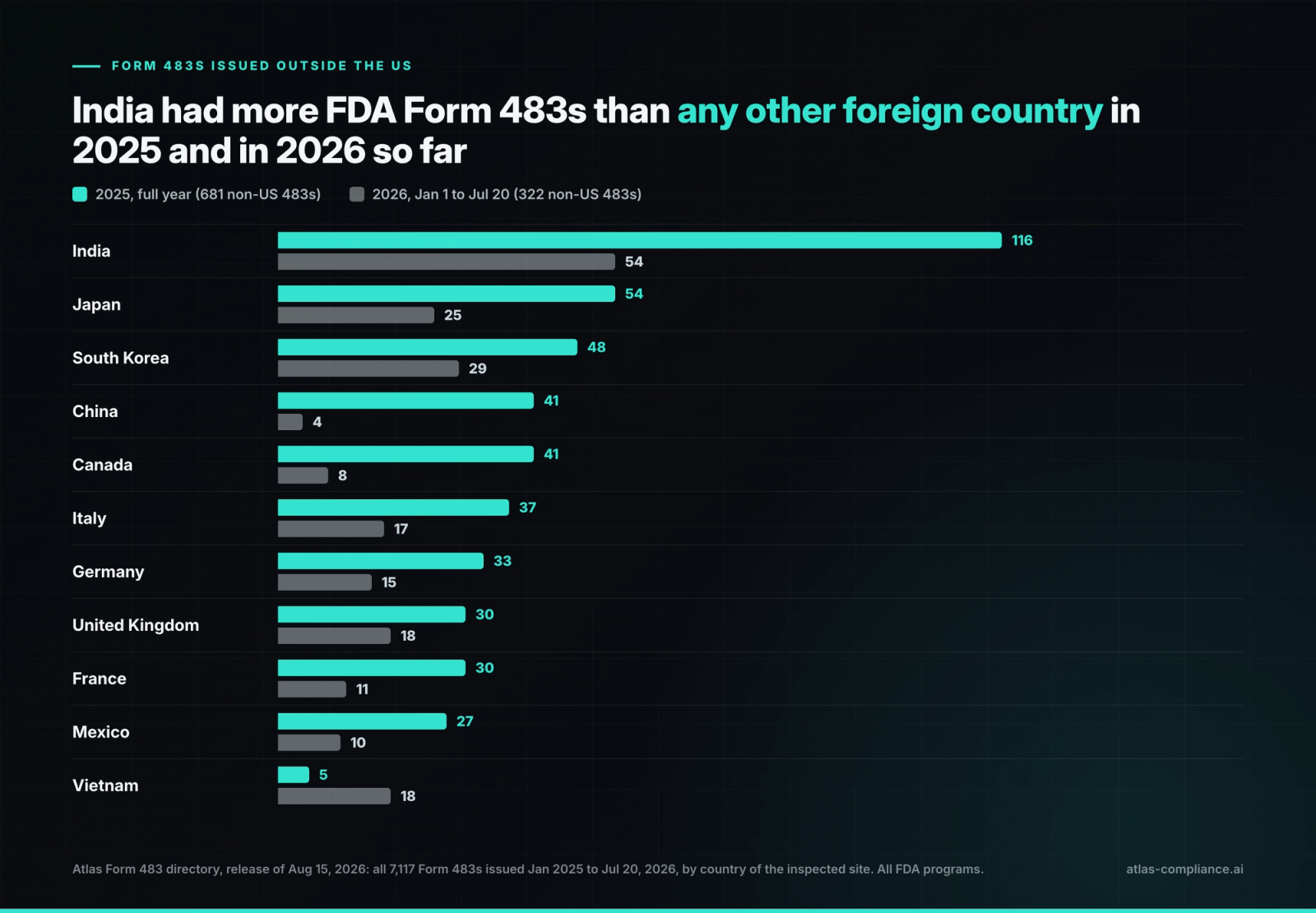
India leads in both periods: 116 Form 483s in 2025 and 54 in 2026 to date, about one in six of all non-US 483s. Japan (54 in 2025), South Korea (48), China and Canada (41 each), Italy (37) and Germany (33) follow. Vietnam is the one country rising: 5 in 2025, 18 in the first half of 2026, 17 of the 18 at food facilities.
For human drugs alone the foreign share is higher. In 2025, 145 of 755 human-drug Form 483s (19.2%) went to non-US sites, and 61 of those 145 were at Indian sites. In 2026 to date it is 52 of 323 (16.1%), with India at 16.
China is the number to read carefully. Atlas has 25 Chinese Form 483s from January to July 20, 2025 but 4 from the same window in 2026, while FDA reports its China office ran 114 inspections in fiscal 2026 to date. Two explanations fit, and the data cannot yet separate them: fewer Chinese inspections ending with a 483, or slower publication of foreign 483 records. We will update this section when the next release lands.
Foreign 483s are not longer than domestic ones. Indian human-drug 483s in 2025 averaged 3.5 observations against 3.7 at US sites, and the median was 3 for both.
What FDA cites at Indian drug facilities compared with US ones
We pulled the cited regulations from every human-drug Form 483 at an Indian site from January 2025 to July 20, 2026 (77 forms, 74 citing the drug CGMP rules in 21 CFR 211) and from every US human-drug 483 in the same window that cites 21 CFR 211 (611 forms). The table shows the share of 483s citing each section at least once.
| 21 CFR section | What it covers | Indian sites (74) | US sites (611) |
|---|---|---|---|
| 211.22 | Quality unit responsibilities and procedures | 47% | 47% |
| 211.192 | Production record review and investigations | 43% | 37% |
| 211.160 | Laboratory controls | 31% | 26% |
| 211.113 | Microbiological contamination, sterile process validation | 27% | 18% |
| 211.67 | Equipment cleaning and maintenance | 26% | 31% |
| 211.100 | Written production and process control procedures | 22% | 28% |
| 211.42 | Building design, aseptic area controls | 19% | 13% |
| 211.68 | Automatic and electronic equipment, computer controls | 18% | 20% |
| 211.84 | Testing of components and containers | 8% | 23% |
Three gaps stand out. Indian 483s cite sterile processing (211.113 and 211.42) about half again as often as US ones. Investigations under 211.192 lead the drug-specific citations at Indian sites. And component testing, cited on 23% of US CGMP 483s, appears on only 8% of Indian ones.
Named examples from the directory:
- Eugia Pharma Specialities, Sangareddy, Telangana, February 6, 2026: 11 observations, led by two 211.113(b) sterile validation citations, plus 211.192, 211.42(c)(10) environmental monitoring and 211.167 sterility testing. The Sangareddy facility record shows 9 FDA inspections, 8 ending with a Form 483, and a warning letter after the January 2024 inspection.
- NATCO Pharma, Rangareddy, Telangana, June 19, 2025: 7 observations covering sterile procedures and validation, investigations, environmental monitoring and cleaning.
- Zhejiang Jingxin Pharmaceutical, Shaoxing, China, October 17, 2025: 2 observations, microbiological testing under 211.165(b) and component identity testing under 211.84(d)(1). The site's 2024 inspection was clean.
- CSL Behring, Marburg, Germany, February 18, 2026: 5 observations, including procedure changes under 211.100(a), cleaning under 211.67(a) and a biologics reporting citation under 600.14.
For a longer Indian case, our Hetero Labs FDA inspection history traces 54 inspections across 15 facility records.
 Atlas
See what the FDA knows about your next investigator.
30 minutes with the founder. No pitch deck.
How to prepare a site that may get no notice
The working assumption for any site that ships to the US is that the next investigator arrives without a call. Our piece on what FDA checks in foreign contract manufacturing sites covers the inspection areas. The checklist below covers what an unannounced foreign visit adds.
- Write the first-hour protocol. Who meets the investigator at the gate, who is called, where the investigator waits, and the maximum time before a responsible person is in the room. Train security staff on it. The delay examples in FDA's guidance almost all happen in the first hour.
- Never stop a line because FDA arrived. Halting production for the visit, or steering the investigator away from an operating area, is the limiting behavior the 501(j) guidance names.
- Keep the back room empty. Records requested on day one should come from the live system in the time FDA asks. A pile of documents being reviewed before release to the investigator reads as delay.
- Have English ready. Batch records, deviations, investigations and SOPs that FDA is likely to request should have verified translations on file, because the 704(a)(4) clock already allows only 15 days, or 30 with translation.
- Review your own 483 history and your peers'. Pull the citations from your last two inspections and from the last year of 483s at facilities like yours. At Indian sterile sites that list starts with 211.113, 211.192 and 211.42.
- Know who is likely to come. The same investigators return to the same countries, and each one has a citation pattern. Our guide to FDA investigators and their inspection history explains how to read one.
- Answer a 483 inside 15 business days. A foreign site's response is read the same way as a domestic one; the response is part of what FDA weighs when it classifies the inspection NAI, VAI or OAI.
AtlasFDA Inspection Intelligence Digest
We track every 483, EIR, and warning letter the moment it happens. Get the signals before they hit the FDA website.
Frequently asked questions
No. FDA's own import alert text says it may contact a foreign manufacturer to schedule an inspection but has no requirement to do so. Pre-announcement was a practical habit for foreign travel, covering visas, translators and making sure production was running. Since May 2025 FDA has dropped it for most visits, and its India office reported 87% of fiscal 2026 inspections as unannounced.

Written by
Bhavish Agarwal
Founder, Atlas
Bhavish Agarwal is the founder of Atlas and previously worked at Google and Microsoft. He has spent the past several years building regulatory data infrastructure for the pharmaceutical industry.