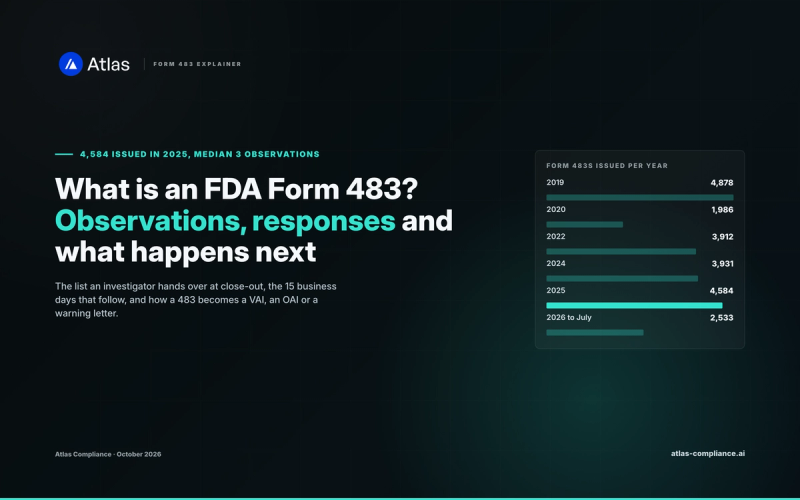

FDA issued two warning letters to Fresenius companies in four weeks. The first, dated August 25, 2026, went to Fresenius Medical Care for its Ogden, Utah dialysis-solution facility after 35 complaints of leaking Delflex bags and a decision not to recall. The second, dated September 22, 2026, went to Fresenius Kabi USA for its Melrose Park, Illinois sterile injectables facility after famotidine injection batches were released despite bioburden failures, patients reported pyrogenic reactions, and three batches were recalled.
Both letters cite 21 CFR 211.192, the investigation requirement, as the first violation. Both followed a Form 483 earlier in 2026. And in both cases the facility's inspection history shows the same regulation cited years before. The news coverage so far has reported the letters; this article adds the inspection and Form 483 record that explains them, and what quality teams at other sterile sites and their customers should take from the two cases.

Two letters, side by side
| Ogden, Utah | Melrose Park, Illinois | |
|---|---|---|
| Company | Fresenius USA Manufacturing, Inc. dba Fresenius Medical Care North America | Fresenius Kabi USA LLC |
| Letter date | August 25, 2026 (ref. 320-26-119) | September 22, 2026 (ref. 320-26-129) |
| FEI | 1713747 | 1450022 |
| Inspection | March 2 to 6, 2026 | January 27 to February 18, 2026 |
| Form 483 response | March 27, 2026 | March 11, 2026 |
| Products | Delflex peritoneal dialysis solution | Famotidine injection; glycopyrrolate, lidocaine, ropivacaine recalled later |
| Violations cited | 211.192 investigations; 211.100(a) production procedures (visual inspection qualification) | 211.192 investigations; 211.113(b) aseptic process validation; 211.110(a) and 211.42(c)(10) process control and aseptic area design |
| Core failure | Leak complaints rated lowest severity; no recall until April 2026 | Batches released on passing finished-product tests despite bioburden action-limit failures |
| Consultant required | Yes, 21 CFR 211.34 qualified, six-system audit | Yes, 21 CFR 211.34 qualified, "because you failed to correct repeat violations" |
The letters come from the same office, CDER's Office of Manufacturing Quality, and ask for the same class of remedy: an independent assessment of the investigation system, a retrospective review (five years of batch defect data at Ogden, three years of critical investigations at Melrose Park), and a consultant. The full text of each is on FDA's site: Ogden and Melrose Park.
Ogden: 35 complaints, 156 bags, and a severity rating that FDA rejected
The Ogden facility makes Delflex, a peritoneal dialysis solution that patients infuse into the abdominal cavity at home. A leaking bag is a sterility breach at the point of use, and FDA's letter says the decision not to recall "exposed peritoneal dialysis patients to potentially non-sterile drug products."
The sequence in the letter:
- The firm received 35 complaints covering about 156 bags from multiple batches.
- Its August 2025 investigation attributed the leaks to holes caused by printing on the bag and assigned the lowest severity level, even though peritonitis was listed as a potential harm.
- No recall followed that investigation.
- FDA inspected March 2 to 6, 2026 and issued a Form 483. The firm responded on March 27.
- A recall was initiated in April 2026, after the inspection.
- FDA found the response inadequate because it lacked a sufficient corrective and preventive action plan, and issued the warning letter on August 25.
The second violation is about visual inspection. The kit used to qualify the people who inspect bags for visible particulates did not include adequately representative particle sizes, and the records did not show what the inspectors were qualified against. FDA's letter spells out the expectation: qualification kits should typically include particles of about 100 to 150 microns.
The Form 483 from the March 2026 inspection carries two observations, one under 21 CFR 211.100(a) and one under 211.192, issued by investigator Nicholas L Hunt. Those are the two sections the warning letter is built on. The gap between a two-observation 483 and a warning letter is the response: FDA read the March 27 reply and found no CAPA that would stop the next leaking batch. Our guide on how to address and prevent Form 483 observations covers what a response needs to show.
Ogden's history: 211.192 was cited in 2020 and 2021 too
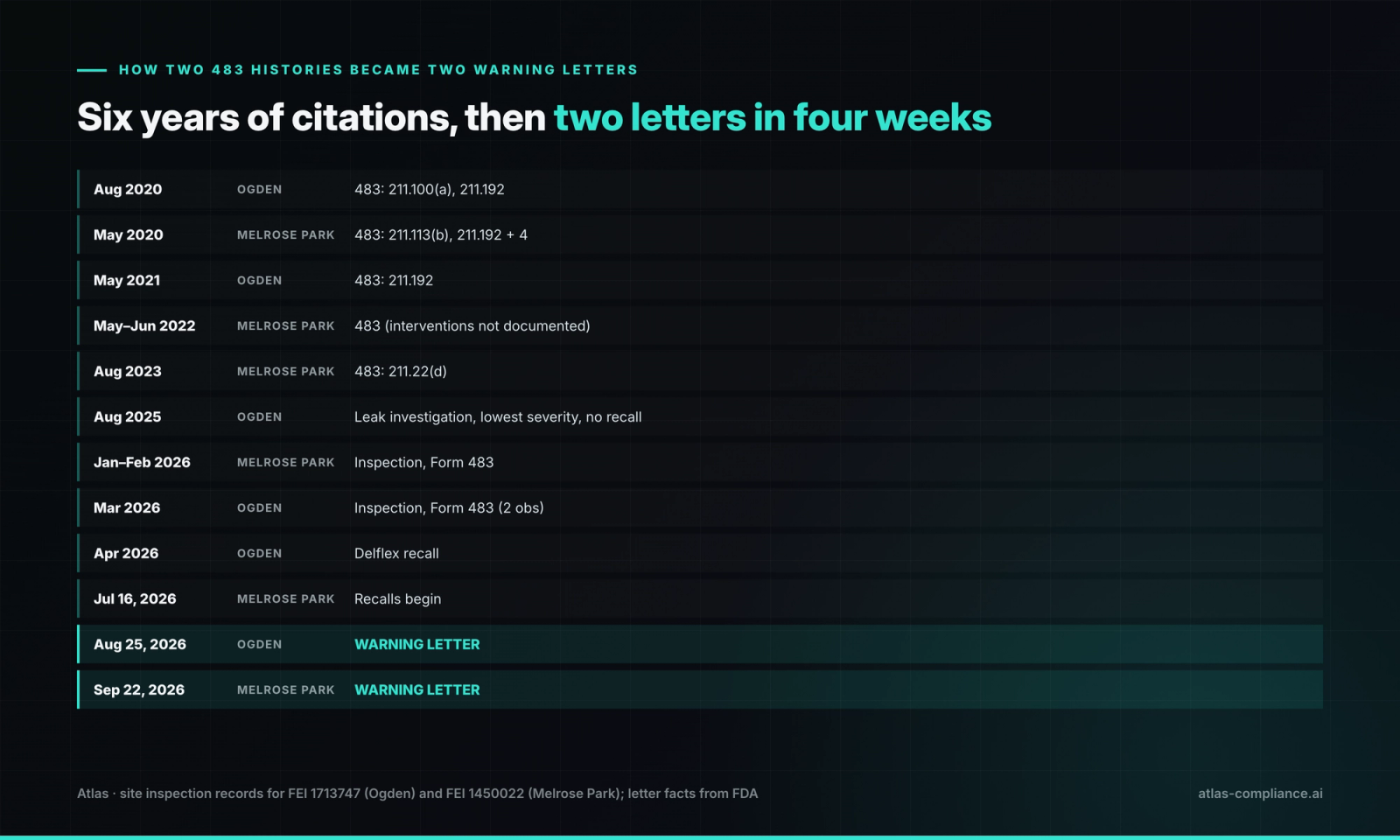
The Ogden facility's inspection record shows 14 FDA inspections since 2001, eight of which ended with a Form 483, and a warning letter in December 2012.
| Inspection | Outcome | Sections cited |
|---|---|---|
| March 2026 | Form 483 | 211.100(a), 211.192 |
| May 2021 | Form 483 | 211.192 |
| August 2020 | Form 483 | 211.100(a) twice, 211.192 twice |
| August 2017 | Form 483 | 211.68(a), 211.68(b) |
| May 2017 (devices) | Clean | |
| January 2014 (devices) | Form 483 | |
| December 2012 | Warning letter |
Three consecutive drug inspections, in 2020, 2021 and 2026, cited the investigation requirement. The 2026 letter is the agency's conclusion that the pattern did not change.
Melrose Park: famotidine released on passing tests, then recalled
Melrose Park is one of Fresenius Kabi's largest sterile injectables sites: a 430,000 square foot facility with six aseptic filling lines and six lyophilizers, a capacity of more than 160 million vials a year, and an expansion of more than $250 million under way, according to BioPharm International. That scale is why the letter matters beyond one product.
The warning letter's first violation describes famotidine injection batches that failed bioburden action limits during manufacturing and were released anyway, because the finished-product sterility and endotoxin tests passed. Patients then reported adverse events that FDA describes as apparent pyrogenic reactions. Testing of retained samples found an endotoxin failure, and three famotidine batches were recalled. The letter's sentence on the risk is short: "Pyrogen contamination in parenteral drug products can lead to significant adverse events."
The same violation covers hair contamination. FDA found at least nine documented instances of hair in product since May 2022 that were not investigated in a timely way, and the visual inspection program classified hair as a major defect rather than a critical one.
The second violation, 211.113(b), is about aseptic process validation. Media fills did not reflect the maximum number of interventions or enough units, inherent interventions were not recorded in batch records, and media fills failed in September and October 2024 and in April and October 2025. The letter notes that "inadequate documentation of interventions was the subject of findings from FDA's 2022 inspection."
The third violation, 211.110(a) with 211.42(c)(10), covers the visual inspection program's low probability of detecting particulates and the design of aseptic lines with limited barrier protection that required frequent high-risk interventions. FDA asked for a tabular plan to move production off those lines, with backup contract manufacturers named. Which lines are affected is redacted in the published letter.
A recall discussion with FDA took place on July 9, 2026, and recalls of glycopyrrolate, lidocaine and ropivacaine batches began on July 16, 2026. Fresenius Kabi has said that no patient-safety concerns have been linked to distributed products and that the site remains operational while remediation is under way.
Melrose Park's history: nine 483s in 25 inspections
The Melrose Park facility's record shows 25 FDA inspections since 2000 and nine Form 483s. The ones that matter for this letter:
| Inspection | Outcome | Sections cited on the 483 |
|---|---|---|
| January to February 2026 | Form 483 (on file) | Basis of the September letter |
| August 2023 | Form 483 | 211.22(d), procedures not followed |
| May to June 2022 | Form 483 (on file) | The inspection the 2026 letter refers back to |
| April to May 2020 | Form 483 | 211.111, 211.113(b), 211.188(b), 211.192, 211.22(d), 211.67(b) |
| August to September 2015 | Form 483 | 211.100(a), three observations |
The May 2020 Form 483 already cited 211.113(b), aseptic processing procedures, and 211.192, investigations. Six years later those are the first two violations in the warning letter. The 2023 inspection was led by a team of four investigators including Chad W Rice and Andrew J Barrowcliff; the 2020 one by Brian D Nicholson and Michele L Glendenning. What each of them tends to cite is on their profiles, which is the kind of preparation our piece on FDA investigators and their inspection history describes.
 Atlas
AtlasSee what the FDA knows about your next investigator.
30 minutes with the founder. No pitch deck.
The wider Fresenius enforcement record, 2024 to 2026
The two 2026 letters are not isolated. Across the Fresenius Kabi USA and Fresenius Medical Care sites in the Atlas directory, the last three years look like this:
| Site | Action | Date |
|---|---|---|
| Fresenius Kabi AG, Ivenix infusion system (devices) | Warning letter, FDA ref. 671249 | January 4, 2024 |
| Wilson, North Carolina (devices) | Form 483 | February 2024 |
| North Andover, Massachusetts | Form 483 | August 2025 |
| Canton, Massachusetts (compounding) | Form 483 | November 2025 |
| Wilson, North Carolina (human drugs) | Form 483 | February 2026 |
| Melrose Park, Illinois | Form 483 | February 2026 |
| Ogden, Utah | Form 483 | March 2026 |
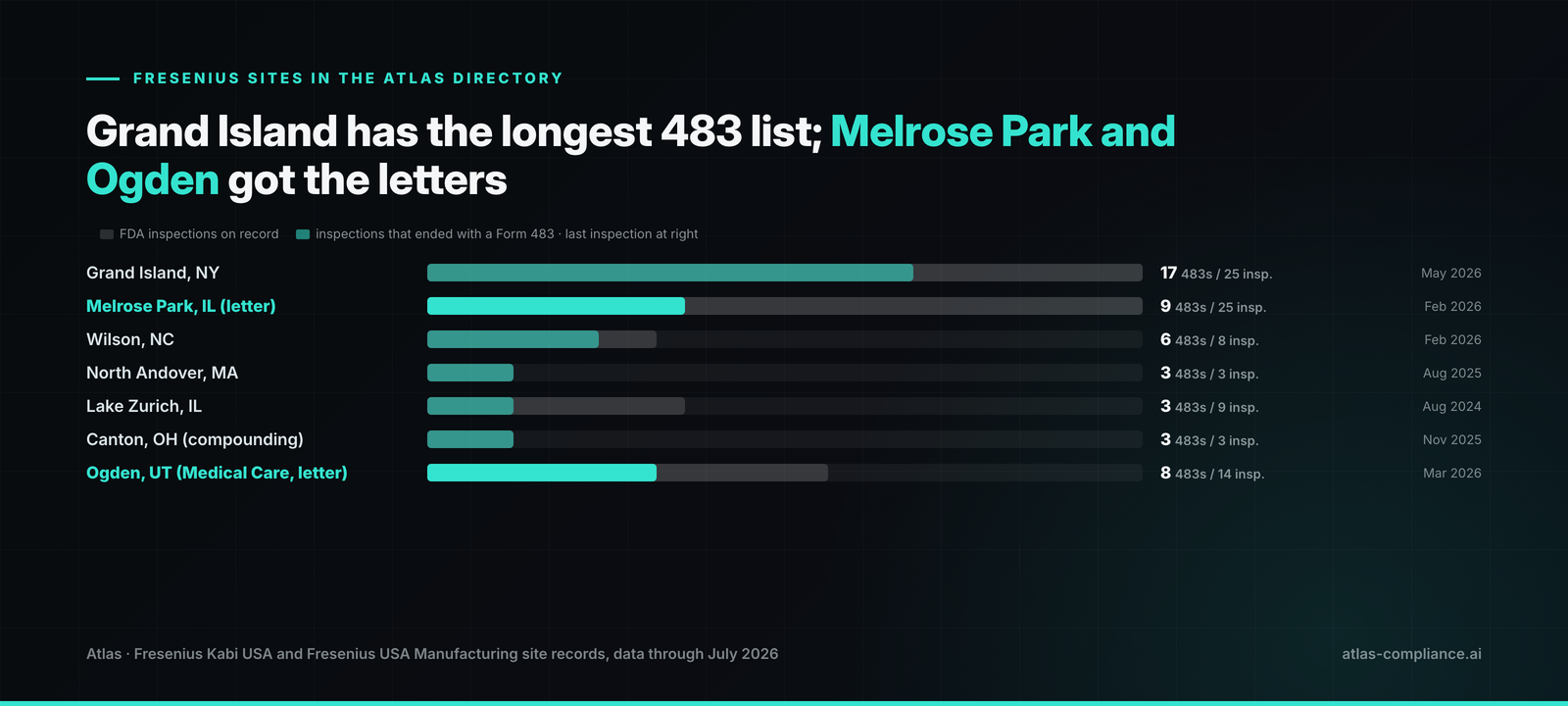
| Grand Island, New York | Form 483 (17th on record, after 483s in October 2023 and August 2023) | May 2026 |
| Ogden, Utah | Warning letter | August 25, 2026 |
| Melrose Park, Illinois | Warning letter | September 22, 2026 |
Seven US sites, eight Form 483s and two warning letters in roughly 30 months. Grand Island has the longest list of any Fresenius facility, 17 Form 483s across 25 inspections, and its most recent 483 was issued in May 2026. Wilson has six 483s in eight inspections. A pattern this dense across a group is what FDA means when a letter says management oversight has not corrected repeat violations; our analysis of how warning letters affect later inspection outcomes covers what usually follows.
What the two letters have in common
Three things, and none of them is specific to Fresenius.
The investigation is what FDA judges. In both letters the first citation is 211.192. At Ogden the problem was an investigation that reached a root cause and then rated the risk too low to act. At Melrose Park it was an investigation that stopped at a passing release test. FDA's language in both is about scope and root cause, not about the defect itself. 211.192 was the third most cited section on human-drug 483s in late 2025, appearing on 31% of them, as our Form 483 explainer shows.
A passing finished-product test does not clear an in-process failure. The famotidine batches passed sterility and endotoxin release testing. The letter treats the bioburden action-limit failures as the signal that should have blocked release, and the later retained-sample failure as proof.
Repeat citations convert a 483 into a warning letter. Ogden's 211.192 citations in 2020, 2021 and 2026; Melrose Park's 211.113(b) and 211.192 in 2020 and the intervention-documentation finding in 2022. The Melrose Park letter says the consultant is required "because you failed to correct repeat violations." A facility's own 483 history is the clearest predictor of whether the next 483 escalates. You can check any site's history and recurring citations in the FDA facility lookup.
If Fresenius is your supplier or contract manufacturer
Both facilities make products that other companies depend on: dialysis solution supplied to clinics and home patients, and sterile generics that hospitals buy through group purchasing contracts. For a quality team on the customer side, the two letters raise three questions worth answering this month:
- What does your quality agreement require them to tell you, and when? At Ogden, 35 complaints and an investigation that rated the risk lowest happened months before FDA inspected. A customer with a notification clause tied to complaint trends would have known in August 2025.
- Have you pulled their inspection history? The Ogden and Melrose Park site pages show the 2020 and 2021 citations; a supplier qualification file that stops at the certificate of analysis would not. The questions to ask a supplier after a 483 are the same ones FDA asks in the letter: root cause, scope, CAPA, evidence.
- Do you have a second source? FDA asked Melrose Park for a line-transfer plan with backup contract manufacturers named. Customers of the affected products should assume supply from those lines will move.
This is the same preparation our piece on what QA teams should prepare before an unannounced inspection describes, applied to a supplier instead of your own site.
What happens next
Each company had 15 business days from receipt to respond. FDA asked both for independent assessments, retrospective reviews, and a qualified consultant, and at Melrose Park for a teleconference after the response. Neither letter mentions an import alert, which does not apply to domestic sites, but both state that FDA may withhold approval of pending applications listing the facility until the violations are corrected.
For other sterile manufacturers, the practical reading is: pull every investigation from the last three years where a release decision overrode an in-process excursion, and every complaint investigation where the severity rating would have changed the recall decision. Those are the two files FDA opened at Fresenius. The most-cited documentation failures of 2024 and 2025 are the same families: investigations, batch records and procedures not followed.
AtlasFDA Inspection Intelligence Digest
We track every 483, EIR, and warning letter the moment it happens. Get the signals before they hit the FDA website.
Frequently asked questions
They went to two different companies in the Fresenius group for two different facilities. Fresenius Medical Care's Ogden, Utah facility received a letter on August 25, 2026 over leaking dialysis-solution bags and an inadequate complaint investigation. Fresenius Kabi USA's Melrose Park, Illinois facility received a letter on September 22, 2026 over famotidine contamination, aseptic process validation and visual inspection failures.

Written by
Bhavish Agarwal
Founder, Atlas
Bhavish Agarwal is the founder of Atlas and previously worked at Google and Microsoft. He has spent the past several years building regulatory data infrastructure for the pharmaceutical industry.