
An FDA warning letter is the agency's formal written notice that it considers a company to be in significant violation of the Food, Drug, and Cosmetic Act and expects the violations corrected. It is not a fine or a shutdown. It is public, it gives the company 15 business days to respond, and it is the last step before import alerts, seizure or a court injunction.
Almost every manufacturing warning letter starts as a Form 483. The investigator lists observations at the end of an inspection, the company responds, and FDA decides whether the response is enough. When it is not, or when the same regulation keeps coming back, the letter follows. That is what happened at two Fresenius facilities and six Olympus facilities in 2026, and the Form 483s that preceded each letter are on record in the FDA Form 483 database.
Where a warning letter sits on FDA's escalation ladder
| Step | Who issues it | When | Public? | What it means for the company |
|---|---|---|---|---|
| Form 483 | The investigator, in person | Close-out meeting on the last day of the inspection | Released under FOIA; FDA posts a selection | A list of observations, not a final agency decision |
| OAI classification | FDA reviewers after the inspection | Typically 45 to 90 days after close-out | Yes, on the FDA Data Dashboard | FDA recommends regulatory action |
| Warning letter | The FDA center responsible for the product (CDER, CDRH, CBER and others) | Months after the 483: 5.5 to 11 months in the 2026 examples below | Yes, posted on fda.gov with redactions | Significant violations; 15 business days to respond |
| Import alert | FDA, for foreign facilities | Often alongside or after a warning letter | Yes, on FDA's import alert list | Products detained at the US border without physical examination |
| Seizure | A federal court, on a complaint filed by the Department of Justice for FDA | When violative product stays on the market | Yes, court record | Product removed by court order |
| Injunction or consent decree | A federal court; a consent decree is the company agreeing to court-ordered terms | Usually after repeated warning letters | Yes, court record | Operations can be stopped until compliance is shown |
Two points the table does not show. First, FDA describes the warning letter as informal and advisory: it is a chance to correct before enforcement, and FDA is not required to send one before taking stronger action. Second, the gap between the 483 and the letter is where most cases are decided. FDA reads the 483 response before it decides, and a response without root cause, scope and evidence is the most common reason a case ends in a letter.
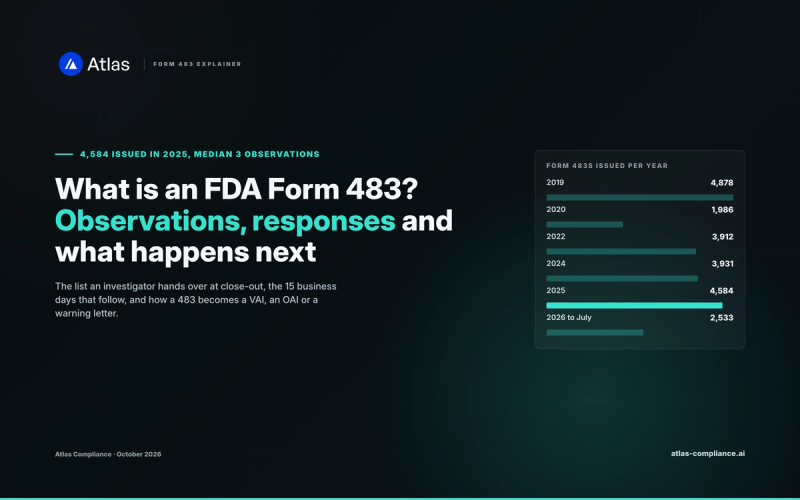
The more Form 483s FDA issues, the larger the pool of possible letters. The Atlas directory holds 4,584 Form 483s with observation detail issued in 2025, the highest count since 2019, and 2,533 issued from January to July 2026. By product area in 2025: 2,504 for foods and cosmetics, 807 for medical devices, 755 for human drugs, 269 for biologics and 249 for animal drugs (directory counts, data through July 2026).
What a warning letter contains, and the 15 business day clock
A manufacturing warning letter follows a fixed shape:
- The inspection. Facility, FEI number, inspection dates, and the Form 483 it follows.
- FDA's review of your 483 response. Usually one paragraph per violation explaining why the response was inadequate: no root cause, too narrow in scope, no evidence the fix worked, or no timeline.
- The violations. Each one cites a regulation, such as 21 CFR 211.192 for drugs or 21 CFR 820.100 for devices, followed by what the investigator saw.
- Specific requests. A retrospective review covering a defined period, an independent assessment of a quality system, a qualified consultant under 21 CFR 211.34, or a plan to move production off a line.
- Consequences. FDA may withhold approval of pending applications that list the facility, refuse export certificates, recommend an import alert for a foreign site, or take action without further notice.
- The deadline. A written response within 15 business days of receipt, describing what has been done and what will be done, with dates.
The letter closes when FDA confirms the corrections, usually through a reinspection, and sends a close-out letter. Our analysis of how warning letters affect later inspection outcomes covers what that next inspection looks like.
The violations behind most warning letters: what the Form 483 data shows
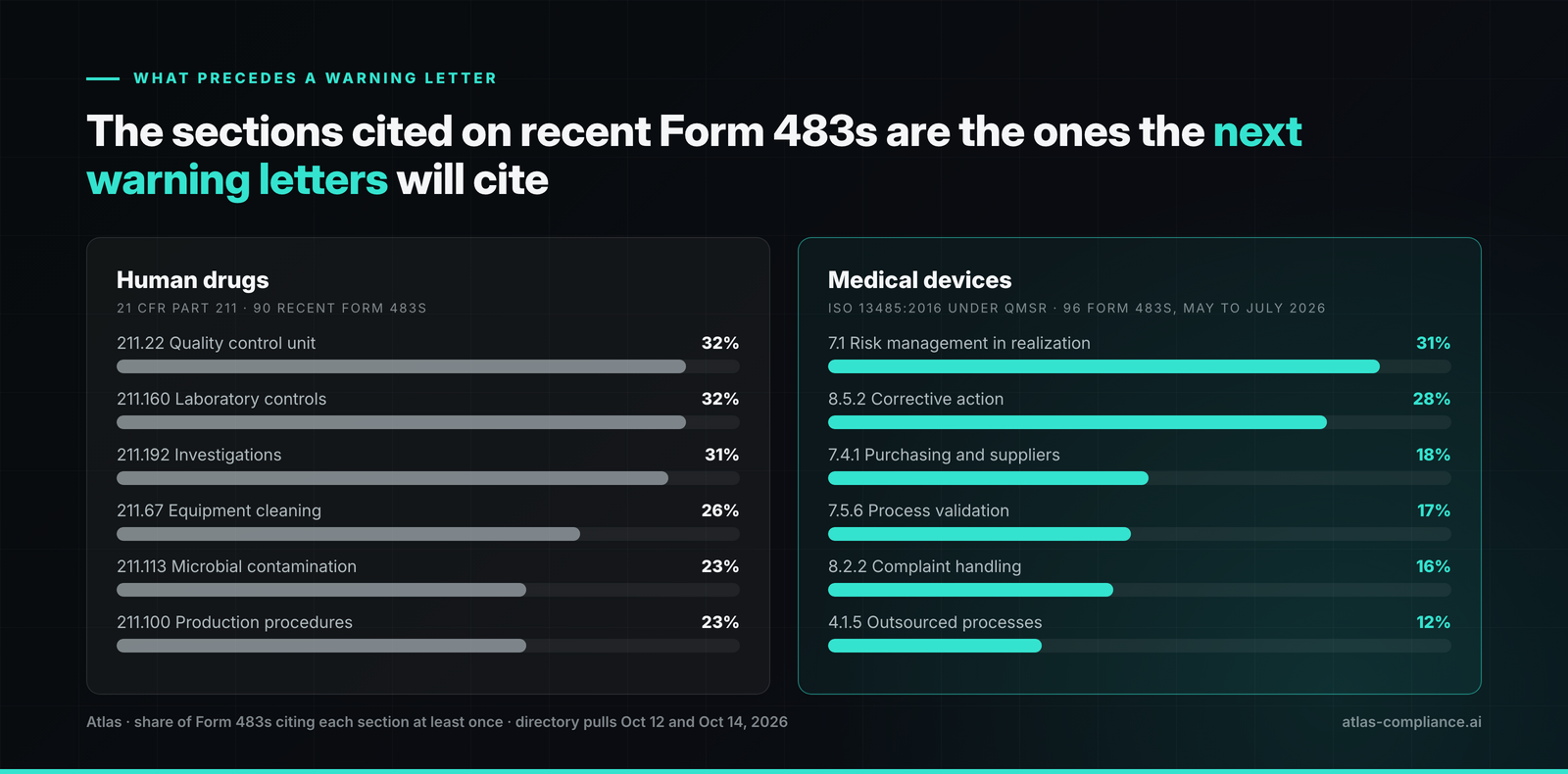
Warning letters cite the regulations that were already on the 483, so the most-cited sections on recent 483s are the best guide to what the next letters will say. We counted them for human drugs and medical devices.
| Rank | Human drugs: section cited | Share of 483s | Medical devices: section cited | Share of 483s |
|---|---|---|---|---|
| 1 | 211.22, quality control unit | 32% | ISO 13485 Clause 7.1, product realization planning and risk management | 31% |
| 2 | 211.160, laboratory controls | 32% | ISO 13485 Clause 8.5.2, corrective action | 28% |
| 3 | 211.192, production record review and investigations | 31% | ISO 13485 Clause 7.4.1, purchasing and supplier controls | 18% |
| 4 | 211.67, equipment cleaning and maintenance | 26% | ISO 13485 Clause 7.5.6, process validation | 17% |
| 5 | 211.113, control of microbial contamination | 23% | ISO 13485 Clause 8.2.2, complaint handling | 16% |
| 6 | 211.100, production and process procedures | 23% | ISO 13485 Clause 4.1.5, outsourced processes | 12% |
Sources: 90 recent human drug Form 483s (Atlas directory, pulled October 12, 2026); 96 medical device Form 483s issued May 15 to July 17, 2026, category Medical Devices & Rad Health (Atlas directory release of August 15, 2026, pulled October 14, 2026). Share is the percentage of 483s citing the section at least once.
Three things stand out.
Device 483s now cite ISO 13485. FDA's Quality Management System Regulation took effect on February 2, 2026 and incorporates ISO 13485:2016 by reference. Of the 96 device 483s in our sample, 91 cite ISO 13485 clauses and only 4 cite any section of the new Part 820. The underlying requirements map closely onto the old 820 sections for design and risk, corrective action, purchasing, process validation and complaints, so a facility's pre-2026 citation history still predicts its next 483. Other device citations in the sample include 21 CFR 803.17, written medical device reporting procedures (8%), and 801.20, the unique device identifier on the label (6%).
Investigations and corrective action are the common thread. On the drug side, 211.192 appears on nearly a third of 483s, and it is the first violation in both 2026 Fresenius letters. On the device side, corrective action is cited on 28% of 483s, and 21 CFR 820.100(a), the pre-QMSR corrective and preventive action section, was cited at all six Olympus facilities that received the October 2026 letter.
Most 483s are short, so letters come from repetition more than volume. The median device 483 in our sample has 3 observations. The two-observation Ogden 483 described below still became a warning letter, because the same section had been cited at the facility twice before.
The other violation families behind warning letters, outside manufacturing, are unapproved products, misbranding and false claims, adverse event reporting failures and data integrity. Our review of the documentation failures FDA flagged in 2024 and 2025 covers the record-keeping side in detail.
 Atlas
See what the FDA knows about your next investigator.
30 minutes with the founder. No pitch deck.
Three 2026 warning letters and the 483s behind them
| Letter | Facility | Letter date | Form 483 before it | Inspection to letter |
|---|---|---|---|---|
| Fresenius Medical Care | Ogden, Utah (dialysis solution) | August 25, 2026 | March 6, 2026: 2 observations, 211.100(a) and 211.192 | About 5.5 months |
| Fresenius Kabi USA | Melrose Park, Illinois (sterile injectables) | September 22, 2026 | Inspection January 27 to February 18, 2026 | About 7 months |
| Olympus | Six facilities in Japan, Germany and the US | October 7, 2026 | Six 483s, November 7 to 21, 2025: 31 observations | About 10.5 to 11 months |
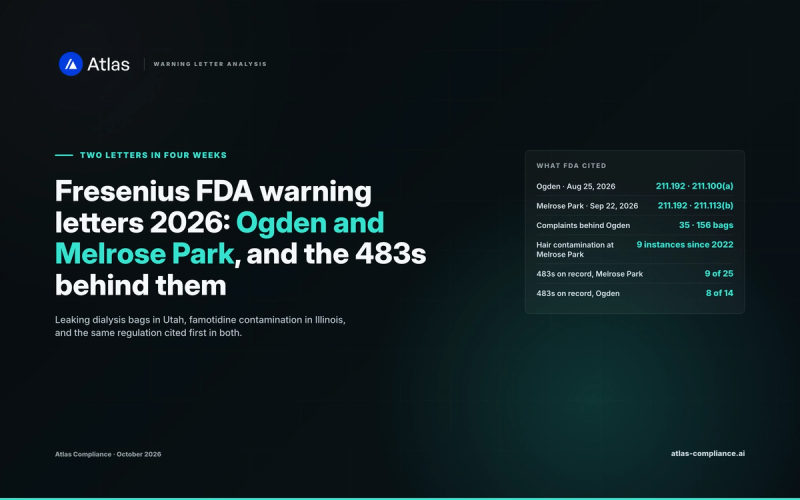
Fresenius, Ogden. The March 2026 Ogden Form 483 had two observations. FDA's Ogden warning letter cites the same two sections after 35 complaints of leaking Delflex bags were investigated, rated lowest severity, and not recalled until after the inspection. The facility had been cited under 211.192 in 2020 and 2021 as well.
Fresenius Kabi, Melrose Park. The Melrose Park warning letter cites 211.192, 211.113(b) aseptic process validation, and 211.110(a) with 211.42(c)(10), after famotidine batches were released despite bioburden failures. The Melrose Park inspection record shows a May 2020 Form 483 that cited 211.113(b) and 211.192 six years earlier. Our full write-up of the Fresenius warning letters of 2026 covers both cases.
Olympus, six facilities. Olympus announced a warning letter dated October 7, 2026 based on late-2025 inspections of six facilities. It says the items concern its quality management system, that the letter does not require a recall or restrict 510(k) clearances, and that it will respond within 15 business days. The six Form 483s from those inspections are in our directory:
| Facility | Form 483 date | Observations | Sections cited |
|---|---|---|---|
| Olympus Medical Systems, Hachioji, Japan | November 21, 2025 | 3 | 820.100(a), 820.30(a), 820.30(g) |
| Olympus Medical Systems, Hinode facility, Japan | November 21, 2025 | 4 | 820.100(a), 820.75(a), 820.75(c), 820.90(a) |
| Aomori Olympus, Kuroishi, Japan | November 7, 2025 | 3 | 820.100(a), 820.30(g), 820.75(a) |
| Shirakawa Olympus, Japan | November 14, 2025 | 6 | 820.100(a), 820.198(c), 820.30(g), 820.50, 820.75(a), 820.80(b) |
| Olympus Winter & IBE, Hamburg, Germany | November 21, 2025 | 7 | 803.50(a)(2), 820.100(a), 820.198(a), 820.25(b), 820.30(c), 820.30(g), 820.50 |
| Gyrus ACMI, Brooklyn Park, Minnesota | November 12, 2025 | 8 | 820.100(a), 820.184, 820.198(a), 820.50, 820.75(a), 820.75(b), 820.80(b), 820.90(a) |
Corrective and preventive action, 820.100(a), is on all six. Process validation (820.75) is on four and design validation (820.30(g)) on four. When the same section appears at every facility of one company, FDA reads it as a corporate quality system problem, which is why a single letter covers all six. The four Japanese 483s were issued between November 7 and 21, 2025 by the same three investigators, Stephen D Eich, Janet Pulver and Rebecca E Dorsey, in different combinations.
How to respond to an FDA warning letter
The response is a regulatory document that FDA will compare against the facility at reinspection. What works:
- Answer inside 15 business days. If a full fix takes longer, send what is done, what is planned, and the dates. Olympus has said it will follow its response with periodic updates, which is the normal pattern.
- Take each violation in the order of the letter. Quote it, then give root cause, scope, corrective action, preventive action and evidence. Attach the evidence: revised procedures, training records, validation reports, data.
- Go wider than the examples. FDA's examples are samples. If one investigation was inadequate, review all investigations for the period FDA names, and say how many you reopened. A multi-site letter needs a global answer.
- Do what the letter asks, by name. If FDA asks for a retrospective review, an independent assessment or a consultant, commit to it with a scope and a date.
- Address the previous response. Explain why the 483 response FDA rejected fell short and what is different now.
- Plan for the reinspection. Every commitment will be checked. Keep a tracker FDA could read.
Our guide to Form 483 response strategies goes through each element with examples, and the warning letter database guide shows how to find letters in your product area to see what FDA asked other companies for.
The best time to act is before the letter. Read your own 483 history the way the reviewer will: any section cited at two inspections in a row is the one most likely to appear in a letter. Our explainer on what a Form 483 is covers the response window that comes first.
AtlasFDA Inspection Intelligence Digest
We track every 483, EIR, and warning letter the moment it happens. Get the signals before they hit the FDA website.
Frequently asked questions
Most warning letters close one to two years after issue. FDA sends a close-out letter only after it has verified the corrections, usually through a reinspection of the facility. Until then the letter stays open on fda.gov and pending applications that list the facility can be held. Periodic progress updates to FDA after the first response help show the corrections are on track.

Written by
Bhavish Agarwal
Founder, Atlas
Bhavish Agarwal is the founder of Atlas and previously worked at Google and Microsoft. He has spent the past several years building regulatory data infrastructure for the pharmaceutical industry.