

An FDA Form 483, titled "Inspectional Observations", is the document an FDA investigator hands to a company's management at the close of an inspection when the investigator saw conditions that may violate the Federal Food, Drug, and Cosmetic Act. It is not a finding of violation and it carries no penalty. What the company sends back in the next 15 business days is what decides whether FDA escalates to a warning letter.
FDA issued 4,584 Form 483s in 2025 across drugs, devices, biologics, foods, and animal products. The typical one is short: three observations, written by one or two investigators, on a facility that had been inspected before. You can look up any company's 483s, the observations on each one, and the investigators who issued them in the FDA Form 483 database.

What a Form 483 contains
A 483 is a numbered list, usually one to four pages. Each one carries:
- The facility and the inspection dates, with the FEI number that identifies the establishment.
- The investigators who conducted the inspection and signed the form. Across a sample of 960 Form 483s issued in 2025, the average form carries 1.3 investigator names; most are signed by one person.
- Numbered observations. Each describes a condition the investigator saw, often with the batch, record, or room involved, and usually paraphrases the regulation it maps to: a procedure the quality unit did not follow, a deviation that was not investigated, a cleaning record that does not exist.
- A printed note that the observations are not a final agency determination. FDA puts this on the form itself.
What the form does not carry is a classification, a severity rating, or a penalty. Those come later, from FDA, not from the investigator.
How many Form 483s does FDA issue?
Fewer than most quality teams assume, and the number has not returned to its pre-2020 level. These are the Form 483s with observation-level detail in the Atlas directory, by year of issue (data through July 2026):
| Year | Form 483s issued |
|---|---|
| 2018 | 4,820 |
| 2019 | 4,878 |
| 2020 | 1,986 |
| 2021 | 2,992 |
| 2022 | 3,912 |
| 2023 | 4,274 |
| 2024 | 3,931 |
| 2025 | 4,584 |
| 2026 (January to July) | 2,533 |
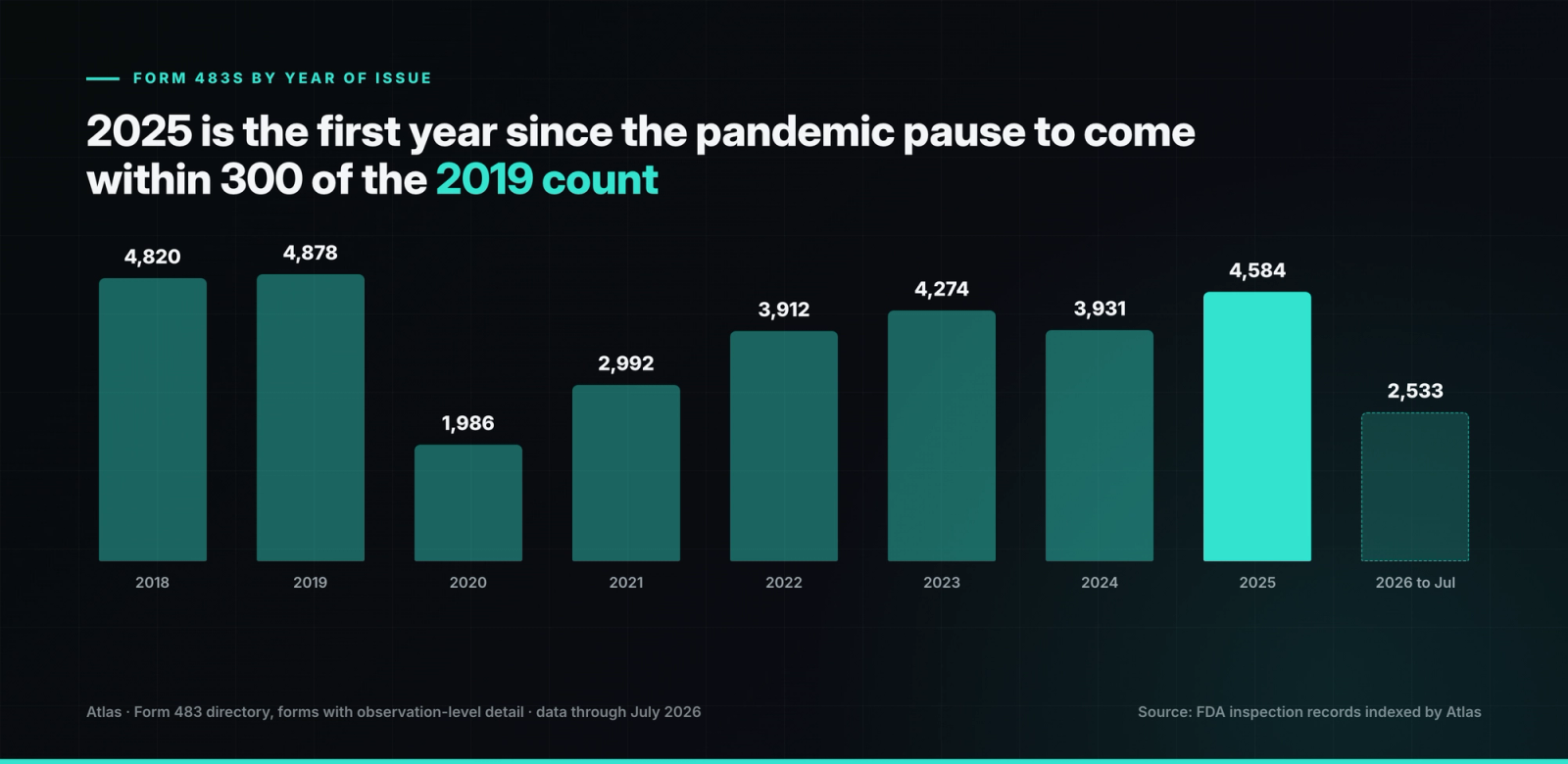
Two things stand out. The 2020 collapse was the pause in routine inspections during the pandemic, and 2025 is the first year since to come within 300 of the 2019 count. And the mix is not what the trade press suggests: in 2025, food and cosmetic facilities received 2,504 Form 483s, medical device facilities 807, human drug facilities 755, biologics 269, and animal drug and feed facilities 249. Drug 483s get the headlines because they lead to warning letters and import alerts more often, not because there are more of them.
What a typical 483 looks like
The 960 Form 483s from 2025 in the sample above break down like this:
| Measure | Value |
|---|---|
| Observations per 483, average | 3.7 |
| Observations per 483, median | 3 |
| Share with 1 to 3 observations | 59% |
| Share with 10 or more observations | 5% |
| Most observations on one form | 21 |
| Investigators per 483, average | 1.3 |
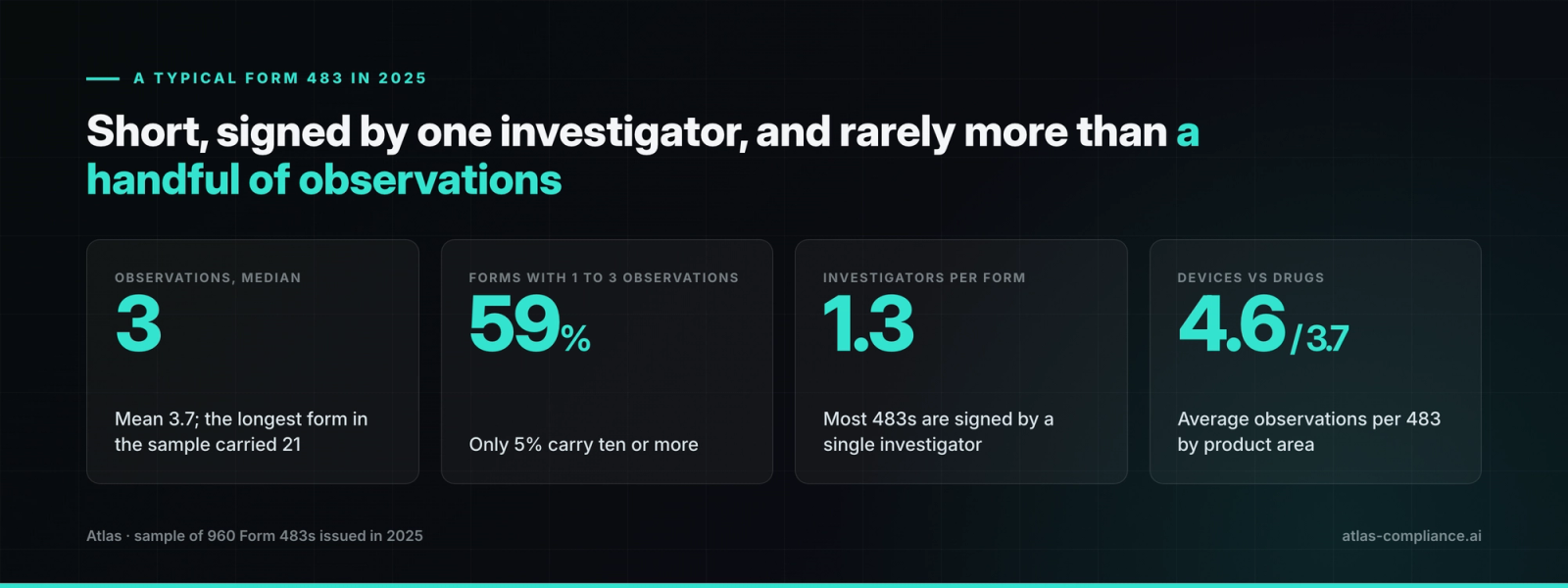
By product area, device inspections produce the longest forms (4.6 observations on average), then human drugs (3.7), foods and cosmetics (3.5), biologics (3.4), and animal drugs (2.9). A 483 with eight or more observations is in the top fifth, and it is the kind that tends to be classified OAI.
These are recent Form 483s from the database, chosen to show the range:
| Company and facility | Issued | Product area | Observations |
|---|---|---|---|
| Health Pharma USA, Rahway, United States | November 18, 2025 | Human drugs | 19 |
| Chartwell Pharmaceuticals, Congers, United States | November 18, 2025 | Human drugs | 15 |
| Excel Vision, Annonay, France | January 22, 2026 | Human drugs | 13 |
| Silgan Unicep Packaging, Spokane, United States | April 2, 2026 | Human drugs | 8 |
| Oxalis Labs, Solan, India | April 24, 2026 | Human drugs | 3 |
| Patheon Italia, Monza, Italy | February 10, 2026 | Biologics | 1 |
Each linked page shows the observations, the regulations they map to, the investigators who issued the 483, and the facility's full inspection history. The Health Pharma form was signed by four investigators; the Patheon form has a single observation and still exists as a public record, which is the point: a 483 is issued for one objectionable condition as readily as for nineteen.
Which regulations come up most on drug 483s
The same handful of sections of 21 CFR Part 211 appear on drug 483s year after year. Across 90 human-drug Form 483s issued in late 2025, the share citing each section was:
| Section | Subject | Share of 483s citing it |
|---|---|---|
| 21 CFR 211.22 | Responsibilities of the quality control unit | 32% |
| 21 CFR 211.160 | Laboratory controls, general requirements | 32% |
| 21 CFR 211.192 | Production record review and investigation of discrepancies | 31% |
| 21 CFR 211.67 | Equipment cleaning and maintenance | 26% |
| 21 CFR 211.113 | Control of microbiological contamination | 23% |
| 21 CFR 211.100 | Written procedures for production and process control | 23% |
| 21 CFR 211.68 | Automatic, mechanical, and electronic equipment | 17% |
| 21 CFR 211.84 | Testing of components and containers | 16% |
| 21 CFR 211.42 | Design and construction of buildings | 14% |
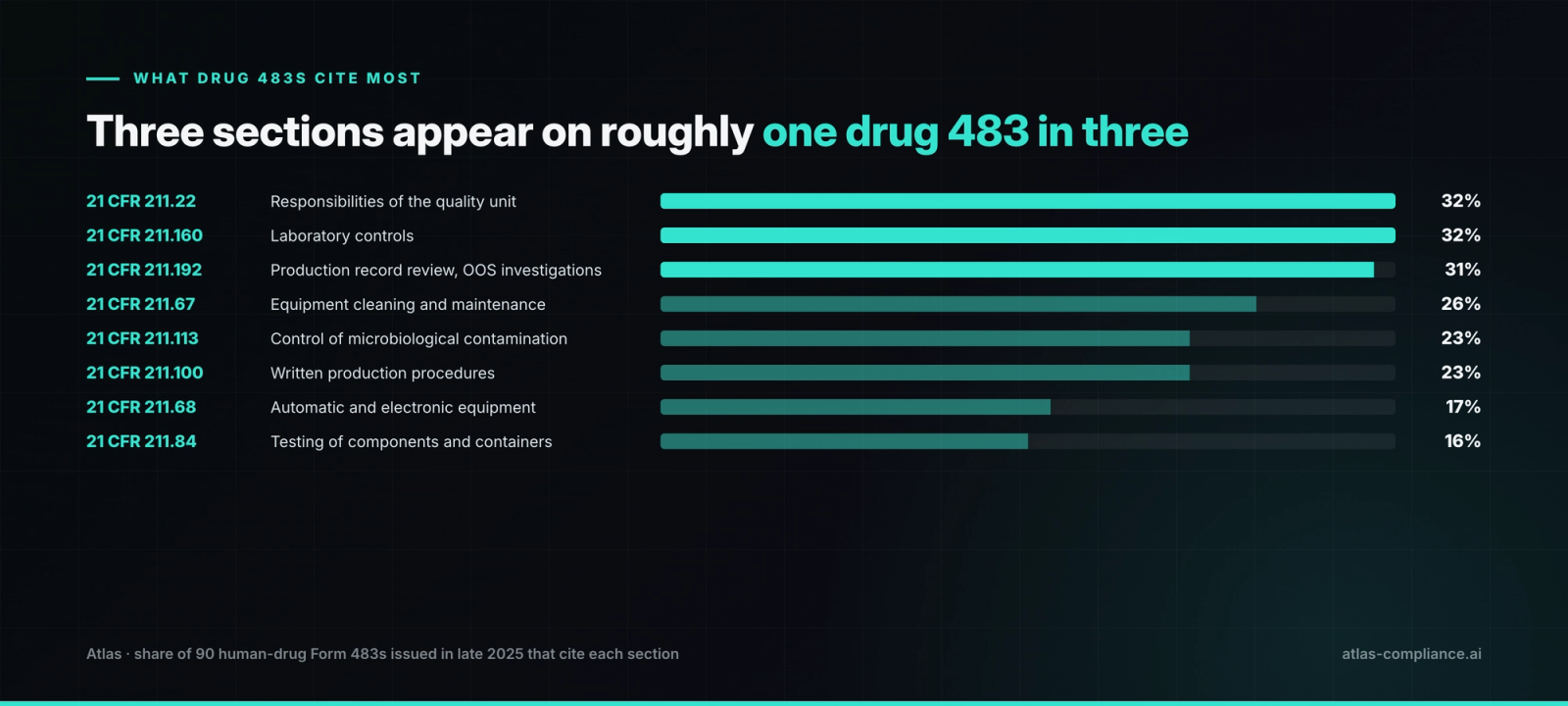
Three sections, 211.22, 211.160, and 211.192, appear on roughly one drug 483 in three. In plain terms: the quality unit did not do what its own procedures say, a laboratory test was not controlled or documented, or an out-of-specification result was not investigated far enough. 21 CFR 312.60, which covers clinical investigator responsibilities, appears on 13% because bioresearch-monitoring inspections of trial sites are filed under human drugs.
For medical devices, corrective and preventive action, complaint handling, and device history records are the long-running leaders. Since February 2, 2026, device inspections run under the Quality Management System Regulation, which incorporates ISO 13485, so new device observations reference the revised Part 820 structure. For food facilities, observations concentrate on preventive controls: hazard analysis, sanitation and allergen controls, and foreign supplier verification for importers.
Each investigator's profile in the FDA investigator lookup shows which regulations that person cites most, which is more useful before an inspection than the industry average.
What a 483 is not
A 483 is often confused with three other FDA documents. They are different steps in one process.
| Document | Who issues it | When | Public? | What it means |
|---|---|---|---|---|
| Form 483 | The investigator, on site | At the close-out meeting | Through FOIA; some posted in FDA's electronic reading room | Conditions observed that may be violations |
| Establishment Inspection Report (EIR) | The investigator | Written after the inspection | Through FOIA once the inspection is closed | The full narrative of the inspection and the reasoning behind each observation |
| Inspection classification (NAI, VAI, OAI) | FDA, after review | Weeks to months later | Posted on the FDA Data Dashboard | NAI: no action indicated. VAI: voluntary action indicated. OAI: official action indicated |
| Warning letter | FDA center or district leadership | After an OAI classification, typically | Posted on fda.gov | FDA's formal notice of significant violations, with a required response |
A clean inspection ends with no 483 at all. A 483 with a strong response usually ends in a VAI classification. OAI is where warning letters, import alerts, and regulatory meetings come from. Our guide to NAI, VAI, and OAI classifications covers that step.
How to respond to a Form 483
There is no legal requirement to respond to a 483. In practice every company that wants to avoid escalation responds, because FDA has said it will consider a response received within 15 business days of the 483's issue date when deciding whether to send a warning letter. A response that arrives later may still be read, but it may not be considered before that decision is made.
A response that holds up has four parts for every observation:
- Acknowledge the observation without arguing with the investigator's description of what they saw.
- Investigate the root cause, and say how far the problem extends: other batches, other lines, other sites.
- Commit to specific corrections and corrective actions, with owners and dates.
- Show evidence: revised procedures, training records, investigation reports, or a schedule for providing them.
The companies that get into trouble are the ones that answer a 211.192 observation with a retraining record and no extended investigation. The observation says the investigation was not thorough; the response has to show it now is. Our article on Form 483 response strategies goes through each step with examples.
What happens after the response
FDA reviews the 483, the investigator's EIR, and the company's response, then classifies the inspection:
- NAI (no action indicated): nothing objectionable was found, or nothing that warrants action.
- VAI (voluntary action indicated): objectionable conditions were found, but FDA is not taking regulatory action. Most inspections that end with a 483 land here.
- OAI (official action indicated): regulatory action is recommended. This is the path to a warning letter, and for foreign facilities, often an import alert.
The classification also sets up the next inspection. A facility with an OAI history should expect a follow-up visit, and the investigator will check whether the corrective actions promised in the last response actually happened. Repeat observations on a second 483 are what turn a VAI history into an OAI one.
How to find a company's past 483s
There are three routes:
- FDA's FOIA electronic reading room publishes a selection of 483s, mostly from higher-profile inspections.
- A FOIA request to FDA for a specific 483 or EIR. Expect redactions and a wait measured in months.
- A searchable database. The Atlas Form 483 database covers 148,507 inspections on record that ended with a Form 483, with observation-level detail on 75,762 of them, searchable by company, facility, investigator, product area, and year. About four in ten recent 483s have the source PDF attached.
For a supplier or contract manufacturer, a facility's 483 history is the fastest way to see whether the same problems keep coming back. Our guide to where to find FDA 483 reports compares the three routes in detail.
Frequently asked questions
Yes, but not automatically. 483s are releasable under the Freedom of Information Act, with confidential commercial information redacted. FDA posts a selection in its electronic reading room, and databases such as Atlas index them by company, facility, and investigator. A 483 issued last month may not be public yet; one issued last year usually is.

Written by
Bhavish Agarwal
Founder, Atlas
Bhavish Agarwal is the founder of Atlas and previously worked at Google and Microsoft. He has spent the past several years building regulatory data infrastructure for the pharmaceutical industry.