
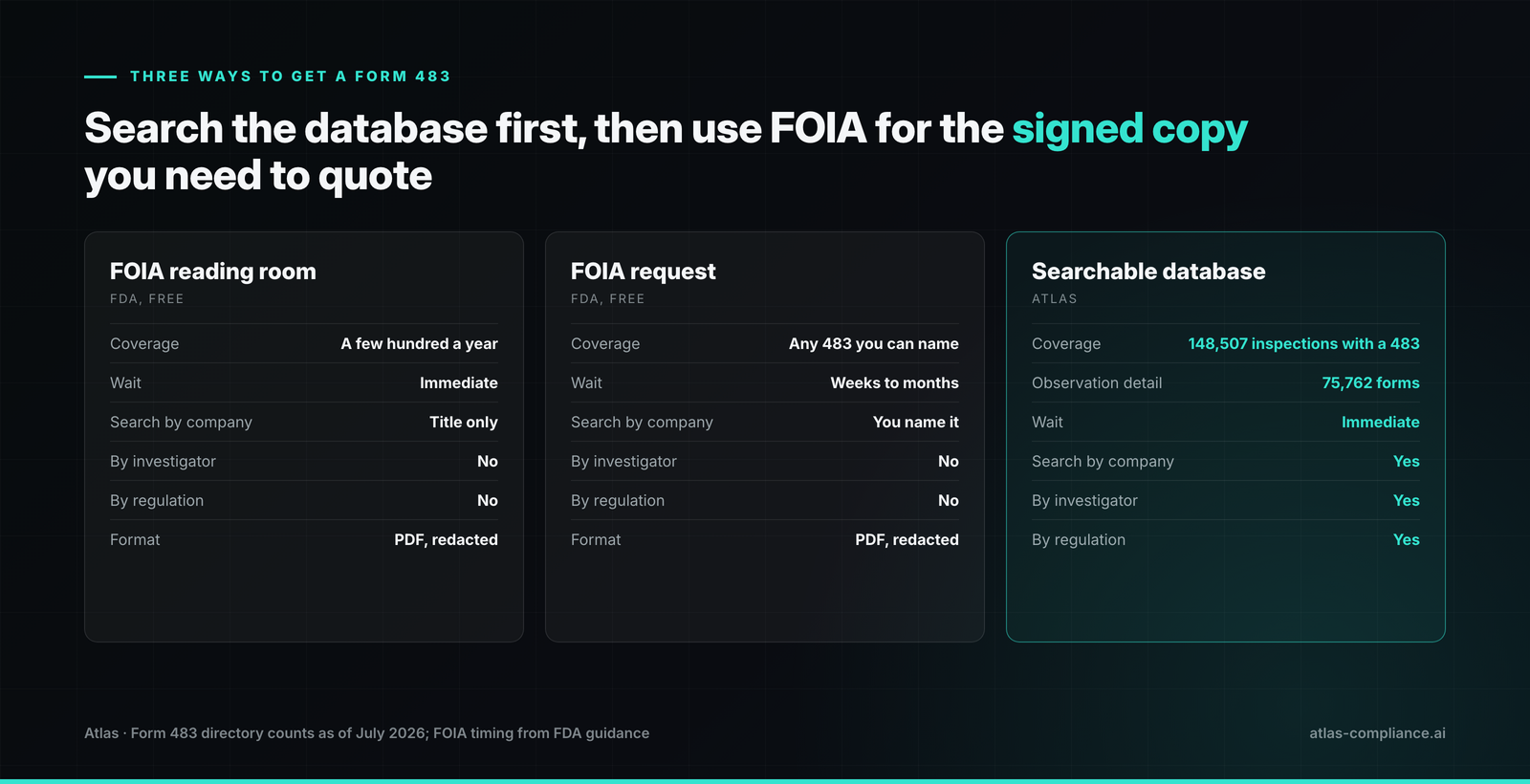
There are three ways to get an FDA Form 483: FDA's FOIA electronic reading room, a FOIA request to FDA, or a searchable database. If you want to search by company, facility, or investigator today, use the FDA Form 483 database, which indexes 148,507 inspections that ended with a 483 and the observations on 75,762 of them. If you need the signed PDF of one specific 483 and can wait, FOIA is free.
FDA does not run a single public 483 database. The agency posts a selection of 483s in its reading room, mostly from inspections that drew attention, and releases the rest on request. Everything else, including the ability to search across companies and investigators, comes from third-party databases built on FOIA releases and FDA's inspection data. This post covers which route fits which need, and what to look for once a 483 is in front of you. If you are not yet sure what the document is, start with what an FDA Form 483 is.
The three routes compared
| FOIA electronic reading room | FOIA request | Searchable database | |
|---|---|---|---|
| Who runs it | FDA | FDA | Third parties (Atlas and others) |
| What you get | A selection of 483s FDA chose to post, as PDFs | The specific 483 or EIR you ask for, as a PDF | Every 483 on record as structured data: observations, regulations cited, investigators, facility history |
| Coverage | A few hundred per year, weighted to higher-profile inspections | Any 483 that exists, if you can name the facility and dates | 148,507 inspections with a 483 outcome; observation detail on 75,762; source PDF on about 4 in 10 recent ones |
| Redactions | Yes, confidential commercial information removed | Yes, often heavier | Observation text is public-safe; the PDF carries FDA's redactions |
| Typical wait | Immediate | Weeks to months; complex requests longer | Immediate |
| Search by company or facility | Limited, by document title | Not applicable; you name it in the request | Yes |
| Search by investigator | No | No | Yes |
| Search by regulation cited | No | No | Yes |
| Cost | Free | Free for most requests; fees for large ones | Free preview; subscription for full text and PDFs |
The practical split: use the database to find out which 483s exist and what they cite, then use FOIA for a signed copy of the one you need to quote verbatim in a supplier audit or a submission.
Route 1: FDA's FOIA electronic reading room
The reading room is where FDA posts records that have been requested often or that it expects to be of public interest. Form 483s sit alongside warning letters, EIRs and correspondence.
How to use it:
- Open the reading room and search for the company name or "Form 483".
- Filter by date or office where the interface allows it.
- Download the PDF. Observations are numbered; the redactions are marked.
What to expect: a small fraction of all 483s, with a bias toward inspections that led to a warning letter, a recall, or press coverage. If the facility you care about is a mid-size contract manufacturer with a routine inspection, it is probably not here.
Route 2: a FOIA request
If the 483 is not posted, you can ask for it. FDA's FOIA request page explains the process.
How to file:
- Identify the facility, its location, and the inspection dates as precisely as you can. The FEI number helps.
- State which documents you want: the Form 483, the EIR, the company's response, or all three.
- Submit online. Simple requests are usually processed in a few weeks; anything involving a large volume of records or a third party's confidential information takes months.
What to expect: a PDF with confidential commercial information and personal data redacted. The company's response, if you request it, is often more heavily redacted than the 483 itself. For a facility's full history you would need one request per inspection, which is why databases exist.
Our guide on how to access an FDA inspection report quickly covers the EIR side of the same process.
Route 3: a searchable database
A 483 database indexes the inspection records FDA publishes, the 483s released under FOIA, and the observations on each form, so you can search across all of them at once. The questions a database answers that FOIA cannot:
- Which facilities of a supplier have received 483s, and for what?
- What does the investigator scheduled for your inspection usually cite?
- How often is a given section of 21 CFR Part 211 cited, and is it rising?
- Did a facility's 483 escalate to a warning letter?
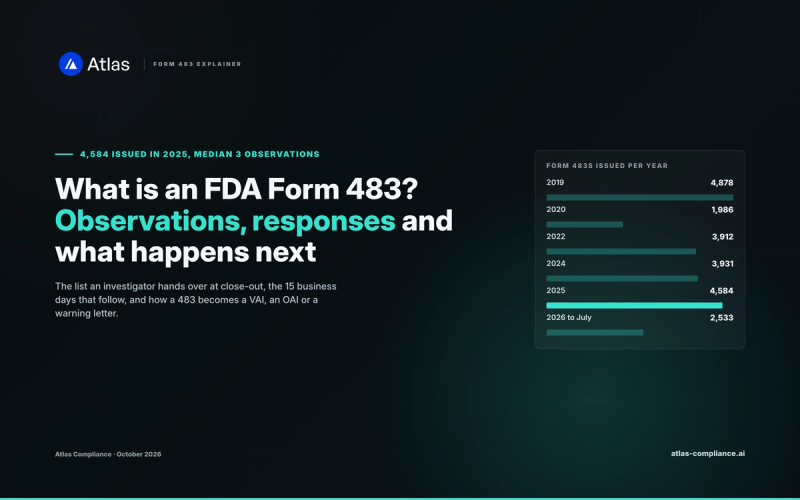
In the Atlas Form 483 database each 483 page shows the observations with the regulation each one maps to, the facility's full inspection history, and the investigators who signed it, with a link to each investigator's own citation pattern in the FDA investigator lookup. A sample of 960 Form 483s issued in 2025 shows what a typical record looks like: a median of 3 observations, 1.3 investigators per form, and the source PDF on file for 41%.
 Atlas
See what the FDA knows about your next investigator.
30 minutes with the founder. No pitch deck.
How to read a Form 483
A 483 is short, usually one to four pages, and every part of it carries information.
The header. Facility name, address, FEI number, inspection dates, and the date the form was issued. The issue date starts the 15-business-day clock for a response that FDA will consider before deciding on a warning letter.
The investigators. Their names and titles. Across 2025 forms the average is 1.3 investigators per 483; a team of three or four usually means a for-cause or pre-approval inspection rather than a routine one. Each investigator's profile shows what they cite most, which tells you how to read their observations.
The numbered observations. Each describes a condition the investigator saw, often paraphrasing the regulation it maps to without citing it. "Written procedures are not followed" is 211.100(b); "there is a failure to thoroughly review any unexplained discrepancy" is 211.192. The three sections that appear most on drug 483s are 211.22 (quality unit), 211.160 (laboratory controls) and 211.192 (investigations), each on roughly one 483 in three.
Repeat observations. FDA sometimes marks an observation as a repeat from a prior inspection. When it does not, the facility's inspection history shows it anyway. A section cited at two consecutive inspections is the strongest single predictor that the next 483 becomes a warning letter; the Fresenius letters of 2026 followed 211.192 citations in 2020, 2021 and 2026 at the same facility.
What is not on it. No classification, no severity, no penalty. Those come weeks later when FDA classifies the inspection NAI, VAI or OAI; our guide to NAI, VAI and OAI covers that step. The investigator's full narrative is in the EIR, which is a separate document.
Three recent 483s, read this way
| Form 483 | Facility | Observations | What it shows |
|---|---|---|---|
| Excel Vision, January 22, 2026 | Annonay, France, human drugs | 13 | A three-investigator team (Justin A Boyd, Khoa Nathan V Tran, Karen A Briggs) and a long form: the profile of a foreign for-cause inspection |
| Silgan Unicep Packaging, April 2, 2026 | Spokane, United States, human drugs | 8 | Two investigators (Crystal Monroy, Carolina D Vasquez), eight observations on a contract packager: the kind a customer's quality agreement should trigger a notification for |
| Oxalis Labs, April 24, 2026 | Solan, India, human drugs | 3 | A short form from a routine inspection; whether it escalates depends on whether the three observations repeat earlier citations |
Each linked page carries the observations, the cited regulations, the inspection team, and the facility's history before and after.
When to use which route
- You are qualifying or auditing a supplier. Database first, for the facility's full history and recurring citations. Then FOIA for the signed 483 and the response if the audit file needs them.
- An investigator has been announced for your inspection. Database: the investigator's profile and the last ten 483s they issued.
- You need to quote a 483 in a regulatory submission or legal matter. FOIA, for the official document. Check the reading room first in case it is already posted.
- You are tracking a competitor or a product category. Database, filtered by product area and year.
The most common documentation failures FDA flagged in 2024 and 2025 is a worked example of what reading several hundred 483s at once tells you.
AtlasFDA Inspection Intelligence Digest
We track every 483, EIR, and warning letter the moment it happens. Get the signals before they hit the FDA website.
Frequently asked questions
Yes. A Form 483 is a federal record and is releasable under the Freedom of Information Act, with confidential commercial information and personal data redacted. FDA posts some in its electronic reading room and releases the rest on request. Databases such as Atlas index them by company, facility and investigator.

Written by
Bhavish Agarwal
Founder, Atlas
Bhavish Agarwal is the founder of Atlas and previously worked at Google and Microsoft. He has spent the past several years building regulatory data infrastructure for the pharmaceutical industry.