
KVK-Tech received two FDA warning letters in 2020. The first, dated February 11, 2020 (CMS 592387), covers its 110 Terry Drive facility in Newtown, Pennsylvania: flawed impurity test methods, uninvestigated particles and unprotected lab data. The second, dated October 8, 2020 (CMS 608236), covers 100 Campus Drive: unvalidated cleaning and incomplete batch records.
Both letters followed a Form 483. The Atlas directory holds 21 FDA inspections and 14 Form 483s for the two KVK-Tech sites between 2008 and 2025, and the same regulations show up before the letters and after them. This article puts the two letters side by side, then walks through the inspection record that explains them and what FDA found at the next three inspections.
The two letters, side by side
| February 11, 2020 letter | October 8, 2020 letter | |
|---|---|---|
| Reference | CMS 592387 | CMS 608236 |
| Facility | 110 Terry Drive, Newtown, PA | 100 Campus Drive, Newtown, PA |
| FEI | 3005117563 | 3013676321 |
| Inspection | April 9 to 16, 2019 | February 4 to March 13, 2020 |
| Form 483 response | May 7, 2019 | April 4, 2020 |
| Products named | Phentermine HCl capsules, methylphenidate oral solution | Hydroxyzine HCl tablets, promethazine HCl tablets, oxybutynin chloride tablets |
| Violations cited | 211.165(e) test methods; 211.192 investigations; 211.68(b) computer system controls | 211.67(b) cleaning procedures; 211.188 batch records |
| Core failure | Co-eluting impurity peaks integrated so an out-of-specification lot stayed on the market | Packaging equipment cleaning never validated; gauge readings recorded that the equipment did not show |
| Recall | Methylphenidate oral solution lot 15315A, November 4, 2019 | None named |
| Consultant | Strongly recommended, for data integrity remediation | Recommended under 21 CFR 211.34, with a full audit |
| Other | Third-party lab assessment and four-year review of manufacturing records | Production at the facility suspended; "repeat violations at multiple sites" |
Both letters came from the same office, FDA's Division of Pharmaceutical Quality Operations I, signed by the same district director. The full text is on FDA's site: February 2020 and October 2020.
February 2020: an impurity problem the company found in 2016
The first violation is the one that matters most, because KVK-Tech had already spotted it. In 2016 a deviation report noted that analysts were integrating closely co-eluting impurity peaks in a way that meant "reported impurity levels may not reflect the true concentrations." The firm retrained analysts in May 2016. In December 2016 an analyst integrated a stability impurity test for phentermine HCl capsules lot 12456A the same way. Integrated correctly, the lot would have failed. It stayed on the market until it failed stability testing on June 20, 2017.
FDA also found that the procedure the quality unit later approved still contained an integration example that would underreport impurities. The letter asks for a review of peak resolution across every HPLC method used on marketed products and an independent assessment of the whole laboratory.
The second violation, 211.192, covers foreign particles found while filling methylphenidate oral solution lot 15315A. The firm filtered them out, inspected the lot visually and released it, attributing the particles to wipes shed during cleaning without opening a deviation. The lot was recalled on November 4, 2019, after the inspection.
The third, 211.68(b), is about data. Quality assurance staff held administrator rights in the chromatography software, and stand-alone instruments allowed files to be overwritten with no audit trail. A CAPA from the previous inspection, CAPA 18-072, had promised to fix the stand-alone equipment and had not been completed by April 2019.
That last finding later became a criminal matter. In March 2024 the Department of Justice announced that KVK Research pleaded guilty to two misdemeanor counts of introducing adulterated drugs and agreed to a $1.5 million fine and forfeiture. KVK-Tech entered a three-year deferred prosecution agreement with an independent compliance monitor and paid $2 million under the False Claims Act. The admitted conduct includes failing to control computer systems between February 27 and April 16, 2019, a window that ends on the last day of FDA's April 2019 inspection, plus at least 62 batches of hydroxyzine made between 2011 and 2013 with API from a foreign facility FDA had not been told about.
October 2020: cleaning validation and gauges at Campus Drive
The Campus Drive facility packaged solid oral drugs. FDA found that the firm had never validated cleaning of its non-dedicated slat counter, contrary to its own SOP-0030, on the reasoning that it resembled tablet counters at the Terry Drive facility. FDA rejected that: the most difficult-to-clean surfaces differ, and the new validation study had no swab sites inside the slat cavities.
The 211.188 violation is concrete. During packaging of hydroxyzine HCl 50 mg tablets, the investigator saw a capper's air pressure gauge outside its range while the batch record showed a conforming value. A mechanic had turned the pressure down to fix cap feeding and nobody documented it. Under "other observations" the letter adds a cleaning validation sample logged as received at 10:50 PM, five hours after its chromatography was finished, by an analyst whom the building's card reader placed outside the facility.
The letter closes with the paragraph that turns two facility problems into a company problem: the Terry Drive letter eight months earlier showed "repeated failures at multiple sites," which "demonstrate that management oversight and control over the manufacture of drugs is inadequate." KVK-Tech had already committed to suspending drug manufacture at the facility.
KVK-Tech's full inspection and Form 483 record
The KVK-Tech Terry Drive site record shows 19 FDA inspections since February 2008, 13 of which ended with a Form 483. Campus Drive has two inspections and one Form 483. All figures below are from the Atlas FDA inspection directory, data to July 2026.
| Inspection ended | Site | Outcome | Sections cited on the 483 |
|---|---|---|---|
| Feb and Jul 2008 | Terry Drive | Clean (2) | |
| Aug 2009 | Terry Drive | Form 483, 6 obs. | 211.160(a), 211.165(e), 211.192, 211.198(b)(2), 211.67(c) |
| Dec 2009 | Terry Drive | Form 483, 4 obs. | 211.58, 211.68(a), 211.100(a), 211.188 |
| Aug 2011 | Terry Drive | Form 483, 10 obs. | 211.192, 211.188, 211.198, 211.204, 211.67(b)(6) |
| Sep 2012 | Terry Drive | Clean | |
| Dec 2013 | Terry Drive | Form 483, 9 obs. | 211.192, 211.188, 211.110(a), 211.67(b), 211.22(d) |
| Dec 2014 | Terry Drive | Form 483, 3 obs. | 211.192, 211.198(a), 211.100(a) |
| Mar 2016 | Terry Drive | Form 483 | 211.160(b), 211.165(a), 211.194(a), 211.67(b), 211.63 |
| Jun 2017 | Terry Drive | Form 483 (on file) | |
| Jan 2018 | Terry Drive | Form 483, 4 obs. | 211.100(a), 211.63 |
| Sep 2018 | Terry Drive | Form 483, 1 obs. | 211.63 |
| Apr 2019 | Terry Drive | Form 483, then warning letter Feb 11, 2020 | 211.165(e), 211.192, 211.160(a), 211.166(a), 211.198(b)(3), 211.22(d) |
| Jun 2019 | Campus Drive | Clean | |
| Mar 2020 | Campus Drive | Form 483, 11 obs., then warning letter Oct 8, 2020 | 211.67(b), 211.188, 211.192, 211.160(a), 211.182, 211.22(d) |
| Jun 2021 | Terry Drive | Form 483, 8 obs. | 211.192, 211.160(a), 211.22(c), 211.42(a), 211.67(b)(3) |
| Jul 2022 | Terry Drive | Form 483, 10 obs. | 211.192, 211.68(b), 211.67(b), 211.198(a), 211.110(d) |
| Oct 2024 | Terry Drive | Clean | |
| Mar 2025 | Terry Drive | Form 483, 4 obs. | 211.165(e), 211.67(a), 211.63, 211.186(b)(9) |
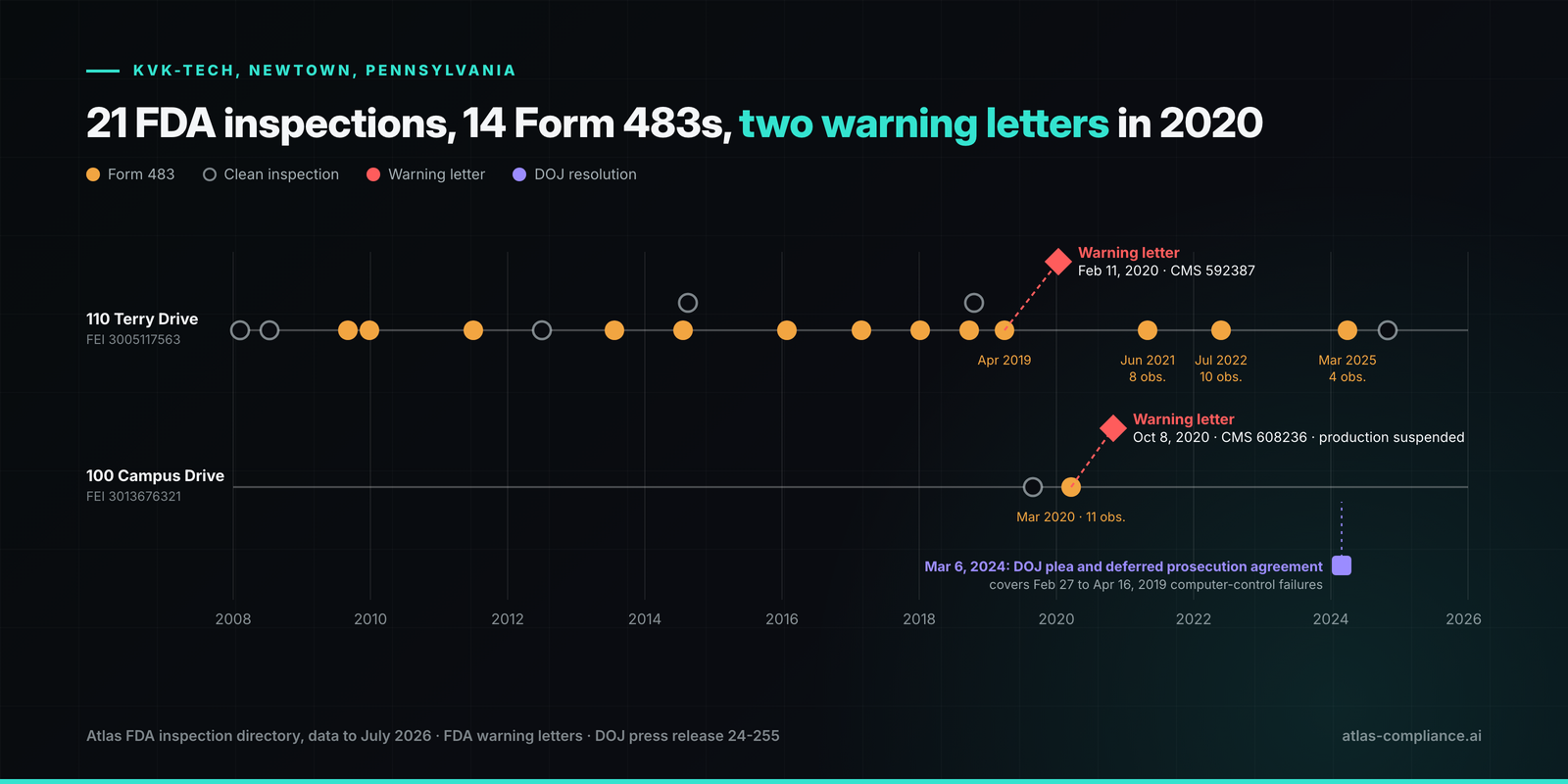
Three patterns stand out. First, 21 CFR 211.192, the investigation requirement, appears on seven of the 12 Terry Drive Form 483s that carry observation detail, from August 2009 to July 2022, and on the 2020 Campus Drive 483. It is the most cited section at the site. Across 90 recent human-drug Form 483s in the directory, 211.192 appears on 31%, so KVK-Tech is not unusual in being cited for it; it is unusual in being cited for it across 13 years.
Second, the test-method section behind the February 2020 letter, 211.165(e), was first cited in August 2009 and came back in March 2025. Third, cleaning under 211.67 appears in 2009, 2011, 2013, 2016, 2020, 2021, 2022 and 2025.
The investigators repeat too. Gayle S Lawson was on five inspections at Terry Drive, including the Form 483s of 2013, 2014, 2016 and January 2018; her profile lists 148 inspections and 373 Form 483 observations. Michele Gottshall was on both the March 2020 Campus Drive inspection that produced the October letter and the June 2021 Terry Drive inspection. When the same investigator returns, they arrive knowing what the last response promised; our piece on how warning letters affect later inspection outcomes covers what that follow-up usually looks for.
 Atlas
See what the FDA knows about your next investigator.
30 minutes with the founder. No pitch deck.
What the two letters have in common
They cite different regulations, but FDA objected to the same things in both.
First, the response was the problem. Both letters say FDA reviewed the Form 483 response and found it inadequate. At Terry Drive the response called the impurity issue "low impact" because the failing batches "were ultimately recalled from the market, albeit at a potentially later time," and did not explain why the 2016 training had failed. At Campus Drive the response fixed the gauges and retrained staff but did not check how far inaccurate recording had spread. In both cases FDA asked for scope: every method, every batch record, every similar event within expiry.
Second, records did not match reality. An impurity result that would have failed, a gauge reading that was not the gauge reading, a sample logged in after it was tested. That is why both letters ask for independent assessments rather than corrected SOPs.
Third, an unfinished CAPA counted against the firm. CAPA 18-072 had promised to fix stand-alone lab equipment before the April 2019 inspection. FDA treated the missed commitment as evidence, and the October letter treated the February letter the same way.
What happened after 2020
The warning letters did not end the Form 483s. FDA returned to Terry Drive in May and June 2021 and issued an 8-observation Form 483 citing 211.192 again, along with laboratory controls, quality unit approval, training and cleaning procedures.
The July 2022 Form 483 carried 10 observations, issued by Jose M Cayuela, Saleem A Akhtar and Monika Borkowska. It cites 211.192 on a fourth consecutive KVK-Tech Form 483, counting Campus Drive, plus 211.68(b), computer control of master records, the same section as the February 2020 letter's data integrity violation. Ten observations would put it among the 5% of 2025 Form 483s with 10 or more in our sample of 960, where the median is three.
March 2024 brought the DOJ plea and deferred prosecution agreement described above, which runs for three years with an independent monitor.
The October 2024 inspection at Terry Drive ended clean, the first clean result at the facility since 2018. Five months later, in March 2025, a team led by Sean R Marcsisin issued a 4-observation Form 483 citing 211.165(e) test methods, 211.67(a) equipment cleaning, 211.63 equipment design and 211.186(b)(9) master production records. Four observations is close to the 2025 human-drug average of 3.7. It is still the first section of the February 2020 letter, cited again five years later. The directory shows no inspection at either site after March 2025, and no warning letter tied to either site after October 2020.
For the full list of every KVK-Tech 483 with investigators and sections, the FDA 483 database has each one as its own page.
Lessons for generic manufacturers
Close the CAPA you already opened. KVK-Tech's 2016 deviation report and CAPA 18-072 both identified the problem FDA later cited. An open CAPA past its due date is the easiest finding an investigator will ever write.
Treat integration parameters as a specification. If analysts can choose how to split co-eluting peaks, the impurity result is a choice. Lock the parameters in the method, review them in the audit trail, and check peak resolution across every HPLC method, not just the product that failed.
Validate cleaning by surface, not by similarity. "It is like the counter at our other site" did not survive the letter. Swab the worst-case locations on the equipment you actually use.
Record the reading the instrument shows. A batch record that states a conforming value when the gauge disagrees is a data integrity finding, whatever the reason the mechanic changed the setting.
Read your own 483 history before FDA does. KVK-Tech's record shows the same sections returning for 13 years. A quality team that charts its own citations by section, and checks which investigators have been on site before, knows what the next inspection will test.
AtlasFDA Inspection Intelligence Digest
We track every 483, EIR, and warning letter the moment it happens. Get the signals before they hit the FDA website.
Frequently asked questions
KVK-Tech received two in 2020. The February 11 letter cited the Terry Drive facility for impurity test methods that hid an out-of-specification phentermine result, a released methylphenidate lot with unexplained particles, and lab data that could be altered without an audit trail. The October 8 letter cited the Campus Drive facility for unvalidated cleaning of packaging equipment and batch records that did not match the equipment readings.

Written by
Bhavish Agarwal
Founder, Atlas
Bhavish Agarwal is the founder of Atlas and previously worked at Google and Microsoft. He has spent the past several years building regulatory data infrastructure for the pharmaceutical industry.