
USP 61 is the United States Pharmacopeia chapter that counts the bacteria, yeasts and molds in a non-sterile product, and USP 62 is the companion chapter that checks whether named objectionable organisms such as E. coli or Staphylococcus aureus are present. USP 1111 sets the limits both results are judged against.
This guide adds how often FDA investigators cited non-sterile microbiology on Form 483s, from the Atlas Form 483 citation dataset (774 drug inspections citing 21 CFR Part 211 that closed January 7, 2025 to September 3, 2026, pulled October 2026), joined to FDA's inspection classifications.
Key facts:
- USP 61 reports two numbers: the total aerobic microbial count (TAMC) and the total combined yeasts and molds count (TYMC), in CFU per gram or milliliter.
- USP 62 is a presence or absence test; which organisms a product must be free of depends on its route of administration in USP 1111.
- 60 of 774 Part 211 drug inspections (7.8%) cited at least one of the three non-sterile microbiology sections: 211.113(a) at 31, 211.165(b) at 27 and 211.84(d)(6) at 4.
- 40.0% of those 60 inspections ended Official Action Indicated (OAI), against 26.3% of the other 714 Part 211 drug inspections.
- 50 of the 60 inspections were at US facilities.
What is USP 61?
USP 61, "Microbiological Examination of Nonsterile Products: Microbial Enumeration Tests", is the compendial method for counting viable aerobic microorganisms in a non-sterile drug product or ingredient. USP 61 gives two results: the TAMC, read on soybean-casein digest agar, and the TYMC, read on Sabouraud dextrose agar.
The chapter allows three counting methods: membrane filtration, plate count (pour plate or surface spread) and, for low-count products where plating does not work, the most probable number (MPN) method. The usual incubation is 30 to 35 °C for 3 to 5 days for the TAMC and 20 to 25 °C for 5 to 7 days for the TYMC.
Before a lab runs USP 61 on a product routinely, it has to show the method recovers organisms from that product. This method suitability test spikes the product with a low inoculum (not more than 100 CFU) of five reference strains: S. aureus, Pseudomonas aeruginosa, Bacillus subtilis, Candida albicans and Aspergillus brasiliensis. Recovery must fall within a factor of 2 of the control. Preservatives, antimicrobial actives and low pH all suppress recovery, so neutralization or dilution is often part of the validated method.
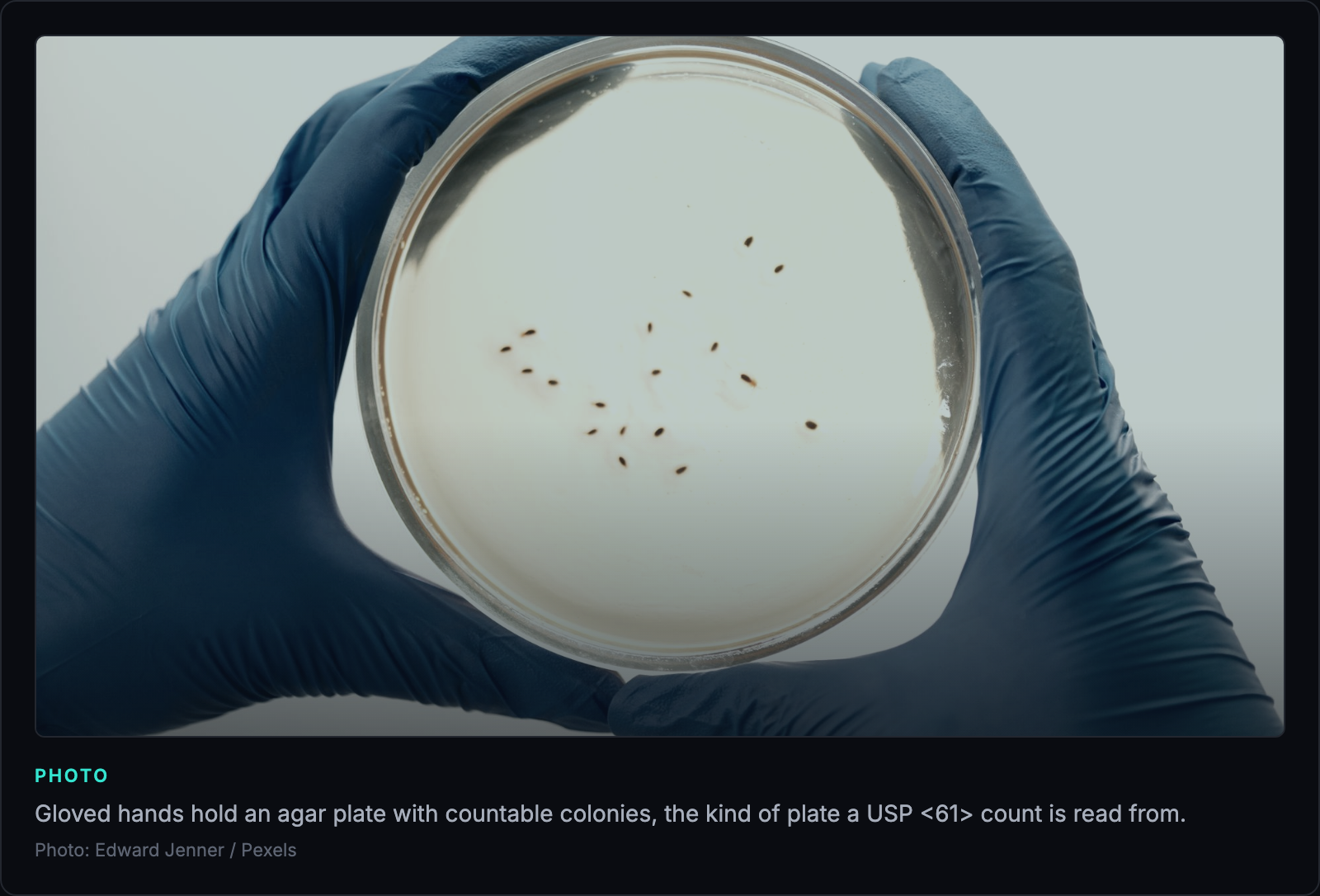
USP 61, USP 62 and USP 1111 are harmonized with the European Pharmacopoeia (2.6.12, 2.6.13 and 5.1.4) and the Japanese Pharmacopoeia, so one validated method can serve all three markets.
What is the difference between USP 61 and USP 62?
USP 61 answers "how many organisms are in this product?" and USP 62 answers "is a specific harmful organism in this product?". USP 61 is quantitative and gives a count; USP 62 is qualitative and gives absent or present for each organism tested, after enrichment and growth on selective media.
| USP 61 | USP 62 | |
|---|---|---|
| Question | How many aerobic bacteria, yeasts and molds? | Is a named organism present? |
| Result | TAMC and TYMC in CFU per g or mL | Absent or present in a stated amount (often 1 g or 1 mL; 10 g for Salmonella) |
| Organisms | All aerobic bacteria and fungi that grow on the media | E. coli, Salmonella, P. aeruginosa, S. aureus, Clostridia, C. albicans, bile-tolerant gram-negative bacteria |
| Judged against | USP 1111 count limits | USP 1111 list for the route of administration |
| Method suitability | Recovery within a factor of 2 of the control | The target organism must be detected in the presence of the product |
Most non-sterile release specifications call for both: a USP 61 count and the USP 62 organisms that USP 1111 names for the product's route.
What are the USP 1111 limits for non-sterile products?
USP 1111 sets the acceptance criteria for USP 61 and USP 62 by route of administration. An oral solid may carry up to 10³ CFU/g of aerobic bacteria and 10² CFU/g of yeasts and molds, with E. coli absent in 1 g; topical, nasal and inhalation products carry tighter count limits and a different organism list.
| Route of administration | TAMC (CFU/g or mL) | TYMC (CFU/g or mL) | Specified organisms that must be absent |
|---|---|---|---|
| Non-aqueous oral | 10³ | 10² | E. coli |
| Aqueous oral | 10² | 10¹ | E. coli |
| Rectal | 10³ | 10² | None listed |
| Oromucosal, gingival, cutaneous, nasal, auricular | 10² | 10¹ | S. aureus, P. aeruginosa |
| Vaginal | 10² | 10¹ | P. aeruginosa, S. aureus, C. albicans |
| Inhalation | 10² | 10¹ | S. aureus, P. aeruginosa, bile-tolerant gram-negative bacteria |
| Substances for pharmaceutical use | 10³ | 10² | None listed by default |
USP 1111 reads each limit as a ceiling with built-in tolerance: a criterion of 10¹ CFU allows a maximum count of 20, 10² allows 200, and 10³ allows 2,000. Check the current official text before setting a specification, because USP revises chapters on its own schedule.
How do USP 51, USP 71 and USP 788 relate to USP 61 and 62?
USP 51, USP 71 and USP 788 test different properties and are not substitutes for USP 61 and 62. USP 51 shows a preservative system works, USP 71 shows a sterile product is sterile, and USP 788 counts subvisible particles in injections. A preserved non-sterile liquid usually needs USP 51 on stability as well as USP 61 and 62 at release.
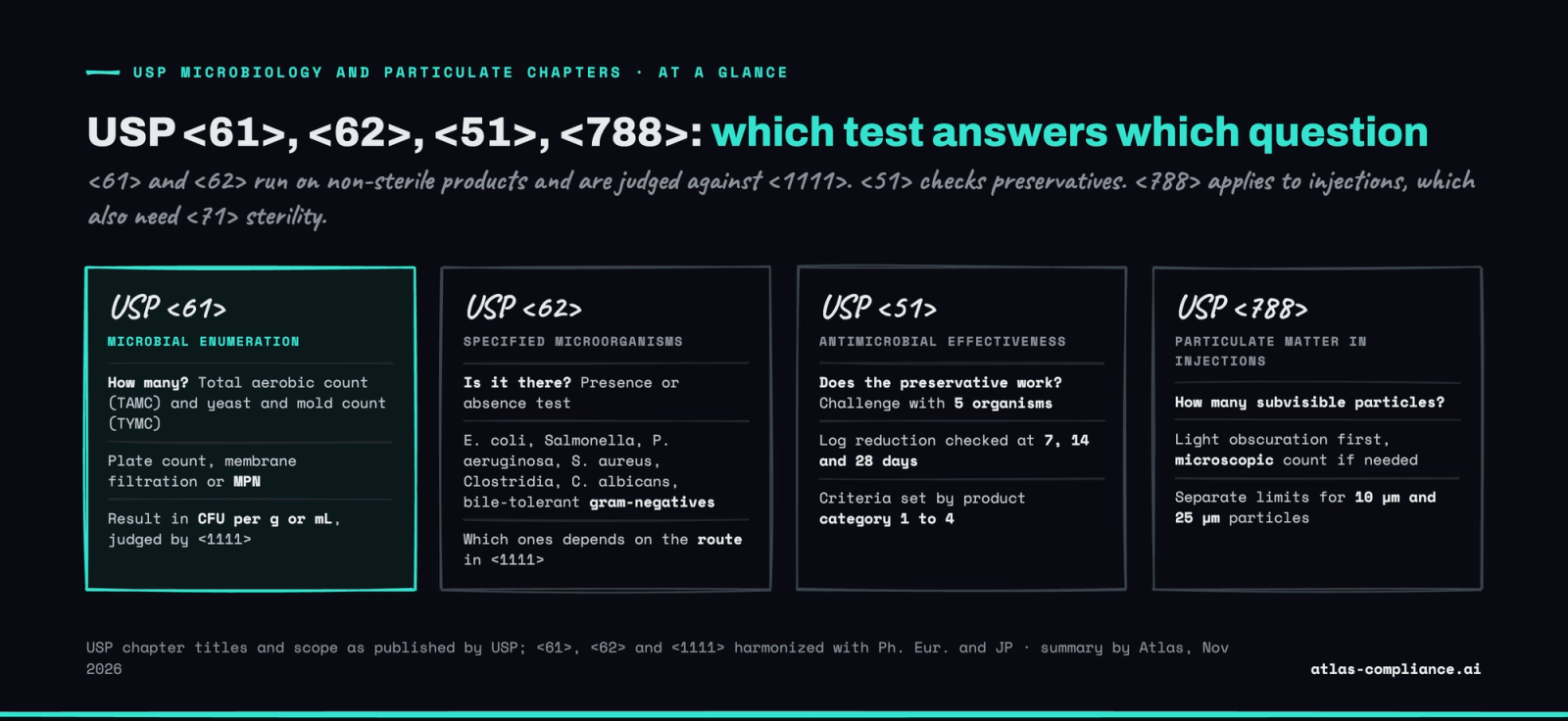
- USP 51, antimicrobial effectiveness testing. The lab inoculates the product with five organisms (S. aureus, P. aeruginosa, E. coli, C. albicans, A. brasiliensis) at 10⁵ to 10⁶ CFU per g or mL and counts survivors at 7, 14 and 28 days. Criteria depend on product category 1 to 4; for category 1 products such as injections, bacteria must drop at least 1.0 log by day 7 and 3.0 log by day 14.
- USP 71, sterility tests. Required for products labeled sterile, run in fluid thioglycollate and soybean-casein digest media for 14 days. A product subject to USP 71 is outside USP 61 and 62.
- USP 788, particulate matter in injections. Light obscuration first, with a microscopic count if the product cannot be tested that way. For large-volume injections (over 100 mL) the light obscuration limits are 25 particles per mL at 10 µm or larger and 3 per mL at 25 µm or larger; small-volume injections are limited per container, at 6,000 and 600.
How often does FDA cite microbiological testing on Form 483s?
FDA cited non-sterile microbiology at 60 of 774 drug inspections that cited Part 211 between January 2025 and September 2026 (7.8%), in the Atlas Form 483 citation dataset. FDA does not cite USP 61 or USP 62 by number on a Form 483; it cites the CGMP sections that require the testing, and the chapters are the methods firms are expected to use.
Three Part 211 sections carry these observations:
- 21 CFR 211.113(a), cited at 31 inspections. FDA's standard wording: procedures designed to prevent objectionable microorganisms in drug products not required to be sterile are not established, written and followed. The eCFR text of 211.113 is two sentences long.
- 21 CFR 211.165(b), cited at 27 inspections under the heading "Microbiological testing": each batch required to be free of objectionable microorganisms is not tested through appropriate laboratory testing.
- 21 CFR 211.84(d)(6), cited at 4 inspections: a component lot liable to objectionable microbiological contamination was not given microbiological tests before use.
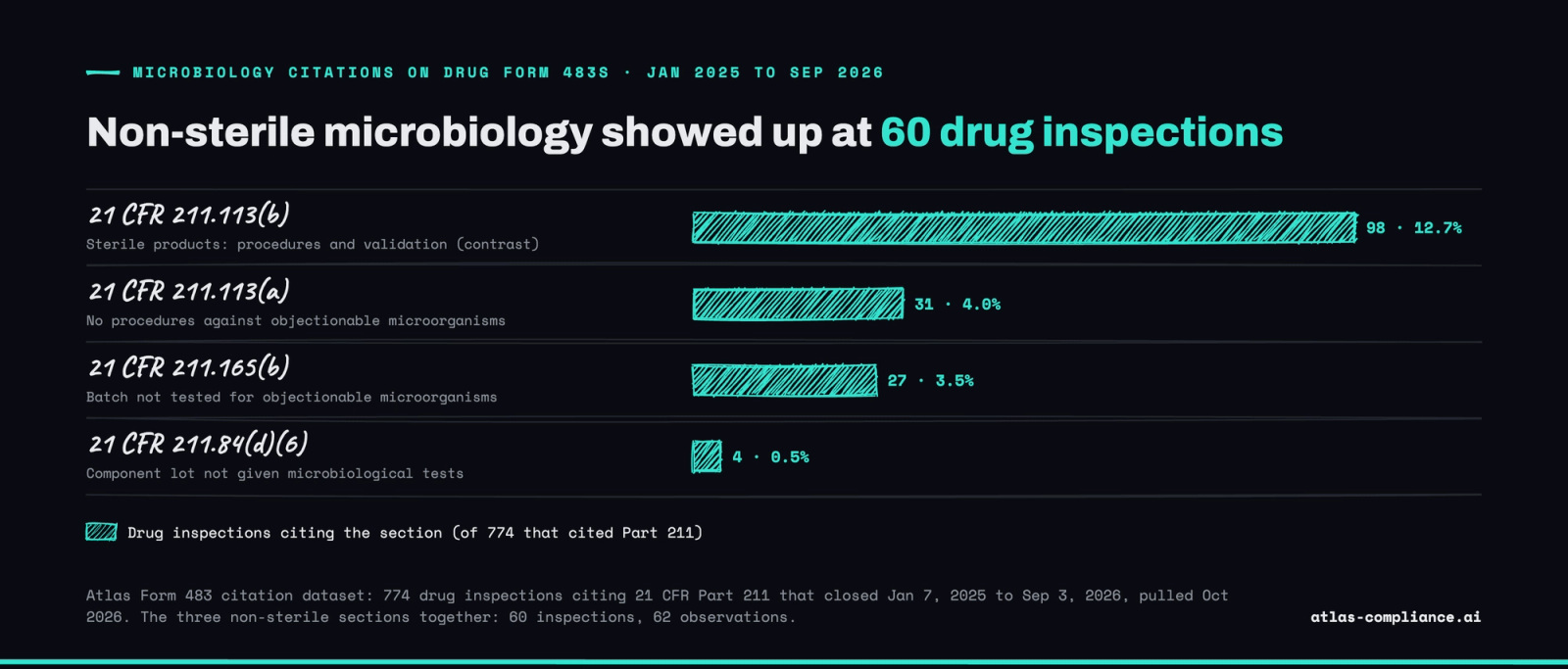
Sterile manufacturing draws more attention: 211.113(b), the sterile counterpart, appeared at 98 inspections, and 54.1% of those ended OAI. The non-sterile share fell from 8.2% of Part 211 drug inspections in 2025 (46 of 562) to 6.6% in January to September 2026 (14 of 212).
Named examples from the FDA Form 483 database:
| Facility | Form 483 date | Microbiology citation | Other sections on the form | Classification |
|---|---|---|---|---|
| Fareva Morton Grove, Morton Grove, IL | Aug 12, 2025 | 211.113(a) and 211.165(b) | 211.166(a)(3), 211.194(a)(4), 211.63, 211.67(c), 211.182 | OAI |
| Eurofins Lancaster Laboratories, Lancaster, PA | Aug 26, 2025 | 211.165(b) | 211.192 | VAI |
| Catalent Greenville, Greenville, NC | Oct 24, 2025 | 211.165(b) | 211.166(a), 211.67(a) | VAI |
| Microbiological Testing & Consulting, Alsip, IL | Sep 16, 2025 | 211.165(b) | OAI | |
| Libby Laboratories, Berkeley, CA | Mar 14, 2025 | 211.165(b) | OAI |
Two of the five are contract testing laboratories, which run USP 61 and 62 for other firms. The Fareva Morton Grove form was written by investigators Jacob G Lutz and Anna M Spiros, and paired the missing microbial controls with a stability method citation and a laboratory data citation. For how a contract lab's microbiology data became a warning letter, see the Eurofins warning letter breakdown.
What does a microbiology citation signal about the rest of the inspection?
A non-sterile microbiology citation tends to arrive with a heavier inspection. In the Atlas data, the 60 inspections that cited 211.113(a), 211.165(b) or 211.84(d)(6) averaged 5.7 observations, against 4.0 for other Part 211 drug inspections, and 40.0% ended OAI, against 26.3%.
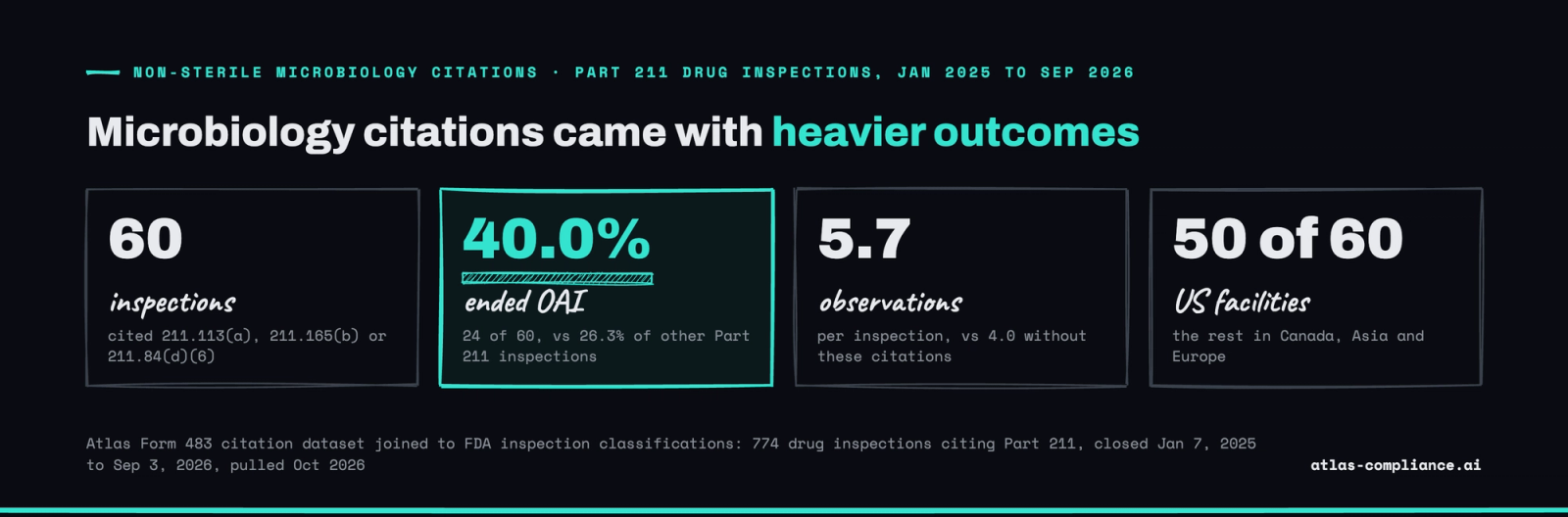
The sections FDA cited alongside them point to the quality system rather than the lab alone: 211.22, the quality unit section, appeared at 27 of the 60 inspections (45.0%), 211.192 production record review and investigations at 24 (40.0%), 211.100 written procedures at 22 (36.7%) and 211.166 stability testing at 19 (31.7%). An out-of-limit count that nobody investigated becomes a 211.192 citation as well as a testing one; the OOS guide covers how that investigation should run.
If your next inspection is with an investigator who has written microbiology observations before, their past forms show what they look for first.
 Atlas
See what the FDA knows about your next investigator.
30 minutes with the founder. No pitch deck.
Where do USP 61 and 62 sit in a non-sterile batch?
USP 61 and 62 sit at the end of a chain that starts with raw materials. FDA expects microbiological control at six checkpoints, from component testing under 211.84(d)(6) to release under 211.165(b), and a citation at any one of them can follow from a gap upstream.
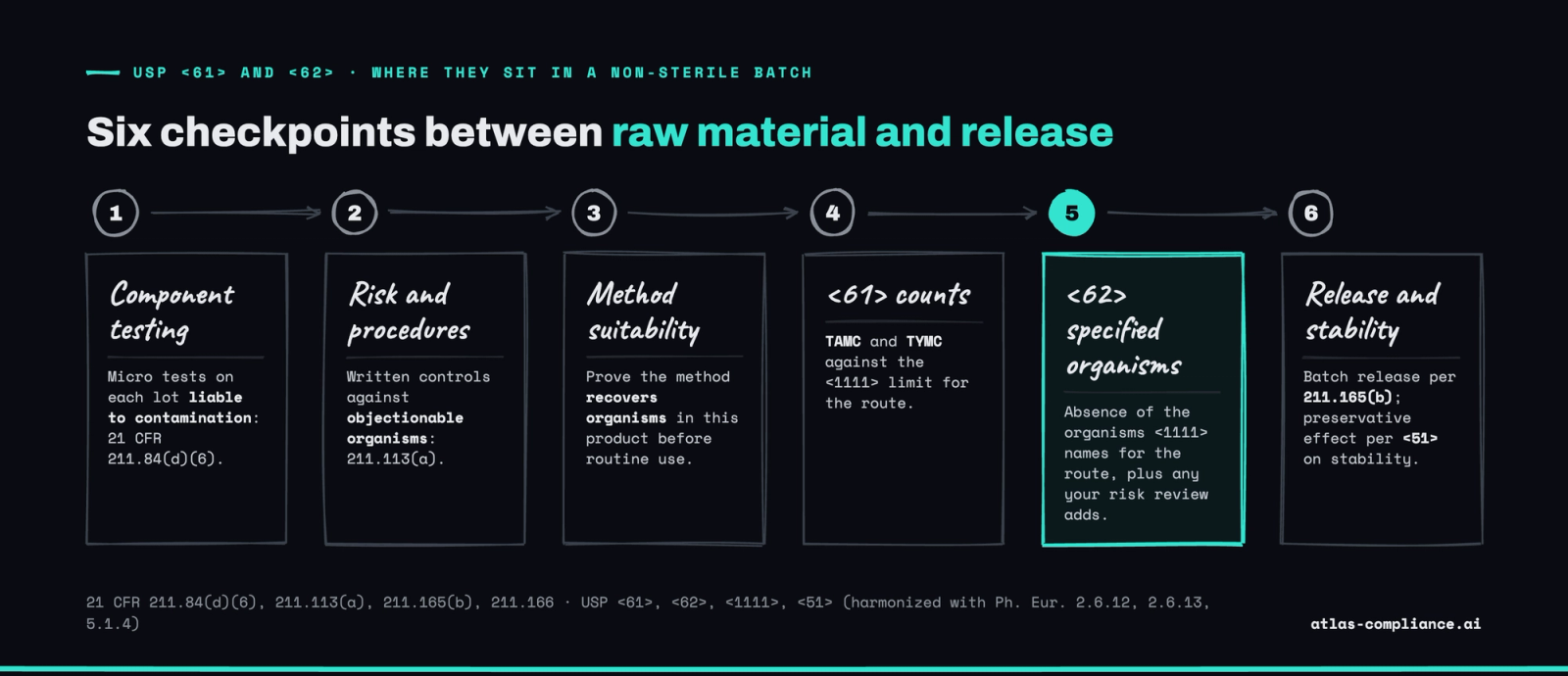
- Test each component lot that can carry objectionable contamination, typically water-sensitive or natural-origin materials, before use.
- Write the procedures 211.113(a) asks for: the risk assessment for the product and route, water system control, hold times and cleaning.
- Validate USP 61 and 62 for each product with method suitability, and repeat it when the formulation changes.
- Run the USP 61 counts at release and compare them with the USP 1111 limits in the specification.
- Run the USP 62 tests for the organisms USP 1111 names for the route, plus any others the risk assessment adds.
- Release the batch only on passing results, and confirm the preservative with USP 51 on stability.
The same chain applies to every product in the 21 CFR Part 211 guide; microbiology is where Subparts E, F and I meet.
Does passing USP 62 mean a product is free of objectionable microorganisms?
Passing USP 62 does not by itself meet 21 CFR 211.113(a). USP 62 covers a fixed list of organisms, while FDA treats "objectionable" as product-specific: an organism is objectionable if it can harm the patient or degrade the product, given the route, the patient population and the formulation.
FDA set out this position in its guidance "Microbiological Quality Considerations in Non-sterile Drug Manufacturing" (final, September 2021). The guidance asks manufacturers to assess risk from water, raw materials and the facility, and names Burkholderia cepacia complex as a recurring problem in aqueous non-sterile products. USP added a separate chapter, USP 60, with a test for Burkholderia cepacia complex, official since December 2019.
In practice, the specification for an aqueous oral liquid or a topical made with purified water often lists more organisms than USP 1111 does, and the 211.113(a) procedure explains why. FDA's standard wording for 211.113(a) cites procedures that are "not established, written and followed", so the finding concerns the risk assessment and procedures behind the tests.
Atlas tracks new Form 483s and warning letters as FDA releases them, including the microbiology citations covered here.
AtlasFDA Inspection Intelligence Digest
We track every 483, EIR, and warning letter the moment it happens. Get the signals before they hit the FDA website.
Frequently asked questions
USP 61 testing takes about 5 to 7 days from plating to result, set by the incubation times: 3 to 5 days for the total aerobic count and 5 to 7 days for yeasts and molds. USP 62 adds enrichment and selective media steps, so combined USP 61 and 62 results for one batch usually take around a week, longer if an organism needs confirmation.

Written by
Bhavish Agarwal
Founder, Atlas
Bhavish Agarwal is the founder of Atlas and previously worked at Google and Microsoft. He has spent the past several years building regulatory data infrastructure for the pharmaceutical industry.