
21 CFR Part 211 is the FDA regulation that sets the minimum current good manufacturing practice (CGMP) for finished drug products for humans or animals. Its 11 subparts and 60 sections cover the quality unit, buildings, equipment, components, production, packaging, holding, laboratory controls, records and returned product.
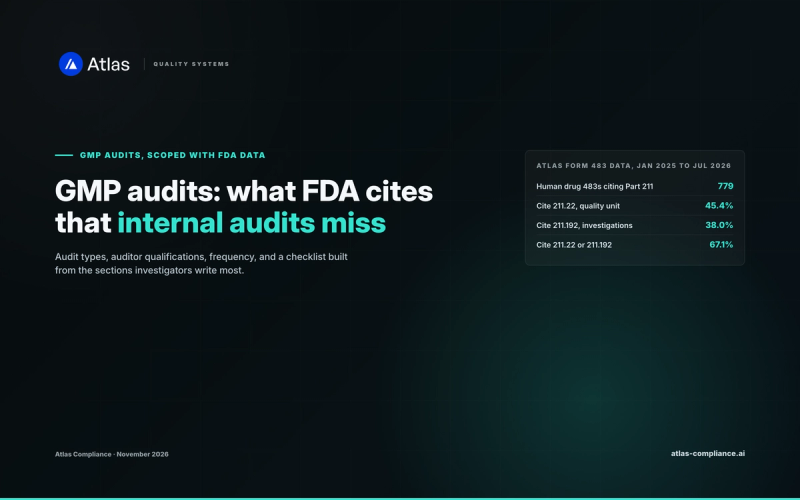
Most summaries of Part 211 list the subparts and stop. This one adds how often FDA investigators cited each subpart on 779 human drug Form 483s issued from January 2025 to July 2026, taken from the Atlas Form 483 directory (release of August 15, 2026, pulled November 6, 2026).
Key facts:
- 21 CFR Part 211 has 11 subparts (A to K) and 60 sections in the eCFR as of November 2026; its current structure dates from a final rule published September 29, 1978.
- 779 of the 1,078 human drug Form 483s in the Atlas window (72.3%) cite at least one Part 211 section.
- Subpart J, records and reports, appears on 437 of those 779 forms (56.1%), more than any other subpart.
- 21 CFR 211.22, quality control unit responsibilities, is the single most-cited section: 354 forms, or 45.4%.
- Investigators cited 49 of the 60 sections at least once; a typical Part 211 form touches three subparts.
- 21 CFR 210.2(c) exempts phase 1 investigational drugs from Part 211 until the drug enters a phase 2 or phase 3 study or reaches the market.
What is 21 CFR Part 211?
21 CFR Part 211 is the "Current Good Manufacturing Practice for Finished Pharmaceuticals" regulation. Section 211.1(a) says it holds the minimum CGMP for preparing drug products for administration to humans or animals, excluding positron emission tomography (PET) drugs and designated medical gases. A drug made outside these rules is adulterated under section 501(a)(2)(B) of the FD&C Act, even if it passes its specification.
The scope is wide. Part 211 covers prescription and over-the-counter drugs, generics, sterile injectables and repackagers. Biologics that are also drugs follow Parts 600 to 680 on top of Part 211, and section 211.1(b) says the more specific rule wins if the two conflict. Under 21 CFR 210.2(b), a firm that runs only some operations, such as a contract testing laboratory, only has to meet the sections that apply to those operations.
Part 211 does not cover active pharmaceutical ingredients directly. FDA applies CGMP to APIs through the statute and treats ICH Q7 as its current thinking; our post on API manufacturer 483s shows what investigators cite at those facilities. For the wider CGMP picture, see the FDA CGMP overview. The full text sits in the eCFR, Part 211.
What are the 11 subparts of 21 CFR Part 211?
The 11 subparts of 21 CFR Part 211 run from general provisions (Subpart A) to returned and salvaged drug products (Subpart K). The table lists each subpart's section range, what it governs, the share of 779 human drug Form 483s that cite it, and the section investigators cite most within it.
| Subpart | Sections | What it governs | Share of 779 Part 211 483s | Most-cited section |
|---|---|---|---|---|
| A, General provisions | 211.1 to 211.3 | Scope and definitions | 0% | none cited |
| B, Organization and personnel | 211.22 to 211.34 | Quality unit, training, hygiene, consultants | 49.9% | 211.22 (354 forms) |
| C, Buildings and facilities | 211.42 to 211.58 | Design, air handling, water, sanitation, maintenance | 21.6% | 211.42 (118) |
| D, Equipment | 211.63 to 211.72 | Design, cleaning, computerized systems, filters | 50.4% | 211.67 (244) |
| E, Components, containers and closures | 211.80 to 211.94 | Receipt, quarantine, testing, supplier C of A | 24.8% | 211.84 (169) |
| F, Production and process controls | 211.100 to 211.115 | Written procedures, in-process testing, contamination control | 47.8% | 211.100 (224) |
| G, Packaging and labeling control | 211.122 to 211.137 | Label issuance, line operations, expiration dating | 4.5% | 211.122 (14) |
| H, Holding and distribution | 211.142 to 211.150 | Warehousing and distribution procedures | 5.0% | 211.142 (39) |
| I, Laboratory controls | 211.160 to 211.176 | Specifications, release testing, stability, reserve samples | 47.5% | 211.160 (216) |
| J, Records and reports | 211.180 to 211.198 | Batch and lab records, record review, complaints | 56.1% | 211.192 (296) |
| K, Returned and salvaged products | 211.204 to 211.208 | Returned drugs and salvaging | 0.3% | 211.204 (2) |
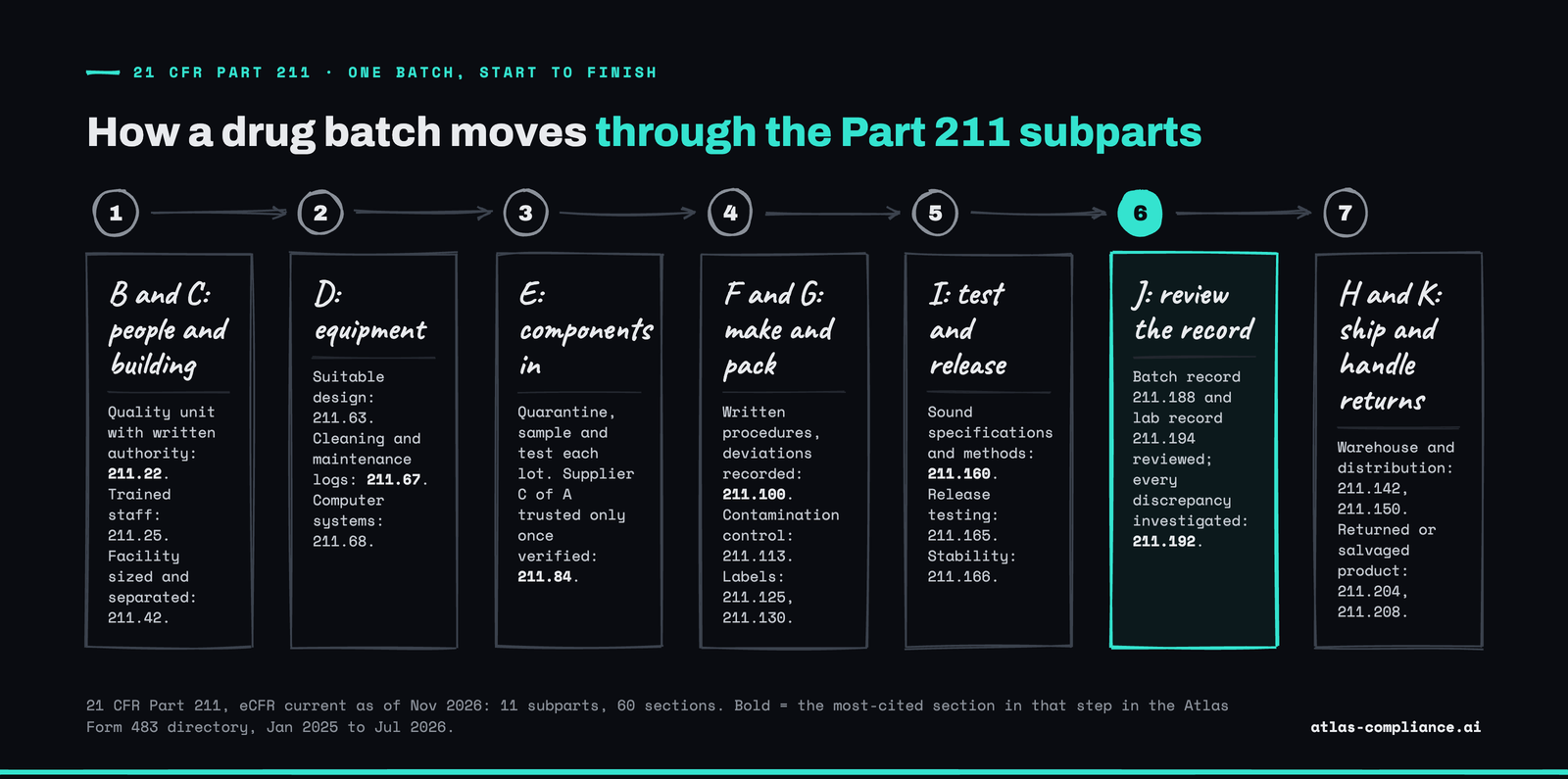
The subparts follow a batch from start to finish. The figure below walks one batch through them, with the most-cited section at each step in bold.
Which Part 211 subparts does FDA cite most often?
FDA cites Subpart J, records and reports, most often: 56.1% of 779 human drug Form 483s citing Part 211 from January 2025 to July 2026 in the Atlas Form 483 directory. Four more subparts sit near half: equipment (50.4%), organization and personnel (49.9%), production (47.8%) and laboratory controls (47.5%).
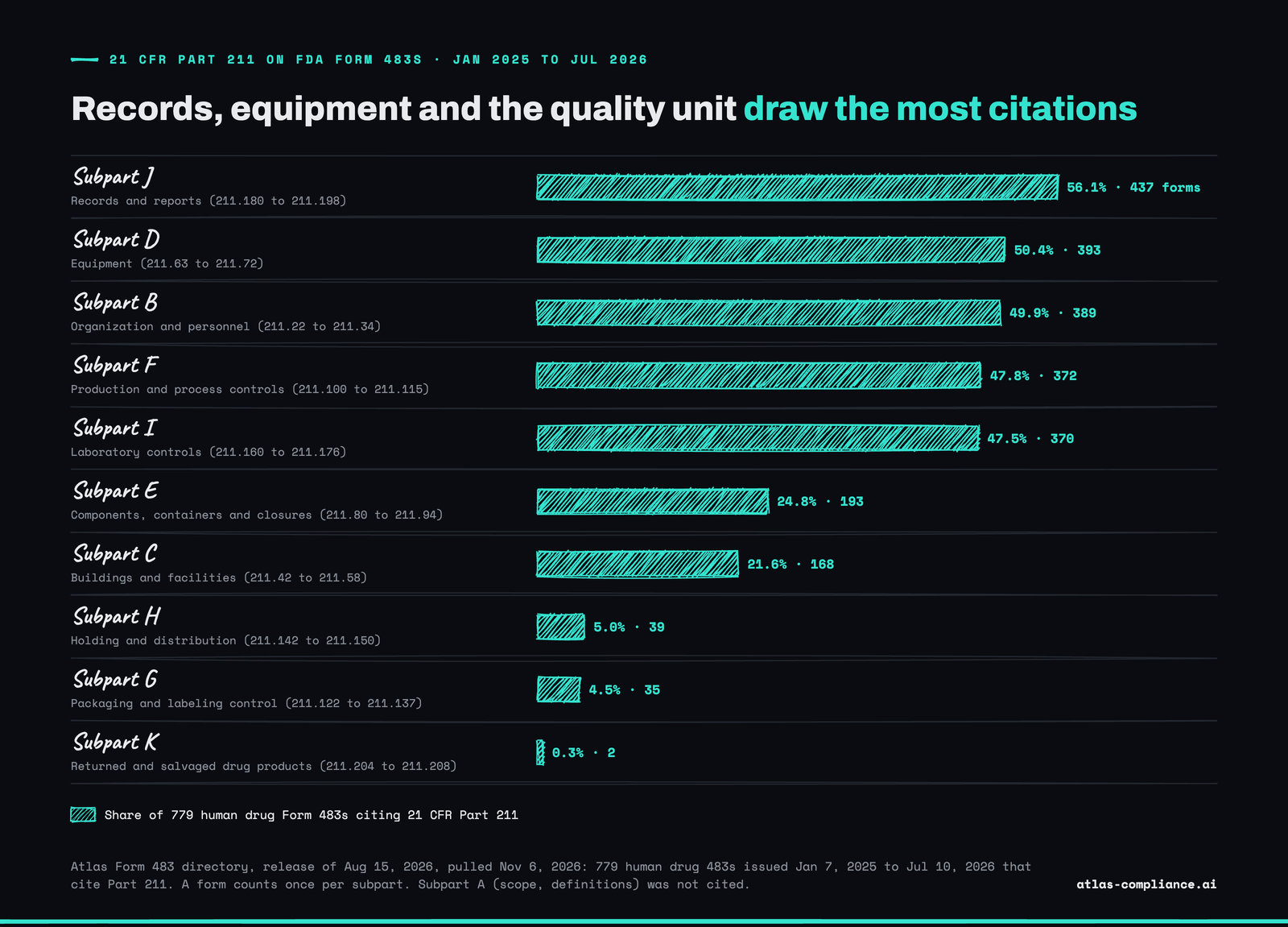
The bottom of the chart is close to empty. Packaging and labeling (4.5%), holding and distribution (5.0%) and returned products (0.3%) together account for fewer forms than equipment cleaning alone. Eleven sections drew no citation at all in the window, among them 211.34 (consultants), 211.72 (filters), 211.132 (tamper-evident packaging) and 211.208 (salvaging).
The mix shifted between years. Buildings and facilities rose from 19.4% of Part 211 forms in 2025 (578 forms) to 27.9% in January to July 2026 (201 forms). Laboratory controls fell from 50.0% to 40.3% over the same split.
Foreign and US facilities draw different subparts. Foreign facilities drew equipment findings on 57.1% of their 168 Part 211 forms, against 48.6% for 611 US forms, and production findings on 54.8% against 45.8%. US facilities drew Subpart B more often, 52.2% against 41.7%.
The forms behind these numbers are searchable in the FDA Form 483 directory, by company, facility or investigator. Investigators differ in what they cite. All six human drug 483s in the window that name investigator Crystal Monroy cite 211.192, so the investigator assigned to your facility tells you where to look first.
 Atlas
See what the FDA knows about your next investigator.
30 minutes with the founder. No pitch deck.
What do investigators write under each Part 211 subpart?
Investigators write most Part 211 observations against a handful of sections in each subpart. The notes below give the leading sections and the wording FDA uses, from the same 779 forms.
Subpart B: the quality unit
21 CFR 211.22 appeared on 354 forms. Paragraph (d), which FDA titles "Procedures not in writing, fully followed", carried most of them. 211.25, personnel qualifications and training, followed with 71 forms. Our GMP audits guide turns the 211.22 findings into internal audit tests.
Subparts C and D: buildings and equipment
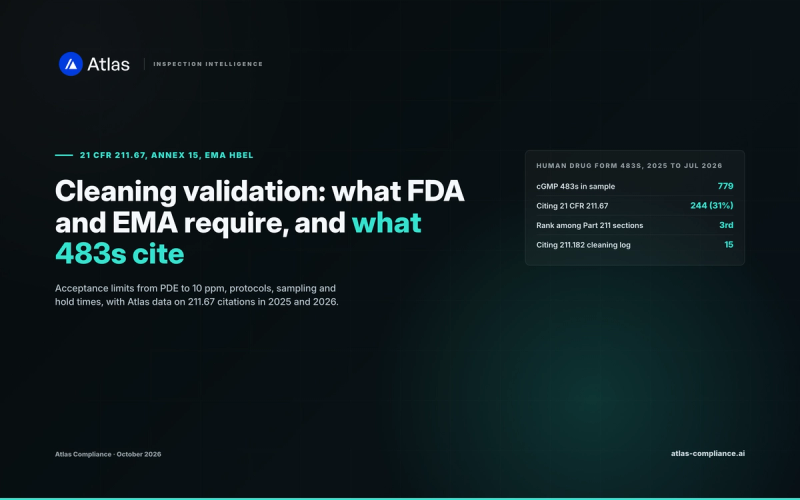
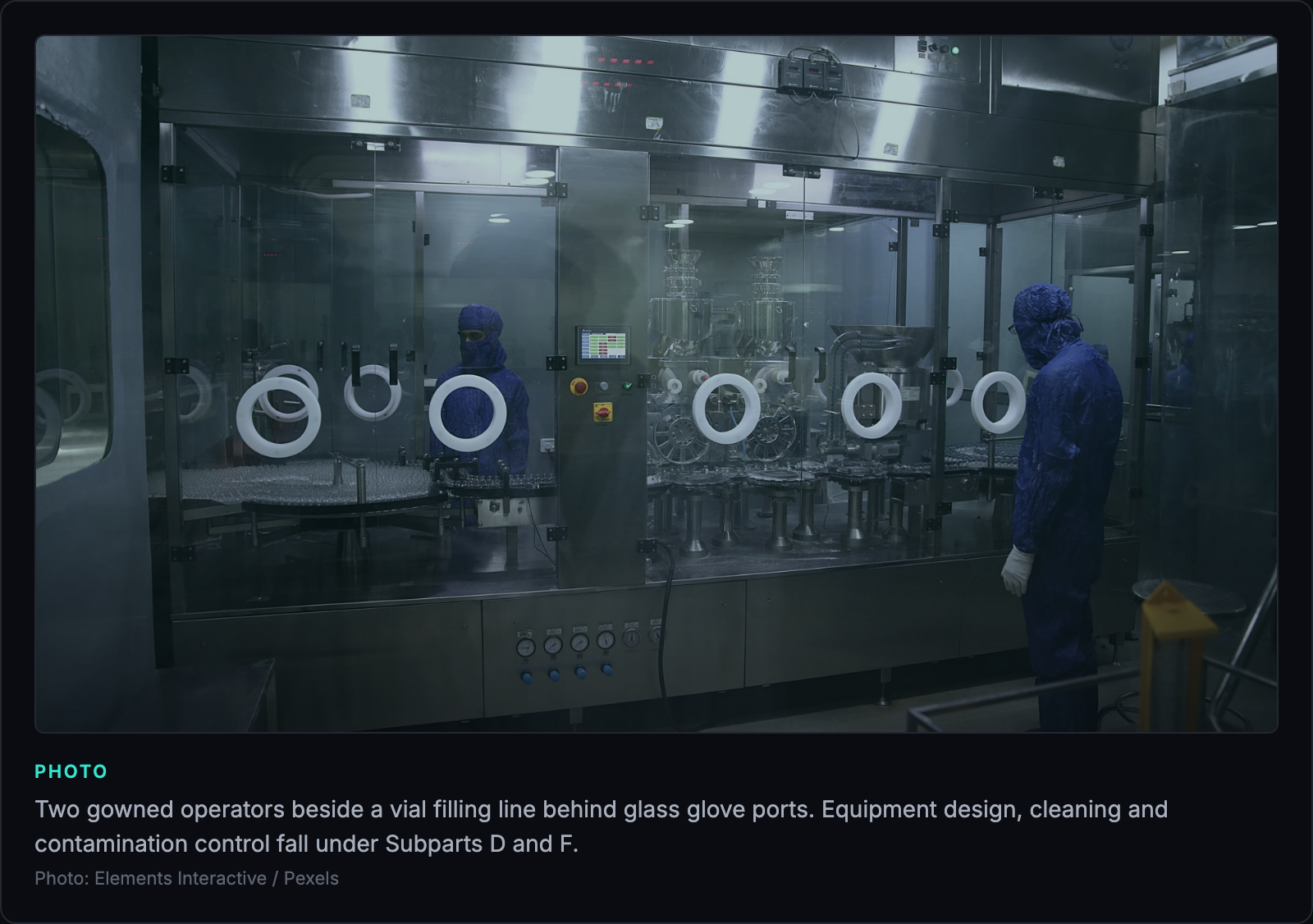
211.67, equipment cleaning and maintenance, appeared on 244 forms, the third most-cited section in Part 211. 211.68, computerized and automatic equipment, followed with 166, usually as "Computer control of master formula records". In Subpart C, 211.42 led with 118 forms; Chartwell's Congers facility drew a 211.42(d) observation titled "Penicillin processing area not kept separate". The cleaning validation guide covers what FDA expects behind 211.67.
Subparts E and F: components and production
211.84, testing of components and reliance on a supplier's certificate of analysis, appeared on 169 forms. In Subpart F, 211.100 (written procedures and deviations) appeared on 224 forms and 211.113 (microbiological contamination control) on 158. Gasco Industrial's Gurabo facility drew both 211.100(a) and 211.113(a) on its February 27, 2026 Form 483, among 13 observations.
Subparts G and H: packaging, holding and distribution
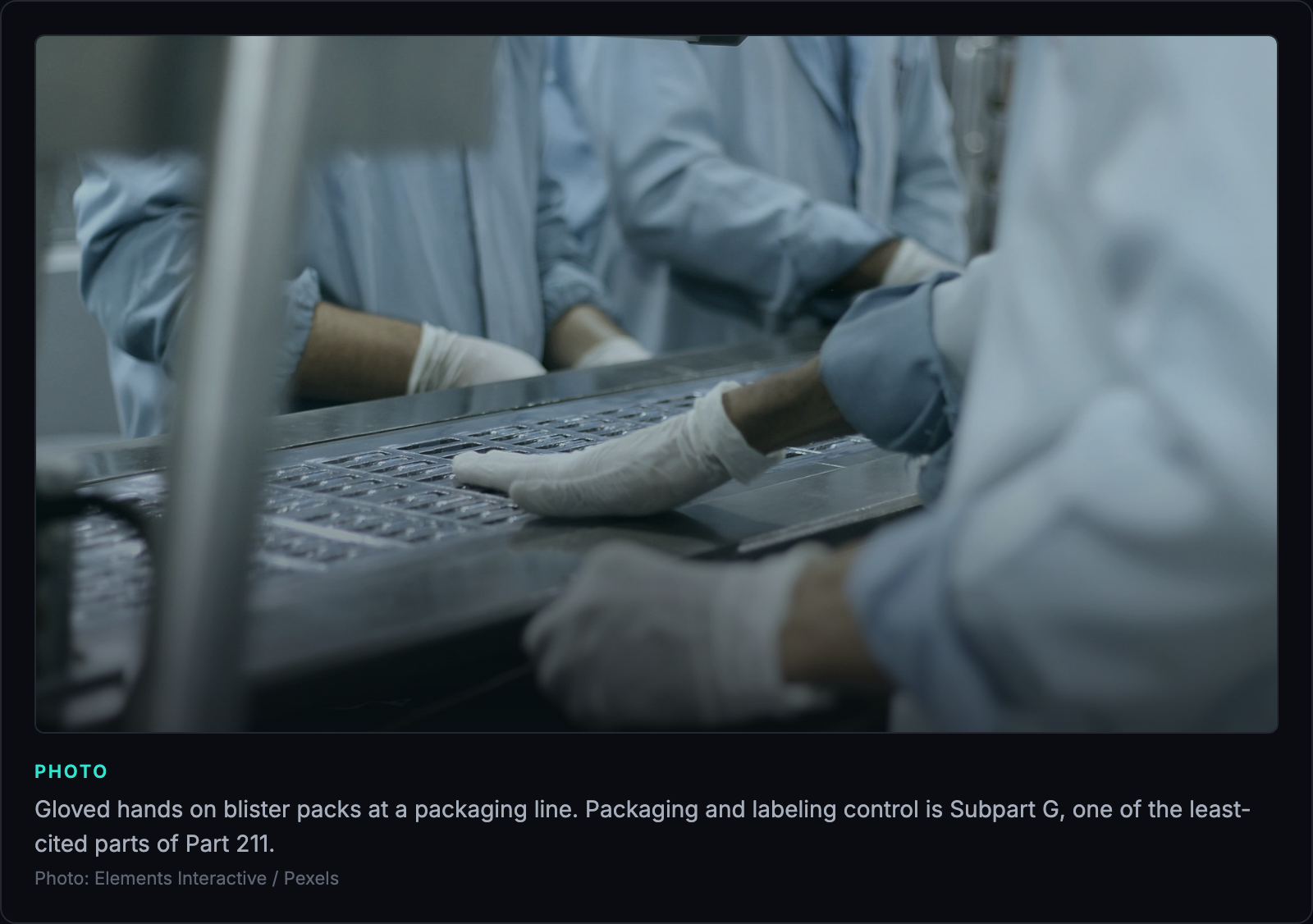
Packaging and labeling findings appeared on 35 forms. 211.122, materials examination and usage criteria, led with 14. Holding and distribution findings appeared on 39 forms, all of them under 211.142, warehousing procedures; one form added 211.150.
Subpart I: the laboratory
211.160, scientifically sound laboratory controls, appeared on 216 forms. 211.166, the written stability program, followed with 141 and 211.165, release testing, with 115. Out-of-specification handling sits between Subparts I and J; our OOS guide walks through it.
Subpart J: records and investigations
211.192 appeared on 296 forms. The eCFR titles the section "Production record review", but FDA's observation title is "Investigations of discrepancies, failures": the quality unit must review the batch record and investigate every unexplained discrepancy, including other batches that may be affected. 211.194, laboratory records, followed with 90 forms. A separate post on 211.192 covers the investigation findings in detail.
Subpart K: returned product
Only two forms cited Subpart K, both under 211.204. One belongs to Chartwell Pharmaceuticals in Congers, New York, below.
What does a Form 483 that spans Part 211 look like?
A Form 483 that spans Part 211 lists one observation per failing requirement, often across several subparts. The Chartwell Pharmaceuticals Congers Form 483 of November 18, 2025 carries 15 observations across 8 of the 11 subparts. Investigators on the form include Lata C Mathew.
| Subpart | Sections cited | FDA observation titles |
|---|---|---|
| B | 211.22(d), 211.28(b) | Procedures not in writing, fully followed; Habits of good sanitation and health |
| C | 211.42(d) | Penicillin processing area not kept separate |
| D | 211.67(b), 211.68(b) | Written procedures not established/followed; Computer control of master formula records |
| E | 211.84(d)(2) | Reports of analysis (components) |
| F | 211.100(a), 211.101(b) | Changes to procedures not reviewed, approved; Identification of new containers |
| I | 211.160(a), 211.160(b)(2), 211.166(a) | Following/documenting laboratory controls; In-process sample representation; Written program not followed |
| J | 211.180(e)(1), 211.188, 211.192 | Review of representative number of batches; Batch record complete information; Investigations of discrepancies, failures |
| K | 211.204 | Returned drug procedures in writing and followed |
Other recent forms with wide Part 211 coverage include K.C. Pharmaceuticals in Pomona (13 observations, February 13, 2026) and Silgan Unicep Packaging in Spokane (8 observations, April 2, 2026). For how to read any of them, see what an FDA Form 483 is.
What is the difference between 21 CFR 210 and 211?
21 CFR Part 210 states the status and reach of the drug CGMP rules; 21 CFR Part 211 holds the requirements. Part 210 has three sections: status (210.1), applicability (210.2) and definitions (210.3). Part 211 has 60. No human drug Form 483 in the Atlas window cited Part 210, while 779 cited Part 211.
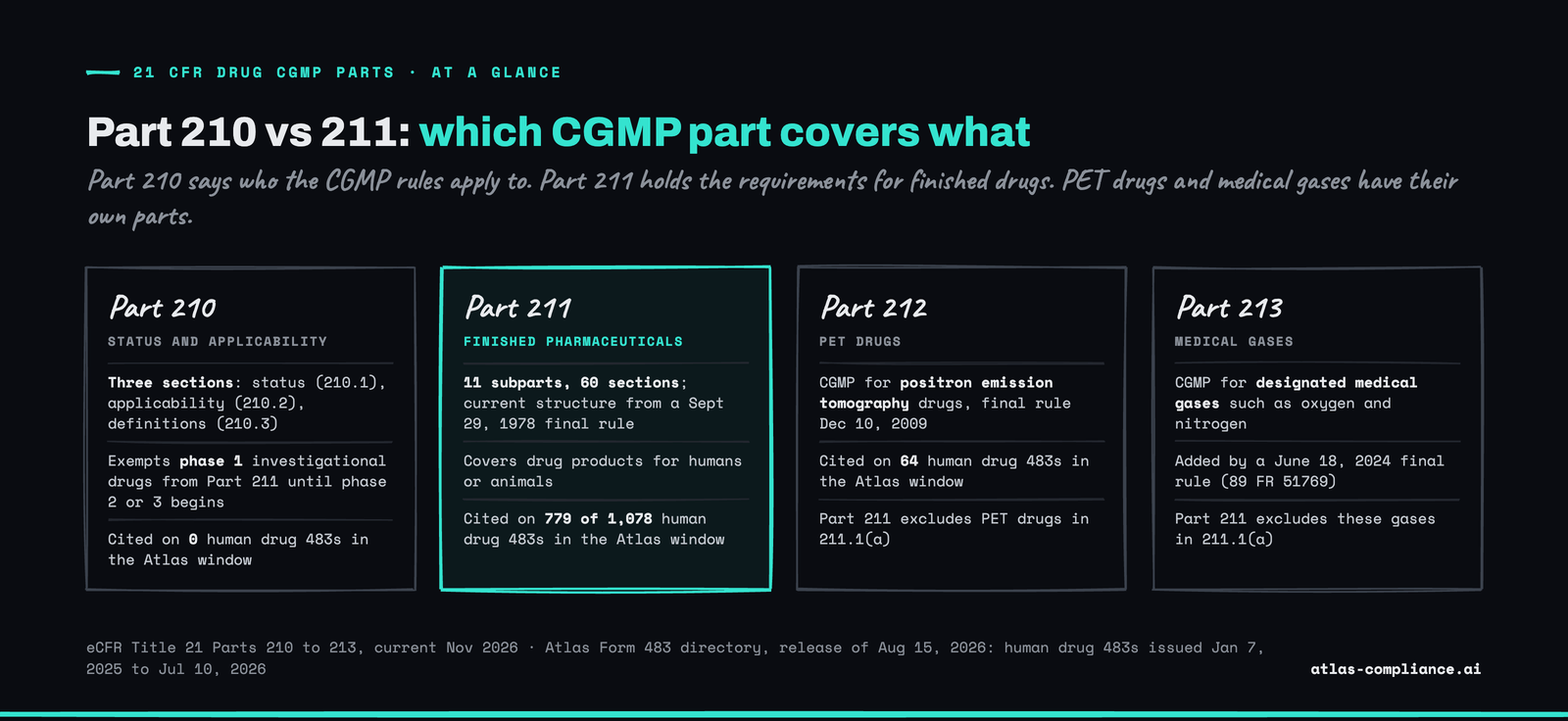
Two other parts sit beside them. Part 212 covers PET drugs and appeared on 64 human drug Form 483s in the window. Part 213 covers designated medical gases, which a June 18, 2024 final rule moved out of Part 211. Definitions used throughout Part 211, such as "batch", "lot" and "quality control unit", live in 21 CFR 210.3.
How do you use Part 211 citation data in your own program?
You use Part 211 citation data by ranking your self-inspection and CAPA effort against the subparts investigators cite most, then adjusting for your facility type. A sterile injectable facility should weight 211.113 and Subpart D higher; a solid-dose facility with a large laboratory should weight Subpart I.
- Start with Subparts J and B. Pull ten closed investigations and test them against 211.192, then check five quality unit procedures against 90 days of records for 211.22(d).
- Audit 211.67 and 211.68 together. Cleaning logs, equipment use logs and computer system access are where Subpart D findings come from.
- Check 211.100 by watching an operation against its batch record, line by line.
- Read 211.160 and 211.166 findings from peers in your dosage form before your next laboratory review.
- Leave Subparts G, H and K on a lighter cycle unless your own history says otherwise.
New 483s keep moving these shares. The digest below sends the Part 211 citations that matter as FDA publishes the forms.
AtlasFDA Inspection Intelligence Digest
We track every 483, EIR, and warning letter the moment it happens. Get the signals before they hit the FDA website.
Frequently asked questions
21 CFR Part 211 is a binding regulation, not guidance. FDA issued it under the FD&C Act, and a drug made, processed, packed or held in a way that does not conform to CGMP is adulterated under section 501(a)(2)(B). FDA guidance documents explain how the agency reads Part 211, but the regulation itself carries the force of law.

Written by
Bhavish Agarwal
Founder, Atlas
Bhavish Agarwal is the founder of Atlas and previously worked at Google and Microsoft. He has spent the past several years building regulatory data infrastructure for the pharmaceutical industry.