
Cleaning validation is documented evidence that a cleaning procedure consistently removes product residues, cleaning agents and microbial contamination from product contact equipment to predefined, scientifically justified limits. In the US, the legal basis is 21 CFR 211.67 and the cleaning log rule in 211.182; in the EU, it is EU GMP Annex 15 section 10 plus the EMA guideline on health-based exposure limits.
The requirement is old. The citations are not. In the Atlas Form 483 database (release of August 15, 2026, pulled October 22, 2026), 21 CFR 211.67 appears on 244 of 779 human drug Form 483s from 2025 and January to July 2026 that cite at least one Part 211 section. That is 31%, the third most-cited cGMP section in the sample.
Key facts:
- 21 CFR 211.67 has three paragraphs: (a) clean and maintain equipment at appropriate intervals, (b) written cleaning procedures with six required elements, (c) records of cleaning and maintenance.
- FDA's 1993 "Guide to Inspections: Validation of Cleaning Processes" says FDA does not set acceptance limits; the firm's limits must be "practical, achievable, and verifiable."
- EU GMP Annex 15, in force since October 1, 2015, requires carryover limits based on a toxicological evaluation and says a visual check alone is not generally acceptable.
- The EMA guideline on health-based exposure limits came into effect on June 1, 2015 and sets the permitted daily exposure (PDE) as the basis for shared-facility risk decisions.
- Across 779 cGMP human drug Form 483s in Atlas (2025 to July 2026), 127 cite 211.67(a), 122 cite 211.67(b) and its sub-paragraphs, and 11 cite 211.67(c).
- Form 483s that cite 211.67 carry 5.6 observations on average, against 3.6 for the other cGMP 483s in the same sample.
What is cleaning validation?
Cleaning validation is the study, run under a pre-approved protocol, that proves a defined cleaning procedure brings equipment to an acceptable residue level every time it is executed. Cleaning validation answers one question for each product changeover: could the next batch receive enough of the previous product, detergent or microbes to harm a patient or fail a specification?
Three related terms get mixed up, and inspectors notice:
| Term | What it proves | When it happens |
|---|---|---|
| Cleaning validation | The procedure works, reproducibly, for worst-case product and equipment | Before routine use, after changes |
| Cleaning verification | This specific clean of this specific equipment met limits | After a single clean, by sampling and testing |
| Visual inspection | No residue is visible on the inspected surfaces | Before each use, required by 211.67(b)(6) |
Verification after every batch is acceptable while validation is in progress; Annex 15 section 10.3 names investigational medicinal products as the typical case.
What does FDA require for cleaning validation?
FDA requires cleaning validation through 21 CFR 211.67, which says equipment must be cleaned "at appropriate intervals to prevent malfunctions or contamination" and that written procedures must be "established and followed." The text of 21 CFR 211.67 lists six things the written procedure must include:
- Assignment of responsibility for cleaning and maintaining equipment.
- Cleaning and maintenance schedules, including sanitizing schedules where appropriate.
- A description of methods, equipment and materials in enough detail, including how to disassemble and reassemble equipment.
- Removal or obliteration of previous batch identification.
- Protection of clean equipment from contamination before use.
- Inspection of equipment for cleanliness immediately before use.
21 CFR 211.182 adds the record: an individual equipment log showing the date, time, product and lot number of each batch processed, with the people who performed and double-checked the cleaning dating and signing it, in chronological order. Dedicated equipment can keep these records in the batch record instead.
The regulation never says "validation." That expectation comes from FDA's 1993 Guide to Inspections: Validation of Cleaning Processes, still the reference investigators carry. The guide expects written general procedures on how cleaning processes will be validated, who performs and approves the study, and when revalidation is required, plus a specific protocol for each system. It also says repeated resampling "can show that the cleaning process is not validated."
For active pharmaceutical ingredients, ICH Q7 section 12.7 applies, and FDA has adopted it as guidance. Cleaning procedures should normally be validated, limits should be practical, achievable, verifiable and based on the most deleterious residue, and the analytical methods must be validated and sensitive enough to detect residues at the limit.
How often does FDA cite 21 CFR 211.67 on Form 483s?
FDA cites 21 CFR 211.67 on roughly one in three cGMP human drug Form 483s. We pulled every human drug Form 483 issued from January 7, 2025 to July 10, 2026 in the FDA Form 483 database (1,078 forms, Atlas release of August 15, 2026) and read the CFR sections on each observation. 779 cite at least one Part 211 section; the rest are mostly clinical investigator 483s under Part 312.
| 21 CFR section | Topic | 483s citing it | Share of 779 |
|---|---|---|---|
| 211.22 | Quality control unit | 354 | 45% |
| 211.192 | Production record review, investigations | 296 | 38% |
| 211.67 | Equipment cleaning and maintenance | 244 | 31% |
| 211.100 | Written production procedures | 224 | 29% |
| 211.160 | Laboratory controls | 216 | 28% |
| 211.84 | Component testing | 169 | 22% |
| 211.68 | Automatic and electronic equipment | 166 | 21% |
| 211.182 | Equipment cleaning and use log | 15 | 2% |
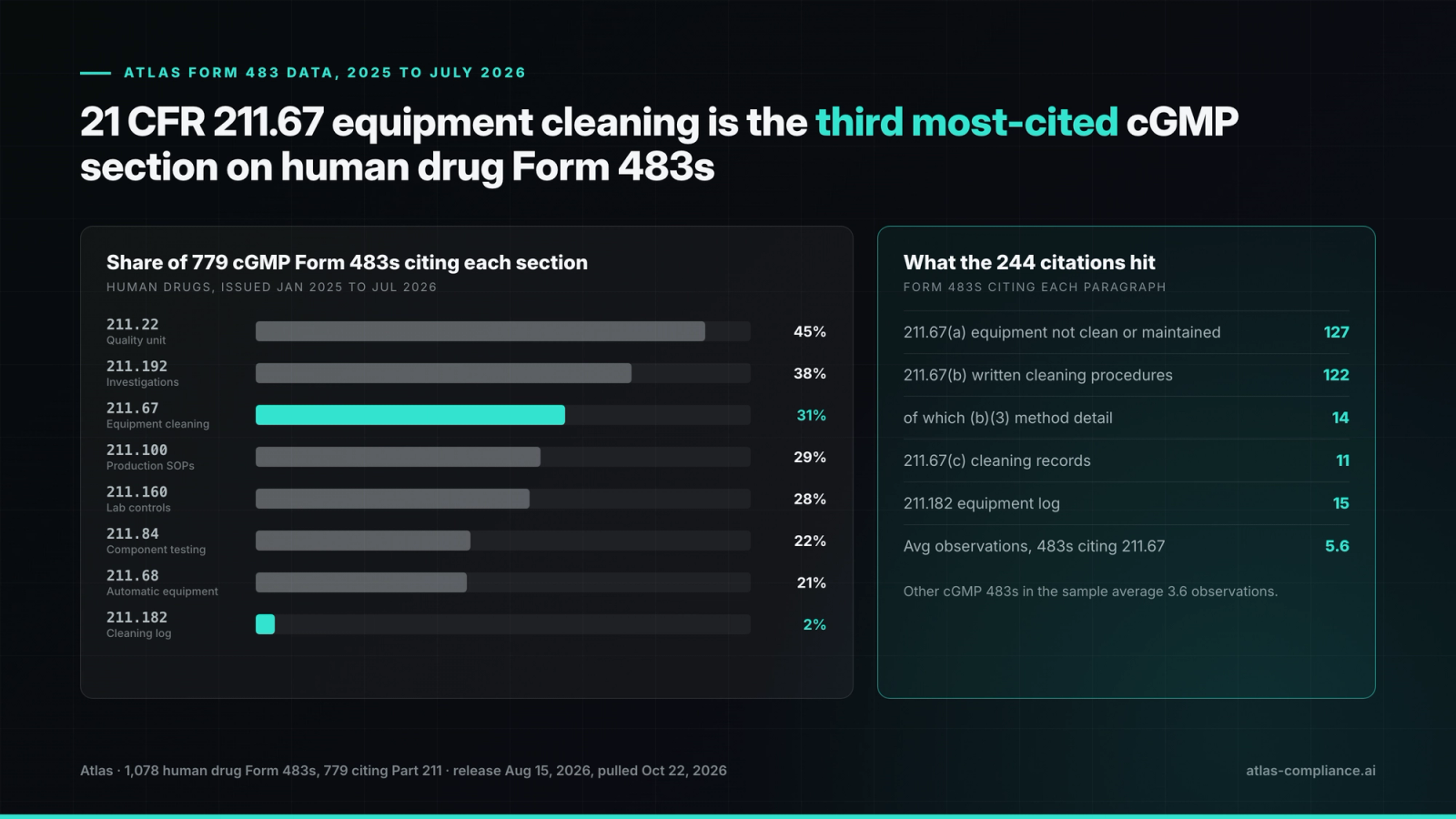
The share held across both years: 178 of 578 cGMP 483s in 2025 (30.8%) and 66 of 201 in January to July 2026 (32.8%). The 244 forms carry 262 observations under 211.67, which is 8% of the 3,284 observations on all 779 forms.
The sub-paragraph split shows where facilities fail. 127 forms cite 211.67(a), the outcome: equipment was not clean or not maintained. 122 cite 211.67(b), the procedure: 103 at the paragraph level and 21 at a numbered element, most often (b)(3), the level of detail in the method (14 forms). Only 11 cite 211.67(c), the records, and 211.182 appears on 15 forms, 7 of them alongside 211.67. Investigators write up the cleaning itself and the SOP far more often than the logbook.
Five named examples from the sample:
- Eli Lilly and Company, Indianapolis, May 20, 2025: five observations, six investigators, one under 211.67(b) next to 211.113(b) sterile process controls.
- Baxter Healthcare Corporation, Round Lake, Illinois, April 2, 2026: nine observations, ending with 211.67(b) and preceded by 211.63 equipment design and 211.192.
- Janssen Ortho LLC, Gurabo, Puerto Rico, June 5, 2026: six observations, including 211.67(a) and 211.68(b) computer control of master records.
- Fareva Morton Grove, Illinois, August 12, 2025: seven observations, one of the few forms citing both 211.182 equipment logs and 211.67(c) cleaning records.
- Lupin Ltd., Aurangabad, India, September 5, 2025: a two-observation 483, one of them 211.67(c), cleaning and maintenance records not kept.
Cleaning findings rarely travel alone. The sections most often co-cited with 211.67 are 211.22 (116 forms), 211.100 (101) and 211.192 (97). If a residue result failed and nobody opened an investigation, expect the 211.192 observation next to the 211.67 one; our guide to OOS results covers how a failing swab should be handled. A Form 483 with a 211.67 observation also tends to be a long one: 5.6 observations on average.
 Atlas
See what the FDA knows about your next investigator.
30 minutes with the founder. No pitch deck.
How are cleaning validation acceptance limits set?
Cleaning validation acceptance limits are set by calculating a maximum allowable carryover (MACO) of the previous product into the next batch, then dividing by the shared product contact surface area to get a per-swab or per-rinse limit. The three historical bases for MACO are a health-based exposure limit (PDE), 1/1000 of the minimum therapeutic dose, and 10 ppm.
| Approach | MACO formula | Basis | Who expects it | Weak point |
|---|---|---|---|---|
| HBEL / PDE | PDE of product A x minimum batch size of B / maximum daily dose of B | Toxicology: NOAEL with adjustment factors F1 to F5, 50 kg body weight | EMA since June 2015; Annex 15 10.6 | Needs a qualified toxicologist and a written PDE monograph per product |
| 1/1000 dose | (Minimum daily dose of A / 1000) x minimum batch size of B / maximum daily dose of B | Pharmacology: a fraction of the lowest clinical dose | Listed in FDA's 1993 guide; Fourman and Mullen, 1993 | Arbitrary safety factor; meaningless for non-dosed intermediates |
| 10 ppm | 10 mg of A per kg of B x minimum batch size of B | Analytical detection, historical | Listed in FDA's 1993 guide | No link to toxicity; can be too loose for potent compounds |
| Visually clean | No visible residue on inspected surfaces | Organoleptic | Required by all, sufficient by none | Detection depends on residue, light and surface |
Most firms calculate all applicable limits and use the lowest. The 2018 EMA questions and answers on the HBEL guideline accept that traditional limits such as 1/1000 of the dose or 10 ppm can still be used for products that are not highly hazardous, provided they are shown to be safe against the HBEL. For highly hazardous products, the limit has to come from the PDE. Cleaning agent limits are set separately, usually from the detergent's toxicity data, and Annex 15 asks for them explicitly.
The analytical method must reach the limit: a swab limit is worthless if the method's quantitation limit sits above it, which is why FDA's guide asks firms to define method sensitivity first. The calculation belongs in a risk assessment tied to the hazard ranking you already use under ICH Q9 quality risk management.
FDA vs EMA cleaning validation: what is the difference?
FDA and EMA both require validated cleaning with documented, scientifically justified limits; the difference is how prescriptive each is about the limit. EMA requires carryover limits based on a toxicological evaluation (an HBEL), while FDA leaves the method of setting limits to the firm, provided the limits are practical, achievable and verifiable.
| Topic | FDA | EMA / EU GMP |
|---|---|---|
| Legal basis | 21 CFR 211.67, 211.182; ICH Q7 12.7 for APIs | EU GMP Annex 15 section 10 (from October 1, 2015); Part I chapters 3 and 5 |
| Limit setting | Firm's choice; 1993 guide lists 10 ppm, 1/1000 dose, visual | Toxicological evaluation per the EMA HBEL guideline (effective June 1, 2015) |
| Visual inspection | Required before use, 211.67(b)(6) | Important part of acceptance criteria; not generally acceptable alone (10.2) |
| Test until clean | Not acceptable except in rare cases | Not an acceptable approach (10.2) |
| Worst case | Expected in practice | Scientific rationale required for worst-case product and equipment selection (10.1, 10.10) |
| Hold times | Time between processing and cleaning should be controlled | Dirty and clean hold times must be defined (10.8) |
| Number of runs | Not specified | Appropriate number based on risk assessment (10.13) |
| Biologics | Case by case | Toxicological evaluation may not apply to degraded macromolecules (10.6.1) |
In practice, a facility shipping to both markets writes one program to the stricter rule: EU GMP Annex 15 plus the EMA HBEL guideline, with the FDA equipment log format layered on top.
What goes into a cleaning validation protocol?
A cleaning validation protocol defines, before any run starts, the equipment and products covered, the worst-case choices and why, the sampling locations and methods, the analytical methods, the acceptance criteria and the number of runs. FDA's 1993 guide and Annex 15 section 10.11 both expect this content written and approved in advance.
- Group products and equipment. Rank products by solubility, cleanability, toxicity and potency, the four criteria Annex 15 section 10.10 names, and pick the worst case. Group equipment of the same design and justify the representative item.
- Define sampling. Swab hard-to-clean spots (gaskets, valves, spray-ball shadows); use rinse sampling for pipework and inaccessible surfaces. FDA's guide notes the weakness of rinse samples: a residue may not dissolve or may be physically occluded.
- Run recovery studies. Spike known amounts on coupons of every product contact material (stainless steel, PTFE, glass) and show what fraction each method recovers. FDA's guide gives 50% and 90% as examples; results are corrected by the recovery factor.
- Validate the analytical method for specificity, linearity, accuracy, precision and a quantitation limit below the acceptance limit. Use TOC or conductivity only where specific methods are not feasible (Annex 15 10.6.2). Electronic data from these instruments falls under the same controls described in our guide to audit trail tests.
- Set visual inspection criteria: lighting, distance, who inspects and how they are trained.
- Establish dirty and clean hold times. Run at least one study at the maximum time equipment sits dirty before cleaning, and at the maximum time it sits clean before use, with bioburden checks on the clean hold.
- State the number of runs and the pass rule. Three consecutive successful runs is the long-standing convention; Annex 15 asks for a number justified by risk.
- Cover campaigns. Validate at the maximum campaign length in time and batches (Annex 15 10.9).
How do you keep a cleaning process validated?
A cleaning process stays validated through continued verification: periodic sampling during routine production, trending of residue and bioburden results against limits, and revalidation triggered by change control. Continued verification is where most 211.67(a) findings start, because the procedure was validated once and the equipment, products or operators changed afterward.
Revalidation triggers: a new product that becomes the worst case, new or modified equipment, a new detergent or cycle parameter, a failing residue or visual result, and repeated manual cleaning deviations. Annex 15 section 10.15 asks that manual cleaning be confirmed at a justified frequency. Trend swab results; a slow drift is a warning before it becomes an observation.
AtlasFDA Inspection Intelligence Digest
We track every 483, EIR, and warning letter the moment it happens. Get the signals before they hit the FDA website.
Frequently asked questions
Neither FDA nor EMA fixes a number. Three consecutive successful runs is the long-standing industry convention, and most protocols still use it. EU GMP Annex 15 section 10.13 asks for an appropriate number based on risk assessment, so a high-potency product or a manual process may justify more. Every run must meet all acceptance criteria; a failed run restarts the count after investigation.

Written by
Bhavish Agarwal
Founder, Atlas
Bhavish Agarwal is the founder of Atlas and previously worked at Google and Microsoft. He has spent the past several years building regulatory data infrastructure for the pharmaceutical industry.