
Computerized system validation (CSV) is the documented, risk-based evidence that a regulated computer system does what it is meant to do and keeps its data trustworthy. FDA, EMA and ICH all expect that evidence to be proportionate to the system's impact on patients, product quality and data. The current way to deliver it is risk-based assurance: spend testing effort where a failure would hurt most, and test the audit trail as hard as any calculation.
In short:
- Rate each requirement by its risk to patients, product and data integrity, then use scripted tests for high-risk functions and assessed vendor evidence for routine features.
- Test audit trails for creation, change, deletion and signature events, user and time capture, tamper resistance, clock failures and readable exports, and name who reviews them and how often.
- Assess every patch, configuration change, interface change, vendor upgrade or change in intended use, then retest or revalidate before the system goes back into use.
- The regulated firm keeps final responsibility when vendors qualify systems, so contract for audit and inspector access, change notices, test evidence and data return.
- Review each system periodically, test restores rather than backups, and confirm migrations keep record meaning, metadata and audit trails.
What computerized system validation covers and why it matters
CSV applies to any computerized system that creates, changes, stores or reports regulated records, or that controls a regulated process. FDA's General Principles of Software Validation describe validation as confirmation by objective evidence that software specifications conform to user needs and intended uses. Confidence comes from verification and testing across the lifecycle, not from one final test event.
Typical systems in scope:
- eCRF and ePRO platforms in clinical trials
- laboratory information management systems (LIMS) and chromatography data systems
- manufacturing execution systems (MES) and electronic batch records
- quality system software such as CAPA, deviation and document control tools
- lab instruments with embedded software
- any system that applies electronic signatures
A validated system is fit for its intended use, with requirements traceable to evidence, auditable records and detectable tampering. A system that cannot show this puts every record it produced in doubt, which is how a software gap becomes a data integrity observation on a Form 483.
Regulatory expectations that shape CSV
A handful of documents carry most of the weight, and they agree on more than they disagree.
- FDA CSA guidance. FDA's Computer Software Assurance guidance asks you to identify intended use, judge the risk of failure, choose assurance activities in proportion to that risk and keep sufficient objective evidence. We compare it with traditional CSV in CSA vs CSV for life sciences.
- 21 CFR Part 11. The electronic records rule requires secure, computer-generated, time-stamped audit trails that record creation, modification and deletion without obscuring earlier entries.
- EMA and ICH for clinical trials. EMA's notice to sponsors says sponsors must validate and document their systems, keep audit trails and security, and maintain lists of authorized users. ICH E6(R3) requires audit trails for initial entries and later changes and puts final responsibility on the sponsor.
The common thread is proportionality: validation effort should match the importance of the data and the activities the system performs. Inspectors read that as a mandate to follow the data and review the audit trail, not to check the validation binder.
How to apply risk-based assurance
The logic is a short decision flow. State the intended use of each function. Judge what happens if it fails: could it affect patient safety, product quality or record integrity? Then pick assurance activities that match.
- scripted testing for high-risk functions such as calculations, release decisions and electronic signatures
- documented unscripted or exploratory testing for moderate-risk features
- automated monitoring for functions that run continuously
- assessed vendor evidence for standard, low-risk functionality
Lighter records for low-risk items are legitimate when the reasoning is written down. A short rationale explaining why a report layout cannot affect product quality is stronger than pages of screenshots no one reads. Keep complete, traceable records for anything that touches a regulated decision.
Pro tip: put the risk rating next to each requirement in the URS. When an inspector asks why functions received different levels of testing, the answer is already on the page.
The CSV lifecycle, step by step
- Scope the system. List functions, interfaces and data flows, mark which are regulated and tie each to a user requirement.
- Write the user requirement specification (URS). Requirements must be testable and uniquely identified.
- Assess risk. Rate each requirement by impact and likelihood of failure, and let the rating set test depth and acceptance criteria.
- Plan validation. Define roles, deliverables, assurance activities and how deviations are handled.
- Run IQ, OQ and PQ. IQ confirms installation and configuration. OQ challenges functions, including audit trail behavior. PQ or production verification confirms performance under real conditions.
- Trace and report. Close the loop from requirement to test to result to deviation to release.
- Release and control change. Approve the validation report before use and keep the system under change control.
The documents an inspector asks for follow the same chain: an approved URS with risk ratings, the validation plan and risk assessment, executed test evidence including failed steps and retests, the traceability matrix, deviation records with impact assessments, and the signed summary and release authorization.
Write change-control triggers into the procedure rather than leaving them to judgment. Patches, configuration changes, interface changes, new regulated functions, vendor upgrades and changes in intended use should each prompt an impact assessment that decides between a targeted retest and full revalidation. That is what prevents "validated once, drifting ever since."
Audit trails and data integrity: the OQ test cases
Audit trails are where many data integrity observations begin. Part 11 expects trails that are secure, computer-generated, time-stamped and beyond the reach of operators, and FDA's data integrity guidance adds that technical controls need procedures and periodic verification behind them. Our analysis of deviation trends in 483s and warning letters shows how often these themes recur.
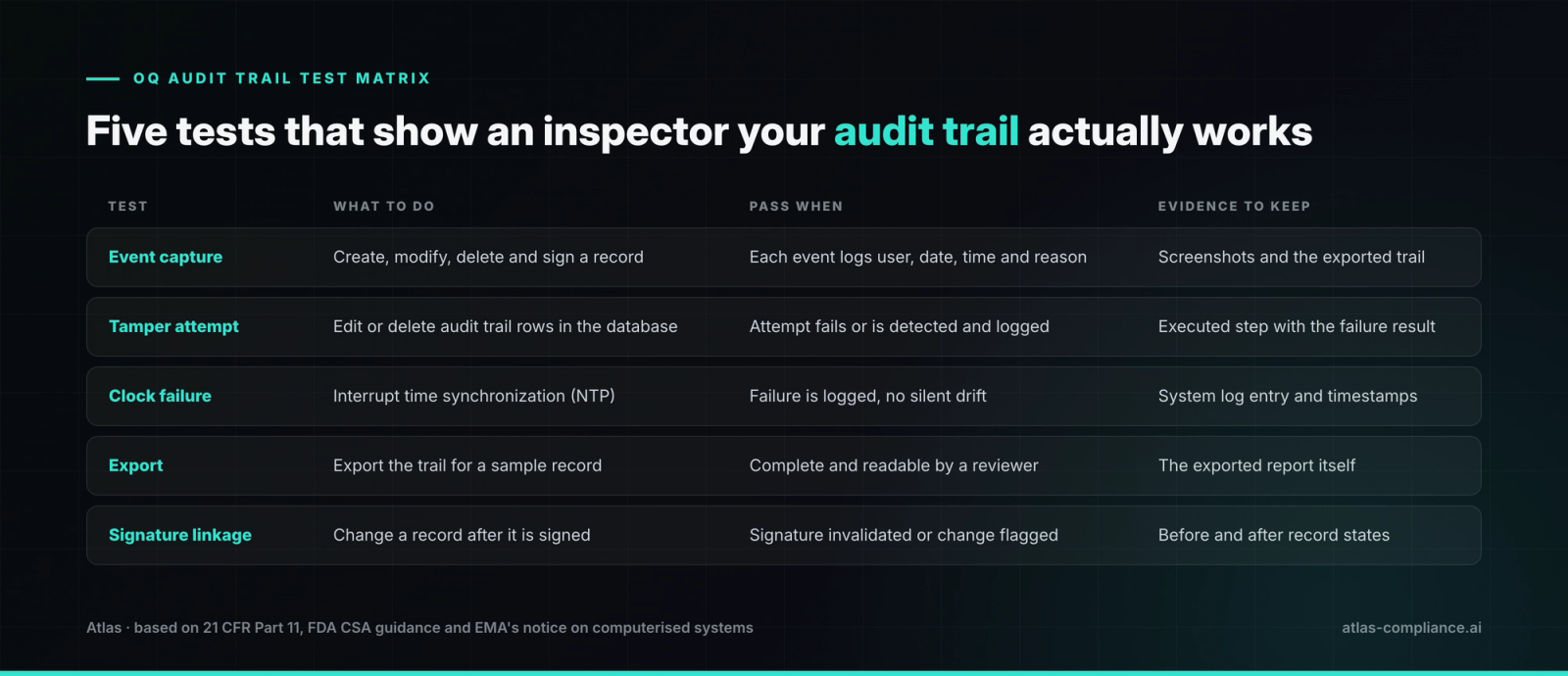
OQ test cases worth including:
| Test | What to do | Pass when |
|---|---|---|
| Event capture | Create, modify, delete and sign a record | Each event is logged with user, date, time and reason |
| Tamper attempt | Try to edit or delete audit trail rows directly in the database | The attempt fails or is detected and logged |
| Clock failure | Interrupt time synchronization, such as an NTP outage | The system logs the failure and does not drift silently |
| Export | Export the audit trail for a sample record | The report is complete and readable by a reviewer |
| Signature linkage | Sign a record, then change it | The signature is invalidated or the change is flagged |
Beyond testing, define who reviews audit trails, how often and where the review evidence lives. Our list of 100 things FDA investigators look for covers how review practices get probed on site.
Pro tip: test the export, not just the screen. An inspector may ask for a printout, and an incomplete export is an audit trail gap.
How often FDA cites computerized systems and data integrity
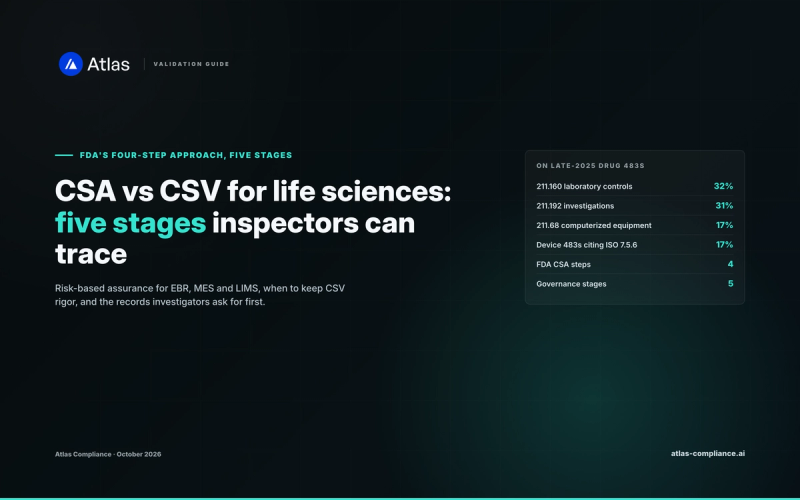
Computerized systems and the data they hold show up on Form 483s regularly. Across 90 human drug Form 483s issued in late 2025 in the FDA Form 483 database, 21 CFR 211.68, which covers checks of computerized equipment, change control over master records and data backup, was cited on 17%. For devices under the QMSR, clause 7.5.6 of ISO 13485, process validation including production software, appeared on 17% of a sample of 96 device Form 483s from May to July 2026.
Data integrity is one of the most frequent themes Atlas tags on FDA findings. At Indian human drug facilities it appeared in 116 of the 439 FDA inspections from January 2025 to June 2026, about one in four, behind only process validation and written procedures, according to our India human drug inspection data.
| Measure | Value | Source |
|---|---|---|
| Late-2025 human drug 483s citing 21 CFR 211.68 | 17% | 90 forms, Atlas directory |
| Device 483s citing ISO 13485 clause 7.5.6 | 17% | 96 forms, May to July 2026 |
| Indian human drug inspections tagged data integrity | 116 of 439 | Jan 2025 to Jun 2026 |
The practical use of these numbers is calibration. Search the 483s by CFR section to see the wording investigators use, and check the FDA investigator lookup for the sections the investigator likely to inspect you cites most. If your risk assessment describes software risk in different terms, close that gap before an inspection does it for you.
 Atlas
AtlasSee what the FDA knows about your next investigator.
30 minutes with the founder. No pitch deck.
Vendor and third-party systems
The regulated firm keeps final responsibility even when a vendor does the qualification work. Vendor documentation can be relied on only after you assess it and find it adequate, and EMA's notice adds that sponsors must secure access to vendor documentation and inspection access.
Contract for these before signing:
- access to requirement specifications and test evidence
- sponsor and inspector audit rights, on site or remote
- timely notice of changes, patches and end of support
- retention and return of data at termination
Audit the supplier, or add your own qualification testing, when the system supports a high-risk function, the vendor's evidence is thin, or the configuration is heavily customized. If a vendor refuses access, decide whether the system can meet documentation and inspection expectations before you use it for regulated work. Our guide to supplier qualification covers the wider program.
Periodic review, migration and decommissioning
Validation does not end at release. Periodic review should cover functionality, deviations, upgrade history, security, performance and current validation status. Test restores, not just backups. After a migration, verify that records keep their meaning, metadata and audit trails. At retirement, keep data readable and retrievable for the full retention period.
Integrating CSV into the quality system
CSV works best as part of the quality system, not as an IT side project. Validation procedures belong in document control, validation deviations flow into the same CAPA process as manufacturing deviations, and software changes go through change control with the same rigor as equipment changes.
- Keep the system inventory as a controlled record listing each system, its GxP impact, validation status and owner. Inspectors often start there.
- Manage software vendors alongside material suppliers, with qualification status and audit schedules.
- Sample computerized systems in internal audits, including audit trail review records.
- Show validation metrics in management review next to batch and deviation metrics.
Quality ownership is the part that fails most often. IT or the business can build and run the system, but quality approves the validation plan, the risk rationale and the release decision.
Training people involved in CSV
People are part of the validated state. Validation leads need working knowledge of the regulations, risk assessment and test design. Testers need training on good documentation practice and on recording a failed step honestly. System owners need training on access control, change control and audit trail review, and end users need role-based training before they get access.
A common weak spot is the person who approves audit trail reviews but has never seen what a suspicious entry looks like. A short session with real examples fixes that faster than a slide deck.
Common challenges
- Over-documentation. Huge test scripts that prove little. Test deeply where risk is high, accept assessed vendor evidence elsewhere, and write down why.
- Vague requirements. If a requirement cannot be tested, it cannot be traced. Write requirements as observable behavior with acceptance criteria.
- Audit trails treated as a checkbox. Teams confirm the trail exists but never test tampering, export or review. Add the OQ cases above and a review cadence.
- Shadow systems. Spreadsheets with calculations and local databases escape the inventory. Sweep for them and assess them by intended use.
- Weak vendor contracts. Contracts signed before validation planning rarely include audit or inspection access. Involve quality in procurement.
- Drift after go-live. Patches and configuration tweaks accumulate. Make change control the only route to production and hold periodic reviews.
Our post on readiness for eLog and eBatch audits shows how inspectors frame these questions.
Using automation and AI to support CSV
Automation fits where work is repetitive and rule-based. Automated regression suites let you rerun high-risk tests after every patch, which supports the CSA preference for rigorous testing of the riskiest functions. Continuous monitoring can flag configuration drift, failed backups or unusual access between reviews, and validation management tools can maintain the traceability matrix so gaps surface early.
AI tools can draft requirement lists, suggest test cases from a URS or summarize vendor documents. Treat them as drafting aids, not evidence: a person who understands the system must review and own the output. If an AI feature sits inside a regulated system, it is part of intended use and needs its own risk assessment, including control of model and version changes. A test automation framework that produces release evidence is a computerized system too, and the same proportionate logic applies.
Metrics that show whether CSV is working
- inventory coverage: share of GxP systems with a current risk rating and validation status
- traceability completeness: requirements with linked tests and results, and open gaps at release
- defects found during validation versus after go-live
- change control cycle time, split by risk level
- periodic review and audit trail review completed on schedule
- CSV-related audit and inspection observations by theme
- vendors with current qualification and contractual access
Read them as trends. A rising post-go-live defect rate points to weak test design, and slipping review timeliness points to resourcing.
Where to start if your team is stretched
Start with audit trail OQ tests that include a tamper attempt and a full export, confirmed inspector access in vendor contracts, and risk-based scoping that stops effort on features that cannot affect patients, product or records. Sample your highest-risk systems for these gaps first, then set a review cadence and start tracking the metrics above. Validation tells you what you built; knowing what investigators cite tells you where to look hardest.
AtlasFDA Inspection Intelligence Digest
We track every 483, EIR, and warning letter the moment it happens. Get the signals before they hit the FDA website.
Frequently asked questions
Computerized system validation is the lifecycle of scoping a system, defining requirements, assessing risk, testing, tracing results to requirements and releasing the system under change control. FDA frames it as confirming, with objective evidence, that software meets user needs and intended uses. It continues after release through periodic review.

Written by
Bhavish Agarwal
Founder, Atlas
Bhavish Agarwal is the founder of Atlas and previously worked at Google and Microsoft. He has spent the past several years building regulatory data infrastructure for the pharmaceutical industry.