
An API 483 is a Form FDA 483 issued at the close of an inspection of an active pharmaceutical ingredient manufacturer, listing the conditions the investigator found objectionable against the CGMP requirement in section 501(a)(2)(B) of the FD&C Act. FDA judges API facilities against ICH Q7, not 21 CFR 211. This post adds Atlas data (release of August 15, 2026): 47 Form 483s issued at registered API facilities from January 2025 to July 2026, by country and by citation, set against 415 issued at finished-dose facilities.
Key facts:
- FDA inspects API manufacturers under Compliance Program 7356.002F, issued August 1, 2025 and in effect since September 2, 2025.
- The compliance program states that FDA has not published CGMP regulations for APIs, so parts 210 and 211 do not apply to them; ICH Q7 represents FDA's current thinking.
- FDA's current Q7 guidance is Revision 1, published in September 2016, with a questions and answers guidance from April 2018.
- In the Atlas Form 483 database, 47 of 1,078 Human Drugs Form 483s with observation detail from January 2025 to July 10, 2026 went to facilities whose FDA registration lists API manufacture.
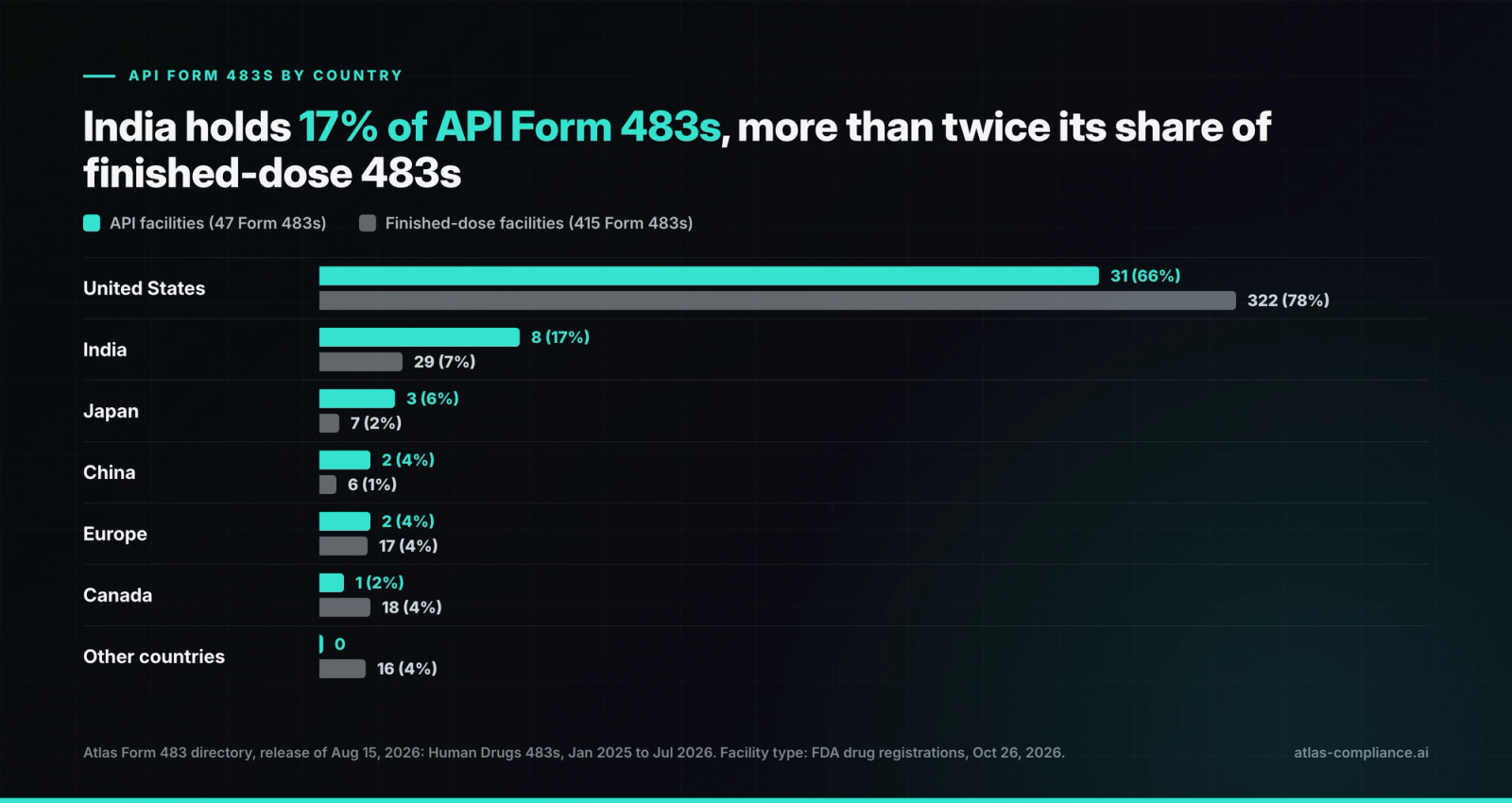
- India received 8 of those 47 API Form 483s (17%), compared with 29 of 415 finished-dose 483s (7%).
- None of the 1,078 Human Drugs 483s in that window carries an observation coded to section 501(a)(2)(B); FDA's citation data codes API observations to the nearest 21 CFR 211 section.
What law does FDA use to inspect API manufacturers?
FDA inspects API manufacturers under section 501(a)(2)(B) of the FD&C Act, which deems any drug adulterated if it is not made in conformance with CGMP. The FD&C Act makes no distinction between an API and a drug product, but FDA's CGMP regulations in 21 CFR parts 210 and 211 cover finished drug products only. For APIs, FDA applies the statute and uses ICH Q7 as the yardstick.
Compliance Program 7356.002F, the field manual for API process inspections, says a facility that follows ICH Q7 "will generally be considered in compliance" with the statutory requirement, and tells investigators to use Q7 as a guideline. The 2025 revision added ICH Q9(R1), Q10 and Q12 concepts and control of hazardous impurities.
The program sets two surveillance options. A full inspection covers at least four of six systems, one of which must be the quality system: quality, facilities and equipment, materials, production, packaging and labeling, and laboratory controls. An abbreviated inspection covers two or three systems, again including quality, and FDA rotates the optional systems from one abbreviated visit to the next.
| API facility | Finished-dose facility | |
|---|---|---|
| Legal basis for CGMP | FD&C Act 501(a)(2)(B) | FD&C Act 501(a)(2)(B) plus 21 CFR 210 and 211 |
| Written standard | ICH Q7 (Revision 1, September 2016) as guidance | 21 CFR 211 regulations |
| Compliance program | 7356.002F, API Process Inspection | 7356.002, Drug Manufacturing Inspections |
| Full inspection scope | At least 4 of 6 systems, quality required | Systems-based, quality required |
| Cited in a warning letter | The statute, not part 211 and not Q7 | Specific 21 CFR 211 sections |
| Sterile steps | Covered by 7356.002A and parts 210 and 211 | Covered by 7356.002A |
How are API 483 observations written?
API 483 observations are written as plain descriptions of what the investigator saw, organized by inspected system. Compliance Program 7356.002F tells investigators not to cite specific ICH Q7 sections on the Form FDA 483 or in the establishment inspection report, and to consult CDER's Office of Manufacturing Quality before writing an observation that conflicts with Q7. Recommendations for regulatory action must cite section 501(a)(2)(B), not part 211.
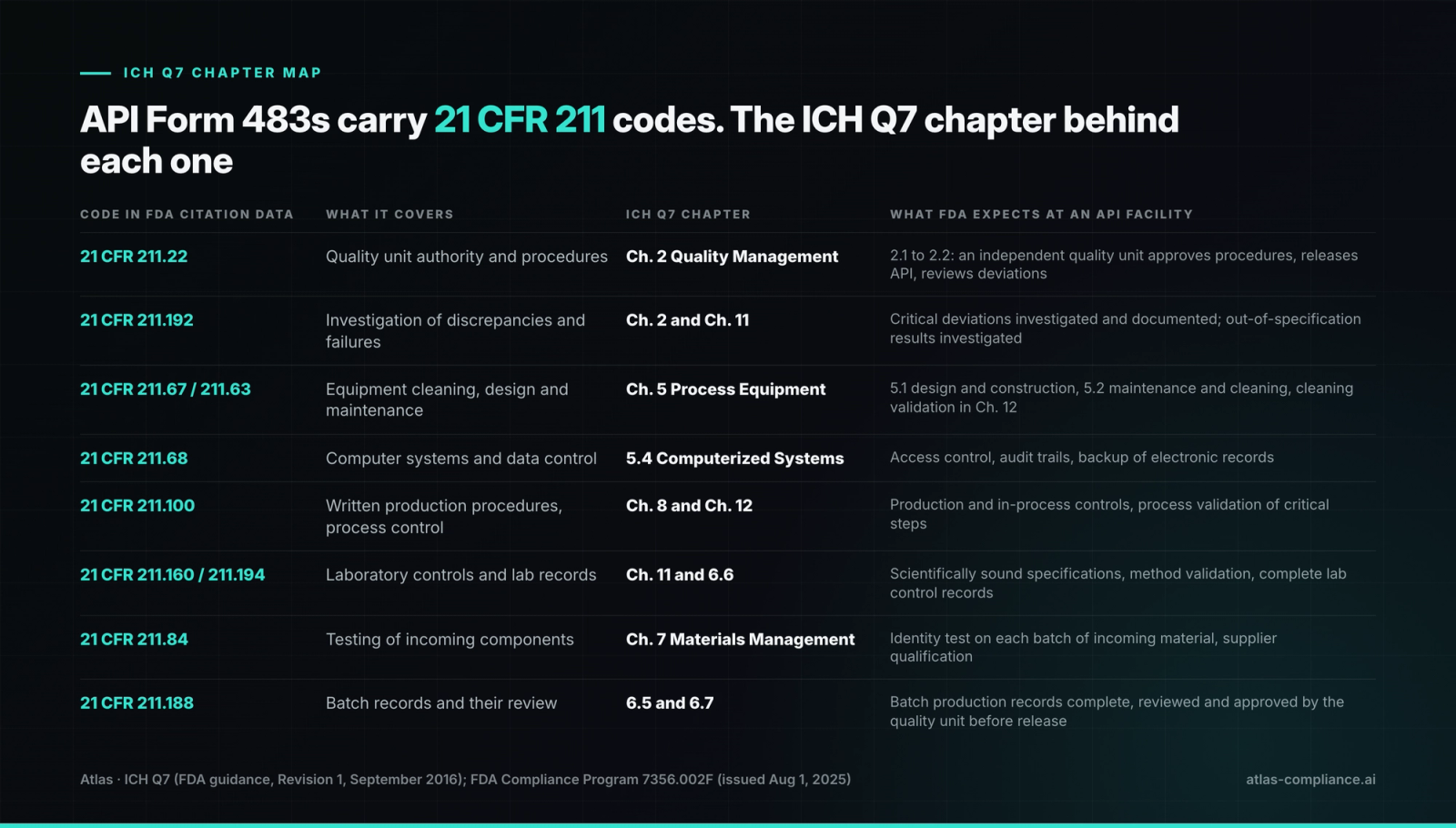
FDA's public citation data still tags each API observation with a 21 CFR 211 code. The September 19, 2025 Form 483 at Thurs Organics in Ratnagiri, India, a facility registered with FDA for API manufacture only, carries two observations coded 21 CFR 211.188 (batch records) and 211.22(d) (quality unit procedures). Across all 1,078 Human Drugs Form 483s in the Atlas window, no observation is coded to 501(a)(2)(B); 74 are coded to 501(a)(2)(A), the insanitary conditions clause used mostly at compounders.
A search by 211 section therefore finds API findings too, and the Q7 chapter behind each code tells you what the investigator measured you against.
How many API manufacturer 483s did FDA issue in 2025 and 2026?
FDA issued 47 Form 483s with observation detail at registered API facilities from January 1, 2025 to July 10, 2026, according to the Atlas Form 483 database (release of August 15, 2026): 40 in 2025 and 7 in 2026 so far. They went to 46 facilities. Over the same period, 415 went to finished-dose facilities.
The method, step by step:
- Pull every Human Drugs Form 483 with observation detail dated January 2025 to July 2026 from the FDA Form 483 database: 1,078 forms at 1,063 sites.
- Match each site's FEI number to FDA's Drug Establishments Current Registration Site (data current through October 26, 2026). Of 1,063 sites, 690 matched a current registration.
- Count a site as an API facility when its registration lists "API manufacture" (45 forms), or when the company lists only bulk ingredients in FDA's NDC directory and its registration shows no packing or labeling at that FEI (2 forms: Cohance Lifesciences and Sri Krishna Pharmaceuticals, both in Telangana).
- Count a site as finished dose when its registration lists manufacture, not API manufacture, and the company lists no bulk ingredients (415 forms).
The method has limits. Registration lists the operations a firm declares today, not on the inspection date. Many Indian and Chinese API makers register under plain "manufacture", so 30 forms at companies that make both APIs and finished dose (Lupin, Zydus, Sun Pharma, MSN and others) stay unassigned. The other 586 forms went to clinical investigators, compounders, testing labs, repackers, PET producers or sites without a current registration. Read the 47 as a floor.
Of the 47, 14 went to facilities registered for API manufacture with no finished-dose manufacture. The other 33 went to facilities that make both.
| Country or region | API facility 483s | Share | Finished-dose 483s | Share |
|---|---|---|---|---|
| United States | 31 | 66% | 322 | 78% |
| India | 8 | 17% | 29 | 7% |
| Japan | 3 | 6% | 7 | 2% |
| China | 2 | 4% | 6 | 1% |
| Europe (Germany, Italy) | 2 | 4% | 17 | 4% |
| Canada | 1 | 2% | 18 | 4% |
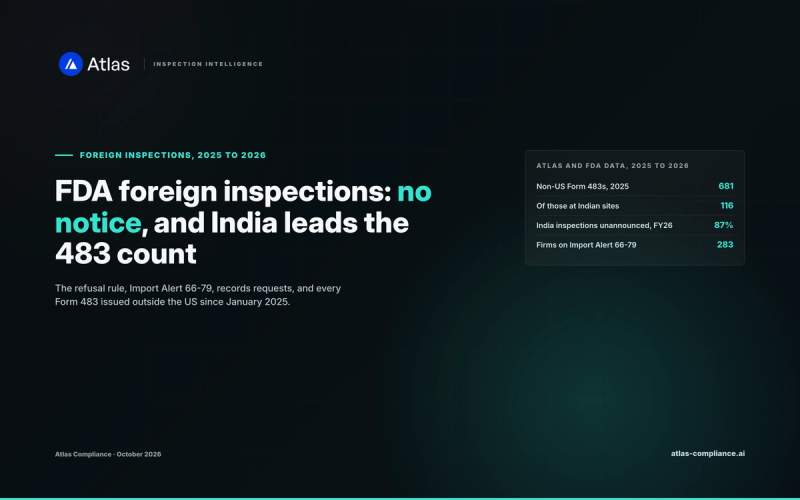
All 8 Indian forms went to API-only registrations, among them Thurs Organics, USV at Ratnagiri, Kothari Phytochemicals in Madurai, Gland Pharma at Parawada and Meghmani LLP at Dahej. Both Chinese forms, Zhejiang Anglikang in Shaoxing and Zhejiang Jinhua Conba in Jinhua, went to facilities that also make finished dose. For the wider picture, India had 116 of the 681 Form 483s FDA issued outside the US in 2025, as covered in our analysis of FDA foreign inspections.
What does FDA cite most often at API facilities?
At API facilities, FDA most often cited 21 CFR 211.113 (contamination control, 36% of the 47 forms), 211.22 (quality unit, 34%), 211.84 (testing of incoming components, 32%) and 211.192 (investigations, 32%), based on the Atlas Form 483 database (release of August 15, 2026). The average API 483 carried 4.1 observations (median 3), against 4.4 (median 4) at finished-dose facilities.
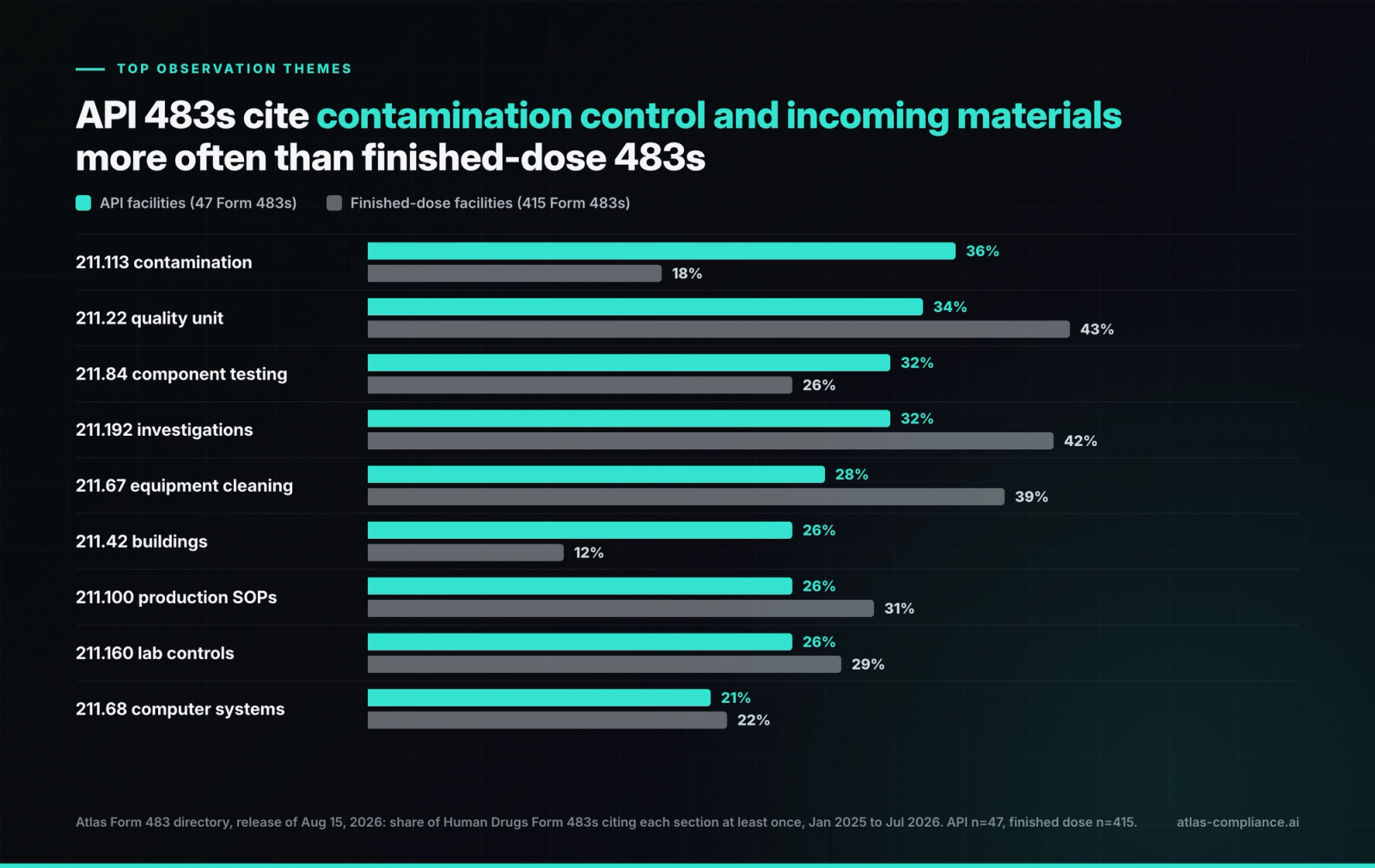
Two gaps stand out. FDA cited 211.113 on 36% of API forms against 18% of finished-dose forms, and 211.42 (building design) on 26% against 12%. Most of that comes from facilities that also run sterile or finished operations: 15 of the 17 API forms citing 211.113 went to API plus finished-dose sites. The 14 API-only forms lean the other way, toward the quality unit (6 forms), incoming material testing (5) and equipment cleaning and design.
Named API facility forms in Atlas:
- Sri Krishna Pharmaceuticals, Hyderabad, June 27, 2025: 8 observations from investigators Wayne D Mcgrath and Arsen Karapetyan, two of them under 211.192, with others on complaint follow-up, cleaning, sampling and records not made available to FDA.
- Cohance Lifesciences, Medchal-Malkajgiri, August 12, 2025: 6 observations covering test methods, investigations, complaints, quality unit procedures and equipment cleaning.
- Meghmani LLP, Dahej, February 3, 2026: 8 observations, five of them facility and equipment findings under 211.42(c)(2), 211.56(a), 211.58, 211.63 and 211.105(a).
- Eli Lilly, Indianapolis, May 20, 2025: 5 observations citing 211.110(a), 211.113(b), 211.22(d), 211.67(b) and 211.84(d)(2).
- AbbVie Biotechnology, Barceloneta, June 10, 2026: 3 observations citing 211.100(b), 211.113(b) and 211.194(a).
- Altaire Pharmaceuticals, Aquebogue, April 21, 2026: 8 observations, including two aseptic area findings under 211.42(c)(10).
If one of these facilities supplies you, the investigator who wrote its last form may be the one who walks into your next inspection, and that record is searchable by name.
 Atlas
See what the FDA knows about your next investigator.
30 minutes with the founder. No pitch deck.
When does an API 483 become a warning letter?
An API 483 becomes a warning letter when FDA classifies the inspection Official Action Indicated and CDER approves regulatory action. Compliance Program 7356.002F says that if one or more systems are documented as out of control, the inspection report should be endorsed OAI. Its list of OAI examples includes failure to ensure data integrity, an incomplete impurity profile, missing validation of critical steps such as final purification, and solvents or water in the final step not shown to be suitable.
Global Calcium in Hosur, India shows the full cycle. FDA inspected the facility from July 29 to August 2, 2024 and issued warning letter 320-25-30 on January 16, 2025. The letter says the firm's APIs "are adulterated within the meaning of section 501(a)(2)(B)" and lists three violations: quality unit failures in document control, poor maintenance of buildings and facilities, and no impurity profile for identified and unidentified impurities. It cites no 21 CFR section and refers to ICH Q7 only as the expectation FDA considers.
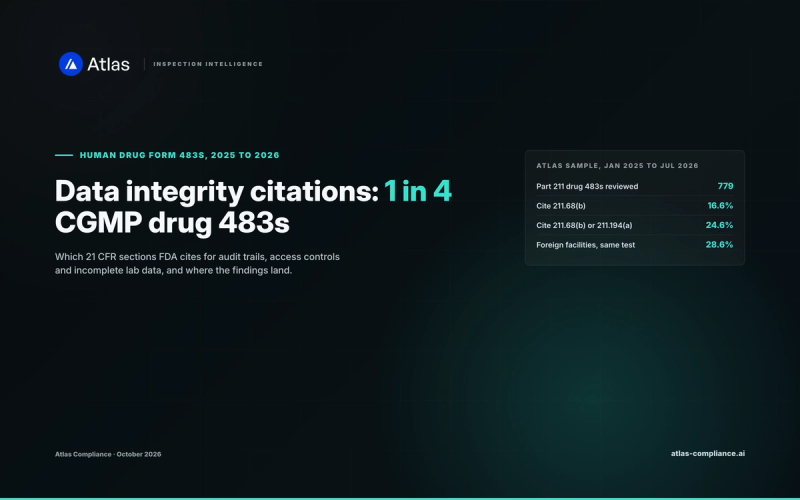
The Global Calcium site record in Atlas shows five inspections since 2015, each ending with a Form 483, the latest from January 27 to February 3, 2026. FDA sent a close-out letter dated July 30, 2026. For how often FDA wrote data integrity findings on drug 483s in the same period, see our breakdown of data integrity citations on Form 483s: 211.68(b) or 211.194(a) appeared on one in four.
What should API buyers and API manufacturers check before the next inspection?
API buyers should check the inspection record of the specific FEI they buy from, and API manufacturers should test their own systems against the Q7 chapters behind the most cited codes. Five checks follow from the 2025 to 2026 data:
- Confirm the FEI. A company with several units can run a clean API site next to a cited finished-dose site, as our Hetero Labs FDA inspection history and Mylan and Viatris India record show unit by unit.
- Ask for the last Form 483 and the response. API forms cite the quality unit on 34% of forms; ask how each observation was closed.
- Review incoming material controls. 211.84 appears on 32% of API forms; Q7 chapter 7 expects an identity test on every batch of incoming material.
- Check the impurity profile and the validation of final purification steps, both named OAI triggers in 7356.002F.
- Audit computerized systems and audit trails against Q7 section 5.4, since failure to ensure data integrity is on the OAI example list.
Our guide to pharma supplier qualification covers how to fold these checks into an approved supplier file. To follow new API Form 483s and warning letters as FDA posts them, the digest below collects them as they appear.
AtlasFDA Inspection Intelligence Digest
We track every 483, EIR, and warning letter the moment it happens. Get the signals before they hit the FDA website.
Frequently asked questions
No. FDA's Compliance Program 7356.002F states that FDA has not published CGMP regulations for APIs, so 21 CFR parts 210 and 211 apply to finished drug products only. API manufacturers must meet the CGMP requirement of FD&C Act section 501(a)(2)(B), and FDA uses ICH Q7 as its current thinking on how to meet it. Sterile processing of a sterile API is the exception: FDA applies parts 210 and 211 to those steps.

Written by
Bhavish Agarwal
Founder, Atlas
Bhavish Agarwal is the founder of Atlas and previously worked at Google and Microsoft. He has spent the past several years building regulatory data infrastructure for the pharmaceutical industry.