
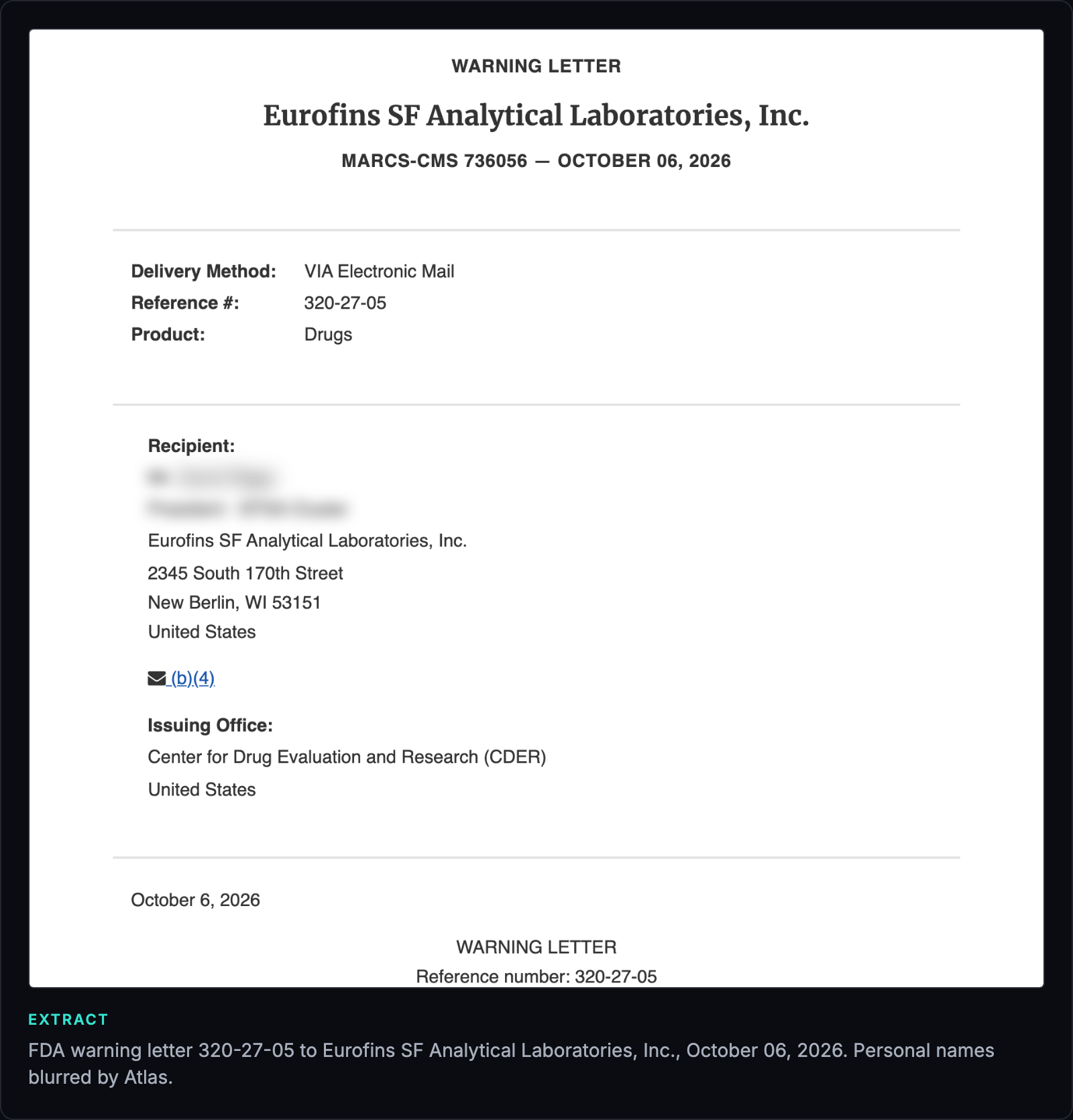
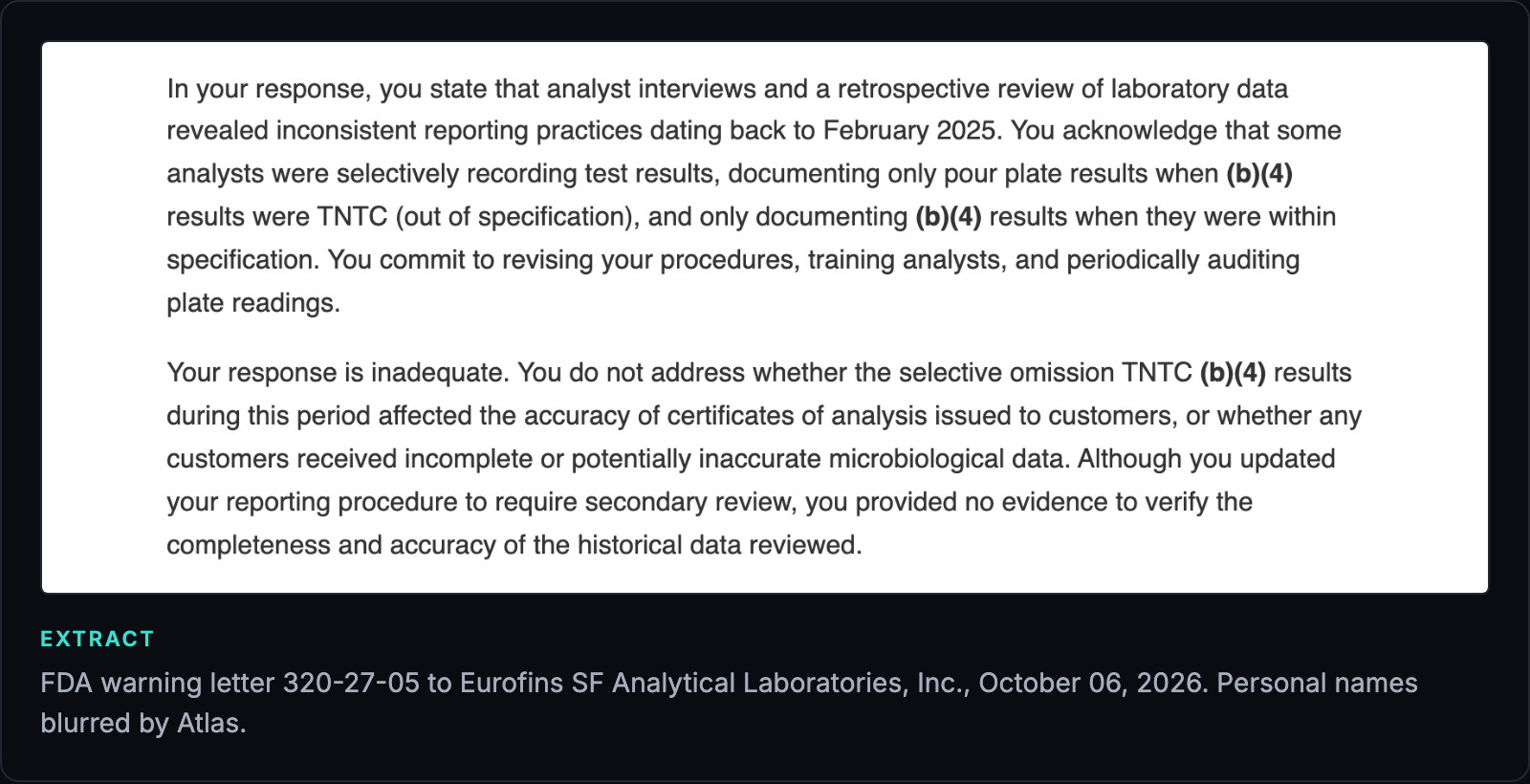
The Eurofins FDA warning letter is a CDER warning letter dated October 6, 2026 that cites Eurofins SF Analytical Laboratories, Inc., a contract testing laboratory in Horsham, Pennsylvania, for incomplete microbiology data. FDA found that analysts recorded pour plate counts and left out results that were too numerous to count (TNTC), and reported cracked, dried plates as within limits.
This article sets the letter against the Atlas inspection record (release of August 15, 2026, pulled October 27, 2026): the two Form 483s at Horsham, 238 FDA inspections across 71 Eurofins facility records, and 22 recent Form 483s at contract testing laboratories. It ends with the checks a sponsor can run on its own contract lab.
Key facts:
- FDA's letter is reference 320-27-05 (MARCS-CMS 736056), issued by CDER's Office of Manufacturing Quality after a June 1 to 3, 2026 inspection of the Horsham facility, FEI 3014704316.
- The letter cites three violations: 21 CFR 211.194(a) for incomplete laboratory records, 211.192 for uninvestigated aberrant media and 211.22 for quality unit oversight.
- Eurofins told FDA in its June 22, 2026 response that inconsistent reporting practices dated back to February 2025.
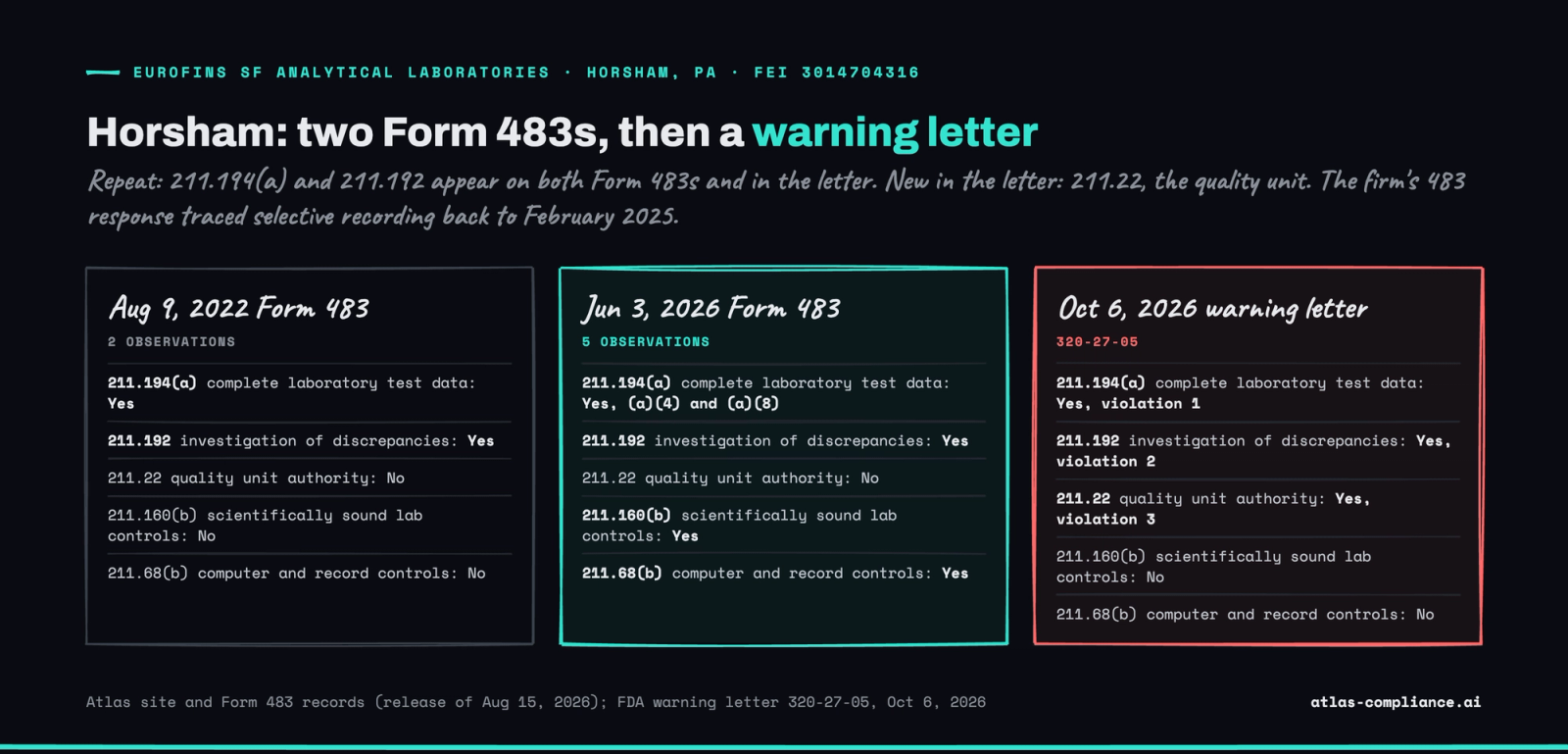
- Both Horsham inspections in Atlas ended with a Form 483, in August 2022 and June 2026, and both cited 211.192 and 211.194(a).
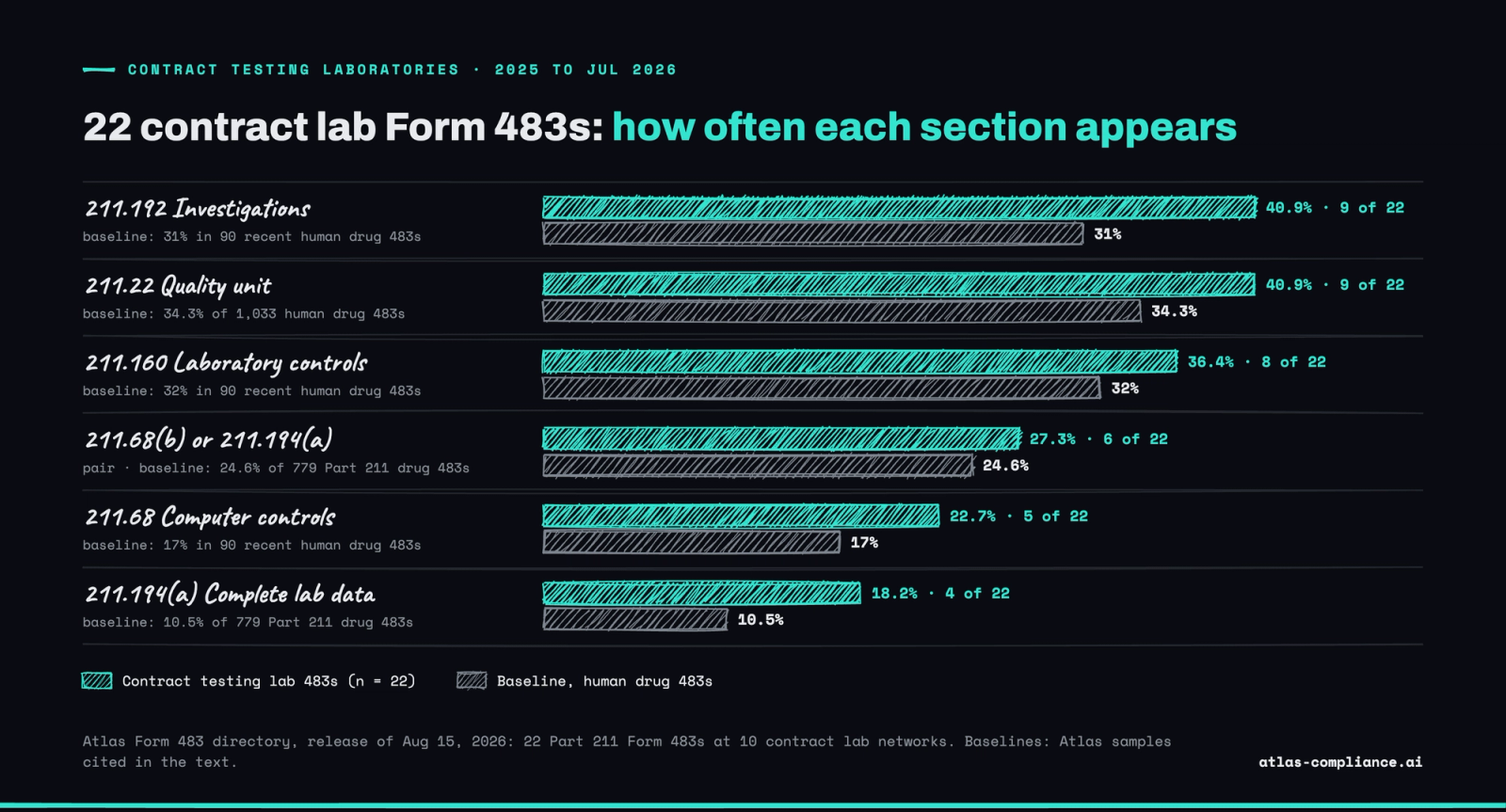
- Across 22 Part 211 Form 483s issued to 10 contract testing lab networks from January 2025 to June 2026, 40.9% cite 21 CFR 211.192.
- Eurofins had 15 business days from receipt to send FDA a written response.
What does the 2026 Eurofins warning letter cite?
The 2026 Eurofins warning letter cites three CGMP violations at the Horsham contract testing laboratory, all under 21 CFR Part 211. FDA says drugs tested there are adulterated under section 501(a)(2)(B) of the FD&C Act because the laboratory's methods, facilities and controls do not conform to CGMP. The letter describes the firm as a lab that runs microbiological analyses of components and drug products for customers.
The source is FDA warning letter 320-27-05 (MARCS-CMS 736056), dated October 6, 2026. It is addressed to the president of the company's cluster in New Berlin, Wisconsin, and covers the Horsham site at 215 Witmer Road.
| # | Section cited | What FDA found at Horsham |
|---|---|---|
| 1 | 21 CFR 211.194(a) | Microbiologists recorded only pour plate counts and left out TNTC results; desiccated and cracked plates reported as within limits; plates read as 0 CFU discarded without second-person review, and an investigator saw a colony on one of them |
| 2 | 21 CFR 211.192 | No investigation of cracked or dried plates used for raw material and drug product testing; results judged valid from analyst interviews and a limited records review |
| 3 | 21 CFR 211.22 | The quality unit lacked oversight and control over laboratory operations and could not exercise proper authority |
Two points in the letter matter to anyone who buys testing from this lab. First, FDA faults the 483 response for not assessing whether the omitted results "affected the accuracy of certificates of analysis issued to customers." Second, FDA asks for time-stamped photographs of every plate at reading, reader signatures and QA verification, plus a six-system audit by a consultant qualified under 21 CFR 211.34. Until the lab corrects the violations, FDA may withhold approval of applications or supplements that list it as a drug manufacturer.
What inspection led to the Eurofins warning letter?
The inspection behind the Eurofins warning letter ran from June 1 to 3, 2026 at Horsham and ended with a Form 483 dated June 3, 2026. The Atlas record for Eurofins SF Analytical Laboratories in Horsham lists five observations on that form, all written by Pushpa S Jayasekara, who has 38 inspections and 147 Form 483 observations on record in Atlas since August 2022.
The June 2026 form cites 21 CFR 211.160(b), 211.192, 211.194(a)(4) for complete test data, 211.194(a)(8) for second-person sign-off and 211.68(b) for computer and record controls. FDA's letter kept the record and investigation findings, dropped 211.160(b) and 211.68(b), and added 211.22.
The earlier inspection matters more. Horsham's only other FDA inspection in Atlas, August 3 to 9, 2022, also ended with a Form 483, and its two observations cite 211.192 and 211.194(a). FDA found the same two lab sections four years apart, and the firm's own response dates the selective recording to February 2025, between the two visits.
Atlas also holds a separate Eurofins QC, Inc. record in Horsham under a different FEI number (3009048205), with Form 483s in 2011 and 2015. Its 2015 form covers investigations and complete test data. We cannot confirm from the public record that it is the same laboratory, so treat it as context only.
How many FDA inspections have Eurofins facilities had?
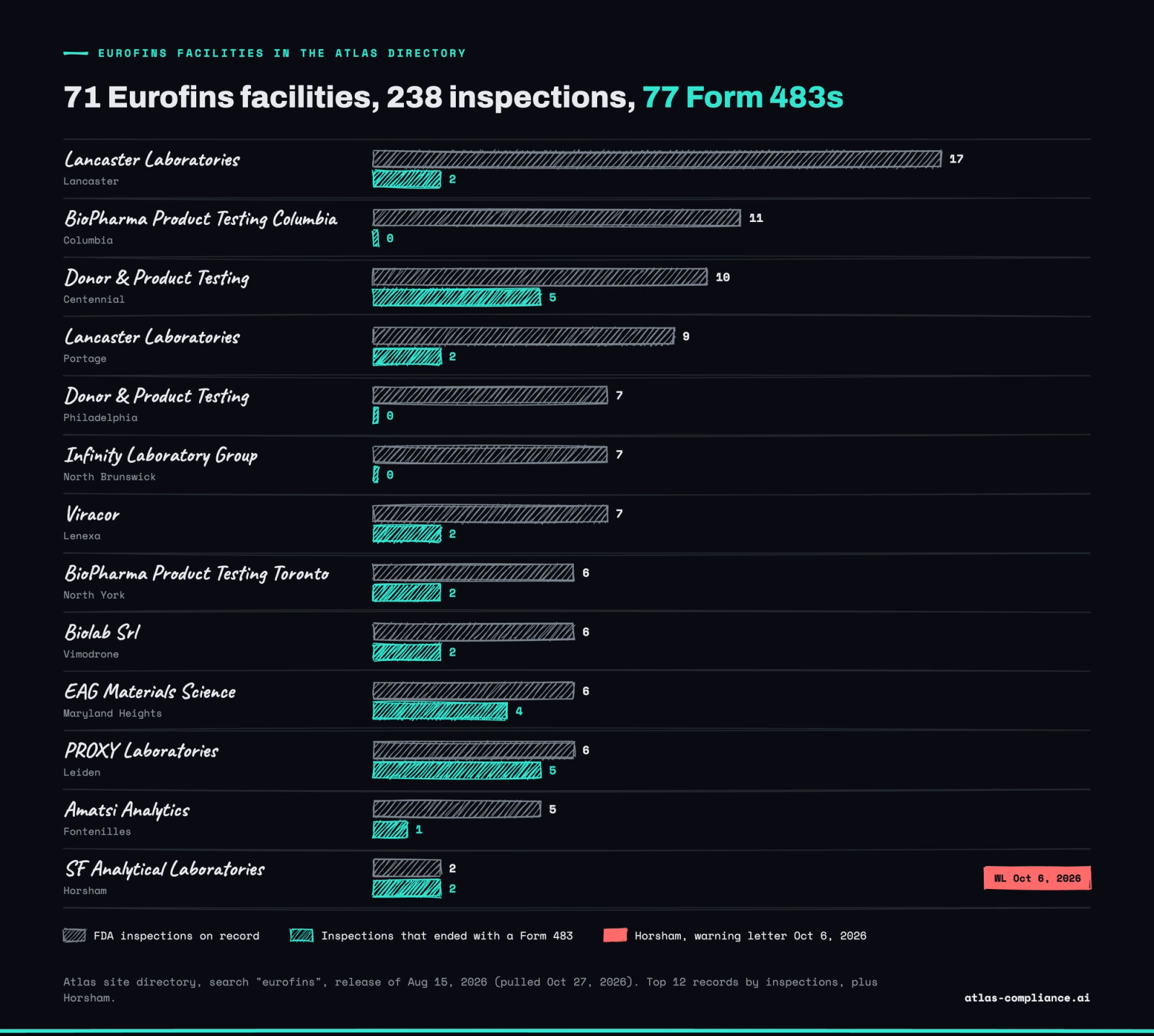
Eurofins facilities have had 238 FDA inspections across 71 facility records in the Atlas site directory (search "eurofins", release of August 15, 2026), and 77 of those inspections, 32.4%, ended with a Form 483. The records span 18 countries; the 37 US records account for 137 inspections and 38 Form 483s.
| Eurofins facility | Location | FDA inspections | Ended with a 483 | Last inspection |
|---|---|---|---|---|
| Lancaster Laboratories, LLC | Lancaster, PA | 17 | 2 | Sep 23, 2025 |
| BioPharma Product Testing Columbia | Columbia, MO | 11 | 0 | Dec 4, 2024 |
| Donor & Product Testing | Centennial, CO | 10 | 5 | Jul 19, 2024 |
| Lancaster Laboratories, Inc | Portage, MI | 9 | 2 | May 30, 2025 |
| PROXY Laboratories | Leiden, Netherlands | 6 | 5 | Sep 19, 2025 |
| EAG Materials Science | Maryland Heights, MO | 6 | 4 | Dec 11, 2025 |
| SF Analytical Laboratories | Horsham, PA | 2 | 2 | Jun 3, 2026 |
Five Eurofins Form 483s issued from January 2025 to June 2026 carry Part 211 citations in Atlas, and four of the five cite 211.192. The May 30, 2025 Form 483 at Eurofins Lancaster Laboratories in Portage, Michigan has five observations, including 211.160(b), 211.192 and 211.68(b), the same lab and record sections that appeared at Horsham a year later. The network is large, and most of its facilities have clean or limited records; Columbia has 11 inspections and no Form 483.
How often do contract testing labs get cited for data integrity?
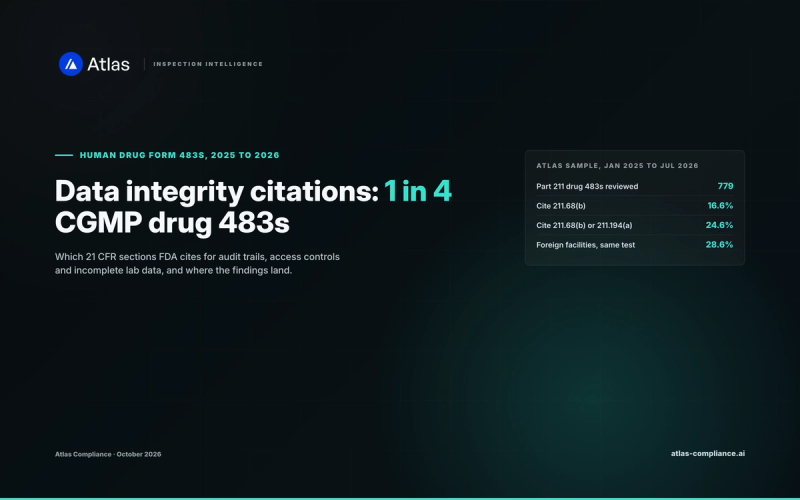
Contract testing laboratories draw investigation and lab-control citations more often than drug facilities overall. We pulled every Form 483 in the Atlas directory issued from January 2025 to June 2026 at 10 contract lab networks Atlas holds (Eurofins, Pace Analytical, SGS, Intertek, Charles River, Element, Nelson Labs, Microbac, PPD and ALS) and kept the 22 forms that cite Part 211. They carry 63 observations.
| 21 CFR section | Contract lab 483s (n = 22) | Baseline in Atlas human drug 483s |
|---|---|---|
| 211.192 investigations | 40.9% (9) | 31% of a 90-form sample |
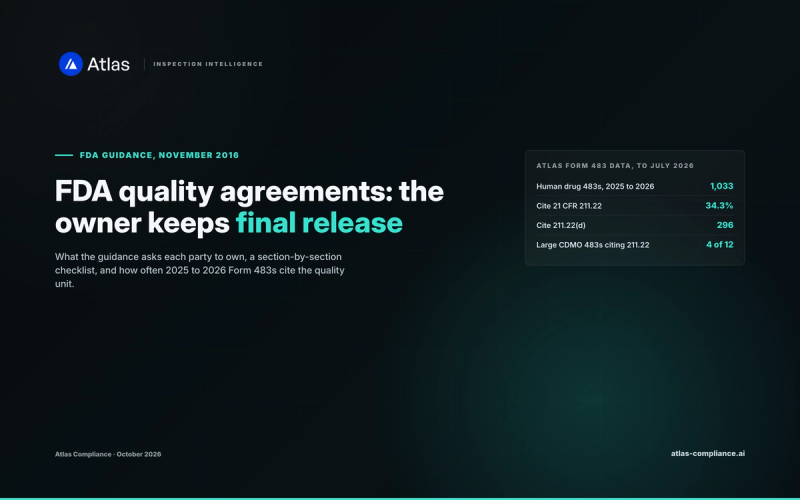
| 211.22 quality unit | 40.9% (9) | 34.3% of 1,033 forms |
| 211.160 laboratory controls | 36.4% (8) | 32% of a 90-form sample |
| 211.68(b) or 211.194(a) | 27.3% (6) | 24.6% of 779 Part 211 forms |
| 211.194(a) complete lab data | 18.2% (4) | 10.5% of 779 Part 211 forms |
The data integrity baselines come from our analysis of data integrity citations on FDA Form 483s: 211.68(b) appeared on 16.6% and 211.194(a) on 10.5% of 779 human drug 483s citing Part 211. At contract labs the pair shows up on 27.3% of forms. Twenty-two forms is a small, hand-picked sample, so read the gap as direction, not a rate.
Named examples you can open in the FDA Form 483 database:
- Pace Analytical Life Sciences, Oakdale, Minnesota, May 29, 2026: two observations, 211.194(a) and 211.68(b).
- SGS North America, Fairfield, New Jersey, June 9, 2026: one observation under 211.160(b). SGS's Lincolnshire, Illinois lab drew the same section in March 2026.
- Nelson Laboratories, Salt Lake City, July 30, 2025: 11 observations across Parts 211, 1271 and 820, including 211.194(a)(4).
If one of these labs tests your products, the investigator who visits it may also visit you; checking that investigator's record before the next inspection takes minutes.
 Atlas
See what the FDA knows about your next investigator.
30 minutes with the founder. No pitch deck.
Is a sponsor responsible for its contract lab's data?
A sponsor is responsible for the data its contract lab produces on its products. Under 21 CFR 211.22(a), the owner's quality unit approves or rejects drug products manufactured, processed, packed or held under contract by another company, and 21 CFR 200.10(b) treats contract facilities as an extension of the manufacturer's own facility.
FDA's guidance for industry, Contract Manufacturing Arrangements for Drugs: Quality Agreements (November 2016), counts analytical testing as a manufacturing operation, so a contract testing lab is a contract facility. Two of its case studies involve contract labs, one of which reported passing results for analyses that failed. Our guide to FDA quality agreements covers the clauses in detail.
The Eurofins letter does not name any customer or discuss customer duties. It does ask whether certificates of analysis sent to customers were accurate, which puts the question on every sponsor that released a batch on a Horsham microbial result since February 2025. A certificate that omitted a TNTC result could hide an out-of-specification count; our explainer on out-of-specification results covers how that investigation should run.
What should a sponsor check at its contract testing lab?
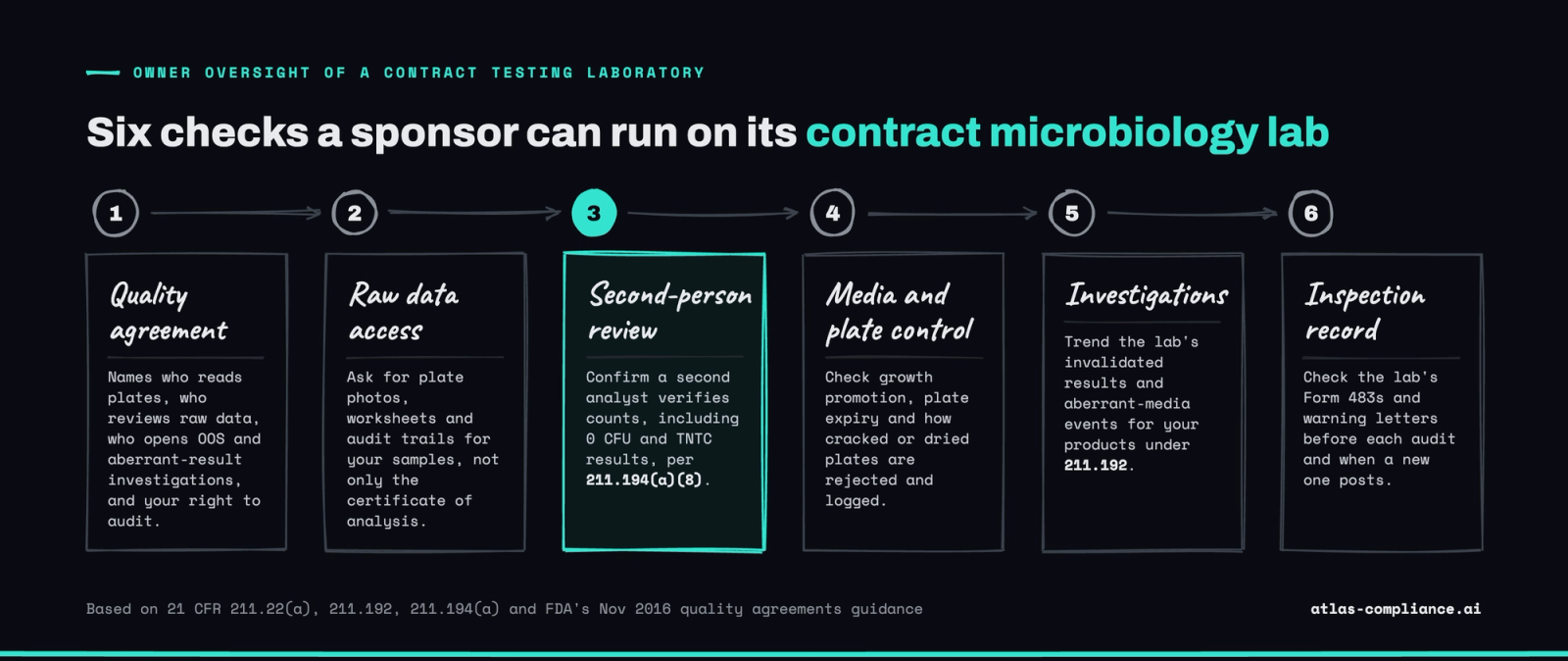
A sponsor should check its contract testing lab's raw data, review practice and inspection record, not only the certificates it receives. The six checks below follow the findings in the Eurofins letter and the sections that recur on contract lab Form 483s.
- Quality agreement. Confirm it names who reads plates, who reviews raw data, who opens and closes investigations, how fast the lab tells you about an aberrant result, and your right to audit.
- Raw data access. For a sample of your lots, ask for worksheets, plate photographs and audit trails, then compare them with the certificate of analysis.
- Second-person review. Confirm a second analyst verifies every count, including 0 CFU and TNTC results, as 21 CFR 211.194(a)(8) requires.
- Media and plate control. Review growth promotion records, plate expiry and the rule for rejecting cracked or desiccated plates, and how each rejection is logged.
- Investigations. Ask for the lab's invalidated results and aberrant-media events on your products for the past 24 months and check each against 211.192.
- Inspection record. Check the lab's Form 483s and warning letters before each audit and whenever a new one posts. For lab software and records, use the tests in our audit trail and computerized system validation guide.
If you use Horsham, add one step: ask Eurofins for its impact assessment on your certificates since February 2025, and record your own quality unit's decision on each affected lot.
What happens next for Eurofins Horsham?
Eurofins had 15 business days from receipt of the October 6 letter to respond in writing with corrections and timelines. FDA usually closes a warning letter only after a follow-up inspection confirms the fixes, and the June 3, 2026 Form 483 remains the latest inspection on the Horsham record in Atlas.
For sponsors the practical clock is shorter. Batches already released on Horsham data stay on the market until the owner or FDA acts, and the review of those batches belongs to the owner's quality unit, not to Eurofins. To follow letters like this one as FDA posts them, the digest below collects new warning letters and Form 483s as they appear.
AtlasFDA Inspection Intelligence Digest
We track every 483, EIR, and warning letter the moment it happens. Get the signals before they hit the FDA website.
Frequently asked questions
TNTC stands for "too numerous to count." An analyst records TNTC when a plate holds so many colonies that a reliable count is not possible, which usually signals a result far above the action limit. Leaving TNTC out of the record, as FDA describes at Horsham, can turn a failing microbial result into an apparent pass on the certificate of analysis.

Written by
Bhavish Agarwal
Founder, Atlas
Bhavish Agarwal is the founder of Atlas and previously worked at Google and Microsoft. He has spent the past several years building regulatory data infrastructure for the pharmaceutical industry.