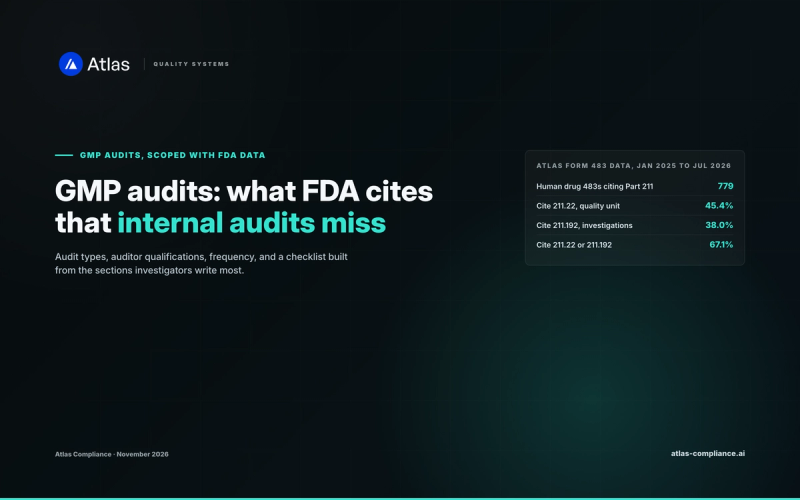

21 CFR 211.192 is the FDA drug GMP rule that requires the quality control unit to review and approve every production and control record before a batch is released, and to investigate in writing any unexplained discrepancy or specification failure, including its effect on other batches. Its title is "Production record review", but most citations are about the investigation half.
This guide adds what FDA investigators wrote under the section: 302 Form 483 observations citing 211.192 at 296 drug inspections that closed between January 2, 2025 and October 9, 2026, from the Atlas Form 483 citation dataset (pulled October 2026), joined to FDA's inspection classifications.
Key facts:
- 211.192 appeared at 296 of 774 drug inspections that cited Part 211 (38.2%), second only to 211.22, the quality unit section, at 352 (45.5%).
- 72.8% of the 302 observations carry FDA's heading "Investigations of discrepancies, failures"; 5.0% say the investigation did not extend to other batches.
- 41.2% of inspections citing 211.192 ended Official Action Indicated (OAI), against 18.8% of Part 211 drug inspections without it.
- Inspections citing 211.192 averaged 5.3 observations, against 3.3 for the rest.
- The share rose from 37.0% of Part 211 drug inspections in 2025 to 41.5% in January to October 2026.
What does 21 CFR 211.192 require?
21 CFR 211.192 requires two things. First, the quality control unit must review and approve all drug product production and control records, packaging and labeling included, before a batch is released or distributed. Second, any unexplained discrepancy or failure to meet specifications must be thoroughly investigated, extended to related batches and products, and written up with conclusions and follow-up.
The full text, as published in the eCFR, reads:
All drug product production and control records, including those for packaging and labeling, shall be reviewed and approved by the quality control unit to determine compliance with all established, approved written procedures before a batch is released or distributed. Any unexplained discrepancy (including a percentage of theoretical yield exceeding the maximum or minimum percentages established in master production and control records) or the failure of a batch or any of its components to meet any of its specifications shall be thoroughly investigated, whether or not the batch has already been distributed. The investigation shall extend to other batches of the same drug product and other drug products that may have been associated with the specific failure or discrepancy. A written record of the investigation shall be made and shall include the conclusions and followup.
Broken into duties an auditor can test, the paragraph holds five:
| Duty | What the text says | Evidence an investigator asks for |
|---|---|---|
| Record review before release | QCU reviews and approves production, control, packaging and labeling records | Signed batch record review, release date after review date |
| Thorough investigation | Any unexplained discrepancy or specification failure | Deviation and OOS reports with a supported root cause |
| Distributed batches included | "whether or not the batch has already been distributed" | Impact assessment for lots already shipped |
| Extended scope | Other batches of the same product and other products | A documented search of related lots, equipment and materials |
| Written record | Conclusions and follow-up | Closed report, CAPA reference, effectiveness check |
Two neighboring sections tie in. 211.186(b)(7) makes the master record state the yield limits "beyond which investigation according to § 211.192 is required", and 211.188(b)(12) requires each batch record to include any 211.192 investigation. A discrepancy report that lives only in the deviation system, with no trace in the batch record, falls short of the second rule.
What counts as an unexplained discrepancy under 211.192?
An unexplained discrepancy under 211.192 is any departure from what the master record, procedure or specification predicts that the batch record does not already explain. The regulation names one example, a yield outside the master record's limits; in practice deviations, out-of-specification (OOS) laboratory results, equipment failures, and complaints traced to a batch all start a 211.192 investigation.
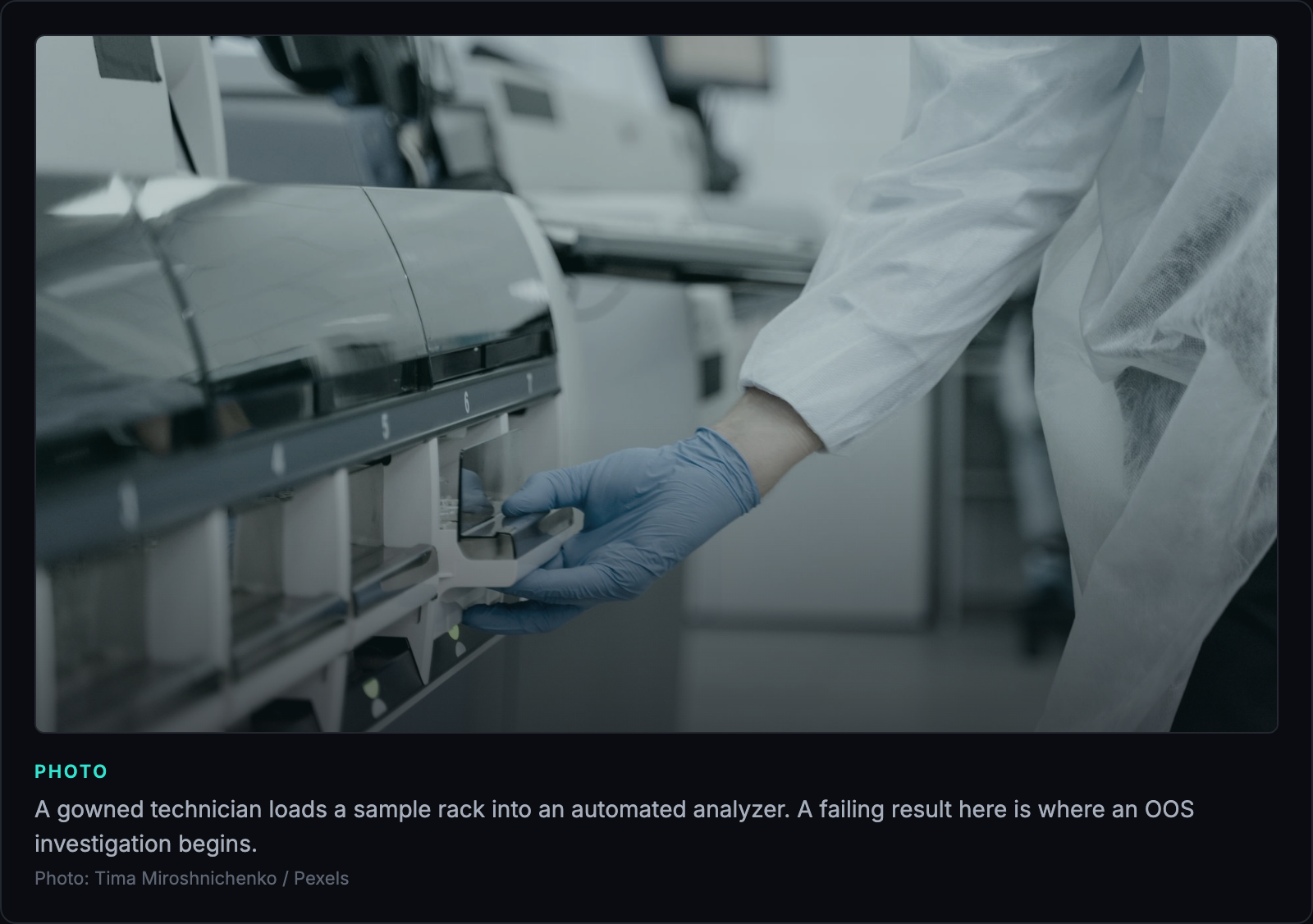
OOS results get their own FDA document: the guidance "Investigating Out-of-Specification (OOS) Test Results for Pharmaceutical Production" (October 2006, Revision 1 May 2022). It splits the work into a Phase I laboratory investigation, which looks for an assignable laboratory error, and a Phase II full-scale investigation that reaches into production when no lab error is found. Both phases are 211.192 investigations, and the guidance cites the section directly. Our explainer on OOS results and OOS vs OOT covers the laboratory side.
Firms often treat a discrepancy as explained once it is described. A discrepancy is explained only when the batch record or an approved procedure already accounts for it, for example a documented, approved rework. An operator's note that a pump "was adjusted" explains nothing until someone records why and what it did to the product.
How does FDA word 211.192 observations on a Form 483?
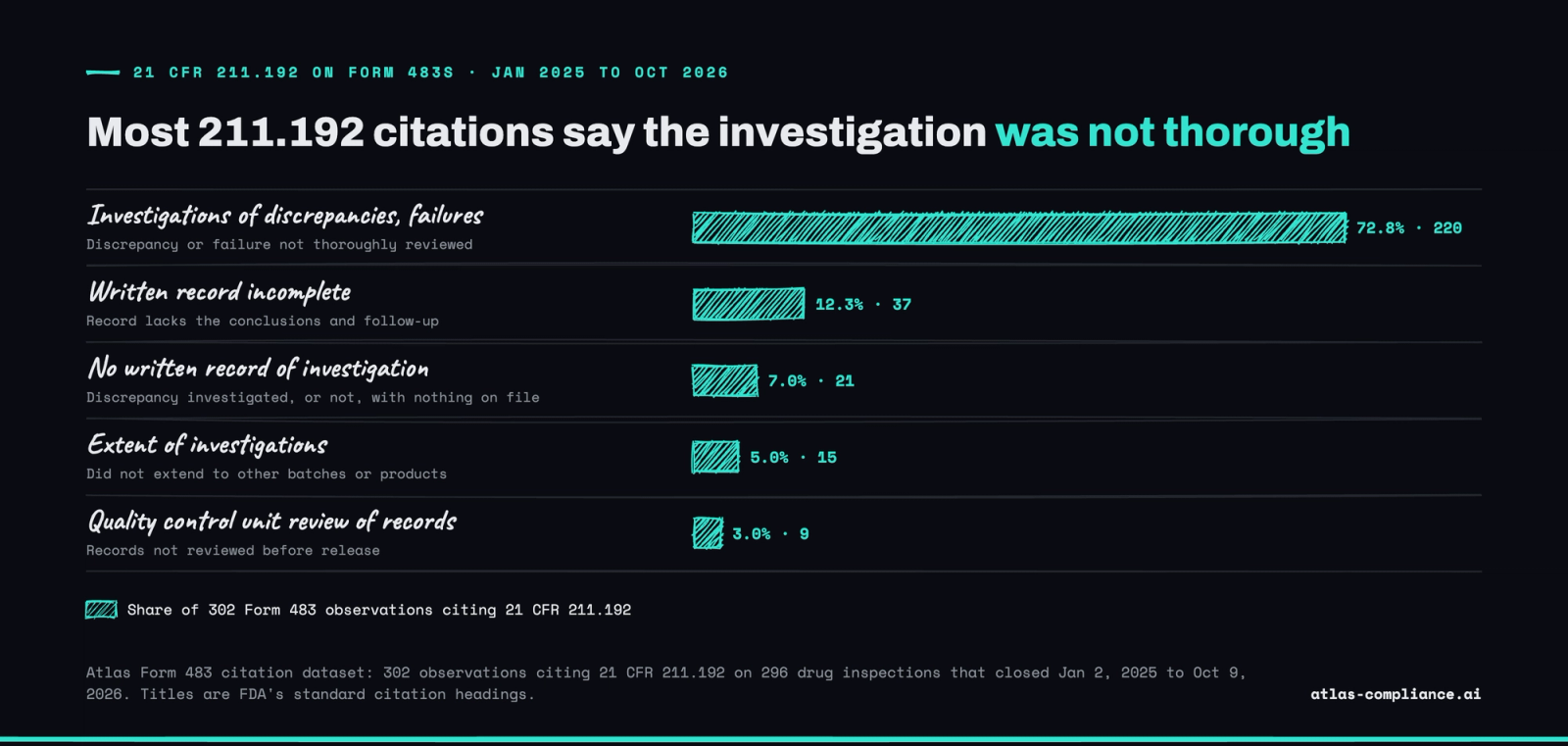
FDA writes 211.192 observations under five standard headings. In the 302 observations in the Atlas dataset, 220 (72.8%) read "Investigations of discrepancies, failures", 37 (12.3%) "Written record of investigation incomplete", 21 (7.0%) "No written record of investigation", 15 (5.0%) "Extent of discrepancy, failure investigations", and 9 (3.0%) "Quality control unit review of records".
Each heading comes with FDA's standard citation sentence, which the investigator then follows with the firm-specific facts. The most common version, used 113 times, reads: "There is a failure to thoroughly review any unexplained discrepancy and the failure of a batch or any of its components to meet any of its specifications whether or not the batch has been already distributed." A shorter form without the specification clause appears 81 times. The incomplete-record citation usually says the written records "do not always include the conclusions and follow-up" (18 times).
The headings map to the duties in the table above, and the mapping tells you where firms fail. Almost three in four citations question the quality of the investigation itself: a root cause asserted without evidence, a "human error" conclusion with no supporting interview or retraining record, or a closed report while the cause was still open. The record-review duty, the first sentence of the section, draws only 3.0% of observations.
The rule also sits inside a cluster. Of the 296 inspections citing 211.192, 42.6% also cited 211.22 (quality unit responsibilities), 40.2% cited 211.160 (laboratory controls), 32.8% cited 211.67 (equipment cleaning and maintenance) and 31.8% cited 211.100 (written procedures and deviations). The quality unit that approves the investigations also owns most of those other systems. Our piece on why companies still fail CAPA and investigation requirements looks at the organizational causes.
Which firms were cited under 211.192 in 2025 and 2026?
FDA cited 211.192 at large and small drug manufacturers, contract laboratories and sterile facilities alike. The table below shows six recent forms from the FDA Form 483s directory, one or two per heading, with the other sections cited on the same form and the final classification.
| Form 483 | Issued | 211.192 heading | Other sections cited | Classification |
|---|---|---|---|---|
| Oakwood Laboratories, Solon, US | May 21, 2026 | Investigations of discrepancies, failures | 211.113(b), 211.25(a) | OAI |
| Owen Biosciences, Baton Rouge, US | May 15, 2026 | No written record of investigation | 211.113(a), 211.22(d) | OAI |
| Ajanta Pharma, Paithan, India | Apr 21, 2026 | Investigations of discrepancies, failures | 211.100(b), 211.22(d), 211.63, 211.67(a) | VAI |
| Novel Laboratories (Lupin Somerset), Somerset, US | Apr 17, 2026 | Extent of discrepancy, failure investigations | 211.22(d), 211.84(b) | VAI |
| Fresenius USA Manufacturing, Ogden, US | Mar 6, 2026 | Written record of investigation incomplete | 211.100(a) | OAI |
| Alliance Medical Products, Irvine, US | Nov 7, 2025 | Extent of discrepancy, failure investigations | 211.113(b), 211.160(b), 211.42(c)(10)(v) | VAI |
Location changes the odds a little. Foreign facilities drew 211.192 at 62 of 142 Part 211 drug inspections (43.7%), against 234 of 632 at US facilities (37.0%). Indian facilities matched the foreign average at 20 of 47 (42.6%). Most inspections in the sample covered human drugs (258 of 296), with 23 veterinary and 13 biologics inspections.
What happens after a 211.192 citation?
A 211.192 citation tends to come with a worse inspection outcome. Of the 296 drug inspections that cited it, 122 (41.2%) were classified Official Action Indicated, meaning FDA considered regulatory action such as a warning letter. Among the 478 Part 211 drug inspections without a 211.192 citation, 90 (18.8%) ended OAI.
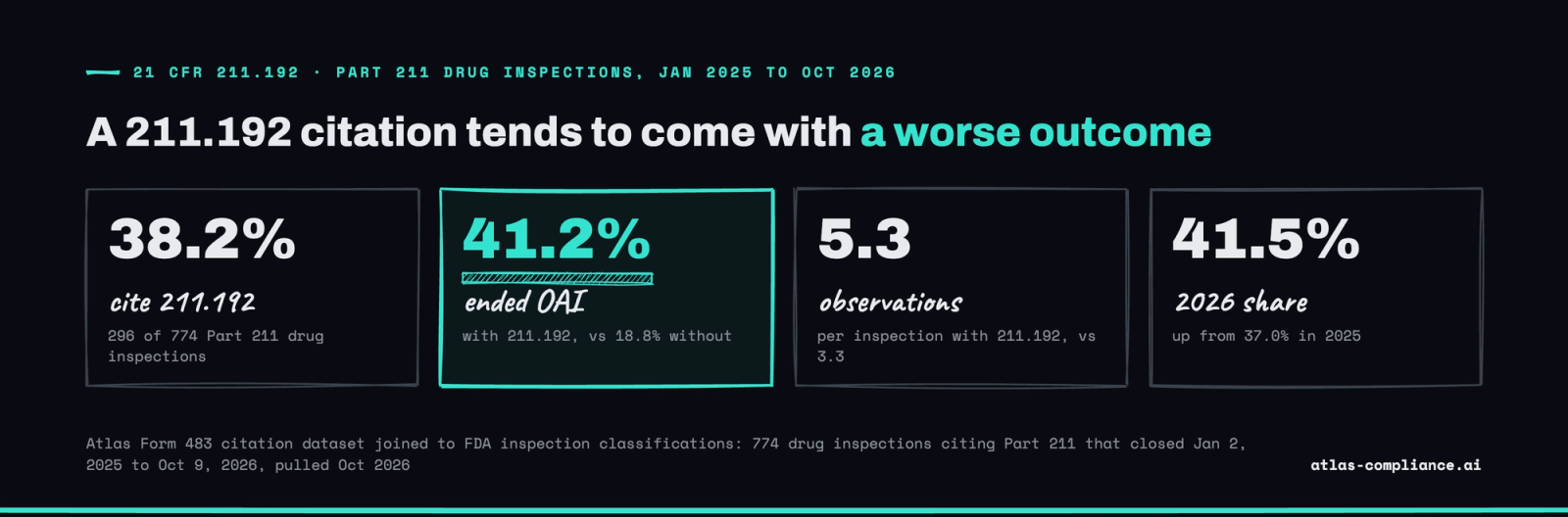
The citation does not cause the OAI on its own. Inspections that cite 211.192 are larger findings overall, averaging 5.3 observations against 3.3, and FDA classifies on the whole picture. The pattern still matters for a quality team: when an investigator writes up your investigations, the other observations on the form tend to be read as symptoms of the same weak quality system, and the NAI, VAI and OAI classification follows from that reading. Investigator habits differ as well, so the section an investigator has cited at your peers is worth knowing before the opening meeting.
 Atlas
See what the FDA knows about your next investigator.
30 minutes with the founder. No pitch deck.
What should a 211.192 investigation file contain?
A 211.192 investigation file should let an investigator follow the discrepancy from first record to closed CAPA without asking anyone to explain it. That means six parts: the recorded event, containment and impact, a root cause backed by evidence, the extended scope, a written conclusion with follow-up, and quality unit approval before the batch is released.
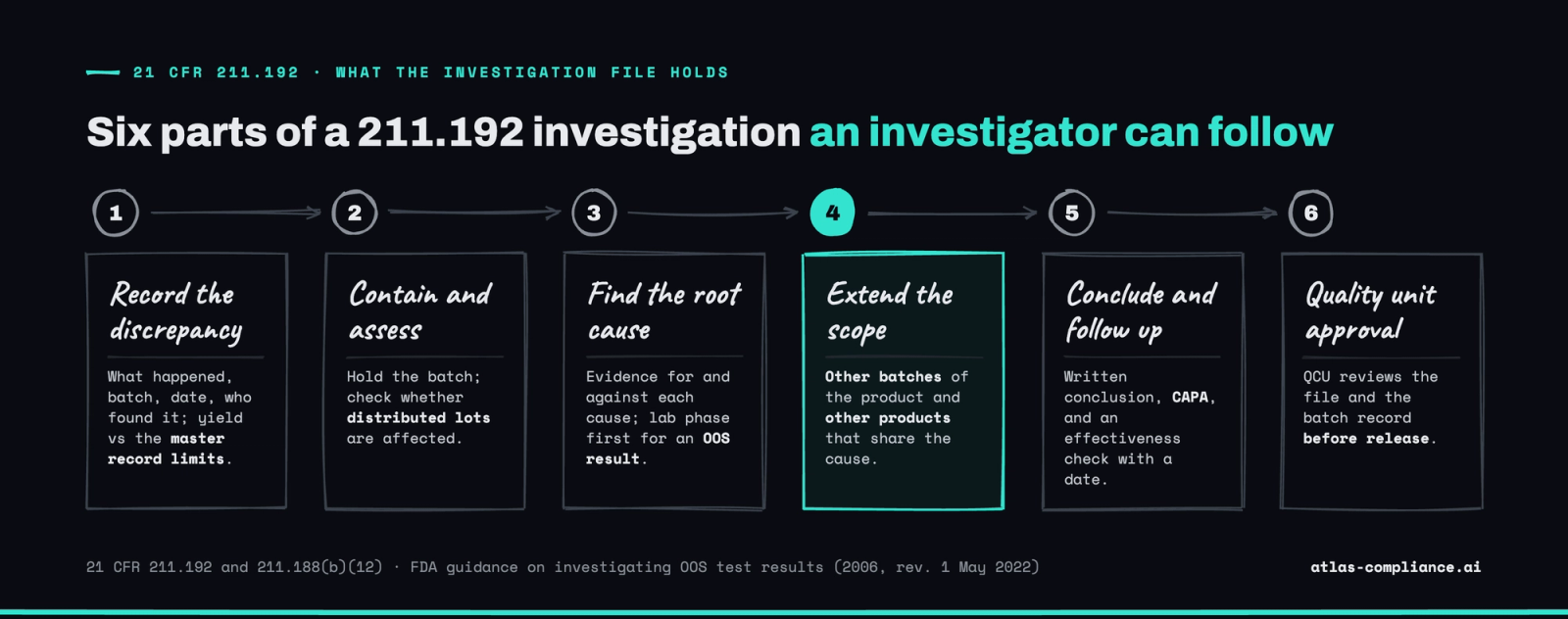
- Record the discrepancy: what happened, which batch, when, who found it, and the measured value against the master record limit or specification.
- Contain and assess: place the batch on hold, and check whether lots already distributed are affected, since the rule applies "whether or not the batch has already been distributed".
- Find the root cause: list the candidate causes and the evidence for and against each. For an OOS result, close the Phase I laboratory investigation before moving into production.
- Extend the scope: search other batches of the same product and other products that share the equipment, material lot, analyst or method. Write down what you searched and what you found, including a negative result.
- Conclude and follow up: state the root cause or, if none is proven, the most probable cause and what was ruled out; open CAPA with owners and dates; define the effectiveness check.
- Quality unit approval: the QCU reviews the investigation and the batch record together and approves before release, which is the first sentence of 211.192.
The 15 "Extent" citations in the dataset show where step 4 breaks. Firms investigate the failing lot well and stop there, with no record of checking the lots made on the same equipment that week. A one-line scope statement listing the lot numbers reviewed would have answered most of those observations. Step 5 links into your CAPA system, covered in our CAPA guide for pharma and medical devices.
How is 211.192 different from 211.100(b) and 211.22?
21 CFR 211.192 covers the investigation of a discrepancy and the review of records before release. 211.100(b) covers recording and justifying deviations from written production procedures at the time they happen. 211.22 sets the quality unit's authority and its written procedures. Investigators often cite two or all three for the same event.
| Section | What it governs | Typical observation |
|---|---|---|
| 211.100(b) | Following written production procedures; recording and justifying any deviation | Deviation not recorded or not justified |
| 211.192 | Record review before release; investigating unexplained discrepancies and failures | Root cause not supported; other batches not checked |
| 211.22 | Quality unit responsibilities and written QCU procedures | QCU procedures not written or not followed |
A deviation logged under 211.100(b) becomes a 211.192 matter as soon as nobody can explain it. If the quality unit then approves the batch with the investigation still open, 211.22(a) is in play too, since it gives the QCU the authority to review records "to assure that no errors have occurred or, if errors have occurred, that they have been fully investigated". On Form 483s the pairing is common: 42.6% of inspections citing 211.192 in the Atlas sample also cited 211.22.
New 211.192 citations arrive every month, and the digest below sends the ones that matter for investigation and release practice as FDA posts them.
AtlasFDA Inspection Intelligence Digest
We track every 483, EIR, and warning letter the moment it happens. Get the signals before they hit the FDA website.
Frequently asked questions
No. 21 CFR 211.192 sets no number of days. FDA's OOS guidance asks for investigations that are thorough, timely, unbiased, well documented and scientifically sound, and most firms write a target, often 30 days, into their deviation SOP with documented extensions. An investigation still open when the batch is released leaves the record without the conclusions 211.192 requires.

Written by
Bhavish Agarwal
Founder, Atlas
Bhavish Agarwal is the founder of Atlas and previously worked at Google and Microsoft. He has spent the past several years building regulatory data infrastructure for the pharmaceutical industry.