
Release testing in pharma is the laboratory testing a finished drug batch must pass against its final specifications before the quality unit releases it for distribution. In the United States the rule is 21 CFR 211.165, "Testing and release for distribution", which also covers microbiological testing, sampling plans, acceptance criteria, method validation and the rejection of failing batches.
This guide adds what FDA investigators wrote under the section: 109 Form 483 observations citing 211.165 at 102 drug inspections that closed between January 7, 2025 and September 3, 2026, from the Atlas Form 483 citation dataset (pulled October 2026) joined to FDA's inspection classifications.
Key facts:
- 21 CFR 211.165 appeared at 102 of 774 drug inspections that cited Part 211 (13.2%), the 11th most cited Part 211 section in the period.
- 39.4% of the 109 observations cite 211.165(a), a batch released without a laboratory check against its final specifications.
- 59.8% of inspections citing 211.165 ended Official Action Indicated (OAI), against 22.5% of Part 211 drug inspections without it.
- Inspections citing 211.165 averaged 6.4 observations, against 3.7 for the rest.
- 85 of the 102 inspections (83%) were at US facilities, including several small over-the-counter and topical drug makers.
What does 21 CFR 211.165 require?
21 CFR 211.165 requires that each batch of drug product be tested in a laboratory for conformance to its final specifications, including the identity and strength of each active ingredient, before release. The section adds five more duties: microbiological testing where the product must be free of objectionable microorganisms, written sampling plans, statistical acceptance criteria, validated test methods, and rejection of batches that fail.
The six paragraphs, as published in the eCFR, break down like this:
| Paragraph | Requirement | Evidence an investigator asks for |
|---|---|---|
| 211.165(a) | Each batch tested against final specifications, including identity and strength of each active, before release | Certificate of analysis tied to the batch, release date after test date |
| 211.165(b) | Testing for objectionable microorganisms where the product must be free of them | Microbial limits results per batch, rationale for any product without a test |
| 211.165(c) | Written sampling and testing plans with the sampling method and units per batch, followed | Sampling SOP, sampling record matching it |
| 211.165(d) | Acceptance criteria and statistical quality control criteria, with acceptance or rejection levels | Specification with limits, sampling plan statistics |
| 211.165(e) | Accuracy, sensitivity, specificity and reproducibility of test methods established and documented | Method validation or verification reports |
| 211.165(f) | Batches failing specifications rejected; reprocessed material must meet specifications before use | Rejection records, reprocessing approvals and retest results |
Paragraph (a) carries one exception: short-lived radiopharmaceuticals may ship before sterility or pyrogen testing is complete, provided the testing finishes as soon as possible. No other finished product gets that allowance in the regulation text.
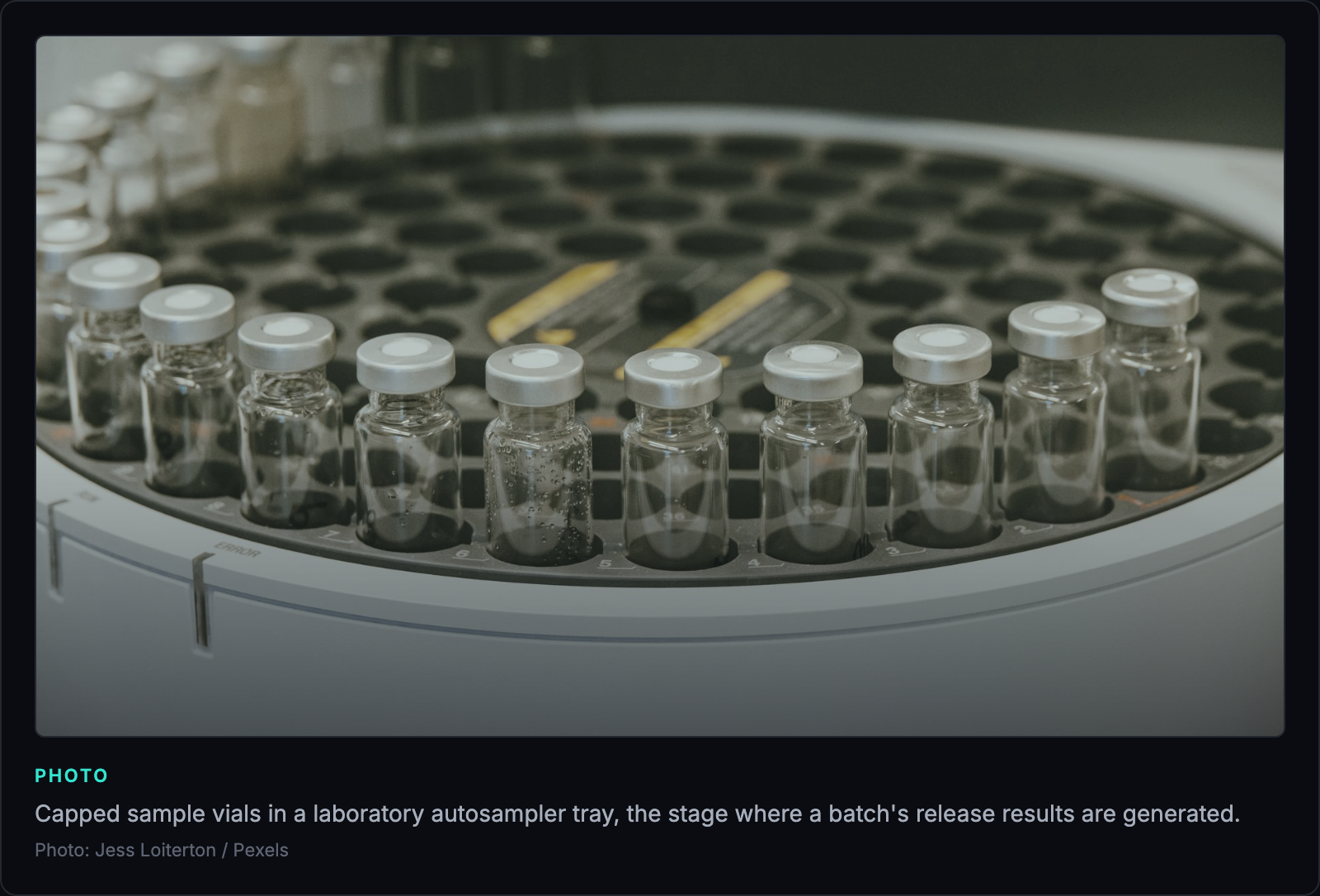
211.165 sits in Subpart I, laboratory controls, next to 211.160 (general laboratory requirements), 211.166 (stability testing) and 211.194 (laboratory records). Our 21 CFR Part 211 guide maps every subpart and how often FDA cites it.
How does release testing fit into batch release?
Release testing is one of two checks the quality control unit completes before it approves a batch. The laboratory confirms the batch meets its specifications under 211.165, and the quality unit reviews the production and control records under 211.192. Only then does the quality unit, which holds release authority under 211.22(a), approve or reject the batch.
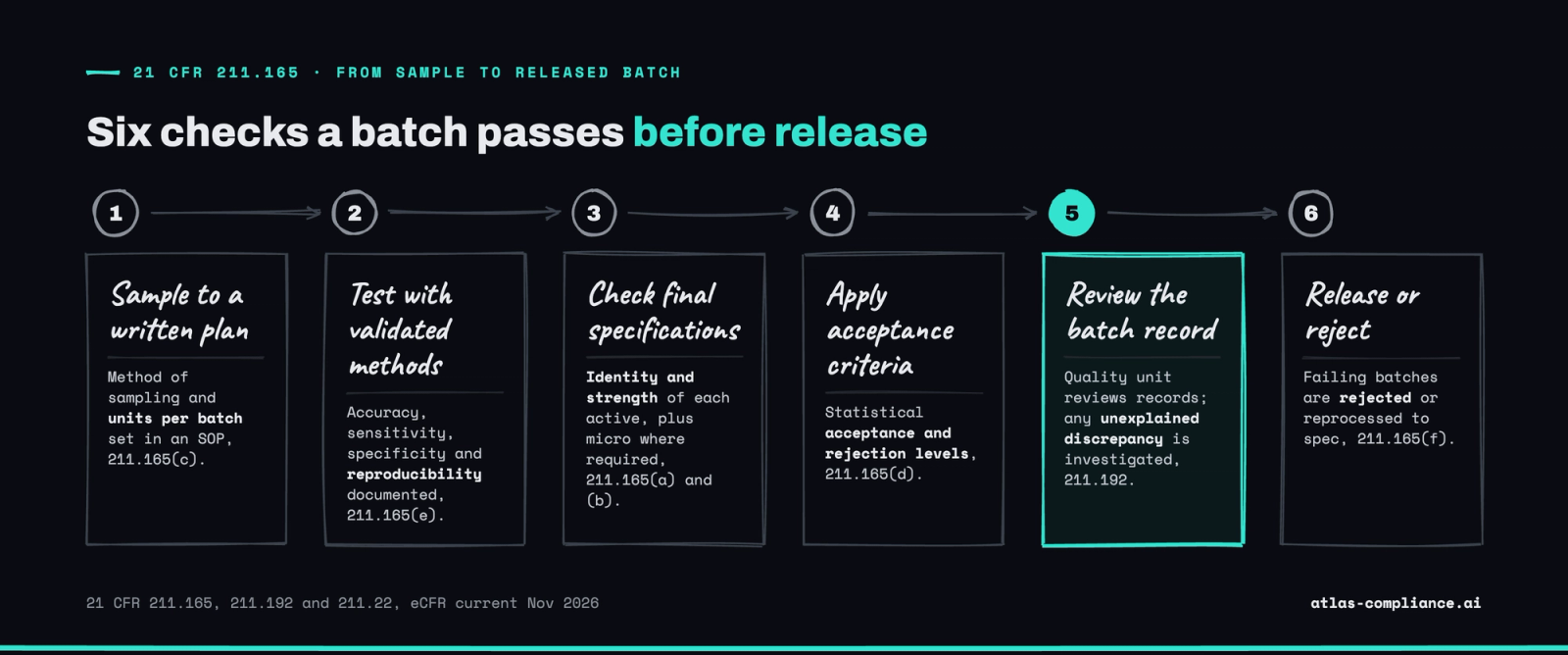
- Sample the batch to a written plan that states the sampling method and the number of units, as 211.165(c) requires.
- Test with methods whose accuracy, sensitivity, specificity and reproducibility are documented, per 211.165(e). Compendial methods still need verification under actual conditions of use, per 211.194(a)(2).
- Compare results with the final specification, including identity, strength and, where required, microbial limits.
- Apply the acceptance and rejection criteria written in the specification and sampling plan, per 211.165(d).
- Review the batch record and investigate any unexplained discrepancy or out-of-specification result under 211.192. Our post on 21 CFR 211.192 covers that review and the investigation file.
- Release the batch, or reject it under 211.165(f). Reprocessed material has to meet the specification again before use.
An out-of-specification result at step 3 stops the sequence. FDA's guidance "Investigating Out-of-Specification (OOS) Test Results for Pharmaceutical Production" (October 2006, Revision 1 May 2022) sets the laboratory and full-scale investigation phases. Our OOS explainer covers OOS vs OOT and when a retest is allowed.
How does FDA word 211.165 observations on a Form 483?
FDA writes most 211.165 observations under three paragraphs. In the 109 observations in the Atlas dataset, 43 (39.4%) cite 211.165(a), testing and release; 27 (24.8%) cite 211.165(b), microbiological testing; and 24 (22.0%) cite 211.165(e), test methods. Acceptance criteria (d), rejection of failing product (f) and sampling plans (c) account for the remaining 15.
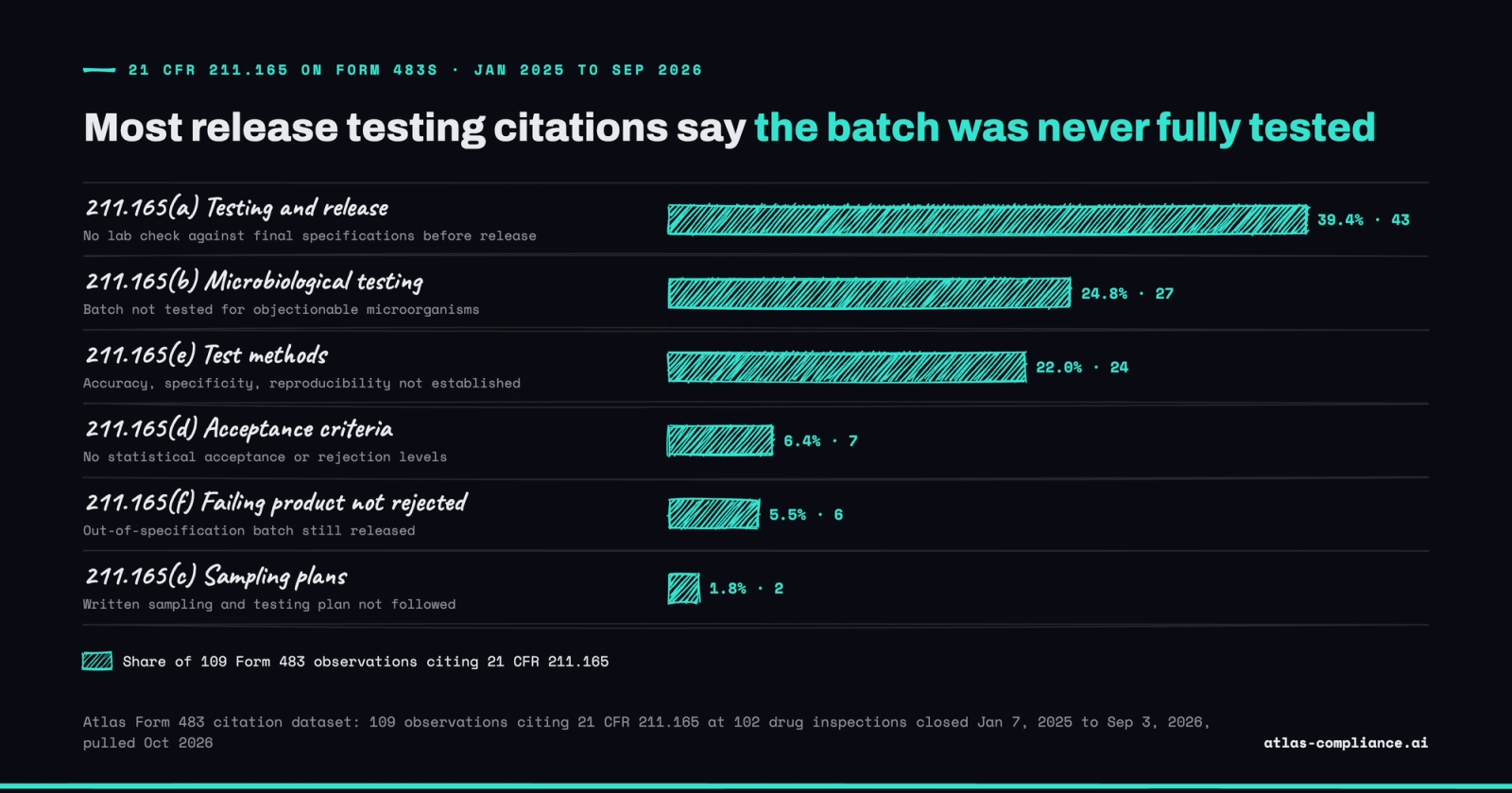
The standard citation sentences are short. The two most common, used 27 times each, read: "Testing and release of drug product for distribution do not include appropriate laboratory determination of satisfactory conformance to the final specifications" and "Each batch of drug product required to be free of objectionable microorganisms is not tested through appropriate laboratory testing." The method citation, used 16 times in two versions, says the "accuracy, sensitivity, specificity and reproducibility of test methods have not been established".
Paragraph (a) and (b) citations say a required test was missing from the release decision, either the check against final specifications or the microbial test. Paragraph (e) citations say a test ran with a method whose performance the firm never established for that product. The six observations under 211.165(f) are the most serious on paper, since they describe batches that failed a specification and were not rejected.
Which firms were cited under 211.165 in 2025 and 2026?
FDA cited 211.165 at sterile injectables makers, contract manufacturers and small over-the-counter firms. The table shows six recent forms from the FDA Form 483s directory, with the 211.165 paragraph cited, the other sections on the same form, and the final classification.
| Form 483 | Issued | 211.165 paragraph | Other sections cited | Classification |
|---|---|---|---|---|
| Unither Manufacturing, Rochester, US | May 15, 2026 | (b) microbiological testing; (d) acceptance criteria | 211.113(b), 211.142(b), 211.160(b), 211.166(a), 211.22(d), 211.67(b), 211.68(b) | OAI |
| Baxter Healthcare, Round Lake, US | Apr 2, 2026 | (d) acceptance and rejection levels | 211.100(b), 211.113(b), 211.160(a), 211.192, 211.25(a), 211.42(c), 211.63, 211.67(b) | OAI |
| Eugia Pharma Specialities, Sangareddy, India | Feb 6, 2026 | (a) testing and release | 211.113(b), 211.160(a), 211.167(a), 211.192, 211.194(a)(8), 211.22(d), 211.25(a), 211.42(c) | OAI |
| Sato Pharmaceutical, Hachioji, Japan | Nov 21, 2025 | (e) test methods | 211.113(b), 211.160(b), 211.166(a), 211.192, 211.22(a), 211.28(a), 211.42(c), 211.67(a) | OAI |
| Catalent Greenville, Greenville, US | Oct 24, 2025 | (b) microbiological testing | 211.166(a), 211.67(a) | VAI |
| Zhejiang Jingxin Pharmaceutical, Shaoxing, China | Oct 17, 2025 | (b) microbiological testing | 211.84(d)(1) | VAI |
In the table, the two short forms, Catalent Greenville with three observations and Zhejiang Jingxin with two, ended VAI. On the longer forms the citation sits beside sterile processing (211.113(b)), laboratory controls (211.160) and investigations (211.192), and all four ended OAI. Across all 102 inspections, the most common companions were 211.22 (59 of the 102 inspections), 211.84 component testing (53), 211.192 (44), 211.100 (42) and 211.67 (41).
What happens after a 211.165 citation?
A 211.165 citation tends to come with a worse inspection outcome. Of the 102 drug inspections that cited it, 61 (59.8%) were classified Official Action Indicated, meaning FDA considered regulatory action such as a warning letter. Among the 672 Part 211 drug inspections without the citation, 151 (22.5%) ended OAI.
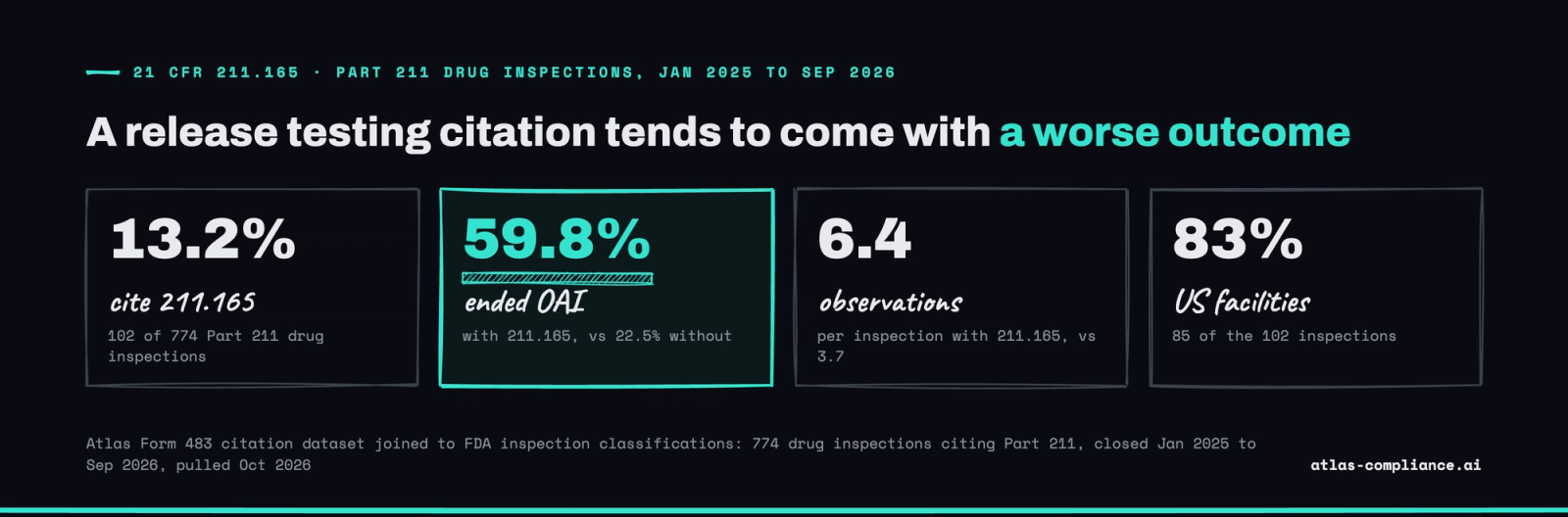
The citation does not drive the OAI on its own. Inspections that cite 211.165 are bigger findings overall, averaging 6.4 observations against 3.7, and FDA classifies on the whole inspection. Still, a product that shipped without full release testing is hard to defend, because nobody can show the released lots met their specification. The NAI, VAI and OAI explainer covers what each classification leads to.
The share fell between years: 211.165 appeared at 83 of 562 Part 211 drug inspections in 2025 (14.8%) and 19 of 212 in 2026 through September (9.0%). Foreign facilities drew it at 17 of 142 inspections (12.0%), close to the US rate of 85 of 632 (13.4%). Before an inspection, it helps to know whether the investigator assigned to you has written up release testing at your peers.
 Atlas
See what the FDA knows about your next investigator.
30 minutes with the founder. No pitch deck.
How is US batch release different from EU QP release?
US batch release is a decision of the quality control unit as an organization, under 21 CFR 211.22(a) and 211.165. EU batch release requires a named Qualified Person to certify each batch in a register before release, under Article 51 of Directive 2001/83/EC and EU GMP Annex 16 (in force since April 15, 2016). Both systems require testing against the specification.
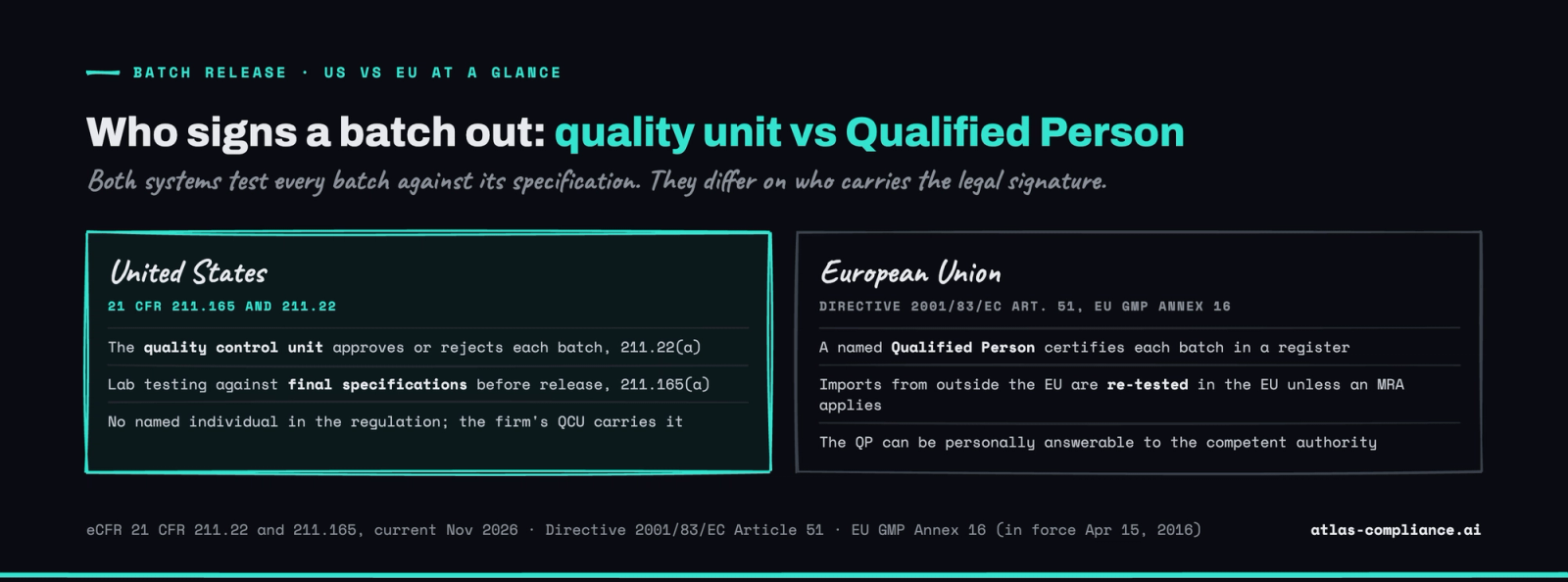
Two practical differences follow. Batches imported into the EU from a third country are re-tested in the EU unless a mutual recognition agreement covers the exporting country. In the US, a contract laboratory can run the release tests, but the owner's quality unit still makes the release decision, a point FDA's guidance "Contract Manufacturing Arrangements for Drugs: Quality Agreements" (November 2016) spells out. Our post on FDA quality agreements covers how to split those duties in the contract.
Release testing citations reach the Form 483 database every month, and the digest below sends the new ones as FDA posts them.
AtlasFDA Inspection Intelligence Digest
We track every 483, EIR, and warning letter the moment it happens. Get the signals before they hit the FDA website.
Frequently asked questions
Batch release tests are set by the product's specification. A typical finished-product specification covers appearance, identity, assay (strength) of each active ingredient, impurities or degradation products, dissolution or disintegration for solid oral forms, uniformity of dosage units, and microbial limits for non-sterile products. Sterile products add sterility and bacterial endotoxins testing.

Written by
Bhavish Agarwal
Founder, Atlas
Bhavish Agarwal is the founder of Atlas and previously worked at Google and Microsoft. He has spent the past several years building regulatory data infrastructure for the pharmaceutical industry.