
Aseptic processing is a sterile manufacturing method that sterilizes the drug product, its container and its closure separately and then fills and seals them in a controlled clean environment, with no sterilization step after the container is closed. In the United States, FDA holds it to 21 CFR 211.113(b) and to its September 2004 guidance, "Sterile Drug Products Produced by Aseptic Processing".
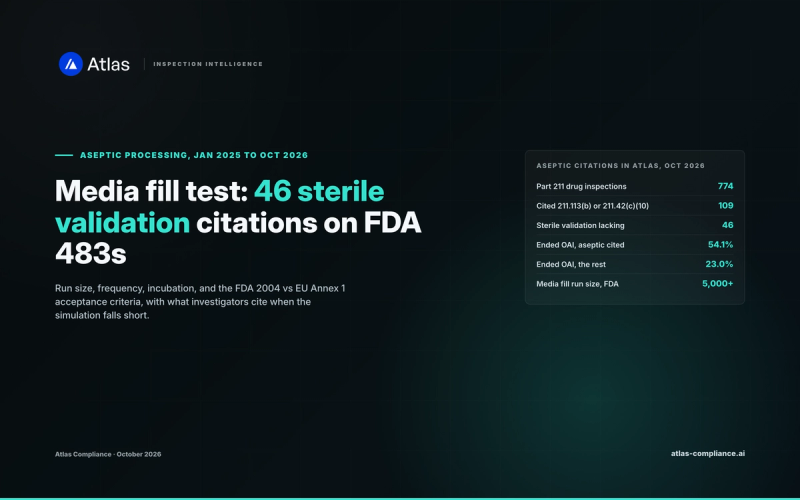
This guide covers what that guidance and the regulation ask for, and adds how FDA investigators wrote up aseptic shortfalls: the exact wording of the 211.113(b) citation at 98 inspections, from the Atlas Form 483 citation dataset (774 drug inspections citing 21 CFR Part 211 that ended January 7, 2025 to September 3, 2026, pulled October 21, 2026).
Key facts:
- 21 CFR 211.113(b) requires written procedures to prevent microbiological contamination of drug products purporting to be sterile, and says those procedures "shall include validation of all aseptic and sterilization processes."
- FDA's 2004 guidance sets the critical area at Class 100 (ISO 5), no more than 3,520 particles of 0.5 µm and larger per cubic meter, and asks for at least Class 10,000 (ISO 7) in the area next to the line.
- In the Atlas dataset, 98 of 774 Part 211 drug inspections (12.7%) cited 211.113(b), and 53 of those 98 (54.1%) ended Official Action Indicated (OAI).
- FDA's heading "Procedures for sterile drug products" appeared at 78 of the 98 inspections, and at 55 of the 78 the wording said the procedure was "not established".
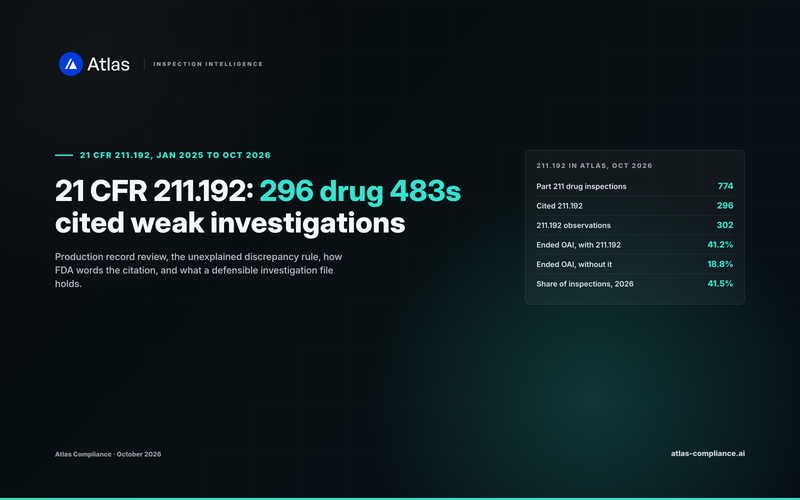
- 61 of the 98 inspections (62.2%) also cited 21 CFR 211.192 for investigations, against 34.8% of the other 676.
What is aseptic processing?
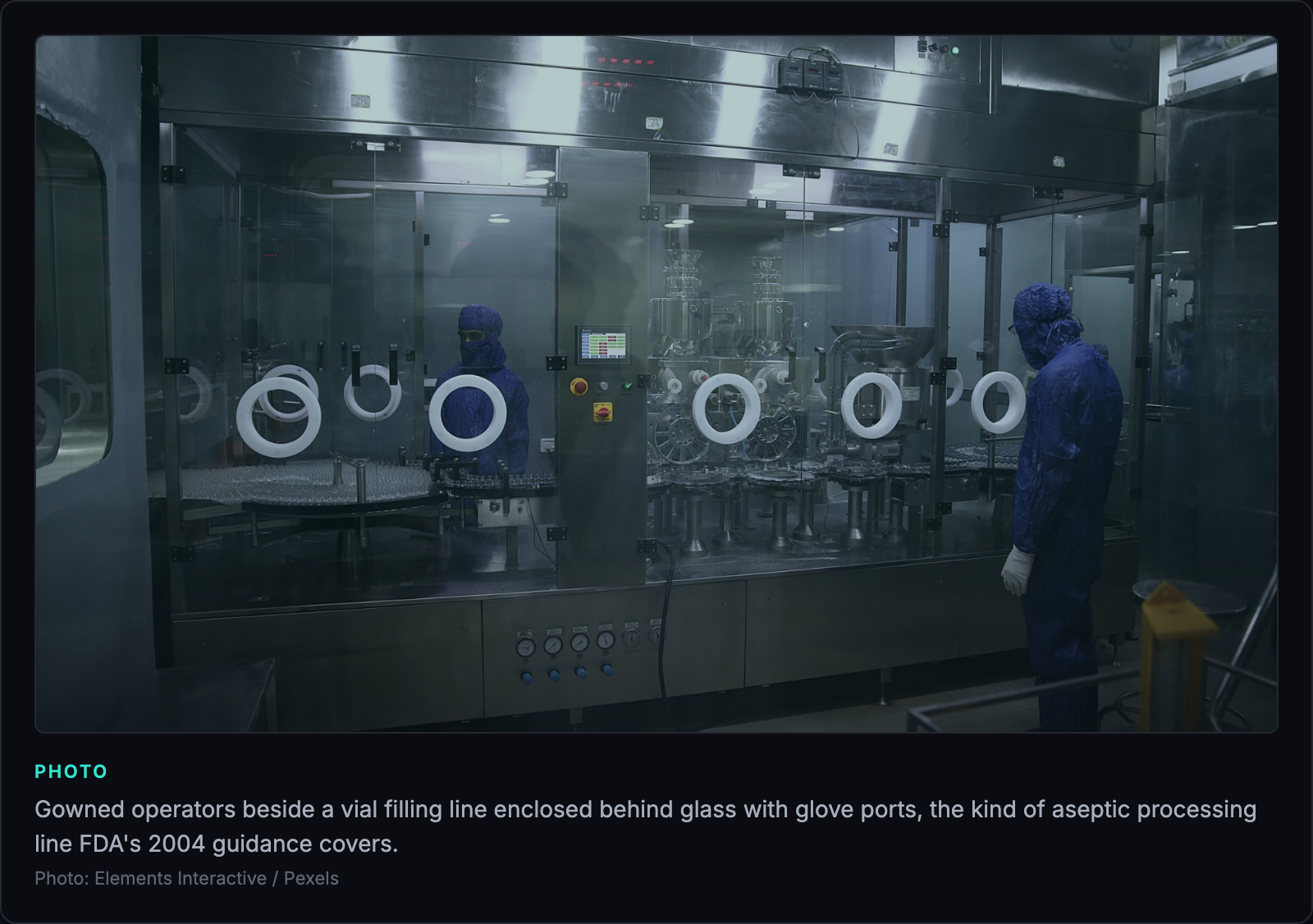
Aseptic processing is the route to a sterile drug product in which each part is sterilized on its own before assembly: liquid product by filtration, glass containers by dry heat and rubber closures by moist heat, in the examples FDA's 2004 guidance gives. The parts meet in a Class 100 (ISO 5) critical area, and no further sterilization follows once the container is sealed.
Terminal sterilization runs in the opposite order. The firm fills and seals the product under clean conditions, then sterilizes the sealed unit with heat or irradiation. The guidance spells out why FDA treats the two routes differently: aseptic processing "involves more variables", every manual or mechanical manipulation can introduce contamination, and a footnote records that nearly all drugs recalled for nonsterility between 1980 and 2000 were made by aseptic processing.
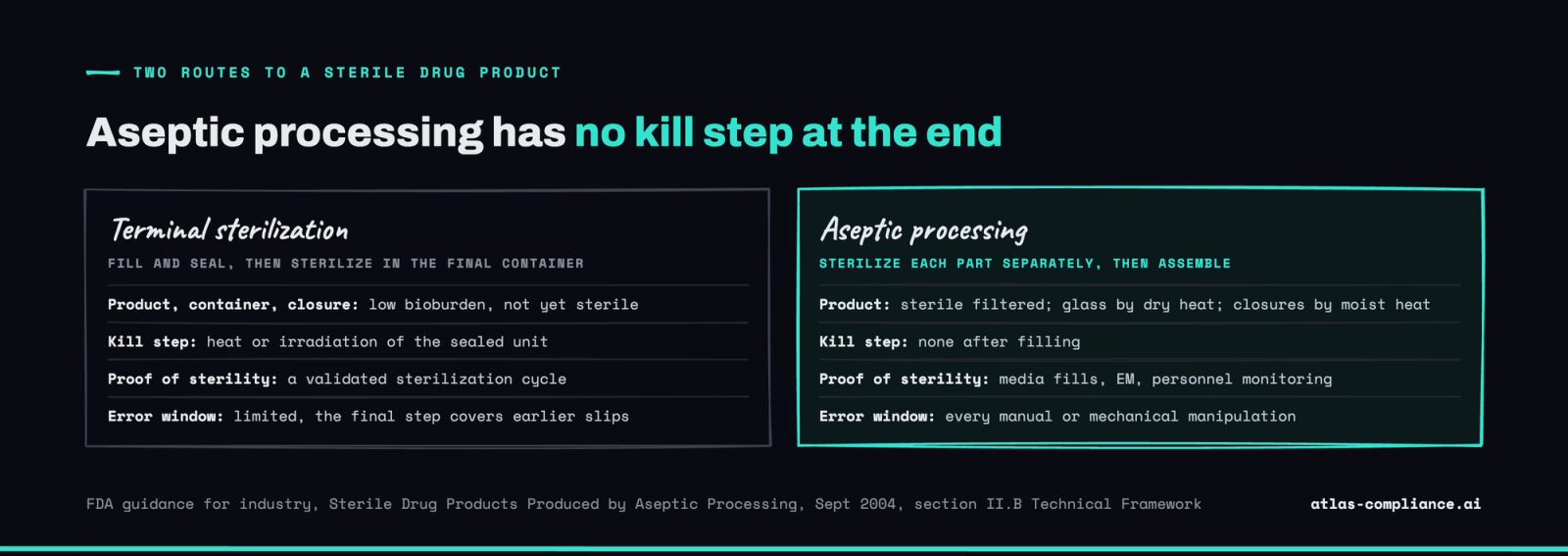
FDA's guidance states the preference in one sentence: sterile drugs should be made by aseptic processing "only when terminal sterilization is not feasible." Products that cannot take heat or irradiation in their final container have no terminal option, so they go through an aseptic line.
What does FDA's aseptic processing guidance require?
FDA's aseptic processing guidance requires, in practice, a classified facility built around an ISO 5 critical area, qualified and monitored people, validated sterilization of every component, time limits, validated aseptic processes, an environmental monitoring program and a batch record review that includes monitoring data. The guidance is nonbinding, but investigators read Part 211 through it, and it organizes those topics into sections IV to XII.
Table 1 of the guidance sets the air classes:
| Clean area class | ISO class | Particles 0.5 µm and larger per m³ | Active air action level (CFU/m³) | Settle plate action level (CFU per 4 h) | Typical use in the guidance |
|---|---|---|---|---|---|
| Class 100 | ISO 5 | 3,520 | 1 (normally no growth) | 1 (normally no growth) | Critical area: exposed sterile product, containers, closures |
| Class 1,000 | ISO 6 | 35,200 | 7 | 3 | Optional class for the area around the line |
| Class 10,000 | ISO 7 | 352,000 | 10 | 5 | Minimum for the area adjacent to the aseptic line |
| Class 100,000 | ISO 8 | 3,520,000 | 100 | 50 | Less critical work, such as equipment cleaning |
Four further numbers from section IV come up in inspections:
- Air velocity in the critical area of 0.45 meters per second (90 feet per minute), plus or minus 20 percent around the setpoint, as a generally established value.
- A positive pressure differential of at least 10 to 15 pascals between adjacent rooms of differing classification, with doors closed.
- At least 12.5 pascals of overpressure from the aseptic processing room to any unclassified room next to it.
- At least 20 air changes per hour for Class 100,000 (ISO 8) supporting rooms.
Particle counts in the critical area should come from locations normally not more than 1 foot from the work site, during filling and closing, and FDA asks for monitoring during each production shift. The EU applies its own grades through Annex 1; our EU GMP Annex 1 guide sets the two systems side by side.
What does 21 CFR 211.113(b) require?
21 CFR 211.113(b) requires two things: appropriate written procedures, "designed to prevent microbiological contamination of drug products purporting to be sterile", that are established and followed, and validation of all aseptic and sterilization processes inside those procedures (eCFR, 21 CFR 211.113). FDA has one standard citation heading for each half: "Procedures for sterile drug products" and "Validation lacking for sterile drug products".
The facility side of the same program sits in 21 CFR 211.42(c)(10), which lists what an aseptic processing area includes "as appropriate" (eCFR, 21 CFR 211.42):
- (i) smooth, hard, easily cleanable floors, walls and ceilings
- (ii) temperature and humidity controls
- (iii) HEPA-filtered air under positive pressure, laminar or not
- (iv) a system for monitoring environmental conditions
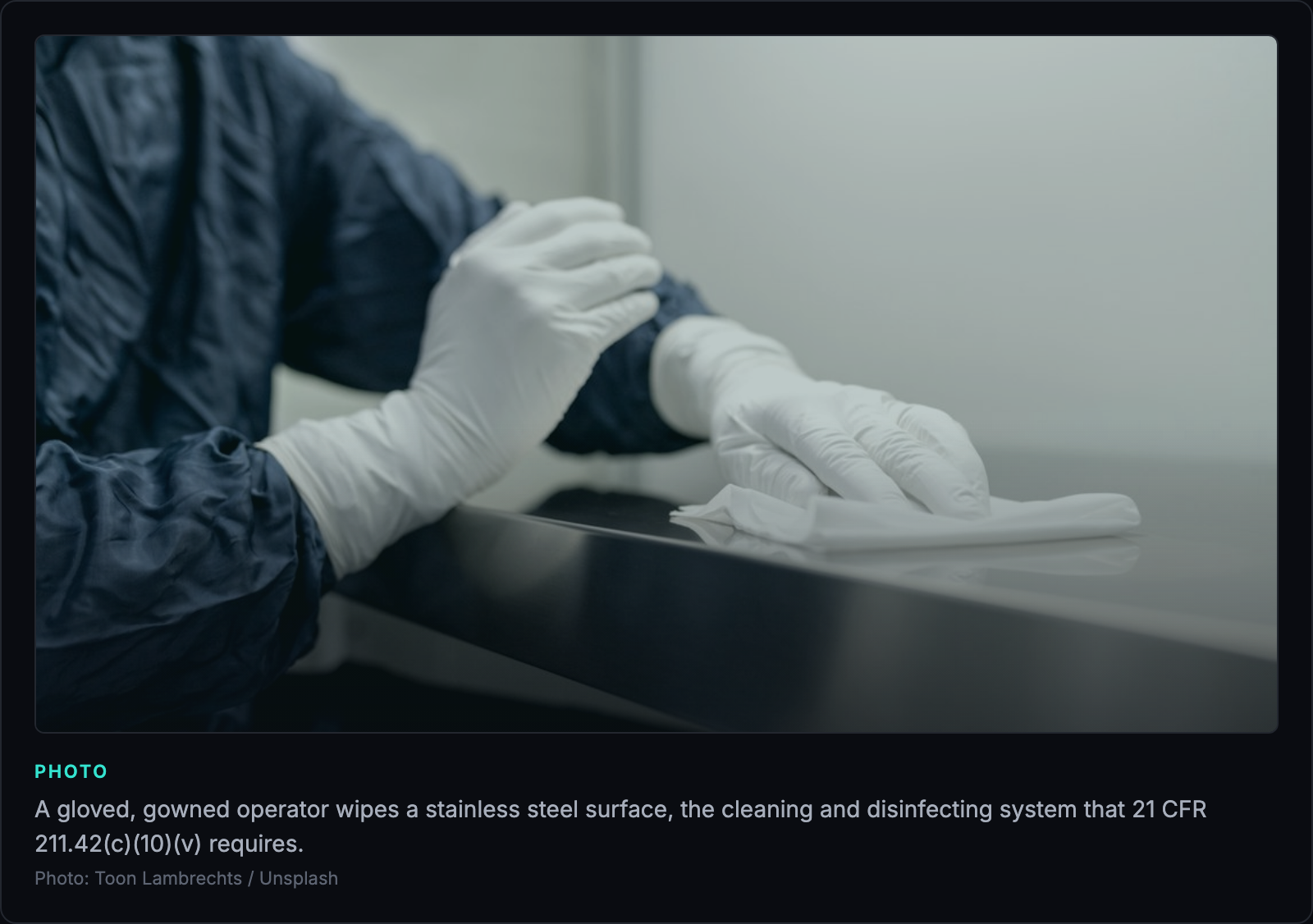
- (v) a system for cleaning and disinfecting the room and equipment
- (vi) a system for maintaining equipment that controls aseptic conditions
The validation half covers sterilization cycles, sterilizing filters and the aseptic process itself, which a firm proves with media fills. Run size, incubation and acceptance criteria for media fills are in our media fill test guide.
How does FDA word a 211.113(b) citation on Form 483s?
FDA words most 211.113(b) procedure citations as a missing procedure. Of the 78 inspections that drew the heading "Procedures for sterile drug products" from January 2025 to September 2026, 55 (70.5%) used wording that included "not established", and 18 said only "not followed", meaning a written procedure existed and the investigator saw operators depart from it.
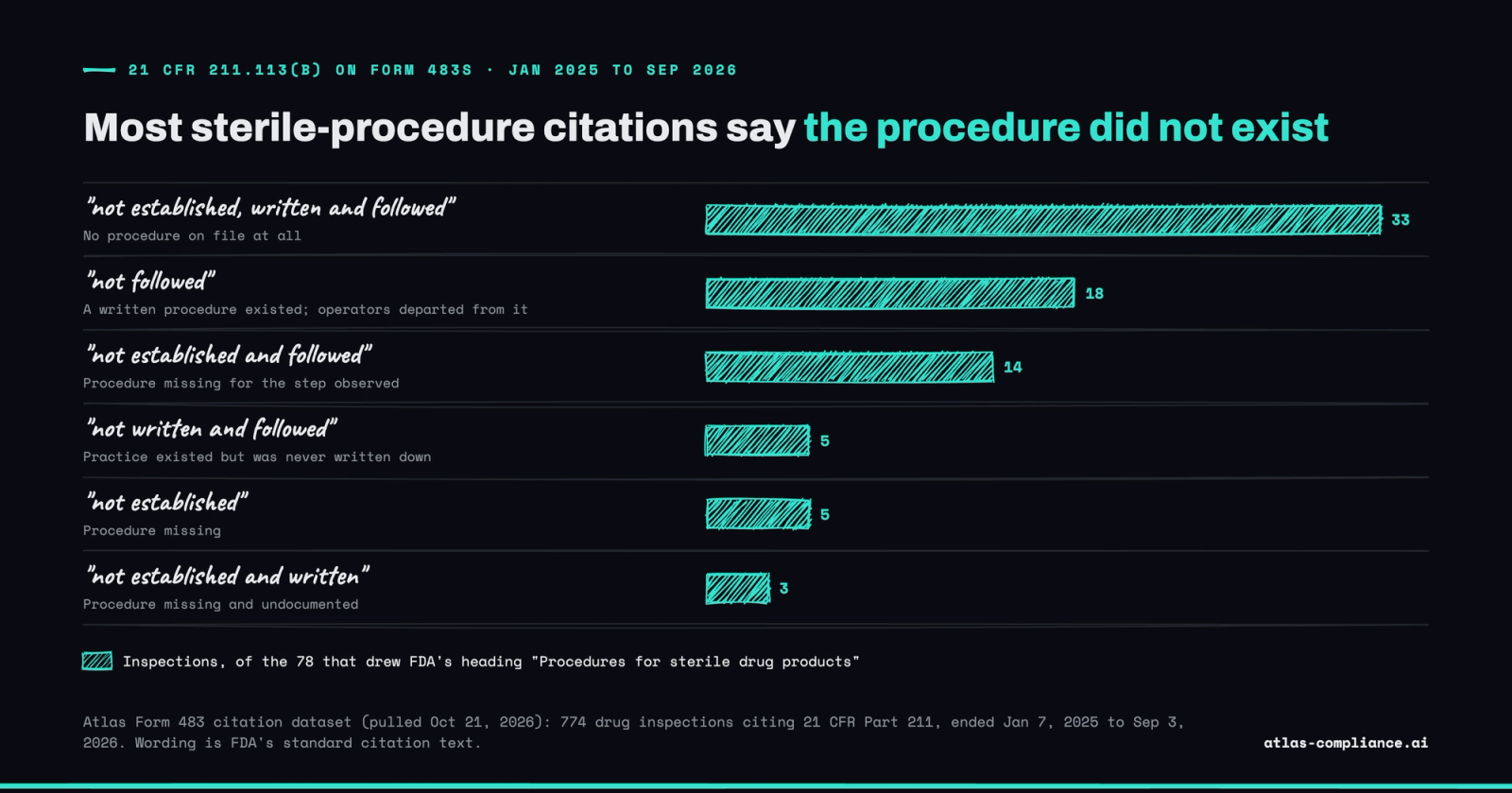
The split matters for the response. A "not followed" observation asks the firm to show retraining, supervision and an investigation of the event. A "not established" observation asks for a new or rewritten procedure, which usually means a gap assessment against the 2004 guidance across every aseptic step.
The validation heading appeared at 46 inspections, and 26 inspections carried both headings. Across all 98, 69 were US facilities and 29 foreign, so 20.4% of the 142 foreign Part 211 drug inspections cited 211.113(b), against 10.9% of the 632 in the US. Recent forms in the FDA Form 483 database show the range:
| Form 483 | Inspection ended | 211.113(b) wording | Other Part 211 sections on the form | Classification |
|---|---|---|---|---|
| Unither Manufacturing, Rochester, US | May 15, 2026 | Not established, written and followed | 211.142(b), 211.160(b), 211.165(b), 211.165(d), 211.166(a), 211.22(d), 211.67(b), 211.68(b) | OAI |
| Altaire Pharmaceuticals, Aquebogue, US | Apr 21, 2026 | Not established and followed | 211.100(a), 211.192, 211.22(d), 211.25(a), 211.42(c)(10)(iv), 211.42(c)(10)(v), 211.68(b) | OAI |
| Sharp Sterile Manufacturing, Lee, US | Mar 5, 2026 | Not followed | 211.192, 211.22(d), 211.42(c)(10)(v), 211.56(a), 211.67(a) | OAI |
| Eugia Pharma Specialities, Sangareddy, India | Feb 6, 2026 | Not established, written and followed; validation of the aseptic process lacking | 211.160(a), 211.165(a), 211.167(a), 211.192, 211.194(a)(8), 211.22(d), 211.25(a), 211.42(c)(10)(iv), 211.42(c)(10)(vi) | OAI |
| American Regent, New Albany, US | Jan 29, 2026 | Not followed | 211.192, 211.22(d), 211.84(e) | VAI |
Two of these forms share an investigator. Syeda N Mahazabin is listed on both the Sharp Sterile and Unither forms, and Atlas records 52 inspections across 51 sites with 194 Form 483 observations attributed to the investigator since October 2021. Pharmaceutics International in Cockeysville (March 6, 2026, OAI) also drew both 211.113(b) headings.
What else does an aseptic processing citation bring with it?
An aseptic processing citation under 211.113(b) usually arrives with an investigations finding and a facility finding. In the Atlas dataset, 61 of the 98 inspections (62.2%) also cited 211.192, against 34.8% of the other 676 Part 211 drug inspections, and 54 (55.1%) also cited 211.42(c)(10), against 1.6% of the rest.
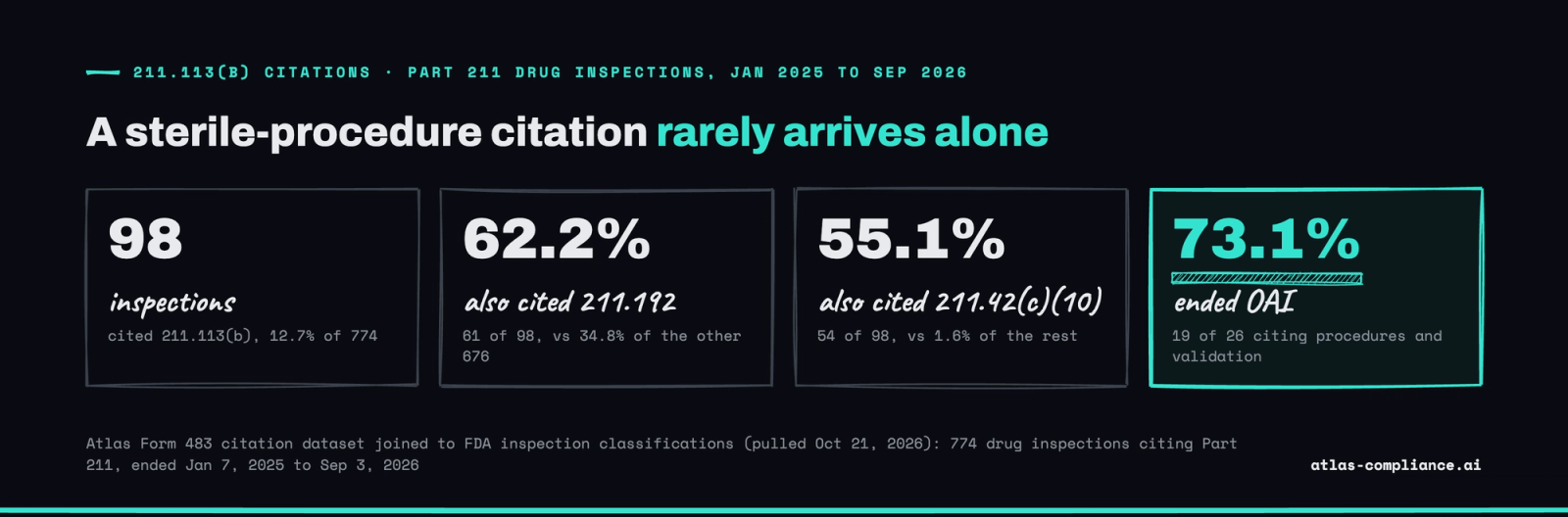
The most common companions after those two were 211.100(a) for written production procedures (31 inspections), 211.22(d) for quality unit procedures (30), 211.42(c)(10)(iv) for environmental monitoring (29) and 211.42(c)(10)(v) for cleaning and disinfecting (28). Laboratory controls under 211.160(b) followed at 24.
Outcomes track the combination. Of the 52 inspections citing only the procedures heading, 26 ended OAI (50.0%). Of the 20 citing only validation, 8 did (40.0%). Of the 26 citing both, 19 did (73.1%). Across all 98 the OAI rate was 54.1%, against 23.5% for the other 676, and the 98 averaged 6.1 Part 211 citations per inspection against 3.8. Our explainer on NAI, VAI and OAI covers what an OAI classification sets off. Endotoxin control sits inside the same section; the endotoxin testing guide covers that side.
The investigators who write these observations have track records you can read before they arrive, including which Part 211 sections they cite at sterile facilities like yours.
 Atlas
See what the FDA knows about your next investigator.
30 minutes with the founder. No pitch deck.
What records make up a defensible 211.113(b) file?
A defensible 211.113(b) file is the set of approved procedures and completed records that shows each aseptic control exists, is followed and was validated. Built from sections IV to XII of FDA's 2004 guidance, it has six parts:
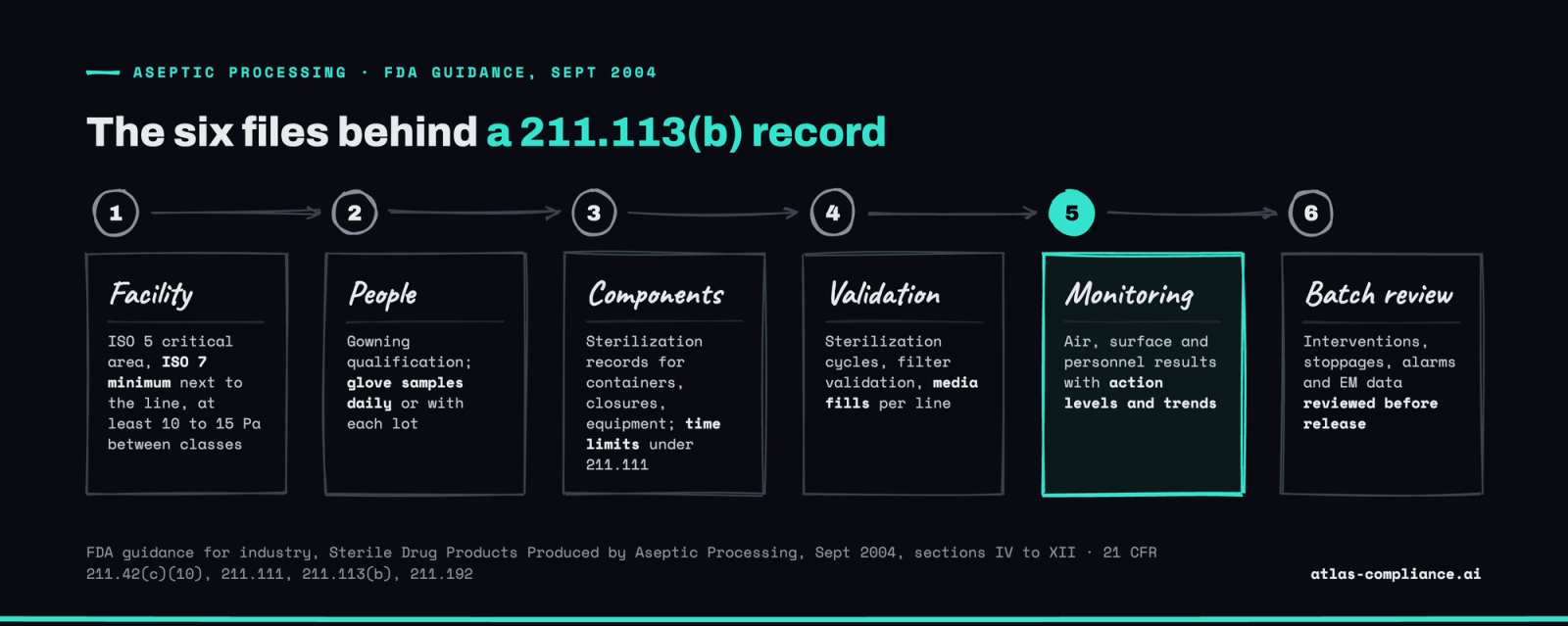
- Facility. Room classification reports under dynamic conditions, in situ airflow pattern studies with written conclusions, and pressure differential data. FDA asks for continuous monitoring of differentials throughout each shift, frequent recording, documentation of every alarm and an investigation of each deviation from limits.
- People. Gowning procedures, initial and periodic gowning qualification, and personnel monitoring results. The guidance asks for surface samples of each operator's gloves daily or with each lot, plus other gown locations.
- Components. Sterilization and depyrogenation records for containers, closures and equipment, and time limits for each phase under 21 CFR 211.111, including the span from compounding to sterilization and the maximum filtration time.
- Validation. Sterilization cycle studies, sterilizing filter validation and media fill reports for each line.
- Monitoring. Air, surface and personnel results against written action levels, with trend reviews and an investigation of each contamination event in the critical area.
- Batch review. Batch records that log interventions, line stoppages and their time and duration, alarms and power disruptions, reviewed with the monitoring data before release.
The sixth file is where a 211.113(b) gap turns into a 211.192 finding. The guidance quotes 211.192 in full in section XII: every unexplained discrepancy is investigated, the investigation extends to other batches, and the written record includes conclusions and follow-up. Our 21 CFR 211.192 guide covers what investigators expect in that record.
Before an inspection, test each file with the question the wording table above implies. Does a procedure exist for the step? Is it approved? Do the batch records show operators following it? The 18 "not followed" citations came from facilities that could answer yes to the first two.
Is aseptic processing regulated the same way for food?
Aseptic processing of food falls under a different rule. FDA regulates low-acid canned foods made by aseptic processing and packaging systems under 21 CFR 113.40(g), which covers product sterilizers, temperature-indicating devices and the aseptic surge tank. Part 211 and the 2004 drug guidance apply to drugs and biologics, not to those food lines.
New aseptic processing citations reach the Form 483 record every month, and the digest sends the sterile-facility findings as FDA releases them.
AtlasFDA Inspection Intelligence Digest
We track every 483, EIR, and warning letter the moment it happens. Get the signals before they hit the FDA website.
Frequently asked questions
FDA prefers terminal sterilization because the product is sterilized in its sealed final container, which limits the chances for error. Its 2004 guidance calls aseptic processing appropriate only when terminal sterilization is not feasible, since each separately sterilized part and each manipulation adds a contamination risk. The guidance also notes that nearly all drugs recalled for nonsterility from 1980 to 2000 were aseptically processed.

Written by
Bhavish Agarwal
Founder, Atlas
Bhavish Agarwal is the founder of Atlas and previously worked at Google and Microsoft. He has spent the past several years building regulatory data infrastructure for the pharmaceutical industry.