
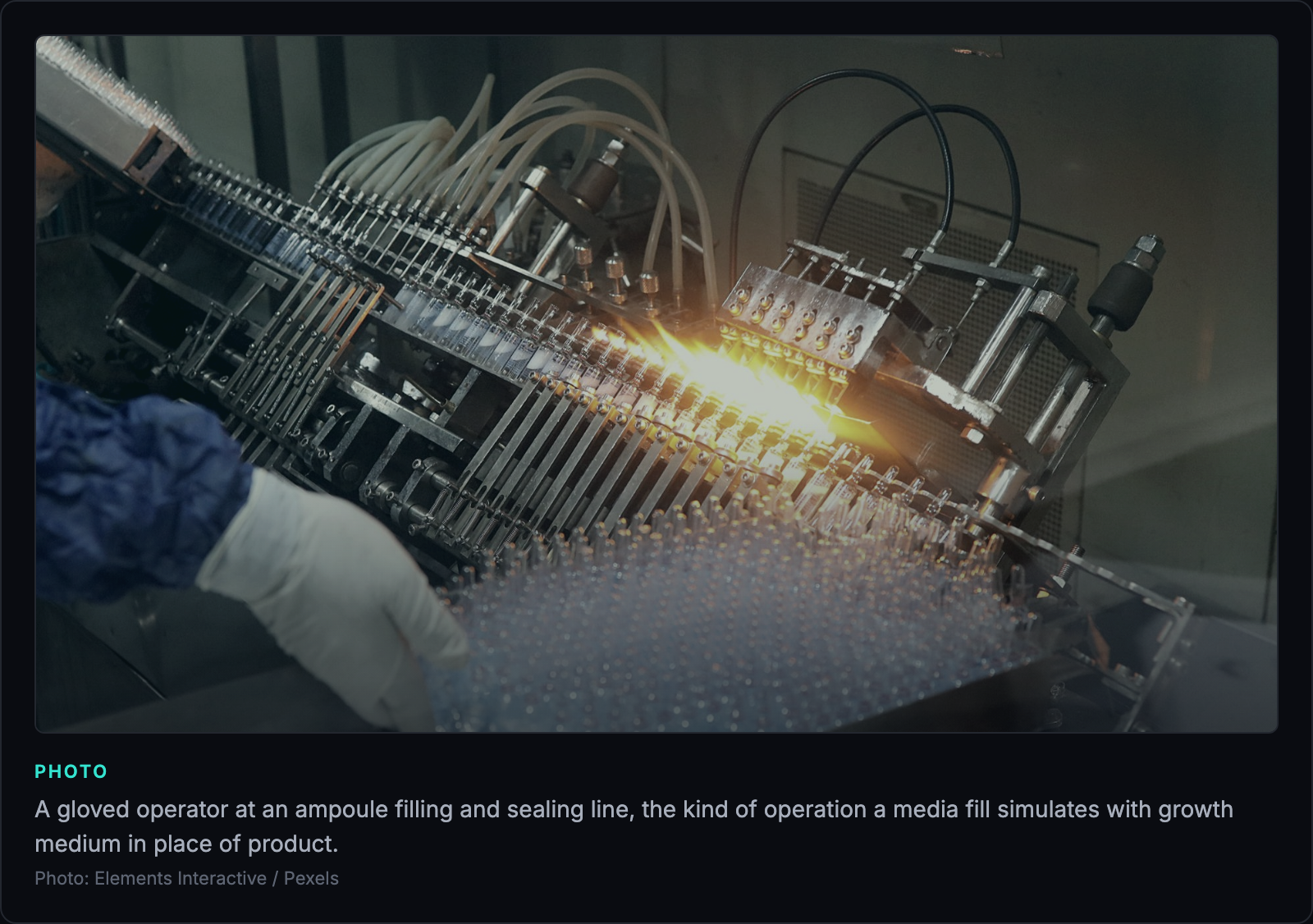
A media fill test is an aseptic process simulation in which a sterile manufacturing line fills a microbial growth medium in place of the drug product, so that any contamination the process lets in will grow and show up after incubation. It is how a manufacturer proves to FDA and EU inspectors that its aseptic process is validated.
This guide sets the FDA 2004 aseptic processing guidance against EU GMP Annex 1 (2022) number by number, and adds what FDA investigators wrote when aseptic controls fell short: citations from 774 drug inspections that cited 21 CFR Part 211 and closed between January 2, 2025 and October 9, 2026, from the Atlas Form 483 citation dataset (pulled October 2026).
Key facts:
- FDA's guidance "Sterile Drug Products Produced by Aseptic Processing" (September 2004) recommends at least three consecutive successful media fills to qualify a line, then semi-annual runs for each line.
- A run of 5,000 to 10,000 units is FDA's starting point; for batches under 5,000 units, the media fill should at least equal the largest batch made on the line.
- Media-filled units are incubated for at least 14 days at 20 to 35 °C; with two temperatures, at least 7 days at each, lower temperature first.
- EU GMP Annex 1, in force since August 25, 2023, sets a target of zero growth: any contaminated unit means a failed simulation.
- In the Atlas dataset, 46 of 774 Part 211 drug inspections (5.9%) carried FDA's citation "Validation lacking for sterile drug products" under 21 CFR 211.113(b), and 27 of those 46 ended Official Action Indicated (OAI).
What is a media fill test?
A media fill test, also called an aseptic process simulation (APS), runs the aseptic part of a sterile manufacturing process with a sterile nutrient medium instead of product. The filled units are incubated and inspected; growth in any unit shows that the process, the environment or the people let microorganisms in.
The legal hook in the United States is 21 CFR 211.113(b), which requires written procedures to prevent microbiological contamination of sterile drug products and says those procedures "shall include validation of all aseptic and sterilization processes" (eCFR, 21 CFR 211.113). Terminal sterilization can be validated with biological indicators and heat distribution studies. An aseptic process has no lethal step after filling, so the media fill is the only practical way to show it works.
FDA's 2004 guidance names soybean casein digest medium as the general choice and says anaerobic media such as fluid thioglycollate should be considered in special circumstances. The medium must pass growth promotion with a challenge of fewer than 100 CFU, using USP indicator organisms and, where they better represent the facility, environmental and sterility test isolates. Our explainer on 503B outsourcing facilities covers the compounders that must meet the same CGMP rules.
How often should a media fill be performed?
A media fill should be performed three times in a row to qualify a new aseptic line, then twice a year for each line, according to FDA's 2004 guidance. EU GMP Annex 1 (paragraph 9.38) asks for the same three consecutive runs covering all working shifts, then a repeat roughly every six months for each aseptic process, each filling line and each shift.
| Requirement | FDA guidance (2004) | EU GMP Annex 1 (2022) |
|---|---|---|
| Initial qualification | At least 3 consecutive separate successful runs | At least 3 consecutive satisfactory runs covering all working shifts |
| Routine requalification | Semi-annual for each processing line, with each shift's activities built in | About every six months for each process, filling line and shift |
| Operators | Everyone authorized to enter the aseptic room, at least once a year | Each operator in at least one successful APS a year |
| Manual operations | Run length no shorter than the actual process | Each operator in 3 initial runs, then one about every 6 months |
| Triggers for revalidation | Facility, equipment, line or closure changes, extended shutdowns, sterility test positives | Significant changes to HVAC, equipment, process, shifts or staff numbers; long periods out of use |
Compounding pharmacies follow a separate track. USP General Chapter <797>, in the revision official since November 1, 2023, folds the media-fill test into each compounder's aseptic manipulation competency, repeated every 6 months for Category 1 and 2 compounding and every 3 months for Category 3.
How many units does a media fill need?
A media fill needs enough units to mimic commercial production; FDA's 2004 guidance gives 5,000 to 10,000 units as a generally acceptable starting point. For operations with batches under 5,000 units, the run should at least equal the largest batch made on the line. Annex 1 (paragraph 9.40) uses the same numbers and asks for the justification to be written into the contamination control strategy.
Risk moves the number in both directions. Manually intensive lines should fill at or near the full production batch, and a manual process should run at least as long as the real one. A process inside an isolator, with no direct human intervention, can justify fewer units as a share of the operation. Batches produced over several shifts need a simulation design that covers the shift changes, breaks and gown changes that happen during them.
What are the media fill acceptance criteria?
The media fill acceptance criteria differ between FDA and the EU. FDA's 2004 guidance scales the response to run size: under 5,000 units, one contaminated unit means revalidation; from 5,000 to 10,000, one unit means an investigation and possibly a repeat run, and two mean revalidation. EU GMP Annex 1 sets a target of zero growth and fails the simulation on any contaminated unit.
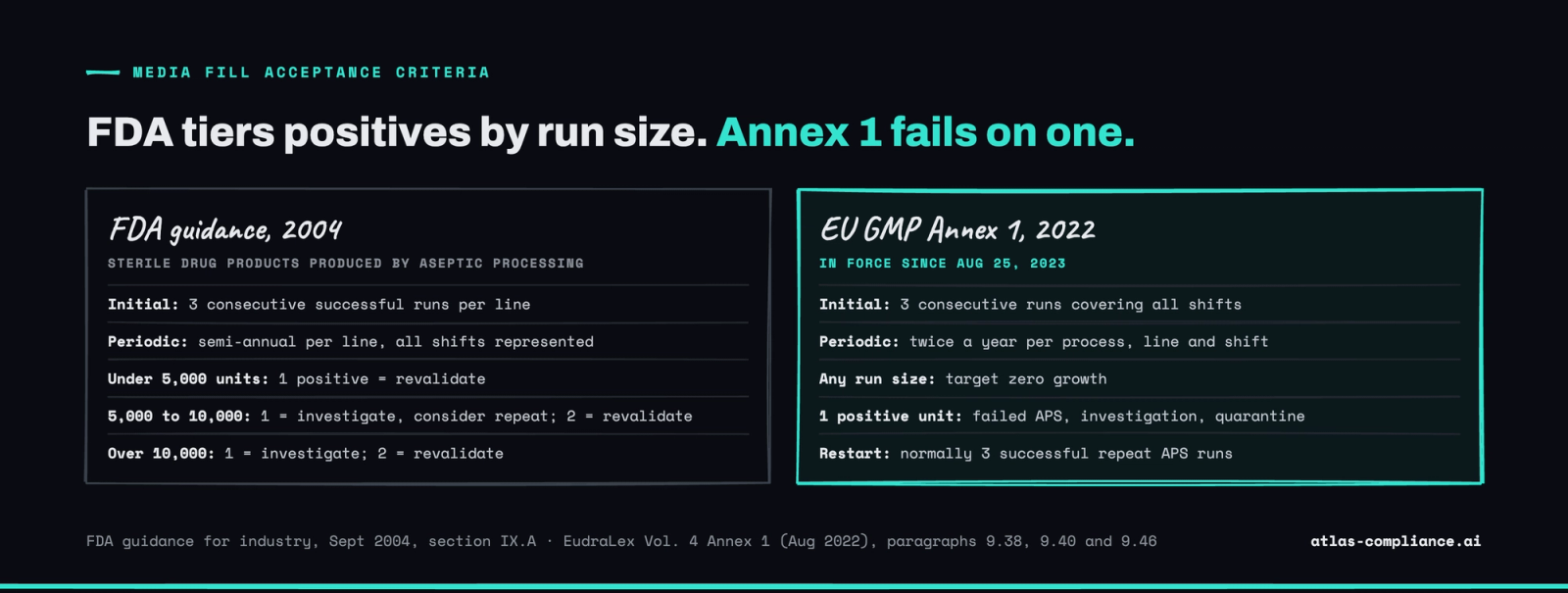
| Units filled | FDA guidance (2004) | EU GMP Annex 1 (2022) |
|---|---|---|
| Fewer than 5,000 | No contaminated units; 1 is cause for revalidation after investigation | Target zero; 1 contaminated unit fails the APS |
| 5,000 to 10,000 | 1 unit: investigate, consider a repeat run; 2 units: revalidate | Target zero; 1 contaminated unit fails the APS |
| More than 10,000 | 1 unit: investigate; 2 units: revalidate | Target zero; 1 contaminated unit fails the APS |
The FDA tiers are not a contamination allowance. The same guidance says any contaminated unit "should be considered objectionable and investigated", that modern facilities "should normally yield no media fill contamination", and that recurring positives on one line signal an adverse trend regardless of the criteria. A firm selling into both markets has, in practice, a zero-growth standard.
How long and at what temperature are media fill units incubated?
Media fill units are incubated for at least 14 days at a temperature that suits the bioburden and environmental isolates, never outside 20 to 35 °C and held within 2.5 °C of the target, according to FDA's 2004 guidance. If two temperatures are used, each gets at least 7 days, starting with the lower one.
Annex 1 (paragraph 9.44) does not fix a number; it asks for incubation conditions and duration that are scientifically justified and validated for detection sensitivity. It adds practical rules that inspectors check. Units are agitated, swirled or inverted so the medium touches every inner surface. Amber or opaque containers are swapped for clear ones of the same configuration. All integral units are incubated, including those with cosmetic defects. Trained staff inspect every unit, and contaminants are identified to species level to trace the source.
Which interventions should a media fill include?
A media fill should include every intervention that happens in routine production, at its routine frequency, plus the worst-case conditions the written procedures permit. Annex 1 (paragraph 9.34) splits these into inherent interventions, which are part of every batch, and corrective interventions, which fix problems such as a jammed stopper or a fallen vial.
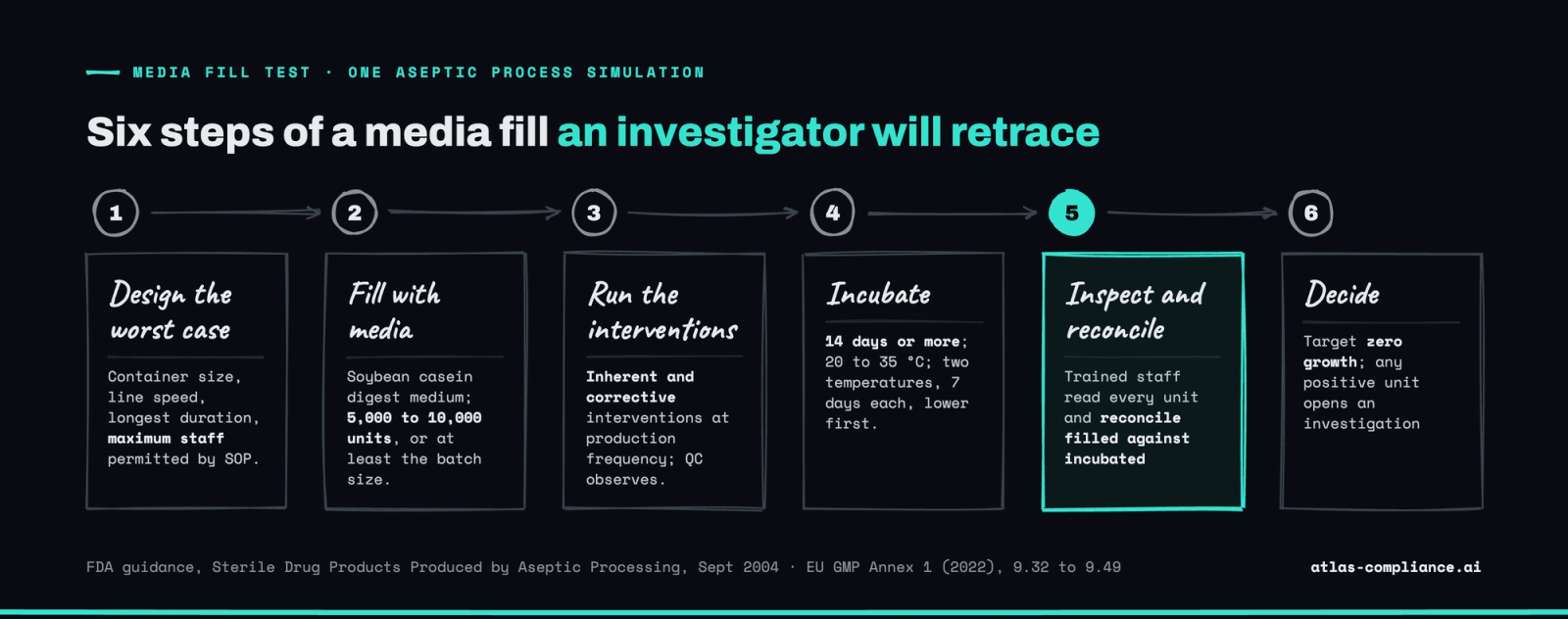
FDA's 2004 list of factors to simulate includes:
- Factors tied to the longest permitted run on the line, such as operator fatigue.
- The number, type and complexity of normal interventions, plus nonroutine events such as maintenance and stoppages.
- Aseptic assembly of equipment, the number of personnel, and aseptic additions such as charging containers and closures.
- Shift changes, breaks and gown changes.
- Aseptic connections and disconnections of equipment.
- Aseptic sample collection and weight checks.
- Line speed and configuration, and the container closure systems used.
- Procedure limits, such as the conditions under which line clearance becomes mandatory.
FDA's guidance sets two limits on the design. A media fill cannot be used to justify a practice that poses unnecessary contamination risk, and stressful conditions mean the maximum staff and activity the SOP allows, not an HVAC system pushed to artificial extremes. Annex 1 (paragraph 9.41) adds that no more units may be removed during a media fill intervention than would be cleared in production. Annex 1 (paragraph 9.47) also requires each intervention to be logged in the APS batch record with its start and end time and the person involved.
What does FDA cite when aseptic processing falls short?
FDA cites aseptic processing failures under two Part 211 sections: 211.113(b), for sterile contamination-control procedures and their validation, and 211.42(c)(10), for the aseptic area's environmental monitoring, cleaning, equipment and surfaces. In the Atlas dataset, 109 of 774 Part 211 drug inspections (14.1%) cited at least one of the two.
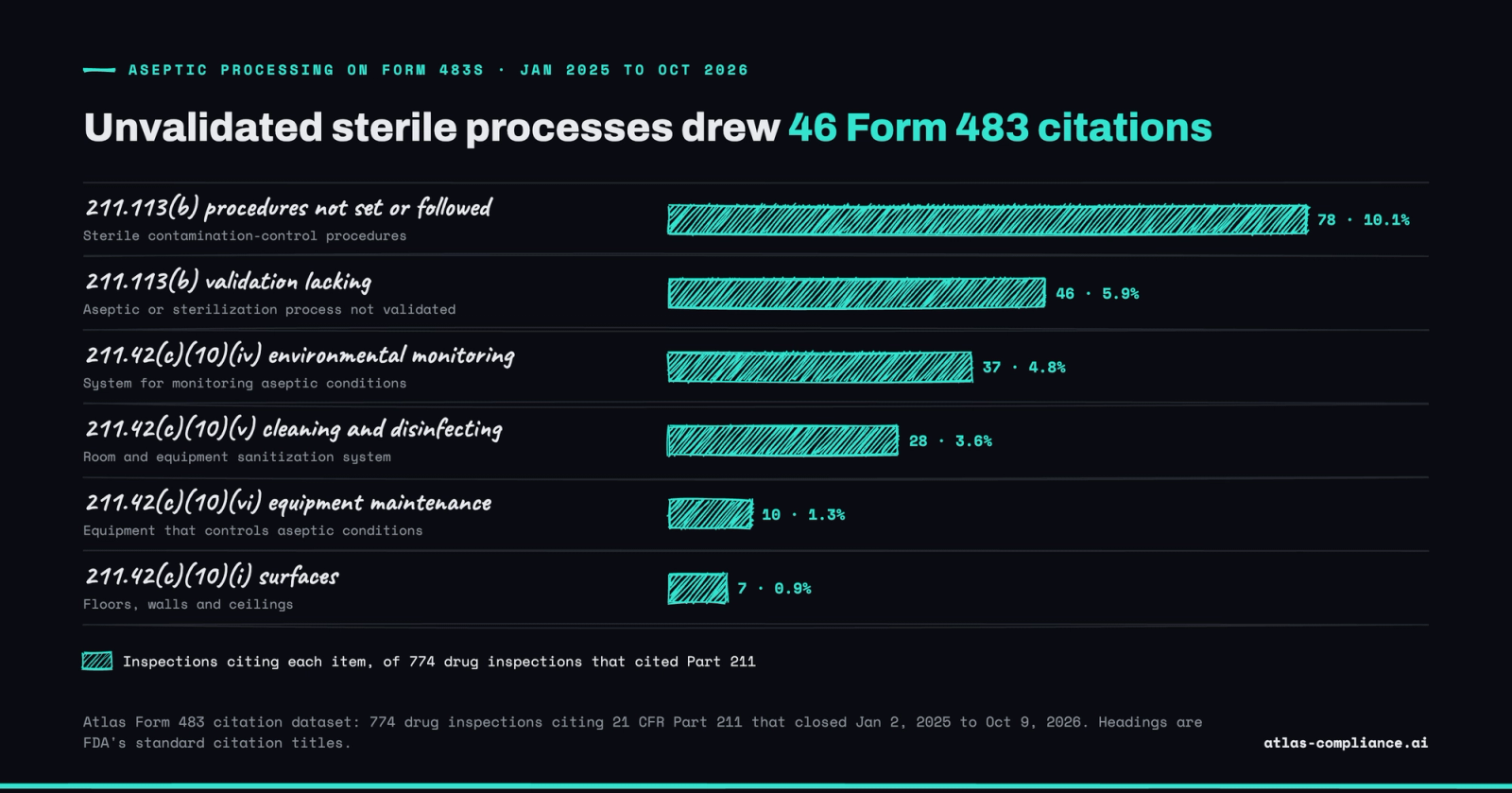
The citation closest to a media fill problem is FDA's heading "Validation lacking for sterile drug products", which appeared at 46 inspections. In 26 of them the standard wording named "the aseptic process" alone, in 13 "the aseptic and sterilization process", and in 5 "the sterilization process". Half of the 46 were foreign facilities. Validation findings rarely come alone: 32 of the 46 inspections also cited 211.42(c)(10), most often environmental monitoring under 211.42(c)(10)(iv).

Recent forms in the FDA Form 483 database show the pattern:
| Form 483 or site | Inspection closed | Aseptic sections cited | Other sections on the form | Classification |
|---|---|---|---|---|
| Samchundang Pharm, Hwaseong, Korea | May 19, 2026 | 211.113(b) validation; 211.42(c)(10), (c)(10)(iv) | 211.100(a), 211.192, 211.198(a), 211.67(a) | OAI |
| Oakwood Laboratories, Solon, US | May 21, 2026 | 211.113(b) validation | 211.192, 211.25(a) | OAI |
| Hanlim Pharm, Yongin, Korea | Apr 24, 2026 | 211.113(b) validation; 211.42(c), (c)(10)(iv), (c)(10)(v) | 211.100(a), 211.160, 211.166(a), 211.22(d), 211.67(a) | OAI |
| Alliance Medical Products, Irvine, US | Nov 7, 2025 | 211.113(b) validation; 211.42(c)(10)(v) | 211.160(b), 211.192 | VAI |
| Grand River Aseptic Manufacturing, Grand Rapids, US | Nov 4, 2025 | 211.113(b) validation | 211.22(d) | VAI |
The Samchundang observations were written by investigators Khoa Nathan V Tran and Damaris Y Hernandez; the Alliance Medical form lists Christopher R Czajka, who has 165 inspections across 158 sites on record in Atlas.
Compounders appear under a different citation. Four pharmacy inspections in the dataset, at Empower Clinic Services, Palmetto Isotopes, Revive Rx and Carolina Infusion, carried FDA's wording "Failure to conduct media fills that closely simulate aseptic production operations under the worst-case, most-challenging, and stressful conditions" under FDCA 501(a)(2)(A), the insanitary conditions provision. All four ended OAI.
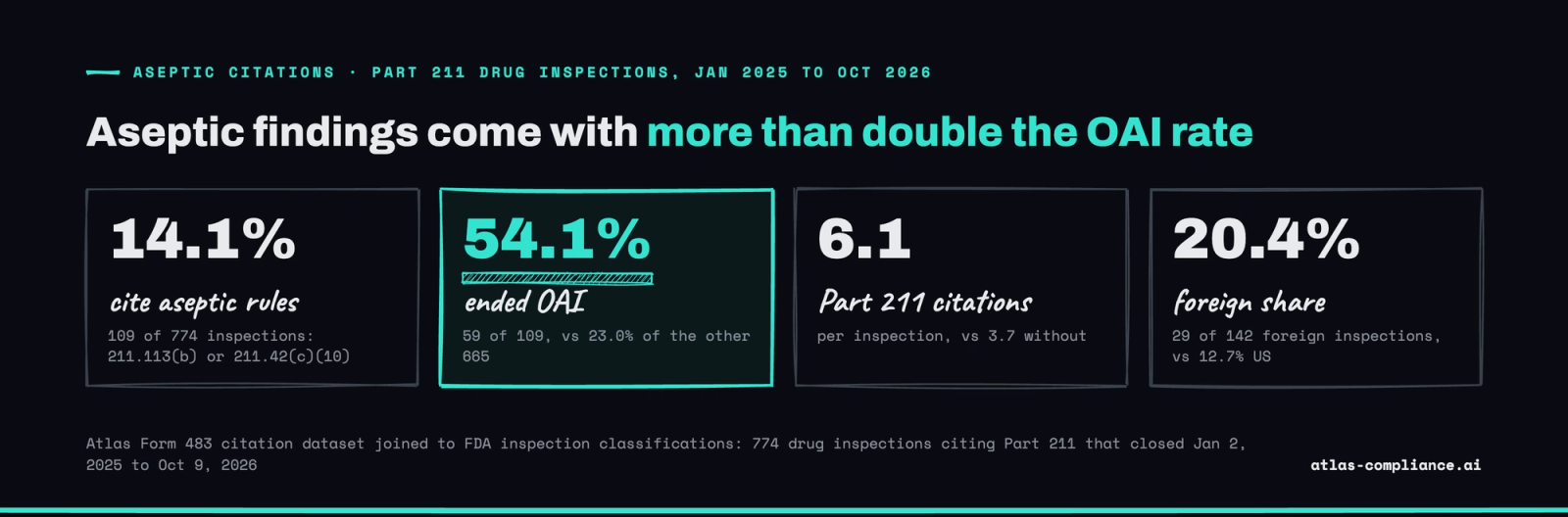
Aseptic findings come with worse outcomes. Of the 109 inspections citing 211.113(b) or 211.42(c)(10), 59 (54.1%) ended OAI, against 153 of the other 665 (23.0%), and they averaged 6.1 Part 211 citations against 3.7. The share also rose, from 13.2% of Part 211 drug inspections in 2025 to 16.5% in January to October 2026. Foreign facilities drew aseptic citations at 29 of 142 inspections (20.4%), against 80 of 632 in the US (12.7%). The NAI, VAI and OAI classifications explain what OAI means for the firm.
Investigators who cite sterile operations have track records in the same database, so a sterile facility can see which sections its likely investigator has written up at peer facilities before the opening meeting.
 Atlas
See what the FDA knows about your next investigator.
30 minutes with the founder. No pitch deck.
What happens when a media fill fails?
When a media fill fails, the firm investigates the most probable cause, identifies the organism to species level, assesses every batch made on the line since the last successful simulation, corrects the cause, and repeats the simulation until the line is back in control. Annex 1 (paragraph 9.46) expects normally at least three successful consecutive repeat runs before production resumes.
The two documents line up on the steps and differ on the detail:
- Investigate. FDA expects contaminated units to be reconcilable with the time and activity being simulated, which is why the QC unit observes the run and why video recording helps.
- Assess product. FDA asks for the impact on commercial batches made since the last media fill; Annex 1 adds a risk assessment of possible sterility breaches and an investigation scope covering all unreleased batches.
- Contain. Annex 1 quarantines all product made on the line after the failure until the failure is resolved, and limits the activities of an operator linked to the cause until retrained and requalified.
- Requalify. FDA suggests three consecutive successful runs with closer scrutiny of production when the investigation fails to reach a well-supported cause; Annex 1 makes three repeats the normal minimum.
A failed simulation is also a 211.192 event: the investigation needs a written conclusion and must extend to other batches, which our 21 CFR Part 211 guide places among the most-cited sections. The cleaning and disinfection program usually comes under review at the same time; cleaning validation requirements cover the equipment side, and the MHRA vs FDA comparison shows how a UK inspector would grade the same failure.
New aseptic processing citations arrive every month, and the digest below sends the ones that matter for sterile operations as FDA publishes them.
AtlasFDA Inspection Intelligence Digest
We track every 483, EIR, and warning letter the moment it happens. Get the signals before they hit the FDA website.
Frequently asked questions
No. A sterility test samples a finished batch of real product and can miss low-level contamination because it tests only a few units. A media fill replaces the product with growth medium and incubates every filled unit, so it tests the aseptic process itself. FDA's 2004 guidance treats the media fill as validation of the process, not as release testing.

Written by
Bhavish Agarwal
Founder, Atlas
Bhavish Agarwal is the founder of Atlas and previously worked at Google and Microsoft. He has spent the past several years building regulatory data infrastructure for the pharmaceutical industry.