
An MHRA inspection is an on-site assessment by the UK Medicines and Healthcare products Regulatory Agency that checks whether a licensed manufacturer, wholesaler or laboratory complies with good manufacturing practice (GMP) or another good practice standard. MHRA inspectors grade each GMP deficiency as critical, major or other; FDA investigators list ungraded observations on a Form 483.
This guide sets MHRA's own deficiency dataset against the Atlas record of FDA inspections at UK facilities (release of August 15, 2026, pulled November 6, 2026).
Key facts
- MHRA grades every GMP deficiency as critical, major or other, and a cluster of "other" deficiencies can be graded major together.
- In MHRA's 2019 GMP deficiency dataset, the latest on gov.uk, 14 of 258 inspections (5.4%) had a critical deficiency and 182 (70.5%) had at least one major or critical.
- EU GMP Chapter 1.4(xiv), root cause analysis, was cited at 176 of those 258 inspections (68%), more than any other reference.
- MHRA refers critical findings and unresolved action plans to its Inspection Action Group, which can refuse or suspend a license.
- The US-UK mutual recognition agreement on pharmaceutical GMP took effect on January 1, 2021, for human medicines.
- The Atlas record holds 1,155 UK facilities with 2,177 FDA inspections and 918 Form 483s.
What is the MHRA?
The MHRA is the UK regulator for medicines, medical devices and blood components for transfusion, run as an executive agency sponsored by the Department of Health and Social Care. For manufacturers, the MHRA issues manufacturing and wholesale licenses, and its GMP Inspectorate checks that licensed sites meet UK GMP.
People often call the MHRA "the UK FDA". The comparison holds for scope: both agencies approve medicines, license or register manufacturers, and inspect facilities at home and abroad. The two differ in legal basis and in how inspectors write findings. UK GMP follows the chapter and annex numbering of the EU GMP guide (EudraLex Volume 4), so an MHRA deficiency cites a clause such as "C1.4(xiv)", while an FDA observation maps to a section of 21 CFR Part 211.
How does an MHRA GMP inspection work?
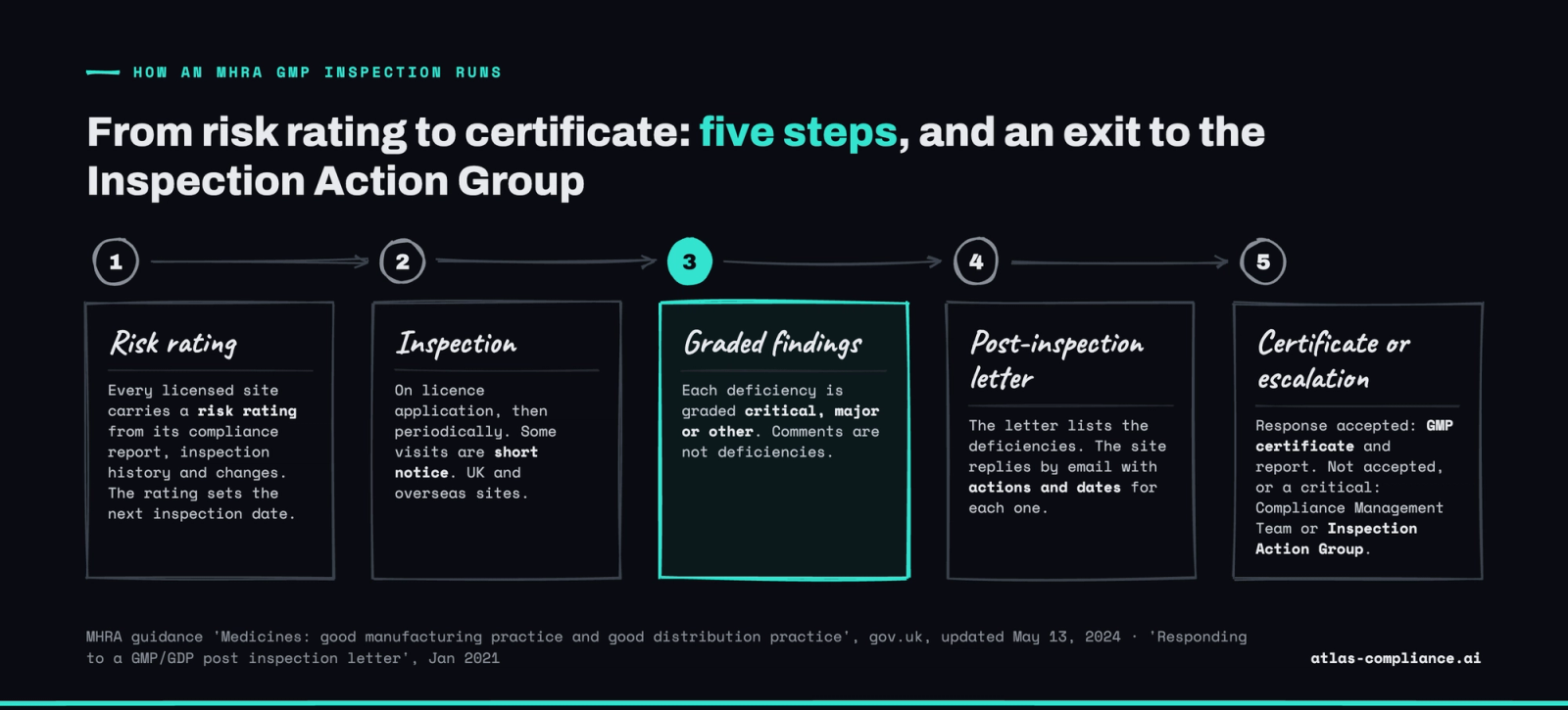
An MHRA GMP inspection starts from a risk rating, not a fixed calendar. MHRA's guidance, "Medicines: good manufacturing practice and good distribution practice" (updated May 13, 2024), says every manufacturer and wholesaler has a risk rating, and the agency inspects the highest-rated sites first. Some inspections are short notice.
- Risk rating. MHRA sets the GMP rating from the site's compliance report, its inspection history and any organizational changes. The site cannot appeal the rating, and a peer review confirms any increase.
- Inspection. Inspectors visit when a company applies for a license and then periodically. They inspect UK sites and overseas sites that supply the UK.
- Graded findings. Each deficiency gets a grade of critical, major or other. Inspectors may also leave comments, which are not deficiencies.
- Post-inspection letter. MHRA sends a letter that confirms the deficiencies. The site replies by email with corrective actions and a completion date for each one.
- Certificate or escalation. If MHRA accepts the response, the site receives a GMP certificate and the inspection report. If not, the case moves into compliance escalation.
MHRA's guidance on responding to a post-inspection letter (January 2021) asks for one editable Word document. The site answers under each deficiency in a new color, with dates in DD/MM/YYYY format and a systemic fix rather than a one-line correction. The inspector replies in a different color, and the full exchange stays in that one file. MHRA asks for no evidence unless the inspector requests it, and the site must tell the inspector before it misses a committed date.
How does MHRA grade GMP deficiencies?
MHRA grades GMP deficiencies on three levels, using definitions from the EU compilation of inspection procedures. The grade drives what happens next, so a site's response plan starts with the grade on each line of the letter.
| Grade | MHRA definition (paraphrased) | Typical consequence |
|---|---|---|
| Critical | Has produced, or leads to a significant risk of producing, a product harmful to the patient | Referral to the Inspection Action Group |
| Major | Non-critical, but may produce non-compliant product, shows a major deviation from GMP or the license, or involves failed batch release; several "other" deficiencies together can make one major | Response with dated actions; may trigger compliance escalation |
| Other | A departure from GMP that cannot be classed as critical or major, or lacks the information to classify | Response with dated actions |
| Comment | Not a deficiency | Acknowledgment only |
FDA has no equivalent grade at the observation level. Every item on a Form 483 carries the same status, and FDA judges severity later, when it classifies the whole inspection.
What happens after an MHRA inspection?
After an MHRA inspection, the outcome depends on whether the inspector accepts the site's response. An accepted response ends in a GMP certificate. Poor compliance below the regulatory action threshold goes to the GMDP Compliance Management Team under MHRA's compliance escalation process.
Critical deficiencies, or earlier action plans that the site has not closed, go to the Inspection Action Group (IAG). The IAG can refuse or suspend a license, increase inspection frequency, or call the license holder to a meeting. When MHRA concludes a manufacturer does not comply with GMP, it may issue a statement of non-compliance and enter it in MHRA-GMDP, the UK database of authorizations, GMP certificates and non-compliance statements.
Since January 1, 2021, the EU's EudraGMDP database no longer adds or updates UK-issued documents, except those for sites in Northern Ireland. A site in Newry or Craigavon can therefore appear in EudraGMDP, while a site in Glasgow appears only in MHRA-GMDP. MHRA does not publish individual GMP inspection reports.
What does MHRA's GMP deficiency data show?
MHRA's GMP deficiency data shows that the pharmaceutical quality system and documentation chapters dominate UK inspection findings. The latest dataset on gov.uk is the 2019 GMP deficiency spreadsheet, published October 15, 2020. MHRA has not posted a newer year on that page.
The spreadsheet lists 5,292 cited references from 258 GMP inspections: 228 in the UK and 30 overseas. Atlas counted each inspection once per reference:
- 14 inspections (5.4%) had at least one critical deficiency; 13 of the 14 were UK sites.
- 168 more had a major deficiency but no critical, so 182 (70.5%) had at least one major or critical.
- 76 inspections (29.5%) found only "other" deficiencies.
- Chapter 1, the pharmaceutical quality system, was cited at 235 of 258 inspections (91%), and Chapter 4, documentation, at 193 (75%).
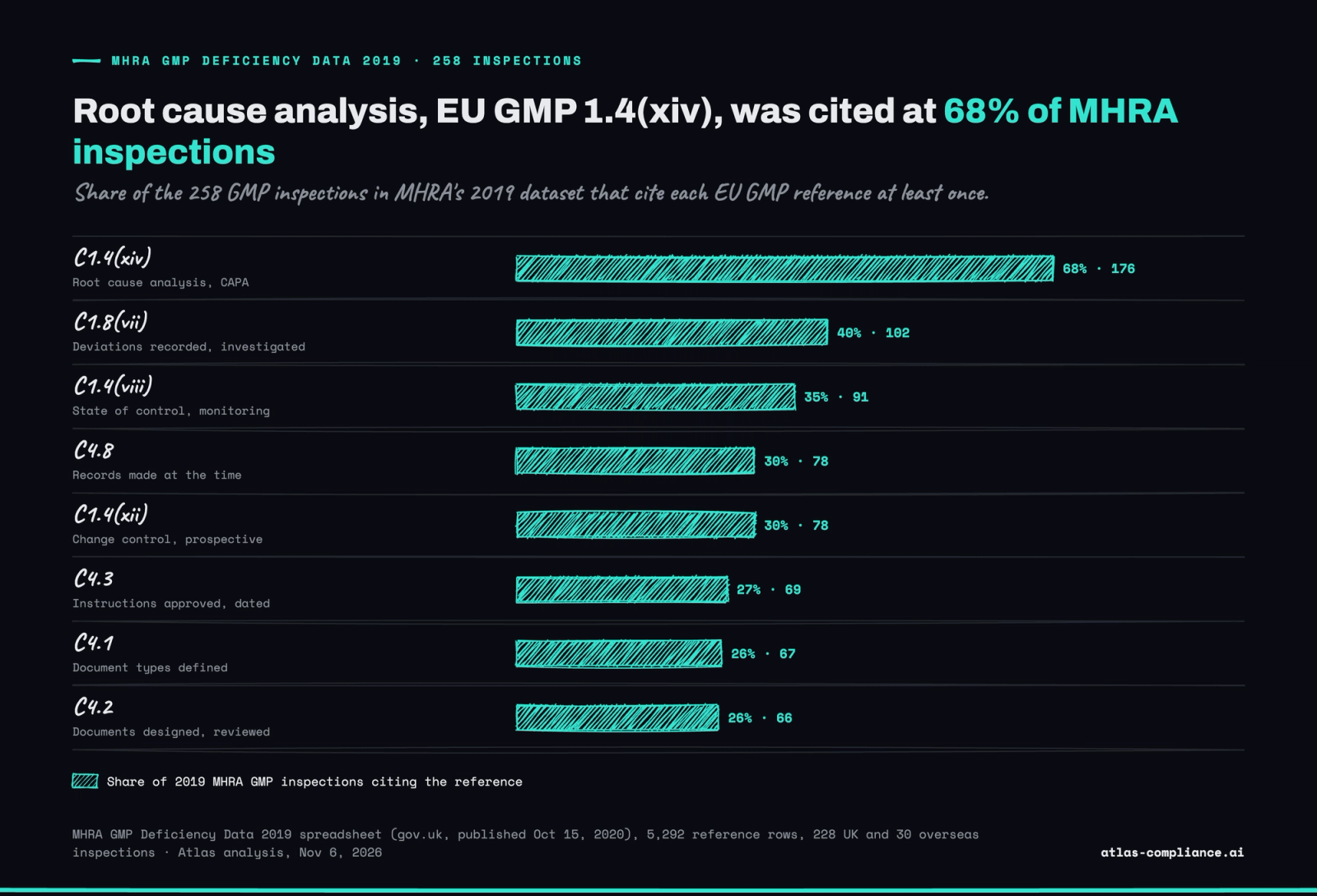
The top reference, C1.4(xiv), requires an appropriate level of root cause analysis when a site investigates deviations and suspected product defects. Second is C1.8(vii), which requires significant deviations to be recorded, investigated for root cause and closed with corrective and preventive action. FDA covers the same ground under 21 CFR 211.192. In the Atlas FDA Form 483 database, 211.192 appears on 28.5% of the 737 human-drug Form 483s from 2025 that carry CFR citations, and 211.22, the quality control unit, on 36%. Investigation failures rank first in the MHRA data and second in the FDA data.
MHRA vs FDA: what is the difference?
The main difference between MHRA and FDA inspections is where severity gets decided. MHRA grades each deficiency in the post-inspection letter. FDA lists ungraded observations on a Form 483 at the close-out meeting, then classifies the inspection as NAI, VAI or OAI after reviewing the establishment inspection report.
| MHRA | FDA | |
|---|---|---|
| GMP standard | UK GMP, EU GMP numbering | 21 CFR Parts 210 and 211 |
| What the site receives | Post-inspection letter, then report | Form 483 at close-out, later the EIR |
| Severity | Critical, major or other per deficiency | None per observation; NAI, VAI or OAI per inspection |
| Response | Email reply with dated actions; required | Written reply within 15 business days to be considered; voluntary |
| Good outcome | GMP certificate | NAI or VAI classification |
| Serious outcome | Inspection Action Group, license suspension, statement of non-compliance | Warning letter, import alert, regulatory meeting |
| Public record | MHRA-GMDP certificates and statements | Form 483s via FOIA, warning letters posted |
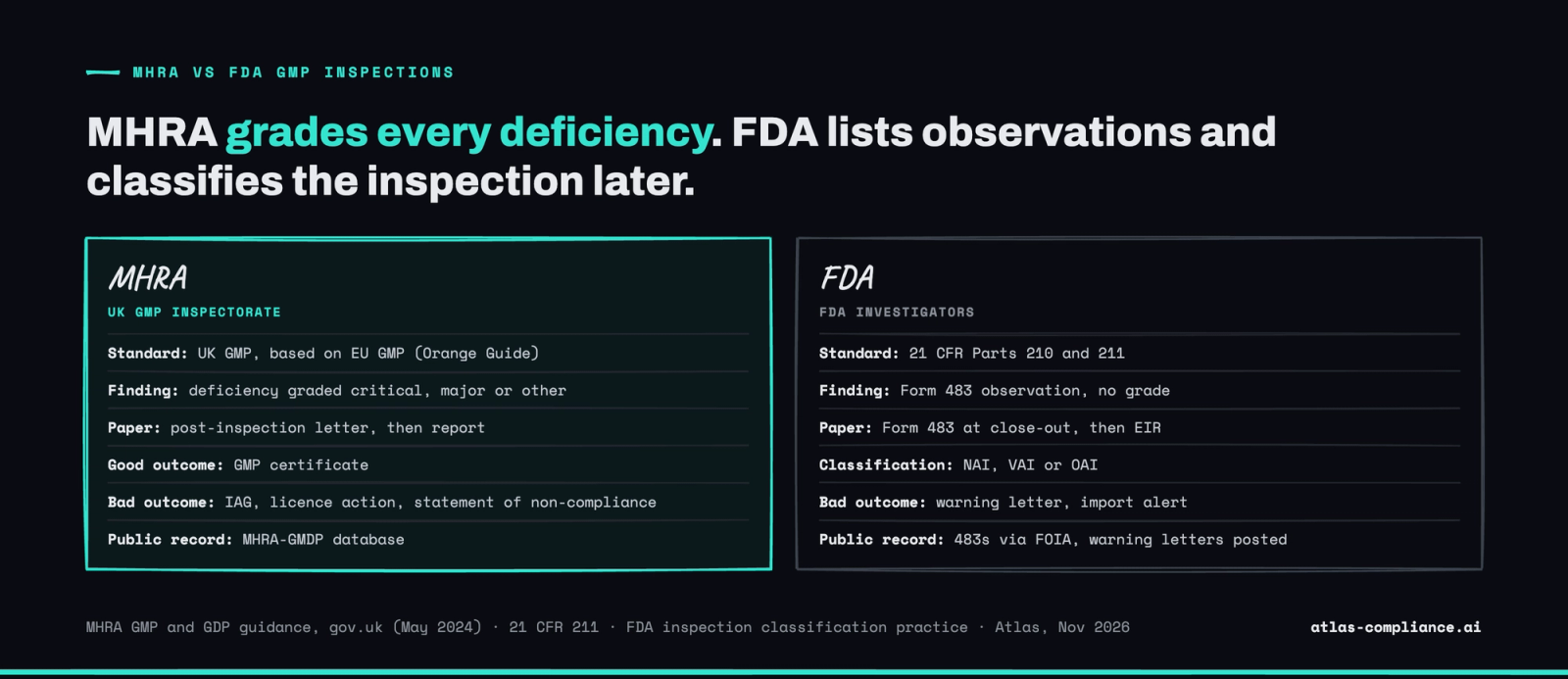
The OAI classification is the closest FDA analogue to an IAG referral: both mean the agency is weighing regulatory action. Our VAI, NAI and OAI explainer covers how FDA reaches each class.
Does FDA recognize MHRA inspections?
FDA recognizes MHRA GMP inspections under the US-UK mutual recognition agreement, whose pharmaceutical GMP annex took effect on January 1, 2021. The annex covers human medicines, and FDA and the UK Veterinary Medicines Directorate added veterinary pharmaceuticals in September 2021.
FDA's page on the agreement (content current as of November 29, 2023) says the capability determinations apply to routine surveillance inspections. It excludes advanced therapy medicinal products, human blood, plasma, tissues and organs, and veterinary immunologicals. Human vaccines and plasma-derived products were left for a later decision, with the two sides due to reconsider in July 2025. FDA still inspects UK sites, as the next section shows, and our analysis of FDA foreign inspections covers how those visits are scheduled.
What does FDA cite at UK facilities?
FDA cites the same quality unit, cleaning and investigation sections at UK facilities as it does elsewhere. The Atlas record (release of August 15, 2026) holds 1,155 UK facilities with 2,177 FDA inspections, 918 of which ended with a Form 483.
Of 33 FDA Human Drugs inspections at UK sites that ended between April 1, 2025 and July 20, 2026, 16 ended with a Form 483, and Atlas marks one more, at A. Nelson & Co. in London in September 2025, with a warning letter outcome; CDER issued that CGMP warning letter on February 12, 2026. The 33 include five inspections of clinical investigators.
Atlas holds structured CFR citations for 16 UK Form 483s since 2023 that cite Part 211. Of those 16, 211.22 appears on 9, 211.67 on 9 and 211.192 on 7.
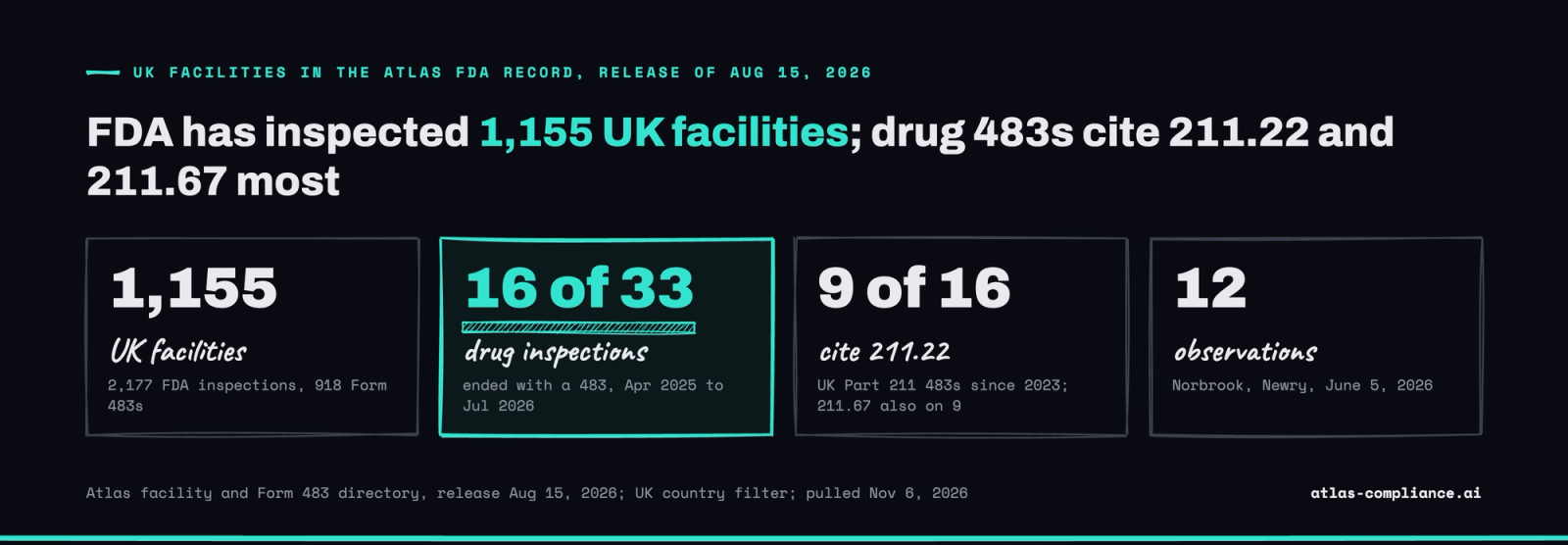
Four UK records show the pattern:
- Norbrook Laboratories, Newry, Northern Ireland: 15 FDA inspections and 12 Form 483s. The June 5, 2026 Form 483 lists 12 observations, including 211.113(b) twice for sterile procedures and validation, 211.42(c)(10) for the aseptic processing area, 211.192 and 211.68(b). Its April 2025 Form 483 also cited 211.113(b) and 211.192.
- Almac Pharma Services, Craigavon, Northern Ireland: 8 inspections and 3 Form 483s. The November 28, 2025 Form 483 cites 211.100(a), 211.188, 211.192, 211.67(a) and 211.68(b).
- Valneva Scotland, Livingston: all 9 FDA inspections on record ended with a Form 483, most recently in February 2026. The March 2024 Form 483 cites 211.198(a), 211.22(d) and 211.42(c)(10)(iv).
- Bioreliance, Glasgow: 12 inspections and 9 Form 483s, the latest issued December 5, 2025.
Norbrook and Almac sit in Northern Ireland, so their EU GMP documents still flow to EudraGMDP while FDA tracks them through the same Form 483 record as any other foreign site.
If your facility or a UK supplier is on FDA's list, you can see which investigators inspected it and which sections they cited.
 Atlas
See what the FDA knows about your next investigator.
30 minutes with the founder. No pitch deck.
How should a UK site prepare for both MHRA and FDA inspections?
A UK site that ships to the United States prepares for both inspections by fixing the systems both regulators cite most: deviation investigations, the quality unit and documentation.
- Test root cause depth. Pull ten closed deviations and check each against C1.4(xiv) and 211.192: did the investigation reach other batches, and does the CAPA match the cause?
- Map your MHRA deficiencies to Part 211. A Chapter 4 documentation deficiency covers the same ground as 211.100 or 211.188 on the FDA side, so one action can close both.
- Keep commitment dates. MHRA tracks the dates in your response, and FDA reads your Form 483 reply before it classifies the inspection.
- Check your public record. Search MHRA-GMDP for your certificates and any statement of non-compliance, and Atlas for your FDA inspection history.
- Use an internal audit to rehearse both styles. Our guide to GMP audits covers self-inspection and supplier audits.
The Atlas digest sends new Form 483s and warning letters as FDA releases them, including those issued to UK and other foreign sites.
AtlasFDA Inspection Intelligence Digest
We track every 483, EIR, and warning letter the moment it happens. Get the signals before they hit the FDA website.
Frequently asked questions
MHRA stands for Medicines and Healthcare products Regulatory Agency. The agency formed in 2003 and regulates medicines, medical devices and blood components for transfusion across the UK. Its inspectorate covers good manufacturing practice, good distribution practice, good clinical practice, good laboratory practice and good pharmacovigilance practice, each with its own inspection program.

Written by
Bhavish Agarwal
Founder, Atlas
Bhavish Agarwal is the founder of Atlas and previously worked at Google and Microsoft. He has spent the past several years building regulatory data infrastructure for the pharmaceutical industry.