
FDA names four types of inspections. Surveillance inspections are routine checks of how a facility makes products already on the market. For-cause inspections happen when FDA has reason to suspect a quality problem, such as a complaint. Application-based inspections, including pre-approval (PAI) and pre-license (PLI) inspections, support the review of a new application. Follow-up inspections verify corrections after a violative inspection or an enforcement action.
Those four definitions come from FDA's own page on types of FDA inspections. FDA adds that any of them can be comprehensive or directed at specific issues, which is why two "surveillance" inspections can look nothing alike. The type rarely appears on any document you receive, so most quality teams work it out from the trigger, the team and the questions asked on day one.
The Atlas numbers below come from the August 15, 2026 release of our Form 483 database, pulled on October 21, 2026: 2,533 Form 483s issued between January 1 and July 20, 2026, each with its investigators and observation count.
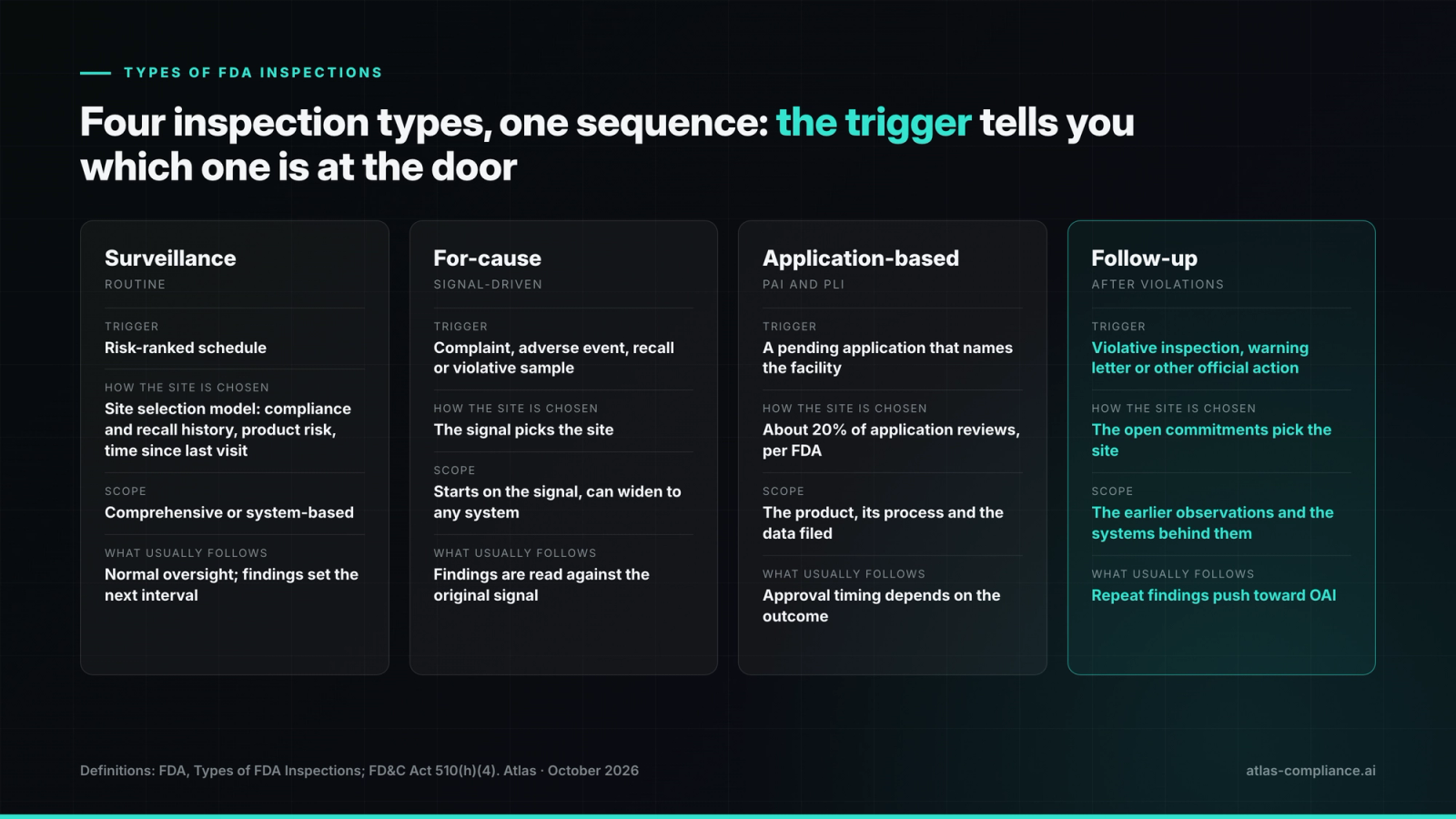
The four types of FDA inspections side by side
| Surveillance | For-cause | Application-based (PAI, PLI) | Follow-up | |
|---|---|---|---|---|
| Trigger | Routine, risk-ranked schedule | A reason to suspect a quality problem: complaints, adverse events, recalls, violative samples | A pending NDA, ANDA, BLA, PMA or similar application that names the facility | A previous violative inspection, violative sample, warning letter or other official action |
| Purpose | Monitor manufacturing and product quality, check CGMP compliance | Investigate the specific signal | Confirm the facility can make the product as the application describes, and that submitted data are accurate | Verify that promised corrections were made and hold |
| Typical scope | Comprehensive or system-based | Starts narrow, can widen | The product, its process, and the data in the file | The earlier observations and the systems behind them |
| What it means for the site | Normal oversight; a gap since the last visit raises the site's priority | FDA already has a concern before arriving | Approval timing depends on the outcome | FDA is testing your 483 or warning letter response |
Two of these overlap in FDA's own wording. The for-cause definition includes checking corrections made for previous violations, which is also the job of a follow-up inspection. In practice, an inspection after a warning letter can carry either label. What matters for you is the same: the investigator arrives with your last response in hand.
Surveillance inspections: how FDA picks the site
Surveillance is the routine work, and it is risk-based rather than calendar-based. For drug establishments, section 510(h)(4) of the FD&C Act lists the factors FDA weighs: the facility's compliance history, its recall history, the inherent risk of the products, its inspection frequency and history (including whether FDA inspected it in the previous four years), and whether a foreign regulator has inspected it. CDER turns those factors into a score through its site selection model, and the highest-scoring sites go to the inspection schedule. FDA describes the approach on its page on risk-based inspections.
Two consequences follow. A long gap since your last inspection is not a safe harbor: time since the last surveillance visit is itself a risk factor, so the score rises the longer FDA stays away. And a poor record keeps a site near the top of the list. If you want to see what that record looks like from FDA's side, our guide to what QA teams should prepare before an unannounced inspection covers the readiness side.
Most 483s in our 2026 data come from small teams, which fits routine work. Of the 2,533 forms, 1,916 (75.6%) list one investigator, 452 (17.8%) list two, and 165 (6.5%) list three or more. The mean is 1.34 investigators per Form 483.
For-cause inspections: the scope can widen
A for-cause inspection starts from a signal FDA already holds: a consumer or healthcare complaint, an adverse event report, a recall, a violative sample, or, for food, an outbreak investigation. The investigator usually arrives with a defined question, such as why a batch failed or why complaints about a leaking container were not escalated.
The narrow start does not cap the inspection. If the complaint file leads to a weak investigation system, the investigator follows it into deviations, CAPA and batch release, and the Form 483 can end up citing systems that had nothing to do with the original signal. For-cause visits are also the least predictable on timing, since the trigger is outside your control.
Application-based inspections: PAI and PLI
Application-based inspections support FDA's review of new marketing applications for drugs, devices and biologics. FDA states that it conducts them for about 20% of the application reviews it performs. They check three things: that the facility complies with manufacturing requirements, that it can make the product consistently, and that the data submitted in the application are accurate and complete. FDA also inspects clinical and nonclinical research sites that supply data to a pending application.
The 20% figure means most applications do not trigger an on-site inspection, often because FDA already has a recent, acceptable record for the facility. A site with no prior inspection, or with a violative history, is more likely to be visited. Our guide on preparing for FDA pre-approval inspections covers the data-integrity checks investigators run against the application.
Follow-up inspections: testing your 483 response
A follow-up inspection asks one question: did the corrections you described actually happen? The investigator compares your Form 483 response or warning letter reply to what is on the floor, in the batch records and in the CAPA system. A repeat observation found here is treated as evidence that the earlier fix failed, which is one of the clearest routes from a voluntary classification to an official one.
The Atlas record shows what this looks like in practice, although the directory does not carry FDA's type label for each inspection:
- K.C. Pharmaceuticals in Pomona, California has 16 inspections on record, 11 ending with a Form 483. The January to February 2023 inspection is recorded with a warning letter outcome. FDA came back in August 2024, and again from January 20 to February 13, 2026. The 2026 Form 483 lists eight investigators and 13 observations, including 21 CFR 211.113(b) sterile process validation and 211.192 investigations.
- Eugia Pharma Specialities in Sangareddy, India has a January to February 2024 inspection recorded with a warning letter outcome, followed by a January 27 to February 6, 2026 inspection that ended with a Form 483 carrying 11 observations from three investigators.
Both are the pattern FDA's follow-up definition describes: an inspection after official action, with a team larger than the norm and an observation count well above the 2026 median of two.
Records requests in advance of or in lieu of an inspection
Section 704(a)(4) of the FD&C Act lets FDA ask a drug establishment for any records it could review on an inspection, either before an inspection or instead of one. The authority was added in 2012 and extended to device establishments in 2022. FDA sends the request on Form FDA 4003, and an establishment that refuses may be in violation of the Act. Under CDER's procedure, 15 calendar days is treated as a reasonable response time, or 30 days when records need translation.
These requests are one form of what FDA calls a remote regulatory assessment, explained in its remote regulatory assessments Q&A. No Form 482 or Form 483 is issued during one. A records request is not a substitute for readiness: what you send can shape whether an on-site inspection follows and what it focuses on.
What 2026 Form 483 data say about team size
A larger team is one of the few visible clues about what kind of inspection you are in. We found no FDA source that ties team size to inspection type, so treat what follows as an observation from the data, not a rule.
| Investigators on the Form 483 | Form 483s (Jan to Jul 2026) | Mean observations | Share with 10+ observations |
|---|---|---|---|
| One | 1,916 | 3.24 | 3.9% |
| Two | 452 | 3.98 | 6.4% |
| Three or more | 165 | 4.82 | 13.3% |
| All | 2,533 | 3.47 | 5.0% |
Forms signed by three or more investigators carry about 50% more observations on average than single-investigator forms, and are more than three times as likely to reach ten. Across all 2,533, the median is two observations; 29.1% have one, 34.7% have two or three, 23.6% have four to six, 7.7% have seven to nine and 5.0% have ten or more. The highest count is 32.
Team size also depends on the product. In human drugs, 45.5% of 2026 Form 483s list more than one investigator and 13.6% list three or more. In medical devices the figures are 9.8% and 1.3%; in biologics 35.8% and 8.8%; in foods and cosmetics 23.1% and 6.3%. A three-person team at a device facility is far more unusual than the same team at a sterile injectables facility.
A big team does not guarantee a long form. The January 2026 Form 483 at Mead Johnson in Zeeland, Michigan lists nine investigators and one observation, under 21 CFR 106.55(a), the infant formula process control rule. The March 2026 Form 483 at Bora Pharmaceuticals Injectables in Baltimore lists five investigators and six observations, including laboratory controls and 211.192 investigations.
 Atlas
See what the FDA knows about your next investigator.
30 minutes with the founder. No pitch deck.
What happens on the day, whatever the type
The sequence is the same for all four types.
- The investigator presents credentials and a Form FDA 482, Notice of Inspection, to the most responsible person on site.
- The inspection runs: document requests, facility walk-through, interviews. Many investigators hold daily wrap-ups on what they have seen.
- At the close-out meeting, if they observed objectionable conditions, they issue a Form FDA 483 and may list discussion items that are not on the form. Our guide to what a Form 483 is covers the document.
- You respond in writing. FDA considers a response received within 15 business days of the 483 before deciding whether to issue a warning letter.
- The investigator writes the Establishment Inspection Report, with a recommended classification. Our piece on FDA EIRs explains what it contains.
- FDA classifies the inspection NAI, VAI or OAI. We cover how that decision is made in NAI, VAI, OAI explained.
Which type should you expect?
Read the signals you already have:
- A pending application that names your facility, with no recent acceptable inspection on record: expect an application-based inspection.
- A warning letter, an OAI classification or a 483 with commitments still open: expect a follow-up, and expect the investigator to test each commitment.
- A recent recall, a cluster of complaints, adverse event reports or a violative sample: a for-cause visit is possible at any time.
- None of the above, and several years since FDA last came: you are rising on the surveillance list.
- A Form FDA 4003 records request: FDA is assessing you remotely, and the response may decide whether and how it inspects.
- More than two investigators at the door, especially outside human drugs: in our 2026 data that is uncommon, and those forms run longer.
AtlasFDA Inspection Intelligence Digest
We track every 483, EIR, and warning letter the moment it happens. Get the signals before they hit the FDA website.
Frequently asked questions
Surveillance inspections make up the routine core of FDA's inspection program, since every registered facility is a candidate for one on a risk-based schedule. For-cause, application-based and follow-up inspections depend on a specific event, such as a complaint, a pending application or an earlier violation, so they reach fewer facilities in any given year.

Written by
Bhavish Agarwal
Founder, Atlas
Bhavish Agarwal is the founder of Atlas and previously worked at Google and Microsoft. He has spent the past several years building regulatory data infrastructure for the pharmaceutical industry.