
EIR stands for Establishment Inspection Report. It is the narrative report an FDA investigator writes after inspecting a facility: why FDA came, what was covered, who was interviewed, what was found, what management said in response, what samples and documents were collected, and the investigator's recommended classification. The Form 483 lists the problems; the EIR explains them.
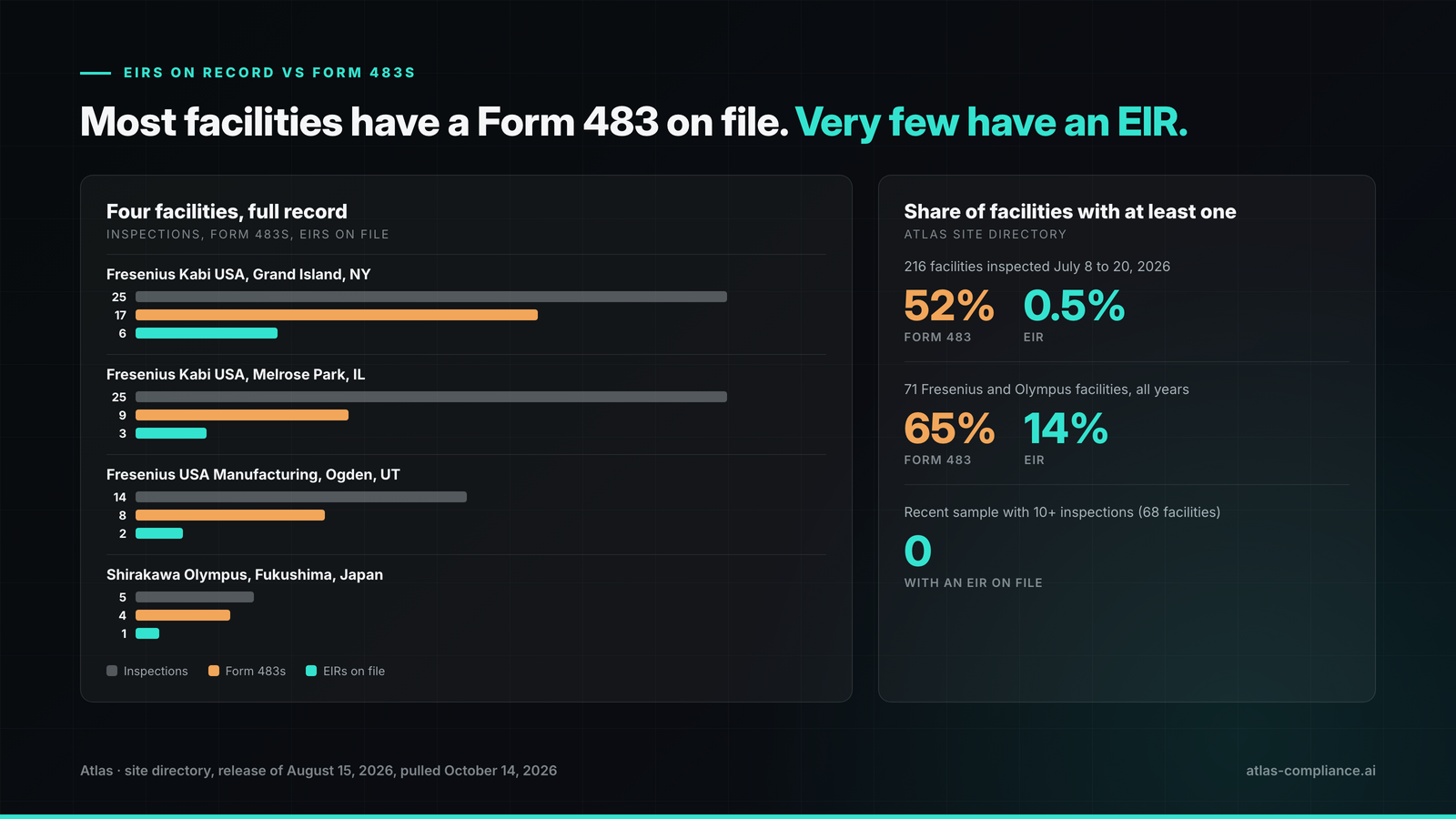
Every inspection produces an EIR, including the ones that end without a Form 483. The firm gets its copy only after FDA has classified the inspection and considers it closed. Everyone else gets it through a Freedom of Information Act request, redacted. That is why EIRs are scarce in the public record: in our directory, 52% of recently inspected facilities have a Form 483 on file and 0.5% have an EIR.
EIR vs Form 483 vs classification letter
Three documents come out of one inspection. They are written by different people, at different times, for different purposes, and people mix them up constantly.
| Form 483 | EIR | Classification letter | |
|---|---|---|---|
| Full name | Form FDA 483, Inspectional Observations | Establishment Inspection Report | Final inspection classification (NAI, VAI or OAI) |
| Who writes it | The investigator or inspection team | The same investigator or team | FDA reviewers in the division or center that owns the case |
| When | Handed over at the close-out meeting, the last day of the inspection | Written after the inspection; released to the firm once the inspection is closed | Usually within about 90 days of the inspection ending |
| Typical length | A few pages | Often dozens of pages, plus exhibits | One or two pages |
| What it contains | Objectionable conditions, one numbered observation each | The full narrative: scope, history, people, operations, findings, discussion, refusals, samples, exhibits | The outcome and, for OAI, what follows |
| Public? | Yes, through FOIA; some are posted in FDA's reading room | Yes, through FOIA after closure, with trade secrets and personal data redacted | The classification is shown on the FDA Data Dashboard |
| How the firm gets it | In hand at close-out | By mail with a release letter after closure | By letter |
| How others get it | FOIA, the reading room, or a 483 database | FOIA, months after the inspection | The Data Dashboard |
The practical difference: a 483 tells you what the investigator objected to. The EIR tells you how they got there, what they looked at and did not cite, and what your people said. Our guide to what a Form 483 is covers the first document, and the NAI, VAI and OAI explainer covers the third.
What is inside an EIR, section by section
FDA's Investigations Operations Manual sets the format. Not every report has every section, and device, food and drug reports differ in emphasis, but a drug EIR usually follows this order.
Header and summary. Firm name, address, FEI number, inspection dates, the investigators and their district, the reason for the inspection (surveillance, pre-approval, for-cause, follow-up) and a short summary of the outcome. This page alone tells you whether FDA came on a routine cycle or because of a complaint, a recall or an application.
Administrative data and history. Ownership, the most responsible person, the products made, the size of the operation, and what happened at earlier inspections. If the last 483 cited a regulation, this is where the investigator notes whether it was corrected.
Scope. Which systems were covered: quality, production, facilities and equipment, laboratory controls, materials, packaging and labeling. Which products, batches and records were reviewed. The scope section is the most underread part of the report, and it is where the next inspection's plan starts.
Persons interviewed and individual responsibility. Names and titles of the people who answered questions and who hold authority over the conditions found. In an enforcement case, this section matters a lot.
Manufacturing operations, complaints and recalls. A description of how the facility makes and releases product, how complaints are handled and how recalls would be run, written in the investigator's words.
Objectionable conditions and management's response. Each 483 observation with the evidence behind it, followed by what management said at the time. If your team promised a fix during the inspection, it is recorded here.
Discussion with management. Items the investigator raised verbally but did not write on the 483. These are not citations, and they are not nothing.
Refusals. Any record, photograph or access the firm declined to provide. A refusal is noted with what was asked and who refused.
Samples collected. What was sampled, why, and the sample numbers. Lab results come later and can drive the classification on their own.
Voluntary corrections. Fixes the firm made during the inspection that the investigator verified.
Exhibits and attachments. Copies of SOPs, batch records, logbooks, emails and photographs collected as evidence. In a released EIR these are often the most heavily redacted pages.
How and when FDA releases the EIR
The firm does not receive the EIR at the end of the inspection. FDA's policy is to release a copy to the inspected establishment once the inspection is closed, which means the classification has been made and, for an OAI, any resulting regulatory action has run its course. The copy arrives with a short release letter.
For an NAI or VAI inspection that usually means a few months after the investigators leave. For an OAI that leads to a warning letter, it can be much longer, because the file stays open until FDA decides the matter is closed.
Anyone else, including a customer qualifying you as a supplier, can request the EIR through FDA's Freedom of Information Act process. FDA will not release it while the inspection is open. When it does, trade secrets, confidential commercial information and the names of junior staff are removed. Queues for inspection records commonly run for months. Our guide on how to access an FDA inspection report quickly covers request wording, fees and the faster routes.
How many facilities have an EIR on record
Because EIRs come out late and mostly through FOIA, far fewer are on file anywhere than Form 483s. We counted both in the Atlas FDA facility lookup, which shows inspections, Form 483s and EIRs on file for every site (directory release of August 15, 2026, pulled October 14, 2026).
| Facility | Inspections | Form 483s | EIRs on file |
|---|---|---|---|
| Fresenius Kabi USA, Grand Island, New York | 25 | 17 | 6 |
| Fresenius Kabi USA, Melrose Park, Illinois | 25 | 9 | 3 |
| Fresenius USA Manufacturing, Ogden, Utah | 14 | 8 | 2 |
| Shirakawa Olympus, Fukushima, Japan | 5 | 4 | 1 |
Even at heavily inspected facilities, EIRs cover a fraction of the history. Grand Island has 6 EIRs for 25 inspections; Ogden has 2 for 14. Melrose Park and Ogden both received warning letters in 2026, which we cover in the Fresenius warning letters analysis.
The wider samples show the same gap:
- Of the 216 facilities most recently inspected in the directory (inspections between July 8 and July 20, 2026), 113, or 52%, have at least one Form 483 on record. One, or 0.5%, has an EIR. Across those 216 facilities there are 1,609 inspections, 300 Form 483s and a single EIR.
- Of the 68 facilities in that sample with ten or more inspections each, none has an EIR on file.
- Across all 71 Fresenius and Olympus facilities in the directory, 65% have a Form 483 on record and 14% have an EIR: 23 EIRs against 143 Form 483s and 325 inspections.
Two readings follow. First, if you want the EIR for a supplier inspected this year, it almost certainly is not public yet, and the 483 is what you can read today. Second, large, frequently inspected companies are where EIRs accumulate, because someone, often a competitor, a customer or a journalist, filed the FOIA request.
 Atlas
See what the FDA knows about your next investigator.
30 minutes with the founder. No pitch deck.
How to read an EIR for inspection readiness
Your own EIRs are the best preparation material you have, because the next investigator reads them before arriving. Read each one for four things.
Repeat findings. Compare the objectionable conditions with the previous report's. The Grand Island record shows why: 21 CFR 211.192 (investigations) appears on the 483s of 2014, 2016 and 2023, and 211.113(b) (sterile process validation) on both the October 2023 Form 483 and the May 2026 one. A section cited twice is the pattern FDA treats as a failed corrective action.
Verbal observations that never reached the 483. The discussion-with-management section lists concerns the investigator raised and chose not to cite. Treat each one as a draft observation for next time. If you fixed it, keep the evidence where you can produce it in minutes.
Scope signals. Note which systems, products and records were covered and which were not. An inspection that spent two days in the laboratory and none in the warehouse tells you where the next one may go. A for-cause inspection triggered by complaints says the complaint file will be read first.
What your people said. Read management's recorded responses against what you later did. A promise in the EIR that was not kept is easy for the next investigator to check.
Then look at who is likely to return. The same investigator, Mindy M Chou, is named on both the 2023 and 2026 Grand Island Form 483s. Knowing which regulations an investigator cites most, at your facility and elsewhere, tells you where an inspection is likely to spend its time. If you do not have your own EIR yet, the Form 483 and the facility's citation history are the closest substitute.
What to do when the EIR arrives
Check the release letter's date against your 483 response and the classification letter. Read the report for factual errors: wrong dates, wrong titles, a misquoted response. You can write to FDA to correct the record, and it is worth doing before a customer reads the FOIA copy. File the EIR with the 483, your response and the classification so the inspection history is in one place. Finally, update your readiness plan with the repeat-risk items and the verbal observations, and assign owners.
AtlasFDA Inspection Intelligence Digest
We track every 483, EIR, and warning letter the moment it happens. Get the signals before they hit the FDA website.
Frequently asked questions
EIR stands for Establishment Inspection Report. It is the investigator's written account of an FDA inspection, covering the reason for the visit, the scope, the people interviewed, the conditions found, management's responses, samples and exhibits. It is separate from the Form 483, which lists only the objectionable conditions, and from the classification letter, which states the outcome.

Written by
Bhavish Agarwal
Founder, Atlas
Bhavish Agarwal is the founder of Atlas and previously worked at Google and Microsoft. He has spent the past several years building regulatory data infrastructure for the pharmaceutical industry.