
Endotoxin testing is the laboratory test that measures bacterial endotoxin, the lipopolysaccharide shed from the outer membrane of gram-negative bacteria, in injectable drugs, biologics, medical devices and the water used to make them. The compendial method is the bacterial endotoxins test in USP 85, harmonized with Ph. Eur. 2.6.14 and JP 4.01, run with Limulus amebocyte lysate (LAL) or, since 2025 in the USP, recombinant reagents.
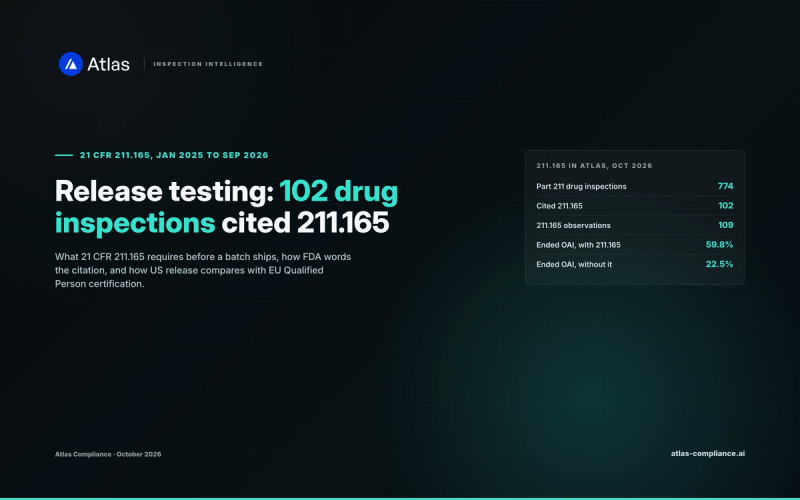
This guide adds how FDA investigators wrote up endotoxin control on Form 483s: 774 drug inspections that cited 21 CFR Part 211 and closed between January 7, 2025 and September 3, 2026, from the Atlas Form 483 citation dataset (pulled October 2026) joined to FDA's inspection classifications.
Key facts:
- FDA cited 21 CFR 211.167(a), batch testing for sterility and pyrogens, at 3 of 774 Part 211 drug inspections (0.4%) from January 2025 to September 2026.
- FDA cited 21 CFR 211.113(b), the sterile process section that endotoxin control sits inside, at 98 of the same 774 inspections (12.7%), and 54.1% of those ended Official Action Indicated (OAI).
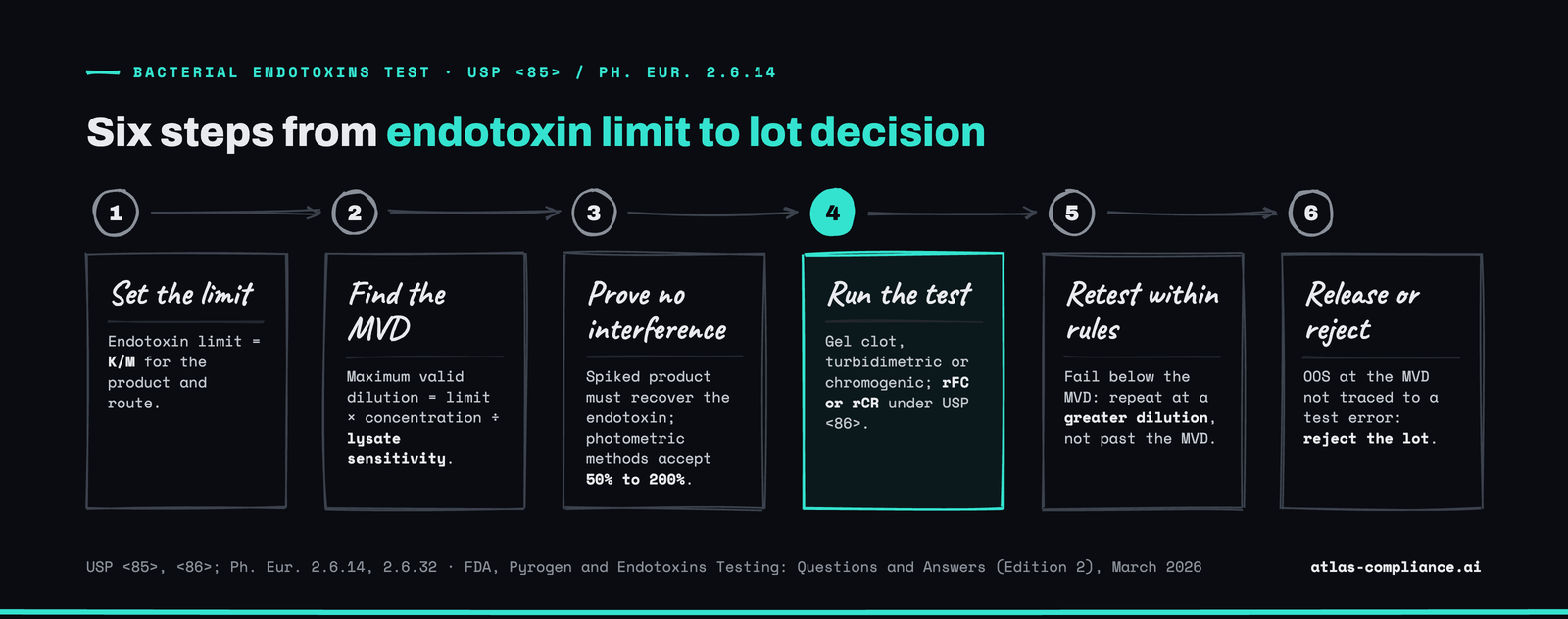
- The usual endotoxin limit for a parenteral drug is K/M, with K set at 5.0 EU per kg of body weight (0.2 EU/kg for intrathecal products) and M the maximum dose per kg per hour.
- FDA's device limit is 0.5 EU/mL or 20 EU per device for products that contact the cardiovascular or lymphatic system, and 0.06 EU/mL or 2.15 EU per device for cerebrospinal fluid contact.
- USP 86, the bacterial endotoxins test using recombinant reagents, became official in May 2025 as an optional alternative to LAL.
What is endotoxin testing?
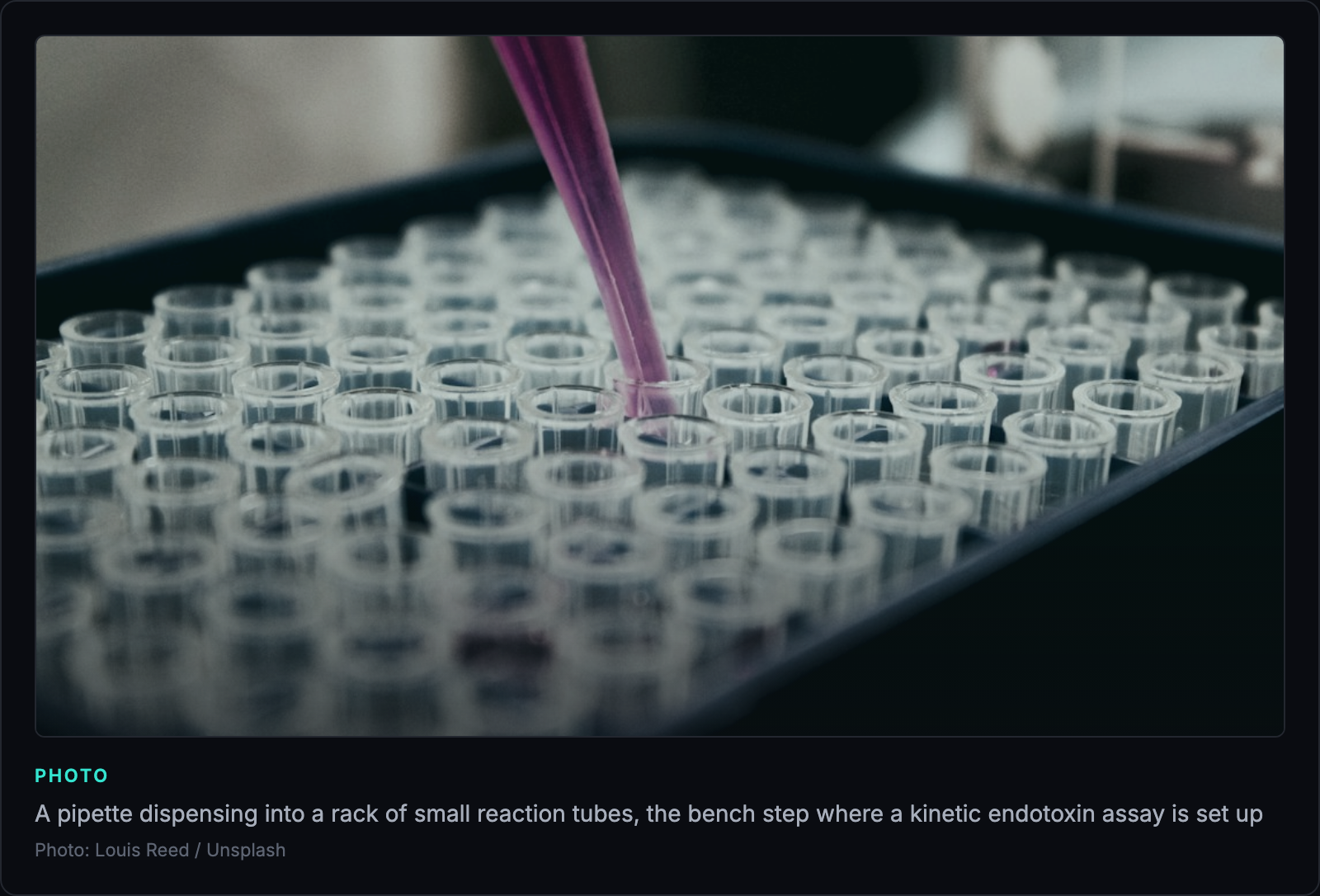
Endotoxin testing is a quantitative or limit test for bacterial endotoxin that a firm runs on parenteral products, devices, components and water to show they stay below a set endotoxin limit. Endotoxin survives heat sterilization and filtration, so a product can be sterile and still cause fever, a drop in blood pressure or shock when injected.
FDA accepted the LAL test in place of the rabbit pyrogen test in a November 4, 1977 Federal Register notice (42 FR 57749). FDA's current view sits in "Pyrogen and Endotoxins Testing: Questions and Answers (Edition 2)", dated March 2026, which defers the methods and limit calculations to USP 85, USP 161 for devices and AAMI ST72, and adds FDA's position on retesting, sample pooling, hold times and alternative methods.
The legal hook for drugs is 21 CFR 211.167(a): each batch purporting to be sterile and/or pyrogen-free must be laboratory tested for conformance, under written procedures that are followed. Release of the batch then runs through 21 CFR 211.165, covered in our release testing guide.
What are the LAL test methods?
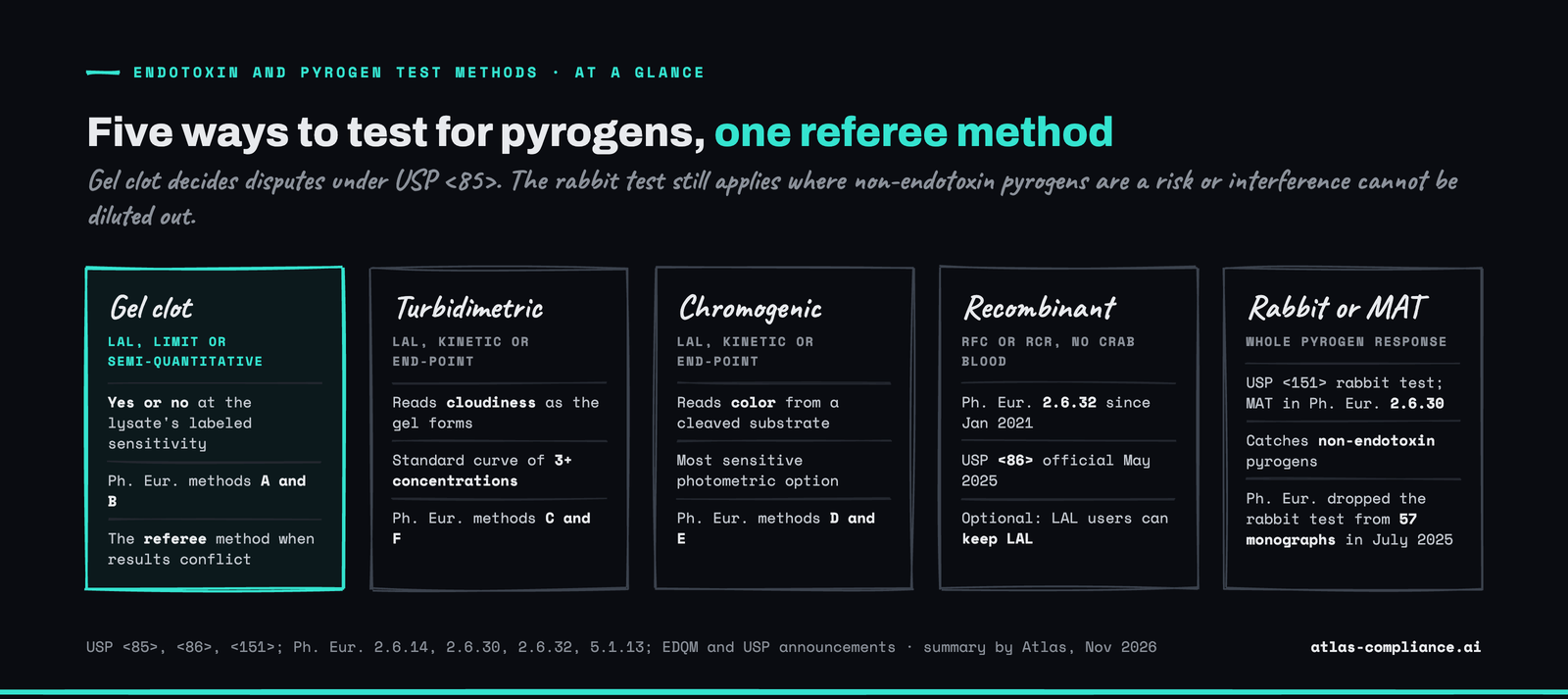
The LAL test methods are gel clot, turbidimetric and chromogenic, all using the same clotting cascade from horseshoe crab blood cells and differing only in how the reaction is read. Ph. Eur. 2.6.14 numbers them as six methods, A to F, and USP 85 describes the same set.
| Method | How the result is read | Ph. Eur. 2.6.14 | Typical use |
|---|---|---|---|
| Gel clot, limit test | A firm gel that holds when the tube is inverted, yes or no at the lysate's labeled sensitivity | A | Release testing where a pass or fail is enough; the referee method |
| Gel clot, semi-quantitative | Endpoint dilution series | B | Estimating the endotoxin level without a reader |
| Turbidimetric, kinetic or end-point | Cloudiness as the gel forms, against a standard curve | C and F | Quantitative trending of water and in-process samples |
| Chromogenic, kinetic or end-point | Color released from a cleaved synthetic substrate, against a standard curve | D and E | The most sensitive photometric option; colored samples may interfere |
When two methods disagree, the gel clot result decides under USP 85, and FDA's 2026 guidance repeats that position. The photometric methods need a standard curve of at least three endotoxin concentrations, and a spiked sample must recover 50% to 200% of the added endotoxin to show the product does not interfere.
Before routine use, each product needs a test for interfering factors at a dilution no greater than the maximum valid dilution (MVD). Proteins, chelating agents and extreme pH can inhibit or enhance the reaction, and dilution is the usual fix.
Is recombinant factor C accepted for endotoxin testing?
Recombinant factor C (rFC) is accepted for endotoxin testing in both major pharmacopoeias: Ph. Eur. 2.6.32, the test for bacterial endotoxins using recombinant factor C, has applied since January 2021, and USP 86, which covers rFC and recombinant cascade reagents (rCR), became official in May 2025. USP 86 is an optional pathway; firms using LAL under USP 85 can keep doing so.
Recombinant reagents remove the dependence on horseshoe crab blood and the lot-to-lot variability of a natural lysate. The cost of switching is validation: FDA's 2026 guidance says an alternative method must be validated under USP 1225 and shown to give equivalent or better results, and for an approved product the change goes through the application as a supplement or annual report, as appropriate.
The rabbit pyrogen test is on its way out in Europe. The European Pharmacopoeia Commission removed it from 57 texts with effect from July 1, 2025, added general chapter 5.1.13 on pyrogenicity, and dropped chapter 2.6.8 from the 12th Edition, in force from January 2026. FDA still lists cases where the rabbit test fits: non-endotoxin pyrogens are a risk, interference cannot be diluted out within the MVD, or 21 CFR 610.13(b) requires it for certain biologics. FDA review divisions consider the monocyte activation test case by case.
How is the endotoxin limit calculated?
The endotoxin limit for a parenteral drug is K/M, where K is the threshold pyrogenic dose of endotoxin per kg of body weight and M is the maximum recommended dose of product per kg per hour. For most injectables K is 5.0 EU/kg; for intrathecal products it is 0.2 EU/kg. USP 85 uses a 70 kg adult when a dose is labeled per person.
A worked example: a product dosed at a maximum of 10 mg/kg in one hour has M = 10 mg/kg, so its limit is 5.0 / 10 = 0.5 EU/mg. The maximum valid dilution then follows as the endotoxin limit times the sample concentration, divided by the lysate sensitivity (lambda). At 50 mg/mL and a lysate labeled 0.125 EU/mL, the MVD is 0.5 × 50 / 0.125 = 200.
FDA's 2026 guidance adds three rules that investigators check against the procedure:
- The endotoxin limit table in Appendix E of the withdrawn 1987 guideline is out of date; calculate limits from the USP or AAMI methods.
- A product with several components still may not exceed the overall threshold in USP 85, whatever each component's own limit.
- For veterinary products used in several species, base the limit on the maximum dose in the smallest species.
What are the endotoxin limits for medical devices?
FDA's endotoxin limits for medical devices follow USP 161: 0.5 EU/mL, or 20 EU per device, for products that directly or indirectly contact the cardiovascular or lymphatic system, and 0.06 EU/mL, or 2.15 EU per device, for devices in contact with cerebrospinal fluid. Devices that contact the intraocular environment may need a lower limit set with the review division.
FDA's recommended extraction is to rinse each of 10 test units with 40 mL of non-pyrogenic water, adjusting the volume by patient-contact surface area for unusually small or large devices. Finished devices can be pooled into one composite extract; individual units or retained extract should stay available for retesting.
How often does FDA cite endotoxin testing on Form 483s?
FDA rarely cites the endotoxin test by its own section. In the Atlas Form 483 citation dataset, 21 CFR 211.167(a) appeared at 3 of 774 Part 211 drug inspections (0.4%) that closed between January 7, 2025 and September 3, 2026, and only two of those observations named pyrogens. Endotoxin risk is written up through the sterile process instead: 21 CFR 211.113(b) appeared at 98 inspections (12.7%) and the aseptic area controls in 211.42(c)(10) at 65 (8.4%).
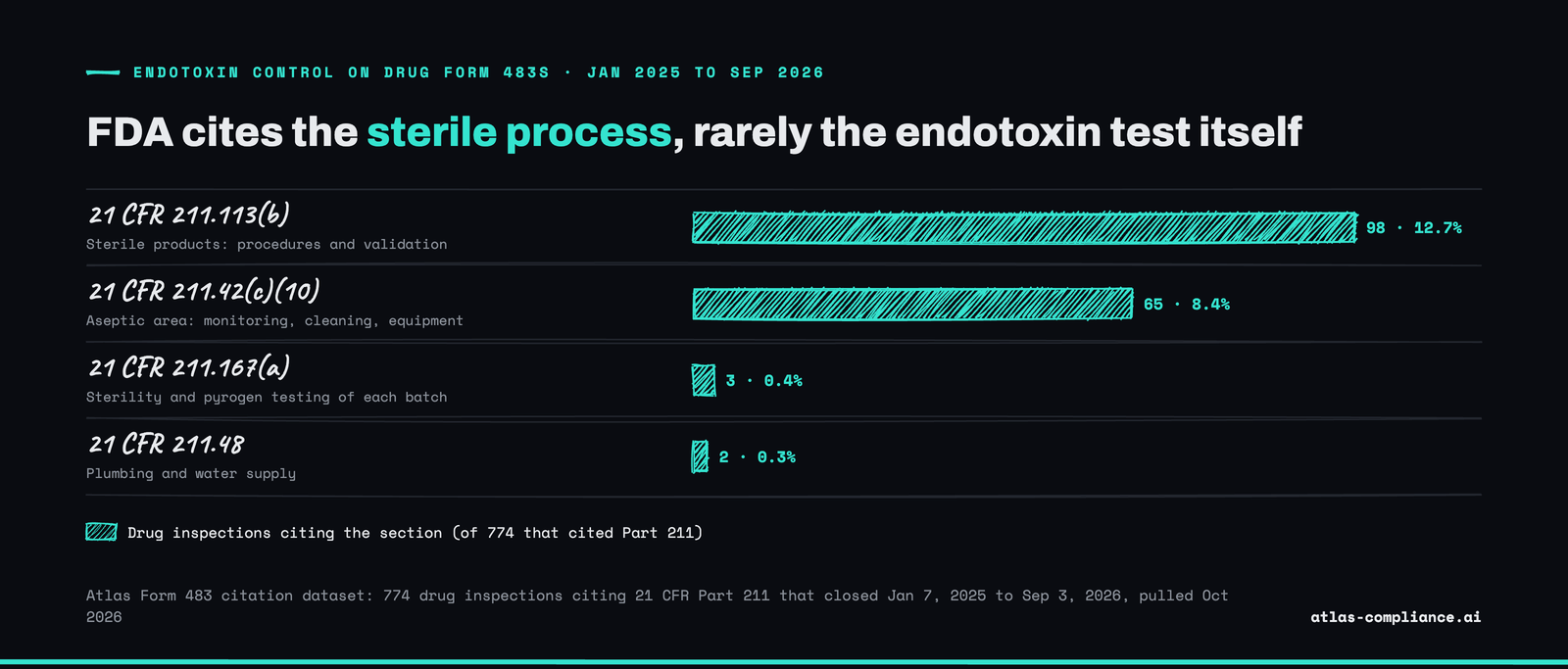
The Atlas FDA Form 483 database shows the same pattern at the heading level. Of 7,117 Form 483s in the directory issued from January 2025 to the August 15, 2026 release, 7 carry a pyrogen heading: 6 in human drugs and 1 in animal drugs.
Two of the forms show what the observations look like in context:
| Facility | Form 483 date | Pyrogen-related citation | Other sections on the form | Classification |
|---|---|---|---|---|
| Eugia Pharma Specialities, Sangareddy, India | Feb 6, 2026 | 211.167(a): test procedures for pyrogens not followed | 211.113(b) twice, 211.42(c)(10)(iv) and (vi), 211.160(a), 211.165(a), 211.192, 211.194(a)(8), 211.22(d), 211.25(a) | OAI |
| Veterinary Enterprises of Tomorrow, Mountain View, US | Jun 3, 2026 | 211.94(c): containers and closures not clean, sterilized and pyrogen-free | 211.113(b), 211.42(c), 211.42(c)(10)(iv), 211.160(b), 211.165(a), 211.166(a), 211.188, 211.194(a), 211.67(b), 211.68(a), 211.80(a), 211.84(d)(2) | Not yet classified in the October 2026 file |
The Eugia form carries 11 observations, and the Sangareddy facility has 9 FDA inspections on record, 8 ending in a Form 483. It was written by an inspection team that included Patty P Kaewussdangkul (162 inspections at 151 sites) and Lisa L Flores (197 inspections at 188 sites). The Mountain View form has 13 observations and was written by Margaret M Annes, who has 230 inspections at 175 sites on record.
The other 211.167(a) citations in the period went to a Medtronic facility in Minneapolis in December 2025 (batches not tested for sterility and pyrogens, classified VAI) and a Gilead Sciences facility in La Verne, California in February 2026 (sterility test procedures not followed, VAI). Both Form 483s are noindexed in Atlas, so they are not linked here.
What does a sterile process citation signal about the inspection?
A 211.113(b) citation signals a heavier inspection outcome. In the Atlas data, 53 of the 98 drug inspections that cited 211.113(b) ended OAI (54.1%), against 159 of 676 other Part 211 drug inspections (23.5%). Of the 98, 69 were at US facilities and 29 at foreign ones.
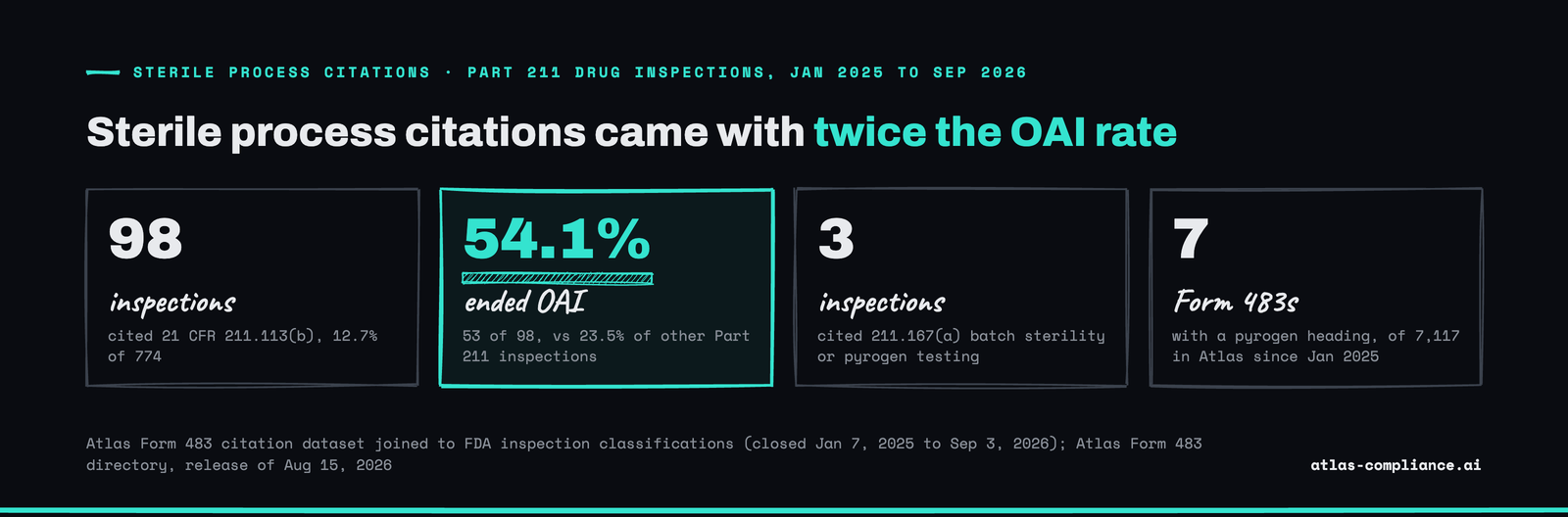
The citation text explains the gap. Of the 124 observations FDA wrote under 211.113(b), 78 carry the heading "Procedures for sterile drug products" and 46 "Validation lacking for sterile drug products". Depyrogenation of glass, closure processing and water system control usually sit inside those observations, so an endotoxin weakness reaches the Form 483 as a process finding long before it shows up as a failed test. Our media fill test guide covers the aseptic validation side, and the 503B outsourcing facility guide shows how often compounders are cited on the same sections.
Investigators who wrote sterile process observations before tend to look at the same records again, and their past forms list which ones.
 Atlas
See what the FDA knows about your next investigator.
30 minutes with the founder. No pitch deck.
How do endotoxin testing and microbial limits testing differ?
Endotoxin testing measures a bacterial toxin that stays active after the bacteria are dead, while microbial limits testing under USP 61 and 62 counts or detects living organisms in non-sterile products. A sterile injectable needs both sterility testing (USP 71) and endotoxin testing; a non-sterile oral product usually needs USP 61 and 62 and no endotoxin test.
The two tests share a cause. Water systems, components and equipment that carry gram-negative bacteria produce endotoxin, so a firm that trends endotoxin in water for injection (limit 0.25 EU/mL in the USP monograph) and in components sees contamination before it reaches a finished lot. FDA's 2026 guidance asks for in-process testing at the steps where endotoxin can form or enter, with quantitative results preferred over limit tests for trending. The 21 CFR Part 211 guide maps where each of those controls sits in the regulation.
Atlas tracks new Form 483s and warning letters as FDA releases them, including the sterile process and pyrogen citations covered here.
AtlasFDA Inspection Intelligence Digest
We track every 483, EIR, and warning letter the moment it happens. Get the signals before they hit the FDA website.
Frequently asked questions
Endotoxin is the most common pyrogen but not the only one. A pyrogen is any substance that causes fever when injected; endotoxin comes from gram-negative bacteria, while non-endotoxin pyrogens include components of gram-positive bacteria, fungi and some materials. The bacterial endotoxins test detects only endotoxin, so FDA expects a risk assessment, and the rabbit test or monocyte activation test, where non-endotoxin pyrogens are likely.

Written by
Bhavish Agarwal
Founder, Atlas
Bhavish Agarwal is the founder of Atlas and previously worked at Google and Microsoft. He has spent the past several years building regulatory data infrastructure for the pharmaceutical industry.