
USP 1790 is the informational United States Pharmacopeia chapter that explains how to design, run and qualify the visual inspection of injectable products for visible particles and other visible defects, as the companion to the official USP 790 chapter on visible particulates in injections.
This guide sets out what the two chapters ask for, then adds Atlas data from November 2026 that other USP 1790 pages do not have: the CGMP sections FDA investigators cited at 98 sterile drug inspections between January 2025 and September 2026, and the four 2026 warning letters that took apart visual inspection programs.
Key facts:
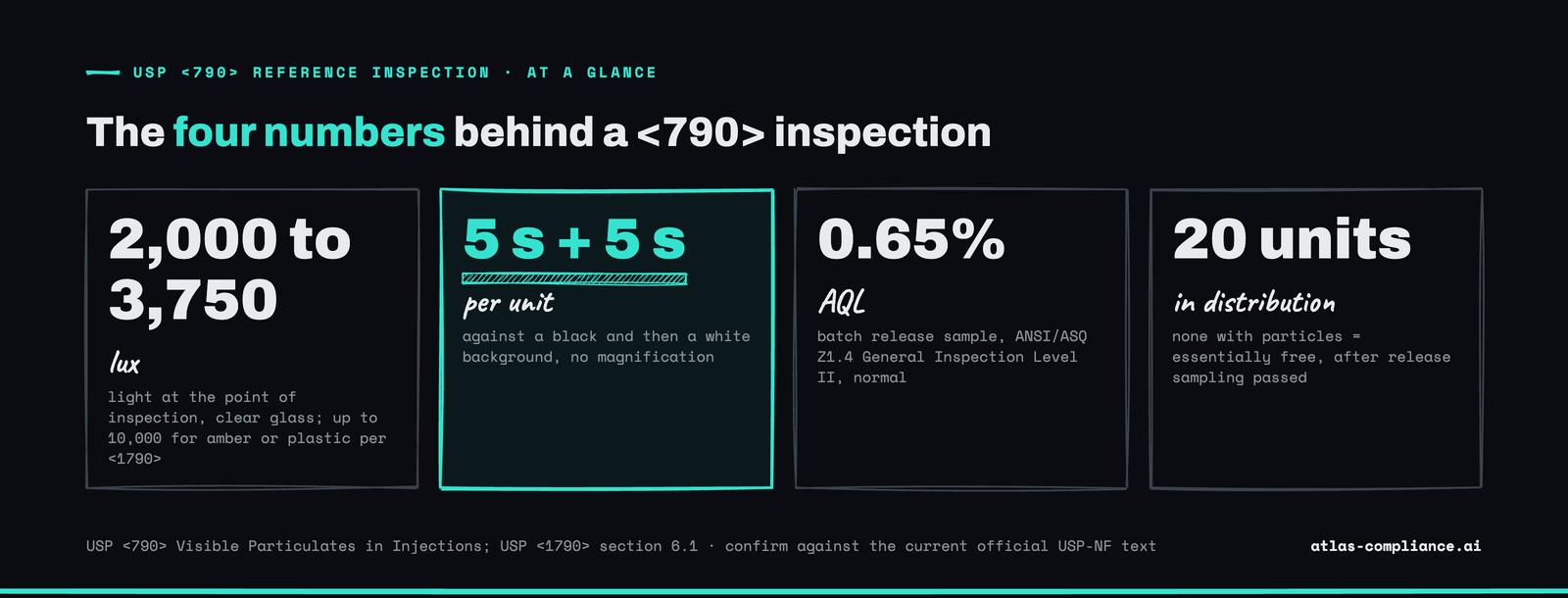
- USP 790 expects 100% inspection of every unit, followed by an acceptance sample inspected under ANSI/ASQ Z1.4 General Inspection Level II with an AQL of 0.65% for visible particulates.
- The USP 790 reference inspection uses 2,000 to 3,750 lux at the point of inspection and about 5 seconds against a black background and 5 seconds against a white one, without magnification.
- USP 1790 lists typical AQL ranges of 0.010% to 0.10% for critical defects, 0.10% to 0.65% for major defects and 1.0% to 4.0% for minor defects.
- Under the Knapp method described in USP 1790, a defect unit belongs in the reject zone when inspectors detect it at least 70% of the time, which for a single particle in a clear 10 mL vial is often near 150 µm.
- In the Atlas Form 483 citation dataset, 98 of 774 Part 211 drug inspections cited sterile drug section 21 CFR 211.113(b), and 61 of those 98 also cited the investigations section, 21 CFR 211.192.
What is USP 1790?
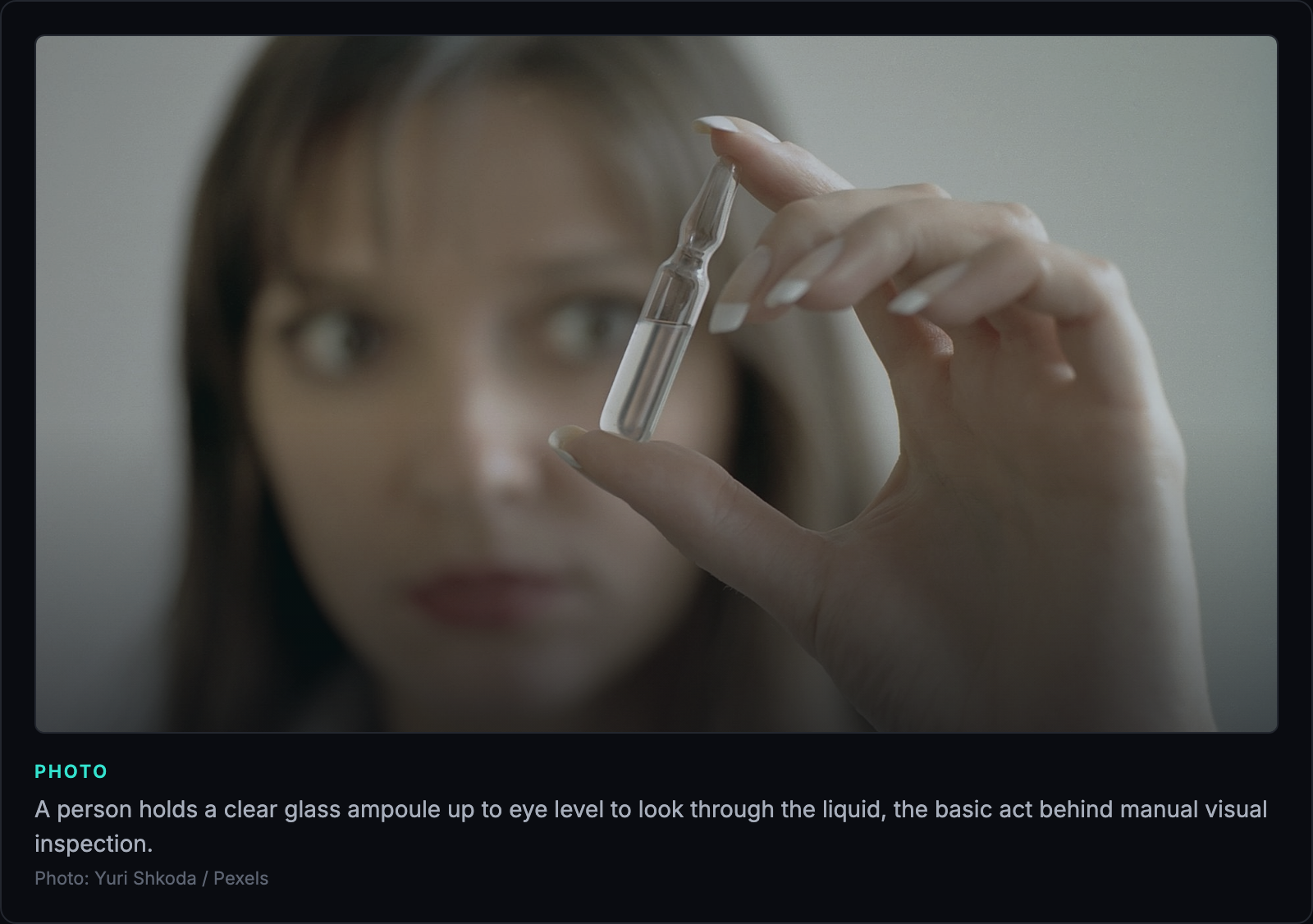
USP 1790, "Visual Inspection of Injections", is a general information chapter numbered above 1000, so its text is guidance and not an enforceable test. USP 1790 explains how to meet USP 790, covering inspection process flow, defect classification, inspection methods, test sets, inspector qualification and products returned from distribution. It became official in 2017.
USP 790, "Visible Particulates in Injections", is the official chapter. USP 1 states that the inspection process for every lot of parenteral preparations should be designed and qualified to ensure the lot is "essentially free from visible particulates", the term USP 790 defines through its sampling plan. FDA's draft guidance repeats that injectable products with a USP monograph must meet these criteria, and that products without one should meet the same standard.
USP 790 vs USP 1790: what is the difference?
USP 790 sets the reference inspection method and the acceptance criteria; USP 1790 explains how to build a program that meets them. A batch is tested against USP 790. A visual inspection program is designed and qualified with USP 1790.
| Point | USP 790 | USP 1790 |
|---|---|---|
| Title | Visible Particulates in Injections | Visual Inspection of Injections |
| Status | Official chapter, numbered below 1000 | Informational chapter, numbered above 1000 |
| Scope | Visible particulates only | Particles plus container, closure and cosmetic defects |
| Core content | Reference inspection method, batch release and in-distribution sampling | Defect classes, AQL ranges, Knapp method, test sets, inspector qualification, automated inspection |
| Used for | Judging whether a batch is "essentially free" | Designing and qualifying the program behind that result |
How do 100% inspection and AQL sampling work together?
100% inspection removes defective units from every batch; AQL sampling then checks a statistical sample of the accepted units to confirm the 100% inspection worked. USP 1790 says acceptance sampling should follow any type of 100% inspection, manual, semi-automated or automated.
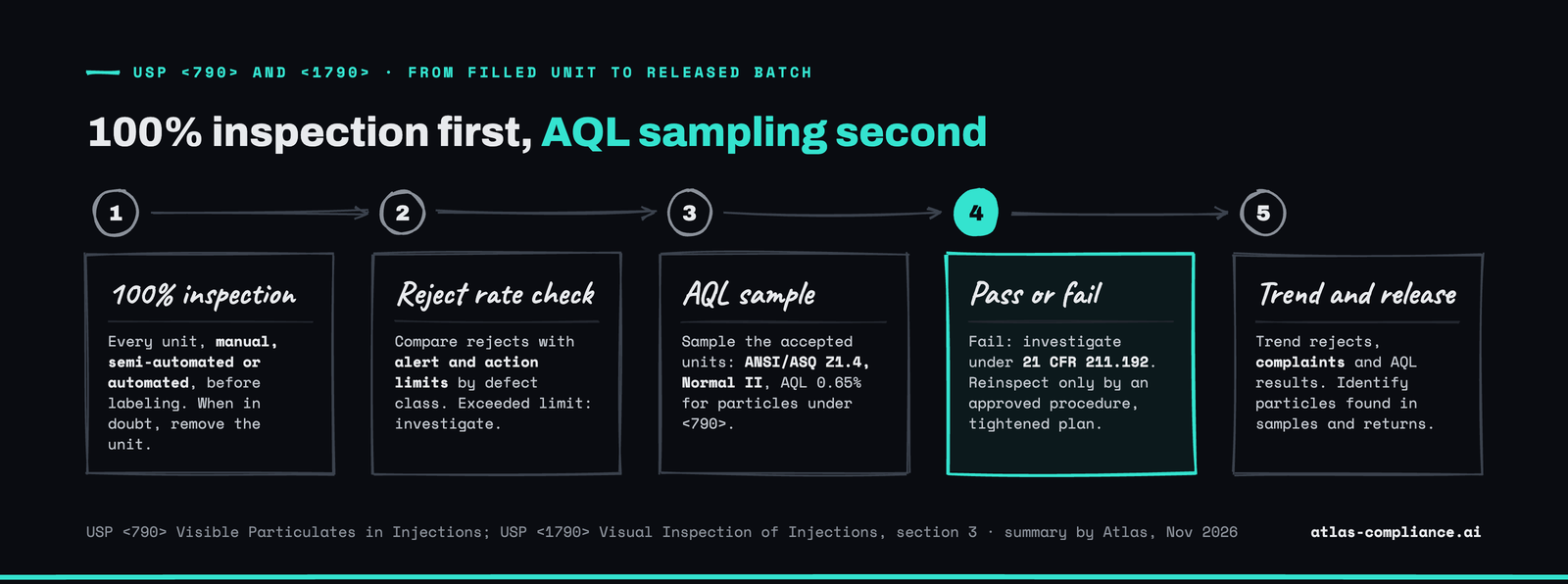
USP 1790 places 100% inspection at the point where defects are easiest to see, such as before labeling, and tells inspectors to remove a unit when in doubt. The firm sets limits on reject rates by defect class, and an exceeded limit triggers an investigation. The AQL sample is then drawn from the accepted units, and the chapter defines the AQL as the defect rate at which 95% of lots are accepted.
USP 1790 groups defects by patient risk and gives typical AQL ranges for each class:
| Defect class | What USP 1790 puts in it | Typical AQL |
|---|---|---|
| Critical | Defects that may cause a serious adverse reaction or death, including any loss of container integrity | 0.010% to 0.10% |
| Major | Risk of a temporary or medically reversible reaction, a remote chance of a serious one, or a defect that impairs use | 0.10% to 0.65% |
| Minor | Cosmetic defects with no effect on product performance | 1.0% to 4.0% |
A failed AQL sample leads to an investigation. Reinspection is allowed only under a pre-approved procedure that limits how many times it may happen, and the chapter recommends a tightened sampling plan afterward. FDA's draft guidance goes further: it does not recommend more than one reinspection to release a batch with atypical defect levels.
What inspection conditions does USP 790 set?
USP 790 sets the reference conditions for manual inspection: light of 2,000 to 3,750 lux at the point of inspection, black and white backgrounds, no magnification, and about 5 seconds per background after the unit is gently swirled or inverted without creating bubbles. USP 1790 calls this a reference time of 10 seconds per container.
USP 1790 adds the practical parameters a qualified station needs:
- Light: no inspection below 2,000 lux, a lower action limit set above it, and up to 10,000 lux for plastic or amber glass containers.
- Breaks: a rest from inspection at least every hour, such as a 5 minute pause or rotation to another task.
- Magnification: useful when investigating a few units, not recommended for routine inspection.
- Pacing: a light or tone can control time per container.
For product already in distribution, USP 790 has a separate test: inspect 20 units, and if none contains visible particles the batch is considered essentially free. That test applies only when batch release sampling was completed successfully.
What is the Knapp test in visual inspection?
The Knapp test is a probabilistic method, described by Knapp and Kushner and adopted in USP 1790, that assigns each defect standard unit a probability of detection (POD) from repeated manual inspections. A unit detected 70% of the time or more sits in the reject zone; under 30% is an accept unit; 30% to under 70% is the grey zone.
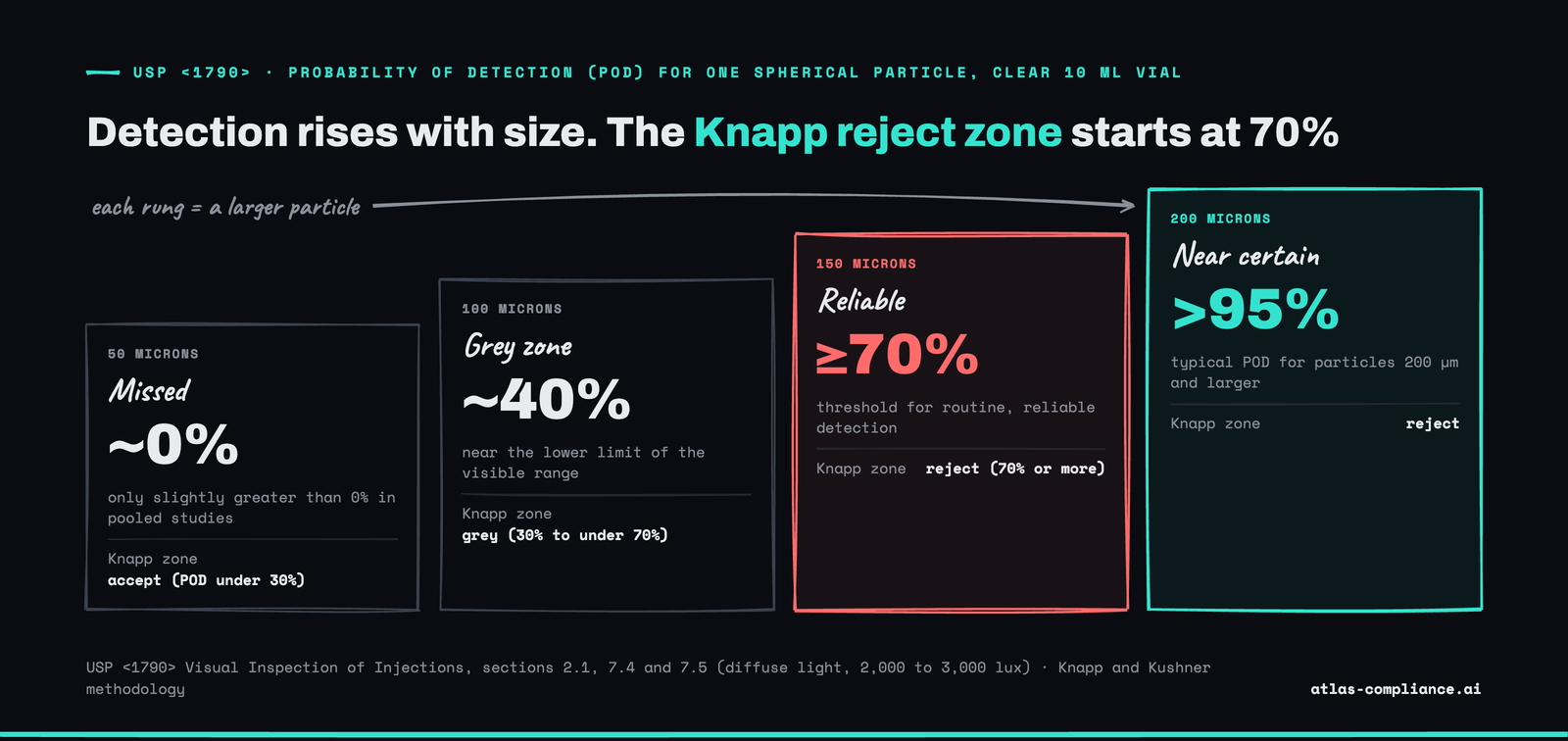
USP 1790 gives the calculation as POD = times rejected divided by times inspected, and says 30 to 50 inspections per container, ideally by several inspectors, produce secure data. The firm then uses the reject zone units to calculate the reject zone efficiency (RZE) of the manual method, and any semi-automated or automated system must match or beat it.
USP 1790 also sets the rules for building test sets and qualifying inspectors:
- Keep defective units to about 10% of each test set, to prevent rejection bias.
- Bracket particle sizes from near the lower visible limit, 100 µm, up to the largest particles seen in rejects.
- Screen candidates for near vision equivalent to 20/20 and no color vision impairment.
- Require three successful test set inspections for initial qualification, with a false reject target under 5%.
- Requalify each inspector at least annually, and again after a long absence such as 3 months.
USP 1790 notes that particles at the threshold size can still go undetected up to 30% of the time, so it asks firms to identify particles found in AQL samples, retains and returned product.
Manual vs semi-automated vs automated inspection: how do they compare?
Manual, semi-automated and automated visual inspection all have to meet the same USP 790 standard, and USP 1790 and FDA's draft guidance both expect alternatives to show performance equal to or better than the manual reference method. The differences are in who decides and what has to be qualified.
| Method | How it works | What gets qualified | Trade-off USP 1790 notes |
|---|---|---|---|
| Manual (MVI) | An inspector holds and swirls each unit at a lit station | Inspectors, light, backgrounds, time per unit | Reference method; depends on people and fatigue |
| Semi-automated | Rollers spin units past an inspector who decides | Inspectors plus spin speed and conveyor rate | Similar detection to manual, more throughput |
| Automated (AVI) | Cameras or light obscuration sensors reject units | Machine validated against the manual RZE | Consistent and fast, but higher false rejects on molded glass and bags |
What does FDA's 2021 draft guidance on visible particulates add?
FDA's draft guidance "Inspection of Injectable Products for Visible Particulates" (December 2021, docket FDA-2021-D-0241) recommends a risk-based visible particulate program. As of November 17, 2026, FDA's guidance listing still shows it as a draft, not for implementation, with no final version.
The draft states that meeting USP 790 acceptance criteria alone does not ensure CGMP compliance. It also recommends feasibility studies on detectability, inspection duration, lighting and fatigue, test sets with no more than 10% to 20% defective units, and investigation of any batch that exceeds defect limits or fails AQL. It treats extrinsic particles found during 100% inspection or AQL as a possible sign of adulteration even when the batch passes its sampling plan.
Which Form 483 sections and warning letters show visual inspection failures?
FDA does not cite USP 790 or USP 1790 by number on a Form 483. Investigators cite the Part 211 section behind each gap, such as 211.192 for an uninvestigated out-of-limit batch or 211.25(a) for inspector training. Each 2026 warning letter below cited a Part 211 section.
In the Atlas Form 483 citation dataset (774 drug inspections citing 21 CFR Part 211, closed January 7, 2025 to September 3, 2026, pulled October 2026 and joined to FDA's inspection classifications), 98 inspections cited 21 CFR 211.113(b) for sterile drug products. 53 of those 98 (54.1%) ended Official Action Indicated (OAI), against 159 of the other 676 (23.5%).
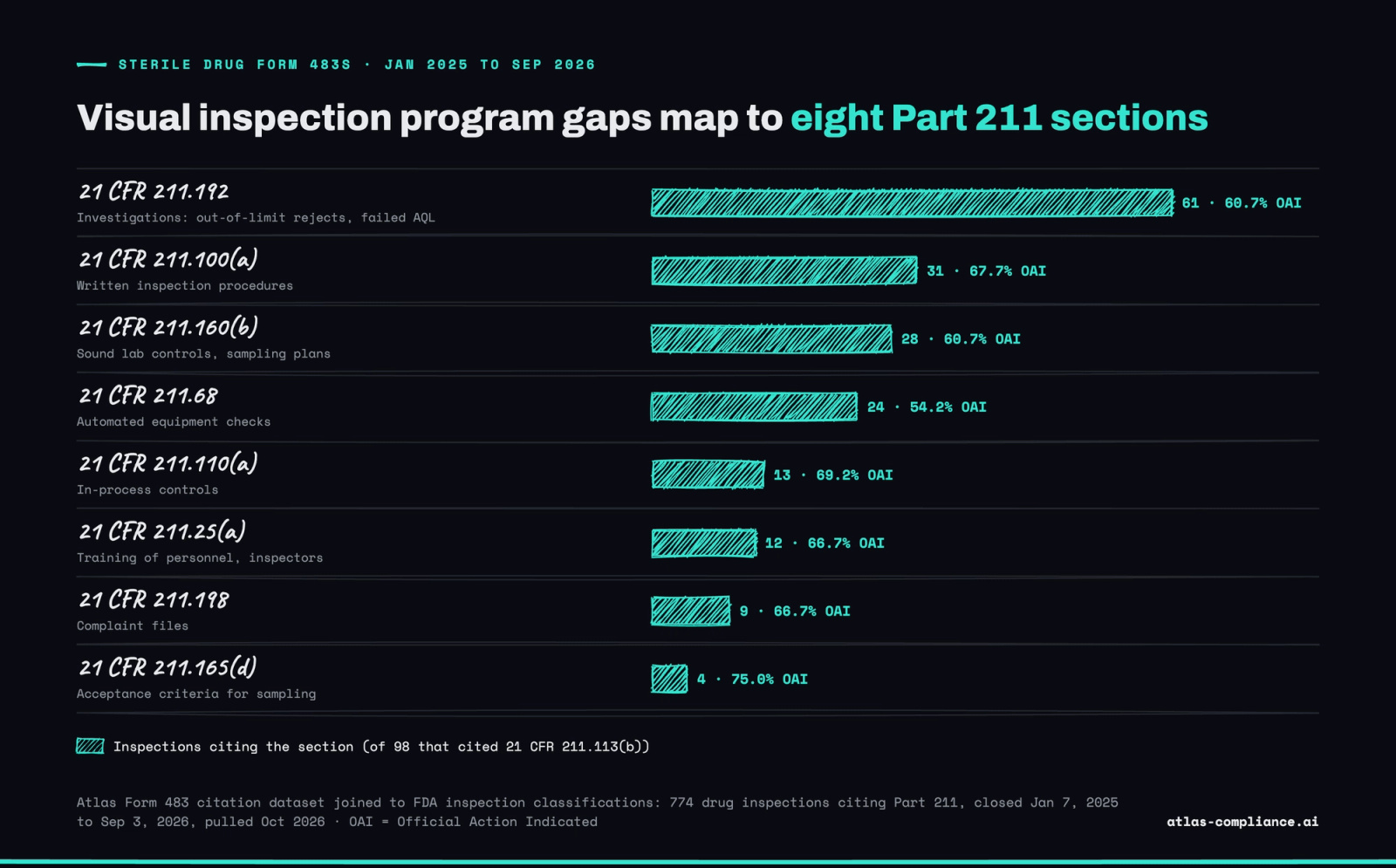
88 of the 98 sterile inspections cited at least one of those eight sections. The public citation data uses FDA's standard section wording, so it does not show whether particles were the subject of each observation. The Unither Manufacturing Form 483 dated May 15, 2026 shows the pattern: 211.113(b) with 211.160(b), 211.165(d) acceptance criteria for sampling, and 211.68(b).
The four 2026 warning letters that cited visual inspection programs:
| Facility | Warning letter | Section cited | What FDA found |
|---|---|---|---|
| Fresenius Medical Care, Ogden, UT | 320-26-119, Aug 25, 2026 | 211.100(a) | Qualification kit lacked representative particle sizes; FDA says kits should typically contain particles of 100 to 150 microns |
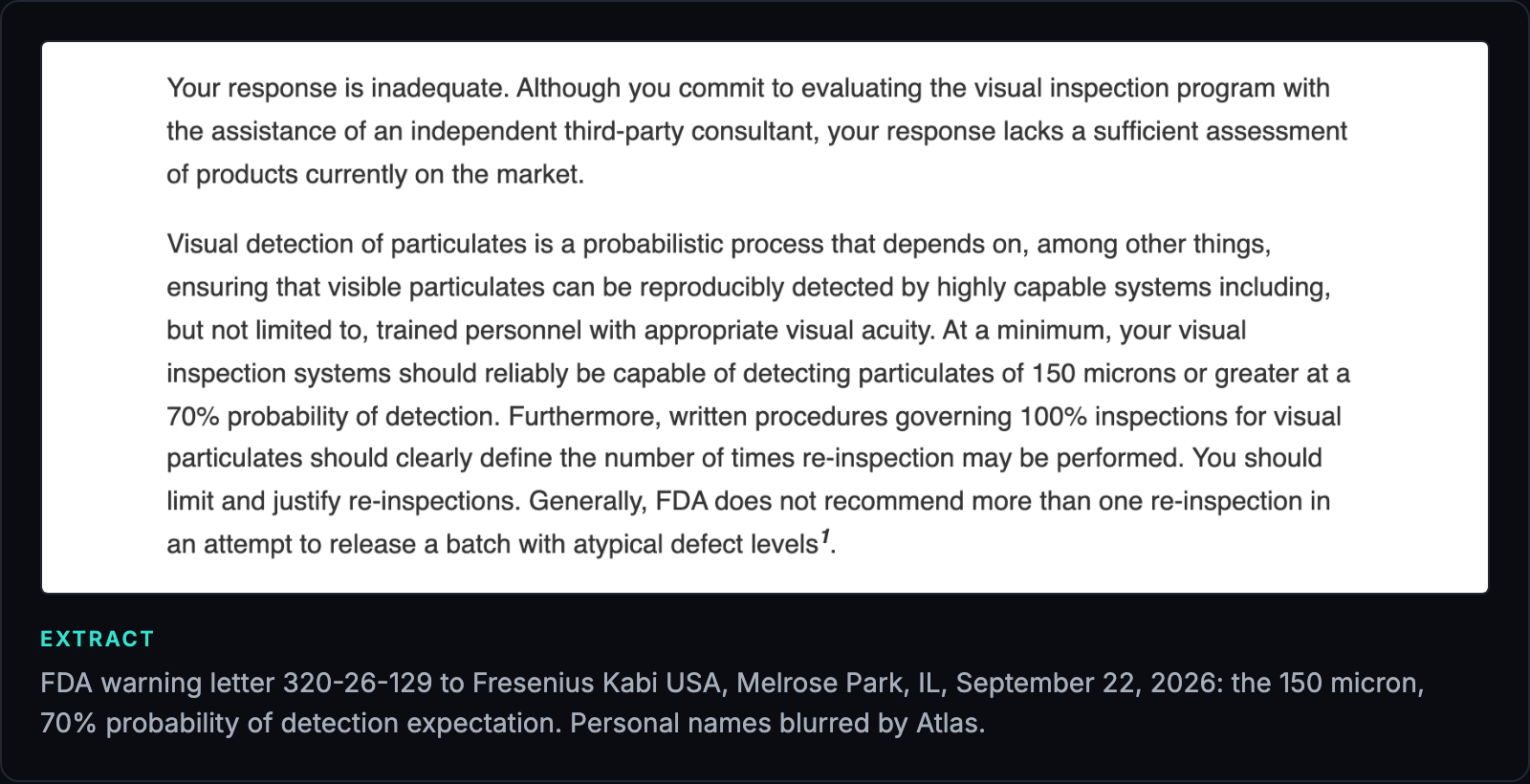
| Fresenius Kabi, Melrose Park, IL | 320-26-129, Sep 22, 2026 | 211.110(a), 211.42(c)(10) | All non-glass particles, hair included, classed as major; POD inadequate; FDA expects 150 micron particles detected at a 70% POD |
| Baxter, Round Lake, IL | 320-26-132, Sep 29, 2026 | 211.160(b) | Challenge kit particles too large, inspection rate too fast, particle complaints from 2023 to 2025 |
| Rohto (Vietnam), Ho Chi Minh City | 320-27-06, Oct 14, 2026 | 211.192 | Out-of-limit 100% visual inspection results for two batches of sterile ophthalmic product not adequately investigated; both shipped to the US |
The Ogden letter followed a two-observation Form 483 dated March 6, 2026 under 211.100(a) and 211.192. The Round Lake letter followed a nine-observation Form 483 dated April 2, 2026 that cited 211.25(a) training and 211.165(d) sampling acceptance criteria. Our breakdowns of the Baxter warning letter and the two Fresenius warning letters cover the remediation FDA asked for, including probability of detection studies and an independent review of every distributed lot.
Each of these forms is in the FDA Form 483 database with the investigators who wrote it. If a sterile inspection is coming, check whether your investigator has written 211.192, 211.25(a) or 211.165(d) observations before.
 Atlas
See what the FDA knows about your next investigator.
30 minutes with the founder. No pitch deck.
What should a visual inspection program show an investigator?
A visual inspection program should show an investigator that each USP 1790 element has a record behind it. The 2026 letters cited missing records at each step: kits, POD, defect classes, inspection rate and investigations.
- Threshold studies and Knapp POD data for each product and container type.
- Test sets with particles near 100 to 150 microns, with about 10% defective units, approved by the quality unit.
- Defect classes that do not lump hair and other particles of biological origin into the major class, with limits for each particle type.
- A qualified inspection rate, light level and break schedule, written into the procedure under 211.100(a).
- Inspector qualification and annual requalification records under 211.25(a).
- An investigation under 21 CFR 211.192 for every exceeded reject limit or failed AQL, with particle identification and a cap on reinspection.
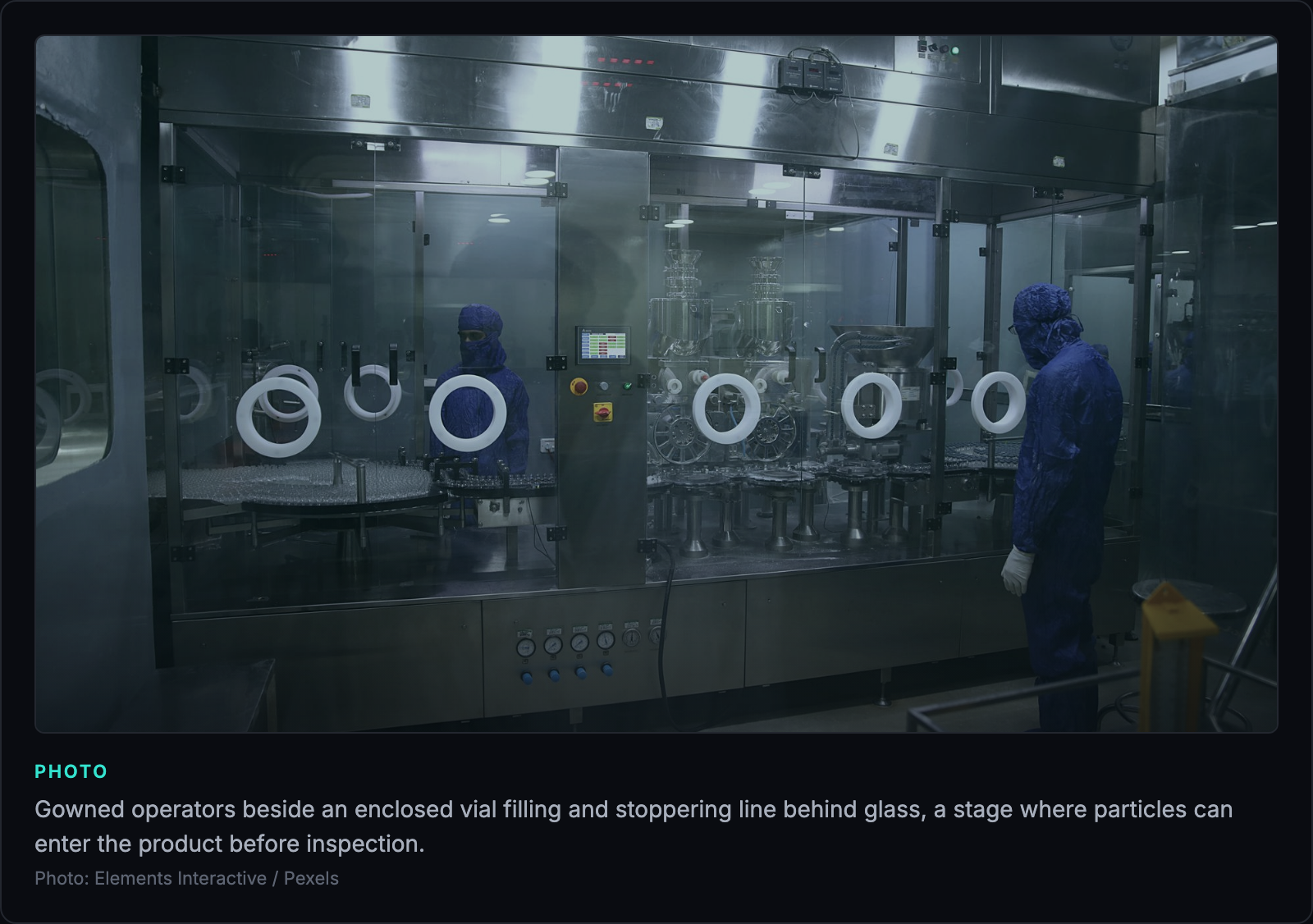
Particle prevention starts upstream of the inspection booth, in the controls covered by our aseptic processing guide. Visual inspection results also sit alongside sterility and endotoxin data in release testing for a parenteral batch.
Atlas tracks new Form 483s and warning letters as FDA releases them, including the sterile and visual inspection citations covered here.
AtlasFDA Inspection Intelligence Digest
We track every 483, EIR, and warning letter the moment it happens. Get the signals before they hit the FDA website.
Frequently asked questions
No. USP 1790 is a general information chapter, and chapters numbered above 1000 are guidance rather than enforceable requirements. USP 790 is the official chapter, and USP 1 expects every lot of parenteral preparations to be essentially free from visible particulates. FDA's December 2021 draft guidance refers to USP 1790, and 2026 warning letters used its concepts, such as probability of detection and qualification kits.

Written by
Bhavish Agarwal
Founder, Atlas
Bhavish Agarwal is the founder of Atlas and previously worked at Google and Microsoft. He has spent the past several years building regulatory data infrastructure for the pharmaceutical industry.