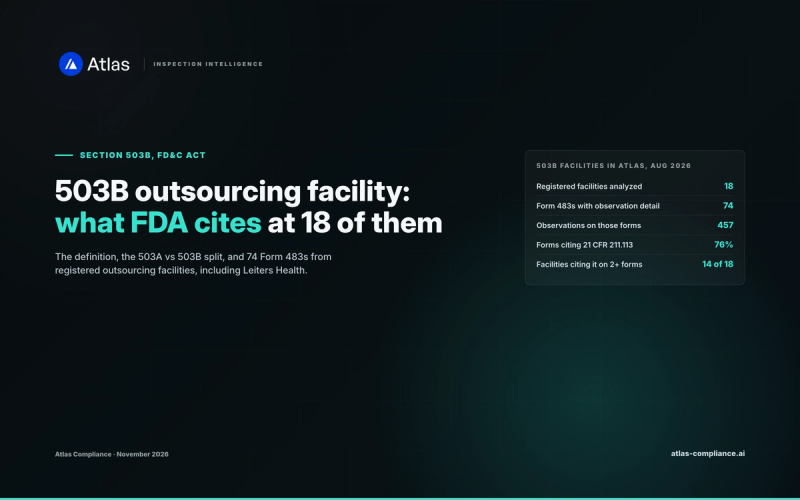

USP 797 is the United States Pharmacopeia general chapter "Pharmaceutical Compounding: Sterile Preparations", the minimum standard for preparing compounded sterile preparations (CSPs) for people and animals. The revised chapter was published on November 1, 2022 and became official on November 1, 2023, replacing the low, medium and high risk levels with Category 1, 2 and 3.
This guide adds what chapter summaries leave out: the Atlas Form 483 record (release of August 15, 2026) for 280 sterile compounding Form 483s issued to 187 pharmacies and outsourcing facilities from February 2013 to June 2026, and what FDA investigators wrote on them.
Key facts:
- USP 797 sorts CSPs into Category 1, 2 and 3 by where they are compounded and how long they may be kept, the beyond-use date (BUD).
- A Category 1 CSP has a BUD of up to 12 hours at room temperature or 24 hours refrigerated, and may be prepared in an ISO 5 primary engineering control inside a segregated compounding area.
- Category 2 and 3 CSPs are prepared in a cleanroom suite, an ISO 5 primary engineering control inside an ISO 7 buffer room.
- State boards of pharmacy enforce USP 797 at 503A pharmacies; 503B outsourcing facilities are held to CGMP under 21 CFR parts 210 and 211.
- In the Atlas record, 148 of 280 sterile compounding Form 483s (52.9%) carry the heading "Environmental Monitoring System", the most common one.
- 24 of the 280 forms were issued after the revision took effect, and 12 of those 24 (50.0%) cite investigations of discrepancies and failures, against 23.9% across all 280.
What is USP 797?
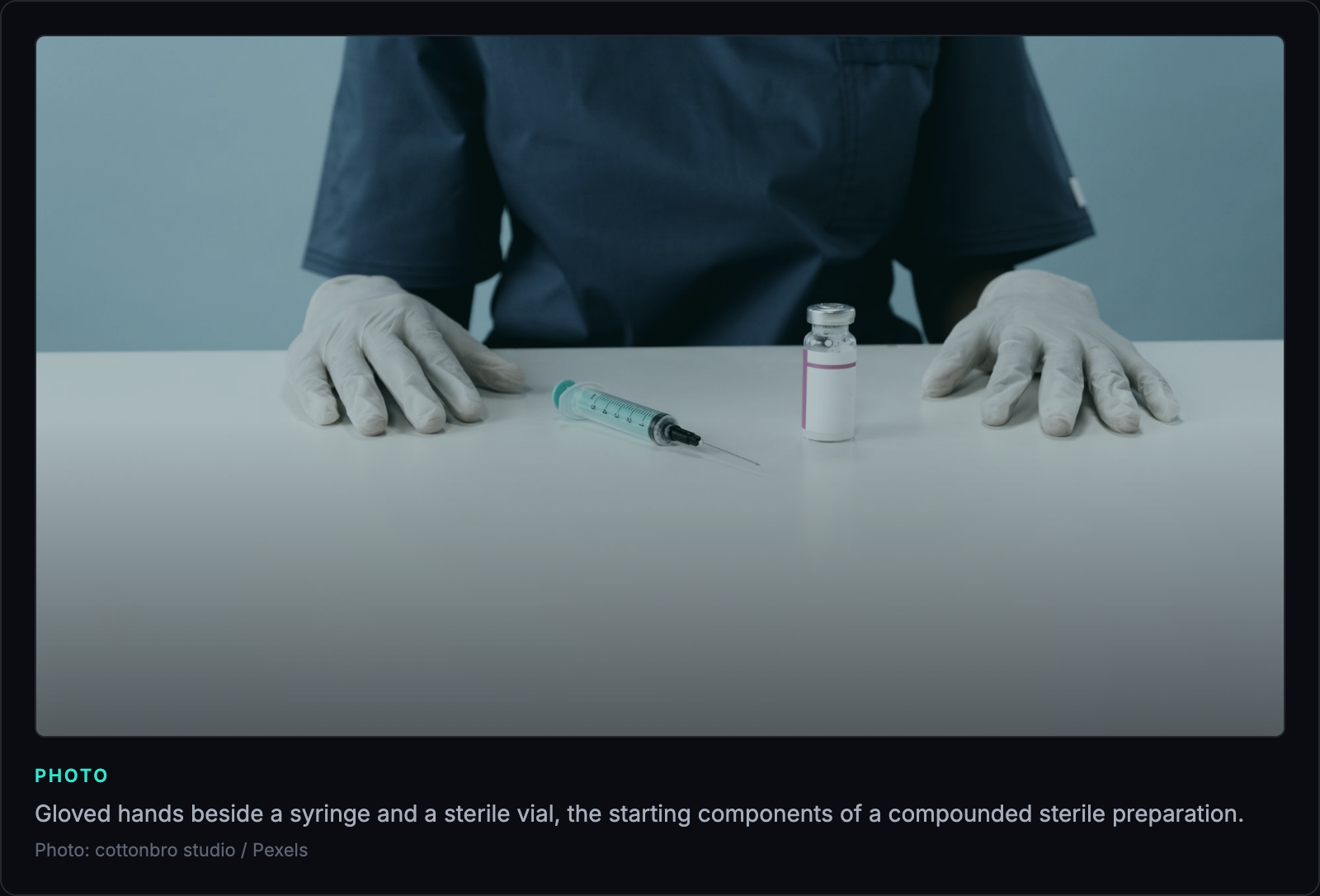
USP 797 is the chapter that tells a compounder how to keep a sterile preparation free of microorganisms, endotoxins and particles from the first component to the moment it leaves the pharmacy. It covers personnel training and garbing, the rooms and hoods where compounding happens, environmental monitoring, cleaning, the release checks on each preparation, and how long a CSP may be stored before use.
USP publishes the standard; it does not enforce it. Section 503A of the FD&C Act names USP chapters as the quality standard for traditional pharmacies, and most state boards of pharmacy write USP 797 into their rules, so a board inspector checks a pharmacy against it. Accrediting bodies and hospital surveyors use it as well. Hazardous drugs follow a separate chapter, USP 800, and nonsterile compounding follows USP 795.
What are Category 1, 2 and 3 CSPs?
Category 1, 2 and 3 are the three CSP classes in the revised USP 797, defined by the conditions the preparation is made in and the BUD it can carry. The category drives almost every other requirement: the room, the monitoring frequency, the personnel testing interval and whether sterility testing is required.
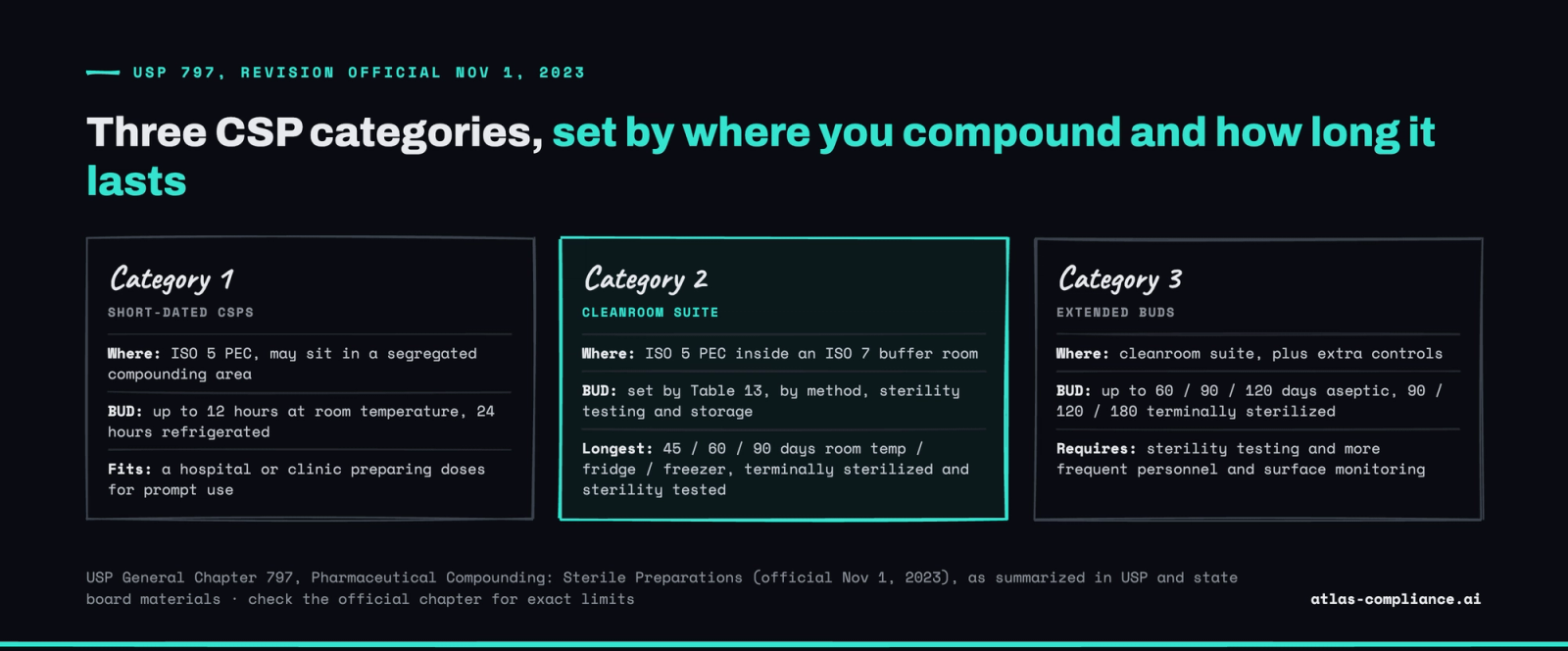
| Category 1 | Category 2 | Category 3 | |
|---|---|---|---|
| Where it is compounded | ISO 5 primary engineering control, which may sit in a segregated compounding area | ISO 5 primary engineering control inside an ISO 7 buffer room (cleanroom suite) | Cleanroom suite, with additional controls |
| Longest BUD | 12 hours at room temperature, 24 hours refrigerated | Set by the chapter's BUD table, by sterilization method, starting components, sterility testing and storage | Extended BUDs, supported by sterility testing |
| Sterility testing | Not required | Required only to claim the longer Category 2 BUDs | Required |
| Typical use | Doses prepared for prompt administration | Most batch and patient-specific sterile compounding | Compounders that need longer dating |
An immediate-use CSP sits outside the three categories. USP 797 exempts it from most of the chapter when administration begins within 4 hours of the start of preparation and the other immediate-use conditions are met.
How are beyond-use dates set under USP 797?
A USP 797 beyond-use date is the date or hour after which a CSP must not be used, counted from the time compounding starts. The compounder takes the shortest of three limits: the category limit in the chapter's BUD tables, any stability data for the drug, and the dating of the components used.
For Category 2, the table turns on four questions: was the CSP aseptically processed or terminally sterilized, did it start from sterile or nonsterile components, was a sterility test passed, and is it stored at room temperature, in a refrigerator or frozen. USP and state board summaries put the longest Category 2 limits at 45 days at room temperature, 60 days refrigerated and 90 days frozen, for a terminally sterilized CSP that passes a sterility test. Category 3 extends this to 60, 90 and 120 days for an aseptically processed, sterility tested CSP, and 90, 120 and 180 days for a terminally sterilized one. Check the current official chapter for the exact table before you change a dating policy.
BUD failures show up on Form 483s as release and dating problems. In the Atlas record, 87 of the 280 sterile compounding forms (31.1%) carry the heading "Testing and release for distribution" and 77 (27.5%) carry "Sterility/pyrogen-free testing". That is the gap between a BUD on a label and the test results that support it, which is also the subject of our guide to USP 61 and 62 microbial testing.
What does USP 797 require for rooms, monitoring and people?
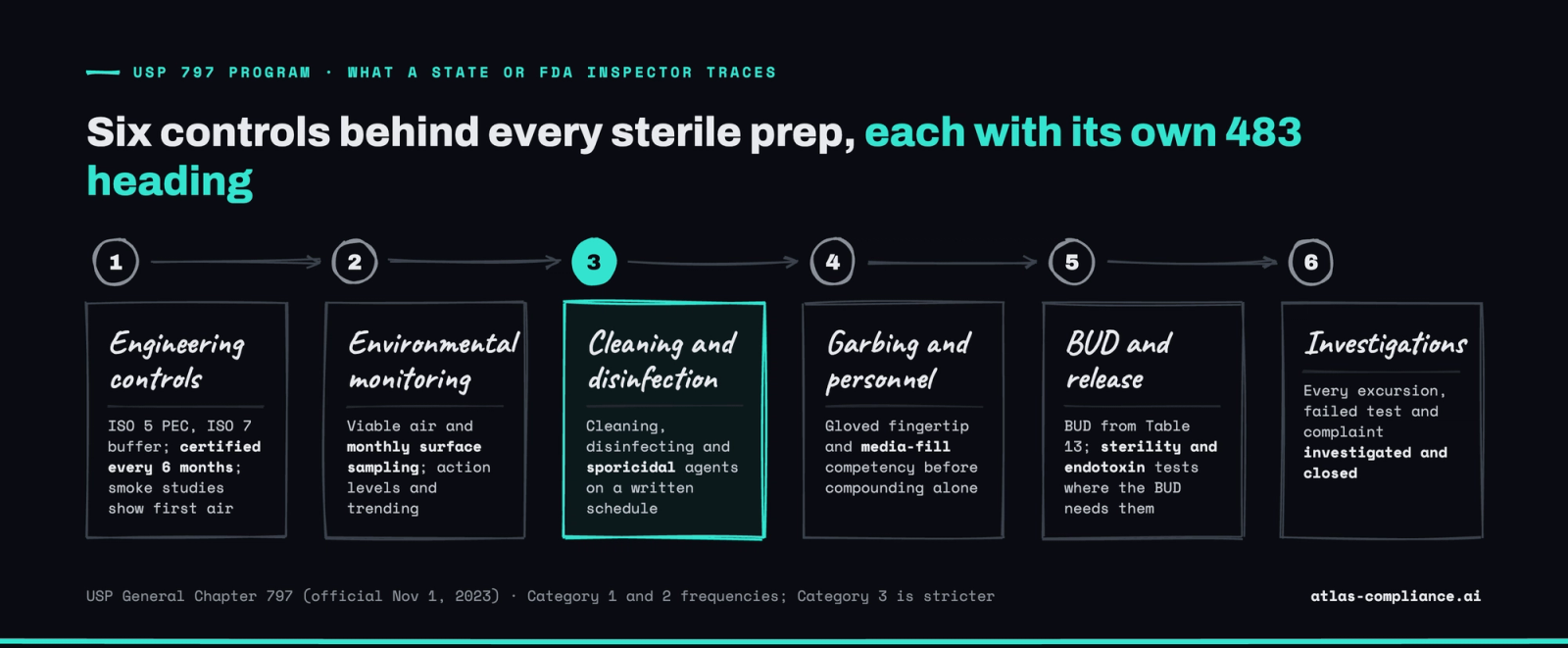
USP 797 requires six sets of controls around every sterile preparation, and an inspector can trace each one to a record. For Category 1 and 2 compounding:
- Engineering controls. Primary engineering controls (laminar airflow workbenches, biological safety cabinets, isolators) and the rooms around them are certified at least every 6 months, and smoke studies show that first air reaches the critical site.
- Environmental monitoring. Viable air sampling at least every 6 months and surface sampling at least monthly, with action levels, trending and a response to every excursion.
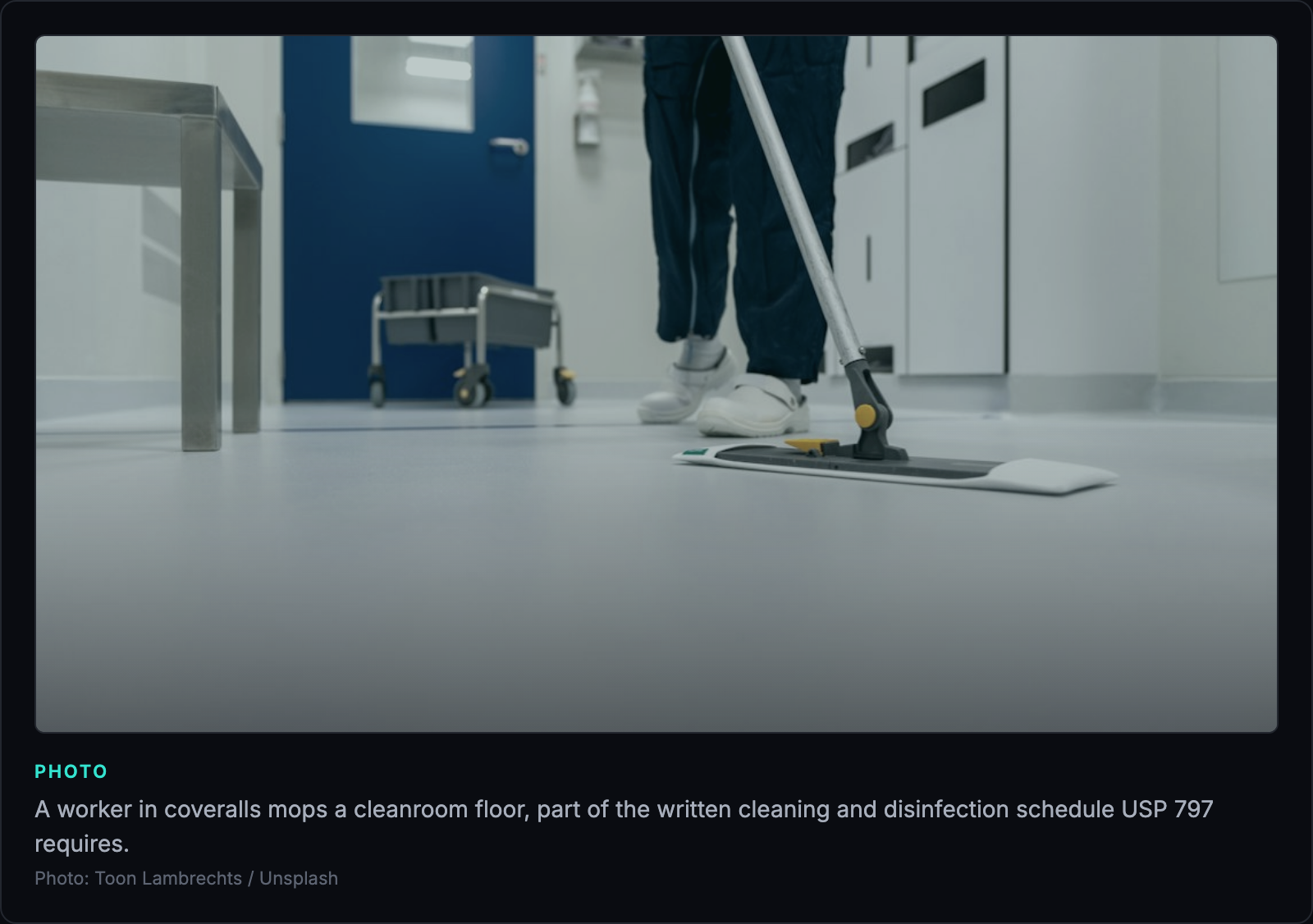
- Cleaning and disinfection. Cleaning, disinfecting and sporicidal agents applied on a written schedule to each surface in the classified areas.
- Garbing and personnel. Hand hygiene and garbing competency proven by gloved fingertip and thumb sampling, and aseptic technique proven by a media fill, before a person compounds alone and every 6 months after.
- BUD and release. BUDs assigned from the chapter's tables, with sterility and endotoxin testing where the BUD depends on them.
- Investigations. Every excursion, failed test and complaint investigated and closed with a documented cause.
Category 3 tightens several of these, for example surface sampling every week and personnel competency testing every 3 months.
The personnel step is the one most often tested in practice. A gloved fingertip sample after garbing has an action level above zero colony-forming units, and a failed media fill means the person cannot compound until the cause is found and the test is repeated. Our media fill test guide covers run design and acceptance criteria in detail.
Who enforces USP 797, and where does FDA come in?
State boards of pharmacy enforce USP 797 at traditional pharmacies, and FDA enforces federal law at both tiers of compounding. The split follows the two sections of the FD&C Act:
- 503A pharmacies compound for identified patients. They are exempt from CGMP while they meet section 503A, and their quality standard is USP 795 and 797 as their state adopts them. FDA can still cite insanitary conditions under section 501(a)(2)(A), which applies to every compounder. Our 503A compounding pharmacy guide covers the seven statutory conditions.
- 503B outsourcing facilities register with FDA, report their products twice a year and must follow CGMP under 21 CFR parts 210 and 211. FDA, not USP 797, sets their standard, although many state boards still apply the chapter to them. The 503B outsourcing facility guide explains the registration and the difference from 503A.
The two tiers produce two vocabularies on Form 483s. Outsourcing facility forms use the 21 CFR 211 headings, such as "Procedures for sterile drug products". From November 2017 onward, a second set appears on pharmacy forms, such as "Inadequate smoke studies", "Exposed to lower quality air/ISO 5" and "Personnel, blocked or disrupted first air". These read like the examples in FDA's guidance on insanitary conditions at compounding facilities, finalized in November 2020. In the Atlas record, 46 of the 280 forms carry at least one heading from that second set.
What does FDA cite at sterile compounders?
FDA cites environmental monitoring most often at sterile compounders: 148 of 280 sterile compounding Form 483s (52.9%) in the Atlas record carry "Environmental Monitoring System". Written procedures for sterile products come second at 136 forms (48.6%), then cleaning at 107 (38.2%) and sterile process validation at 99 (35.4%).
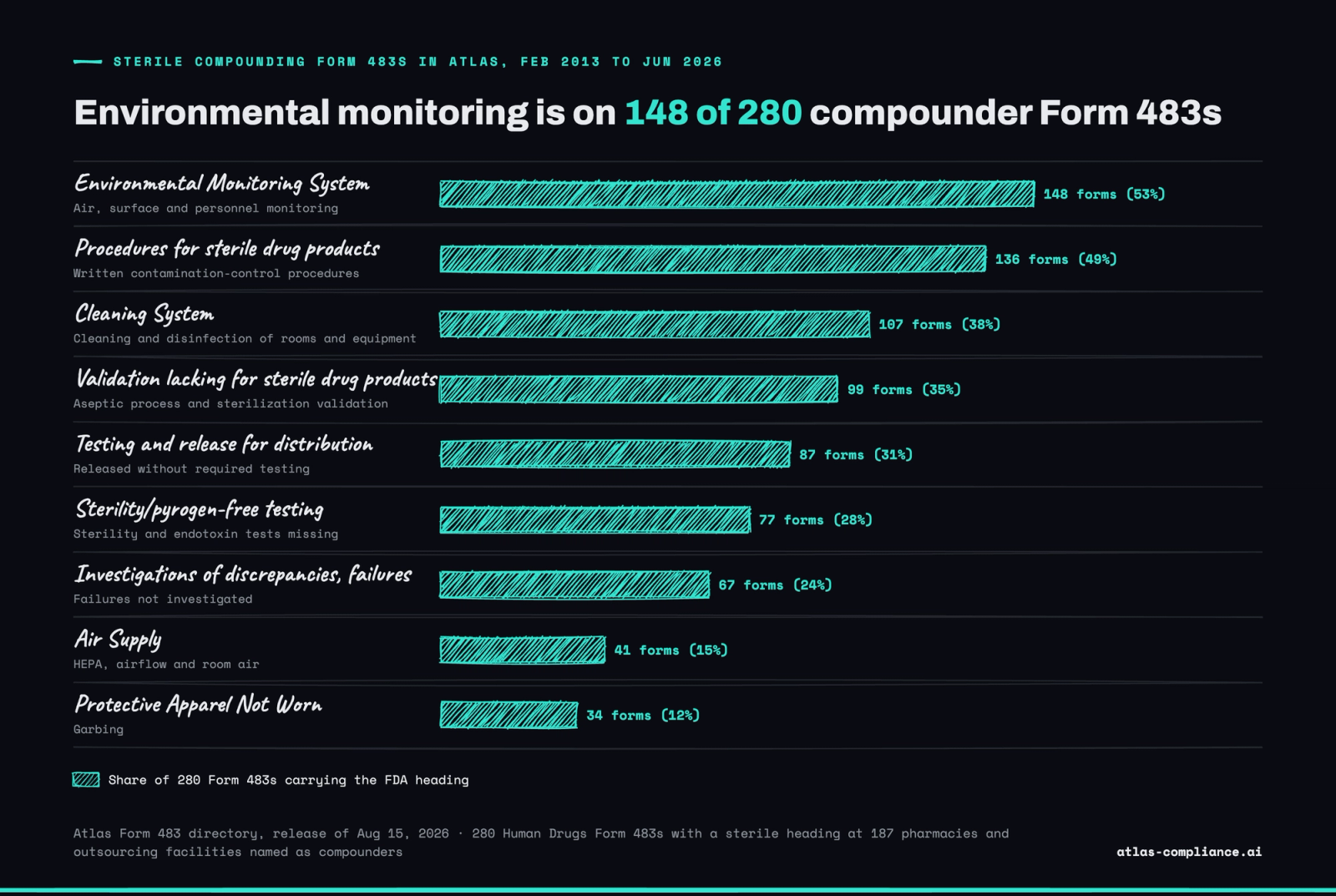
The 280 forms come from the FDA Form 483 database in Atlas: every Human Drugs Form 483 issued to a firm whose name identifies it as a pharmacy, apothecary, compounder, outsourcing facility, infusion or admixture service, and that carries at least one sterile heading. They cover 187 compounders and 2,180 observations, with a median of 7 observations per form. 60 of the 187 compounders received two or more.
Five recent forms show both vocabularies:
| Compounder | Form 483 date | Observations | Headings on the form | Investigator |
|---|---|---|---|---|
| Hallandale Pharmacy, Fort Lauderdale | Jun 13, 2025 | 2 | Exposed to lower quality air/ISO 5; Inadequate smoke studies | Logan T Williams |
| RC Outsourcing, Lowellville | Aug 28, 2025 | 8 | Procedures for sterile drug products; Environmental Monitoring System; investigations; laboratory controls | Margaret M Annes |
| Fresenius Kabi Compounding, Canton | Nov 5, 2025 | 7 | Procedures for sterile drug products; Environmental Monitoring System; Cleaning System; investigations | Jonathan G Matrisciano |
| Revive Rx Pharmacy, Houston | Mar 27, 2026 | 5 | Exposed to lower quality air/ISO 5; Inadequate smoke studies; Lack of personnel sampling; Microbial contamination in ISO 5 and adjacent areas | Sangeeta M Khurana |
| PQ Pharmacy, Brooksville | Jun 1, 2026 | 7 | Procedures for sterile drug products; Validation lacking for sterile drug products; investigations | Saundrea A Munroe |
Each heading on these forms maps to a USP 797 control: smoke studies and ISO 5 exposure to engineering controls, personnel sampling to garbing competency, and sterile validation to media fills. Each investigator page lists the other forms that investigator has written, so you can see which of these headings they have used before.
 Atlas
See what the FDA knows about your next investigator.
30 minutes with the founder. No pitch deck.
What has FDA cited since the 2023 revision?
FDA issued 24 sterile compounding Form 483s in the Atlas record between November 1, 2023, when the revised chapter took effect, and June 1, 2026. They went to 17 pharmacies and outsourcing facilities and carry 150 observations, a median of 6 per form.
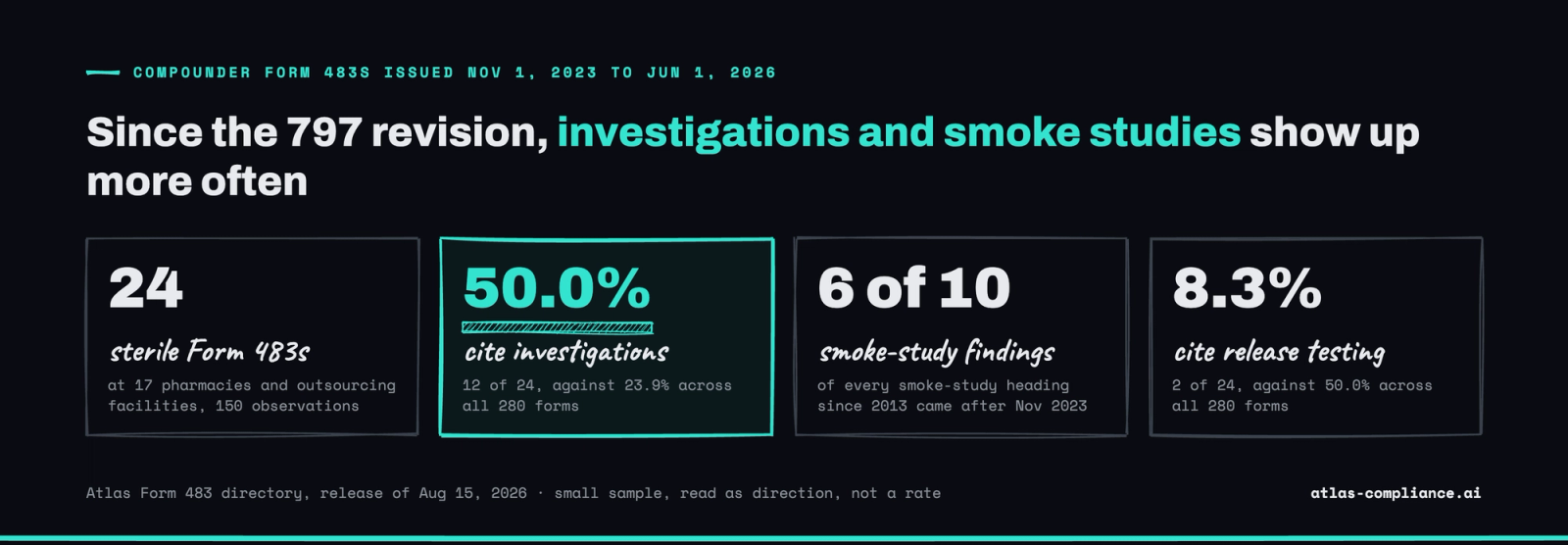
Three shifts stand out against the full set of 280:
- Investigations. 12 of the 24 forms (50.0%) cite "Investigations of discrepancies, failures", against 23.9% across all 280.
- Smoke studies. 6 of the 10 smoke-study headings in the record were written after November 2023, on 6 of the 24 recent forms (25.0%).
- Release testing. 2 of the 24 forms (8.3%) cite sterility, pyrogen or release testing, against 50.0% across all 280.
Twenty-four forms is a small sample, so read these as direction rather than rates, and note that the record runs only to the August 2026 Atlas release. The same investigations heading leads drug manufacturing inspections too, as our 21 CFR 211.192 guide shows.
How do you prepare a USP 797 program for inspection?
Prepare for a USP 797 inspection by pulling the records an inspector reads first and checking each against the chapter's frequency for your category:
- Certification reports for every primary engineering control and room, dated within the last 6 months, with smoke study video or documentation.
- Environmental monitoring results for the last 12 months, with every excursion linked to an investigation and a corrective action.
- The cleaning log for each classified area, showing the sporicidal agent and its schedule.
- Garbing, gloved fingertip and media fill results for every person who compounds, with the next due date.
- The BUD policy, with the sterility and endotoxin results behind any CSP dated beyond the shortest table limit.
- Open investigations, with their age and owner.
If a past Form 483 named any of these areas, check that the fix is still in place before the next visit. Our post on compounding warning letters shows what followed at firms where it was not.
AtlasFDA Inspection Intelligence Digest
We track every 483, EIR, and warning letter the moment it happens. Get the signals before they hit the FDA website.
Frequently asked questions
USP 797 is not a federal law by itself. It is a compendial standard published by the United States Pharmacopeia. It becomes enforceable when a law or rule adopts it: section 503A of the FD&C Act refers to USP chapters for traditional pharmacies, and most state boards of pharmacy write USP 797 into their regulations, so a pharmacy that ignores it can lose its license or face board action.

Written by
Bhavish Agarwal
Founder, Atlas
Bhavish Agarwal is the founder of Atlas and previously worked at Google and Microsoft. He has spent the past several years building regulatory data infrastructure for the pharmaceutical industry.