
An FDA compounding warning letter is a letter from CDER's Office of Compounding Quality and Compliance telling a 503A pharmacy or a 503B outsourcing facility that its drugs are adulterated, misbranded or unapproved, and asking for a written answer within 15 working days. Two letters from September 2026 show the current priorities. On September 18, FDA wrote to Empower Pharmacy in Houston, a 503A pharmacy, about compounded tirzepatide and semaglutide it called essentially copies of approved drugs. On September 14, it wrote to SCA Pharmaceuticals, a 503B outsourcing facility in Little Rock, Arkansas, about sterile insanitary conditions.
This analysis of FDA warning letters to 503A and 503B compounders uses both letters as published on fda.gov and the Atlas Form 483 record (release of August 15, 2026, data to June 2026).
- FDA's September 18, 2026 letter to Empower Clinic Services, LLC dba Empower Pharmacy names three GLP-1 combination products and cites section 503A(b)(1)(D), the bar on compounding copies regularly or in inordinate amounts.
- FDA's September 14, 2026 letter to SCA Pharmaceuticals, LLC cites the same four 21 CFR sections that appeared on its October 30, 2025 Form 483: 211.113(b), 211.42(c)(10)(iii), 211.160(b) and 211.192.
- FDA declared the tirzepatide shortage resolved on December 19, 2024 (first on October 2, 2024) and the semaglutide shortage resolved on February 21, 2025.
- In the Atlas record, 52 Form 483s went to registered 503B outsourcing facilities from January 2025 to June 2026, with a median of 5 observations each.
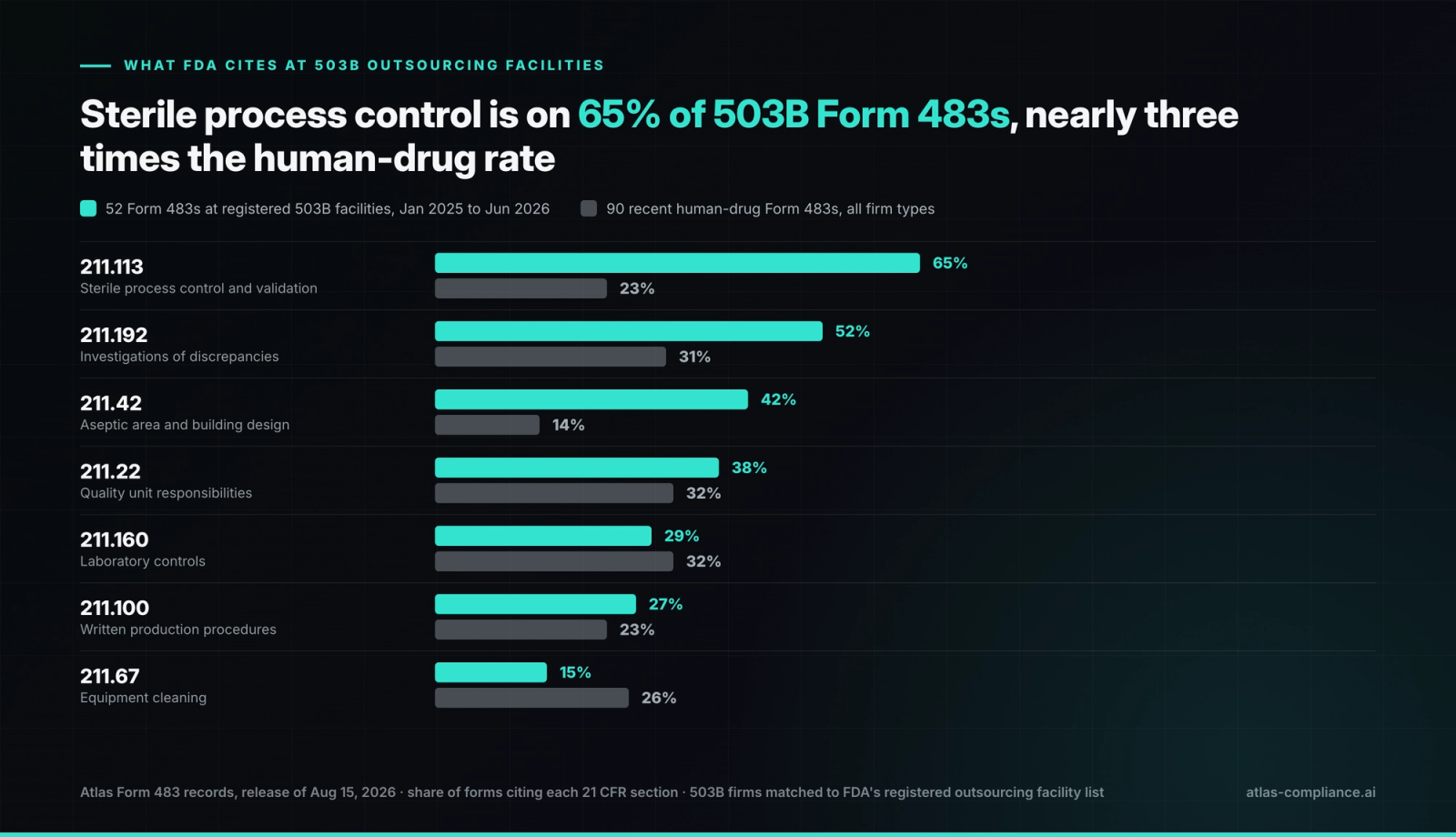
- 21 CFR 211.113(b), the sterile process control and validation rule, appears on 65% of those 52 forms, against 23% of recent human-drug 483s overall.
What is the difference between 503A and 503B?
A 503A pharmacy is a state-licensed pharmacy that compounds for identified patients on a prescription, and a 503B outsourcing facility is a compounder registered with FDA that may make larger batches with or without prescriptions. The trade for 503B is federal oversight: 503B facilities must meet current good manufacturing practice, 503A pharmacies do not.
| 503A pharmacy | 503B outsourcing facility | |
|---|---|---|
| Statute | FD&C Act section 503A | FD&C Act section 503B |
| Who | State-licensed pharmacy or physician | Facility that registers with FDA as an outsourcing facility |
| Prescription needed | Yes, for an identified individual patient | No; may supply office stock to hospitals and clinics |
| CGMP (21 CFR parts 210 and 211) | Exempt from section 501(a)(2)(B) | Required; FDA applies 21 CFR 211 through its interim CGMP guidance for outsourcing facilities |
| Insanitary conditions, section 501(a)(2)(A) | Applies | Applies |
| Primary regulator | State board of pharmacy; FDA inspects for cause or for surveillance | FDA, on a risk-based inspection schedule |
| Copies of approved drugs | Not "regularly or in inordinate amounts", 503A(b)(1)(D) | Not "essentially a copy", 503B(a)(5) |
| Bulk drug substances | USP monograph, a component of an approved drug, or the 503A bulks list | The 503B bulks list, or a drug on FDA's shortage list |
| Reports to FDA | None | Product reports twice a year and adverse event reports |
The CGMP line explains most of what follows. When FDA inspects a 503A pharmacy, its observations are written under section 501(a)(2)(A): conditions under which the drug may have been contaminated. When it inspects a 503B facility, it can cite specific 21 CFR 211 sections. A 503A pharmacy that loses its exemptions, for example by compounding copies, also becomes subject to CGMP, which is why the Empower letter cites both.
What does "essentially a copy" of an approved drug mean?
An essentially a copy of a commercially available drug, for a 503A pharmacy, is a compounded drug with the same active ingredient as an approved product, in the same or an easily substitutable strength, given by the same route. Section 503A(b)(1)(D) bars compounding such copies regularly or in inordinate amounts.
Two exceptions matter. A prescriber can document a significant difference for an individual patient, such as an allergy to an inactive ingredient, and the compounded drug is then not treated as a copy. And a drug on FDA's shortage list is not considered commercially available. FDA has also said it does not intend to act on copies when a pharmacy fills four or fewer prescriptions of that drug in a calendar month.
For 503B facilities, section 503B(a)(5) is stricter: the compounded drug may not be identical or nearly identical to an approved drug unless that drug appears on the shortage list. There is no monthly allowance.
FDA's GLP-1 policy statement addresses the combination products directly. Semaglutide with vitamin B12 (cyanocobalamin) may still be a copy when it is injected like the approved product and each ingredient is within 10% of the approved strength. Adding a vitamin does not, by itself, make a different drug.
When did semaglutide and tirzepatide leave the FDA shortage list?
Tirzepatide left the FDA drug shortage list on October 2, 2024, and FDA confirmed that decision on December 19, 2024 after re-evaluating it. Semaglutide injection left the list on February 21, 2025. Each decision started a transition window before FDA would act against compounded copies.
| Drug | Shortage resolved | 503A window ended | 503B window ended |
|---|---|---|---|
| Tirzepatide | Oct 2, 2024; reaffirmed Dec 19, 2024 | Planned Feb 18, 2025; ended after a court denied an injunction on Mar 5, 2025 | Mar 19, 2025 |
| Semaglutide | Feb 21, 2025 | Planned Apr 22, 2025; ended after a court denied an injunction on Apr 24, 2025 | May 22, 2025 |
The dates are from FDA's statement on compounding as GLP-1 supply stabilized. On April 30, 2026, FDA also proposed excluding semaglutide, tirzepatide and liraglutide from the 503B bulks list, saying it found no clinical need for outsourcing facilities to compound them from bulk substances. While a drug was in shortage, compounded versions were not copies under either section. After these dates, the copies rules applied in full, and the Empower letter is the result.
What did FDA's September 18, 2026 warning letter to Empower Pharmacy cite?
FDA's September 18, 2026 warning letter to Empower Clinic Services, LLC dba Empower Pharmacy (WL 738238) says three compounded GLP-1 products appear to be essentially copies of approved semaglutide and tirzepatide, so they lost the section 503A exemptions. It also cites insanitary conditions and CGMP violations found during a November 3 to 14, 2025 inspection of the Houston facility.
The products named are tirzepatide/niacinamide 17/2 mg/mL (4 mL), tirzepatide/niacinamide 8/2 mg/mL (2.5 mL) and semaglutide/cyanocobalamin 5/0.5 mg/mL (1 mL). FDA's case for calling them copies rests on three points:
- Some orders carried no prescriber determination of a significant difference at all.
- Many significant-difference statements were word-for-word identical across records, which FDA reads as text written in advance for prescribers to select.
- The monthly order volume suggests the stated differences are pretextual.
Having lost the 503A exemptions, the products are cited as unapproved new drugs under section 505(a), misbranded under 502(f)(1), and adulterated under 501(a)(2)(B) for CGMP violations of 21 CFR 211.22, 211.42(c)(10)(iv) and (vi), 211.100(a) and 211.113(b). Under 501(a)(2)(A), FDA cites smoke studies that did not show unidirectional airflow in the ISO 5 area, media fills not run under the most challenging conditions, and a January 2026 media fill whose vial counts did not reconcile. The full text is on FDA's warning letter page for Empower.
The October 16, 2026 "FDA in Flux" newsletter from the law firm Mintz calls this the first warning letter to a compounding pharmacy alleging it compounded essentially a copy of an approved drug. The letter itself does not say so.
The inspection record explains why sterility shares the letter. The Atlas site record for Empower's Houston facility holds three FDA inspections from 2023 to 2025, each ending with a Form 483, for 22 observations, every one under section 501(a)(2)(A). Failure to clean and disinfect equipment in the ISO 5 area appears on all three forms. Inadequate smoke studies appear in October 2024 and again in November 2025. The 2024 inspection led to a 503A warning letter dated April 2, 2025. Investigator Camerson E Moore is on the 2023 and 2025 forms.
What did the SCA Pharmaceuticals warning letter cite?
FDA's September 14, 2026 warning letter to SCA Pharmaceuticals, LLC (WL 724202) cites insanitary conditions and CGMP violations at its 503B outsourcing facility at 8821 Knoedl Court, Little Rock, Arkansas, inspected October 20 to 30, 2025. SCA has been registered as an outsourcing facility since December 13, 2013. The letter does not involve GLP-1 drugs.
Under section 501(a)(2)(A), FDA lists six problems: ISO 5 areas without routine certification that included dynamic airflow visualization; weak product evaluation after microbial contamination was recovered in the ISO 5 area; foreign material between syringe stopper ribs; poor aseptic technique during fentanyl/bupivacaine and methadone lots, such as hands blocking first air; misplaced active air sampling; and smoke studies that did not clearly sweep critical areas. Under 501(a)(2)(B), it cites 21 CFR 211.113(b), 211.42(c)(10)(iii), 211.192 and 211.160(b), and notes the facility kept still images rather than video for an excursion investigation. FDA also told SCA that extrinsic particulates should be classified as critical defects, not major. The letter is on FDA's warning letter page for SCA.
The Atlas SCA Pharmaceuticals Little Rock site record (listed as SCA Pharmaceuticals, Inc.) shows five FDA inspections since 2014, all ending with a Form 483, and 21 observations. The October 30, 2025 form, issued by investigator Demario L Walls, has four observations, and each one became a CGMP charge in the letter:
| 21 CFR section | Form 483 history at Little Rock | In the Sept 2026 letter |
|---|---|---|
| 211.192 investigations | 2014, 2017, 2023, 2025 | Yes |
| 211.113(b) sterile process validation | 2014, 2017, 2025 | Yes |
| 211.42(c)(10)(iii) aseptic area air supply | 2023, 2025 | Yes |
| 211.160(b) laboratory controls | 2025 | Yes |
The 2014 inspection is recorded with a warning letter outcome. Walls also inspected Empower in 2023 and 2024. SCA's Windsor, Connecticut outsourcing facility received a separate three-observation Form 483 on March 13, 2026, citing 211.113(b), 211.192 and 211.67(b).
What do FDA investigators cite at 503B outsourcing facilities?
FDA investigators at 503B outsourcing facilities cite sterile process control first. We matched FDA's list of registered outsourcing facilities against the FDA Form 483 database in Atlas (release of August 15, 2026) and found 52 Form 483s issued to 45 registered facilities from January 2025 to June 2026: 41 in 2025 and 11 in 2026. They carry 254 observations, a median of 5 per form, against a median of 3 across a sample of 960 Form 483s from 2025.
| 21 CFR section | What it covers | 503B 483s citing it (n=52) | Recent human-drug 483s (n=90) |
|---|---|---|---|
| 211.113 | Microbial contamination control, sterile process validation | 65% | 23% |
| 211.192 | Investigations of discrepancies and failures | 52% | 31% |
| 211.42 | Building design; aseptic processing areas | 42% | 14% |
| 211.22 | Quality unit responsibilities | 38% | 32% |
| 211.160 | Laboratory controls | 29% | 32% |
| 211.100 | Written production procedures | 27% | 23% |
| 211.67 | Equipment cleaning | 15% | 26% |
The human-drug column comes from our earlier pull of 90 recent human-drug Form 483s across all manufacturer types. Of the 22 outsourcing facility forms citing 211.42, 21 cite its 211.42(c)(10) subsections for aseptic areas, most often environmental monitoring (iv) and cleaning (v). Section 501(a)(2)(A) appears on only one of the 52. The 503A side looks different: five 2025 and 2026 Form 483s we found at 503A pharmacies, including Empower and Hallandale Pharmacy in Fort Lauderdale, cite nothing but 501(a)(2)(A).
Two named examples show the range. RC Outsourcing in Lowellville, Ohio received an eight-observation form on August 28, 2025, covering sterile procedures, laboratory controls, batch records and two investigation failures. QuVa Pharma in Sugar Land, Texas received a three-observation form on May 4, 2026, citing 211.113(b), 211.192 and 211.58. Six of the 52 forms also cite the 503B(a)(10) labeling requirements.
This method has limits. Matching is by firm name, some registered firms also run 503A or manufacturing operations, and a Form 483 is not a final agency finding.
 Atlas
See what the FDA knows about your next investigator.
30 minutes with the founder. No pitch deck.
What compounders and their customers should check now
Telehealth GLP-1 programs carry the most exposure. Mintz notes FDA's letter flags technology platforms that give prescribers pre-selected significant-difference options; a menu of reasons is the pattern FDA described. If your program relies on a 503A pharmacy, ask how each significant-difference determination is documented and how many prescriptions of each formulation it fills a month.
Hospitals buying from 503B facilities should read the last Form 483 before signing a supply contract. At SCA, every CGMP charge in the 2026 letter was already on the 2025 form, and 211.192 had appeared on four forms since 2014. A repeat citation on a supplier's record is the best early signal of a letter to come, as our guide to FDA violations and warning letters explains.
Outsourcing facilities should treat smoke studies, media fills and ISO 5 certification as the inspection's first hour. Both September letters cite airflow visualization. When FDA closes a case without a warning letter, it may send an untitled letter instead. To find past compounding letters by firm, our warning letter database guide shows the search filters, and the GLP-1 import alert post covers the bulk ingredient side.
AtlasFDA Inspection Intelligence Digest
We track every 483, EIR, and warning letter the moment it happens. Get the signals before they hit the FDA website.
Frequently asked questions
Yes, but only within the copies limits. Semaglutide has been off the shortage list since February 21, 2025, so a 503A pharmacy may compound it only when a prescriber documents a significant difference for an individual patient, or when it fills four or fewer prescriptions of the copy a month. The September 2026 Empower letter shows FDA will test whether those determinations are genuine.

Written by
Bhavish Agarwal
Founder, Atlas
Bhavish Agarwal is the founder of Atlas and previously worked at Google and Microsoft. He has spent the past several years building regulatory data infrastructure for the pharmaceutical industry.