
An FDA untitled letter is a written notice that cites violations of the Food, Drug, and Cosmetic Act which, in FDA's words, do not meet the threshold of regulatory significance for a warning letter. It carries no title, does not warn of enforcement, and requests rather than requires a response. Most posted untitled letters come from CDER's Office of Prescription Drug Promotion (OPDP) and concern misleading drug promotion.
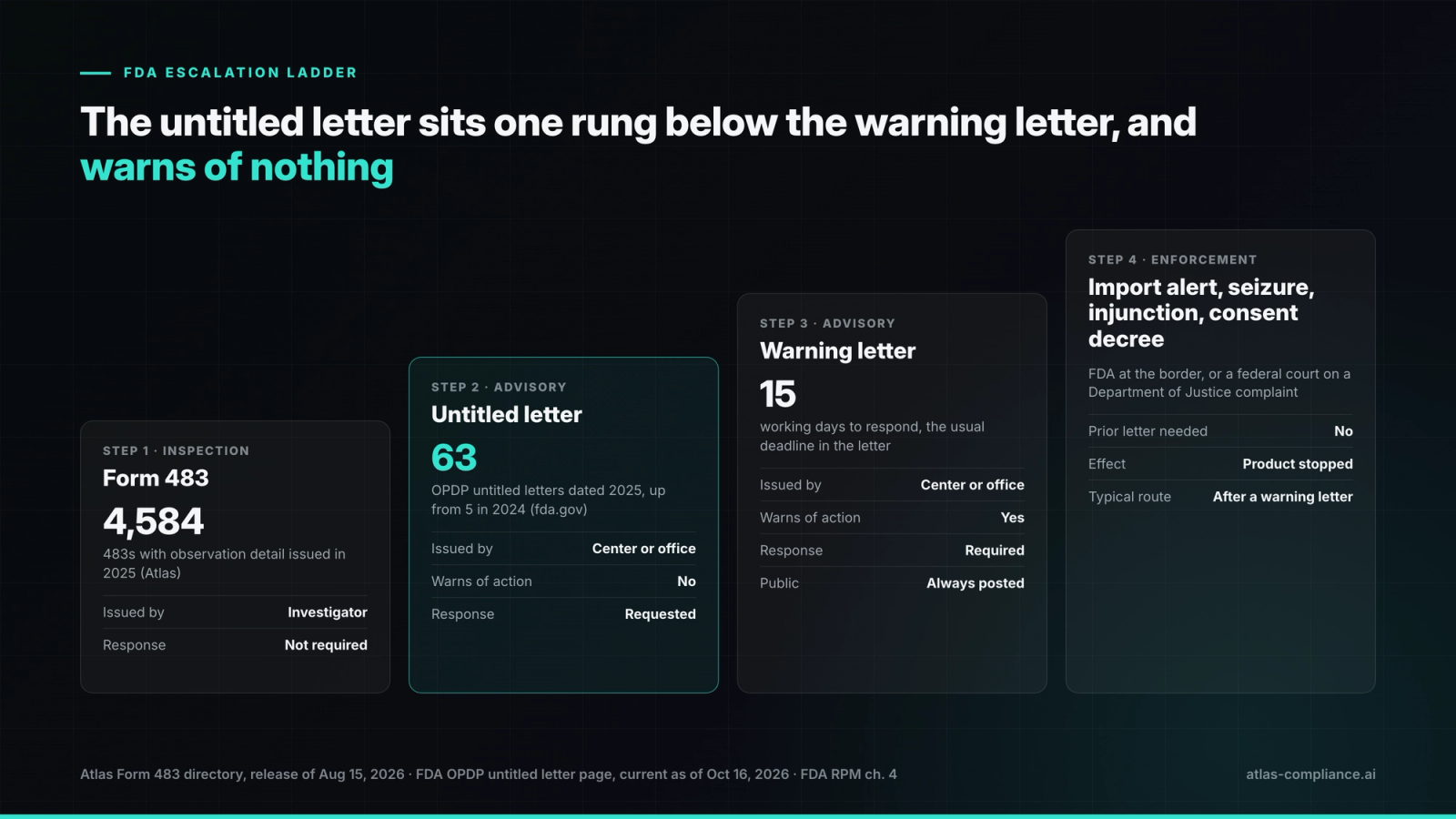
The volume changed sharply in 2025. FDA's OPDP untitled letter page lists 63 letters dated 2025, against 5 in 2024 and 4 in 2023, and 24 more dated January to September 2026 (page current as of October 16, 2026). Our explainer on FDA warning letters and the violations behind them has a short comparison; this post goes deeper on the untitled letter itself.
What FDA's Regulatory Procedures Manual says an untitled letter is
Untitled letters are governed by section 4-2 of Chapter 4 of FDA's Regulatory Procedures Manual, "Advisory Actions" (July 2024 revision). Section 4-2-1 says the format and content should clearly distinguish an untitled letter from a warning letter, and lists five ways it does so:
- The letter is not titled. A warning letter says "Warning Letter" at the top; an untitled letter does not.
- It does not tell the recipient that FDA will advise other federal agencies, which a warning letter does so they can weigh it when awarding contracts.
- It does not include a warning that failure to correct may result in enforcement action.
- It does not evoke a mandated follow-up.
- It requests a written response "within a reasonable amount of time", with "Please respond within 30 days" as the manual's example, unless a compliance program says otherwise.
The same chapter says any appropriate agency compliance official may issue one, and that center concurrence is required unless the issuing office has direct reference authority.
Both letter types go through the same clearance procedure, Exhibit 4-1, so it is not accurate to say untitled letters escape review. The difference is in legal review. For CDER, the Office of Chief Counsel must review warning letters about advertising or promotion, except those about a plain omission of risk information, while untitled letters reach Chief Counsel only when the issue is novel, controversial or sensitive, or involves compounding. Section 4-1-5 also sets the line between the two: promotional activity gets a warning letter, not an untitled letter, when the center would support further regulatory or administrative action.
Untitled letter vs warning letter vs Form 483 vs regulatory meeting
Four FDA communications get confused. They come from different people, at different stages, with different weight.
| Form 483 | Untitled letter | Warning letter | Regulatory meeting | |
|---|---|---|---|---|
| What it is | Investigator's list of inspectional observations | Advisory letter citing violations below the warning letter threshold | Advisory letter citing violations of regulatory significance | Meeting between FDA and company management, with no letter title of its own |
| Who issues it | The investigator, at close-out | A center (OPDP, CBER, CDRH, CVM, foods) or a program office with concurrence | The center or program office, after clearance | Program office or center |
| Typical trigger | Objectionable conditions seen during an inspection | Promotional claims, labeling, minor or first-time violations | Inspection findings or promotion FDA would escalate | Violations where FDA wants corrective commitments before or instead of a letter |
| Warns of enforcement | No | No | Yes | It counts as prior notice |
| Response | Not legally required; FDA weighs responses received within 15 business days | Requested; OPDP letters ask for 15 working days | Required within 15 working days | Commitments made at the meeting |
| Public | Released under FOIA | Posted when FDA judges it meets its posting criteria | Posted on fda.gov | Not usually published |
| Final agency action | No | No | No | No |
The regulatory meeting comes from Chapter 10 of the same manual. Chapter 4 says program offices and centers can meet with a firm's management before pursuing administrative or regulatory action, and that the meeting also serves as prior notice.
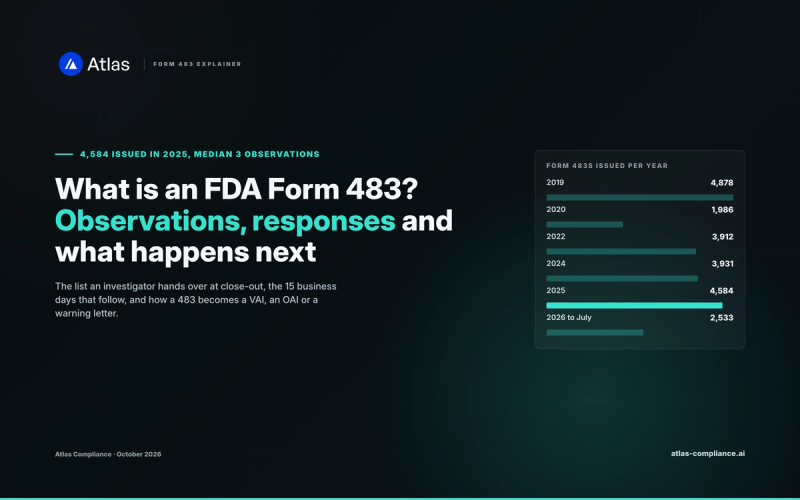
The 483 is far more common than any letter. The Atlas directory holds 4,584 Form 483s with observation detail issued in 2025 and 2,533 issued from January to July 2026 (release of August 15, 2026). You can search them by company, investigator or regulation in the FDA Form 483 database. If your question is the narrower one of 483 versus warning letter responses, our guide to responding to a 483 vs a warning letter covers it.
Who issues untitled letters
FDA's page on the issuance of untitled letters lists center pages for CDER, CBER, CDRH, CVM and foods. The senders fall into four groups.
OPDP at CDER. The Office of Prescription Drug Promotion reviews prescription drug advertising and promotional labeling, including material submitted on Form FDA 2253. It is the source of almost every untitled letter a pharmaceutical marketer will see, and the only office whose letters FDA posts in a steady stream.
CBER. The Advertising and Promotional Labeling Branch reviews promotion for biologics such as vaccines and blood products. The RPM also lists untitled letters on product jurisdiction and on unregistered or unlicensed blood banks among the CBER letters that need legal review.
CDRH. Device untitled letters cover advertising and promotion, false or misleading labeling, and bioresearch monitoring. The RPM gives one concrete device use: letters to assemblers of diagnostic x-ray systems for Class B violations found in field testing are issued as untitled letters, while Class A violations get a warning letter.
Bioresearch monitoring and other program areas. At CDRH, bioresearch monitoring inspections of clinical investigators, sponsors and IRBs can end in untitled letters for minor findings. CVM sends them for animal drug promotion and compounding, and the foods program for dietary supplement CGMP issues.
For a manufacturing facility the untitled letter is uncommon. CGMP findings usually travel the 483, classification and warning letter route, which our guide to what a Form 483 is explains from the start.
What OPDP untitled letters cite, and how many FDA has posted
OPDP letters follow a fixed shape. The letter names the promotional piece, often a TV ad, a social media post, a speaker deck or an exhibit panel, quotes the claims, and states that the piece is false or misleading and therefore misbrands the drug. The recurring findings are:
- Overstated efficacy or claims not supported by substantial evidence
- Minimized risks, or risk information left out or buried
- Comparative claims against other products without head-to-head data
- Omitted material facts, such as limits of the approved indication
Two recent letters show the pattern. On April 28, 2025, OPDP wrote to Mayne Pharma about a speaker deck for Nextstellis that it said minimized the product's risks against other combined hormonal contraceptives. On February 26, 2026, it wrote to Novo Nordisk about an Ozempic video built around the claim "There's Only One Ozempic", which it found misrepresented the drug's efficacy.
Here is the count of OPDP untitled letters on FDA's OPDP untitled letter page by the year of the letter. Letters from 1997 to 2016 sit in FDA's archive and are not counted.
| Year | OPDP untitled letters posted |
|---|---|
| 2017 | 2 |
| 2018 | 5 |
| 2019 | 7 |
| 2020 | 2 |
| 2021 | 4 |
| 2022 | 3 |
| 2023 | 4 |
| 2024 | 5 |
| 2025 | 63 |
| 2026, to Sept 28 | 24 |
From 2017 to 2024 the total was 32 letters in eight years. Then 56 letters were dated September 2025 alone, most of them on September 9, the day FDA announced a push against misleading direct-to-consumer drug advertising. The 2026 pace, 24 letters in nine months, is still several times the pre-2025 rate.
Atlas does not hold untitled letters. Our directory covers inspections, Form 483s, investigators and inspection outcomes, and promotional letters are not tied to an inspection, so the counts above come straight from fda.gov.
Same company, two tracks: Novo Nordisk in Plainsboro
An untitled letter and a warning letter can reach the same company in the same quarter for unrelated reasons. Novo Nordisk Inc. in Plainsboro, New Jersey shows both.
The promotional track: OPDP sent Novo Nordisk untitled letters dated February 5, 2026 about Wegovy and February 26, 2026 about Ozempic.
The inspection track is in the Atlas record for Novo Nordisk Inc., Plainsboro: 10 FDA inspections on record, 3 ending with a Form 483. The latest ran from January 13 to February 7, 2025 and produced a Form 483 with four observations, all under 21 CFR 314.80, the postmarketing adverse drug experience reporting rule: written procedures, late 15-day reports, failure to investigate serious unexpected events, and a late individual case safety report. The observations were cited by Tyanna N Hadley and Mayar M Mussa.
That 483 became a warning letter dated March 5, 2026, which cites 21 CFR 314.80(b) and 314.80(c)(1)(ii), the same sections on the form. The untitled letters about advertising had nothing to do with it. Two offices, two kinds of violation, three letters to the same company in four weeks.
 Atlas
See what the FDA knows about your next investigator.
30 minutes with the founder. No pitch deck.
How to respond to an untitled letter
The letter requests a response rather than requiring one, but ignoring it is a bet that FDA will not escalate. Recent OPDP letters are specific. They ask for a written response within 15 working days of receipt that addresses the concerns, lists every promotional communication containing similar claims with its 2253 submission date, and explains the plan to discontinue them. A company that disagrees can send its reasoning and supporting information within the same 15 working days. The response goes in with a subject line marking it as a Response to Untitled Letter.
What works in practice:
- Pull the cited piece and every derivative of it, across TV, web, social and sales materials, not only the one FDA named.
- List each piece with its 2253 date. A list that misses obvious variants invites a second letter.
- Give a discontinuation date for each piece, and say who confirmed removal.
- If you contest the finding, cite the labeling and the evidence. OPDP letters invite this; a reasoned disagreement is better than silence.
- Fix the review process that approved the piece. A repeat of the same claim is how a promotional matter becomes a warning letter under section 4-1-5.
What can follow an untitled letter
An untitled letter is not a final agency action, and it carries no penalty of its own. What follows depends on whether the violation stops.
Nothing, if corrected. Most promotional matters end when the company pulls the material and responds.
A warning letter. If the same claims recur, or the center decides it would support further action, the next letter is titled. The Fresenius Medical Care facility in Ogden, Utah shows the manufacturing version of escalation without an untitled letter in between: 14 inspections, 8 ending in a Form 483, a March 2026 Form 483 with two observations under 211.100(a) and 211.192, then a warning letter on August 25, 2026 built on those two sections.
Stronger action. After a warning letter, FDA can move to import alerts for foreign facilities, seizure, injunction or a consent decree. Zhejiang Huahai's Linhai facility has 12 inspections on record and 6 Form 483s, a January 2025 inspection recorded with a warning letter outcome, and another 483 in April 2026. Our analysis of how warning letters affect later inspections covers that next step.
Are untitled letters public?
Not all of them. FDA's policy is to post an untitled letter on a center website when posting would meet at least one of three aims: answer three or more FOIA requests for it, received or expected; inform the public about violative practices that may pose a health risk; or deter future violations by showing similar companies what FDA finds violative. OPDP posts its letters routinely, with confidential information redacted. Letters from other centers and program areas are posted far less often, so a quiet public record does not prove a company never received one. Warning letters, by contrast, are posted as standard practice, and our warning letter database guide shows how to search them.
AtlasFDA Inspection Intelligence Digest
We track every 483, EIR, and warning letter the moment it happens. Get the signals before they hit the FDA website.
Frequently asked questions
It is the lowest level of written advisory action FDA sends, but it is still a finding that the company violated the FD&C Act. It does not threaten enforcement or require a response. If the same violation continues, FDA can issue a warning letter next, and for promotional claims the posted letter is visible to competitors, investors and physicians.

Written by
Bhavish Agarwal
Founder, Atlas
Bhavish Agarwal is the founder of Atlas and previously worked at Google and Microsoft. He has spent the past several years building regulatory data infrastructure for the pharmaceutical industry.