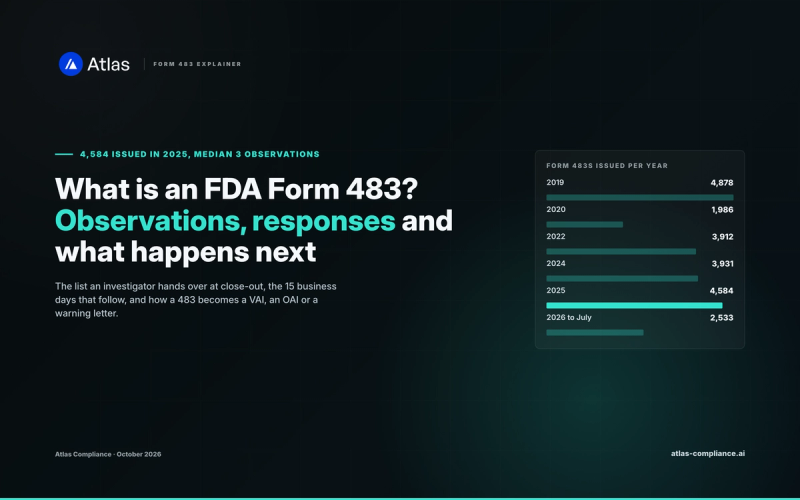

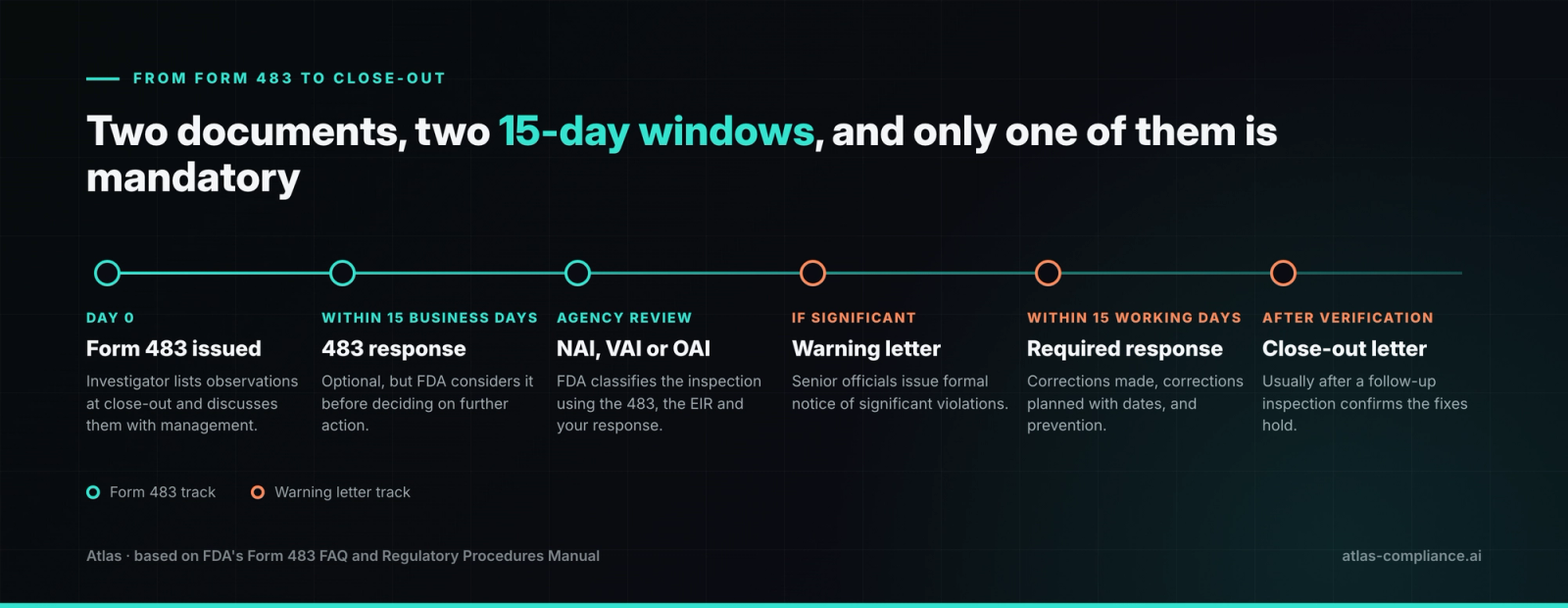
A Form FDA 483 is the investigator's list of observations, handed to your management at the close of an inspection. It is not a final agency decision. A warning letter comes later: FDA issues it after reviewing the findings and your response, when it judges the violations significant. Both start a 15 business day clock, but only the warning letter makes a response mandatory.
In short:
- FDA does not legally require a response to a Form 483, but it considers responses received within 15 business days before deciding whether to escalate.
- A warning letter asks for a written response within 15 working days, and FDA usually verifies the corrections, often at a follow-up inspection, before it issues a close-out letter.
- Commit only to corrective actions, owners and dates your investigation, validation and supplier timelines can support.
- Repeat observations under the same CFR section, data integrity or sterility findings, and thin or late responses raise the risk of escalation.
- Neither document is final agency action, and FDA can take enforcement action without a warning letter in serious cases.
What a Form FDA 483 is and when it is issued
The investigator issues the 483 to firm management at the end of an inspection. It records conditions that, in the investigator's judgment, may be violations, and FDA's Form 483 FAQ says the agency considers it alongside the Establishment Inspection Report and other evidence. The investigator discusses each observation with senior management before leaving, so you hear the findings in real time and can correct facts on the spot.
Three points practitioners often get wrong:
- A 483 is a report of observations for agency review, not a finding of violation. It still carries weight when observations are serious or repeated.
- FDA encourages a written response with a corrective action plan but does not require one.
- Not every 483 is public. Whether one appears in FDA's reading room depends on disclosure rules and FOIA redactions, so a missing record does not prove a clean history. The FDA Form 483 database collects the ones that are available.
Our explainer on what an FDA Form 483 is covers the basics in more depth.
What a warning letter is and how it is issued
A warning letter comes later and from higher up. FDA issues it after internal review, signed by senior officials, when violations are of regulatory significance. Its stated purpose is voluntary compliance: the Regulatory Procedures Manual treats it as prior notice before enforcement.
When one arrives:
- It asks for a written response within 15 working days, describing the corrections and how you will prevent recurrence.
- It is advisory, not final agency action, but it is a serious escalation. FDA has weighed the evidence, usually including your 483 response, and found the issues serious enough for formal notice.
- Verification follows, usually through a follow-up inspection.
The warning letter is the point where FDA stops asking whether you understand the problem and starts checking whether you fixed it. Our guide to FDA warning letters and common violations covers what the letters contain.
Key differences at a glance
| Form FDA 483 | Warning letter | |
|---|---|---|
| When | At the close of the inspection | Weeks or months later, after review |
| Who writes it | The investigator | Senior FDA officials |
| What it is | A list of observations | A formal advisory of significant violations |
| Response | Optional, considered if received within 15 business days | Expected within 15 working days |
| Public | Some, depending on disclosure rules | Posted on FDA's website, with redactions |
| Next step | Classification as NAI, VAI or OAI | Verification, then a close-out letter |
A warning letter often follows an inadequate 483 response, but FDA does not have to warn first in serious cases. Treat every warning letter as top priority, and treat any 483 observation with escalation potential the same way. The NAI, VAI and OAI classifications sit between the two documents.
Timing and response: the 15-day rule explained
The most common myth is that you must answer a 483 within 15 days or face consequences. A response is not required. The 15 business day figure is the window in which FDA says it will consider your response before deciding on further action, including whether to issue a warning letter.
In practice:
- A response is optional in law and wise in practice. A prompt, credible plan can shape whether the matter escalates.
- Split the reply. Send an initial response inside the window covering containment and your investigation approach, then send CAPA milestones as they complete.
- Ask for a regulatory meeting when observations are complex or you disagree with a finding.
Pro tip: never commit to a date in your first response that your validation or supplier timelines cannot support. A missed commitment costs more credibility than a longer, honest schedule.
What the Form 483 record shows
The Atlas directory holds observation-level detail for 4,584 Form 483s issued in 2025, and another 2,533 issued from January through July 2026. Most are short. The median 2025 form had three observations, 59% had three or fewer, and 5% had ten or more. Across every FDA inspection that ended with a 483 in 2025, the average was 3.20 observations, according to our average observations per inspection data.
| Measure | 2025 Form 483s |
|---|---|
| Forms with observation-level detail | 4,584 |
| Median observations per form | 3 |
| Forms with three or fewer observations | 59% |
| Forms with ten or more observations | 5% |
Length does not predict escalation. What does is the content of the observations and whether they repeat. In 2024 the most cited sections across FDA inspections were 21 CFR 211.22(d), quality unit procedures, with 175 citations, and 211.192, investigation of discrepancies, with 136, per our most cited CFR sections analysis. Both point at a quality system that does not enforce its own procedures, which is the pattern warning letters tend to describe.
The Olympus case shows the path. Six Olympus facilities received Form 483s in late 2025 with 31 observations in total, and 21 CFR 820.100(a), corrective and preventive action, was cited at all six. FDA issued a warning letter in October 2026, covered in our Olympus warning letter analysis. The Fresenius Kabi warning letters follow a similar route from inspection findings to formal notice.
 Atlas
AtlasSee what the FDA knows about your next investigator.
30 minutes with the founder. No pitch deck.
Consequences and enforcement escalation
An inadequate response to a warning letter can lead FDA to consider further action, such as an import alert, a regulatory meeting, a hold on pending applications, seizure, injunction or a consent decree. The Regulatory Procedures Manual is clear that the agency does not always have to warn before enforcement.
Signals worth watching:
- repeat observations under the same CFR section across inspections
- observations touching data integrity or sterility assurance
- a thin or late response to an earlier 483
Our analysis of how warning letters affect inspection outcomes goes deeper on what escalation looks like.
How FDA evaluates responses and closes out a warning letter
FDA does not close a warning letter on promises. The agency verifies corrective actions, usually by follow-up inspection, before it issues a close-out letter.
- The 483, the Establishment Inspection Report and your written response are read together to decide next steps.
- Completed actions, records and effectiveness checks carry more weight than commitments.
- What you submit can become public through FOIA, so write every response assuming a wider audience.
Practical steps to prepare an effective response
Start this sequence the day a 483 or warning letter arrives:
- Contain the issue: quarantine affected product, pause the process or tighten controls.
- Assemble a team spanning quality, manufacturing, regulatory and site leadership.
- Run a root-cause investigation for each observation, not a symptom fix.
- Build a CAPA plan with owners, milestones and effectiveness checks.
- Gather evidence: records, training logs, revised procedures and validation data.
- Request a regulatory meeting if scope or timelines need discussion, and prepare for a follow-up inspection.
Pro tip: device experts writing for RAPS warn that overpromising erodes credibility. Specific actions with realistic dates beat ambitious, vague commitments.
For wording, see our guides to effective Form 483 response strategies and how to address and prevent Form 483 observations.
Our take: stop fixating on the clock
The 15-day conversation crowds out the harder question: will your response survive verification? A fast, polished response that rests on an unfinished root-cause analysis is the common route from a 483 to a warning letter. FDA reads your response alongside the 483 and the inspection report, and thin evidence shows.
Prioritize three things, in this order. First, decide which observations carry escalation risk, using citation history rather than gut feel. The FDA investigator lookup shows which sections the person who inspected you cites most. Second, commit only to actions you can complete and document. Third, treat the response as a record that will be reread at the next inspection, because it will be.
AtlasFDA Inspection Intelligence Digest
We track every 483, EIR, and warning letter the moment it happens. Get the signals before they hit the FDA website.
Frequently asked questions
A Form 483 lists the investigator's observations at the close of an inspection. A warning letter is a formal advisory that senior FDA officials issue later, after reviewing the findings and the firm's response, when they judge the violations significant. A 483 does not always lead to a warning letter.

Written by
Bhavish Agarwal
Founder, Atlas
Bhavish Agarwal is the founder of Atlas and previously worked at Google and Microsoft. He has spent the past several years building regulatory data infrastructure for the pharmaceutical industry.