
FDA sent Olympus Corporation a warning letter dated October 7, 2026 covering six device facilities: Olympus Medical Systems' Hachioji and Hinode sites, Aomori Olympus and Shirakawa Olympus in Japan, Olympus Winter & IBE in Hamburg, Germany, and Gyrus ACMI in Brooklyn Park, Minnesota. Olympus announced it on October 13 and said the letter concerns "aspects of the company's quality management system and related processes." Olympus shares fell as much as 17% in Tokyo the next day.
The letter itself was not yet posted on FDA's site when this was written. What is public is the inspection record behind it: each of the six facilities received a Form 483 between October and November 2025, those forms carry 31 observations in total, and one regulation, 21 CFR 820.100(a) on corrective and preventive action procedures, appears on all six. This article lays out that record facility by facility and what it says about where the letter will land.

What Olympus has said about the letter
From the company's October 13 announcement:
| Letter date | October 7, 2026 (US time) |
| Facilities named | Olympus Medical Systems Corporation (Hachioji and Hinode), Aomori Olympus, Shirakawa Olympus, Olympus Winter & IBE (Hamburg), Gyrus ACMI (Brooklyn Park, Minnesota) |
| Basis | FDA inspections of facilities in the US, Japan and Europe conducted in late 2025 |
| Subject | "Aspects of the company's quality management system and related processes" |
| Production or distribution restricted | No. No recall required, no restriction on 510(k) submissions |
| Response | A comprehensive response within 15 business days of receipt, followed by periodic updates until FDA finds the actions adequate |
| Customer action | None required; products remain safe and effective when used according to their instructions |
Trade coverage reports that the letter turns on the adequacy of Olympus's responses to the Form 483 observations from those inspections. That is consistent with how FDA usually escalates a multi-site case: the 483s are issued, the company responds, and the warning letter says the responses did not show the problems were fixed across the quality system.
The six Form 483s, side by side
These are the late-2025 inspections at the six facilities named in the letter, from the Atlas facility records:
| Facility | Inspection | Observations | Sections cited on the Form 483 | Investigators |
|---|---|---|---|---|
| Olympus Medical Systems, Hachioji, Japan | Nov 17 to 21, 2025 | 3 | 820.100(a), 820.30(a), 820.30(g) | Janet Pulver, Rebecca E Dorsey |
| Olympus Medical Systems, Hinode, Japan | Nov 17 to 21, 2025 | 4 | 820.100(a), 820.75(a), 820.75(c), 820.90(a) | Stephen D Eich |
| Aomori Olympus, Kuroishi, Japan | Nov 4 to 7, 2025 | 3 | 820.100(a), 820.30(g), 820.75(a) | Stephen D Eich, Janet Pulver, Rebecca E Dorsey |
| Shirakawa Olympus, Japan | Nov 10 to 14, 2025 | 6 | 820.100(a), 820.198(c), 820.30(g), 820.50, 820.75(a), 820.80(b) | Stephen D Eich, Janet Pulver, Rebecca E Dorsey |
| Olympus Winter & IBE, Hamburg, Germany | Nov 10 to 21, 2025 | 7 | 803.50(a)(2), 820.100(a), 820.198(a), 820.25(b), 820.30(c), 820.30(g), 820.50 | Katelyn A Staub-Zamperini |
| Gyrus ACMI, Brooklyn Park, Minnesota | Oct 6 to Nov 12, 2025 | 8 | 820.100(a), 820.184, 820.198(a), 820.50, 820.75(a), 820.75(b), 820.80(b), 820.90(a) | Christina L Bigham |
Thirty-one observations across six facilities in roughly six weeks. The four Japanese sites were inspected by the same small team in consecutive weeks: Stephen D Eich, with 397 inspections on record, and Janet Pulver, with 209. Hamburg was inspected by Katelyn A Staub-Zamperini and Brooklyn Park by Christina L Bigham. A coordinated sweep of one company's global sites, rather than six independent routine inspections, is what makes a single multi-site letter possible.
The citation all six share, and the ones most of them share
Counting each section once per facility:
| Section | What it covers | Facilities citing it |
|---|---|---|
| 21 CFR 820.100(a) | Corrective and preventive action procedures | 6 of 6 |
| 21 CFR 820.30(g) | Design validation, including risk analysis | 4 of 6 |
| 21 CFR 820.75(a) | Process validation | 4 of 6 |
| 21 CFR 820.198 | Complaint files and investigation of device failures | 3 of 6 |
| 21 CFR 820.50 | Purchasing controls | 3 of 6 |
| 21 CFR 820.90(a) | Nonconforming product | 2 of 6 |
| 21 CFR 820.80(b) | Receiving acceptance | 2 of 6 |
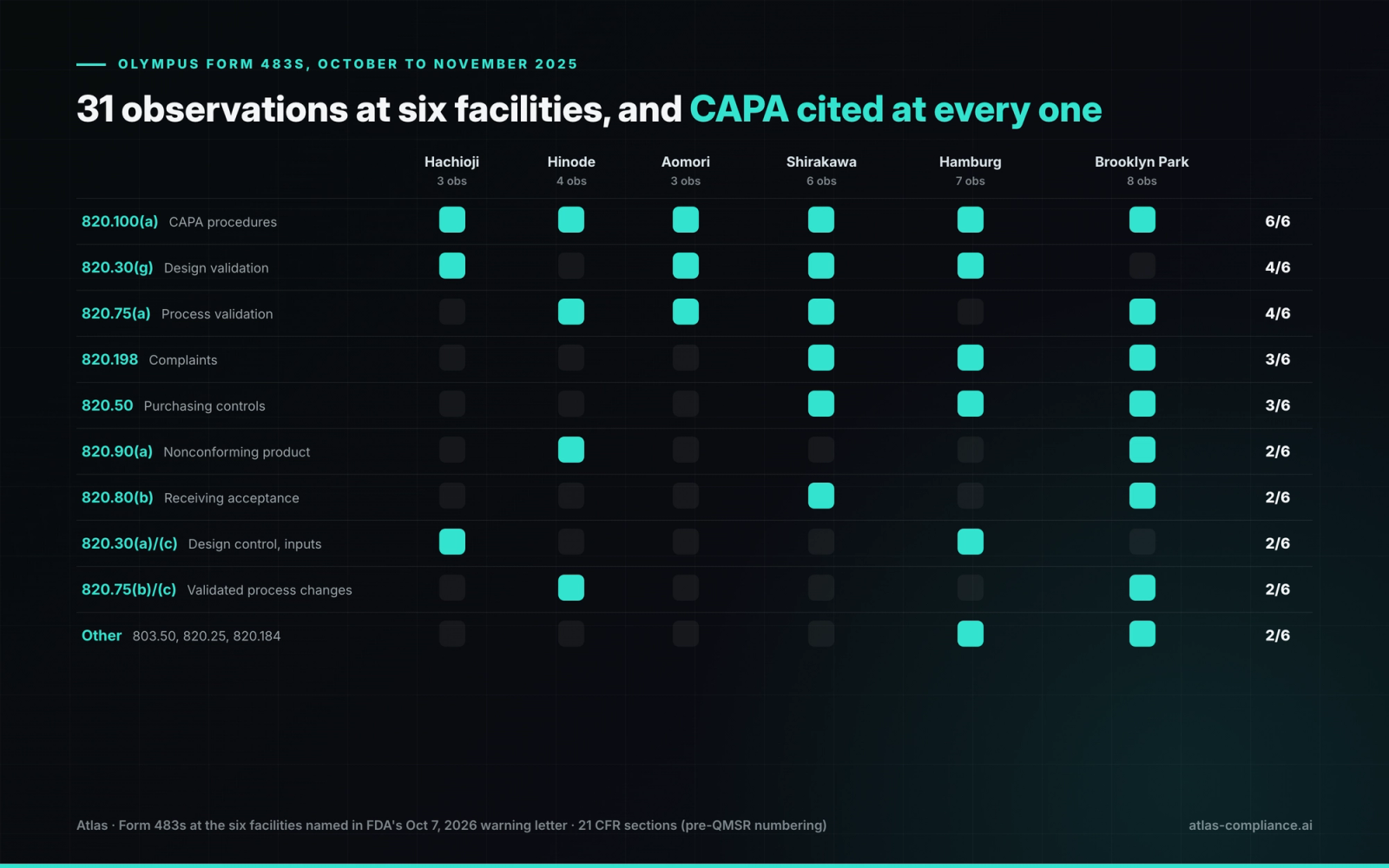
A CAPA citation at every site is the signature of a systemic finding. A single facility with a weak CAPA procedure gets a 483. The same procedure failing in Japan, Germany and Minnesota tells FDA that corporate quality oversight is not making the system work, and that is the language warning letters use. Design validation (820.30(g)) or process validation (820.75(a)) appears at all six as well, and both point the same way: the problems are in how the quality system is designed to work across sites, not in one production line.
A note on the regulation numbers. These inspections took place before February 2, 2026, when the Quality Management System Regulation replaced the old Quality System Regulation and incorporated ISO 13485 into Part 820. The 483s therefore cite the pre-QMSR section numbers. The corrective action Olympus describes will be judged against the current QMSR, which is one reason a company in this position talks about a "multi-year quality system transformation."
 Atlas
AtlasSee what the FDA knows about your next investigator.
30 minutes with the founder. No pitch deck.
Hachioji has been here before
The Hachioji facility's record shows three FDA inspections, all three ending with a Form 483, and the two before 2025 ending in a warning letter outcome:
| Inspection | Outcome | Sections cited |
|---|---|---|
| November 17 to 21, 2025 | Form 483 | 820.100(a), 820.30(a), 820.30(g) |
| September 6 to 9, 2022 | Warning letter | 803.50(a)(1), reporting of deaths and serious injuries |
| April 20 to 24, 2015 | Warning letter | 803.50(a)(1) twice, 820.100(b) twice |
Hachioji is Olympus's main endoscope engineering and manufacturing site, and the 2015 and 2022 cases centred on medical device reporting: telling FDA about deaths and serious injuries within the required time. The 2025 inspection moved to CAPA and design. The pattern across three inspections is a facility where FDA has never closed an inspection clean.
The other sites have histories too. Shirakawa Olympus has four Form 483s in five inspections (2012, 2018, 2022, 2025), and 820.30(g), design validation, was cited in both 2012 and 2025. Hinode has three 483s in five (2012, 2022, 2025). Aomori had 483s in 2022 and 2025, with 820.100(a) and 820.75(a) on both. Hamburg has four 483s in six inspections, with 820.198(a), complaint procedures, cited in 2017 and again in 2025. Gyrus ACMI Brooklyn Park is the exception: three clean inspections in 2015, 2017 and 2020, then eight observations in 2025.
Repeat citations of the same section at the same site are what FDA reads as a failed corrective action, and our analysis of how warning letters affect later inspection outcomes covers what usually follows. The same pattern drove the Fresenius warning letters earlier this year.
One more Olympus 483 not in the letter
Olympus Corporation of the Americas' Center Valley, Pennsylvania site, the US headquarters, received a Form 483 on December 16, 2025 with four observations: 803.50(a)(2) malfunction reporting, 820.100(b) CAPA documentation, 820.198(a) complaint procedures and 820.25(b) training, cited by investigator Brian S Keefer. It is not one of the six facilities Olympus listed. Its themes, complaints and CAPA, are the same ones that run through the letter.
What it means for device quality teams
CAPA is judged across sites, not per site. If your company runs one CAPA procedure in several facilities, a 820.100(a) finding at one site is evidence about all of them. The response that holds up is a corporate one: a single root cause analysis of why the procedure is not working, and effectiveness checks at every site that uses it.
Coordinated inspections are a signal. When the same investigators work through a company's sites in consecutive weeks, the company should assume FDA is building a multi-site case and prepare one response, not six. Every investigator's profile in the FDA investigator lookup shows their inspection history and what they cite most, which is the fastest way to see a sweep coming.
The 483 response is the decision point. Olympus's letter is reported to turn on the adequacy of its 483 responses. FDA considers responses received within 15 business days of the 483 before deciding whether to escalate; our guide to Form 483 response strategies goes through what a response needs to show.
If Olympus is your supplier. The letter does not restrict production or distribution, and Olympus says no customer action is needed. Hospital and distributor quality teams should still record the letter in their supplier files and watch for the posted text, which will name the specific deficiencies. Each facility's page shows its full inspection history in the meantime, and the FDA Form 483 database lists every Olympus 483 on record.
What happens next
Olympus has 15 business days from receipt to respond, and has committed to periodic updates after that. FDA will post the redacted letter on its warning letters page, usually within a few weeks, which will show the specific violations and what FDA asked for. A warning letter is closed only after FDA confirms the corrections, typically through re-inspection, so the next round of inspections at these six facilities, under QMSR, is what to watch. Our guide to NAI, VAI and OAI classifications explains how those outcomes are decided.
AtlasFDA Inspection Intelligence Digest
We track every 483, EIR, and warning letter the moment it happens. Get the signals before they hit the FDA website.
Frequently asked questions
FDA's letter of October 7, 2026 concerns aspects of Olympus's quality management system and related processes at six facilities inspected in late 2025, in Japan, Germany and the United States. Trade coverage reports that it centres on whether Olympus's responses to the Form 483 observations from those inspections were adequate. All six facilities had been cited for corrective and preventive action procedures.

Written by
Bhavish Agarwal
Founder, Atlas
Bhavish Agarwal is the founder of Atlas and previously worked at Google and Microsoft. He has spent the past several years building regulatory data infrastructure for the pharmaceutical industry.