
A 503A compounding pharmacy is a state-licensed pharmacy, federal facility or licensed physician that compounds drugs for an identified individual patient on a valid prescription, under section 503A of the Federal Food, Drug, and Cosmetic Act. Drugs that meet every condition of section 503A are exempt from three federal requirements: FDA approval, labeling with adequate directions for use, and current good manufacturing practice.
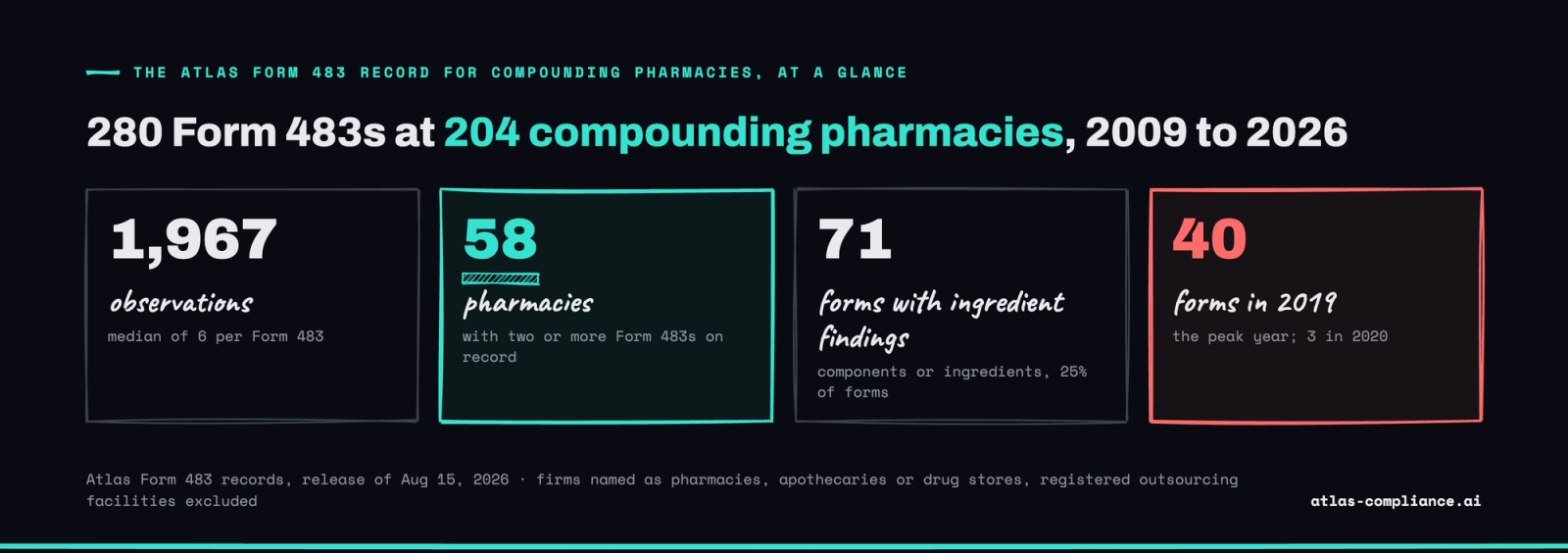
This guide adds what the definitions leave out: the Atlas Form 483 record (release of August 15, 2026) for 204 compounding pharmacies, covering 280 Form 483s and 1,967 observations issued from January 2009 to April 2026.
Key facts:
- Section 503A exempts a compounded drug from sections 501(a)(2)(B), 502(f)(1) and 505 of the FD&C Act, but never from the insanitary conditions rule in section 501(a)(2)(A).
- A bulk drug substance used by a 503A pharmacy must have a USP or NF monograph, be a component of an FDA-approved drug, or appear on the 503A bulks list, and must come from a registered establishment with a valid certificate of analysis.
- In states without a memorandum of understanding with FDA, section 503A(b)(3)(B) caps out-of-state distribution at 5 percent of the pharmacy's total prescription orders.
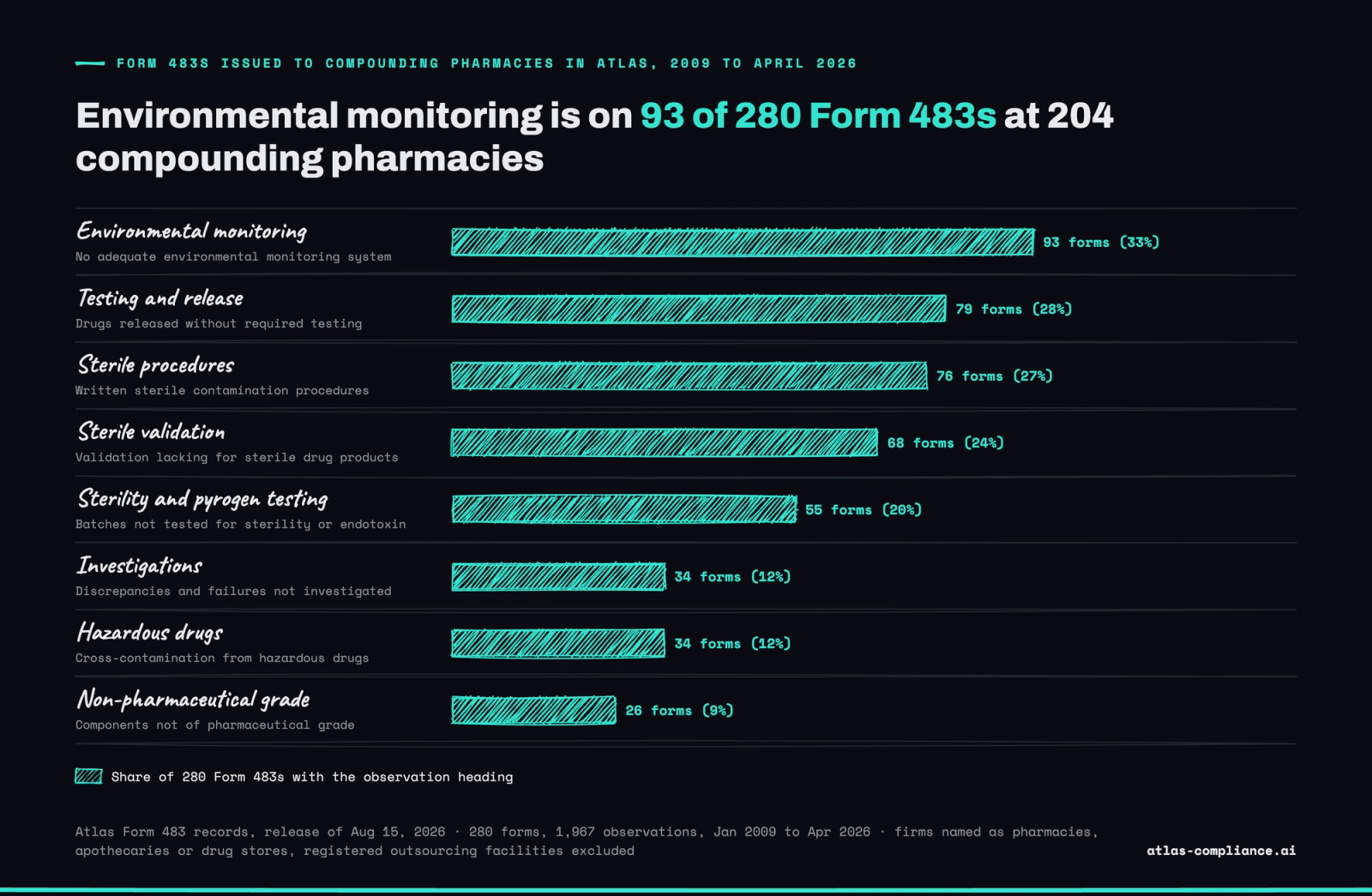
- In the Atlas record, 93 of 280 compounding pharmacy Form 483s (33%) carry an environmental monitoring observation, the most common heading.
- 71 of the 280 forms (25%) include at least one observation about components or ingredients, and 26 cite non-pharmaceutical grade components.
- 58 of the 204 pharmacies received two or more Form 483s.
What is a 503A compounding pharmacy?
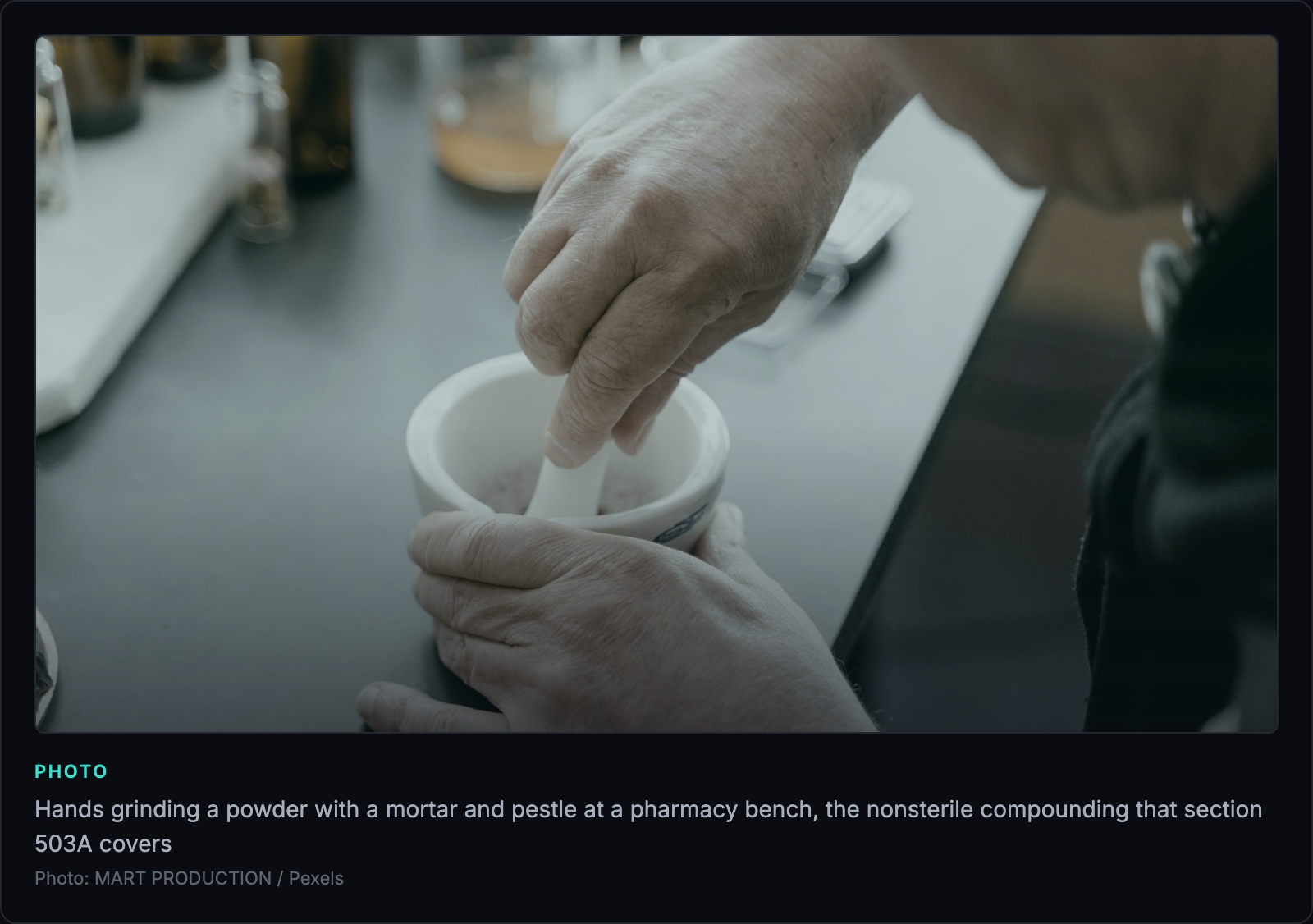
A 503A compounding pharmacy is a traditional pharmacy that prepares a drug for a named patient when an approved product does not fit, for example a dye-free capsule, a liquid for a child who cannot swallow a tablet, or a strength that is not sold. The state board of pharmacy licenses and inspects it. FDA steps in for cause, after complaints or adverse events, and to enforce the conditions of section 503A.
Congress added section 503A through the Food and Drug Administration Modernization Act of 1997. The Drug Quality and Security Act of 2013 removed the advertising provisions the Supreme Court had struck down and left the rest in force. The same law created the second tier, the 503B outsourcing facility, which registers with FDA, follows CGMP and may make office stock without prescriptions.
| 503A compounding pharmacy | |
|---|---|
| Statute | FD&C Act section 503A, 21 U.S.C. 353a |
| Who compounds | A licensed pharmacist in a state-licensed pharmacy or federal facility, or a licensed physician |
| Prescription | Required, for an identified individual patient |
| Primary regulator | State board of pharmacy |
| Quality standard | USP nonsterile and USP sterile, as revised and official on November 1, 2023 |
| CGMP under 21 CFR 211 | Exempt while every 503A condition is met |
| Federal rule that always applies | Insanitary conditions, section 501(a)(2)(A) |
What does section 503A require?
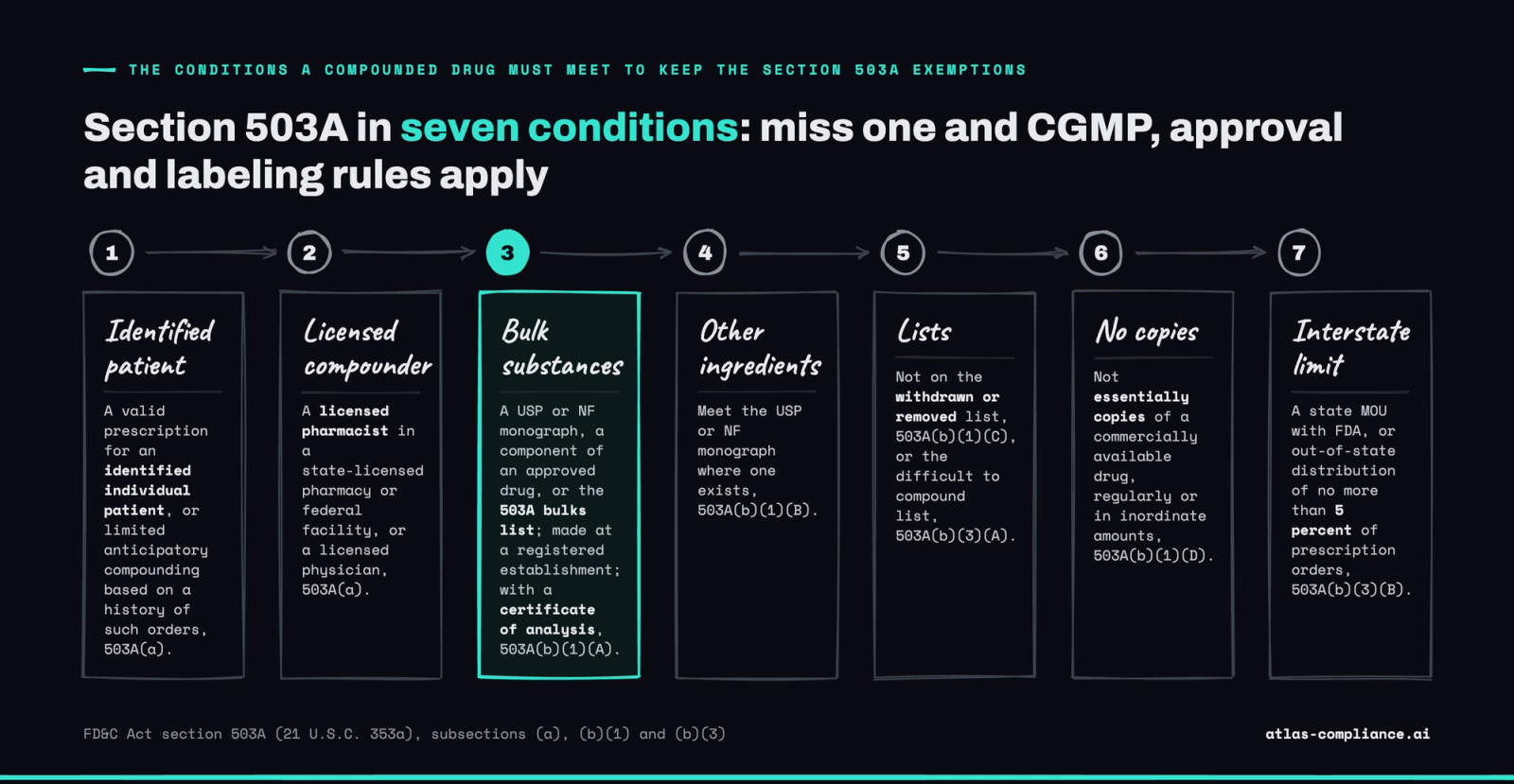
Section 503A requires a compounded drug to meet seven conditions, and a drug that misses any one of them loses all three exemptions. FDA then treats it as an unapproved new drug that must also meet CGMP. The conditions, in the order the statute sets them:
- Identified patient. A valid prescription for an identified individual patient, or anticipatory compounding in limited quantities based on a history of valid prescriptions, 503A(a).
- Licensed compounder. A licensed pharmacist in a state-licensed pharmacy or federal facility, or a licensed physician, 503A(a).
- Bulk drug substances. A USP or NF monograph, a component of an approved drug, or the 503A bulks list; manufactured at an establishment registered with FDA; accompanied by a valid certificate of analysis, 503A(b)(1)(A).
- Other ingredients. Compliance with the USP or NF monograph where one exists, 503A(b)(1)(B).
- Lists. Not on the list of drugs withdrawn or removed from the market for safety or effectiveness, 503A(b)(1)(C), and not on the list of drugs demonstrably difficult to compound, 503A(b)(3)(A).
- Copies. Not essentially copies of a commercially available drug, compounded regularly or in inordinate amounts, 503A(b)(1)(D).
- Interstate distribution. A state that has signed FDA's memorandum of understanding, or out-of-state distribution of no more than 5 percent of total prescription orders, 503A(b)(3)(B).
The copies condition is behind FDA's recent GLP-1 compounding letters. In its January 2018 final guidance on essentially copies under section 503A, FDA said it would not consider a pharmacy to compound a copy regularly or in inordinate amounts if it fills four or fewer prescriptions of that copy in a calendar month. A prescriber's note of a significant difference for the patient takes a drug outside the copies definition altogether, 503A(b)(2). Our analysis of FDA compounding warning letters in 2026 shows how FDA applied this to compounded GLP-1 drugs.
FDA published a final standard MOU in October 2020, a federal court ruled against it on procedural grounds in October 2021, and FDA has extended the date it intends to start enforcing the 5 percent limit in states without an MOU. A pharmacy that ships across state lines should check the current status on FDA's compounding pages before relying on either number.
What does FDA check on ingredient sourcing at a 503A pharmacy?
FDA checks three things on ingredient sourcing at a 503A pharmacy: whether each bulk drug substance is eligible, whether it came from an FDA-registered manufacturer, and whether a valid certificate of analysis came with it. Those are the three tests in section 503A(b)(1)(A), and a failure on any of them takes the drug outside section 503A.
Eligibility follows a fixed order. A bulk substance with a USP or NF monograph must meet it. Without a monograph, it must be a component of an FDA-approved drug. Without either, it must be on the 503A bulks list in 21 CFR 216.23. While that list is being built, FDA applies an interim enforcement policy to nominated substances it has placed in Category 1. Substances outside those routes, including peptides FDA placed in Category 2, cannot be compounded under section 503A.
The Atlas record shows how often ingredients come up. Of 280 Form 483s at compounding pharmacies, 71 (25%) include at least one observation about components or ingredients:
| Observation heading | Form 483s (n=280) | Share |
|---|---|---|
| Use of non-pharmaceutical grade components | 26 | 9.3% |
| Reports of analysis for components | 13 | 4.6% |
| Components withheld from use pending release | 8 | 2.9% |
| Testing each component for conformity with specifications | 5 | 1.8% |
| Identity testing of each component | 4 | 1.4% |
| Any component or ingredient heading | 71 | 25.4% |
These observations usually concern a certificate of analysis filed without a check against the supplier's FDA registration or the monograph.
What is the 503A common ownership rule?
The 503A common ownership rule is FDA's policy for hospital and health system pharmacies that compound for other facilities in the same system without patient-specific prescriptions. Section 503A itself has no such exception. FDA addressed it in guidance on hospital and health system compounding under section 503A.
The first draft, in 2016, limited the policy to facilities under common ownership and control within one mile of the compounding pharmacy. The revised draft, Revision 1 of October 2021, dropped the one-mile radius and defined a health system as a hospital and the entities connected to it through common ownership or joint management. It remains a draft guidance, so it describes FDA's intended enforcement approach and does not change the statute. A pharmacy outside a health system, or one that ships to unrelated clinics, still needs a prescription for each identified patient.
When does FDA inspect a 503A compounding pharmacy?
FDA inspects a 503A compounding pharmacy for cause or as risk-based surveillance, usually after an adverse event report, a product complaint, a recall, a state board referral, or signs that the pharmacy is compounding copies or shipping office stock. State boards carry out routine inspections; FDA has no fixed schedule for 503A pharmacies.
What the investigator writes depends on the pharmacy's status. If the drugs meet section 503A, observations fall under section 501(a)(2)(A): conditions under which a drug may have been contaminated or rendered injurious to health. FDA's final guidance on insanitary conditions at compounding facilities, issued in November 2020, lists examples, including smoke studies that do not show unidirectional airflow and personnel practices that expose sterile drugs to lower quality air. If the drugs lose the exemptions, the investigator can also cite specific 21 CFR 211 sections, as at a manufacturer.
FDA posts Form 483s from compounding inspections, and the Atlas FDA Form 483 database holds them with observation headings and investigator names. Our explainer on what an FDA Form 483 is covers the response window.
What are the most common FDA Form 483 observations at 503A compounding pharmacies?
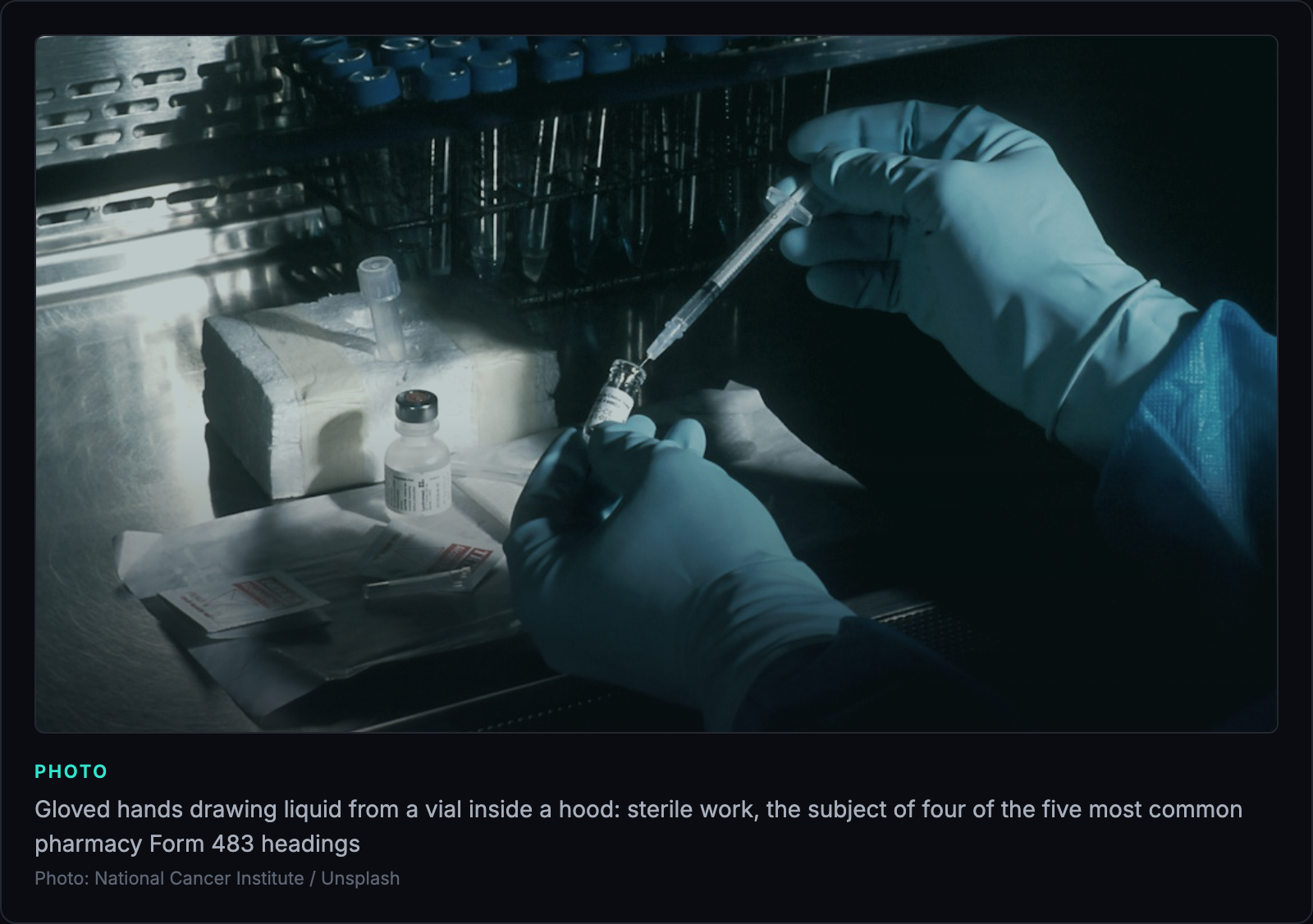
The most common FDA Form 483 observations at 503A compounding pharmacies concern sterile work: environmental monitoring, release testing, sterile procedures, sterile process validation, and sterility or endotoxin testing. We pulled every Form 483 in Atlas (release of August 15, 2026) issued to a firm named as a pharmacy, apothecary or drug store, excluding registered outsourcing facilities. That gave 280 forms at 204 pharmacies, 1,967 observations and a median of 6 observations per form.
| Observation heading | Form 483s (n=280) | Share |
|---|---|---|
| Environmental monitoring system | 93 | 33.2% |
| Testing and release for distribution | 79 | 28.2% |
| Procedures for sterile drug products | 76 | 27.1% |
| Validation lacking for sterile drug products | 68 | 24.3% |
| Sterility and pyrogen-free testing | 55 | 19.6% |
| Investigations of discrepancies and failures | 34 | 12.1% |
| Hazardous drugs, prevention of cross-contamination | 34 | 12.1% |
| Cleaning, sanitizing and maintenance | 30 | 10.7% |
| Use of non-pharmaceutical grade components | 26 | 9.3% |
Volume peaked in 2019 with 40 forms, fell to 3 in 2020 when FDA paused most inspections, and has run at 2 to 18 a year from 2021 (2026 counts run through April). Forms from 2021 onward also use the insanitary conditions vocabulary: inadequate smoke studies appear on 8 of the 49 forms issued since 2021, and hazardous drug cross-contamination on 13.
Two recent records show the pattern:
- Revive Rx Pharmacy in Houston received a seven-observation Form 483 on February 7, 2025 and a five-observation form on March 27, 2026. Four headings repeat across the two: exposure of sterile drugs to lower quality air in the ISO 5 area, inadequate smoke studies, lyophilizers not adequately sterilized, and microbial contamination in or next to the ISO 5 area.
- Hallandale Pharmacy in Fort Lauderdale received a two-observation Form 483 on June 13, 2025, for lower quality air in the ISO 5 area and inadequate smoke studies.
Repeat findings are common: 58 of the 204 pharmacies have two or more Form 483s in Atlas. A handful of investigators account for many of the forms. Patty P Kaewussdangkul is named on 12 of the 280, and Jennifer L Huntington on 9.
The method has limits. Firms were matched by name, so a few pharmacies may also have operated as outsourcing facilities at some point, and a Form 483 is an investigator's list of observations, not a final agency finding.
If a 503A pharmacy you rely on has a Form 483 on record, the investigator who wrote it is a useful next check: Atlas shows which observations that investigator has written at other compounders.
 Atlas
See what the FDA knows about your next investigator.
30 minutes with the founder. No pitch deck.
What should a prescriber or telehealth program check before using a 503A pharmacy?
A prescriber or telehealth program should confirm the pharmacy's license, then read its inspection record before sending prescriptions. Five checks, in order:
- Confirm the pharmacy's license with the board of pharmacy in its home state and in each state where patients live.
- Search the pharmacy's name in a Form 483 database and read the last two forms. A heading that repeats, such as smoke studies or environmental monitoring, is the pattern that comes before a warning letter.
- Ask for the certificates of analysis and supplier registrations behind each bulk drug substance, and check the substance against the 503A eligibility routes.
- Ask how many prescriptions a month the pharmacy fills for any compounded drug that resembles an approved product, and how each significant difference is documented.
- For sterile drugs, ask for the latest media fill, smoke study and environmental monitoring results.
FDA's warning letter database shows whether a Form 483 has already turned into a letter, and an FDA untitled letter is the step below it.
AtlasFDA Inspection Intelligence Digest
We track every 483, EIR, and warning letter the moment it happens. Get the signals before they hit the FDA website.
Frequently asked questions
Under federal law, generally no. Section 503A requires a prescription for an identified individual patient, so office stock falls outside it. Limited anticipatory compounding is allowed against a history of patient prescriptions, and FDA's draft guidance covers distribution within a health system. Some states permit office use under state law, but a drug made without a patient prescription does not meet section 503A.

Written by
Bhavish Agarwal
Founder, Atlas
Bhavish Agarwal is the founder of Atlas and previously worked at Google and Microsoft. He has spent the past several years building regulatory data infrastructure for the pharmaceutical industry.