
A purified water system is the set of pretreatment, purification, storage and distribution equipment that turns drinking water into water meeting the USP Purified Water monograph for use in drug manufacturing, cleaning and testing. FDA inspects the system as equipment: its design, sanitization, monitoring data and the investigations behind every out-of-limit result.
This guide adds how FDA wrote those failures up in practice, from the Atlas Form 483 citation dataset (pulled October 2026): 774 drug inspections that cited 21 CFR Part 211 and closed between January 7, 2025 and September 3, 2026, joined to FDA's inspection classifications, plus two 2026 warning letters that describe water system findings.
Key facts:
- Purified Water is tested for total organic carbon (TOC) under USP 643 and for conductivity under USP 645; the Japanese Pharmacopoeia sets the TOC limit at not more than 0.50 mg/L (500 ppb).
- FDA's 1993 water inspection guide calls any microbial action limit above 100 CFU/mL unacceptable for a purified water system.
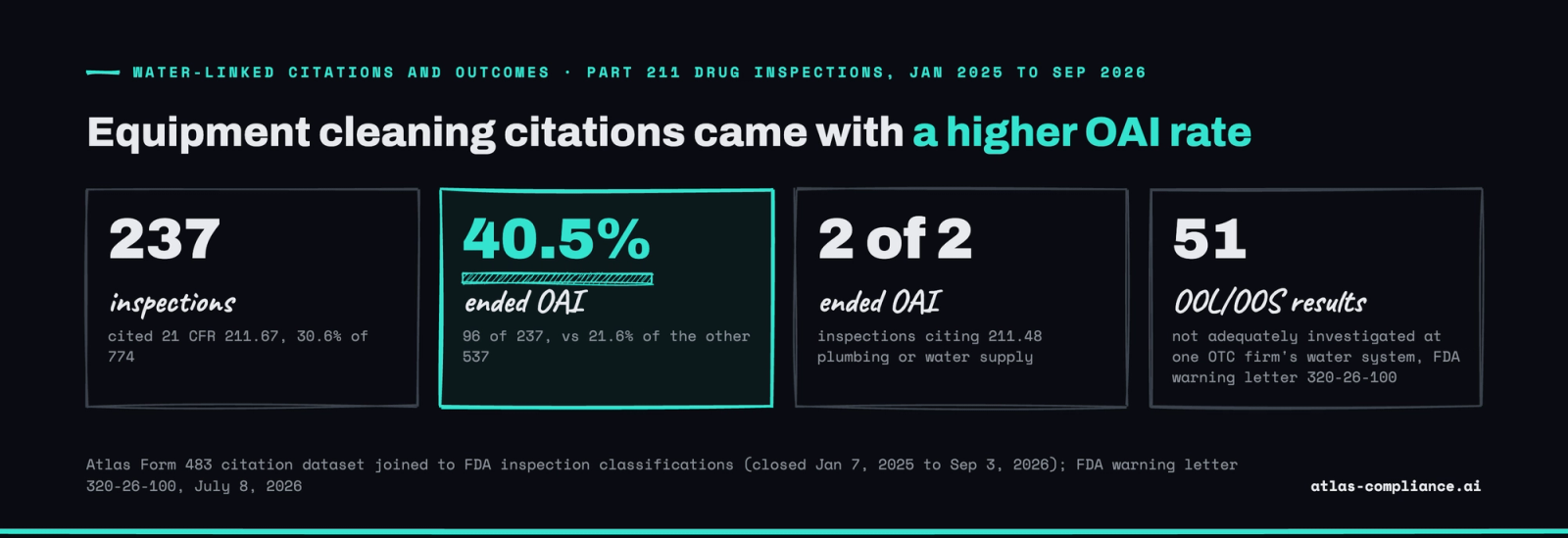
- FDA cited 21 CFR 211.48, the plumbing and potable water section, at 2 of 774 Part 211 drug inspections (0.3%) from January 2025 to September 2026, and both ended Official Action Indicated (OAI).
- FDA cited 21 CFR 211.67, equipment cleaning and maintenance, at 237 of the same 774 inspections (30.6%), and 40.5% of those ended OAI against 21.6% of the rest.
- FDA's 1993 guide treats a water system as validated only after a full year of monitoring data.
What is a purified water system?
A purified water system is a validated utility that produces, stores and circulates water meeting the USP Purified Water monograph: chemical purity shown by TOC and conductivity, and microbial quality held under in-house alert and action levels. The feed is drinking water; FDA's 1993 guide describes compliance with EPA drinking water regulations as the USP requirement for it, and calls that requirement minimal.
The regulation underneath is 21 CFR Part 211. 21 CFR 211.48 requires potable water under continuous positive pressure, in a plumbing system free of defects, meeting the EPA Primary Drinking Water Regulations in 40 CFR part 141. Everything downstream of the city or well supply falls under the equipment sections: 211.63 for design, 211.65 for materials that contact the water, and 21 CFR 211.67 for cleaning, sanitizing and maintenance under written procedures. Our 21 CFR Part 211 guide maps where each section sits.
Firms use Purified Water as an ingredient in non-sterile products, as rinse water for equipment, and as the feed for water for injection stills and membranes. The grade a product needs depends on its route and the compendial requirements in its application.
How is a purified water system designed?
A purified water system is designed in six stages, and each one removes a contaminant the next stage cannot handle:
- Feed water: potable water meeting 40 CFR part 141, tested on a schedule because its chemistry changes by season.
- Pretreatment: multimedia filtration, activated carbon or chemical dosing to remove chlorine, and softening to protect the membranes.
- Purification: reverse osmosis, often two units in series, followed by electrodeionization or ion exchange to reach the conductivity limit.
- Storage: a tank with a hydrophobic vent filter and spray ball, held hot or ozonated.
- Distribution: a recirculating loop with continuous flow, sanitary fittings and no dead legs.
- Points of use: the valves where production draws water, and where the system is sampled.
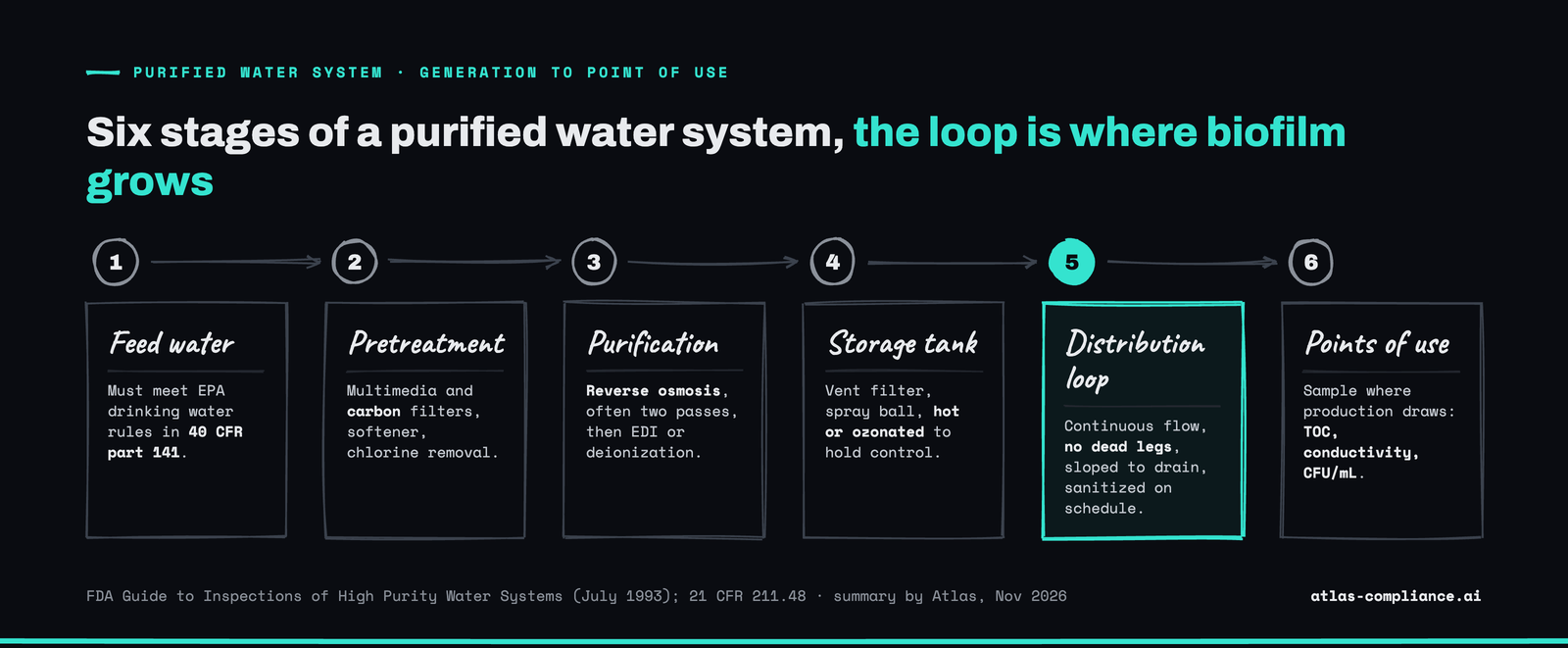
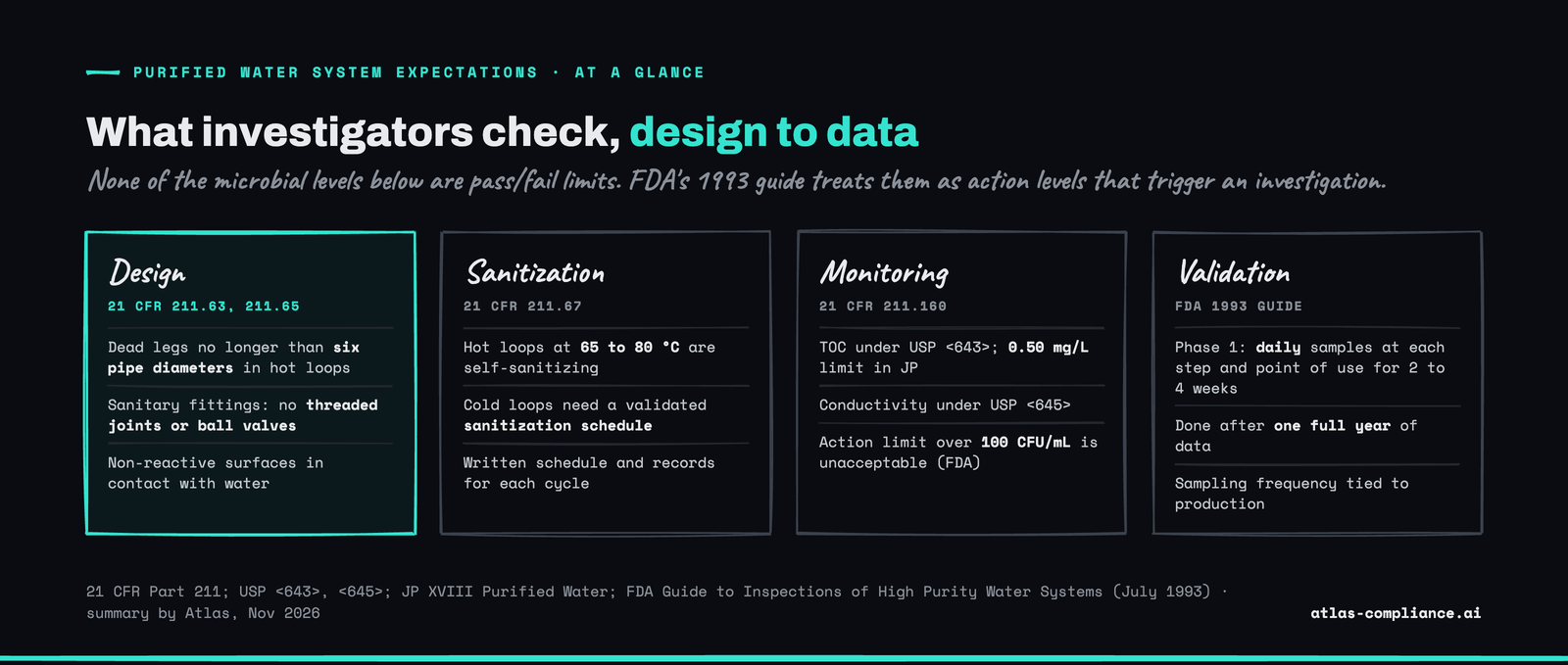
FDA's Guide to Inspections of High Purity Water Systems (July 1993) still sets the questions investigators ask about each stage. It warns that reverse osmosis membranes are not absolute filters, so microbial contamination after RO is common, and that an ultraviolet lamp kills at most about 90% of the organisms passing through it, and only when maintained. The guide recognizes hot systems running at 65 to 80 °C as self-sanitizing. Cold systems need a sanitization schedule.
Dead legs are the design flaw investigators look for first. The 1993 guide cites the proposed large volume parenteral rule, which allowed an unused branch no longer than six diameters of the unused pipe, a limit developed for hot loops at 75 to 80 °C. For colder systems the guide says any drop or unused length of pipe can grow biofilm.
What are the specifications for purified water?
The specifications for Purified Water are chemical, with microbial quality controlled by levels the firm sets and justifies. The monograph tests are TOC and conductivity; FDA's 1993 guide states that none of the water limits are pass/fail limits and that all of them are action limits.
| Attribute | Purified Water expectation | Where it comes from |
|---|---|---|
| Feed water | Meets EPA drinking water rules | 21 CFR 211.48; 40 CFR part 141; FDA 1993 guide |
| Total organic carbon | Not more than 0.50 mg/L (500 ppb) in the JP monograph | USP 643 test; JP XVIII |
| Conductivity | Passes the water conductivity test | USP 645 |
| Microbial action level | Any limit over 100 CFU/mL unacceptable | FDA 1993 guide; JP uses the same 100 CFU/mL action level |
| Objectionable organisms | Absent, based on product risk | 21 CFR 211.113(a) |
| Bacterial endotoxin | No routine limit; WFI carries less than 0.25 EU/mL | JP XVIII monographs |
Alert and action levels are process control tools. The Japanese Pharmacopoeia's general information chapter on water quality control asks each facility to set its own alert and action levels and countermeasures, and recommends TOC action levels of 300 ppb in-line and 400 ppb off-line, below the 500 ppb monograph limit. Water used in a non-sterile product must also stay free of organisms that are objectionable for that product, which is why investigators ask whether routine monitoring identifies what grows, not only how much. Our USP 61 and 62 guide covers how firms test the finished product for the same organisms, and the endotoxin testing guide covers the endotoxin side.
How often should a purified water system be sampled?
A purified water system should be sampled daily at every purification step and every point of use during the first two to four weeks of validation, according to FDA's 1993 guide, and then at a routine frequency the firm can justify against its production schedule. The guide treats validation as complete only when the firm has a full year of data, so seasonal changes in feed water are captured.
Routine sampling has to reflect how production uses the water. A firm that samples a point of use weekly but draws from it daily has little evidence for the batches made in between, and FDA made that point in a July 2026 warning letter covered below. Samples should be drawn the way production draws water, through the same hose or valve and after the same flush, or the result describes a different water.
Qualification of the system itself falls under equipment qualification; our IQ OQ PQ guide walks through the protocol structure. FDA warning letter 320-26-122 to a Taiwan facility, dated September 2, 2026, cited a qualification protocol and report that lacked TOC, conductivity and microbial testing for a utility, with the system name redacted, that the firm used to clean manufacturing equipment, and placed the finding under 21 CFR 211.100(a).
What does FDA cite on purified water systems?
FDA rarely cites a purified water system under a water section of its own. In the Atlas Form 483 citation dataset, 21 CFR 211.48 appeared at 2 of 774 Part 211 drug inspections (0.3%) that closed between January 7, 2025 and September 3, 2026, and only one of those citations concerned water quality; the other concerned drains. Water findings reach the Form 483 through the equipment, laboratory and investigation sections instead.
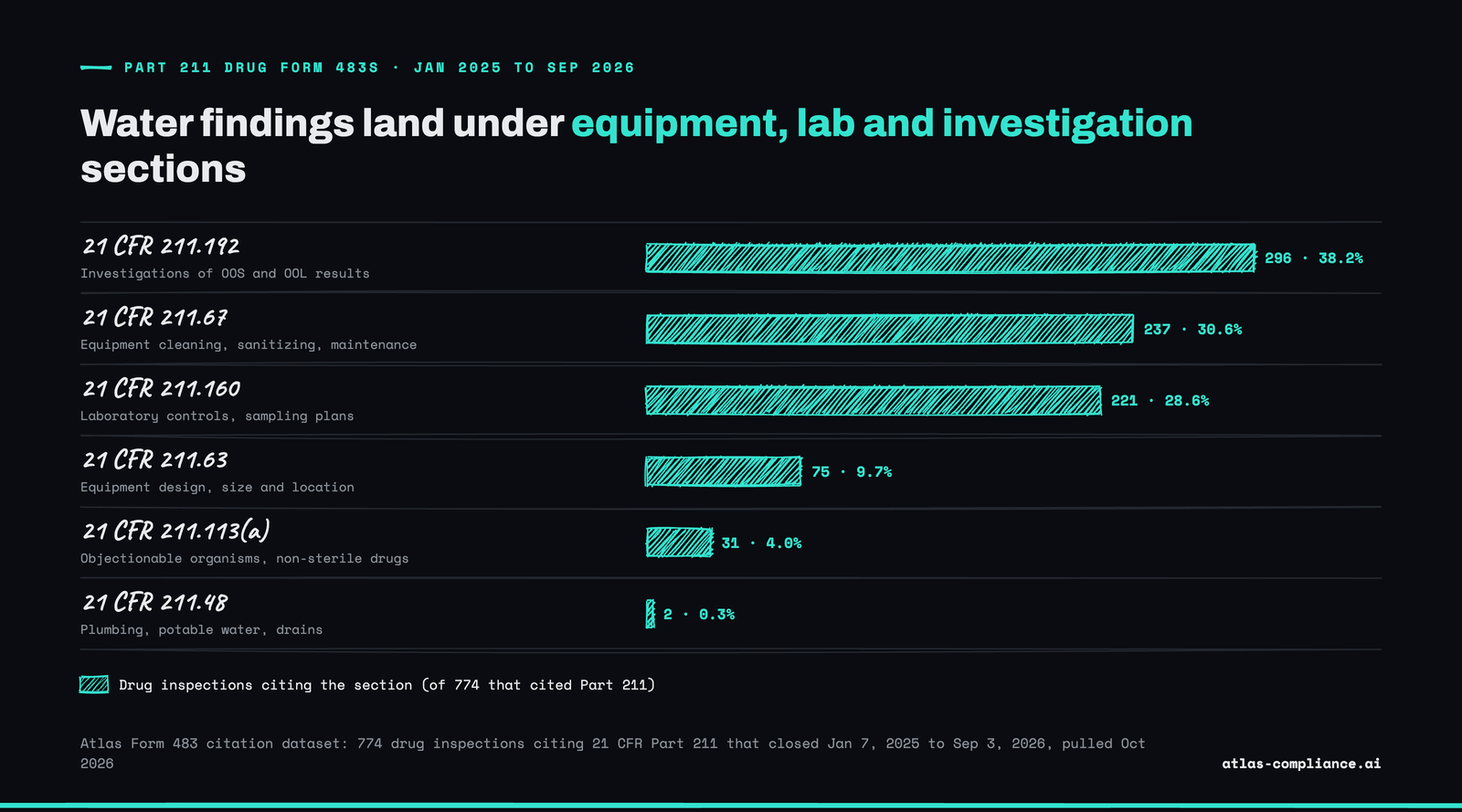
The chart shows the sections that carry water system observations, not water observations alone: 211.192 at 296 inspections (38.2%), 211.67 at 237 (30.6%), 211.160 at 221 (28.6%) and 211.63 at 75 (9.7%). FDA's citation dataset gives the section and a standard heading but not the full observation text, so it cannot separate water from other equipment. Two 2026 cases show how a water failure maps onto those sections.
| Facility | Inspection closed | Water-related citation | How FDA described it | Outcome |
|---|---|---|---|---|
| Spa De Soleil, Sun Valley, California | Jan 26, 2026 | 211.192, with 211.67(b) and 211.160(b) on the same Form 483 | 51 out-of-limit and out-of-specification water results not adequately investigated; dead legs, threaded fittings, Teflon tape and ball valves | OAI; warning letter 320-26-100, July 8, 2026 |
| International Medication Systems, South El Monte, California | Dec 19, 2025 | 211.48(a), potable water standards not met; 211.67(b) | Warning letter cites 211.63 for a redacted system used to clean equipment, with gross contamination in its storage tank | OAI; warning letter 320-26-99, July 2, 2026 |
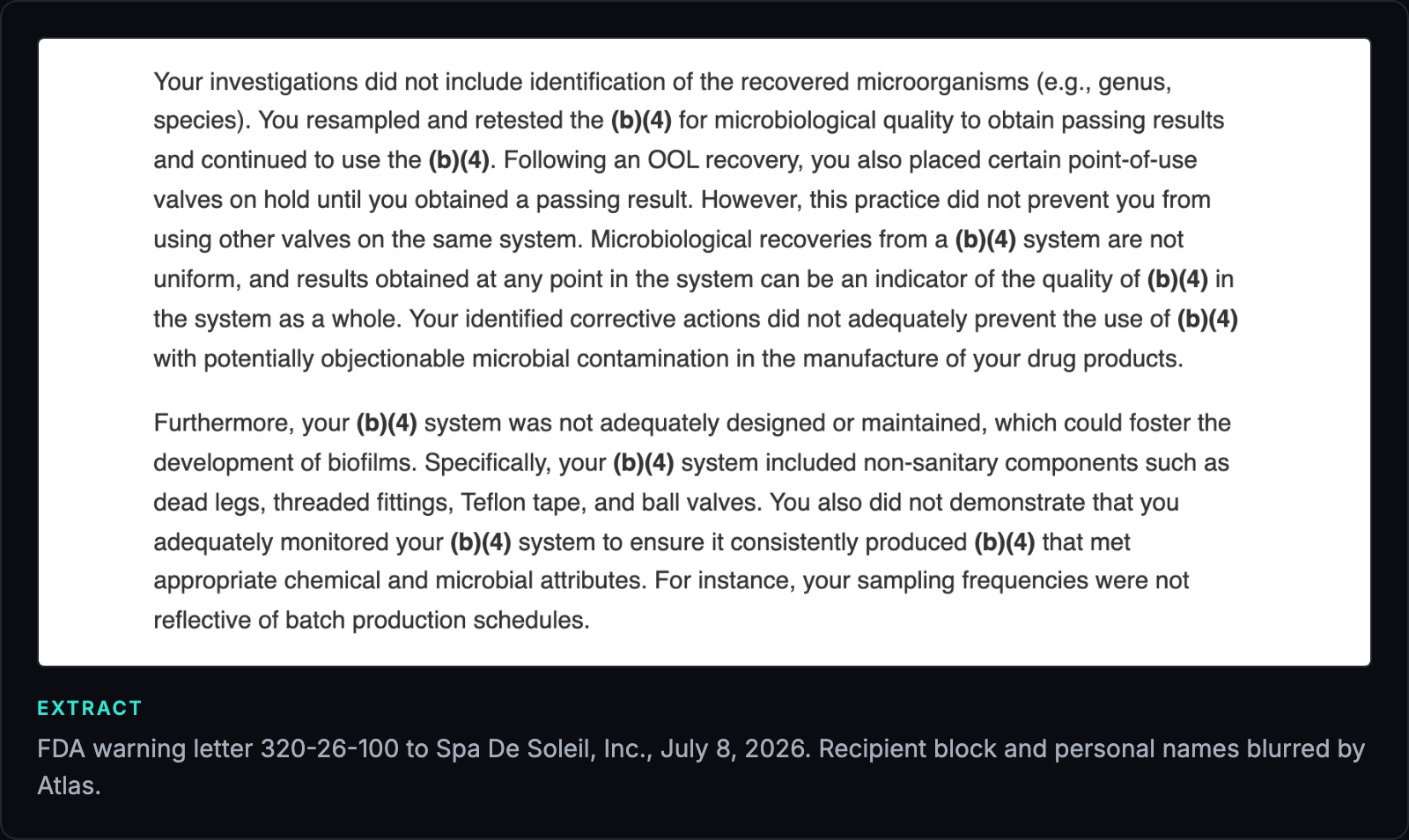
The Spa De Soleil inspection produced a Form 483 with 7 observations, all written by one investigator who has 13 inspections at 13 sites and 42 Form 483 observations on record in Atlas. The facility has 9 FDA inspections on record, 4 of them ending in a Form 483. FDA's warning letter put the water finding under 21 CFR 211.192: the over-the-counter manufacturer resampled and retested until it got passing results, did not identify the organisms it recovered, and kept using the system.
The International Medication Systems facility has 30 FDA inspections on record in Atlas, 13 of them ending in a Form 483. Its December 2025 Form 483 is the only one in the period that cited 211.48(a) for potable water, and the four-person team included an investigator with 100 inspections at 97 sites on record. Both Form 483s are noindexed in Atlas and are named here in plain text: the Spa De Soleil Form 483 of January 26, 2026 and the International Medication Systems Form 483 of December 19, 2025. The full FDA Form 483 database lists the other equipment and investigation citations from the period.
An investigator who has written up a water system before tends to ask for the same records again: sampling schedules, trend reports, organism identifications and every out-of-limit investigation. Their past Form 483s show which ones.
 Atlas
See what the FDA knows about your next investigator.
30 minutes with the founder. No pitch deck.
What does a water system citation signal about the inspection outcome?
A water system citation signals a heavier outcome. In the Atlas data, 96 of the 237 drug inspections that cited 21 CFR 211.67 ended OAI (40.5%), against 116 of the 537 Part 211 inspections that did not (21.6%). Both inspections that cited 211.48 ended OAI.
The pattern in both 2026 letters is the same. A bad water result reached the laboratory, the firm treated it as a sampling problem, and FDA treated it as evidence about the system. The Spa De Soleil letter says microbial recoveries in a water system are not uniform, so a result at one valve speaks for the whole loop; putting one point-of-use valve on hold while others stay in service does not contain the risk. Our 21 CFR 211.192 guide covers what a complete investigation record contains.
The two letters point to four checks worth running on your own system. Trend TOC, conductivity and counts by sample point rather than by system. Identify recovered organisms, at least to genus. Tie sampling frequency to production days. Open an investigation on the first action level excursion, before any retest.
Atlas tracks new Form 483s and warning letters as FDA releases them, including the equipment and investigation citations where water findings land.
AtlasFDA Inspection Intelligence Digest
We track every 483, EIR, and warning letter the moment it happens. Get the signals before they hit the FDA website.
Frequently asked questions
21 CFR Part 211 does not name Purified Water. Section 211.48 requires potable water meeting EPA drinking water standards, and water used as an ingredient is treated as a component that must meet its specifications under 211.84 and 211.160. The grade comes from the product: an application or compendial monograph that calls for Purified Water makes the USP monograph the specification.

Written by
Bhavish Agarwal
Founder, Atlas
Bhavish Agarwal is the founder of Atlas and previously worked at Google and Microsoft. He has spent the past several years building regulatory data infrastructure for the pharmaceutical industry.