
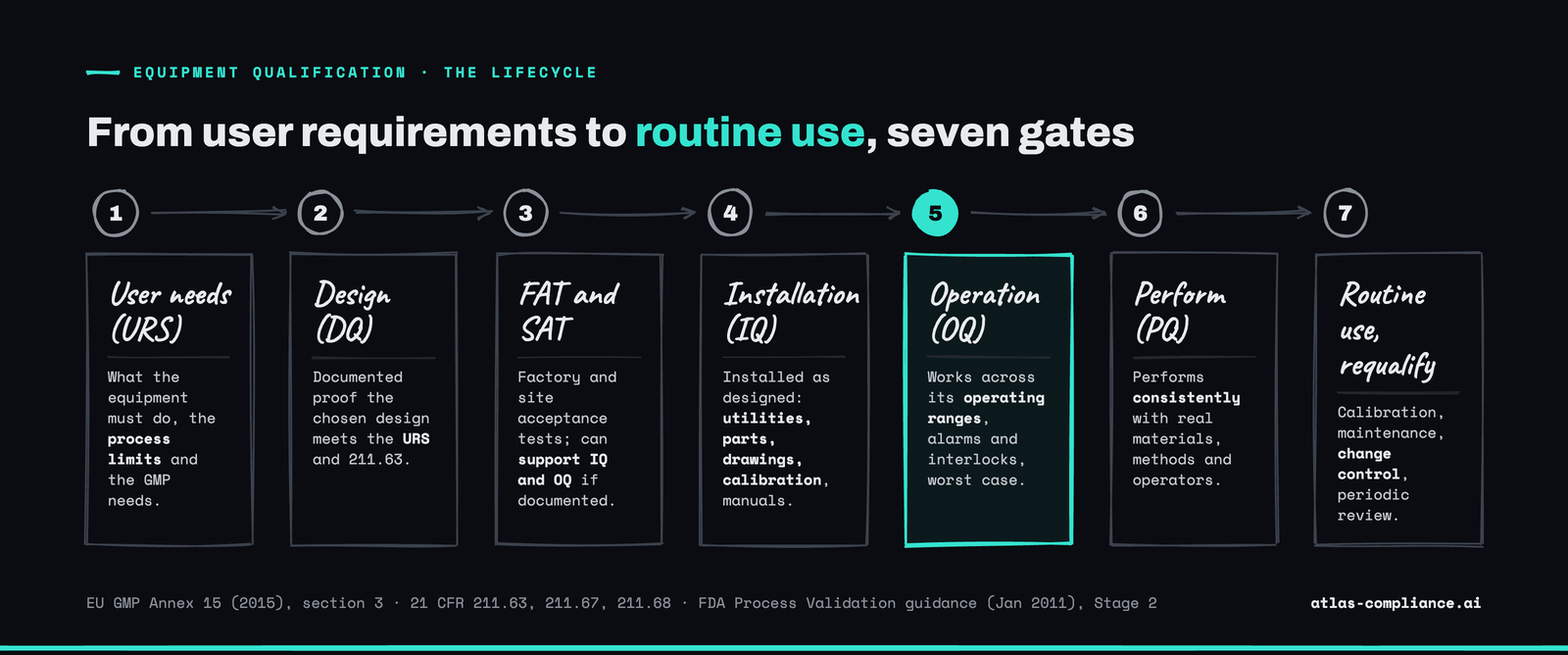
IQ, OQ and PQ are the three documented stages of equipment qualification: installation qualification (IQ) proves the equipment was installed as designed, operational qualification (OQ) proves it works across its operating ranges, and performance qualification (PQ) proves it performs consistently in routine use. Design qualification (DQ) comes before them and records that the chosen design meets the user requirements.
This guide adds what FDA investigators write when equipment is not qualified, calibrated or maintained: equipment citations at 774 drug inspections that cited 21 CFR Part 211 and closed between January 7, 2025 and September 3, 2026, from the Atlas Form 483 citation dataset (pulled October 2026), joined to FDA's inspection classifications.
Key facts:
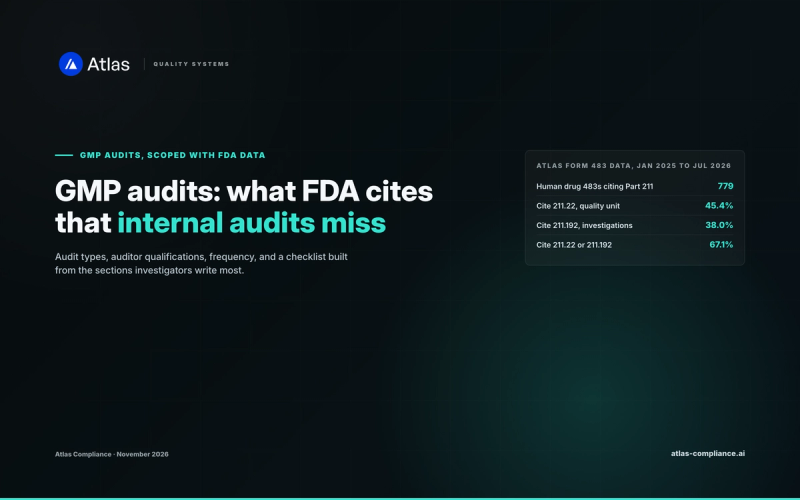
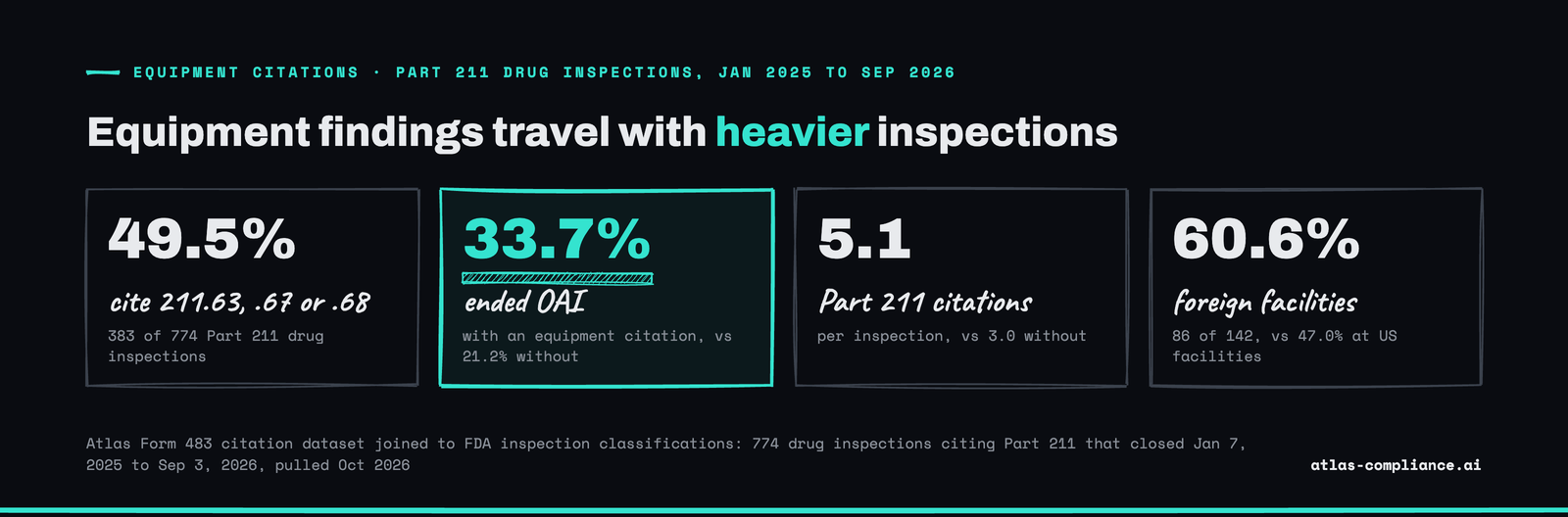
- 383 of 774 Part 211 drug inspections (49.5%) cited at least one equipment section: 211.63 design, 211.67 cleaning and maintenance, or 211.68 automatic equipment and calibration.
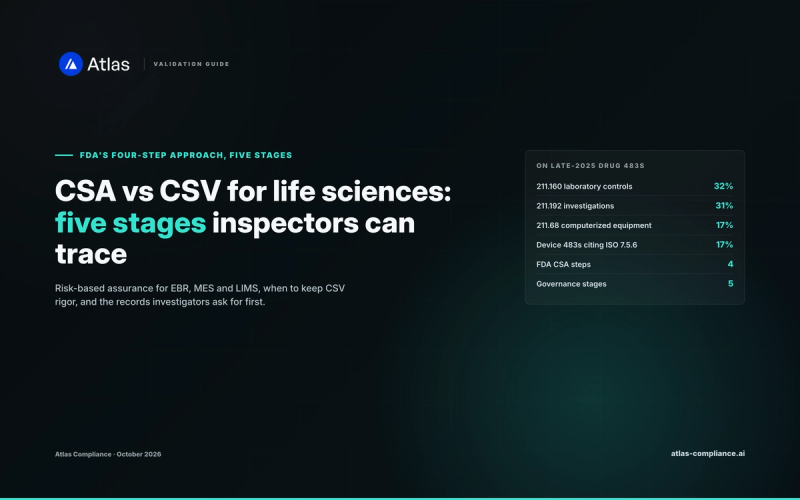
- 21 CFR 211.63, the design section that DQ and IQ answer to, appeared at 75 inspections (9.7%); 211.68(a), calibration and routine checks, at 48 (6.2%).
- 33.7% of inspections with an equipment citation ended Official Action Indicated (OAI), against 21.2% of Part 211 drug inspections without one.
- Foreign facilities drew equipment citations at 60.6% of their Part 211 inspections (86 of 142), against 47.0% at US facilities (297 of 632).
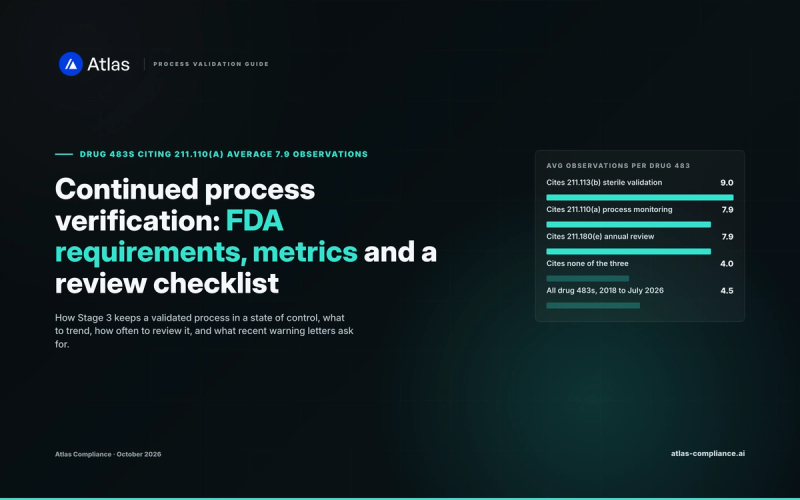
- Under the device QMSR, process validation (ISO 13485 clause 7.5.6) appeared at 56 of 377 device inspections (14.9%) from February to October 2026.
What is the difference between IQ, OQ and PQ?
IQ, OQ and PQ answer three different questions in a fixed order. IQ asks whether the equipment is installed as designed, OQ asks whether it operates as intended across its full range, and PQ asks whether it performs consistently with real materials, methods and operators. Each stage starts only after the previous protocol is executed and approved.
| Stage | Question it answers | Typical tests and checks | Output |
|---|---|---|---|
| DQ, design qualification | Does the design meet the user requirements? | URS traced to specifications, drawings, materials of construction, GMP review | Approved design and URS trace matrix |
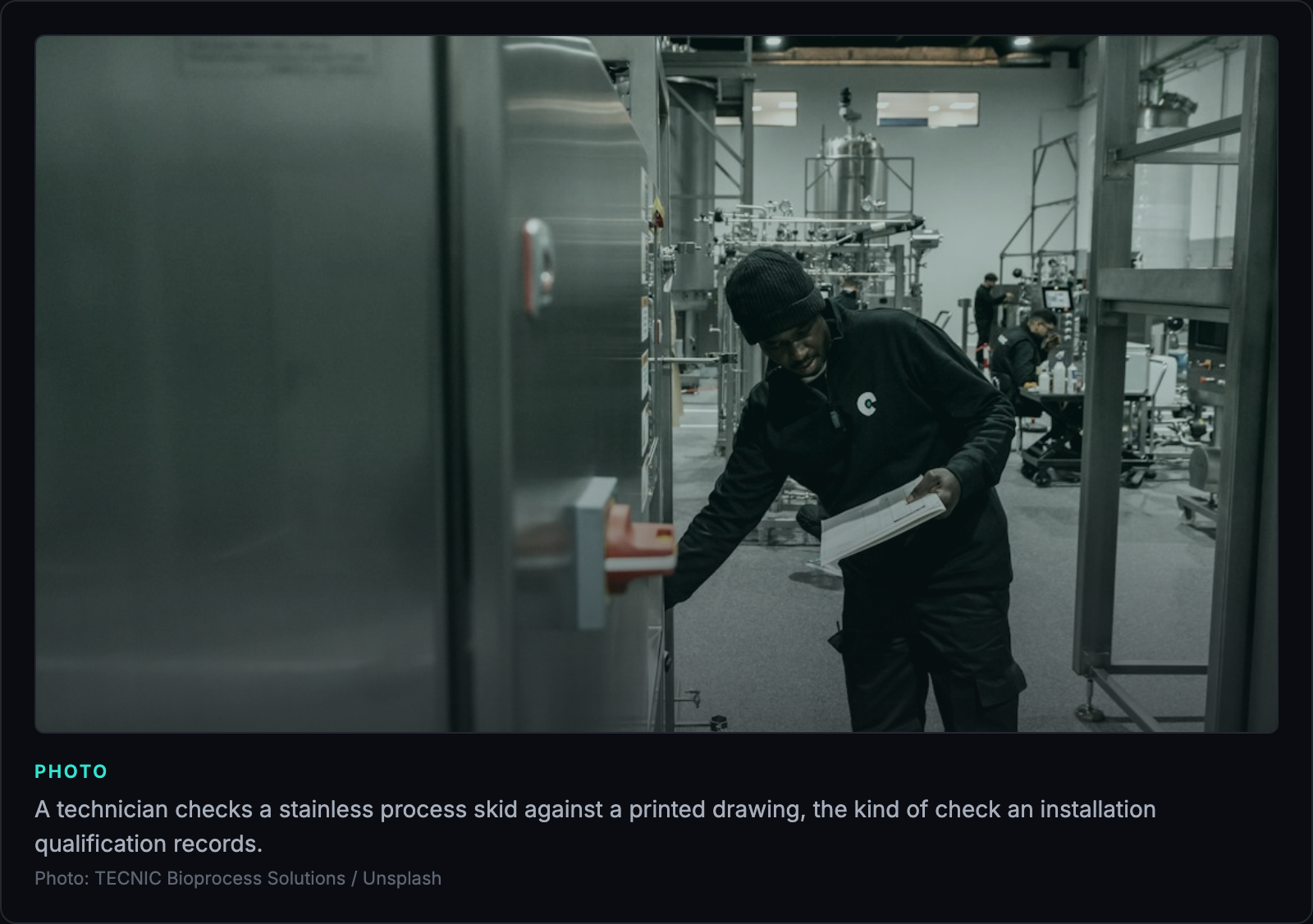
| IQ, installation qualification | Is it installed as designed? | Model and serial numbers, parts lists, utilities, drawings, calibration of critical instruments, manuals and SOPs on file | Installation baseline |
| OQ, operational qualification | Does it work across its ranges? | Each function at upper and lower limits, alarms, interlocks, power failure and recovery, worst-case settings | Proven operating ranges |
| PQ, performance qualification | Does it perform every time? | Several runs with production materials or a qualified surrogate, routine operators and methods | Evidence of consistent performance |
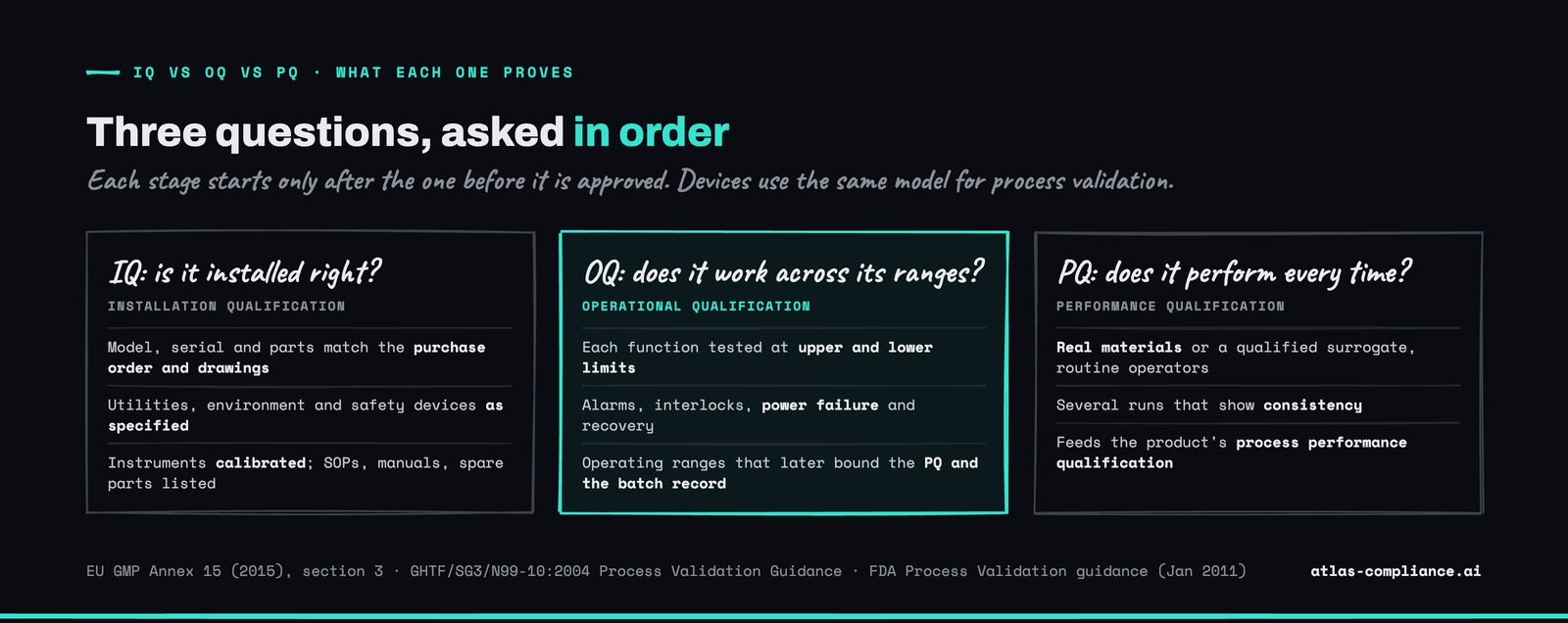
The order matters because each stage relies on the one before it. An OQ run on equipment with an undocumented wiring change proves little, and a PQ run outside the ranges OQ established proves nothing about routine production.
What is DQ, and where do FAT and SAT fit?
Design qualification is the documented check that the proposed design of a facility, system or piece of equipment is suitable for its intended purpose. EU GMP Annex 15 (2015) places DQ after the user requirements specification (URS) and before installation, and asks that compliance of the design with GMP be shown and documented at this stage.
Factory acceptance testing (FAT) at the vendor and site acceptance testing (SAT) after delivery are commercial tests, not qualification on their own. Annex 15 allows documentation review and some tests done at FAT to stand without being repeated at IQ or OQ on site, where that is justified and the firm can show transport and installation did not affect the function.
The US rules do not use the words IQ, OQ and PQ. 21 CFR 211.63 requires equipment "of appropriate design, adequate size, and suitably located to facilitate operations for its intended use and for its cleaning and maintenance", 211.67 requires cleaning and maintenance at appropriate intervals, and 211.68(a) requires automatic, mechanical and electronic equipment to be "routinely calibrated, inspected, or checked according to a written program designed to assure proper performance." The eCFR text of Part 211, Subpart D is the source for each quote. IQ, OQ and PQ are how the industry shows it met those sections.
Is IQ OQ PQ required by FDA?
IQ, OQ and PQ are not named in 21 CFR Part 211, but FDA expects the evidence they produce. FDA's guidance Process Validation: General Principles and Practices (January 2011) makes "qualification of utilities and equipment" one of the two elements of Stage 2, process qualification, alongside process performance qualification (PPQ). A manufacturer that cannot show qualified equipment cannot complete PPQ for the product.
For medical devices, the former 21 CFR 820.75 and now ISO 13485:2016 clause 7.5.6, incorporated by the QMSR on February 2, 2026, require validation of processes whose output cannot be fully verified. The GHTF process validation guidance (GHTF/SG3/N99-10:2004) describes that validation as IQ, OQ and PQ, and device firms still use the same three stages. Our 21 CFR Part 820 guide covers the QMSR change.
How often does FDA cite equipment on Form 483s?
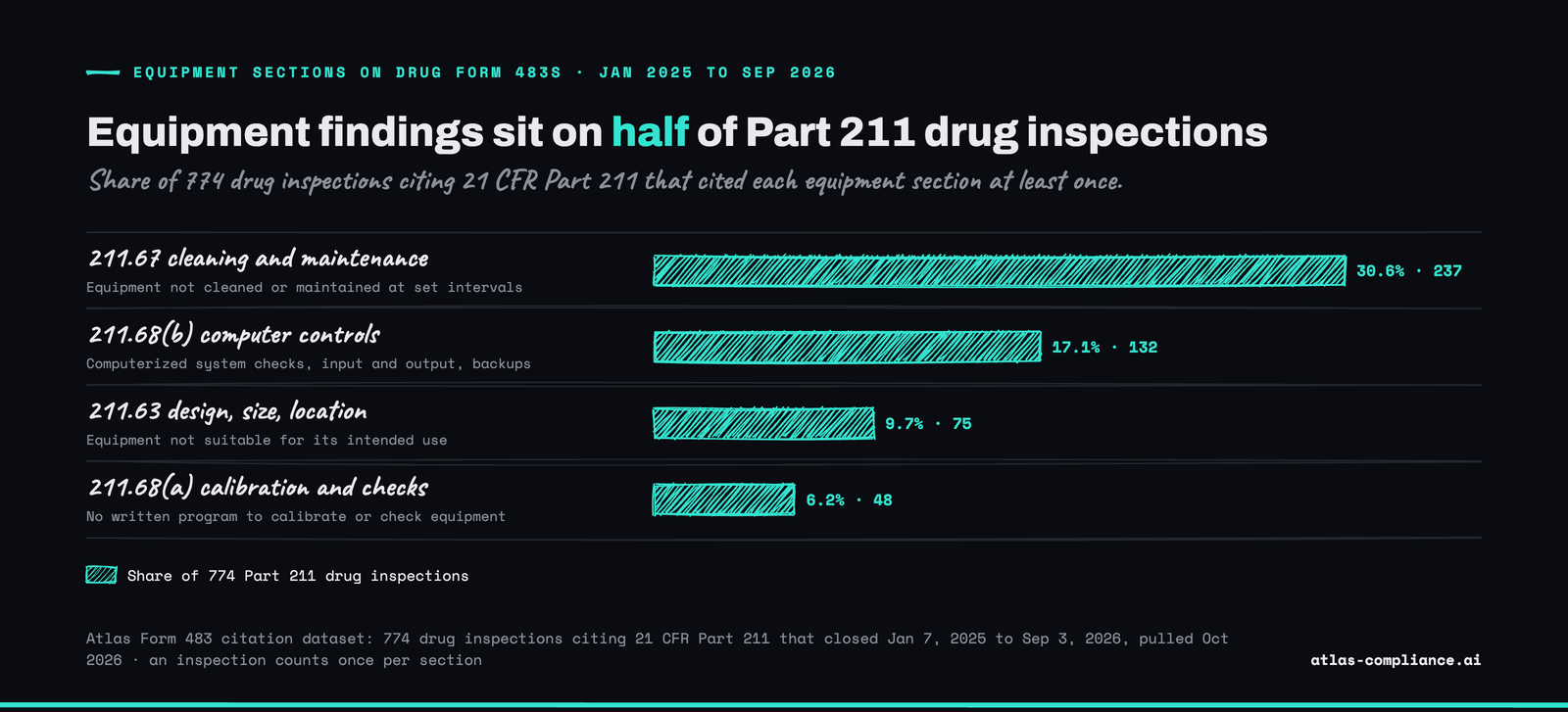
FDA cited at least one equipment section at 383 of 774 drug inspections that cited Part 211 between January 2025 and September 2026 (49.5%), in the Atlas Form 483 citation dataset. FDA does not write "IQ" or "OQ" on a Form 483; it cites the Part 211 section the missing qualification evidence would have satisfied.
- 21 CFR 211.67, at 237 inspections (30.6%). Most observations say equipment was not cleaned or maintained at appropriate intervals, or that written cleaning and maintenance procedures were missing or not followed.
- 21 CFR 211.68(b), at 132 inspections (17.1%). These cite computerized system controls: input and output checks, master record access and backups.
- 21 CFR 211.63, at 75 inspections (9.7%), under the heading "Equipment Design, Size and Location". This is the section that DQ and IQ evidence answers to.
- 21 CFR 211.68(a), at 48 inspections (6.2%), for calibration, inspection or checking that was not done under a written program, or not recorded.
Named examples from 2026 show how the citations read:
| Facility | Form 483 date | Equipment citation | Other sections on the form | Classification |
|---|---|---|---|---|
| Ajanta Pharma, Paithan, India | Apr 21, 2026 | 211.63, 211.67(a) | 211.22(d), 211.100(b), 211.192 | VAI |
| Eosera, Fort Worth, Texas | Mar 20, 2026 | 211.63, 211.67(b), 211.68(a) | 211.84, 211.100(a), 211.160(b), 211.182, 211.192 | OAI |
| Emcure Pharmaceuticals, India | May 15, 2026 | 211.63 | VAI | |
| Hetero Labs Unit VI, India | Jun 26, 2026 | 211.68(a) | VAI | |
| Aspen SA Sterile Operations, South Africa | Jul 14, 2026 | 211.68(a) | OAI |
The Ajanta form was written by two investigators, including Tamil Arasu, whose Atlas profile lists 110 inspections at 103 sites and 186 Form 483 observations since November 2014. The Eosera form pairs a design citation with a calibration citation and a 211.182 equipment log citation, three of the areas an IQ file and a calibration program are meant to cover. The full observations for each form sit in the FDA Form 483 database.
What does an equipment citation signal about the rest of the inspection?
An equipment citation tends to arrive with a heavier inspection. In the Atlas data, the 383 inspections that cited 211.63, 211.67 or 211.68 averaged 5.1 Part 211 citations, against 3.0 for the 391 Part 211 drug inspections without one, and 33.7% of them ended OAI (129 of 383), against 21.2% (83 of 391).
The narrower group of 115 inspections that cited 211.63 or 211.68(a), the two sections closest to qualification and calibration, ended OAI 39.1% of the time (45 of 115). The share of Part 211 inspections with an equipment citation rose slightly, from 48.8% in 2025 (274 of 562) to 51.4% in January to September 2026 (109 of 212). How FDA classifies an inspection is covered in our NAI, VAI and OAI explainer.
An investigator's past Form 483s show which equipment sections they have cited before, a practical checklist before your own inspection.
 Atlas
See what the FDA knows about your next investigator.
30 minutes with the founder. No pitch deck.
What should an IQ, OQ and PQ protocol contain?
An IQ, OQ or PQ protocol is an approved, pre-written test plan with acceptance criteria set before execution. Each protocol names the equipment and its identifiers, the scope and the requirement each test traces to, the test method, the acceptance criteria, who executes and who reviews, how deviations are handled, and the signatures that close it. The executed protocol and a summary report become the qualification record.
- Header and scope. Equipment ID, location, the URS and DQ it traces to, and what is out of scope.
- Prerequisites. Approved drawings and specifications, calibrated test instruments with certificates, trained executors, and the previous stage closed.
- Test cases. For IQ: component and utility checks against drawings. For OQ: each function at its limits, alarms, interlocks and recovery. For PQ: consecutive runs at routine conditions.
- Acceptance criteria. Numeric where possible and fixed before testing starts.
- Deviation handling. Every failed step gets a deviation, an impact assessment and a documented resolution before the stage closes.
- Summary report and approval. The quality unit approves the report and releases the equipment for the next stage or for routine use.
After release, the qualified state is held by calibration under 211.68(a) and 211.160(b)(4), preventive maintenance under 211.67, change control for any modification, and periodic review. Annex 15 asks that equipment be re-evaluated at an appropriate frequency to confirm it remains in a state of control. Computerized systems add their own validation, covered in our guide to audit trail tests in computerized system validation.
What do device inspections cite for qualification and calibration?
Device inspections cite process validation more often than equipment calibration. In the FDA Data Dashboard citations dataset (Devices program, downloaded October 21, 2026), 21 CFR 820.75 process validation appeared at 114 of 747 device inspections under the old QSR (15.3%) and 820.72 inspection, measuring and test equipment at 41 (5.5%). Under the QMSR from February 2026, ISO 13485 clause 7.5.6 appeared at 56 of 377 device inspections (14.9%) and clause 7.6, control of monitoring and measuring equipment, at 21 (5.6%).
The typical clause 7.5.6 observation reads "Procedures for validation of processes were not adequately documented", the wording on the June 24, 2026 Form 483 for Boehringer Laboratories in Phoenixville, Pennsylvania, classified VAI. Clause 7.6 observations most often say calibration or verification was not performed according to documented procedures.
How is qualification different from validation?
Qualification applies to equipment, utilities, facilities and systems; validation applies to processes, methods and computerized systems as used. Equipment is qualified through DQ, IQ, OQ and PQ, and the qualified equipment then supports process validation, which FDA's 2011 guidance splits into process design, process qualification (which includes equipment qualification and PPQ) and continued process verification.
Cleaning is a separate validation of its own, with residue limits and recovery studies; our cleaning validation guide covers what FDA cites there. The section-by-section map of the drug rules is in the 21 CFR Part 211 guide.
New equipment, calibration and validation findings like these appear as FDA publishes more forms, and the digest tracks them as they land.
AtlasFDA Inspection Intelligence Digest
We track every 483, EIR, and warning letter the moment it happens. Get the signals before they hit the FDA website.
Frequently asked questions
FDA does not set a number. The January 2011 process validation guidance does not specify a number of runs or batches and asks the manufacturer to justify the number from process understanding and statistics. Many firms still run three consecutive successful PQ runs as a minimum for equipment, but the protocol must explain why that number gives confidence in consistent performance.

Written by
Bhavish Agarwal
Founder, Atlas
Bhavish Agarwal is the founder of Atlas and previously worked at Google and Microsoft. He has spent the past several years building regulatory data infrastructure for the pharmaceutical industry.