
The ICH guidelines are harmonised technical standards for developing, registering and manufacturing medicines, written by the International Council for Harmonisation of Technical Requirements for Pharmaceuticals for Human Use (ICH) and adopted by regulators including FDA, the European Commission and Japan's PMDA. They come in four series: Quality (Q), Safety (S), Efficacy (E) and Multidisciplinary (M).
Most pages on this topic stop at the list. This one adds which ICH quality ideas FDA investigators enforce, measured on 774 FDA drug inspections that cited 21 CFR Part 211 between January 7, 2025 and September 3, 2026, from the Atlas Form 483 citation dataset (pulled October 2026).
Key facts:
- ICH publishes 14 quality topics, Q1 to Q14; several topics hold more than one guideline, such as Q3A to Q3E on impurities and Q5A to Q5E on biotechnology products.
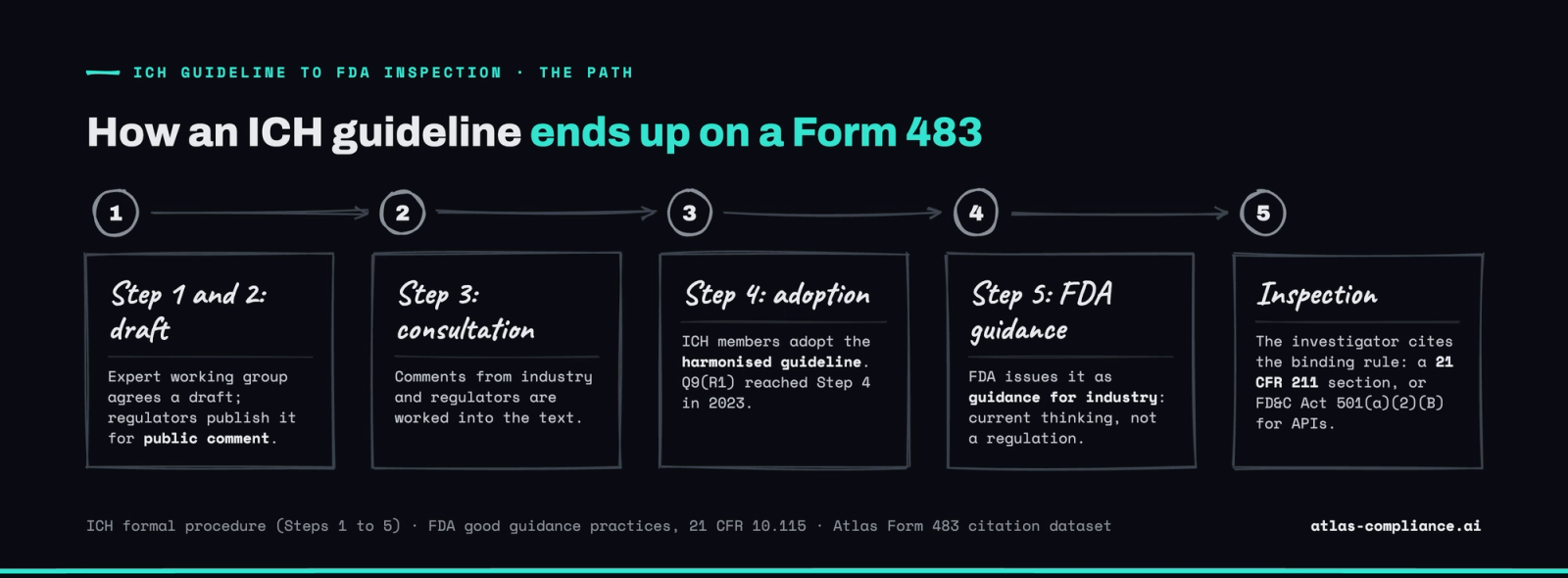
- FDA issues ICH guidelines as guidance for industry, which states FDA's current thinking and does not bind a firm the way a regulation does.
- On a Form 483, FDA investigators cite a binding rule such as a 21 CFR 211 section, or section 501(a)(2)(B) of the FD&C Act for active pharmaceutical ingredients, not an ICH guideline number.
- In the Atlas dataset, 352 of 774 drug inspections citing Part 211 (45.5%) cited 21 CFR 211.22, the quality unit duties that ICH Q10 builds its pharmaceutical quality system around.
- 21 CFR 211.166, the written stability program that ICH Q1A details, appeared on 132 of those 774 inspections (17.1%).
- As of early November 2026, a consolidated revision of ICH Q1 on stability and the new ICH Q3E on extractables and leachables had not reached Step 4; ICH's Q1 work plan targets Step 4 in November 2026.
What are the ICH guidelines?
The ICH guidelines are consensus documents that regulators and industry write together so one development program can satisfy several regulators at once. ICH was founded in 1990 by the regulators and industry associations of the US, Europe and Japan, and became a council with a legal identity in 2015. FDA is a founding regulatory member.
The guidelines sit in four series:
| Series | Covers | Examples |
|---|---|---|
| Q, Quality | Chemistry, manufacturing, controls and GMP | Q1 stability, Q7 API GMP, Q10 quality system |
| S, Safety | Nonclinical toxicology and pharmacology | S7A safety pharmacology |
| E, Efficacy | Clinical trial design, conduct and reporting | E6 good clinical practice |
| M, Multidisciplinary | Topics that cross the other three | M4 Common Technical Document, M7 mutagenic impurities |
Quality and GMP teams work mostly in the Q series, so the rest of this post stays there.
What are the ICH Q guidelines, Q1 to Q14?
The ICH Q guidelines are 14 quality topics, Q1 to Q14, covering stability, analytical validation, impurities, pharmacopoeias, biotechnology products, specifications, API GMP, development, risk management, the quality system, drug substance development, lifecycle change, continuous manufacturing and analytical development. The table lists the current version of each, with the year it reached Step 4, final adoption, on the ICH quality guidelines page.
| Guideline | Topic | Current version (Step 4 year) |
|---|---|---|
| Q1A to Q1E | Stability testing, photostability, new dosage forms, bracketing and matrixing, evaluation of data | Q1A(R2) 2003; Q1B and Q1C 1996; Q1D 2002; Q1E 2003. A consolidated Q1 draft reached Step 2 in April 2025 |
| Q2(R2) | Validation of analytical procedures | 2023 |
| Q3A to Q3E | Impurities in drug substances and products, residual solvents, elemental impurities, extractables and leachables | Q3A(R2) and Q3B(R2) 2006; Q3C(R9) 2024; Q3D(R2) 2022; Q3E draft, Step 2 in August 2025 |
| Q4B | Recognition of pharmacopoeial texts across regions | Annexes adopted from 2007 onward |
| Q5A to Q5E | Quality of biotechnology products: viral safety, expression constructs, stability, cell substrates, comparability | Q5A(R2) 2023; Q5B and Q5C 1995; Q5D 1997; Q5E 2004 |
| Q6A, Q6B | Specifications for chemical and biotechnology products | 1999 |
| Q7 | Good manufacturing practice for active pharmaceutical ingredients | 2000 |
| Q8(R2) | Pharmaceutical development and quality by design | 2009 |
| Q9(R1) | Quality risk management | 2023 |
| Q10 | Pharmaceutical quality system | 2008 |
| Q11 | Development and manufacture of drug substances | 2012 |
| Q12 | Technical and regulatory considerations for lifecycle management | 2019 |
| Q13 | Continuous manufacturing | 2022 |
| Q14 | Analytical procedure development | 2023 |
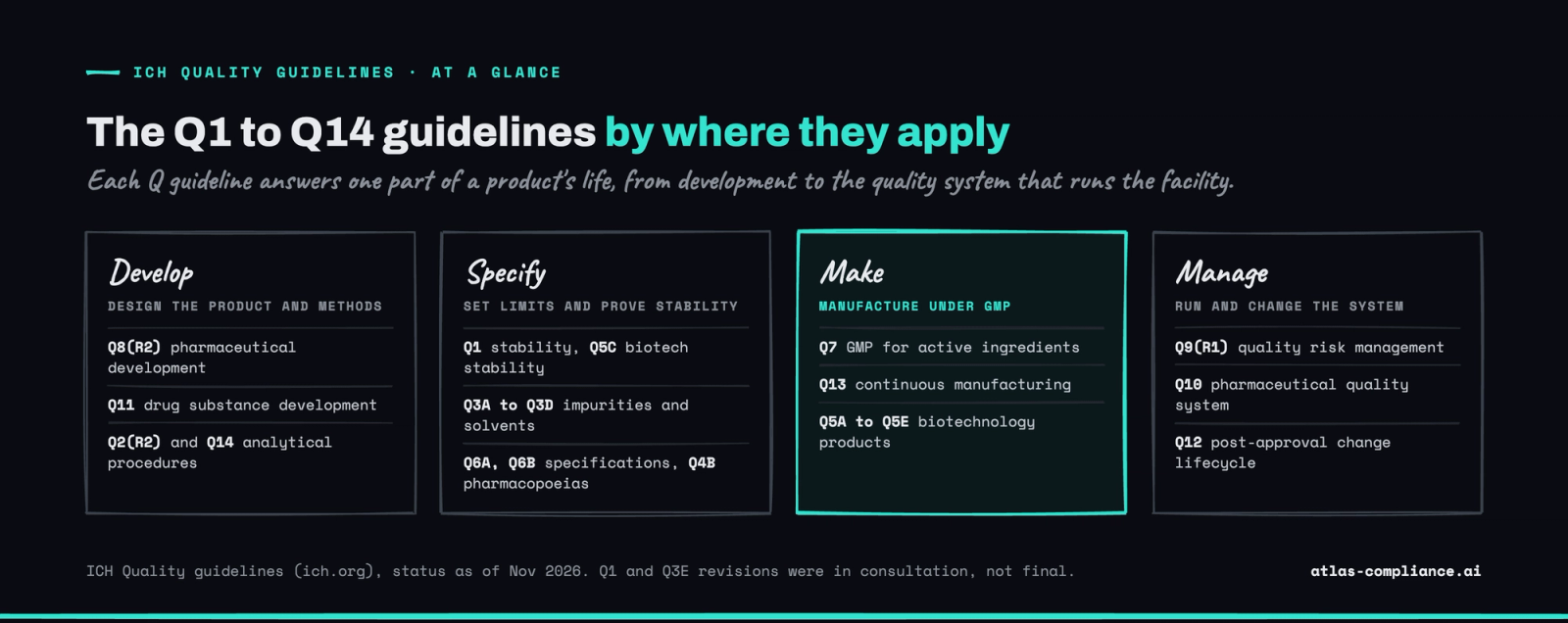
Three groups do most of the work in a GMP facility. Q1, Q2, Q3 and Q6 define the numbers a laboratory tests against. Q7 is the GMP text for API manufacturers. Q9 and Q10 describe the management system that decides what happens when a result or a process goes wrong.
Are ICH guidelines legally binding in the US?
ICH guidelines are not legally binding in the US. FDA publishes each adopted ICH guideline as guidance for industry under its good guidance practices regulation, 21 CFR 10.115, which says guidance documents describe FDA's current thinking and do not establish legally enforceable rights or duties. A firm may use another approach if it satisfies the statute and regulations.
The binding rules for finished drugs are the CGMP regulations in 21 CFR Part 211. That is why a Form 483 never reads "violation of ICH Q10." The investigator writes the observation against the regulation that carries the same expectation, and the ICH text explains what a compliant system looks like.
In practice the gap between "guidance" and "requirement" is narrow. An investigator who finds no written stability program cites 211.166; the firm's response will be judged against what ICH Q1A describes.
What is ICH Q7?
ICH Q7 is the GMP guideline for active pharmaceutical ingredients, adopted in 2000, covering the quality unit, facilities, materials, production, laboratory controls, validation, change control and contract manufacturers for API production. FDA treats Q7 as its current thinking on API CGMP, because 21 CFR Parts 210 and 211 cover finished drug products and do not apply to APIs.
That legal gap shows up on paper. FDA cites API facilities under section 501(a)(2)(B) of the FD&C Act and refers to Q7 as the expectation. Warning letter 320-25-30, dated January 16, 2025, to Global Calcium in Hosur, India, named three API violations, including no impurity profile for identified and unidentified impurities, and pointed to ICH Q7 for what FDA expects. The Global Calcium site record in Atlas shows five FDA inspections, each ending with a Form 483, the latest in February 2026.
For how many API facilities received a Form 483 and what investigators wrote, see our breakdown of API manufacturer 483s, which counts 47 API Form 483s from January 2025 to July 2026.
What are ICH Q8, Q9 and Q10?
ICH Q8, Q9 and Q10 are the three guidelines that together describe modern pharmaceutical quality: Q8(R2) covers pharmaceutical development and quality by design, Q9(R1) covers quality risk management, and Q10 covers the pharmaceutical quality system that runs a product from development to discontinuation.
- Q8(R2), development. Defines the quality target product profile, critical quality attributes, design space and control strategy. Process validation under FDA's lifecycle approach, including continued process verification, rests on these terms.
- Q9(R1), risk. Sets the principles and tools for risk assessment, control, communication and review. The 2023 revision added text on subjectivity, formality and product availability risk. Our ICH Q9 guide covers the tools in detail.
- Q10, quality system. Describes management responsibility, process performance and product quality monitoring, CAPA, change management and management review. FDA issued Q10 as guidance in 2009.
At inspection the two meet: Q9 describes how a risk decision is made, and Q10 describes the system that records the decision and follows it up.
Which ICH concepts does FDA cite most on Form 483s?
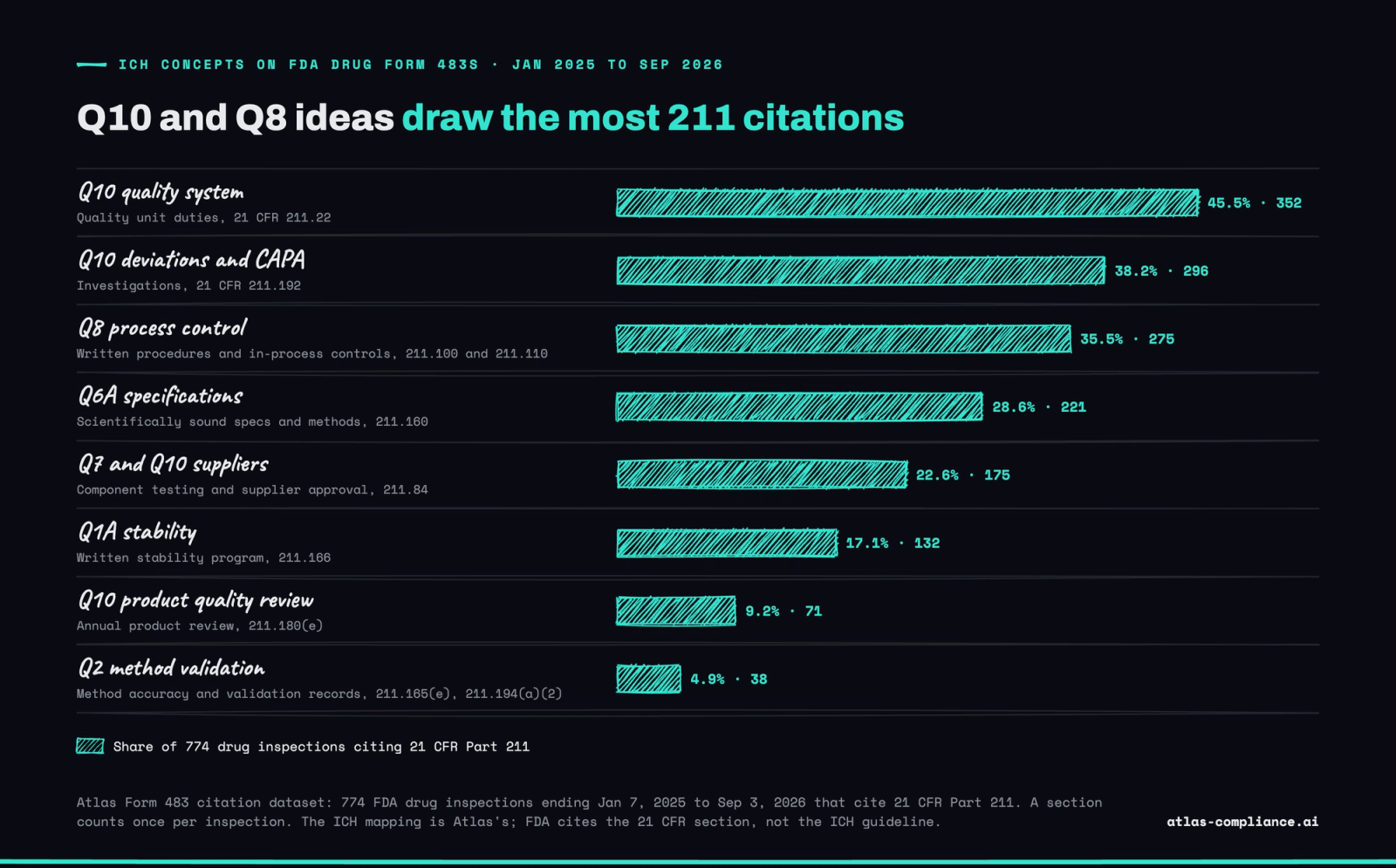
ICH Q10 quality system concepts draw the most FDA citations. In the Atlas Form 483 citation dataset, 352 of 774 drug inspections citing 21 CFR Part 211 (45.5%) cited 211.22, the quality unit's responsibilities, and 296 (38.2%) cited 211.192, investigations of discrepancies, which is the CAPA trigger Q10 describes. The mapping of sections to ICH topics below is Atlas's; FDA cites the section, not the guideline.
| ICH topic | 21 CFR 211 section that carries it | Drug inspections citing it | Share of 774 |
|---|---|---|---|
| Q10 quality system | 211.22 quality unit | 352 | 45.5% |
| Q10 deviations and CAPA | 211.192 investigations | 296 | 38.2% |
| Q8 process control | 211.100 and 211.110 | 275 | 35.5% |
| Q6A specifications | 211.160 laboratory controls | 221 | 28.6% |
| Q7 and Q10 suppliers | 211.84 component testing and approval | 175 | 22.6% |
| Q1A stability | 211.166 stability program | 132 | 17.1% |
| Q10 product quality review | 211.180(e) annual product review | 71 | 9.2% |
| Q2 method validation | 211.165(e) and 211.194(a)(2) | 38 | 4.9% |
The order held across years. The quality unit section appeared on 258 of 562 Part 211 inspections in 2025 (45.9%) and 94 of 212 in 2026 so far (44.3%). Method validation sits last, at 38 inspections, while the quality unit and investigation sections each appeared on more than a third. Our 21 CFR 211.192 breakdown shows how FDA words those investigation observations.
You can check how often investigators cite these sections at a specific facility, or for a specific investigator, in the FDA Form 483 database.
 Atlas
See what the FDA knows about your next investigator.
30 minutes with the founder. No pitch deck.
What does a Form 483 across several ICH topics look like?
A single Form 483 often touches four or five ICH topics at once. The Eli Lilly Indianapolis Form 483 of May 20, 2025 cites 211.22(d) for quality unit procedures (Q10), 211.100(a) and 211.110(a) for process and in-process controls (Q8), 211.84(a) for component testing (Q7 and Q10 supplier control) and 211.194(a)(2) for method suitability records (Q2).
Smaller firms show the same pattern with fewer sections. The Altaire Pharmaceuticals Form 483 of April 21, 2026 pairs 211.22(d) with 211.192 and 211.100(a), and the Ajanta Pharma Paithan Form 483 of April 21, 2026 pairs 211.22(d) with 211.192 and two equipment sections. In both, the quality unit and the investigation system failed together, which is the Q10 pattern the table above shows.
How do you use the ICH guidelines in an inspection-ready quality system?
Use the ICH guidelines as the design standard and 21 CFR 211 as the test. A practical sequence:
- Map each Part 211 section you operate under to the ICH guideline that explains it, as in the table above.
- Write procedures to the ICH level of detail, then confirm each one meets the regulation's wording.
- Run CAPA and investigations to the Q10 standard, since 211.192 and 211.22 lead FDA's citations.
- Track the open ICH revisions, Q1 and Q3E, so stability and extractables programs are not rewritten twice.
- Audit against recent Form 483 language for your dosage form, not against the guideline text alone.
AtlasFDA Inspection Intelligence Digest
We track every 483, EIR, and warning letter the moment it happens. Get the signals before they hit the FDA website.
Frequently asked questions
ICH publishes dozens of guidelines across its four series. The quality series alone covers 14 topics, Q1 to Q14, and several topics contain more than one document: Q1 has five stability guidelines, Q3 has five on impurities, and Q5 has five on biotechnology products. Q&A documents and Q4B annexes sit alongside them.

Written by
Bhavish Agarwal
Founder, Atlas
Bhavish Agarwal is the founder of Atlas and previously worked at Google and Microsoft. He has spent the past several years building regulatory data infrastructure for the pharmaceutical industry.