
Good clinical practice (GCP) is the international ethical and scientific quality standard for designing, running, recording and reporting clinical trials in people. It protects the rights, safety and well-being of trial participants and makes trial results reliable. The current global text is ICH E6(R3); in the US, FDA enforces GCP through 21 CFR Parts 50, 56 and 312.
This guide covers what E6(R3) changed, which rules carry legal force, and what FDA investigators write up when they inspect trials. The data comes from FDA's bioresearch monitoring (BIMO) inspection records as compiled by Atlas: 1,934 inspections that ended January 8, 2025 to September 18, 2026, and the 196 of them with posted Form 483 citations.
Key facts
- ICH adopted E6(R3), the principles and Annex 1, at Step 4 on January 6, 2025. FDA published it as final guidance in September 2025, and the EU applied it from July 23, 2025.
- E6(R3) has 11 principles, consolidated from the 13 in E6(R2).
- ICH E6(R3) Annex 2, on decentralized and pragmatic trials and real-world data, reached Step 4 on June 3, 2026. The EU applies it from January 15, 2027.
- In the US, GCP guidance is not binding on its own; 21 CFR Part 50 (informed consent), Part 56 (IRBs) and Part 312 (drug and biologic trials) are.
- 77.1% of 1,934 FDA BIMO inspections ended NAI, 21.8% VAI and 1.1% OAI.
- 21 CFR 312.60, an investigator not following the protocol or the signed Form FDA 1572, appeared at 116 of 196 cited BIMO inspections (59.2%).
What is good clinical practice?
Good clinical practice is the set of duties that the people running a clinical trial owe to participants and to the data. ICH E6 defines it, and regulators in the US, EU, UK, Japan and other ICH members adopt it as guidance. GCP covers three groups: the investigator who runs the trial at a site, the sponsor who designs and pays for it, and the institutional review board (IRB) or ethics committee that approves it and keeps watching it.
The E6(R3) principles cover the same ground as the older version in fewer, broader statements: trials must be ethical and respect participants' rights, consent must be freely given and informed, an IRB must review the trial, the science must be sound, quality must be built into the design, risks must be proportionate to the benefit, the protocol must be clear, roles must be clear, products must be made under GMP, and records must be reliable and protected. The ACRP comparison of the two versions notes that no E6(R2) principle was dropped; they were merged into 11.
What changed in ICH E6(R3)?
E6(R3) rewrites the guideline from the top. It splits the guideline into overarching principles plus annexes, so that one set of principles can cover trial designs the 2016 text did not anticipate.
| Topic | ICH E6(R2), 2016 | ICH E6(R3), 2025 |
|---|---|---|
| Structure | One guideline with an addendum | Principles plus Annex 1, with Annex 2 added in 2026 |
| Principles | 13 | 11, consolidated |
| Quality approach | Risk-based monitoring added as an addendum | Quality by design and risk proportionality throughout |
| Data | Focus on source documents | Data governance across the full data life cycle, including computerized systems |
| Trial types | Traditional site-based trials | Annex 2 covers decentralized elements, pragmatic designs and real-world data |
| Participant expenses | Not addressed in principles | Reasonable reimbursement of costs such as travel is stated as not coercive |
The dates matter for anyone writing SOPs. ICH reached Step 4 for the principles and Annex 1 on January 6, 2025. The EU applied them from July 23, 2025. FDA posted E6(R3) as final guidance and announced it in the Federal Register on September 9, 2025, without a compliance date. Annex 2 reached Step 4 on June 3, 2026, and the EMA set January 15, 2027 as its effective date. We could not find a final FDA issuance of Annex 2 as of early November 2026.
Are GCP guidelines legally binding in the US?
No, not on their own. ICH E6(R3) is FDA guidance, and FDA guidance describes the agency's current thinking without creating legal duties. The binding duties sit in regulations, and those are what appear on a Form 483.
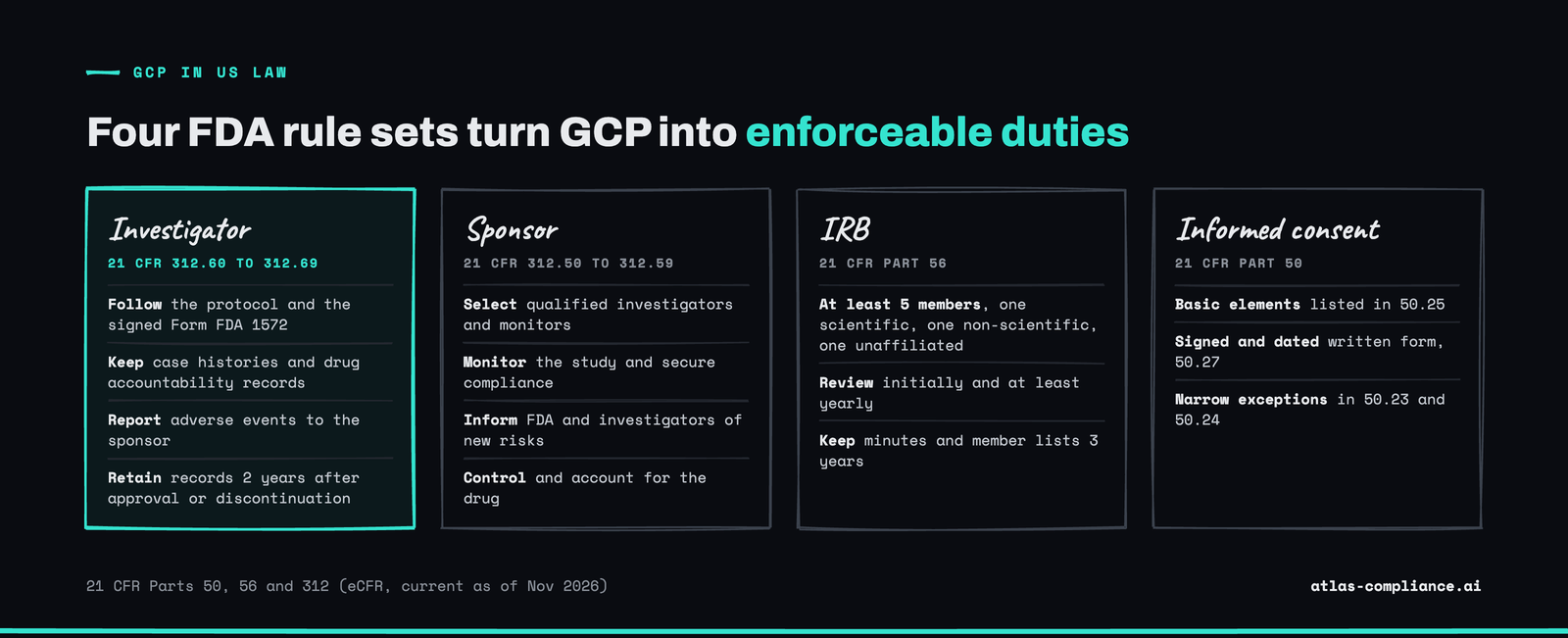
- 21 CFR Part 50 sets the elements of informed consent (50.25), how it is documented (50.27) and the narrow exceptions (50.23 and 50.24).
- 21 CFR Part 56 governs IRBs: at least five members including one scientist, one non-scientist and one member not affiliated with the institution (56.107), review at least once a year (56.109(f)), and records kept for three years (56.115(b)).
- 21 CFR Part 312, Subpart D splits duties between sponsors (312.50 to 312.59) and investigators (312.60 to 312.69). Investigators sign Form FDA 1572, keep case histories and drug accountability records (312.62), and report adverse effects to the sponsor (312.64).
- Device trials follow 21 CFR Part 812 instead of Part 312, and nonclinical lab studies follow Part 58, good laboratory practice.
The full text of the drug and biologic duties is in 21 CFR Part 312 on eCFR.
What do FDA BIMO inspections look at?
FDA checks GCP through its bioresearch monitoring program. A BIMO inspection compares what a trial site, sponsor or IRB actually did with the protocol, the regulations and the records it submitted. The same program covers bioequivalence studies and postmarketing safety reporting.
In the Atlas compilation of FDA classification data, 1,934 BIMO inspections ended between January 8, 2025 and September 18, 2026. By inspection type:
- Clinical investigator sites: 1,084
- IRBs: 256
- Sponsors and contract research organizations: 190
- Clinical bioavailability and bioequivalence (BA/BE) studies: 188
- Bioanalytical BA/BE labs: 85
- Postmarketing adverse drug experience reporting: 68
Drug trials made up 1,312 of the inspections, devices 378 and biologics 223. 564 inspections (29.2%) were outside the US, led by India with 132, China with 69 and Poland with 49. The FDA foreign inspections guide explains how those are scheduled.
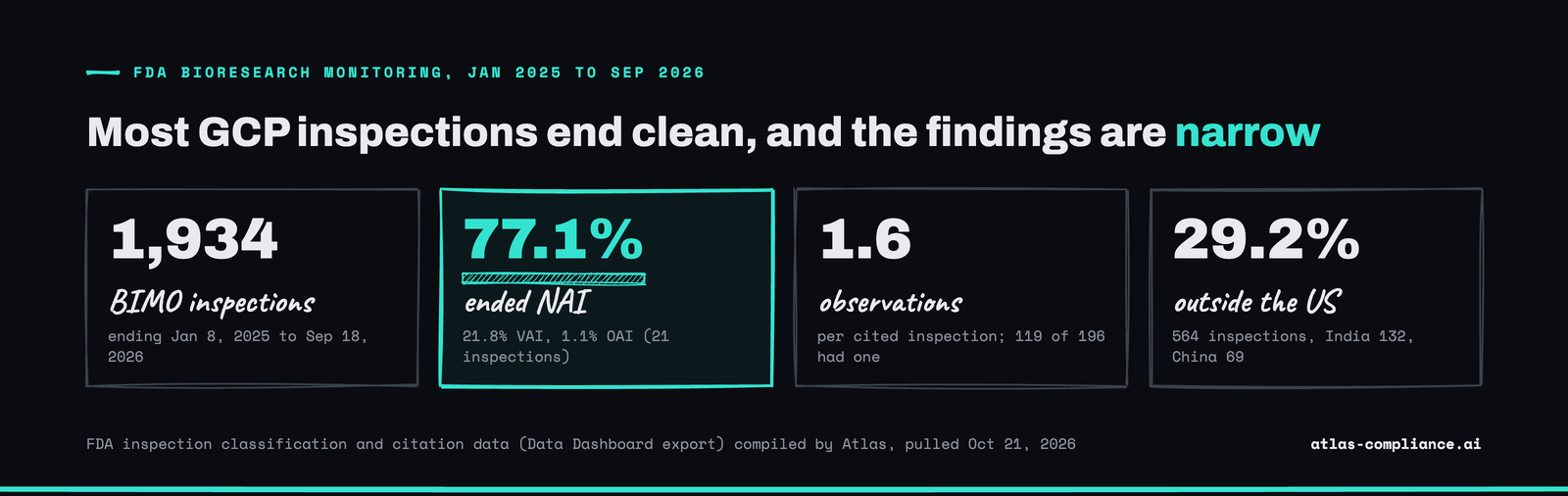
Most of these inspections end clean. 1,492 ended No Action Indicated (77.1%), 421 Voluntary Action Indicated (21.8%) and 21 Official Action Indicated (1.1%). For what each class means, see NAI, VAI and OAI explained.
What does FDA cite most at clinical trial sites?
FDA cites the investigator far more often than anyone else. Of the 196 BIMO inspections with posted citations, 116 (59.2%) cited 21 CFR 312.60, which FDA labels "FD-1572, protocol compliance": the investigator did not run the study according to the signed investigator statement and the investigational plan. Case history records under 312.62(b) followed at 68 inspections, and 312.62 in all at 76 (38.8%).
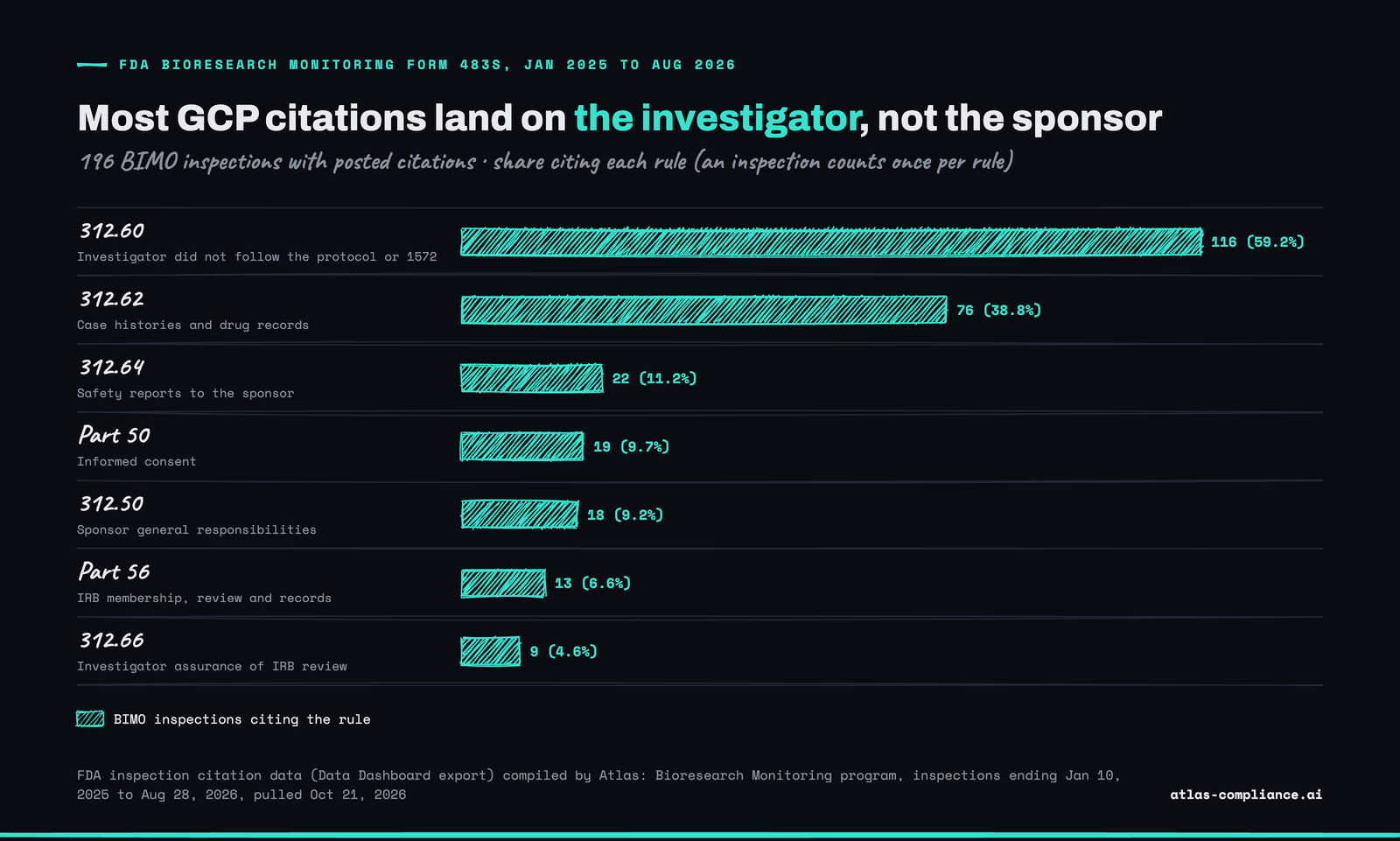
The rest of the list is short:
| Rule | What FDA cited | Inspections | Share of 196 |
|---|---|---|---|
| 21 CFR 312.60 | Protocol and Form FDA 1572 compliance | 116 | 59.2% |
| 21 CFR 312.62 | Case histories (68), drug disposition (10), record retention (6) | 76 | 38.8% |
| 21 CFR 312.64 | Safety reports to the sponsor | 22 | 11.2% |
| 21 CFR Part 50 | Informed consent elements and documentation | 19 | 9.7% |
| 21 CFR 312.50 | Sponsor general responsibilities | 18 | 9.2% |
| 21 CFR Part 56 | IRB membership, review and records | 13 | 6.6% |
| 21 CFR 312.66 | Investigator assurance of IRB review | 9 | 4.6% |
GCP observations are narrow. The 196 cited inspections carried 314 citations, 1.6 each, and 119 of them had a single observation. Human drug Form 483s in the Atlas directory average 3.7 observations, more than twice as many.
Sponsors get written up too, usually under 312.50 for not making sure a study ran to plan. The Exelixis facility record in Alameda shows five FDA inspections and three Form 483s; the May 5, 2026 form and a September 2012 form both cite 312.50. The 2026 observation was cited by Cynthia J Tsui, whose record shows 37 inspections across 35 sites since December 2023; her most recent ones are at clinical investigators, sponsors and a device developer. Dustin P Tran, also tied to the Exelixis record, has 86 inspections across 84 sites since January 2016, many of them at trial sites. IRBs appear as well: Wills Eye Hospital IRB received four 56.108 citations in October 2025, covering continuing review and prompt reporting of problems and noncompliance.
You can check any investigator's record in the FDA investigator lookup before an inspection, and the guide to FDA investigators and their inspection history shows how to read one.
 Atlas
See what the FDA knows about your next investigator.
30 minutes with the founder. No pitch deck.
Which BIMO inspections end with findings most often?
Bioequivalence work draws findings about twice as often as clinical sites. 38.8% of clinical BA/BE inspections and 37.6% of bioanalytical BA/BE inspections ended VAI or OAI, against 20.4% for clinical investigator sites and 15.2% for IRBs.
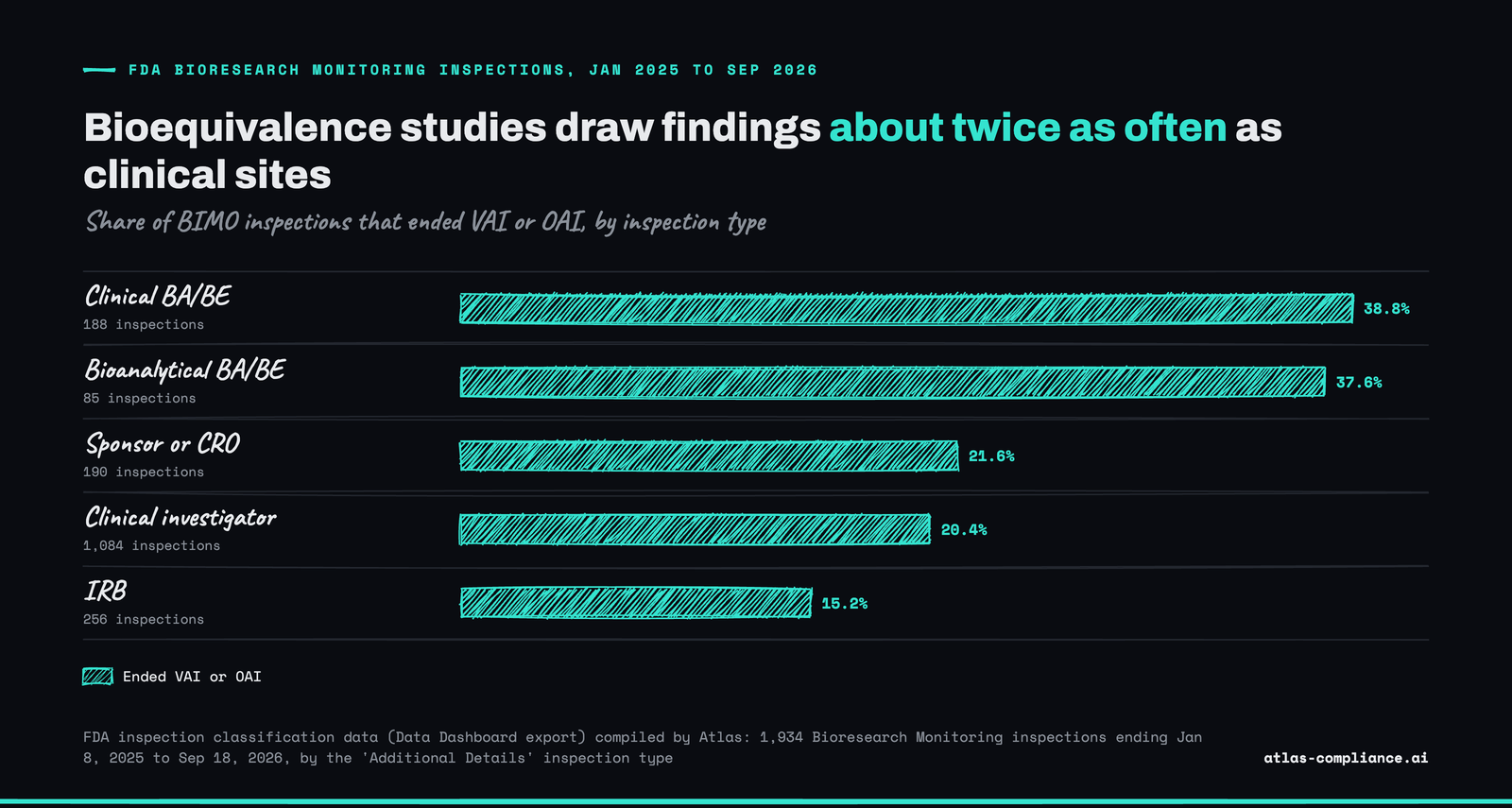
The OAI count is small but concentrated: 8 of 1,084 clinical investigator inspections, 5 of 190 sponsor and CRO inspections, 5 of 188 clinical BA/BE inspections and 1 of 85 bioanalytical inspections ended OAI. Bioequivalence data feeds generic drug approvals directly, so a finding there can stall an application. The BLA vs NDA guide shows where those inspections sit in each approval pathway.
How should a trial site prepare for an FDA BIMO inspection?
Prepare against the citations FDA writes most, in the order it writes them:
- Reconcile the protocol with what happened. List every protocol deviation, with the date, the participant and the sponsor and IRB notification. This is the 312.60 citation that appears at 59% of cited inspections.
- Check the signed Form FDA 1572. Every sub-investigator and lab doing trial work should be on the current version.
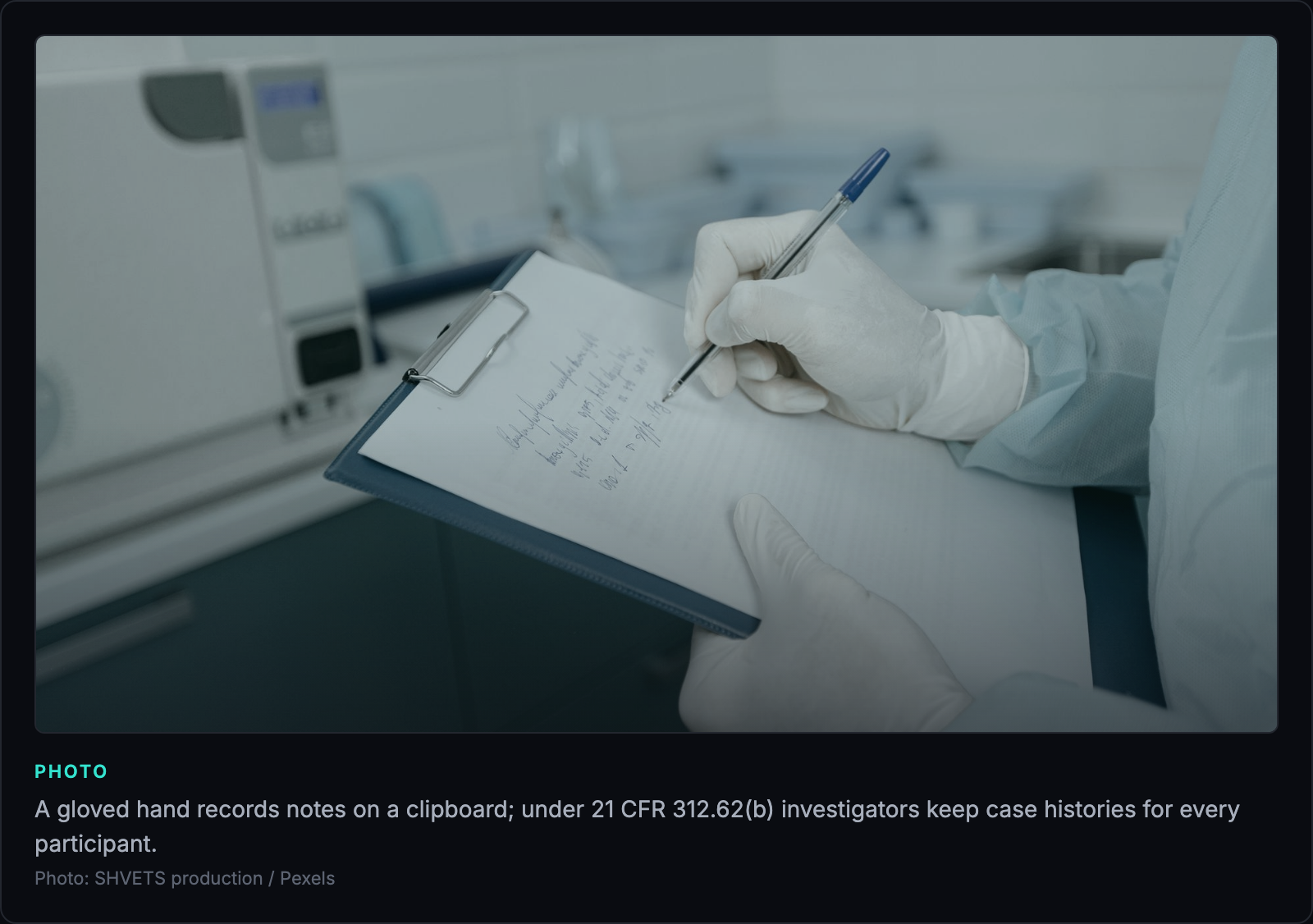
- Audit case histories against source. Eligibility, dosing, visit dates and adverse events in the case report forms must match the source records (312.62(b)).
- Reconcile drug accountability. Dispensed, returned and destroyed amounts must add up for each participant (312.62(a)).
- Trace every safety report. Each adverse event should show when the site learned of it and when it told the sponsor (312.64).
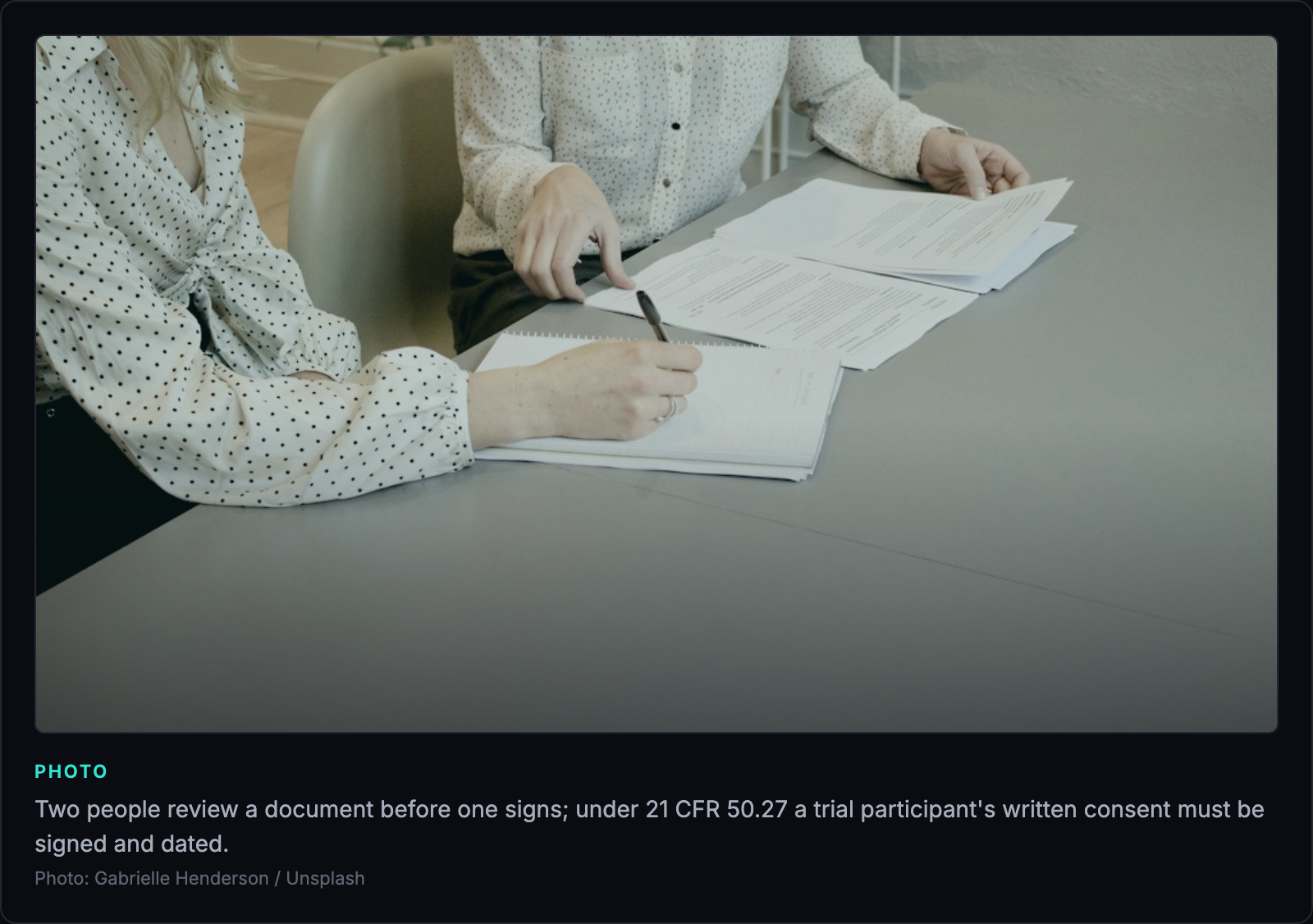
- Pull every consent form. Confirm the IRB-approved version, the signature and the date for each participant (50.27).
- Know the retention clock. Investigators keep records for 2 years after the marketing application is approved for the indication, or 2 years after the investigation is stopped and FDA is notified (312.62(c)).
The inspection itself follows the same steps as any FDA visit, covered in what happens during an FDA inspection, and a Form 483 at the end works as described in what is an FDA Form 483.
AtlasFDA Inspection Intelligence Digest
We track every 483, EIR, and warning letter the moment it happens. Get the signals before they hit the FDA website.
Frequently asked questions
No FDA regulation requires a specific GCP certificate. 21 CFR 312.53 requires sponsors to choose investigators qualified by training and experience, and FDA expects records that show it. Sponsors and institutions usually require GCP training anyway, and NIH requires it for investigators and staff on NIH-funded clinical trials, with a refresher at least every three years.

Written by
Bhavish Agarwal
Founder, Atlas
Bhavish Agarwal is the founder of Atlas and previously worked at Google and Microsoft. He has spent the past several years building regulatory data infrastructure for the pharmaceutical industry.