
An FDA inspection is an on-site examination of a facility by FDA investigators, under section 704 of the Federal Food, Drug, and Cosmetic Act, to check whether products are made, tested and held in line with the law. It runs in a fixed order: notice, opening meeting, floor tour, records review, daily debriefs, a closeout meeting and, weeks later, a classification.
Most guides describe those steps. This one adds how long each takes in practice, from Atlas facility records (2,245 sites with a Form 483 since January 2025, pulled November 6, 2026) and FDA's classification data on 35,021 inspections that ended between January 2, 2025 and October 14, 2026.
Key facts:
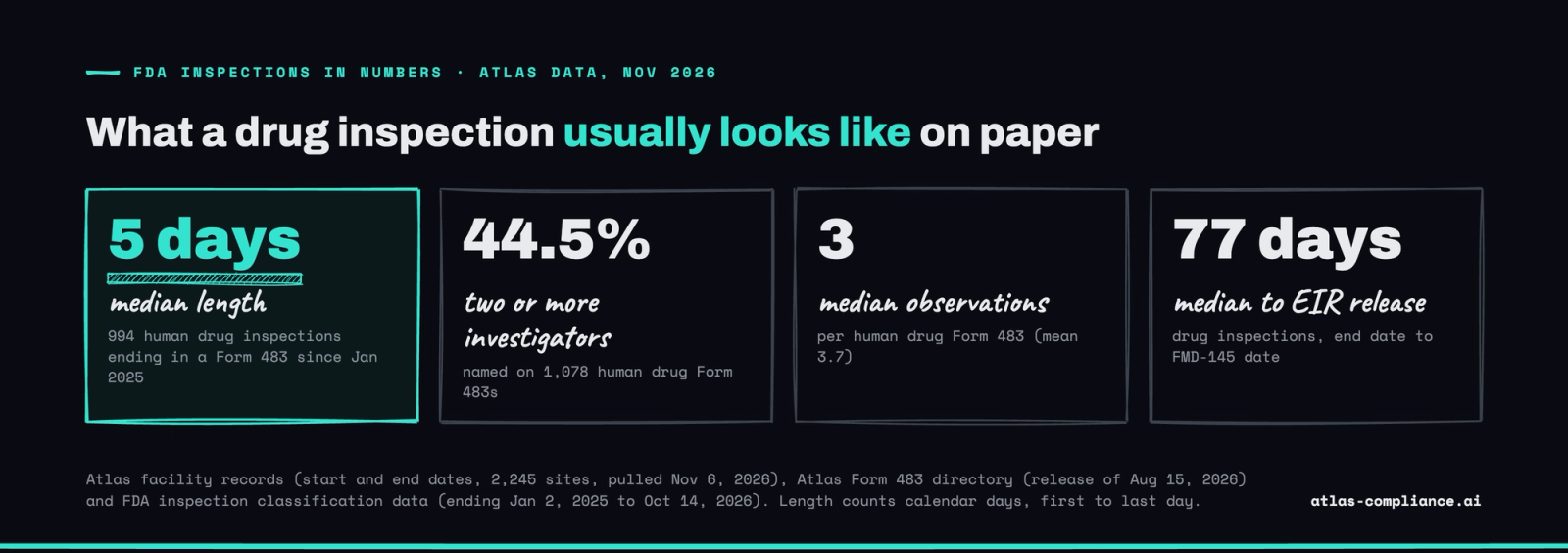
- Human drug inspections that ended in a Form 483 since January 2025 lasted a median of 5 calendar days, first day to last, across 994 inspections in Atlas facility records; device inspections lasted a median of 4.
- 44.5% of 1,078 human drug Form 483s in the Atlas directory (January 2025 to July 2026) name two or more investigators, against 11.6% of device 483s.
- A human drug Form 483 carries a median of 3 observations (mean 3.7), per the same Atlas directory.
- Of 3,288 drug inspections that ended January 2, 2025 to October 14, 2026, 43.6% were classified NAI, 46.5% VAI and 9.9% OAI.
- The median gap from the end of a drug inspection to the date FDA released the Establishment Inspection Report (EIR) under FMD-145 was 77 days, across 2,663 inspections.
What will FDA inspectors do when they conduct an inspection?
When FDA conducts an inspection, the investigators show their credentials, hand a Form FDA 482 Notice of Inspection to the most responsible person on site, hold an opening meeting, tour the facility, review records and interview staff, raise concerns in daily debriefs, and close with a meeting where they issue a Form 483 if they saw objectionable conditions. FDA classifies the inspection later.
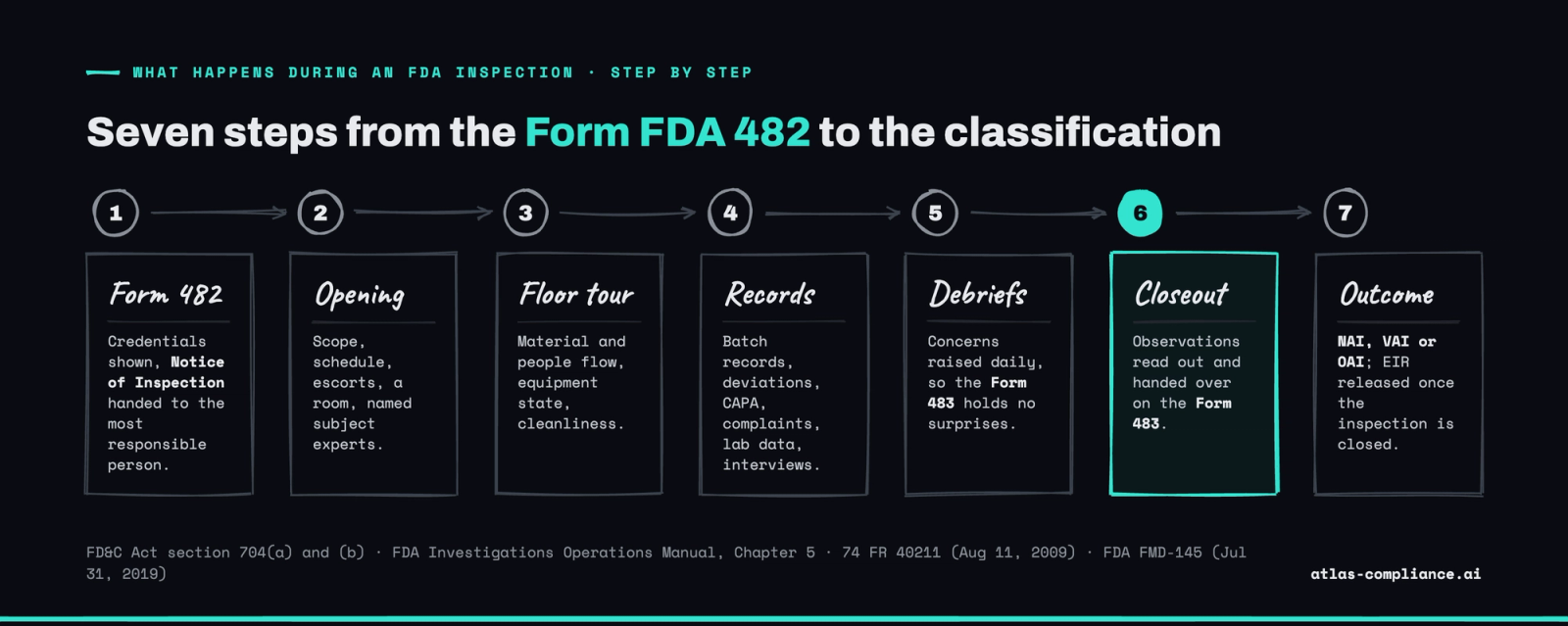
- Form 482 and credentials. Section 704(a)(1) requires written notice. The investigator presents identification and the Form FDA 482 to the owner, operator or agent in charge. Foreign inspections do not use the form.
- Opening meeting. The investigator states the purpose and scope; your team names escorts, subject experts and a room for document review.
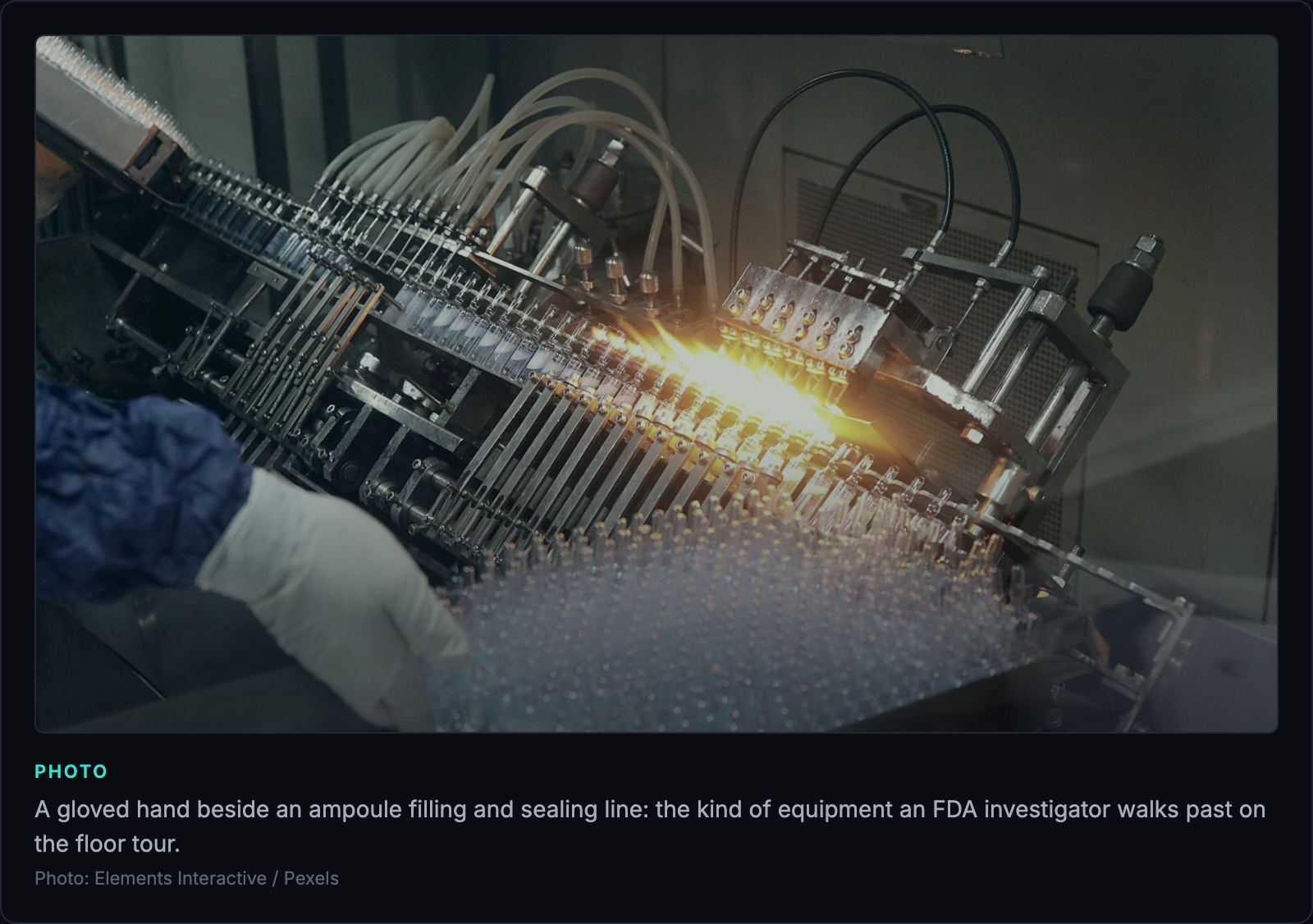
- Floor tour. Investigators usually walk the operation early, following materials and people through warehouse, production, packaging and the laboratory.
- Records and interviews. Most of the inspection happens here: batch records, deviations, investigations, CAPA, complaints, change control, training and lab data, plus questions to the people who do the work.
- Daily debriefs. Many investigators summarize concerns at the end of each day, which gives your team time to pull evidence or correct an error.
- Closeout meeting. If the investigator saw objectionable conditions, they read and hand over a Form 483 under section 704(b), and may note corrections your facility made or promised during the inspection.
- Outcome. FDA's division reviews the investigator's report and classifies the inspection No Action Indicated (NAI), Voluntary Action Indicated (VAI) or Official Action Indicated (OAI).
Investigators who collect physical samples must leave a Form FDA 484, Receipt for Samples, under section 704(c). The day-by-day roles for your own team, including front room and back room staffing, are in our FDA inspection playbook.
How long does an FDA inspection take?
An FDA inspection of a drug facility takes about a week. In Atlas facility records, the 994 human drug inspections that ended in a Form 483 since January 2025 lasted a median of 5 calendar days from first to last day; half ran 4 to 9 days, 22.0% ran 10 days or more and 6.4% ran 15 days or more.
Device inspections run shorter. Across 1,146 device inspections that ended in a Form 483 over the same period, the median was 4 calendar days and 15.3% lasted 10 days or more. That matches FDA's 2020 guidance "Review and Update of Device Establishment Inspection Processes and Standards", which sets a standard of 3 to 6 continuous business days for routine device inspections and says FDA will pre-announce them at least 5 calendar days ahead.
US and foreign drug inspections had the same median, 5 days (782 and 212 inspections). The long tail is for-cause visits and pre-approval inspections covering several products; the longest drug inspection in the sample ran 55 days.
| Measure | Human drugs | Medical devices |
|---|---|---|
| Inspections ending in a Form 483, since Jan 2025 | 994 | 1,146 |
| Median length, calendar days | 5 | 4 |
| Middle half | 4 to 9 days | 4 to 8 days |
| Share lasting 10 days or more | 22.0% | 15.3% |
| Form 483s naming two or more investigators | 44.5% | 11.6% |
| Median observations per Form 483 | 3 | 3 |
These figures count only inspections that produced a Form 483, because those are the records with full start and end dates in the Atlas facility pages. Clean inspections in the same sample had the same median length.
Who comes to an FDA inspection?
Most FDA inspections are run by one investigator, but drug inspections are the exception. In the Atlas Form 483 directory (release of August 15, 2026), 44.5% of human drug Form 483s from January 2025 to July 2026 name two or more investigators, and 13.3% name three or more. For foods and cosmetics the share with a team is 22.0%; for devices, 11.6%.
With two or more investigators, one can stay on the floor while another works the records room, so document requests arrive in parallel and your back room needs more staff.
At Carlsbad Technology's facility in Carlsbad, California, a human drug inspection ran June 23 to June 30, 2026, eight calendar days, and ended in a Form 483 with 3 observations citing 21 CFR 211.192, 211.22(d) and 211.67(a). The form names four investigators. Two of them have long Atlas records: Cecilia H Kieu, with 39 inspections across 36 sites and 127 attributed observations since August 2021, and Ngozi G Offor, with 18 inspections and 98 observations since August 2024. The facility itself has 17 FDA inspections on record, 8 of them ending in a Form 483.
The investigator's name on the Form 482 is the first thing you can research. The FDA investigator directory shows what that person has cited before and at which sites.
What do FDA investigators look at on the floor and in the records?
FDA investigators look at whether the facility's written procedures match what people do, and whether the records prove it. On the floor that means material and personnel flow, equipment status and cleaning, environmental controls and how deviations are flagged. In the records room it means batch records, investigations, CAPA, complaints, change control, training and laboratory data.
Drug investigators follow FDA's six-system model (quality, facilities and equipment, materials, production, packaging and labeling, laboratory controls). Device investigators follow the Quality System Inspection Technique, which starts with management controls and CAPA. Either way, the records review drives the outcome. The Carlsbad form above follows the common drug pattern: an investigation that was not thorough enough (211.192), a quality unit procedure not followed (211.22(d)) and an equipment cleaning or maintenance gap (211.67(a)).
The 100 things FDA investigators look for list breaks this down by area.
What happens at the end of an FDA inspection?
At the end of an FDA inspection, the investigator holds a closeout meeting with management. If the investigator observed conditions that may violate the law, they issue a Form 483 listing each observation, read it aloud and discuss it. If nothing objectionable was seen, no Form 483 is issued and the inspection usually ends NAI.
A human drug Form 483 in the Atlas directory carries a median of 3 observations and a mean of 3.7. The Form 483 is the investigator's list, not FDA's final decision, which is why the written response matters. FDA said in 2009 (74 FR 40211) that it will review a response received within 15 business days of the Form 483 before deciding whether to issue a warning letter. Our Form 483 explainer covers the document and the reply.
What happens after an FDA inspection?
After an FDA inspection, the investigator writes the Establishment Inspection Report (EIR), the division classifies the inspection NAI, VAI or OAI, and FDA sends the narrative of the EIR to the facility once the inspection is closed, under Field Management Directive 145. For drug inspections that ended since January 2025, the median wait for that release was 77 days.
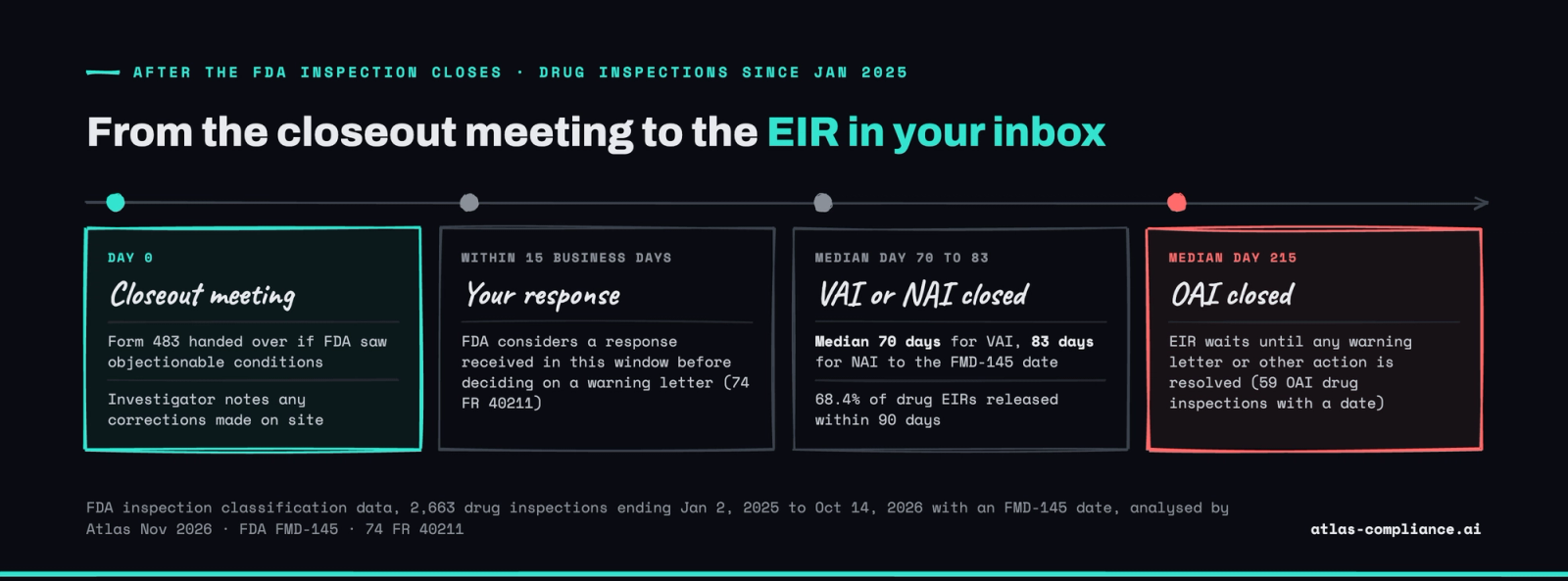
The wait depends on the outcome. In FDA's classification data, drug inspections classified VAI reached the FMD-145 date in a median of 70 days and NAI in 83 days. OAI inspections took a median of 215 days among the 59 with a date, because FMD-145 holds the EIR until any warning letter or other action is resolved. Overall, 68.4% of drug EIRs were released within 90 days of the inspection's end.
For what the EIR contains and how to request one, see our guide to the FDA EIR.
How often do FDA inspections end in NAI, VAI or OAI?
Most FDA inspections end NAI, but drug inspections are the exception. Across all 35,021 inspections that ended January 2, 2025 to October 14, 2026, 70.4% were NAI, 26.7% VAI and 2.8% OAI. For the 3,288 drug inspections in the same period, VAI was the most common outcome at 46.5%, and 9.9% ended OAI.
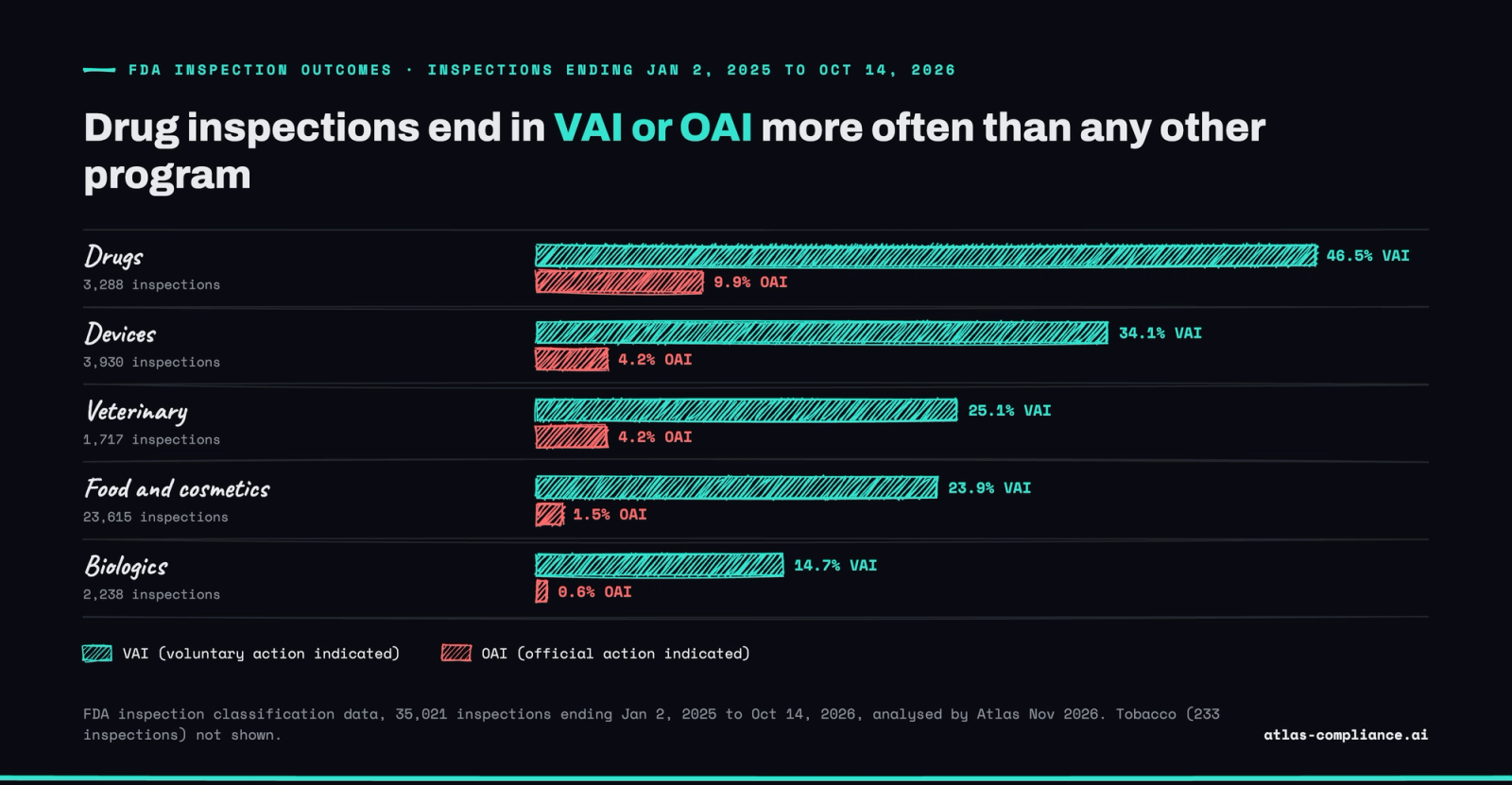
| Program | Inspections | NAI | VAI | OAI |
|---|---|---|---|---|
| Drugs | 3,288 | 43.6% | 46.5% | 9.9% |
| Devices | 3,930 | 61.7% | 34.1% | 4.2% |
| Veterinary | 1,717 | 70.7% | 25.1% | 4.2% |
| Food and cosmetics | 23,615 | 74.5% | 23.9% | 1.5% |
| Biologics | 2,238 | 84.7% | 14.7% | 0.6% |
Foreign drug inspections ended OAI in 7.0% of 1,331 cases in this period. An OAI classification is the one that leads to warning letters, import alerts and held approvals; NAI, VAI and OAI explained covers what each means for the facility.
If an inspection is coming, the investigator's record and your facility's own history are the two inputs you can check today.
 Atlas
See what the FDA knows about your next investigator.
30 minutes with the founder. No pitch deck.
How should you prepare for an FDA inspection?
You prepare for an FDA inspection by running the same seven steps on yourself before FDA does: a named host and escorts, a records room, an SOP for document requests, and a mock inspection that tests the records investigators pull most. Start with the sections FDA cites most on drug Form 483s, 211.22 and 211.192, because those decide most outcomes.
Use the mock FDA inspection formats to rehearse, and the checklist for an unannounced inspection for the first 48 hours.
Each week Atlas sends the new Form 483s, warning letters and investigator patterns in one short digest.
AtlasFDA Inspection Intelligence Digest
We track every 483, EIR, and warning letter the moment it happens. Get the signals before they hit the FDA website.
Frequently asked questions
FDA gives notice before some inspections but not all. Routine device inspections are pre-announced at least 5 calendar days ahead under FDA's 2020 device inspection guidance. Drug and food inspections can start without notice, and since May 2025 FDA has expanded unannounced inspections at foreign facilities. For-cause inspections are usually unannounced in every program.

Written by
Bhavish Agarwal
Founder, Atlas
Bhavish Agarwal is the founder of Atlas and previously worked at Google and Microsoft. He has spent the past several years building regulatory data infrastructure for the pharmaceutical industry.