

The FDA IOM (Investigations Operations Manual) is the manual FDA investigators follow when they inspect a facility, collect samples or investigate a complaint. FDA calls it "the primary operational reference for FDA investigators and other field employees." The current edition is the 2026 IOM, posted on fda.gov with content current as of July 15, 2026, and it is public so industry can see how inspections are run.
The IOM does not set the rules your facility must meet; 21 CFR does that. It sets the rules the investigator must follow: how to show credentials, when to issue a Form FDA 482, what to do if you refuse a photograph, how to write and hand over a Form 483. Knowing those rules tells you what to expect at each step. Section numbers below are from the 2026 edition of Chapter 5.
Who uses the IOM: FDA's Office of Inspections and Investigations
On October 1, 2024, FDA's Office of Regulatory Affairs (ORA) became the Office of Inspections and Investigations (OII). Chapter 1 of the 2026 IOM describes OII as responsible for FDA's operational activities through headquarters and field staff, including inspections, sample analysis and import review. Some Chapter 5 text still names ORA systems, so expect both names in the manual for a while.
OII is organized by product program, not by geography. The OII organization chart dated October 13, 2026 lists nine offices, including separate inspectorates for human and animal drugs, biologics, medical devices and radiological health, human food, animal food and bioresearch monitoring, plus the Office of Criminal Investigations and the Office of Import Operations. In practice, a drug facility is inspected by drug specialists, and a device facility by device specialists.
The people are trackable. In the Atlas investigator directory (release of August 15, 2026), 4,996 FDA investigators have a profile, out of 6,103 named in inspection records. The median profile holds 34 inspections. 1,553 profiles show activity in 2025 or 2026.
The 2026 IOM, chapter by chapter
The manual has ten chapters plus an appendix. Each is a separate PDF on the FDA IOM page. Most inspected firms only need Chapter 5, but the others explain things that happen around it.
| IOM chapter | What it covers | What it tells you as the inspected site |
|---|---|---|
| 1. Administration | OII, travel, media interactions, official identification, ethics | Investigators are OII staff; press questions during an inspection go to the OII press team |
| 2. Notes, Records and Information | Regulatory notes, records management, information disclosure, English language requirement | What you say and show goes into notes that support the report, and the report is written in English |
| 3. Regulatory | Statutory authority, evidence, advisory, administrative and judicial actions | Investigators document jurisdiction, interstate commerce, violation and responsibility when action is possible |
| 4. Sampling | Collection technique, documents collected with samples, shipping | What a sample collection looks like and when a Form FDA 484 is due |
| 5. Inspections | Pre-inspection work, the inspection itself, Form 483, the EIR, and program sections for foods, drugs, devices, biologics, BIMO and tobacco | The chapter to read: every step of an on-site inspection |
| 6. Imports | Entry review, field examination, import sampling, FSVP | How imported product is examined and held |
| 7. Recall Activities | Recalls found during inspections, FDA recall monitoring, termination | What FDA checks during and after a recall |
| 8. Investigations | Investigations by program: foods, drugs, devices, biologics, BIMO, tobacco | Why an investigator may visit for a specific problem rather than a routine inspection |
| 9. Public Health Collaboration | Other federal agencies, state, local, tribal and territorial partners, international agreements | Why a state inspector or a foreign regulator may be part of the picture |
| 10. Safety | Investigator safety in the field | Why investigators may refuse to enter some areas or use some equipment |
Chapter 5 is the longest, at more than 150 pages. Its general sections (5.1 to 5.7) apply to every program; sections 5.8 onward add program detail, such as 5.10 for drugs and 5.12 for devices.
What Chapter 5 says about each step of an inspection
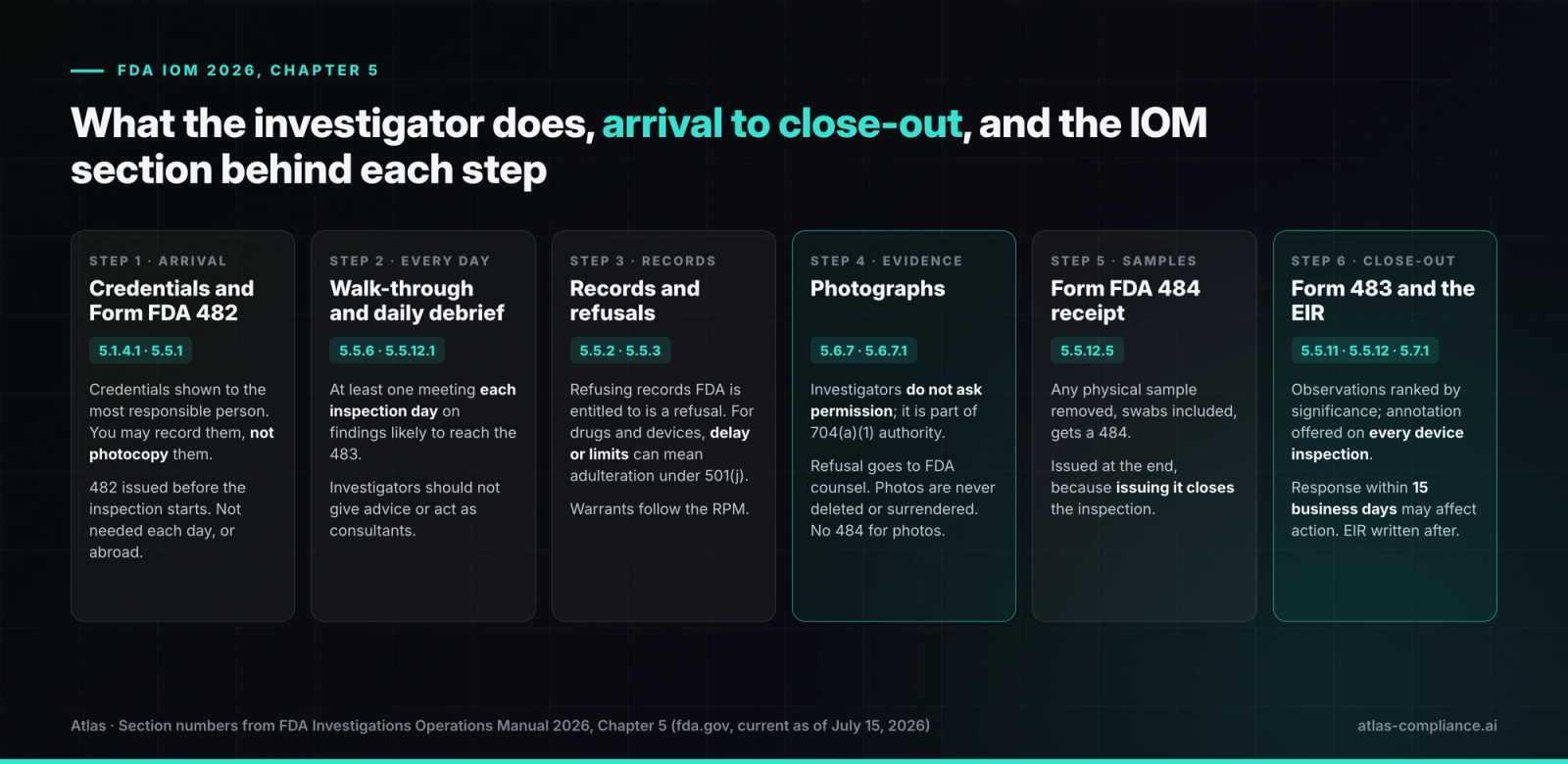
Credentials (5.1.4.1). The investigator shows FDA credentials to the most responsible person on site. You may examine them and write down the name and number. You may not photocopy them; the IOM cites 18 U.S.C. 701. Investigators are told not to let a firm take their fingerprints.
Form FDA 482, Notice of Inspection (5.5.1). Issued on site before the inspection starts, on paper or by email as a signed PDF. Every FDA participant signs it, and anyone joining later issues a new one. A new 482 is not needed for each day of a multi-day inspection (5.5.1.1). For foreign inspections a 482 is not required, though credentials are still shown (5.1.4.2.1).
Refusals (5.5.2). A refusal is anything that stops the investigator from getting records or information FDA is entitled to by law. If entry is refused, the investigator leaves the completed 482 with you, exits and calls a supervisor. For drugs and devices, delaying, denying, limiting or refusing an inspection can make your product adulterated under section 501(j) of the FD&C Act. Declining to give information the law does not require, such as formulations, is not a refusal (5.5.2.3). Warrants are handled under the Regulatory Procedures Manual.
Photographs (5.6.7 and 5.6.7.1). This is the question most firms ask. The IOM tells investigators not to ask permission, because photography is part of the inspection authority in section 704(a)(1). If you object, the investigator explains, cites two court cases including Dow Chemical v. United States, and if you still refuse, takes your legal counsel's details and escalates to FDA's Office of Chief Counsel. The investigator will not delete photos or hand over storage media. For a drug or device firm, refusing without a reasonable explanation (for example, that a camera would harm product quality) may be treated as limiting the inspection under 501(j). You can take your own photos of the same scene and request FDA's under FOIA. Photographs do not get a Form 484 receipt (5.5.12.5.2).
Daily discussions (5.5.12.1). At minimum, the investigator should meet management once each inspection day to discuss findings likely to become 483 observations. Use these meetings to correct misunderstandings before close-out.
Samples and Form FDA 484 (5.5.12.5). Any physical sample taken off site, including swabs and filter pads, gets a 484. It is normally issued at the end because issuing it closes the inspection. Records copied and labels do not need a receipt.
The Form 483 (5.5.10 and 5.5.11). Observations must be significant, specific, not repetitive, and ranked in order of significance. Uncorrected or repeat observations from a previous inspection may be marked as such. Concerns of questionable significance are not written down; they are discussed and recorded in the EIR as discussion items (5.5.12.4), and the next investigator may follow them up. Our guide to what an FDA Form 483 is covers the form itself.
Annotation (5.5.11.4). For every medical device inspection, the investigator offers to annotate each observation with its status: "Reported corrected, not verified", "Corrected and verified", "Promised to correct" or "Promised to correct by" a date. In other programs annotation is at the division's discretion; BIMO inspections are generally excluded. It is voluntary for you.
Close-out (5.5.12.2 and 5.5.12.3). The 483 goes to the most responsible person on site, with a copy to top management. The investigator explains each observation, should not argue, and should not act as a consultant. The investigator also tells you that a response received within 15 business days of the inspection end date may affect whether FDA takes further action. How to use that window is covered in our piece on Form 483 response strategies.
After the inspection (5.5.13 and 5.7.1). If you contact the investigator afterwards about your response, they refer you to a supervisor. The Establishment Inspection Report combines the eNSpect coversheet, the narrative, attachments and exhibits, written either as a Summary of Findings or as a Comprehensive report. Our guide to the FDA EIR explains how to request it and what it contains.
IOM, CPGM and RPM: three manuals, three jobs
Firms often mix up FDA's three field manuals. They cover different stages.
| Investigations Operations Manual (IOM) | Compliance Program Guidance Manual (CPGM) | Regulatory Procedures Manual (RPM) | |
|---|---|---|---|
| Question it answers | How does the investigator conduct the inspection? | What should the inspection cover for this product type? | What does FDA do with the findings? |
| Used by | Investigators on site | Investigators and center compliance staff | Compliance and enforcement staff |
| Example | 5.5.1: issue the Form FDA 482 before starting | CPGM 7356.002, drug manufacturing inspections: six systems, at least four for a full inspection | Chapter 4: warning letters and untitled letters; Chapter 6: inspection warrants |
| Scope | All programs | One program per manual | All enforcement actions |
| When it matters to you | During the inspection | Before it, to predict coverage | After it, if a 483 escalates |
The IOM itself points to the other two. Section 5.10.2.2 tells drug investigators to follow CPGM 7356.002, which names six systems (quality, facilities and equipment, materials, production, packaging and labeling, laboratory control) and always includes the quality system. Section 5.5.3 sends investigators to RPM Chapter 6 for warrants. Read the IOM for the procedure, the CPGM for the scope, the RPM for the consequences.
What the investigators who apply the IOM actually cite
The IOM is the same for every investigator. What they find is not. Atlas links each Form 483 to the investigators named on it, so you can see the workload and the citation pattern behind the procedure. Figures below are from the Atlas Form 483 directory, release of August 15, 2026, with 2026 data to July.
In 2025, 4,584 Form 483s with observation detail named 1,253 distinct investigators, an average of 1.33 per form. The median investigator signed 4 forms that year and the busiest signed 24. The workload is spread out, not concentrated:
| 483s signed in 2025 | Investigators | Share |
|---|---|---|
| 1 | 244 | 19% |
| 2 to 4 | 447 | 36% |
| 5 to 9 | 413 | 33% |
| 10 to 19 | 143 | 11% |
| 20 or more | 6 | 0.5% |
The top 10% of investigators, 125 people, accounted for 26.7% of all 2025 signatures. From January to July 2026, 2,533 forms named 1,073 investigators, with a median of 3 each. Across both periods, 1,410 distinct investigators signed at least one Form 483.
Four human-drug investigators with many recent forms show how individual the patterns are. All counts are their 2025 and 2026 Form 483s in Atlas.
- Camerson E Moore has 185 inspections at 168 sites since May 2010 and 768 observations. Eighteen forms in 2025 and 2026, 17 of them human drugs, with 80 observations. The most cited sections were 211.68 (automatic equipment) and 211.113 (microbial contamination), each on 7 forms, and 212.20 and 212.30, the PET drug rules, on 5. The QuVa Pharma Form 483 of May 4, 2026 in Sugar Land, Texas cites 211.113(b), 211.192 and 211.58.
- Khoa Nathan V Tran, whose recent forms include facilities in Greece, France and South Korea, signed 14 forms with 82 observations, a mean of 5.9. 211.192 (investigations) appears on 11 of the 14. The Pharmathen International form of November 21, 2025 in Rodopi, Greece has 11 observations.
- Ngozi G Offor signed 14 human-drug forms with 91 observations, a mean of 6.5. 211.22 (quality unit) appears on 9, 211.160 (laboratory controls) on 8 and 211.192 on 7. The K.C. Pharmaceuticals form of February 13, 2026 in Pomona, California has 13 observations.
- Pushpa S Jayasekara signed 14 forms with 93 observations. 211.192 appears on 9, 211.68 on 8 and 211.194 (laboratory records) on 7.
For comparison, a sample of 960 Form 483s issued in 2025 averaged 3.7 observations per form. All four average more, three of them above 5, and their lead sections range from equipment and sterility controls to investigations and the quality unit. The IOM tells you how they will run the inspection; their record tells you where they tend to look. You can check anyone named on your 482 in the FDA investigator lookup, and our earlier piece on FDA investigators and their inspection history explains what each profile shows.
 Atlas
See what the FDA knows about your next investigator.
30 minutes with the founder. No pitch deck.
How to prepare your team using the IOM
Turn the Chapter 5 steps into your inspection SOP, one role per step.
- Front desk and host. Check credentials without copying them, receive the 482, record the names, and know who the most responsible person on site is.
- Records room. Know which records the law entitles FDA to and which it does not, and how long a reasonable delay is. Delays without a reason are the 501(j) risk for drug and device firms.
- Escort. Agree in advance what happens if the investigator wants photographs. Take a matching photo rather than refusing, and log every sample for the 484.
- Daily debrief. Use the daily meeting in 5.5.12.1 to clarify and correct before anything reaches the 483.
- Close-out lead. Ask for annotation where available, note every discussion item, and start the 15 business day response clock on the last inspection day.
A rehearsal against these steps is the core of a mock FDA inspection; run one before the investigator arrives, not after.
AtlasFDA Inspection Intelligence Digest
We track every 483, EIR, and warning letter the moment it happens. Get the signals before they hit the FDA website.
Frequently asked questions
Yes. FDA posts the full Investigations Operations Manual on fda.gov as separate chapter PDFs and as one complete file. The current version is the 2026 edition. Internal documents it refers to, such as eNSpect user guides and some program procedures, are not public, but the investigator procedures themselves are.

Written by
Bhavish Agarwal
Founder, Atlas
Bhavish Agarwal is the founder of Atlas and previously worked at Google and Microsoft. He has spent the past several years building regulatory data infrastructure for the pharmaceutical industry.