
An FDA inspection playbook is a written procedure that tells your facility who does what, and in what order, from the day an investigator could arrive until FDA closes the inspection and releases the Establishment Inspection Report (EIR). It covers five phases: readiness before any notice, day 1 and the Form FDA 482, front room and back room operations during the inspection, the Form 483 close-out, and the response window after it.
The steps follow Chapter 5 of FDA's 2026 Investigations Operations Manual (IOM). The numbers come from the Atlas Form 483 database, release of August 15, 2026, pulled in October 2026: who signs Form 483s, how many observations they carry, and which 21 CFR sections they cite most.
Key facts:
- FDA investigators issue a Form FDA 482, Notice of Inspection, before the inspection starts, under IOM section 5.5.1; foreign inspections do not require one.
- The IOM tells investigators to discuss likely observations with management at least once each inspection day (section 5.5.12.1).
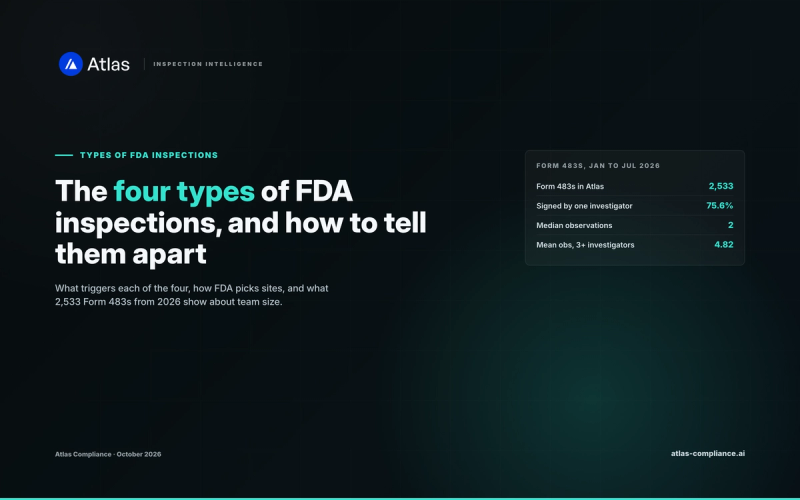
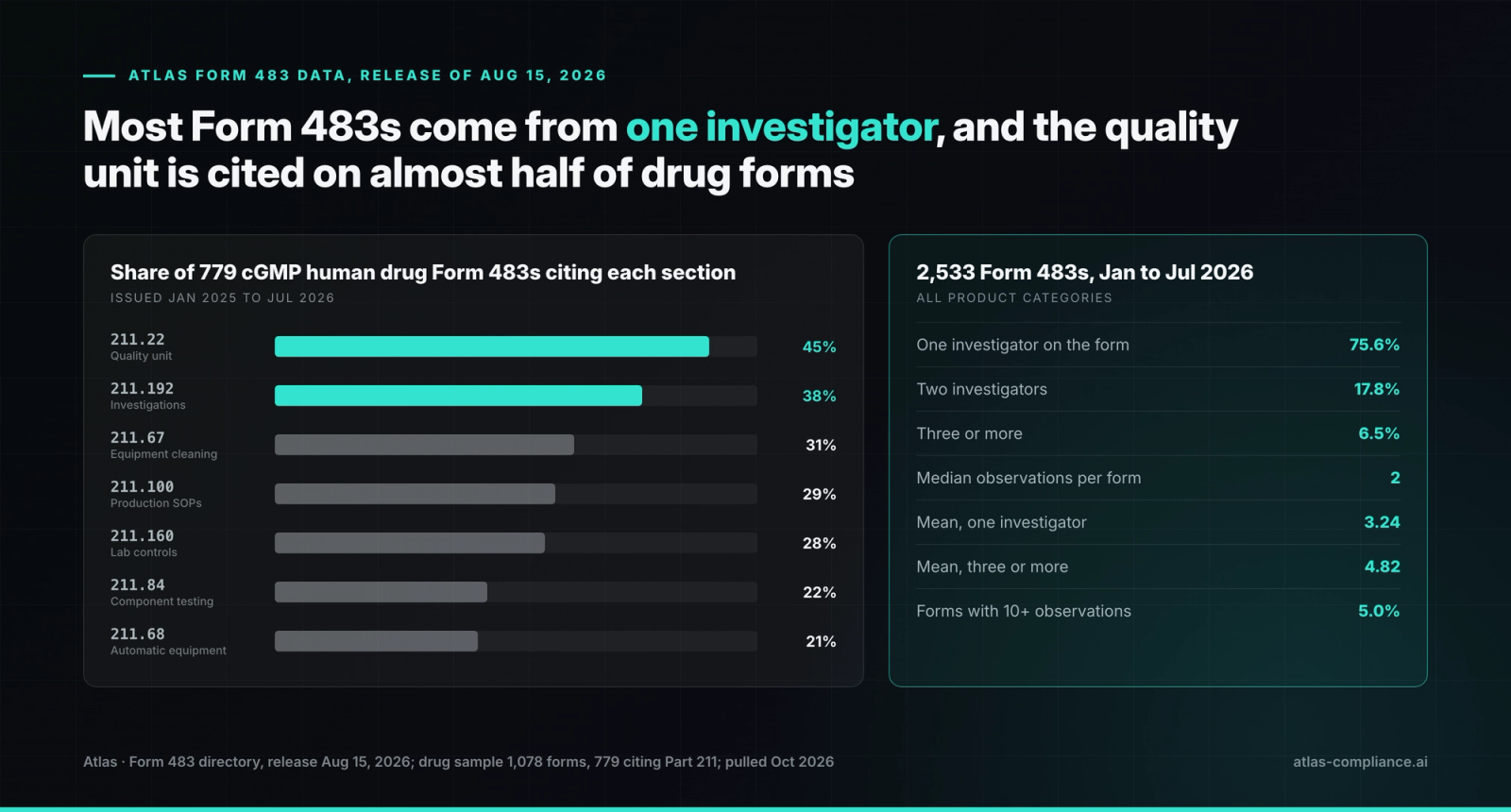
- Of 2,533 Form 483s issued from January to July 2026, 75.6% list one investigator and the median form carries two observations.
- On 779 cGMP human drug Form 483s issued from January 2025 to July 2026, 45% cite 21 CFR 211.22 (quality unit) and 38% cite 211.192 (investigations).
- FDA considers a Form 483 response received within 15 business days of the inspection end date before deciding on further action.
- For medical device inspections, the investigator offers to annotate each Form 483 observation with its correction status (IOM 5.5.11.4).
What are the five phases of an FDA inspection playbook?
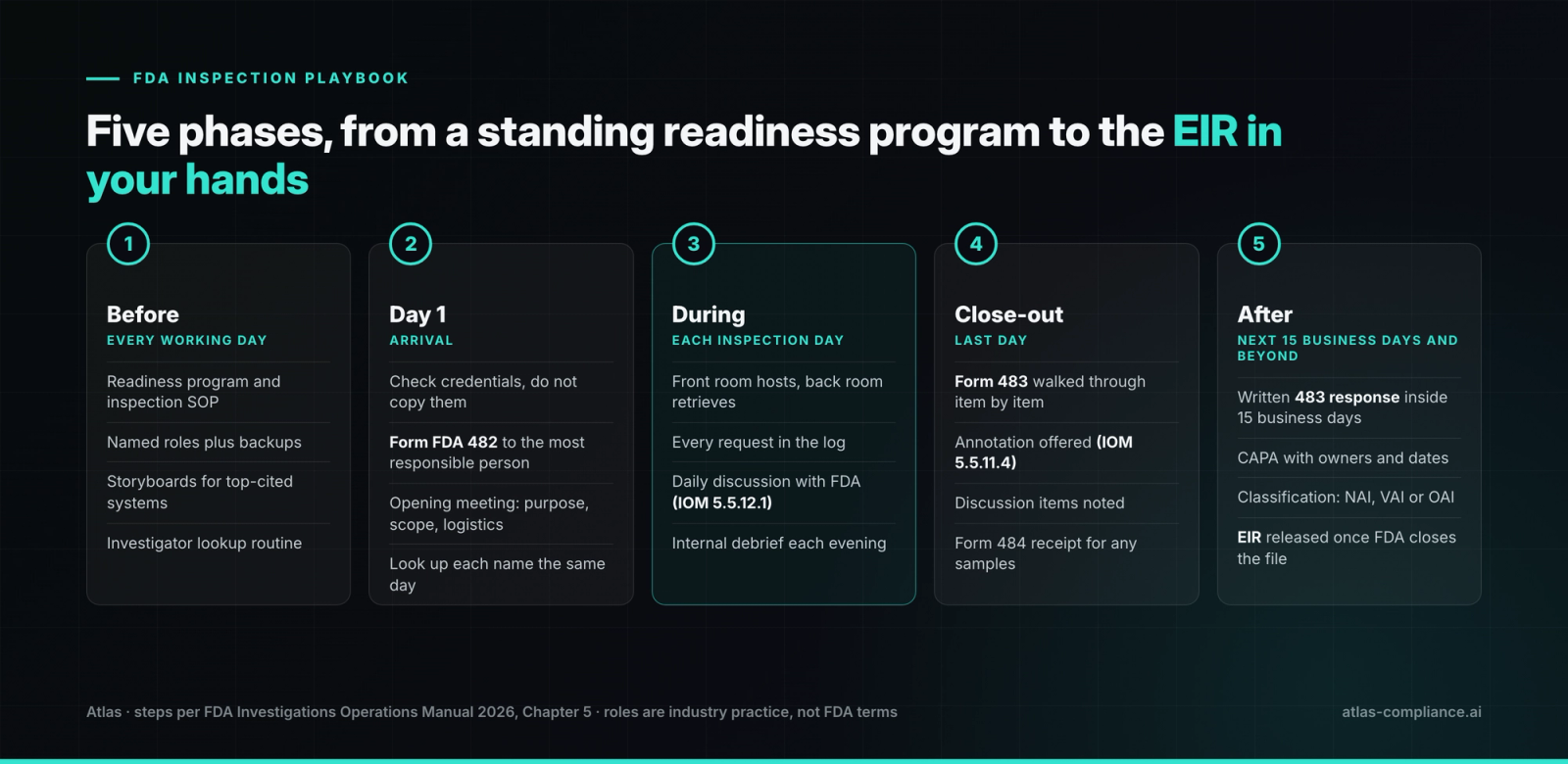
The five phases of an FDA inspection playbook are before, day 1, during, close-out and after. Each phase has a trigger, an owner and an output the next phase depends on.
| Phase | Starts when | Owner at your facility | Output | Detailed guide |
|---|---|---|---|---|
| 1. Before | Every working day | Head of quality | Inspection SOP, roles, storyboards | Mock FDA inspections |
| 2. Day 1 | Investigator shows credentials | Host | Signed Form 482, opening meeting notes, investigator names | FDA IOM explained |
| 3. During | First document request | Back room lead | Request log, daily debrief notes | This article |
| 4. Close-out | Last inspection day | Most responsible person on site | Form 483, discussion items, Form 484 if samples | 483 vs warning letter |
| 5. After | Inspection end date | Quality and site leadership | Written response, CAPA, EIR review | FDA EIR guide |
Surveillance, for-cause, pre-approval and follow-up inspections all run through these five phases; the type sets the scope, as our piece on FDA inspection types explains.
How do you prepare for an FDA inspection?
You prepare for an FDA inspection by running readiness as a standing program: a written inspection SOP, named people for each role, storyboards for the systems investigators cite most, and a routine for researching investigators. Domestic inspections are usually unannounced, so the program has to work on an unplanned day.
- Write the inspection SOP. Name who greets the investigator, who receives the Form 482 and which rooms you use. Our checklist for what QA teams should prepare before an unannounced inspection covers the 48-hour version.
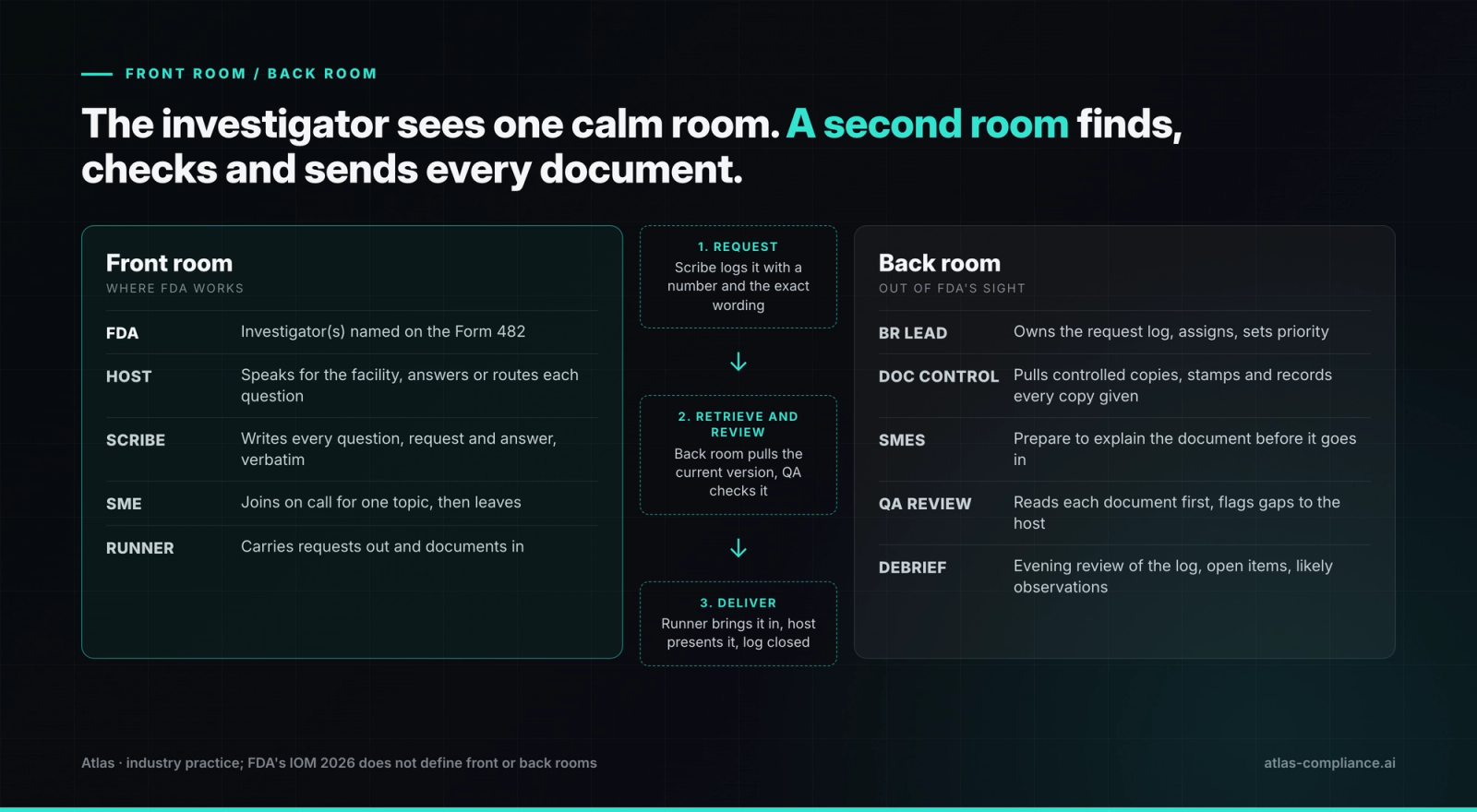
- Assign roles with backups. Each of the six roles in the front room and back room table below needs a primary and a deputy.
- Build storyboards. A storyboard is a short, approved explanation of one system or past event, such as a deviation or an OOS investigation, with its records indexed behind it.
- Set up investigator research. Bookmark the FDA investigator directory and decide who looks up each name on day 1.
- Rehearse. Run a mock inspection against the 2026 IOM steps. Our list of 100 things FDA inspectors look for gives a scope for the rehearsal.
The Atlas Form 483 data tell you which storyboards to write first. We read the CFR sections on 1,078 human drug Form 483s issued from January 2025 to July 2026 (release of August 15, 2026); 779 cite at least one Part 211 section. Of those, 45% cite 211.22 (quality unit), 38% cite 211.192 (production record review and investigations), 31% cite 211.67 (equipment cleaning and maintenance), 29% cite 211.100 (production procedures) and 28% cite 211.160 (laboratory controls). Storyboards for the quality unit and for open investigations cover the two most-cited sections.
What happens on day 1 of an FDA inspection?
Day 1 of an FDA inspection starts when the investigator shows credentials and hands a signed Form FDA 482, Notice of Inspection, to the most responsible person on site. Your host then runs a short opening meeting and starts the request log, and someone looks up each investigator before the end of the day.
- Check credentials. You may examine them and write down the name and credential number. You may not photocopy them (IOM 5.1.4.1).
- Receive the Form 482. Every FDA participant signs it, and anyone who joins later issues a new one. FDA does not issue a new 482 for each day of a multi-day inspection (IOM 5.5.1 and 5.5.1.1).
- Hold a short opening meeting. Introduce the host, ask the investigator about the purpose and expected areas of the inspection, agree on a working room, and explain how document requests will be handled.
- Start the request log and the scribe notes from the first question.
- Look up every investigator named on the 482 the same day.
Team size sets how many people your front room needs. In the Atlas data for January to July 2026, 1,916 of 2,533 Form 483s (75.6%) list one investigator, 452 (17.8%) list two and 165 (6.5%) list three or more. Human drug inspections run larger: 45.5% of 2026 human drug 483s list more than one investigator, against 9.8% for medical devices. Drug and biologics facilities should staff for two parallel tracks; most device facilities need one.
How do you research the FDA investigator named on your Form 482?
You research an FDA investigator by searching the name on the Form 482 in an investigator directory, matching the middle initial, and reading the CFR sections on that person's recent Form 483s. Use the record to check your own files against the sections this investigator has cited before.
Two Atlas profiles from the August 15, 2026 release show what that looks like:
- Lisa L Flores has 197 inspections at 188 sites on record since January 2015, with 336 Form 483 observations attributed. Her recent inspections are at human drug manufacturers in India, the latest in Bangalore in May 2026. On her five Form 483s from January 2025 to July 2026, 211.113 (microbial contamination) and 211.192 each appear on four.
- Khoa Nathan V Tran has 64 inspections at 64 sites since March 2021, with 203 observations attributed. His 14 Form 483s from 2025 to July 2026 carry 82 observations, a mean of 5.9, and 211.192 appears on 11 of the 14.
One named form shows the pattern in practice. The Eugia Pharma Specialities Form 483 of February 6, 2026 in Sangareddy, India lists three investigators, including Lisa L Flores, and 11 observations, among them 211.113(b) sterile process validation, 211.192 investigations and 211.22(d) written procedures. A site expecting either investigator should have its open investigations, their root causes and their timelines in a storyboard before day 2. For a domestic facility this research happens on the evening of day 1; our US FDA investigator list explains how to confirm the right profile.
If your Form 482 names someone tomorrow, the same lookup gives your back room the sections to stage first.
 Atlas
See what the FDA knows about your next investigator.
30 minutes with the founder. No pitch deck.
How does a front room back room FDA inspection work?
A front room back room FDA inspection splits your team into two spaces. The front room is where the investigator works with your host, scribe and subject matter experts. The back room, out of the investigator's sight, receives every request, retrieves the controlled document, has quality review it, and sends it in. FDA does not define either room; the IOM governs only the investigator's conduct. Facilities use the split to keep answers consistent and every document traceable.
The six roles
| Role | Room | What the role does | Who usually holds it |
|---|---|---|---|
| Host | Front | Speaks for the facility, answers or routes each question, presents documents | Head of quality or site QA lead |
| Scribe | Front | Records each question, request and answer verbatim, numbers requests | QA specialist |
| Runner | Both | Carries requests to the back room and documents back | QA or document control associate |
| Subject matter expert (SME) | Front, on call | Explains one process or event, then leaves the room | Process owner, lab or validation lead |
| Back room lead | Back | Owns the request log, assigns retrieval, sets priority, flags risks to the host | Senior QA manager |
| Document control | Back | Pulls the current controlled version, stamps copies, keeps a duplicate of every copy given | Document control lead |
The request log
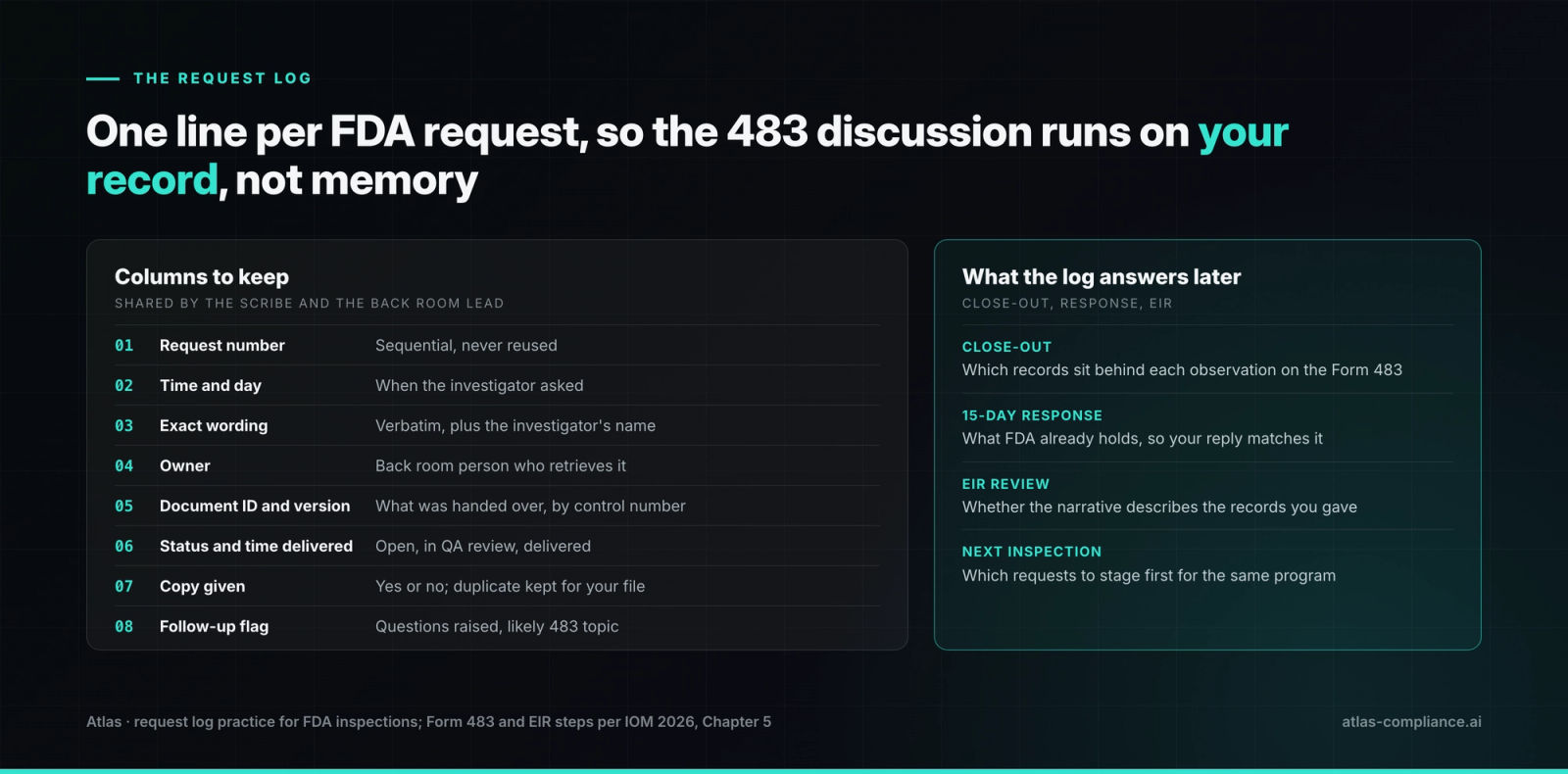
The request log is a single list of every FDA request with a number, the exact wording, an owner, the document ID and version handed over, and the time delivered. At close-out it tells you which records sit behind each observation, and during the 15 business day response it tells you what FDA already holds.
The daily debrief
Two meetings happen each day. The IOM directs the investigator to meet management at least once each inspection day to discuss findings likely to become Form 483 observations (5.5.12.1); use it to correct misunderstandings. After the investigator leaves, your own team meets: the back room lead walks the request log, the scribe reads back the questions that drew follow-up, and the host lists likely observations and the evidence needed overnight.
What happens at an FDA inspection close-out meeting?
At an FDA inspection close-out meeting, the investigator hands the Form 483 to the most responsible person on site, with a copy to top management, and explains each observation (IOM 5.5.12.2 and 5.5.12.3). The investigator ranks observations by significance, should not argue or act as a consultant, and records concerns of questionable significance in the EIR as discussion items (5.5.12.4).
- Ask clarifying questions and correct factual errors with records from the request log.
- Accept annotation where it is offered. For every medical device inspection, the investigator offers to annotate each observation as "Reported corrected, not verified", "Corrected and verified", "Promised to correct" or "Promised to correct by" a date. In other programs annotation is at the division's discretion, and BIMO inspections are generally excluded (IOM 5.5.11.4). Annotation is voluntary for you.
- Write down every discussion item, because the next investigator may follow them up.
- Collect the Form 484 receipt for any physical samples, which the investigator normally issues at the end (5.5.12.5).
- Note the inspection end date; the response clock starts there.
Expect a short form. Across the 2,533 Form 483s from January to July 2026, the median carries two observations and the mean is 3.47. Forms signed by one investigator average 3.24 observations; forms signed by three or more average 4.82, and 5.0% of all forms reach ten or more.
What should you do in the 15 business days after an FDA inspection?
In the 15 business days after an FDA inspection, send a written response to the Form 483 that addresses each observation with a root cause, the corrections made, the corrective and preventive actions planned, and dates with evidence. FDA does not legally require a response, but it considers one received within 15 business days of the inspection end date before deciding on further action, such as a warning letter.
- Draft the response observation by observation, in the order of the Form 483.
- Open a CAPA for each observation, with an owner, a due date and an effectiveness check.
- Attach evidence you have; promise only dates you can meet.
- Track the classification. FDA classifies the inspection NAI, VAI or OAI after reviewing the EIR and your response.
- Read the EIR when it arrives. FDA releases a copy to the inspected facility once the inspection is closed, and the narrative shows what the investigator recorded about your answers.
How the response differs from a warning letter reply is covered in our guide to Form 483 vs warning letter responses. A repeat observation at the next inspection can move a VAI to OAI, so today's CAPA is phase 1 of the next cycle.
Each new Form 483 in your program shows which sections investigators are writing up this quarter, and the digest sends them as they appear.
AtlasFDA Inspection Intelligence Digest
We track every 483, EIR, and warning letter the moment it happens. Get the signals before they hit the FDA website.
Frequently asked questions
An FDA inspection has no fixed length; the scope and the findings set it. In Atlas records, the 2026 inspection at Mead Johnson in Zeeland, Michigan ran January 13 to 22, and the K.C. Pharmaceuticals inspection in Pomona, California ran January 20 to February 13. The investigator does not issue a new Form 482 for each day. Sterile manufacturing, pre-approval work and for-cause visits that widen tend to run longest.

Written by
Bhavish Agarwal
Founder, Atlas
Bhavish Agarwal is the founder of Atlas and previously worked at Google and Microsoft. He has spent the past several years building regulatory data infrastructure for the pharmaceutical industry.