
CDER, the Center for Drug Evaluation and Research, is the FDA center that approves and regulates drugs sold in the United States: prescription and over-the-counter drugs, generics, and most therapeutic biologics such as monoclonal antibodies. CDER reviews applications before approval and, after approval, decides on warning letters, import alerts and recalls for drug quality problems.
This guide adds what FDA's own pages do not show: Atlas counts of who signs drug warning letters and how many Form 483s go to drug and biologics facilities, from the Atlas Form 483 directory (release of August 15, 2026) and FDA's warning letter index (current as of October 20, 2026), pulled November 6, 2026.
Key facts
- CDER reviews new drug applications (NDAs), abbreviated new drug applications (ANDAs) for generics, OTC monograph orders, and biologics license applications (BLAs) for therapeutic biologics.
- CBER keeps vaccines, blood, cell and gene therapies, tissues and allergenics; therapeutic proteins and antibodies moved from CBER to CDER in 2003.
- On October 1, 2024, FDA's Office of Regulatory Affairs (ORA) became the Office of Inspections and Investigations (OII), the field force that inspects for every center.
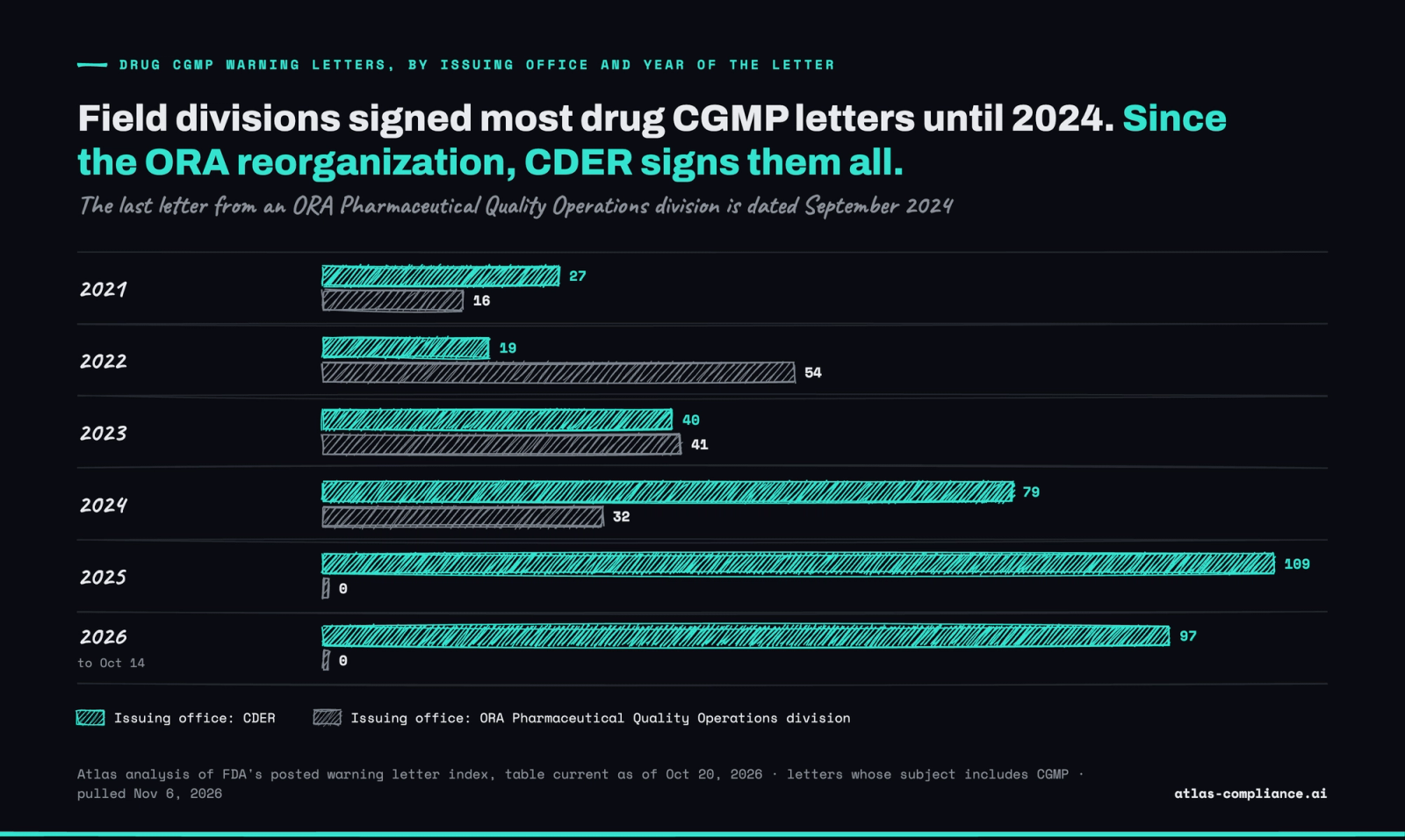
- In FDA's warning letter index, CDER signed 109 drug CGMP warning letters dated 2025 and ORA field divisions signed none; in 2022 the field divisions signed 54 and CDER 19.
- CDER issued 319 of the 737 posted warning letters dated 2025 (43%) and 251 of 474 dated January 1 to October 14, 2026 (53%).
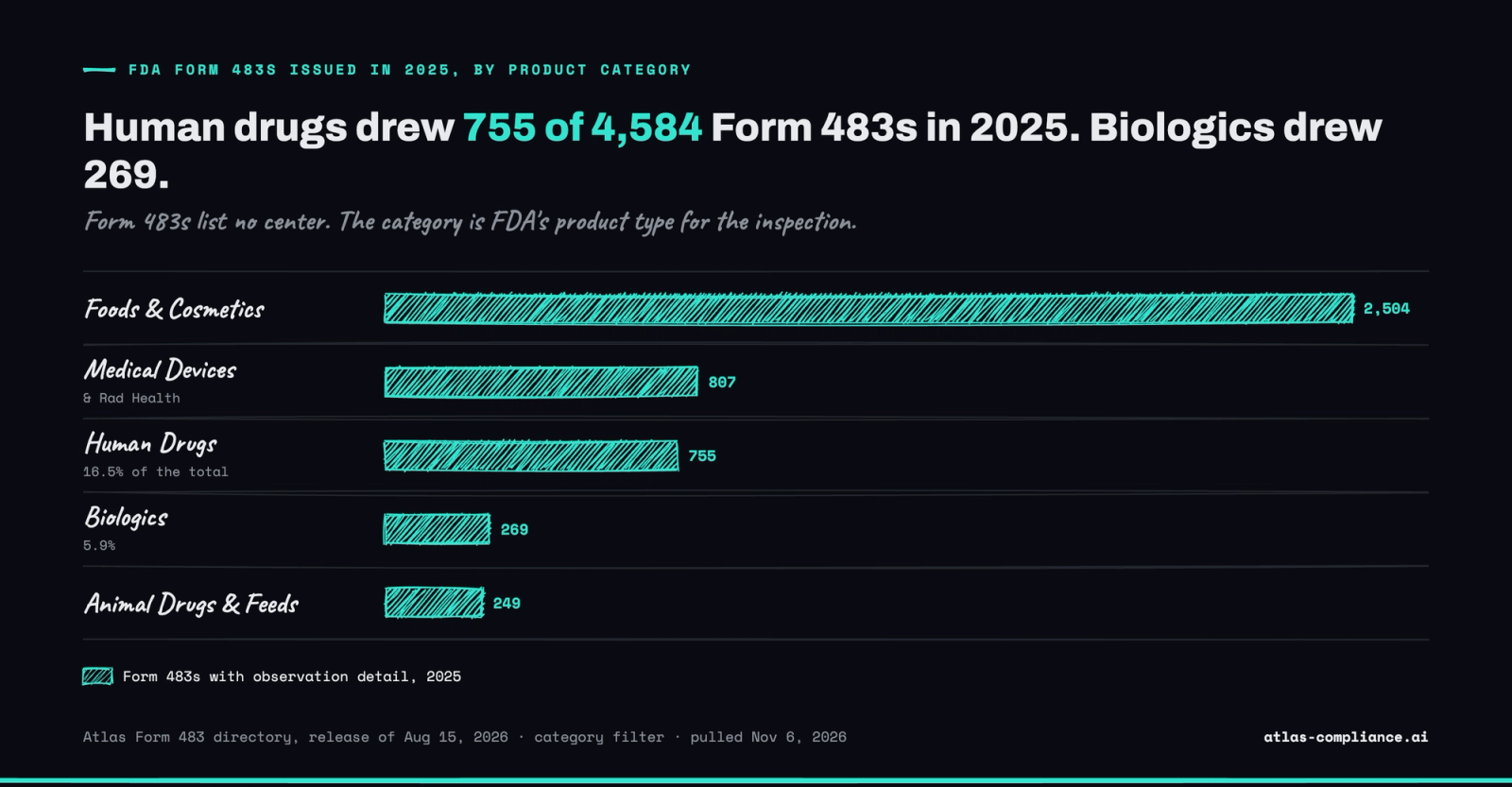
- In the Atlas Form 483 directory, 755 of the 4,584 Form 483s issued in 2025 (16.5%) came from human drug inspections and 269 (5.9%) from biologics inspections.
What is CDER at FDA?
CDER at FDA is the Center for Drug Evaluation and Research, one of the agency's product centers, and it holds legal responsibility for drugs from first-in-human study to market withdrawal. CDER decides whether a drug is safe and effective for its labeled use, whether the facilities making it meet current good manufacturing practice (CGMP), and what happens when they do not.
CDER covers these product groups:
| Product group | Application or pathway | Main CDER office |
|---|---|---|
| New prescription drugs | NDA, 21 CFR Part 314 | Office of New Drugs (OND) |
| Generic drugs | ANDA | Office of Generic Drugs (OGD) |
| Therapeutic biologics and biosimilars | BLA, 351(a) and 351(k) of the PHS Act | OND, Office of Therapeutic Biologics and Biosimilars |
| OTC drugs | OTC monograph orders, or an NDA | Office of Nonprescription Drugs |
| Active pharmaceutical ingredients | Drug master files referenced by applications | Office of Pharmaceutical Quality (OPQ) |
| Compounded drugs, 503A and 503B | No approval; CGMP for 503B outsourcing facilities | Office of Compliance |
Since March 23, 2020, products such as insulin and human growth hormone that FDA had approved under NDAs have been deemed BLAs. They stayed with CDER. Our post on preparing for FDA pre-approval inspections covers how the application route decides which inspection you get first.
Which CDER offices matter to a manufacturer?
Four CDER offices decide most quality outcomes for a manufacturing facility: the Office of Pharmaceutical Quality, the Office of Compliance, the Office of New Drugs and the Office of Generic Drugs. FDA's CDER offices and divisions page (November 2026) lists them as follows.
- Office of Pharmaceutical Quality (OPQ): Assesses chemistry, manufacturing and controls (CMC) in applications. Its Office of Pharmaceutical Manufacturing Assessment evaluates the facilities named in an application and requests pre-approval inspections. Its Office of Quality Surveillance ranks facilities for routine surveillance inspections.
- Office of Compliance (OC): Holds the Office of Manufacturing Quality, which decides on drug CGMP warning letters, regulatory meetings and import alert recommendations after an inspection is classified. OC also contains the Office of Scientific Investigations (clinical and bioequivalence site inspections), the Office of Unapproved Drugs and Labeling Compliance, and the Office of Compounding Quality and Compliance.
- Office of New Drugs (OND): Reviews clinical data for NDAs and BLAs, organized by therapeutic area.
- Office of Generic Drugs (OGD): Reviews ANDAs, including bioequivalence.
The Office of Prescription Drug Promotion sits under CDER's Office of Medical Policy and sends the untitled and warning letters about drug advertising. Quality teams meet it when a label claim or a sales piece is in question.
CDER vs CBER vs CDRH vs OII: what is the difference?
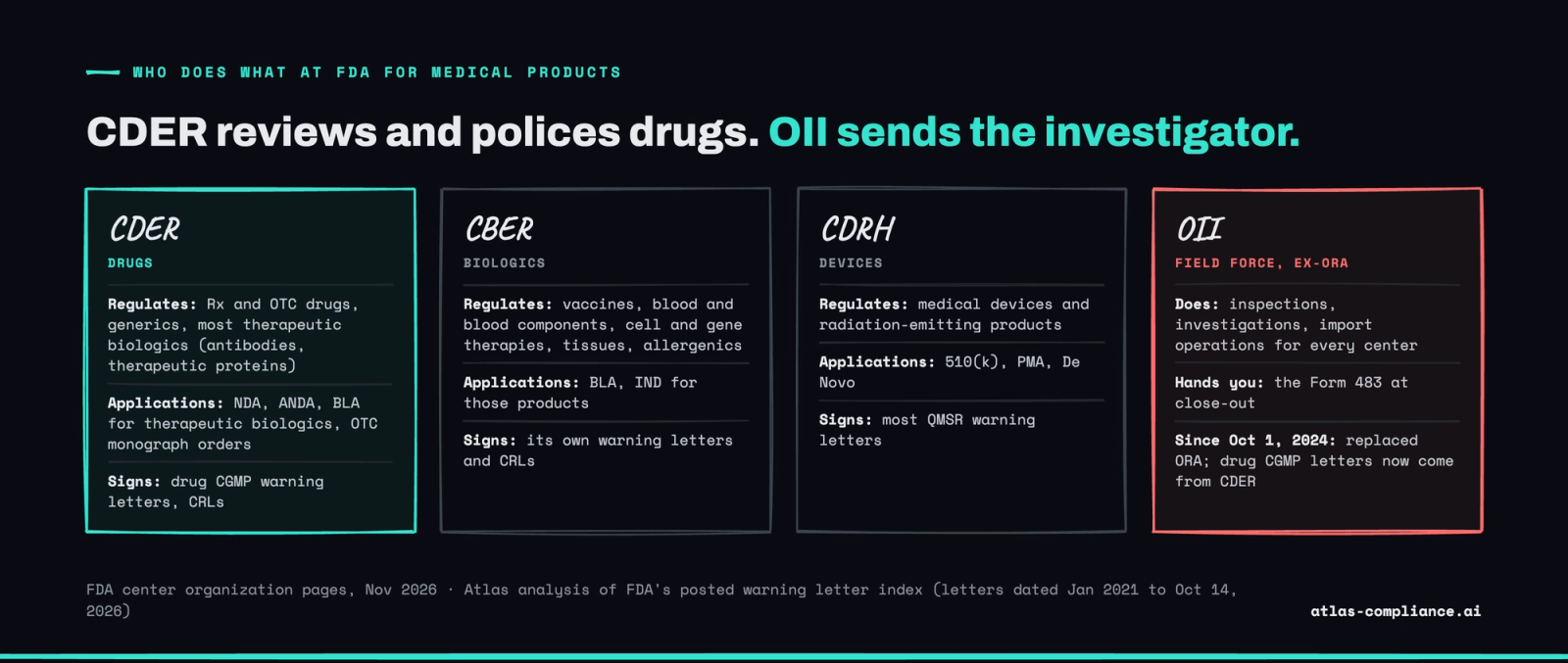
CDER regulates drugs and therapeutic biologics, CBER regulates vaccines, blood and cell and gene therapies, CDRH regulates medical devices, and OII is the field organization that inspects for all three. A manufacturer deals with one lead center for its product and with OII investigators on site.
| CDER | CBER | CDRH | OII (formerly ORA) | |
|---|---|---|---|---|
| Full name | Center for Drug Evaluation and Research | Center for Biologics Evaluation and Research | Center for Devices and Radiological Health | Office of Inspections and Investigations |
| Regulates | Rx and OTC drugs, generics, most therapeutic biologics | Vaccines, blood and blood components, cell and gene therapies, tissues, allergenics | Medical devices, radiation-emitting products | No products; inspects, investigates and runs import operations for every center |
| Main applications | NDA, ANDA, BLA (therapeutic), OTC monograph orders | BLA, IND for its products | 510(k), PMA, De Novo | None |
| Quality rules applied | 21 CFR 210, 211, 212 | 21 CFR 600 to 680, plus 211 | 21 CFR 820 (QMSR since Feb 2, 2026) | Whatever the product center's rules are |
| Who hands you the Form 483 | OII investigator | OII investigator, sometimes with CBER staff | OII investigator | OII investigator |
| Posted warning letters dated 2025 | 319 | 20 | 61 | 31, including OII import divisions |
Warning letter counts come from the Atlas analysis of FDA's posted warning letter index, by issuing office, for letters dated in 2025.
Combination products, such as a prefilled syringe or a drug-coated stent, get one lead center. FDA's Office of Combination Products assigns it by the product's primary mode of action under 21 CFR Part 3.
What changed when ORA became OII?
FDA renamed the Office of Regulatory Affairs as the Office of Inspections and Investigations on October 1, 2024, and kept it focused on inspections, investigations and imports. For drug manufacturers the visible change is the issuing office on warning letters: drug CGMP letters that ORA's Pharmaceutical Quality Operations divisions used to sign now come from CDER.
The Atlas analysis of FDA's warning letter index (3,768 letters dated January 4, 2021 to October 14, 2026, table current as of October 20, 2026) shows the handover by year:
| Letter year | Drug CGMP letters signed by CDER | Signed by an ORA Pharmaceutical Quality Operations division | All warning letters from CDER | All posted warning letters |
|---|---|---|---|---|
| 2021 | 27 | 16 | 111 | 689 |
| 2022 | 19 | 54 | 105 | 691 |
| 2023 | 40 | 41 | 117 | 608 |
| 2024 | 79 | 32 | 138 | 569 |
| 2025 | 109 | 0 | 319 | 737 |
| 2026, to Oct 14 | 97 | 0 | 251 | 474 |
The last letter in the index from a Pharmaceutical Quality Operations division is dated September 2024. CDER's total also jumped in 2025 for a second reason: 67 of its 2025 letters concerned online and telehealth drug sales and 81 concerned unapproved or misbranded products.
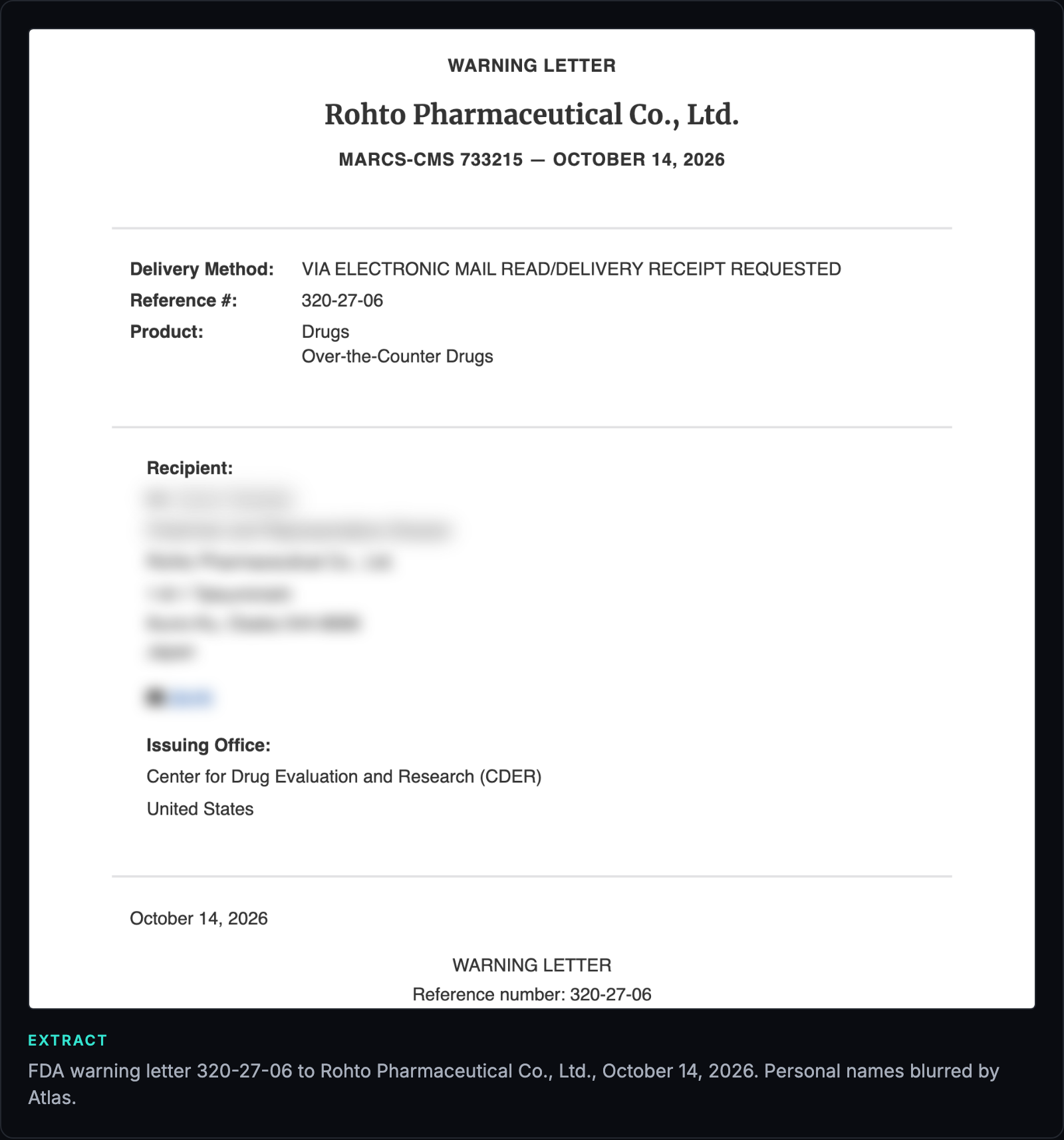
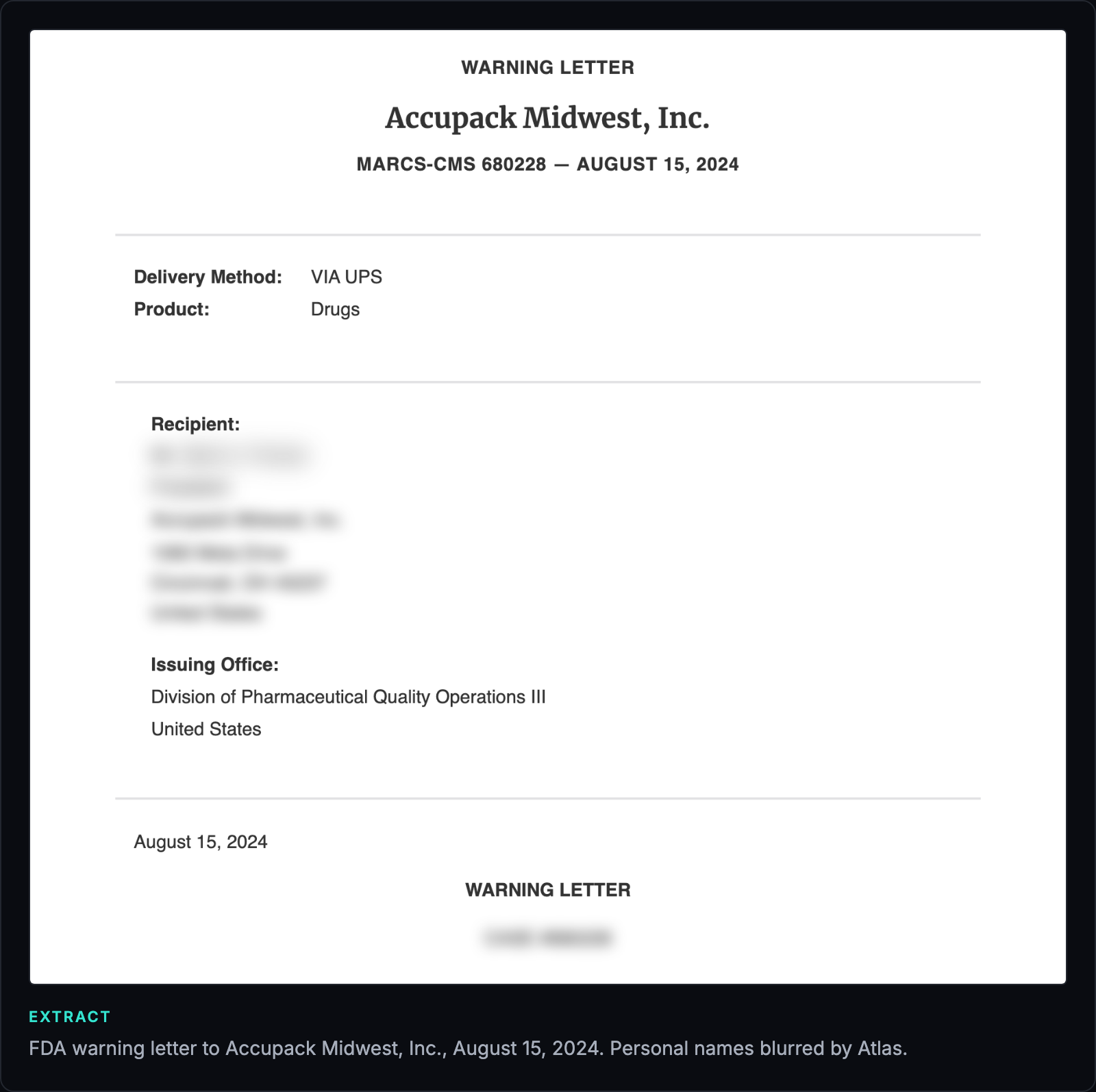
The letter itself shows the change. An August 15, 2024 letter to Accupack Midwest, Inc. names Division of Pharmaceutical Quality Operations III as the issuing office. Warning letter 320-27-06 to Rohto Pharmaceutical Co., Ltd., dated October 14, 2026, names the Center for Drug Evaluation and Research (CDER). The 320 prefix in the reference number marks a letter from CDER's Office of Manufacturing Quality.
For the full set of October 2026 letters, with the sections each one cites, see our FDA warning letters October 2026 tracker.
How does CDER show up at a manufacturing facility?
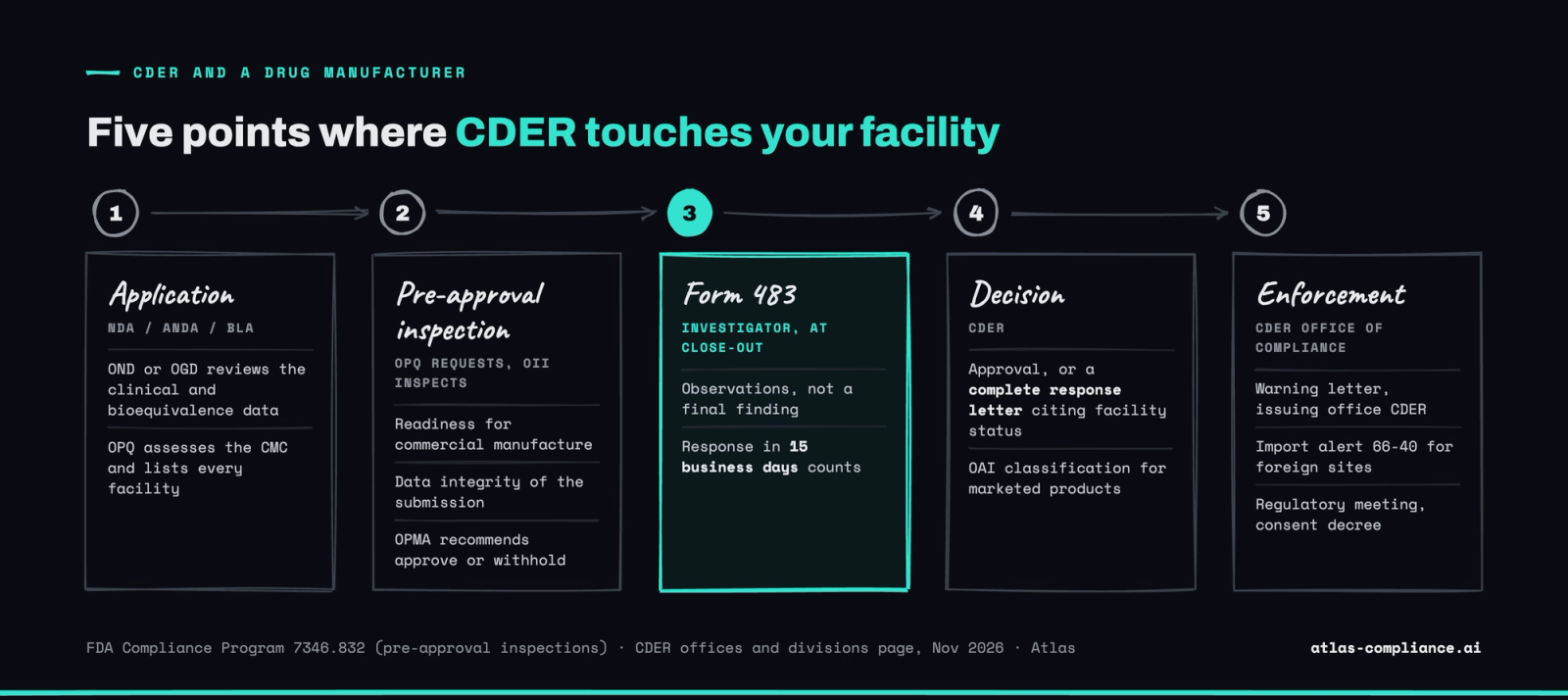
CDER reaches a drug manufacturing facility at five points: the application, the pre-approval inspection, the Form 483, the approval decision and enforcement. OII investigators do the inspecting, but CDER asks for the inspection, reads the report and decides what follows.
- Application review: OPQ checks the CMC section and lists every facility named in the NDA, ANDA or BLA, including contract manufacturers and testing labs.
- Pre-approval inspection: Under FDA Compliance Program 7346.832, OII investigators check readiness for commercial manufacture, conformance to the application and the integrity of submitted data.
- Form 483: The investigator lists observations at close-out. FDA weighs a written response received within 15 business days before it decides on a warning letter. Our guide to what an FDA Form 483 is covers the response.
- Decision: For a pending application, an unacceptable facility can lead to a complete response letter. In the Atlas analysis of published CRLs, facility inspection problems appear in 42 of the 65 letters FDA issued in 2024, as our post on complete response letters and facility readiness shows.
- Enforcement: For marketed products, an inspection classified Official Action Indicated goes to CDER's Office of Compliance, which can issue a warning letter, hold a regulatory meeting, or recommend a foreign facility for Import Alert 66-40.
How many Form 483s go to drug and biologics facilities?
Human drug inspections produced 755 of the 4,584 Form 483s issued in 2025 in the Atlas FDA Form 483 database, or 16.5%, and biologics inspections produced 269, or 5.9% (release of August 15, 2026). A Form 483 does not name a center. Atlas files each one under the product category FDA records for the inspection, so a CDER-regulated therapeutic biologic can sit under Human Drugs.
| Year issued | Human Drugs | Biologics | All Form 483s | Human Drugs share |
|---|---|---|---|---|
| 2021 | 388 | 108 | 2,992 | 13.0% |
| 2022 | 548 | 166 | 3,912 | 14.0% |
| 2023 | 601 | 195 | 4,274 | 14.1% |
| 2024 | 633 | 218 | 3,931 | 16.1% |
| 2025 | 755 | 269 | 4,584 | 16.5% |
| 2026, Jan to Jul | 323 | 137 | 2,533 | 12.8% |
Foods and cosmetics inspections produced the most 483s every year, 2,504 in 2025. Device inspections produced 807.
Three Atlas records show the path from an OII inspection to a CDER letter in 2026:
- Rohto-Mentholatum (Vietnam) Co., Ltd., Ho Chi Minh: 5 inspections on record, all 5 ending in a Form 483. The April 6 to 14, 2026 inspection cited 21 CFR 211.100(a) and 211.113(b). CDER's warning letter 320-27-06 followed on October 14, 2026.
- Hanlim Pharm Co. Ltd., Yongin: 6 inspections, 5 with a Form 483. The April 16 to 24, 2026 inspection cited the same two sections, and CDER signed warning letter 320-27-03 on October 2, 2026.
- Northland Nuclear Medicine, LLC, Bismarck: a PET drug producer with 3 inspections, all ending in a Form 483. The May 2026 form cited 21 CFR 212.20(d), 212.30(a) and 212.40(a), and CDER's October 22, 2026 letter cited 212.20(d) and 212.30(b).
The same investigator, Justin A Boyd, led the Rohto and Hanlim inspections with Hung H Do. Atlas holds 279 of his inspections across 240 sites since August 2008, with 1,374 Form 483 observations attributed to him. A therapeutic biologics maker such as Regeneron Pharmaceuticals in Rensselaer, New York appears under Human Drugs: 19 inspections, 9 with a Form 483.
The investigator who closes your inspection decides what goes on the 483 that CDER later reads, so check that person's record before the next visit.
 Atlas
See what the FDA knows about your next investigator.
30 minutes with the founder. No pitch deck.
Where can you check CDER actions against a facility?
You can check CDER actions against a facility in four public records: FDA's warning letter index (filter the issuing office to CDER), the import alert lists, FDA's published complete response letters, and the inspection classifications in the FDA Data Dashboard. None of them links the four together by facility. Our FDA Data Dashboard guide explains what the dashboard holds and where it stops, and the Atlas facility pages above join inspections, Form 483s and outcomes for one site.
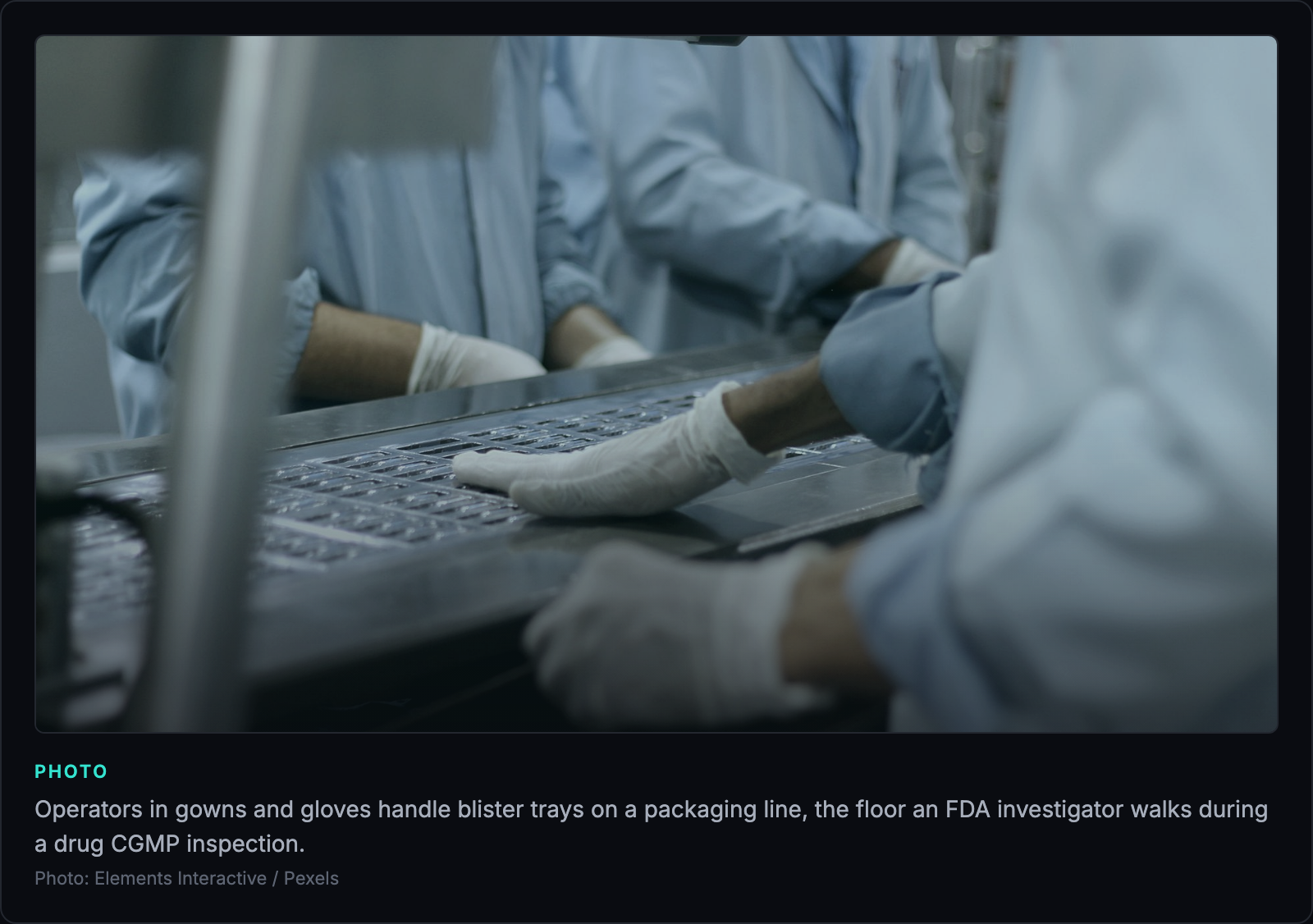
Read the issuing office line first when a letter arrives at a peer or supplier. "Center for Drug Evaluation and Research (CDER)" with a 320 reference means a CGMP letter from the Office of Manufacturing Quality. Other CDER offices send the letters on unapproved drugs, online sales and promotion.
AtlasFDA Inspection Intelligence Digest
We track every 483, EIR, and warning letter the moment it happens. Get the signals before they hit the FDA website.
Frequently asked questions
CDER stands for the Center for Drug Evaluation and Research. It is one of FDA's product centers and regulates prescription drugs, over-the-counter drugs, generics and most therapeutic biologics. The acronym appears on FDA warning letters as the issuing office, on complete response letters, and in guidance documents CDER publishes alone or with CBER and CDRH.

Written by
Bhavish Agarwal
Founder, Atlas
Bhavish Agarwal is the founder of Atlas and previously worked at Google and Microsoft. He has spent the past several years building regulatory data infrastructure for the pharmaceutical industry.