
A PDUFA date is the goal date by which FDA commits to act on a new drug application (NDA) or biologics license application (BLA), either by approving it or by issuing a complete response letter. The name comes from the Prescription Drug User Fee Act, which ties FDA's review deadlines to the user fees sponsors pay.
This guide explains how FDA calculates the date under PDUFA VII, what extends it, and where facility inspections sit on the clock. It adds two things other PDUFA pages do not: the reasons behind the complete response letters FDA issued in 2024, from the Atlas analysis of published letters (data as of October 14, 2026), and the outcomes of 3,426 drug and biologic inspections that ended between January 2, 2025 and October 14, 2026.
- Under PDUFA VII, FDA aims to act on 90 percent of standard new molecular entity NDAs and original BLAs within 10 months of the 60-day filing date, and on priority applications within 6 months of that date.
- A major amendment submitted during the review cycle can extend the PDUFA date by three months, and FDA allows only one extension per review cycle.
- FDA's goal is to finish GCP, GLP and GMP inspections 2 months before the PDUFA date, so there is time to address what the inspections find.
- Facility inspection problems appeared in 42 of the 65 complete response letters FDA issued in 2024, second only to clinical deficiencies (56 of 65), in the Atlas analysis of published letters.
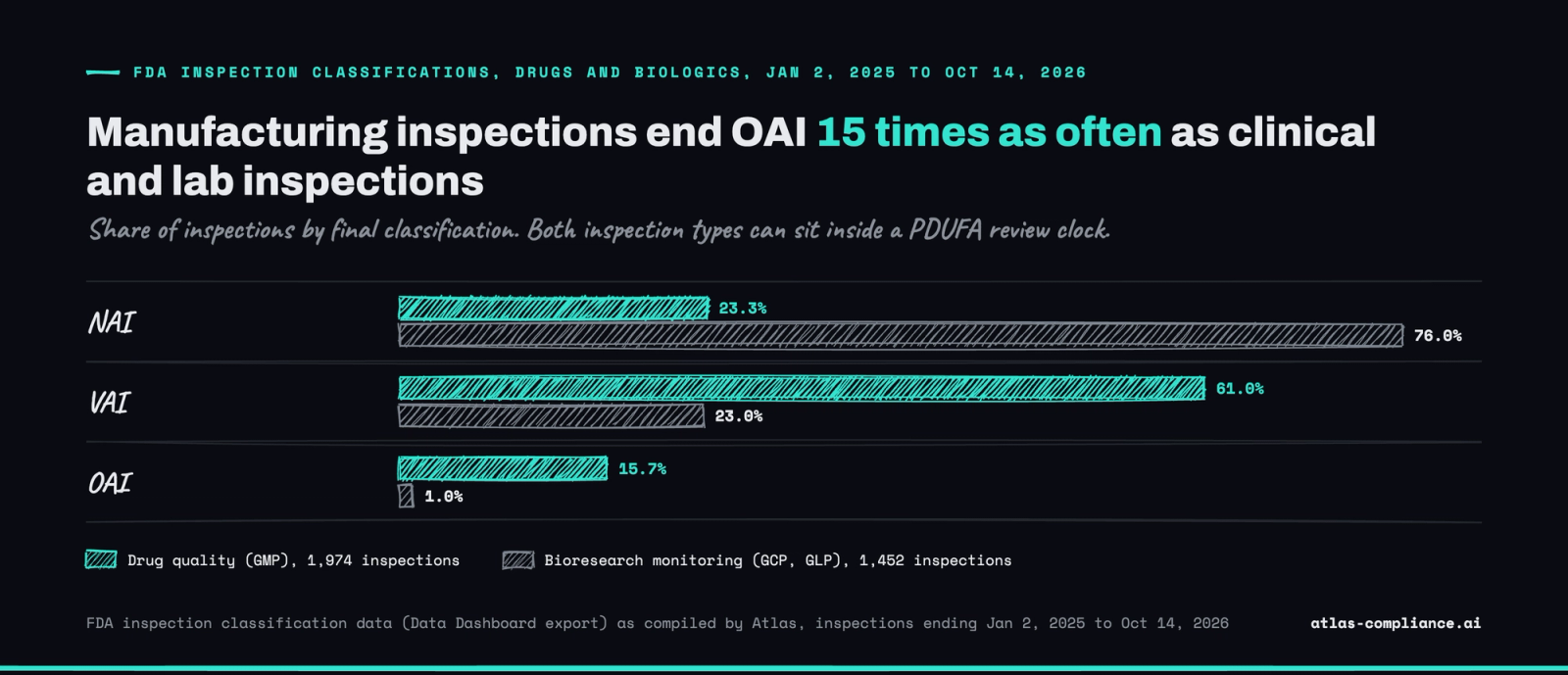
- Drug quality (GMP) inspections of drug and biologic facilities ended Official Action Indicated (OAI) 15.7% of the time from January 2025 to October 2026; bioresearch monitoring inspections ended OAI 1.0% of the time.
What is a PDUFA date?
A PDUFA date is the target action date FDA sets for a drug or biologic application under the Prescription Drug User Fee Act. On or before that date, FDA aims to approve the application or send a complete response letter that lists every deficiency. The PDUFA date is a performance goal, not a legal deadline, and FDA does not guarantee the outcome.
FDA tells the sponsor the date after it files the application. FDA does not publish PDUFA dates, so the public learns them only when a sponsor announces one in a press release or securities filing. That is why every "PDUFA calendar" you find online is assembled from company disclosures, and why dates on those calendars can be out of date after an extension.
The terms "PDUFA date", "PDUFA goal date", "target action date" and "action date" mean the same thing. CDER sets the dates for most drugs and CBER for many biologics; our explainer on what CDER is covers how the two centers split the work.
How does FDA set the PDUFA date?
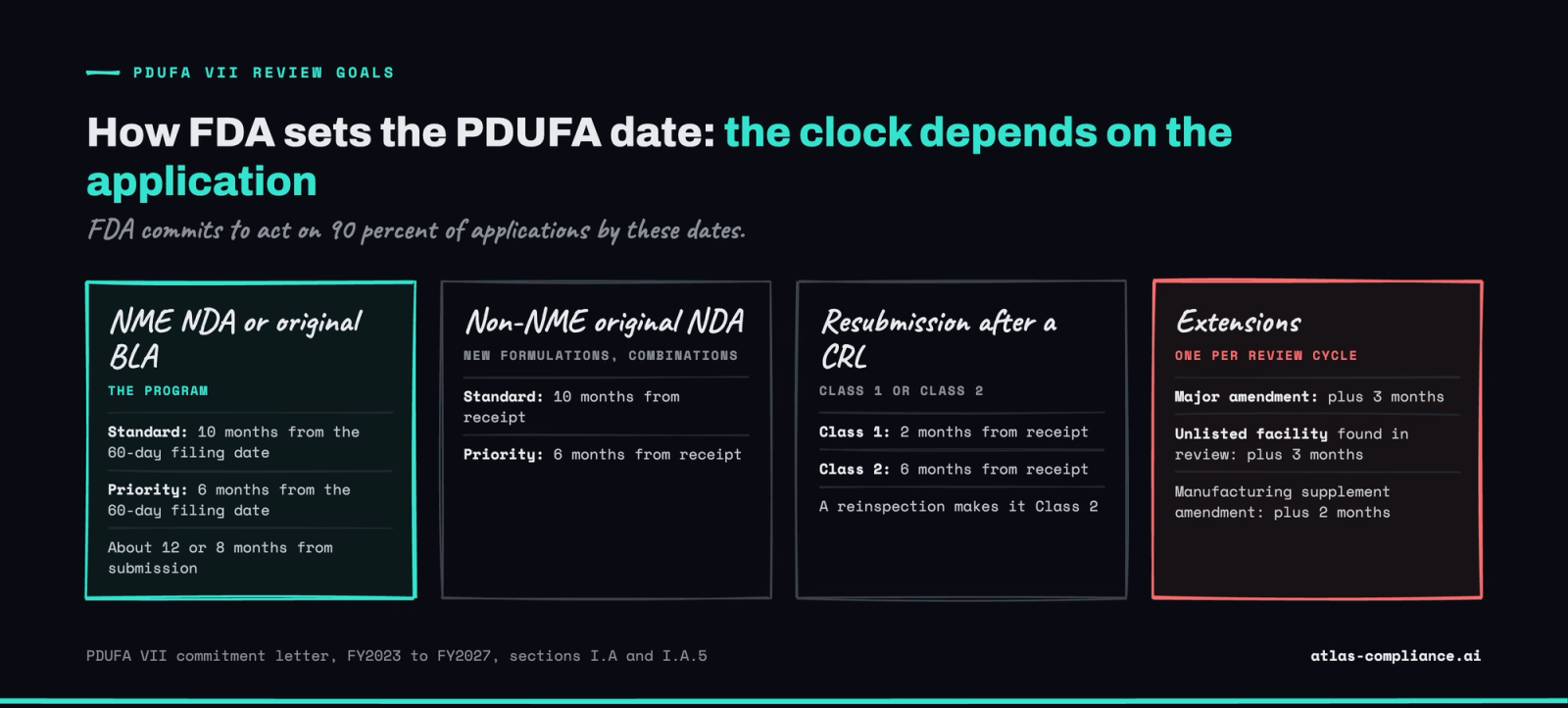
FDA sets the PDUFA date from the review goals in the PDUFA VII commitment letter, which covers fiscal years 2023 to 2027. The clock depends on the type of application and on whether FDA grants standard or priority review. For new molecular entities and original BLAs, the clock starts at the 60-day filing date rather than at submission.
| Application | Standard review | Priority review |
|---|---|---|
| NME NDA or original BLA (the "Program") | 10 months from the 60-day filing date | 6 months from the 60-day filing date |
| Non-NME original NDA | 10 months from receipt | 6 months from receipt |
| Efficacy supplement | 10 months from receipt | 6 months from receipt |
| Class 1 resubmission after a CRL | 2 months from receipt | 2 months from receipt |
| Class 2 resubmission after a CRL | 6 months from receipt | 6 months from receipt |
| Prior approval manufacturing supplement | 4 months from receipt | 4 months from receipt |
In practice, a standard NME application gets a PDUFA date about 12 months after submission and a priority one about 8 months after. Priority review applies to drugs that would offer a significant improvement in the treatment, diagnosis or prevention of a serious condition, and a sponsor can also redeem a priority review voucher to get the shorter clock.
What can change a PDUFA date?
A PDUFA date changes when FDA extends the review clock, and the PDUFA VII commitment letter allows that in two main cases. Each extension adds three months to an original application or efficacy supplement, and FDA grants only one extension per review cycle.
- A major amendment. When a sponsor submits substantial new information during the review, such as a major new clinical study report, a major reanalysis, or a REMS with elements to assure safe use that was not in the original application, FDA may extend the goal date by three months. FDA is meant to extend only when reviewing the new material could lead to approval in the current cycle.
- A manufacturing facility missing from the application. Every application is expected to include a "comprehensive and readily located list" of all manufacturing facilities. If FDA finds during review that it must inspect a facility that is not on that list, it can extend the goal date by three months.
A recent example shows how the first rule plays out. Savara announced in 2026 that FDA treated its responses to information requests on the molgramostim BLA as a major amendment, which moved its PDUFA date from August 22 to November 22, 2026. The company said FDA did not cite safety, efficacy or manufacturing concerns in that correspondence.
A major amendment to a manufacturing supplement extends that supplement's goal date by two months rather than three.
Where do inspections fall on the PDUFA clock?
Inspections fall in the last months of the review. FDA's PDUFA VII goal is to complete all GCP, GLP and GMP inspections for Program applications within 10 months of receipt for standard review and within 6 months for priority review. That leaves about 2 months before the PDUFA date to address any deficiencies the inspections find.
FDA also aims to tell the applicant at least 60 days before a pre-approval inspection (NDA) or pre-license inspection (BLA), and no later than mid-cycle, when it plans to inspect a facility while the product is being made. FDA keeps the right to inspect any facility at any time during the review.
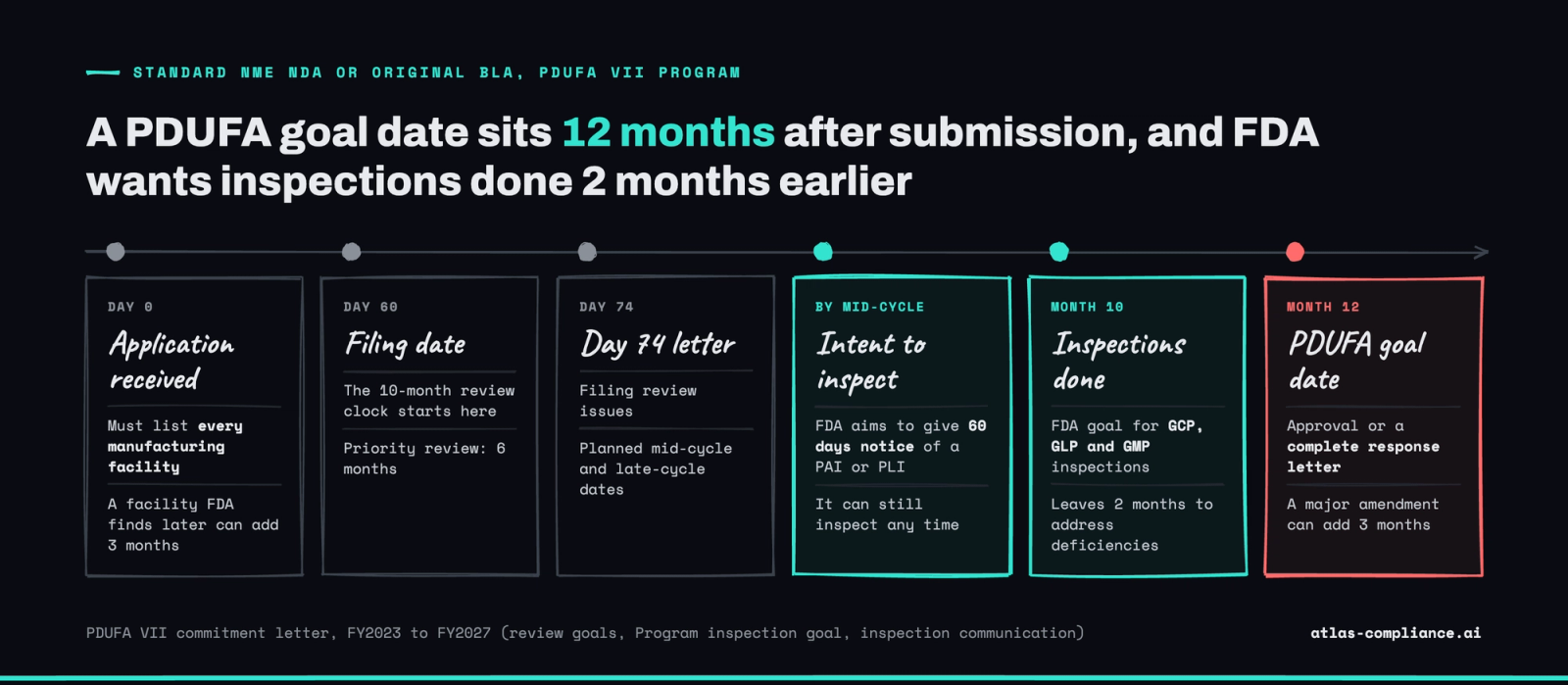
Two months is short. If a pre-approval inspection ends with a Form 483 and FDA classifies the facility as unacceptable, the facility rarely closes the observations, gets a reinspection and earns a new classification before the action date. Our guide to preparing for a pre-approval inspection covers what investigators check, and our explainer on FDA inspection types covers how a pre-approval inspection differs from a surveillance or for-cause visit.
Why do facility inspections cause missed approvals?
Facility inspection problems are the most common non-clinical reason FDA does not approve an application on its PDUFA date. In the Atlas complete response letter analysis of letters FDA published through openFDA (data as of October 14, 2026), facility inspections appear in 42 of the 65 letters FDA issued in 2024. Clinical deficiencies appear in 56, clinical pharmacology in 11 and device issues in 5.
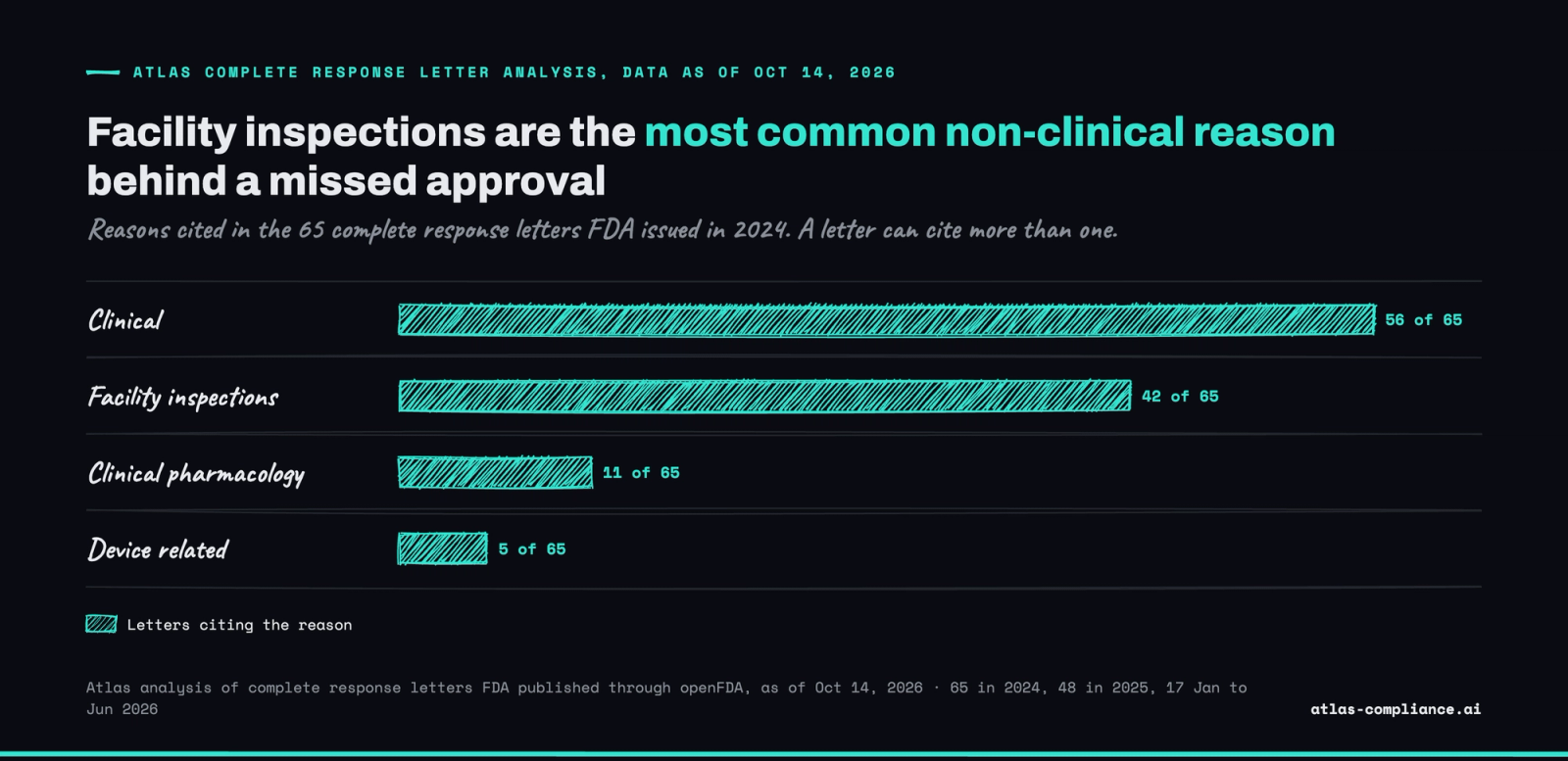
The same analysis counts 48 complete response letters in 2025 and 17 from January to June 2026. A letter can cite more than one category, so the reasons do not add up to the total. Our post on complete response letters and facility readiness breaks down the four facility sentences FDA reuses in these letters.
The inspection data points the same way. Across drug and biologic inspections that ended between January 2, 2025 and October 14, 2026, FDA classified 15.7% of drug quality (GMP) inspections as OAI (310 of 1,974). Bioresearch monitoring inspections, which cover clinical trial sites and nonclinical labs (GCP and GLP), ended OAI 1.0% of the time (14 of 1,452). A manufacturing facility is far more likely than a clinical site to produce the finding that holds an application back. Our guide to NAI, VAI and OAI classifications explains what each outcome means.
The sponsor often learns of the problem late, because the Form 483 goes to the facility, which may be a contractor. Regeneron's filings, summarized in our Regeneron Form 483 analysis, tie two 2025 complete response letters to a June 23 to July 14, 2025 inspection of its contract filler, Catalent Indiana, LLC in Bloomington. The Atlas record for that facility (release of August 15, 2026) lists 19 FDA inspections, 13 of them ending with a Form 483. Its November 15, 2023 Form 483 cited six sections, including 211.192, and investigator Andrew J Barrowcliff, one of the six named on it, has 93 inspections across 79 sites in his Atlas profile.
Before a filing names a contract site, you can pull that site's inspection record and the investigators who have visited it in the Atlas FDA-inspected facilities directory.
 Atlas
See what the FDA knows about your next investigator.
30 minutes with the founder. No pitch deck.
What PDUFA dates are coming up in late 2026?
The PDUFA dates below are the ones sponsors announced for the rest of 2026, checked against each company's own press release or quarterly report on November 6, 2026. FDA does not confirm PDUFA dates, and any of them can move after a major amendment.
| PDUFA date | Sponsor | Product and application | Indication | Note from the sponsor |
|---|---|---|---|---|
| November 22, 2026 | Savara | Molgramostim inhalation solution, BLA | Autoimmune pulmonary alveolar proteinosis | Priority review; moved from August 22 after a major amendment |
| November 25, 2026 | Sanofi | Venglustat, NDA | Type 3 Gaucher disease | Priority review |
| November 27, 2026 | Nuvalent | Neladalkib, NDA | TKI pre-treated ALK-positive non-small cell lung cancer | Priority review |
| November 30, 2026 | Vertex | Povetacicept, BLA (accelerated approval) | IgA nephropathy | Priority review |
| December 19, 2026 | Hansa Biopharma | Imlifidase, BLA | Desensitization for kidney transplant | Date set in March 2026 |
Sources, in plain text: Savara press release on the extended molgramostim review (2026) and its Form 10-Q for the quarter ended June 30, 2026; Sanofi press release of May 28, 2026 and its Q2 2026 results; Nuvalent press release of May 27, 2026; Vertex press release of June 1, 2026 and its Q3 2026 results; Hansa Biopharma press release of March 4, 2026.
How can a sponsor protect its PDUFA date?
A sponsor protects its PDUFA date mostly through the facilities named in the application, since that is the part of the review a quality team controls. The PDUFA VII rules and the 2024 letters point to five checks.
- List every manufacturing and testing facility in the application. A facility FDA finds later can add three months to the review.
- Pull the inspection history of each listed facility, including contractors, and flag any open Form 483 or recent OAI classification.
- Confirm that each facility is making the product, or can, when FDA wants to inspect, since FDA plans pre-approval inspections around production.
- Keep a dated log of every Form 483 response for every facility. FDA's complete response letters ask the applicant for those dates.
- Decide early whether a second filler or lab is needed where one facility carries a recent 483 history.
AtlasFDA Inspection Intelligence Digest
We track every 483, EIR, and warning letter the moment it happens. Get the signals before they hit the FDA website.
Frequently asked questions
On the PDUFA date, FDA aims to take action on the application, which means either approving it or issuing a complete response letter that lists the deficiencies. FDA can also act before the date. If FDA has extended the review after a major amendment, the action moves to the new date, three months later. Sponsors usually announce the outcome the same day.

Written by
Bhavish Agarwal
Founder, Atlas
Bhavish Agarwal is the founder of Atlas and previously worked at Google and Microsoft. He has spent the past several years building regulatory data infrastructure for the pharmaceutical industry.