
21 CFR Part 312 is the FDA regulation that governs the investigational new drug application (IND): the exemption a sponsor needs to ship an unapproved drug or biologic and test it in people. Part 312 sets what goes into an IND, when it takes effect, how safety is reported, when FDA can stop a study, and what sponsors and investigators must do while it runs.
This guide puts all nine subparts in one table, lists the deadlines, and adds what other Part 312 pages leave out: the sections FDA actually wrote on Form 483s. The citation data comes from FDA inspection records compiled by Atlas: 269 Part 312 citations at 172 inspections that ended between January 10, 2025 and August 28, 2026, pulled October 21, 2026.
Key facts
- An IND goes into effect 30 days after FDA receives it, unless FDA imposes a clinical hold or allows an earlier start (21 CFR 312.40(b)).
- Sponsors must report unexpected fatal or life-threatening suspected adverse reactions to FDA within 7 calendar days, and other serious and unexpected suspected adverse reactions within 15 calendar days (21 CFR 312.32(c)).
- Sponsors file an IND annual report within 60 days of the anniversary of the date the IND went into effect (21 CFR 312.33).
- 21 CFR 312.60, an investigator not following the protocol or the signed Form FDA 1572, was cited at 116 of the 172 inspections with a Part 312 citation from January 2025 to August 2026.
- Investigator duties (312.60 to 312.70) drew 242 of the 269 Part 312 citations in that period; sponsor duties (312.50 to 312.59) drew 26.
- A direct final rule published September 22, 2026 (91 FR 60003) replaces "animal" and "preclinical" wording with "nonclinical" in 312.32 and 312.33, effective February 4, 2027.
What is 21 CFR Part 312?
21 CFR Part 312 is Title 21, Chapter I, Subchapter D, Part 312 of the Code of Federal Regulations, titled "Investigational New Drug Application." Part 312 applies to every clinical investigation of a drug subject to section 505 of the FD&C Act or a biologic subject to the licensing provisions of the Public Health Service Act (312.2(a)). Device studies follow Part 812 instead. The current text is on eCFR, 21 CFR Part 312.
Part 312 has nine subparts. Subpart H is reserved and holds no sections.
| Subpart | Title | Sections | What it covers |
|---|---|---|---|
| A | General Provisions | 312.1 to 312.10 | Scope, exemptions for marketed drugs (312.2(b)), definitions, labeling, the ban on promoting investigational drugs (312.7), charging (312.8), waivers |
| B | Investigational New Drug Application (IND) | 312.20 to 312.38 | When an IND is required, the three phases, IND content (312.23), protocol and information amendments, safety reports, annual reports, withdrawal |
| C | Administrative Actions | 312.40 to 312.48 | The 30-day wait, clinical holds (312.42), termination, inactive status, meetings, dispute resolution |
| D | Responsibilities of Sponsors and Investigators | 312.50 to 312.70 | Sponsor duties (312.50 to 312.59), investigator duties (312.60 to 312.69), investigator disqualification (312.70) |
| E | Drugs for Life-threatening and Severely-debilitating Illnesses | 312.80 to 312.88 | Early consultation, treatment protocols, risk-benefit review for drugs where no satisfactory alternative exists |
| F | Miscellaneous | 312.110 to 312.145 | Import and export, foreign studies not run under an IND (312.120), public disclosure of IND data |
| G | Drugs for Laboratory Research Animals or In Vitro Tests | 312.160 | Labeling and shipping of drugs used only in lab animals or in vitro |
| H | Reserved | None | No current sections |
| I | Expanded Access to Investigational Drugs for Treatment Use | 312.300 to 312.320 | Individual patients including emergency use, intermediate-size populations, treatment INDs |
Part 312 works alongside Part 50 (informed consent) and Part 56 (IRBs). 312.40(a) makes compliance with both a condition of using an investigational drug in a study. The good clinical practice guide covers how those three parts and ICH E6(R3) fit together.
When is an IND required under 21 CFR 312.20?
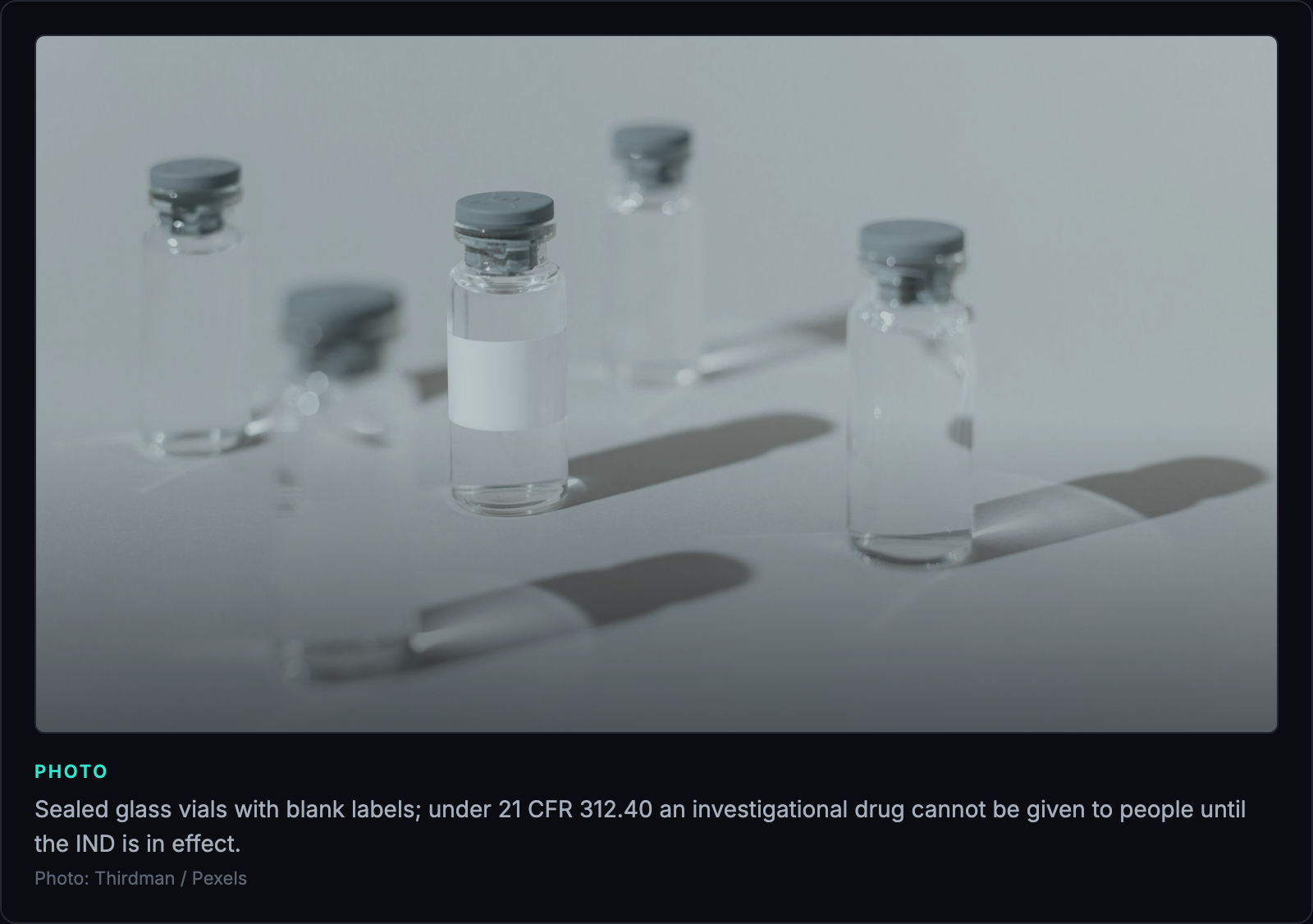
An IND is required whenever a sponsor intends to run a clinical investigation with an investigational new drug that falls under 312.2(a). The sponsor files before any person receives the drug, and 312.40(d) bars an investigator from giving it to anyone until the IND is in effect.
312.2(b) exempts some studies of drugs already lawfully marketed in the US, provided all its conditions hold: the study will not support a new indication or a significant labeling or advertising change, does not raise the risk through route, dose or population, and follows Parts 50 and 56. An IND may cover one or more of the three phases defined in 312.21: Phase 1 (first use in humans), Phase 2 (early controlled studies in patients) and Phase 3 (expanded studies on safety and effectiveness).
Skipping the IND is rare but serious. In the Atlas compilation, one inspection in the period was cited under 312.20(a), "Failure to submit an IND": Prodrome Sciences USA, LLC in Temecula, California, on January 10, 2025. It was classified Official Action Indicated, the most serious outcome.
What are the key IND timelines in 21 CFR Part 312?
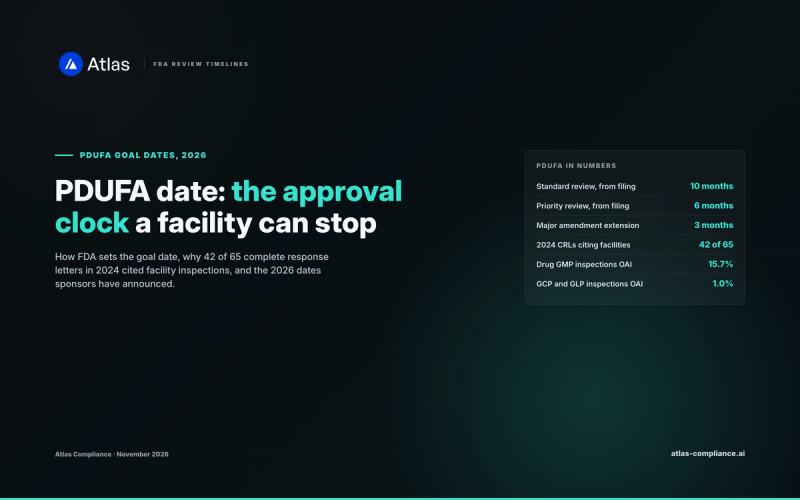
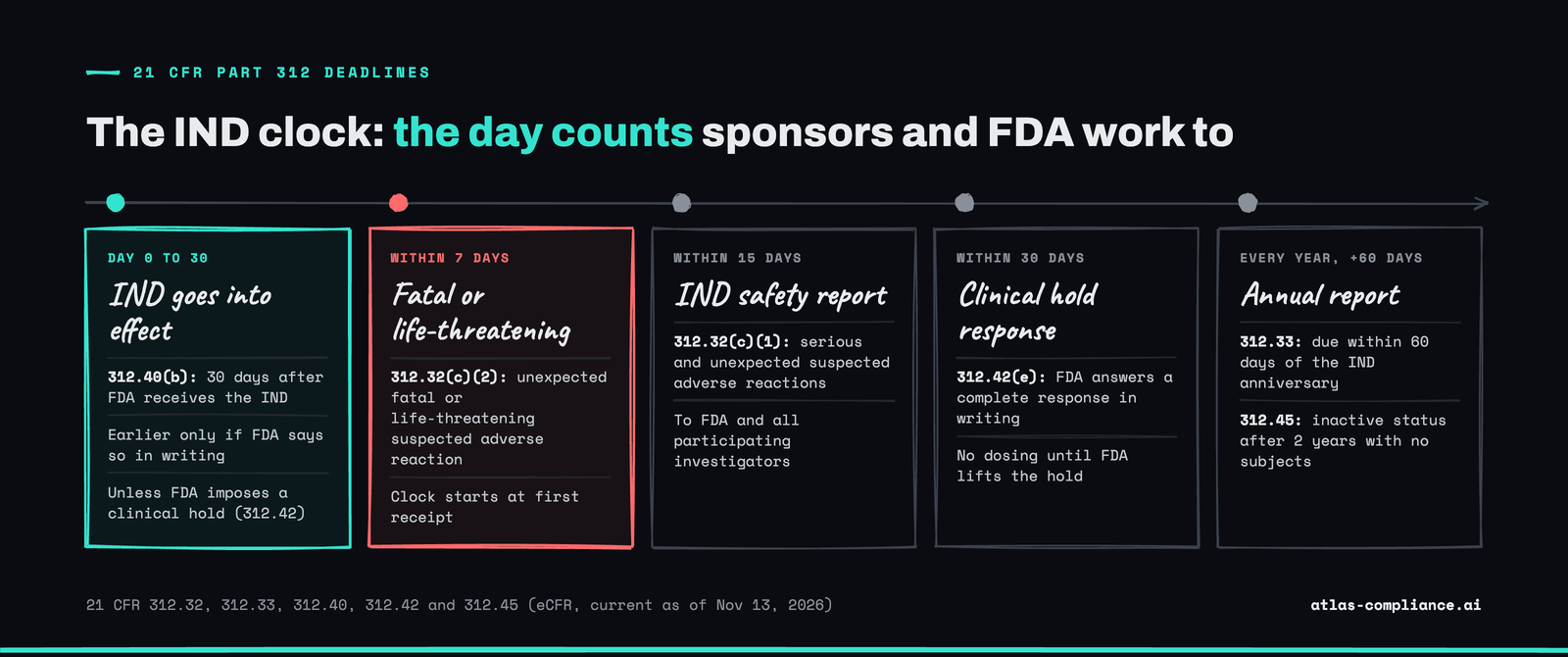
21 CFR Part 312 sets five clocks that sponsors plan around: the 30-day wait before a study starts, the 7-day and 15-day IND safety reports, the 30-day written explanation of a clinical hold, and the annual report due within 60 days of the IND anniversary.
| Clock | Rule | What starts it | Deadline |
|---|---|---|---|
| IND goes into effect | 312.40(b) | FDA receipt of the IND | 30 days, or earlier on FDA notice |
| Fatal or life-threatening report | 312.32(c)(2) | Sponsor's first receipt of the information | 7 calendar days |
| IND safety report | 312.32(c)(1) | Sponsor determines the information qualifies | 15 calendar days |
| Extra data FDA requests | 312.32(c)(1)(v) | FDA request | 15 calendar days |
| Written basis for a clinical hold | 312.42(d) | Imposition of the hold | 30 days |
| FDA answer to a complete response | 312.42(e) | Receipt of the sponsor's complete response | 30 calendar days |
| Annual report | 312.33 | Anniversary of the IND going into effect | Within 60 days |
| Inactive status | 312.45(a) | No subjects entered, or all studies on hold | 2 years, or 1 year on hold |
Two clocks belong to investigators rather than sponsors. 312.64(b) requires an investigator to report any serious adverse event to the sponsor immediately, drug-related or not. Records then run on a retention clock: investigators keep them for 2 years after approval for the indication (312.62(c)), and sponsors for 2 years after approval or after shipment for investigational use stops and FDA is notified (312.57(c)).
Protocol changes follow 312.30. A new protocol, or a change that significantly affects subject safety, scope or scientific quality, may proceed once the sponsor has submitted it to FDA and the IRB has approved it, in either order. A change to remove an apparent immediate hazard to subjects can go in at once, with FDA and the IRB told afterward.
What is a clinical hold under 21 CFR 312.42?
A clinical hold is an order from FDA to the sponsor to delay a proposed clinical investigation or suspend one already running. Under a hold on a proposed study, no subject may receive the drug. Under a hold on an ongoing study, no new subjects may be enrolled, and patients already dosed should come off the drug unless FDA allows otherwise for their safety (312.42(a)).
For a Phase 1 study, 312.42(b)(1) lists the grounds: subjects would face an unreasonable and significant risk of illness or injury, the investigators are not qualified, the investigator brochure is misleading or materially incomplete, or the IND lacks enough information under 312.23 to assess risk. Phase 2 and 3 studies can also be held when the plan is clearly deficient in design to meet its stated objectives.
FDA can impose a hold by telephone. The Division Director must send the written basis within 30 days, and once the sponsor submits a complete response, FDA has 30 calendar days to lift or keep the hold. Dosing restarts only after FDA says so (312.42(e)). Holds are FDA actions, so they do not appear on Form 483s; the citation data below covers how studies are run once they start.
What are sponsor and investigator responsibilities under Part 312?
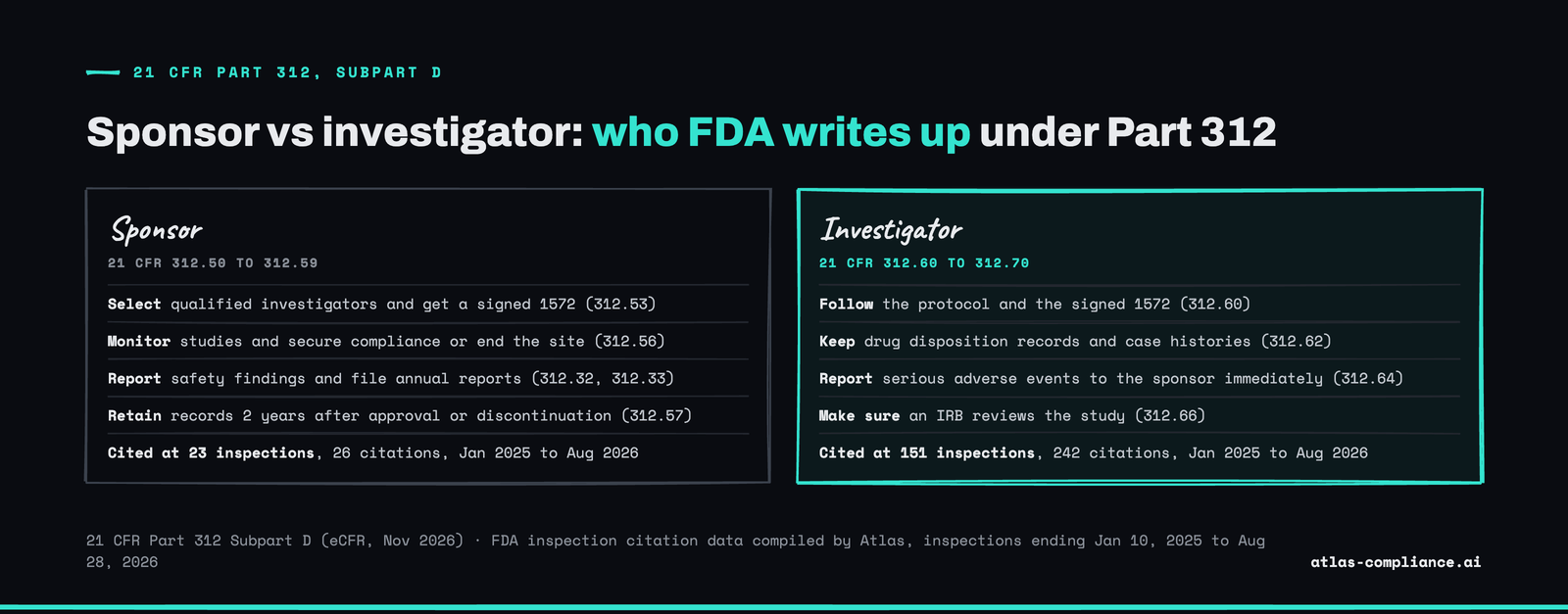
Subpart D divides the work. Sponsors (312.50 to 312.59) pick qualified investigators, give them the information they need, monitor the studies, keep FDA and investigators informed of new risks, and control the drug. Investigators (312.60 to 312.69) run the study as the protocol and the signed Form FDA 1572 say, protect subjects, control the drug, keep records and report to the sponsor.
| Duty | Sponsor | Investigator |
|---|---|---|
| Qualification | Selects qualified investigators and monitors; collects a signed Form FDA 1572 (312.53) | Signs the 1572 and runs the study under it (312.60) |
| Oversight | Monitors progress; secures compliance or ends a noncompliant investigator's participation (312.56) | Gives the drug only to subjects under personal or sub-investigator supervision (312.61) |
| Safety | IND safety reports to FDA and all investigators (312.32) | Immediate report of serious adverse events to the sponsor (312.64(b)) |
| Records | Drug shipment and disposition, financial interests (312.57) | Drug disposition and case histories (312.62) |
| Retention | 2 years after approval or after shipments stop (312.57(c)) | 2 years after approval or after the study is discontinued (312.62(c)) |
An individual who both starts and runs a study is a sponsor-investigator under 312.3(b) and carries both columns. 312.52 lets a sponsor transfer obligations to a contract research organization in writing; any obligation not listed in the transfer stays with the sponsor.
Which 21 CFR Part 312 sections does FDA cite most?
FDA cites 21 CFR 312.60 most often. In FDA citation data compiled by Atlas, 172 inspections ending January 10, 2025 to August 28, 2026 carried at least one Part 312 citation, and 116 of them cited 312.60, "FD-1572, protocol compliance." Case history records under 312.62(b) followed at 68 inspections. Together those two paragraphs account for 189 of the 269 Part 312 citations.

| Paragraph | FDA short description | Inspections | Most recent inspection end date |
|---|---|---|---|
| 312.60 | FD-1572, protocol compliance (plus 6 informed consent citations) | 116 | Aug 28, 2026 |
| 312.62(b) | Case history records | 68 | Aug 28, 2026 |
| 312.64(b) | Safety reports, serious and non-serious events | 22 | Jul 2, 2026 |
| 312.50 | General responsibilities of sponsors | 18 | Jul 2, 2026 |
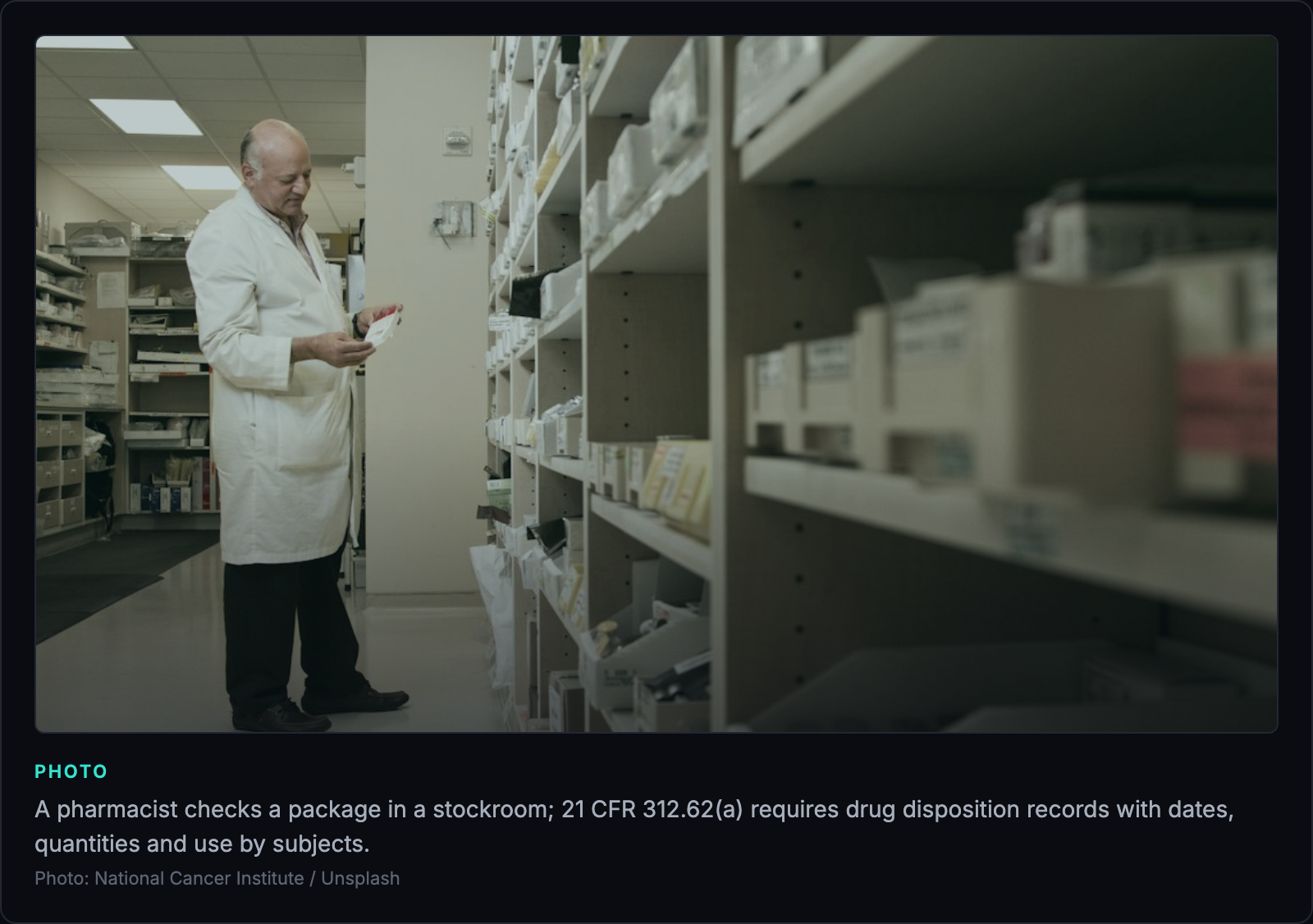
| 312.62(a) | Accountability records | 10 | Jan 23, 2026 |
| 312.66 | Unanticipated problems, changes in research, IRB review | 9 | Apr 1, 2026 |
| 312.62(c) | Record retention | 6 | Jun 18, 2026 |
| 312.56 | Monitoring, investigator noncompliance, annual and safety reports | 5 | Jun 22, 2026 |
| 312.53(c) | Investigator statement (Form FDA 1572) | 2 | Mar 2, 2026 |
The split by role is lopsided. Investigator sections drew 242 citations at 151 inspections. Sponsor sections drew 26 citations at 23 inspections, and 3 inspections cited both, which is what a sponsor-investigator inspection looks like. Most findings are single items: 103 of the 172 inspections carried exactly one Part 312 citation.
Sponsor citations in 2026 show what FDA checks at the sponsor's desk:
- Vera Therapeutics, Brisbane, California, Form 483 of March 2, 2026: 312.50 and 312.53(c)(1), the investigator statement.
- Axsome Therapeutics, New York, Form 483 of February 6, 2026: 312.50 and 312.56(b), notifying FDA when an investigator is terminated.
- Elevar Therapeutics, Fort Lee, New Jersey, Form 483 of May 20, 2026: 312.56(b), investigator noncompliance.
- Abbisko Therapeutics, Pudong New Area, China, Form 483 of March 20, 2026: 312.50, at a sponsor outside the US.
- Protagonist Therapeutics, Newark, California, Form 483 of April 3, 2026: 312.50.
Each record lists the cited sections and the investigators tied to the inspection. The full set is searchable in the FDA Form 483 database, and the guide to what a Form 483 is explains how to read one.
If your study runs at a site or sponsor office FDA is likely to visit, the investigator assigned matters as much as the rule cited.
 Atlas
See what the FDA knows about your next investigator.
30 minutes with the founder. No pitch deck.
How do Part 312 inspections end?
Most Part 312 inspections end with no action. Counting only drug and biologic inspections, the products Part 312 governs, FDA closed 829 clinical investigator inspections between January 8, 2025 and September 17, 2026: 655 No Action Indicated, 168 Voluntary Action Indicated and 6 Official Action Indicated, so 21.0% ended with findings. Sponsor and CRO inspections ran at 137, with 111 NAI, 25 VAI and 1 OAI, or 19.0% with findings.
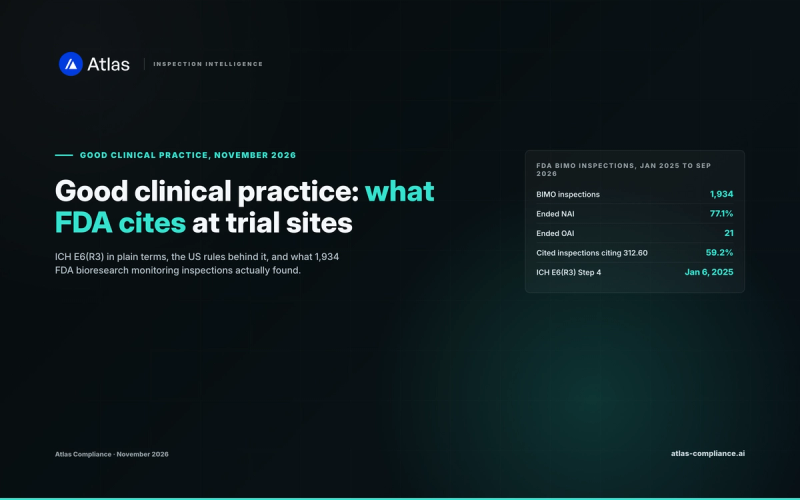
The source is FDA inspection classification data compiled by Atlas from the bioresearch monitoring program, pulled October 21, 2026. These figures leave out device studies, IRBs and bioequivalence work, which the good clinical practice guide covers across all 1,934 bioresearch monitoring inspections.
Among the 172 inspections that carried a Part 312 citation, 151 were classified VAI and 10 OAI. All 10 OAI inspections involved drugs. Six were clinical investigator sites, three were bioequivalence studies (two in India), and one was the 312.20(a) case above. Their citations repeat the same short list: 312.60, 312.62(b), 312.62(c) and, in one case, six citations covering protocol, records, safety reports and IRB review. For what VAI and OAI mean in practice, see NAI, VAI and OAI explained.
What changes to Part 312 take effect in 2027?
The next change to Part 312 is a wording change. FDA published the "Nonclinical Testing Terminology" direct final rule in the Federal Register on September 22, 2026 (91 FR 60003). It replaces references to "animal" and "preclinical" studies with "nonclinical" studies, adds a definition, and touches the safety reporting and annual report sections, 312.32 and 312.33. The rule is effective February 4, 2027, and FDA states it adds no new requirements. A sponsor's SOPs that quote 312.32(c)(1)(iii) or 312.33(b)(6) word for word will need the new wording after that date.
Marketing applications that follow the IND sit under different parts: NDAs under Part 314 and BLAs under Part 601. The BLA vs NDA guide shows where the IND ends and approval review begins, and the manufacturing side of the same product falls under 21 CFR Part 211.
Atlas tracks new Form 483s and warning letters each week, including the Part 312 citations that reach sponsors and trial sites.
AtlasFDA Inspection Intelligence Digest
We track every 483, EIR, and warning letter the moment it happens. Get the signals before they hit the FDA website.
Frequently asked questions
21 CFR Part 312 governs clinical investigations of drugs and biologics under an investigational new drug application. 21 CFR Part 812 governs investigational device exemptions (IDEs) for medical device studies. Both rely on Part 50 for informed consent and Part 56 for IRB review, and FDA inspects both through its bioresearch monitoring program, but the submission, the risk categories and the reporting rules differ.

Written by
Bhavish Agarwal
Founder, Atlas
Bhavish Agarwal is the founder of Atlas and previously worked at Google and Microsoft. He has spent the past several years building regulatory data infrastructure for the pharmaceutical industry.