
Water for injection (WFI) is a pharmacopeial grade of water that is purified by distillation or an equivalent process and held to a bacterial endotoxin limit of less than 0.25 EU/mL, so that it can be used to make parenteral drugs and to rinse product contact surfaces. Bulk WFI is not sterile. Sterile water for injection is a separate, packaged and sterilized product.
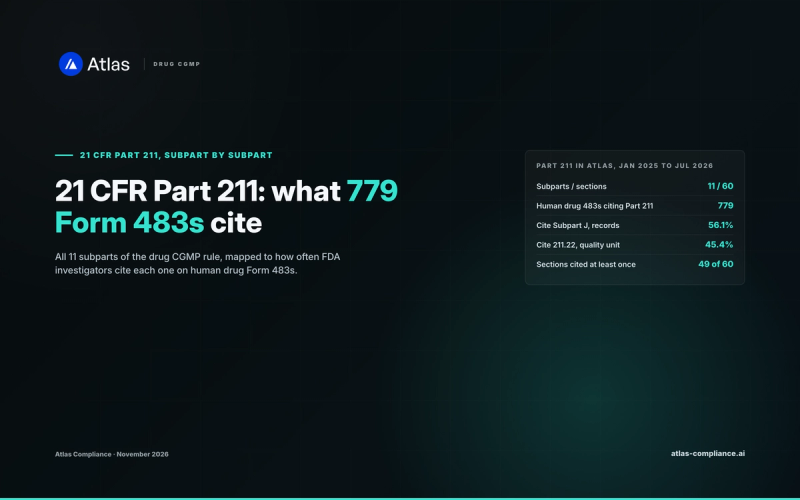
This guide sets the WFI specification next to purified water and adds what most pages leave out: how often FDA investigators cited the water and equipment sections of 21 CFR Part 211 at 774 drug inspections that closed between January 7, 2025 and September 3, 2026, from the Atlas Form 483 citation dataset (pulled October 2026) joined to FDA's inspection classifications.
Key facts:
- Water for injection carries a bacterial endotoxin limit of less than 0.25 EU/mL; purified water carries the same TOC and conductivity tests but no routine endotoxin limit.
- FDA's Guide to Inspections of High Purity Water Systems (July 1993) calls less than 10 CFU per 100 mL an acceptable action limit for WFI, and any action limit over 100 CFU per mL unacceptable for purified water.
- Since April 1, 2017, Ph. Eur. monograph 0169 has allowed WFI made by reverse osmosis coupled with other techniques, not only by distillation, according to EMA's 2020 water quality guideline.
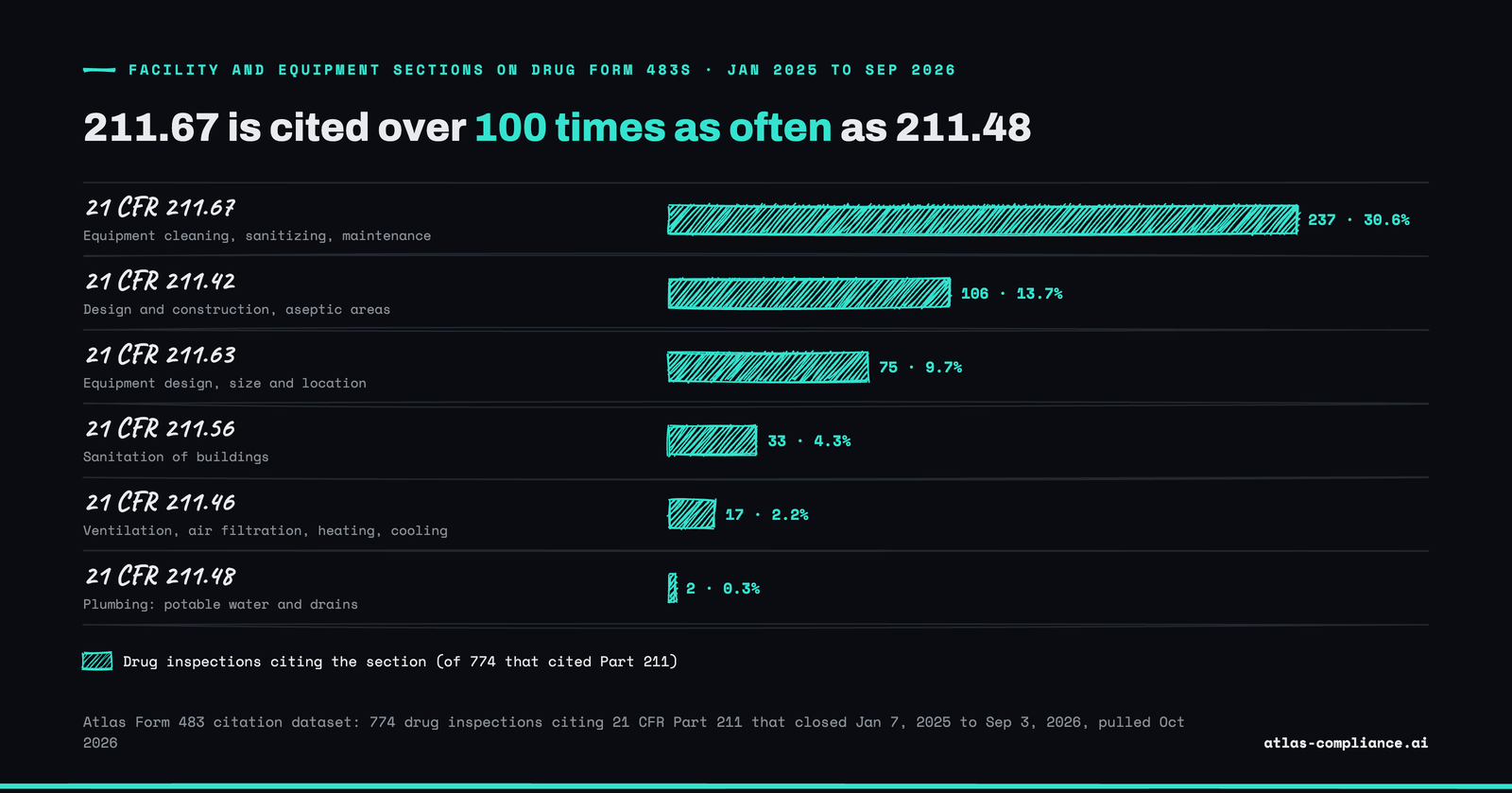
- FDA cited 21 CFR 211.48, the plumbing and potable water section, at 2 of 774 Part 211 drug inspections (0.3%), and both ended Official Action Indicated (OAI).
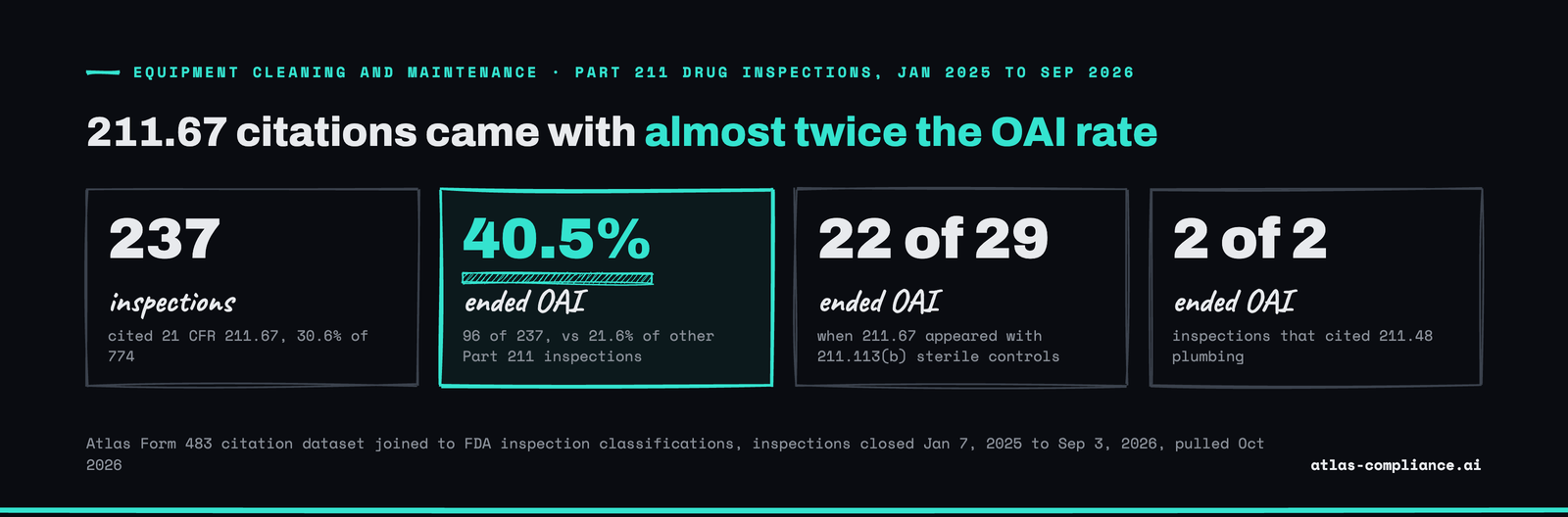
- FDA cited 21 CFR 211.67, equipment cleaning and maintenance, at 237 of the same 774 inspections (30.6%), and 40.5% of those ended OAI against 21.6% of the rest.
What is water for injection used for?
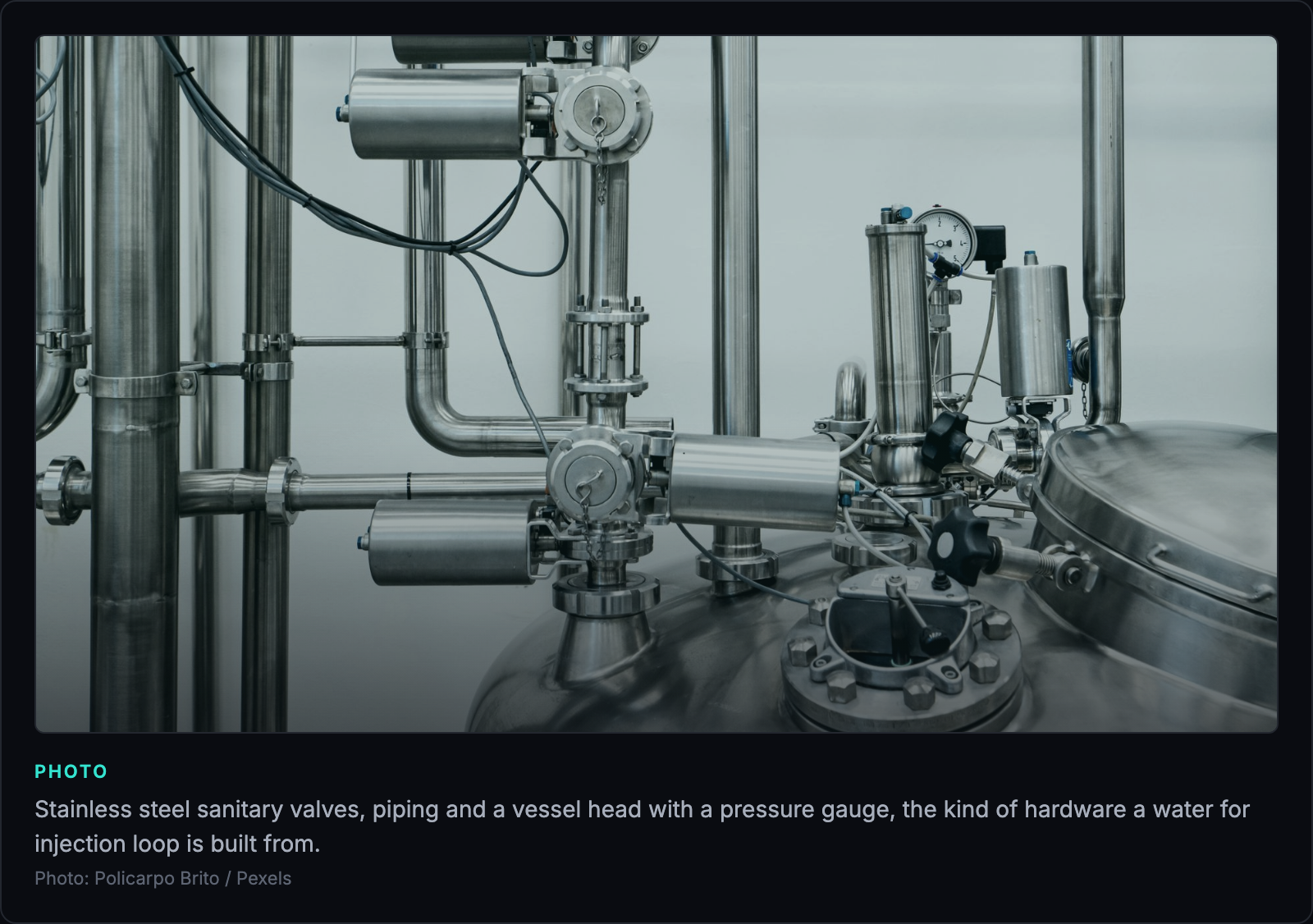
Water for injection is used as the solvent and diluent in parenteral manufacturing, as the final rinse for equipment and containers that touch sterile product, and as the feed water for clean steam in many facilities. Any step where water ends up in, or on the way into, an injectable product calls for WFI quality.
The pharmacopoeias define the grade by its source and its process. The source is drinking water: FDA's 1993 guide notes that the USP requirement for the feed is compliance with EPA drinking water regulations, the standards now in 40 CFR Part 141. The process is distillation or, in the USP wording quoted in EMA's 2020 guideline, a purification process "equivalent or superior to distillation".
Part 211 contains no WFI specification. The specification comes from the USP monograph, and the Part 211 sections on plumbing, equipment, process control and investigations decide how FDA inspects the system that makes it.
WFI vs purified water: what is the difference?
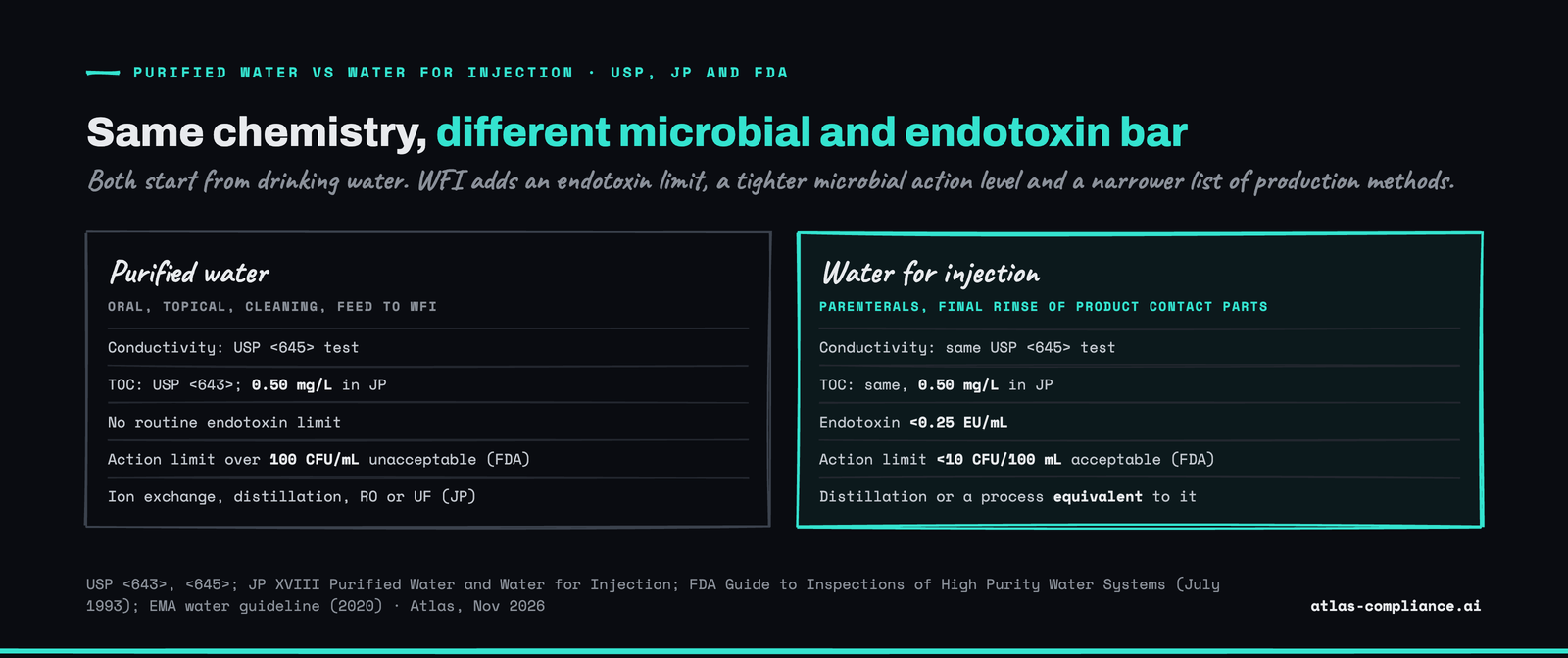
The difference between WFI and purified water is the microbial and endotoxin bar, plus the production method. Both grades share the same chemistry tests: water conductivity under USP 645 and total organic carbon under USP 643. The Japanese Pharmacopoeia sets TOC at not more than 0.50 mg/L (500 ppb) for both grades. Only WFI has an endotoxin limit, and its microbial action level is a thousand times tighter per mL.
| Attribute | Purified water | Water for injection |
|---|---|---|
| Typical use | Oral and topical products, cleaning, feed to WFI | Parenteral products, final rinse of product contact parts |
| Conductivity | USP 645 test | Same test |
| Total organic carbon | USP 643 test; 0.50 mg/L (500 ppb) in the JP monograph | Same |
| Bacterial endotoxins | No routine limit | Less than 0.25 EU/mL |
| Microbial action level (FDA 1993 guide) | Over 100 CFU/mL unacceptable | Less than 10 CFU/100 mL acceptable |
| Production method | Ion exchange, distillation, RO or ultrafiltration (JP) | Distillation or an equivalent process |
The microbial numbers are action levels, not release specifications. FDA's Guide to Inspections of High Purity Water Systems (July 1993) states that none of the limits for water are pass or fail limits and that no microbial specification other than the EPA standards had been set, so firms set alert and action levels from their own validation data under that ceiling.
Our endotoxin testing guide covers how the 0.25 EU/mL limit is tested with LAL and recombinant reagents.
How is water for injection made?
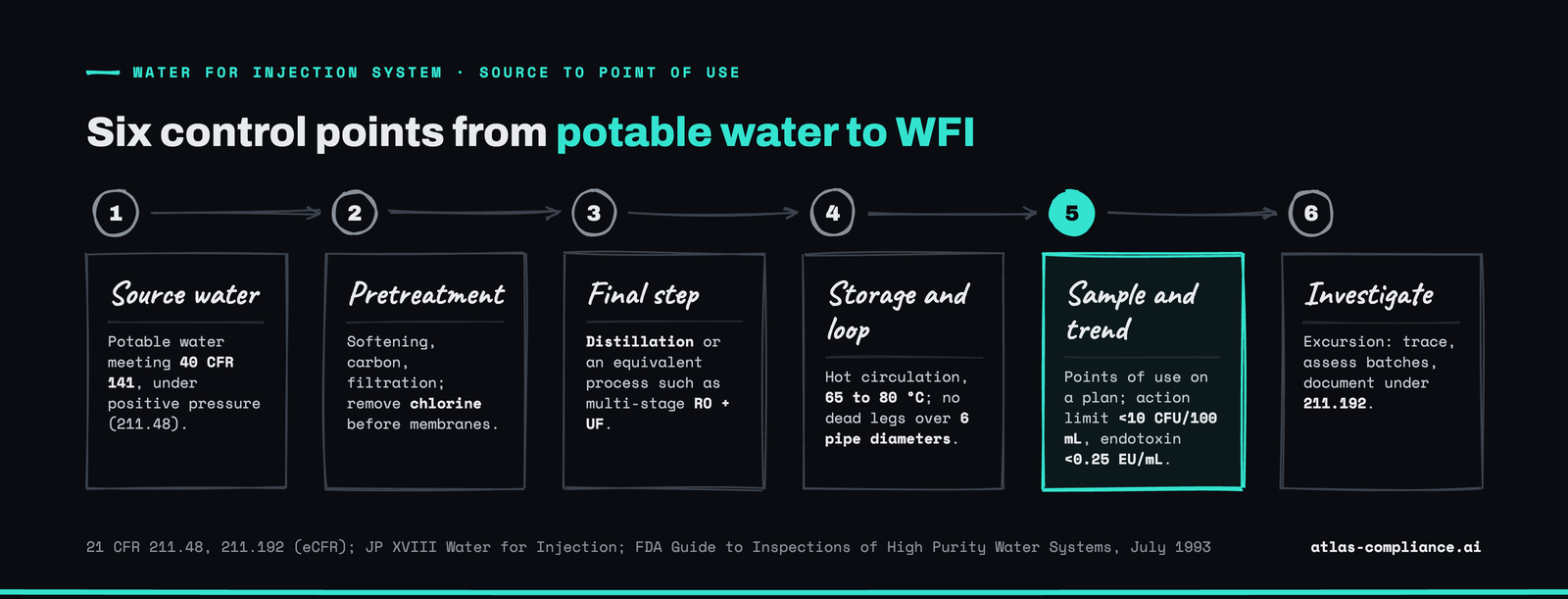
Water for injection is made in a validated system of six control points: potable source water, pretreatment, a final purification step, hot storage and circulation, sampling at points of use, and investigation of excursions. The final step is the one the pharmacopoeias regulate by name.
- Source water meets 40 CFR Part 141, and under 21 CFR 211.48(a) arrives under continuous positive pressure in a plumbing system free of defects.
- Pretreatment (softening, activated carbon, filtration) removes hardness, organics and chlorine that would damage membranes or stills.
- The final step is multiple-effect or vapor compression distillation, or, where the pharmacopoeia allows it, a multi-stage reverse osmosis system followed by ultrafiltration or electrodeionization.
- The storage tank and distribution loop keep the water moving. FDA's 1993 guide says hot systems at 65 to 80 °C are self-sanitizing and cites the proposed LVP rule that dead legs in a 75 to 80 °C loop should be no longer than six diameters of the unused pipe.
- The firm samples at each point of use on a written plan and trends the results against alert and action levels.
- Any excursion goes to a documented investigation under 21 CFR 211.192, including an assessment of every batch made with that water.
Europe changed its rule in 2017. EMA's 2020 Guideline on the quality of water for pharmaceutical use records that the revised WFI monograph 0169, published in Ph. Eur. Supplement 9.1 and effective April 1, 2017, allows reverse osmosis, single or double pass, coupled with techniques such as electrodeionization, ultrafiltration or nanofiltration. EU GMP Annex 1, revised in 2022, adds design and monitoring expectations for WFI systems; our EU GMP Annex 1 guide sets those rules against FDA findings.
Validation follows the three phases in FDA's 1993 guide. Phase 1 runs two to four weeks of intensive sampling, daily after each purification step and at each point of use, to set operating parameters. Phase 2 repeats the sampling while the system runs under its final procedures. Phase 3 shows the system keeps producing water of the required quality over a long period. The guide treats validation as complete only when that year of data exists.
How often does FDA cite water systems on Form 483s?
FDA rarely cites water by its own section. In the Atlas Form 483 citation dataset, 21 CFR 211.48 appeared at 2 of 774 Part 211 drug inspections (0.3%) that closed between January 7, 2025 and September 3, 2026. Equipment cleaning and maintenance under 211.67 appeared at 237 (30.6%), and equipment design under 211.63 at 75 (9.7%).
The two 211.48 citations show both halves of the section. A facility in North Oxford, Massachusetts was cited in April 2025 under 211.48(b) for drains connected directly to a sewer without an air break or other device to prevent back-siphonage. International Medication Systems in South El Monte, California was cited on December 19, 2025 under 211.48(a) because the potable water permitted into its potable water system did not meet the EPA standards. Both inspections ended OAI.
The International Medication Systems site has 30 FDA inspections on record in Atlas, 13 of them ending in a Form 483. The December 2025 inspection team included an investigator with 100 inspections at 97 sites and 313 Form 483 observations on record. FDA followed with Warning Letter 320-26-99 on July 2, 2026, which cites 21 CFR 211.192, 211.42(c)(10), 211.113(b) and 211.63; the letter does not repeat the potable water observation. The Form 483 itself is noindexed in Atlas, so it is not linked here.
The Atlas FDA Form 483 database shows the same pattern at the heading level. Of the 7,117 Form 483s in the directory issued from January 2, 2025 to July 20, 2026 (release of August 15, 2026), one human drug form carries a "Potable water standards not met" heading, the International Medication Systems form above.
The low count does not mean investigators skip water systems. FDA's public citation data assigns each observation one CFR section, and a loop that grows biofilm, a still that is not maintained, or a sanitization that is not followed usually lands under equipment, process control or investigation sections rather than 211.48.
What does a 211.67 citation signal about the inspection?
A 211.67 citation signals a heavier inspection outcome. In the Atlas data, 96 of the 237 drug inspections that cited 211.67 ended OAI (40.5%), against 116 of the other 537 Part 211 drug inspections (21.6%). When 211.67 appeared together with 211.113(b), the sterile process section, 22 of 29 inspections ended OAI.
21 CFR 211.67 has three parts. Paragraph (a) requires equipment to be cleaned, maintained and, where appropriate, sanitized or sterilized at intervals that prevent contamination; it was cited at 122 inspections. Paragraph (b) requires written cleaning and maintenance procedures with assigned responsibility, schedules and methods; also 122 inspections. Paragraph (c) requires the records, cited at 10. A WFI still, storage tank and loop are equipment under this section, and their sanitization schedule is a 211.67(b) procedure.
Four sterile drug manufacturers in the Atlas directory show how 211.67 sits beside sterile process citations. Public Form 483 data gives the section and heading, not the equipment, so these forms do not show whether a water system was involved.
| Facility | Form 483 date | 211.67 heading | Other sections on the form | Classification |
|---|---|---|---|---|
| B. Braun US Pharmaceutical Manufacturing, Irvine, US | Nov 21, 2025 | 211.67(a) Cleaning / Sanitizing / Maintenance | 211.160(b)(3), 211.165(f), 211.192, 211.22(d), 211.80(a) | OAI |
| Sharp Sterile Manufacturing, Lee, US | Mar 5, 2026 | 211.67(a) Cleaning / Sanitizing / Maintenance | 211.113(b), 211.192, 211.22(d), 211.42(c)(10)(v), 211.56(a) | OAI |
| American Regent, Shirley, US | Apr 21, 2026 | 211.67(a) Cleaning / Sanitizing / Maintenance | 211.100(a), 211.113(b), 211.192, 211.22(d), 211.42(c)(10)(iv), 211.63, 211.68(b) and 2 more | Not in the October 2026 file |
| Samchundang Pharm, Hwaseong, Korea | May 19, 2026 | 211.67(a) Cleaning / Sanitizing / Maintenance | 211.100(a), 211.113(b) twice, 211.192, 211.198(a), 211.42(c)(10) and (c)(10)(iv) | OAI |
The B. Braun Irvine site has 25 FDA inspections on record, 11 ending in a Form 483, and its November 2025 team included an investigator with 176 inspections at 152 sites on record. Our cleaning validation guide covers the 211.67 procedures in detail.
Investigators who have written equipment and sterile process observations before tend to ask for the same records again, and their past forms list which ones.
 Atlas
See what the FDA knows about your next investigator.
30 minutes with the founder. No pitch deck.
What do investigators check in a WFI system?
Investigators check whether the water system is in a state of control, using records more than the hardware itself. FDA's 1993 guide points them at the drawings, the validation data, the sampling plan and the trend of results, and at how the firm reacted when results crossed an action limit.
The records an investigator usually asks for:
- An as-built drawing of the system, compared against a walkdown, to find dead legs, low points and unsanitized branches.
- The validation report with all three phases and the full year of data.
- The sampling procedure and the points of use it covers, including hoses and drops used in production.
- Trend charts for microbial counts, endotoxin, TOC and conductivity, with the alert and action levels and how they were set.
- Deviation and investigation records for each excursion, with the batch impact assessment that 211.192 requires.
- Maintenance and sanitization records for the still, tank, heat exchangers and pumps under 211.67(c).
Heat exchangers draw specific attention. The 1993 guide asks for pressure gauges that show the clean side always runs at higher pressure, or double tubesheet designs, so that a pinhole leak pushes WFI outward instead of drawing coolant in. The 21 CFR Part 211 guide maps where each of these controls sits in the regulation, and the media fill test guide covers the aseptic validation that depends on WFI quality.
Atlas tracks new Form 483s and warning letters as FDA releases them, including the plumbing, equipment and sterile process citations covered here.
AtlasFDA Inspection Intelligence Digest
We track every 483, EIR, and warning letter the moment it happens. Get the signals before they hit the FDA website.
Frequently asked questions
Bulk water for injection is not sterile. The monograph controls endotoxin, chemistry and the production process, and the microbial level is managed through action levels such as 10 CFU per 100 mL. Sterile water for injection is a different article: WFI that is filled into sealed containers and sterilized, or sterilized first and filled aseptically, as the Japanese Pharmacopoeia monograph describes.

Written by
Bhavish Agarwal
Founder, Atlas
Bhavish Agarwal is the founder of Atlas and previously worked at Google and Microsoft. He has spent the past several years building regulatory data infrastructure for the pharmaceutical industry.