
USP 800 is the United States Pharmacopeia general chapter, "Hazardous Drugs: Handling in Healthcare Settings", that sets the practice and quality standards for receiving, storing, compounding, dispensing, administering and disposing of hazardous drugs to protect patients, workers and the environment. It applies to every person and entity that handles hazardous drugs, from hospital pharmacies to compounding pharmacies and clinics.
This guide adds what the requirement summaries leave out: the Atlas Form 483 directory (release of August 15, 2026), where 50 of 397 Form 483s issued to compounding pharmacies from February 2013 to June 2026 carry a hazardous or highly potent drug containment heading.
Key facts:
- USP published General Chapter 800 on February 1, 2016, with an official date of December 1, 2019; it became compendially applicable through USP 795 and 797 on November 1, 2023, to the extent those chapters apply.
- The NIOSH List of Hazardous Drugs in Healthcare Settings, 2024 (DHHS NIOSH Publication 2025-103) is the reference list; each entity keeps its own list and reviews it at least every 12 months.
- Antineoplastic hazardous drugs that need manipulation and hazardous drug active pharmaceutical ingredients must follow every containment requirement; other dosage forms may be handled under a documented assessment of risk.
- A containment secondary engineering control (C-SEC) is externally vented and held at 0.01 to 0.03 inches of water column negative pressure to adjacent areas.
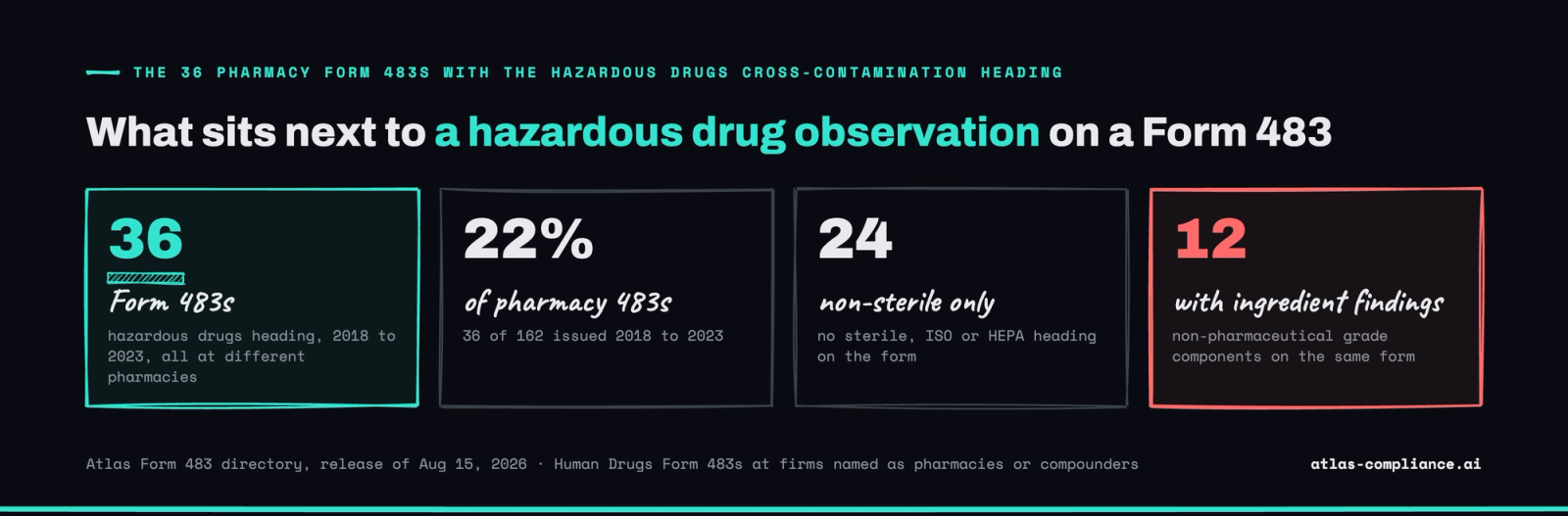
- In the Atlas record, 36 of 162 compounding pharmacy Form 483s issued from 2018 to 2023 (22%) carry the heading "Hazardous drugs, prevention of cross-contamination".
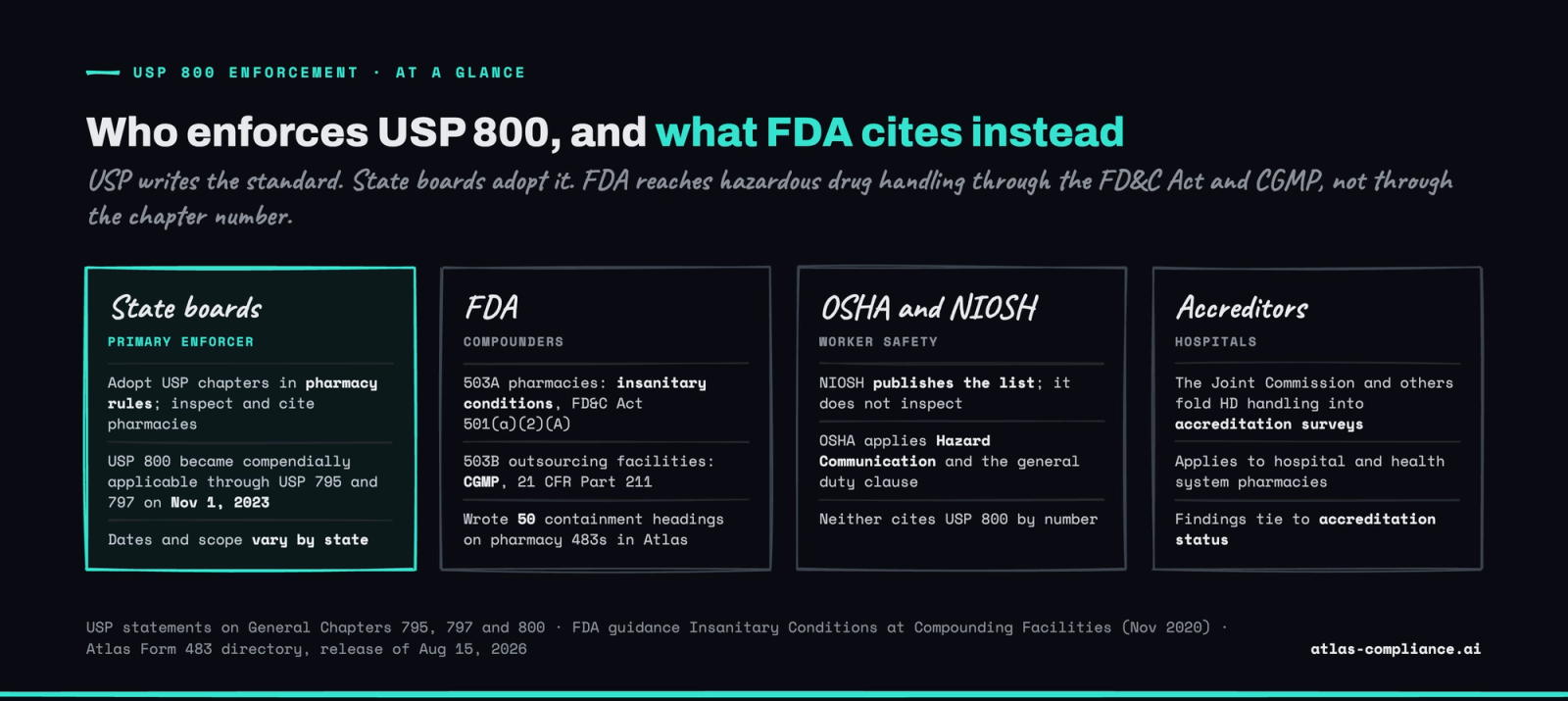
- FDA does not enforce USP 800 by number; state boards of pharmacy do, while FDA cites hazardous drug handling at 503A pharmacies as an insanitary condition under section 501(a)(2)(A) of the FD&C Act.
What is USP 800?
USP 800 is the standard that tells a healthcare entity how to keep hazardous drugs away from the people who handle them. A hazardous drug is one that is carcinogenic, toxic to development or reproduction, toxic to organs at low doses, or genotoxic, and most entities start from the NIOSH list to identify them. Chemotherapy agents are the best known group, but the list also covers hormones, some antivirals, immunosuppressants and other drugs.
The chapter covers the whole path of a hazardous drug through an entity: receipt, storage, compounding (sterile and nonsterile), dispensing, transport, administration, spill control, and disposal. It sits beside two other USP chapters. USP 797 governs sterile compounding and USP 795 governs nonsterile compounding; when either involves a hazardous drug, USP 800 adds the containment and worker-protection layer on top.
| USP 800 | |
|---|---|
| Full title | Hazardous Drugs: Handling in Healthcare Settings |
| Published | February 1, 2016 |
| Official date | December 1, 2019 |
| Compendially applicable | November 1, 2023, through USP 795 and 797 |
| Reference list | NIOSH List of Hazardous Drugs in Healthcare Settings, 2024 |
| Who enforces it | State boards of pharmacy and other state agencies; accreditors fold it into surveys |
What does USP 800 require?
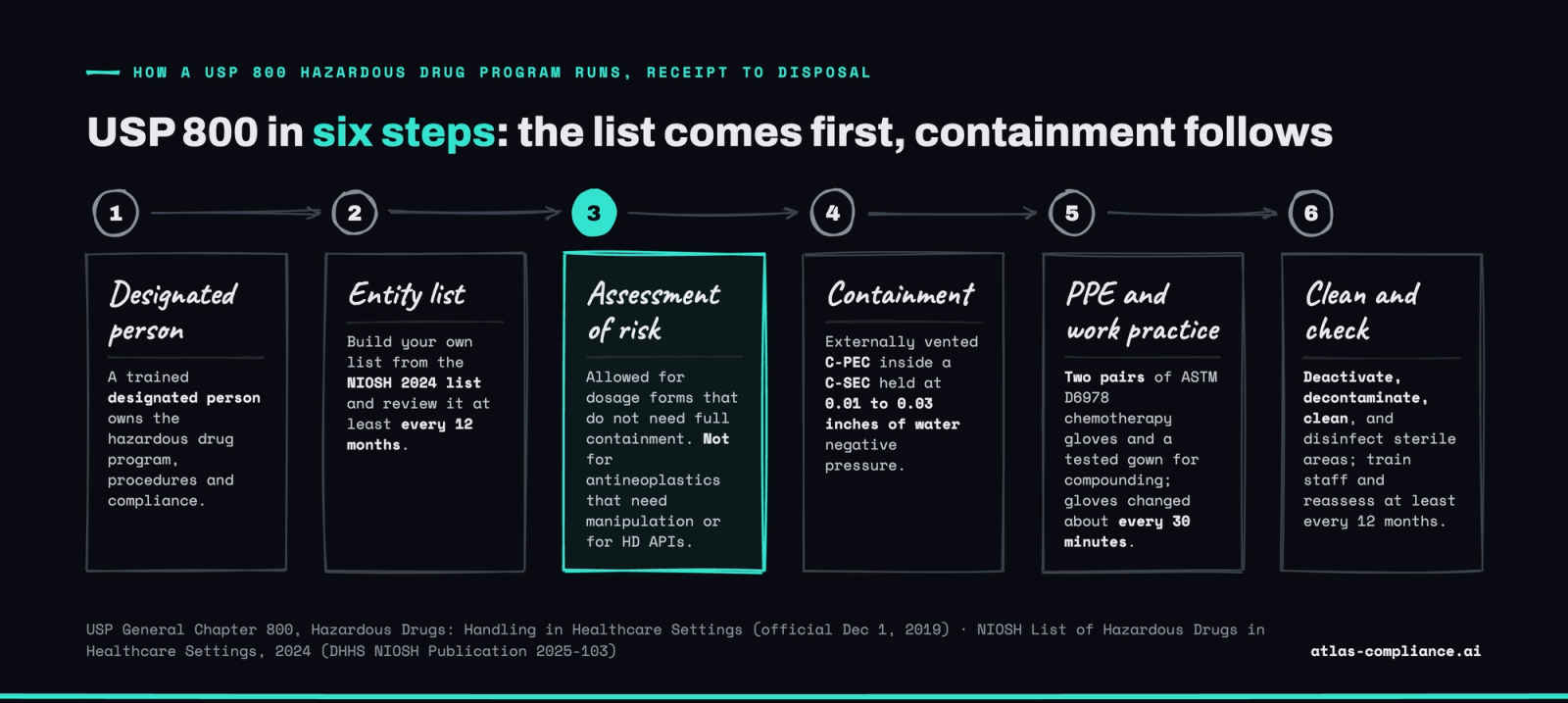
USP 800 requires an entity to name a designated person, keep a list of the hazardous drugs it handles, contain those drugs with engineering controls, protect staff with tested PPE, clean surfaces with a four-step process, and train every handler before work starts. The requirements below are a summary, not the chapter text; read the current official chapter before writing procedures.
- Designated person. One qualified, trained person develops and implements the hazardous drug procedures and oversees compliance.
- Entity list. The entity builds its own list from the NIOSH list, adds any new drug or dosage form as it arrives, and reviews the list at least every 12 months.
- Assessment of risk. For drugs and dosage forms that do not need full containment, the entity may document an assessment of risk instead.
- Engineering controls. Compounding happens in a containment primary engineering control (C-PEC) placed in a containment secondary engineering control (C-SEC).
- PPE. Gowns shown to resist hazardous drug permeability and two pairs of chemotherapy gloves for compounding.
- Cleaning. Deactivation, decontamination, cleaning, and disinfection for sterile areas.
- Training and surveillance. Training before handling, competency reassessed at least every 12 months, and medical surveillance for workers as part of the program.
What is the NIOSH list of hazardous drugs?
The NIOSH list of hazardous drugs is the federal reference list that USP 800 tells entities to start from. NIOSH published the 2024 update in December 2024 as DHHS NIOSH Publication 2025-103. The update replaced the three groups of the 2016 list with two tables: Table 1 holds drugs that carry manufacturer special handling information or a carcinogen classification from the National Toxicology Program or IARC, and Table 2 holds the remaining hazardous drugs. According to NIOSH, the update added 25 drugs and removed 7 compared with the 2016 list, so an entity list built in 2019 needs a fresh review.
What is an assessment of risk under USP 800?
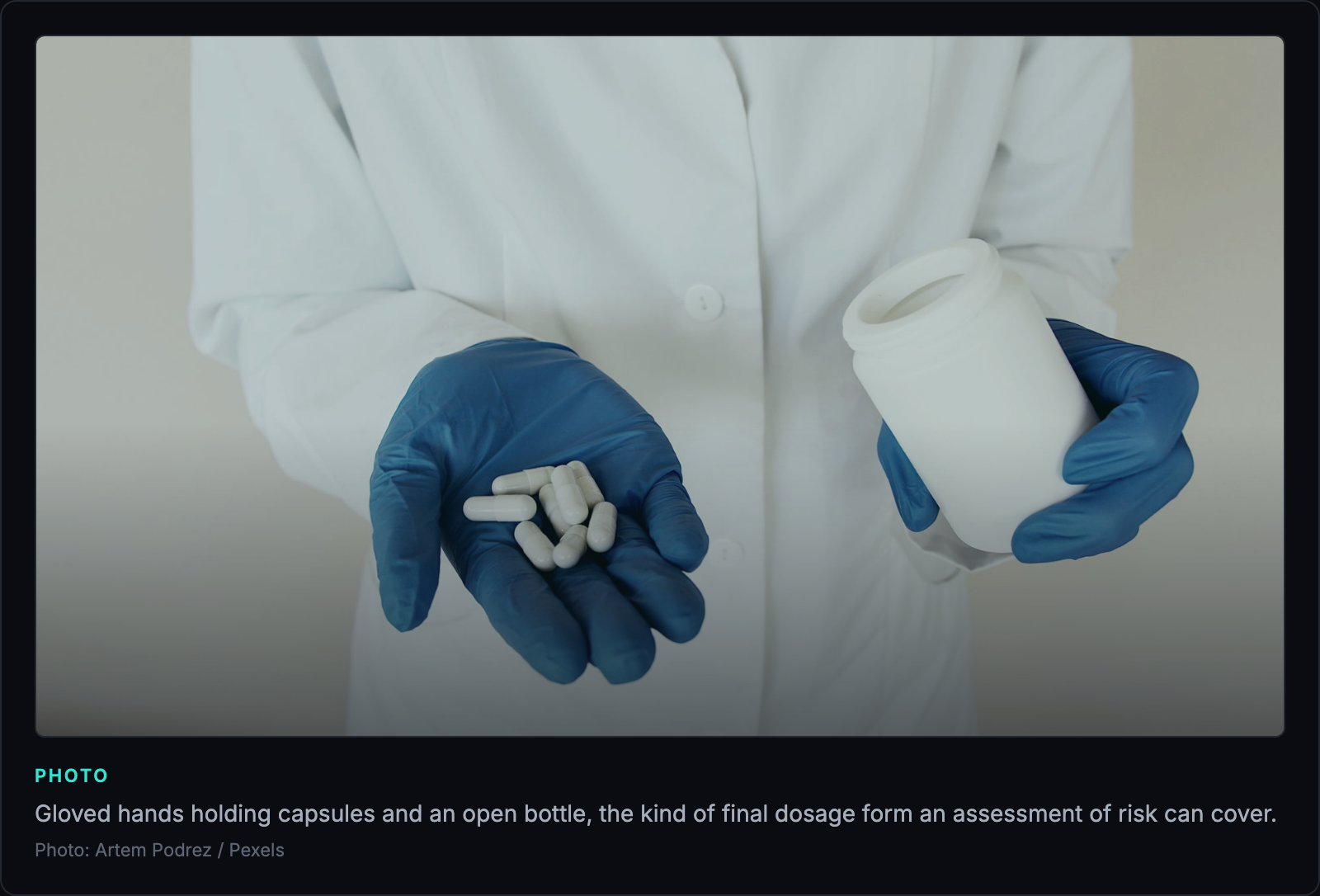
An assessment of risk is a documented decision to handle a hazardous drug dosage form with alternative containment or work practices instead of every containment requirement in USP 800. It can cover final dosage forms such as tablets and capsules that are only counted or repackaged. It cannot cover antineoplastic hazardous drugs that need manipulation or any hazardous drug active pharmaceutical ingredient; those always need full containment. The assessment considers at least the type of drug, the dosage form, the risk of exposure, the packaging and the manipulation, and the entity reviews and documents it at least every 12 months.
What are the USP 800 engineering controls?
USP 800 engineering controls are the two layers that keep hazardous drug residue inside the compounding area: a C-PEC that the worker reaches into, and a C-SEC, the room that holds it. Both must be externally vented for most hazardous drug work.
| Control | What it is | Key numbers |
|---|---|---|
| C-PEC, nonsterile | A ventilated device such as a containment ventilated enclosure, a biological safety cabinet or a compounding aseptic containment isolator | Externally vented |
| C-PEC, sterile | A Class II biological safety cabinet or a compounding aseptic containment isolator | Provides the ISO Class 5 work zone |
| C-SEC, nonsterile | A separate room, no ante-room needed | 0.01 to 0.03 inches of water column negative; at least 12 air changes per hour |
| C-SEC, sterile buffer room | ISO Class 7 buffer room with an ISO Class 7 ante-room | Negative pressure; at least 30 air changes per hour of HEPA-filtered air |
| Containment segregated compounding area | An unclassified room for sterile work without a buffer room | Negative pressure; at least 12 air changes per hour; shorter beyond-use dates |
Storage follows the same logic. Antineoplastic hazardous drugs that need manipulation and hazardous drug active ingredients are stored apart from other inventory in an externally vented, negative pressure room with at least 12 air changes per hour, and hazardous drugs are unpacked in an area that is not positive pressure.
What PPE does USP 800 require?
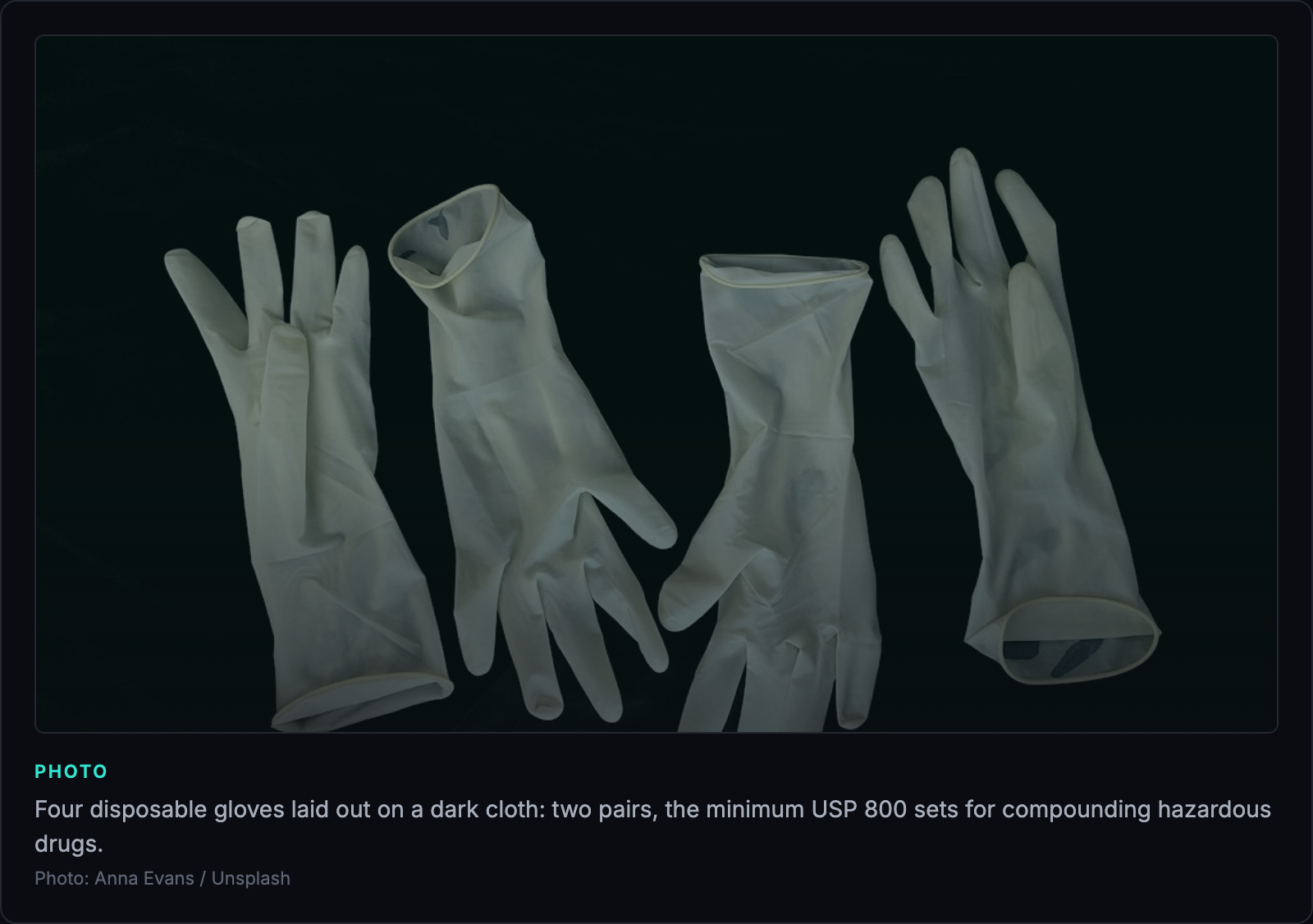
USP 800 requires two pairs of chemotherapy gloves tested to ASTM D6978 and a gown shown to resist permeability by hazardous drugs for compounding, plus head, hair and shoe covers. Gloves are changed about every 30 minutes, or on the schedule in the manufacturer's permeation data, and immediately when torn, punctured or contaminated. Eye and face protection is needed where splashes are possible, and respiratory protection applies to spill cleanup and some unpacking tasks.
Closed-system drug-transfer devices are part of the same layer. USP 800 requires them for administering antineoplastic hazardous drugs when the dosage form allows and recommends them for compounding.
How does USP 800 cleaning work?
USP 800 cleaning is a four-step sequence: deactivation renders the drug inert, decontamination removes the residue, cleaning removes organic and inorganic material, and disinfection kills microorganisms in sterile compounding areas. Each step uses an agent chosen for that purpose, and the worker wears full PPE throughout. USP 800 also describes environmental wipe sampling as a way to check surfaces for hazardous drug residue, starting with a baseline. The cleaning validation guide covers how manufacturers set residue limits, a related problem for facilities that make highly potent drugs.
Who enforces USP 800?
State boards of pharmacy enforce USP 800, not FDA. Many states adopt USP chapters by reference in their pharmacy rules, so the board inspects pharmacies against them and the state sets its own effective dates and scope. Accreditors such as The Joint Commission fold hazardous drug handling into hospital surveys. NIOSH publishes the list but does not inspect, and OSHA applies its Hazard Communication standard and the general duty clause rather than the chapter itself.
FDA reaches hazardous drug handling through federal law. A 503A compounding pharmacy is exempt from CGMP while it meets section 503A, but it is never exempt from the insanitary conditions rule in section 501(a)(2)(A) of the FD&C Act. FDA sets out how it judges those conditions in its guidance "Insanitary Conditions at Compounding Facilities" (November 2020), and its compounding notices give hazardous drugs handled without adequate containment, segregation or cleaning of work surfaces and utensils as an example. A 503B outsourcing facility follows CGMP under 21 CFR Part 211, so FDA can cite separation and cleaning failures there directly.
What hazardous drug observations does FDA write at compounding pharmacies?
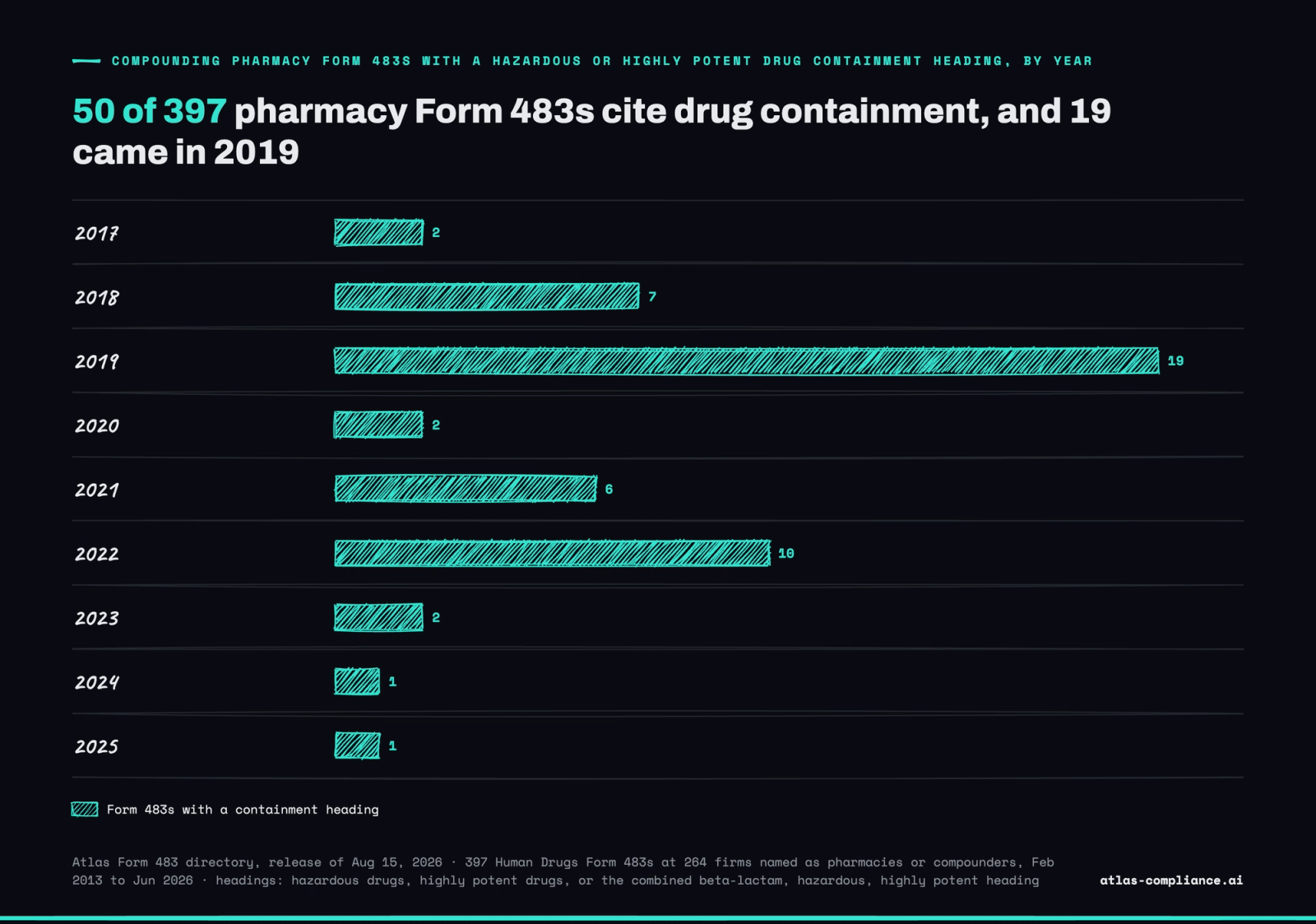
FDA writes hazardous drug observations at compounding pharmacies under the heading "Hazardous drugs, prevention of cross-contamination", and the related headings for highly potent and beta-lactam drugs. In the FDA Form 483 database at Atlas (release of August 15, 2026), 50 of 397 Human Drugs Form 483s issued from February 2013 to June 2026 to firms named as pharmacies or compounders carry at least one of these headings. The 50 forms went to 49 different pharmacies.
| Heading on the Form 483 | Forms |
|---|---|
| Hazardous drugs, prevention of cross-contamination | 36 |
| Highly potent drugs, prevention of cross-contamination | 13 |
| Beta-lactam, hazardous, highly potent drugs, prevention of cross-contamination | 3 |
| Any of the three | 50 |
The standard wording behind the heading, in FDA's citation data, reads that hazardous drugs were produced without adequate containment, segregation, or cleaning of work surfaces, utensils or personnel to prevent cross-contamination.
The timing tracks FDA's compounding inspection program. The headings appear from 2017, peak at 19 forms in 2019, fall to 2 in 2020 when FDA paused most inspections, and return at 10 in 2022. From 2018 to 2023, the years the hazardous drug heading was in use, it sits on 36 of the 162 compounding pharmacy Form 483s in the directory (22%).
Three patterns stand out on the 36 forms with the hazardous drug heading:
- Nonsterile work. 24 of the 36 forms carry no sterile, ISO-classified area or HEPA heading, so the finding came from nonsterile compounding: capsules, creams and powders made on open benches.
- Ingredients. 12 of the 36 also cite the use of non-pharmaceutical grade components, the second most common heading beside it.
- Short forms. The forms average 4.2 observations, against 6.7 on the other compounding pharmacy Form 483s in the same set.
The same investigators recur. Jolanna A Norton (88 inspections across 85 sites in Atlas) and Christopher R Czajka (165 inspections across 158 sites) each appear on 3 of the 36 forms, and Jennifer L Huntington (90 inspections across 81 sites) appears on 2.
The newest data is thinner. In FDA's citation dataset for inspections that closed from January 2025 to October 2026, 8 inspections drew citations under section 501(a)(2)(A), and 2 of them carried the combined beta-lactam, hazardous and highly potent heading. If a pharmacy you compound with, or buy from, appears in that record, the investigator's history shows what the next visit is likely to check.
 Atlas
See what the FDA knows about your next investigator.
30 minutes with the founder. No pitch deck.
How should a pharmacy prepare for a USP 800 inspection?
A pharmacy prepares for a USP 800 inspection by proving each requirement with a record, because inspectors read documents before they walk the room. Five records cover most of what boards and FDA ask for:
- The entity list, dated, with the last 12-month review and any drugs added since the NIOSH 2024 update.
- Each assessment of risk, with the drug, dosage form, containment chosen and review date.
- Pressure and air change logs for every C-SEC and storage room, showing 0.01 to 0.03 inches of water column negative.
- Training and competency records for every handler, reassessed within 12 months.
- Cleaning logs that show deactivation and decontamination as separate steps, with the agents used.
The FDA compounding warning letters for 2026 show what follows when insanitary conditions are not corrected after a Form 483.
AtlasFDA Inspection Intelligence Digest
We track every 483, EIR, and warning letter the moment it happens. Get the signals before they hit the FDA website.
Frequently asked questions
USP 800 is mandatory where a state board of pharmacy or another regulator adopts it, and many states have. It became compendially applicable on November 1, 2023, through USP 795 and 797, to the extent those chapters apply. Hospitals also meet it through accreditation surveys. Check your state board's rules for the exact effective date and any state-specific changes.

Written by
Bhavish Agarwal
Founder, Atlas
Bhavish Agarwal is the founder of Atlas and previously worked at Google and Microsoft. He has spent the past several years building regulatory data infrastructure for the pharmaceutical industry.