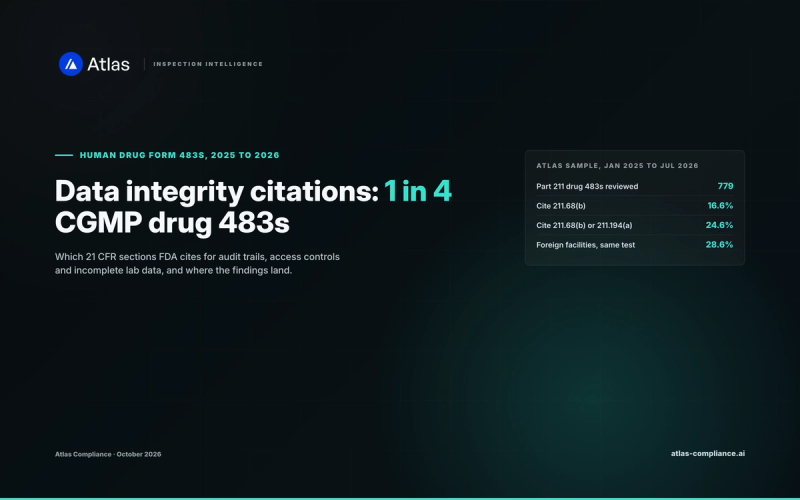

The most common FDA 483 observations are the 21 CFR sections FDA investigators cite most often on Form 483, the list of objectionable conditions handed to a facility at the end of an inspection. For drug manufacturers, 21 CFR 211.192 (investigations of discrepancies and failures) and 211.22(d) (quality unit procedures) lead the list.
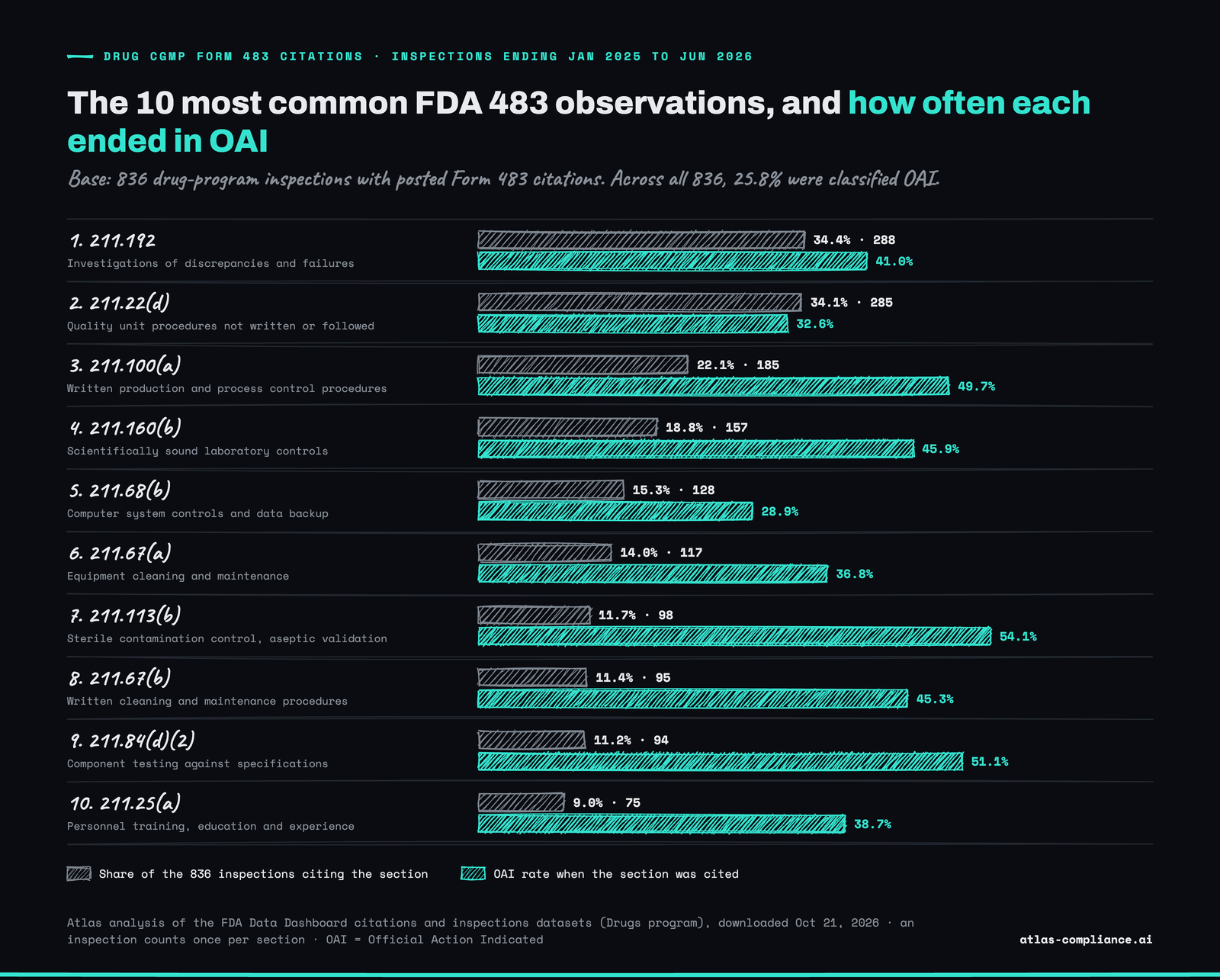
This ranking comes from an Atlas analysis of FDA Data Dashboard citation and inspection records downloaded on October 21, 2026, covering 836 drug-program inspections that ended between January 1, 2025 and June 30, 2026 with posted Form 483 citations. For each section you also get the share of those inspections that FDA later classified Official Action Indicated (OAI), which most top 10 lists leave out.
Key facts
- 21 CFR 211.192 was the most cited drug CGMP observation, cited in 288 of 836 drug inspections with posted Form 483 citations (34.4%) that ended from January 2025 to June 2026.
- 21 CFR 211.22(d), quality unit procedures not written or not followed, came second at 285 inspections (34.1%), three fewer than 211.192.
- Across all 836 inspections, FDA classified 216 (25.8%) as OAI; when 211.113(b) on sterile drug contamination appeared, the OAI rate was 54.1%.
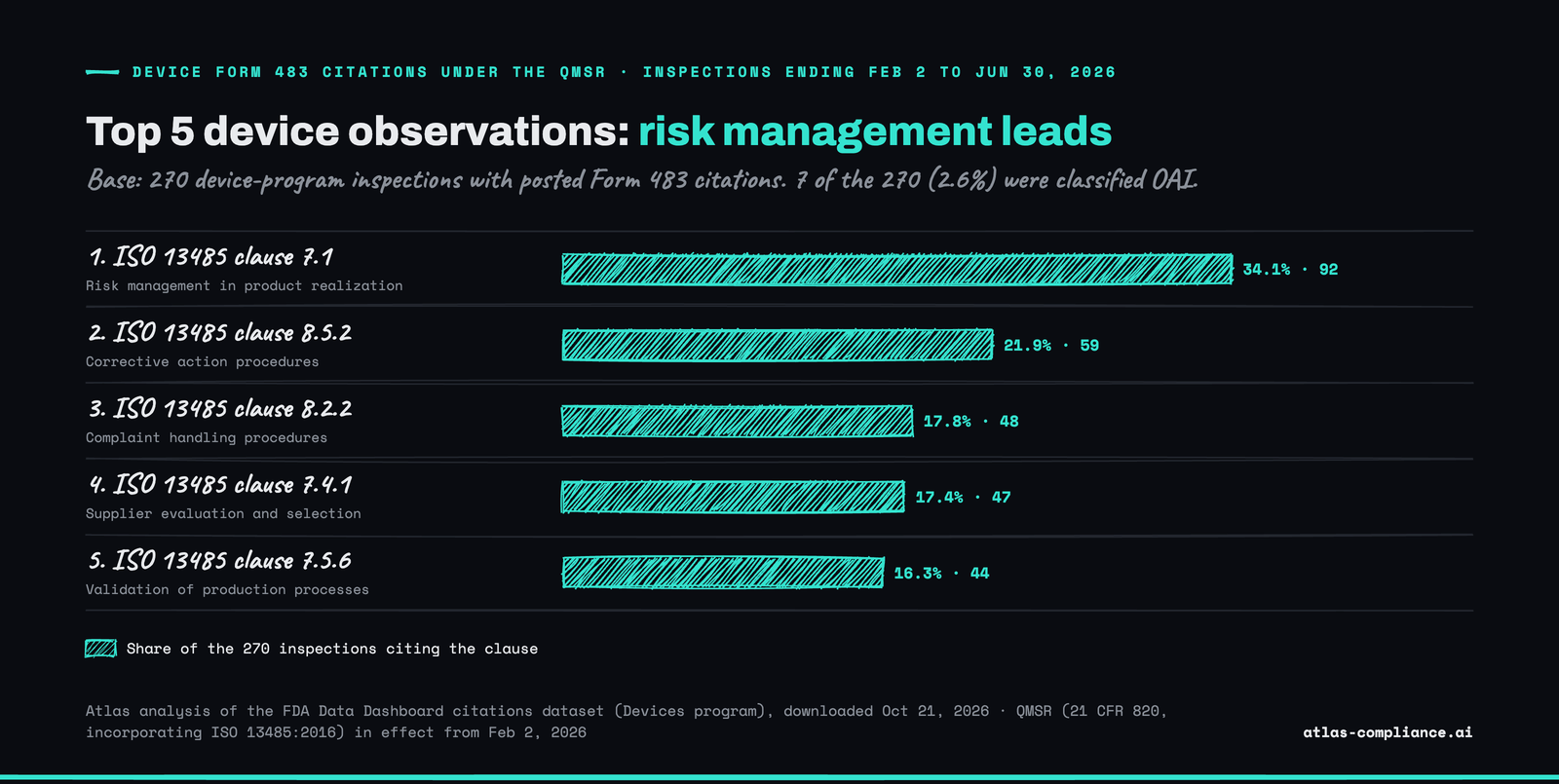
- Under the device QMSR, in force from February 2, 2026, ISO 13485 clause 7.1 on risk management led device citations, in 92 of 270 inspections (34.1%) through June 2026.
- A Form 483 is not a warning letter: FDA says the form is not a final agency determination, and a warning letter, if one comes, follows FDA's review.
What are the top 10 observations of the FDA 483?
The top 10 FDA 483 observations for drug manufacturers, January 2025 to June 2026, are 21 CFR 211.192, 211.22(d), 211.100(a), 211.160(b), 211.68(b), 211.67(a), 211.113(b), 211.67(b), 211.84(d)(2) and 211.25(a). Investigations, written procedures, laboratory controls, computer controls, cleaning, sterility assurance, component testing and training cover the whole list.
| Rank | 21 CFR section | What FDA found, in plain English | Inspections citing (of 836) | Share | OAI rate when cited |
|---|---|---|---|---|---|
| 1 | 211.192 | Discrepancies and failures not investigated thoroughly | 288 | 34.4% | 41.0% |
| 2 | 211.22(d) | Quality unit procedures not written or not followed | 285 | 34.1% | 32.6% |
| 3 | 211.100(a) | No adequate written production and process control procedures | 185 | 22.1% | 49.7% |
| 4 | 211.160(b) | Laboratory specifications, methods or sampling not scientifically sound | 157 | 18.8% | 45.9% |
| 5 | 211.68(b) | Computer systems lack access, accuracy or backup controls | 128 | 15.3% | 28.9% |
| 6 | 211.67(a) | Equipment not cleaned or maintained at proper intervals | 117 | 14.0% | 36.8% |
| 7 | 211.113(b) | Sterile contamination control procedures or aseptic validation inadequate | 98 | 11.7% | 54.1% |
| 8 | 211.67(b) | Written cleaning and maintenance procedures missing or not followed | 95 | 11.4% | 45.3% |
| 9 | 211.84(d)(2) | Components not tested against all written specifications | 94 | 11.2% | 51.1% |
| 10 | 211.25(a) | Staff lack the training, education or experience for their job | 75 | 9.0% | 38.7% |
Source: Atlas analysis of the FDA Data Dashboard citations and inspections datasets (Drugs program), downloaded October 21, 2026. An inspection counts once per section, at the paragraph level FDA uses on the form. The OAI rate describes the whole inspection, so it shows association, not cause.
Section text is from 21 CFR Part 211 on eCFR, current as of November 12, 2026. Every example links to the Atlas record of a Form 483 that cites the section. For a section-by-section tour of the regulation, see our guide to 21 CFR Part 211.
1. 21 CFR 211.192: investigations of discrepancies and failures
Section 211.192 requires the quality control unit to review production and control records before release, and to investigate any unexplained discrepancy or specification failure thoroughly, extending the investigation to other batches that may be affected. FDA cited it in 288 inspections; 41.0% of those ended OAI. The June 5, 2026 Janssen Ortho Form 483 for Gurabo cites 211.192 among six observations, next to 211.100(a), 211.67(a) and 211.68(b).
Prevention: write the impact assessment into every investigation and list the other lots you checked. Our 211.192 guide covers the investigation file.
2. 21 CFR 211.22(d): quality unit procedures not written or not followed
Section 211.22(d) says the responsibilities and procedures of the quality control unit must be in writing and must be followed. FDA cited it in 285 inspections, with the lowest OAI rate in the top five, 32.6%. The May 18, 2026 Viatris Pharmaceuticals Form 483 for Vega Baja pairs 211.22(d) with 211.192 and 211.100(b).
Prevention: map each quality unit duty in your SOPs to a record that proves someone did it, and audit that map once a year.
3. 21 CFR 211.100(a): written production and process control procedures
Section 211.100(a) requires written production and process control procedures, approved by the quality control unit, that assure each drug has the identity, strength, quality and purity it claims. FDA cited it in 185 inspections, and half of them (49.7%) ended OAI. The May 14, 2026 Fresenius Kabi USA Form 483 for Grand Island cites 211.100(a) with 211.113(b), three observations in all.
Prevention: check that every critical step in the batch record traces to an approved procedure, and that validation data supports each parameter range.
4. 21 CFR 211.160(b): scientifically sound laboratory controls
Section 211.160(b) requires laboratory controls with scientifically sound and appropriate specifications, standards, sampling plans and test procedures. FDA cited it in 157 inspections; 45.9% ended OAI. The June 9, 2026 SGS North America Form 483 for Fairfield has a single observation, and it cites 211.160(b).
Prevention: keep method validation or verification on file for every test you report, including compendial methods run in your own laboratory.
5. 21 CFR 211.68(b): computer system controls
Section 211.68(b) requires controls so that only authorized people change master records, input and output are checked for accuracy, and a backup of data entered into the system is kept. FDA's dashboard labels the citation "computer control of master formula records". It appeared in 128 inspections, with a 28.9% OAI rate. The June 12, 2026 Epic Pharma Form 483 for Laurelton cites it with 211.22(d) and 211.67(a).
Prevention: review audit trails and user access lists on a schedule, and test that you can restore a backup. Our analysis of data integrity 483 citations goes deeper.
6. 21 CFR 211.67(a): equipment cleaning and maintenance
Section 211.67(a) requires equipment and utensils to be cleaned, maintained and, where the drug calls for it, sanitized or sterilized at intervals that prevent contamination or malfunction. FDA cited it in 117 inspections; 36.8% ended OAI. The June 30, 2026 Carlsbad Technology Form 483 for Carlsbad cites 211.67(a) alongside the top two sections, 211.192 and 211.22(d).
Prevention: base cleaning intervals on validated hold times, not habit, and inspect equipment for residue before each use.
7. 21 CFR 211.113(b): sterile drug contamination control
Section 211.113(b) requires written procedures to prevent microbiological contamination of drugs that claim to be sterile, including validation of all aseptic and sterilization processes. It ranks seventh by volume, at 98 inspections, but carries the highest OAI rate in the top 10: 54.1%. The May 21, 2026 Oakwood Laboratories Form 483 for Solon cites 211.113(b) twice, along with 211.192 and 211.25(a).
Prevention: run media fills that copy your worst-case interventions and shift lengths, and investigate every environmental monitoring excursion as a 211.192 event.
8. 21 CFR 211.67(b): written cleaning and maintenance procedures
Section 211.67(b) requires written procedures for cleaning and maintaining equipment, covering who is responsible, the schedule, the methods and materials, and protection of clean equipment before use. FDA cited it in 95 inspections; 45.3% ended OAI. The May 22, 2026 Catalent Pharma Solutions Form 483 for Morrisville has one observation, and it cites 211.67(b).
Prevention: write the disassembly steps and cleaning agents into the procedure itself.
9. 21 CFR 211.84(d)(2): component testing against specifications
Section 211.84(d)(2) requires each component to be tested against all written specifications for purity, strength and quality. A supplier's report of analysis may replace that testing only if the manufacturer runs at least one specific identity test and validates the supplier's results at intervals. FDA cited it in 94 inspections; 51.1% ended OAI. The April 2, 2026 Silgan Unicep Packaging Form 483 for Spokane lists it among eight observations.
Prevention: keep the supplier qualification data that justifies each certificate of analysis you accept, and test periodically to confirm it.
10. 21 CFR 211.25(a): personnel training and qualifications
Section 211.25(a) requires every person who manufactures, processes, packs or holds a drug to have the education, training and experience for the job, including training in CGMP and the procedures that apply to their work. FDA cited it in 75 inspections; 38.7% ended OAI. The April 21, 2026 Altaire Pharmaceuticals Form 483 for Aquebogue cites it among eight observations, with 211.113(b) and 211.192.
Prevention: retrain on the procedure that failed after every deviation, and record that training in the CAPA, not only in the training system.
 Atlas
See what the FDA knows about your next investigator.
30 minutes with the founder. No pitch deck.
Eight of the ten example forms cite two or more top 10 sections together. If you want to see which sections the investigators assigned to your facility have cited before, the Atlas Form 483 database lists their past forms by section.
Which FDA 483 observations most often lead to OAI?
Within the top 10, the FDA 483 observations most often followed by an OAI classification were 211.113(b) at 54.1%, 211.84(d)(2) at 51.1% and 211.100(a) at 49.7%, against a 25.8% OAI rate for all 836 drug inspections with posted citations from January 2025 to June 2026.
Just outside the top 10, 211.166(a), the written stability program requirement, appeared in 70 inspections and 57.1% of them ended OAI.
The two most cited sections sit lower. Inspections citing 211.22(d) ended OAI 32.6% of the time, and those citing 211.68(b), 28.9%. A quality unit procedure gap or an access control gap gets written up often, but on its own it is rarely the finding that moves an inspection to OAI. Sterility assurance, untested components and missing process procedures go to product quality directly, and FDA classifies them that way.
What are the most common device 483 observations under the QMSR?
The most common device 483 observations under the Quality Management System Regulation, in force since February 2, 2026, cite ISO 13485:2016 clauses that 21 CFR 820.10 incorporates by reference. Clause 7.1 on risk management in product realization led, cited in 92 of 270 device inspections (34.1%) that ended February 2 to June 30, 2026.
| Rank | ISO 13485:2016 clause | Topic | Inspections citing (of 270) | Share | OAI when cited |
|---|---|---|---|---|---|
| 1 | 7.1 | Risk management in product realization | 92 | 34.1% | 4 |
| 2 | 8.5.2 | Corrective action | 59 | 21.9% | 5 |
| 3 | 8.2.2 | Complaint handling | 48 | 17.8% | 2 |
| 4 | 7.4.1 | Supplier evaluation and selection | 47 | 17.4% | 2 |
| 5 | 7.5.6 | Validation of production processes | 44 | 16.3% | 3 |
Source: Atlas analysis of the FDA Data Dashboard citations dataset (Devices program), downloaded October 21, 2026. Only 7 of the 270 device inspections (2.6%) were classified OAI, so OAI is shown as a count.
The June 5, 2026 C. R. Bard Form 483 for Queensbury cites clauses 7.1 and 8.5.2, the top two. The June 25, 2026 Vynacron Dental Resins Form 483 for Jackson cites 8.2.2 and 8.5.2 among eight observations. The regulation text is on eCFR, 21 CFR Part 820, and our 21 CFR Part 820 guide compares the old QSR sections with these clauses.
Is FDA 483 a warning letter?
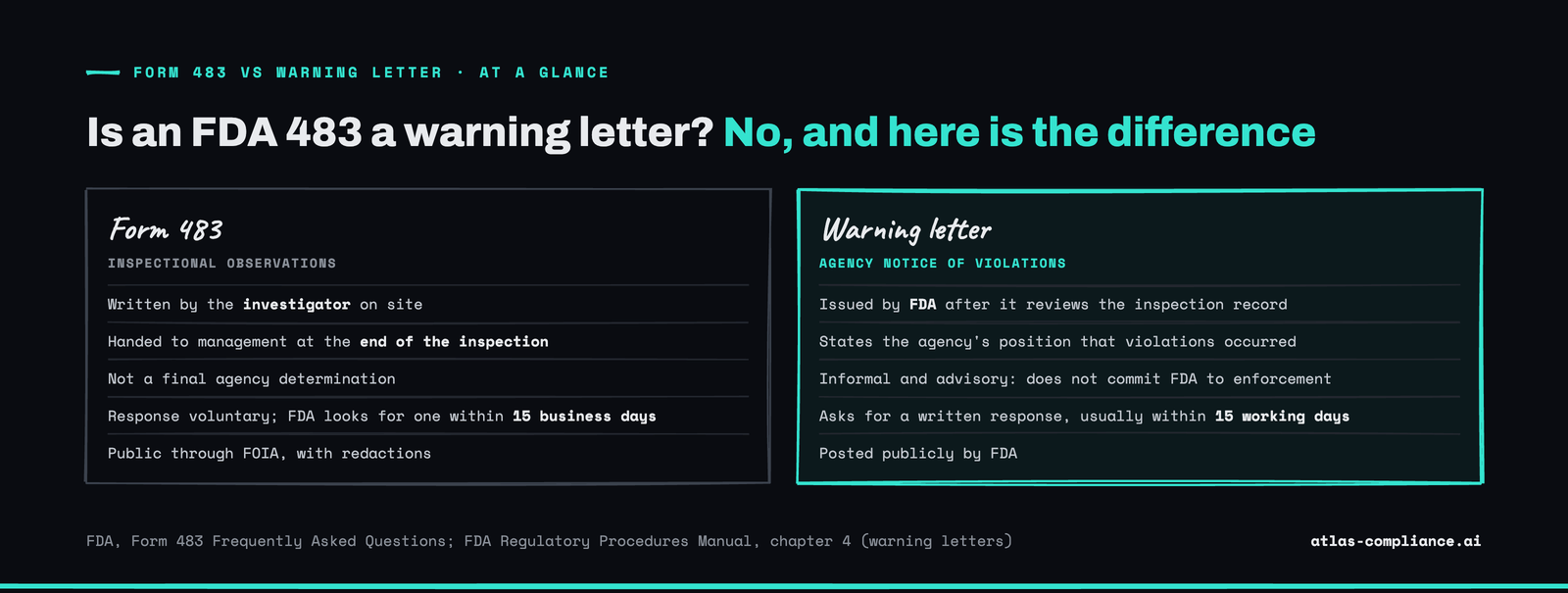
A Form 483 is not a warning letter. FDA's Form 483 Frequently Asked Questions say the form does not constitute a final agency determination that a condition violates the law. A warning letter comes later, from FDA rather than the investigator, after the agency reviews the 483, the establishment inspection report, evidence collected on site and the firm's response.
| Form 483 | Warning letter | |
|---|---|---|
| Who issues it | The investigator, on site | FDA, after review |
| When | At the end of the inspection | After the inspection is reviewed and classified |
| Legal weight | Not a final agency determination | Informal and advisory; states FDA's position |
| Response | Voluntary; FDA looks for it within 15 business days | Requested, usually within 15 working days |
| Public | Through FOIA, with redactions | Posted by FDA |
Sources: FDA, Form 483 Frequently Asked Questions and Understanding the Form FDA 483 Process and Timeline; FDA Regulatory Procedures Manual, chapter 4. For how the response window works in practice, read FDA 483 vs warning letter: the 15-day response window.
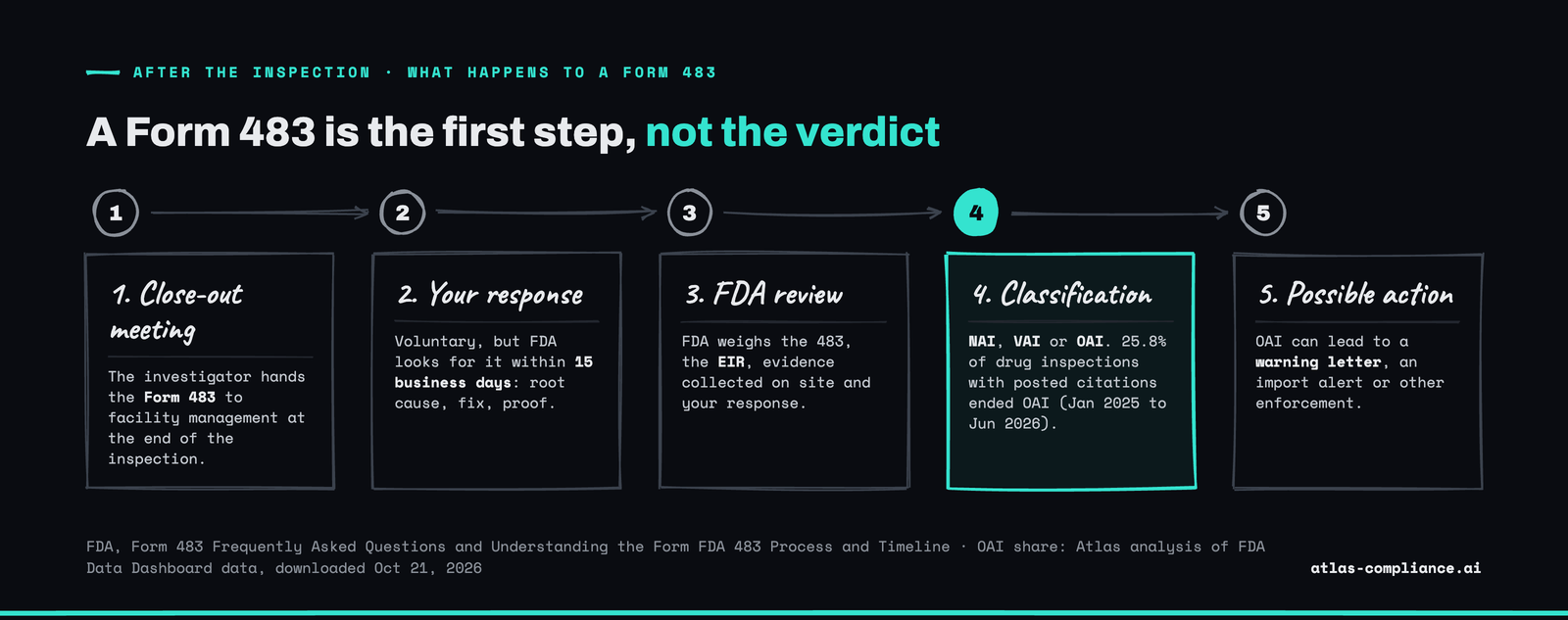
The classification step decides what follows. OAI means FDA will recommend regulatory or administrative action, which can include a warning letter, as our guide to NAI, VAI and OAI explains.
What are some recent FDA 483s issued?
Recent FDA 483s for drug manufacturers include forms issued to Carlsbad Technology on June 30, 2026, Epic Pharma on June 12, 2026, SGS North America on June 9, 2026 and Janssen Ortho on June 5, 2026, all linked above. FDA also posted 17 Form 483 documents to its public list between September 3 and October 6, 2026.
One of those postings is the Form 483 dated September 3, 2026 for RC Outsourcing, LLC in Lowellville, which FDA posted on October 6, 2026. FDA posted 245 Form 483 documents in 2026 through October 6, by publish date in the FDA published-483 records downloaded October 21, 2026.
To search by company, date or investigator, use our walkthrough of the FDA 483 reports database. For the response itself, how to address and prevent Form 483 observations covers root cause, CAPA and evidence.
How to use this ranking before your next inspection
Start with the three sections that combine volume and OAI risk: 211.192, 211.100(a) and 211.160(b). At least one of the three appeared in 442 of the 836 inspections (52.9%), and each carried an OAI rate above 40%. Pull your last 12 months of deviations and check that each investigation names a root cause, lists the other batches reviewed and closes with a CAPA that has an effectiveness check.
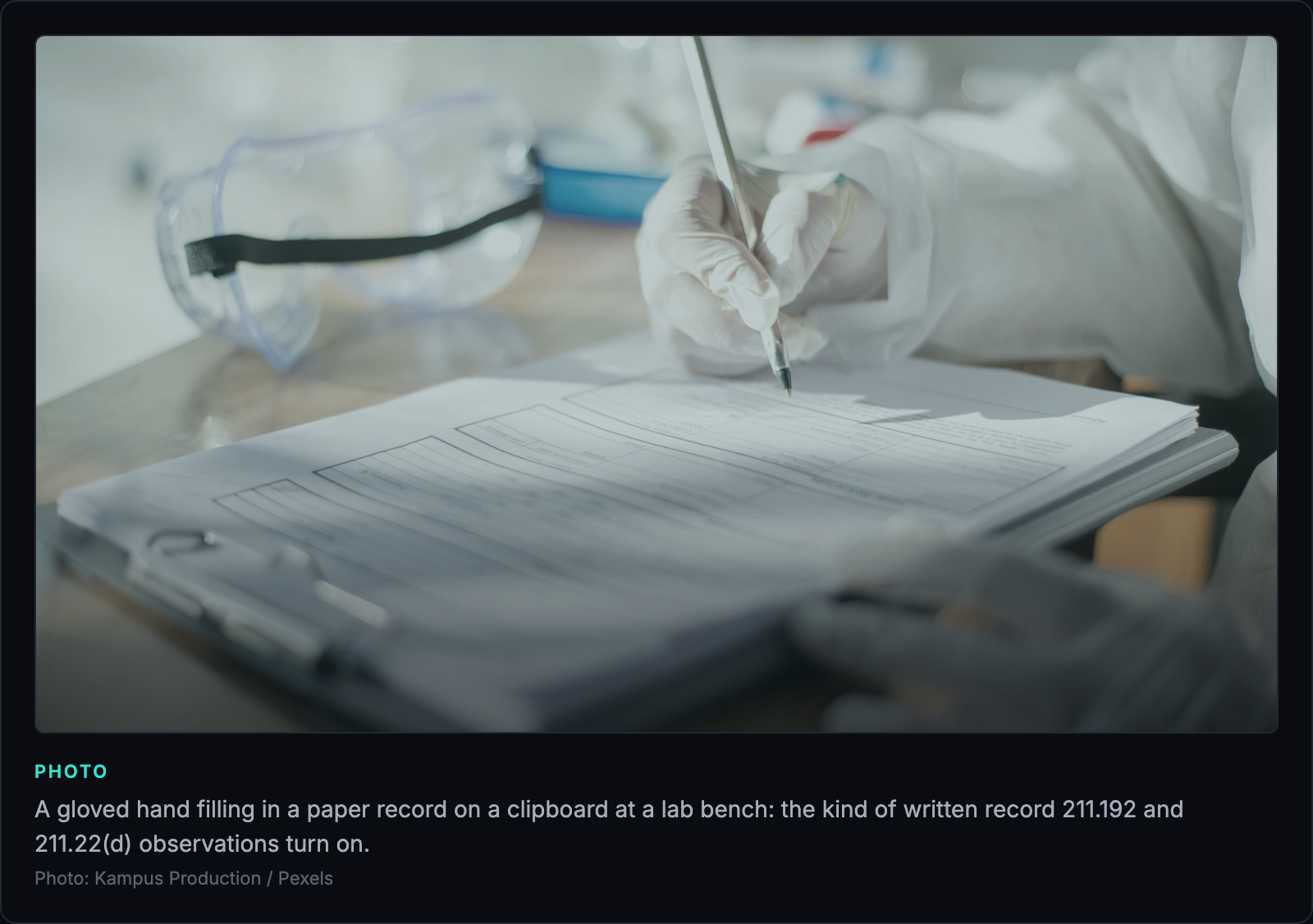
Then test the two paper-heavy sections, 211.22(d) and 211.25(a), by picking five quality unit duties and five operators at random and asking for the record that proves each one. If you make sterile products, put 211.113(b) first: it had the highest OAI rate in the top 10.
AtlasFDA Inspection Intelligence Digest
We track every 483, EIR, and warning letter the moment it happens. Get the signals before they hit the FDA website.
Frequently asked questions
Yes, FDA 483 observations become public in two ways. FDA releases Form 483 documents under the Freedom of Information Act after removing trade secrets and confidential commercial information, and posts frequently requested ones in its electronic reading rooms. FDA's Data Dashboard also publishes citation-level data: the CFR section and a short description for each observation on inspections with posted citations.

Written by
Bhavish Agarwal
Founder, Atlas
Bhavish Agarwal is the founder of Atlas and previously worked at Google and Microsoft. He has spent the past several years building regulatory data infrastructure for the pharmaceutical industry.