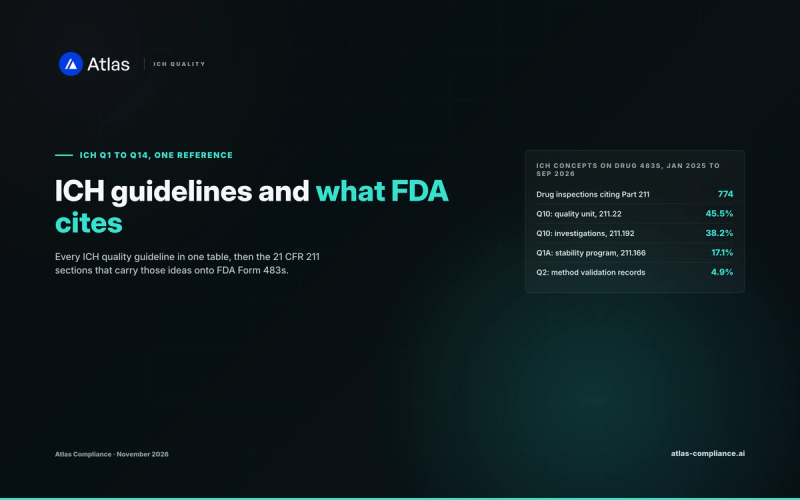

ICH Q7 is the international good manufacturing practice (GMP) guideline for active pharmaceutical ingredients (APIs) that sets how an API manufacturer should run quality management, facilities, materials, production, laboratory controls and validation from the step where the API starting material enters the process. ICH adopted it at Step 4 on November 10, 2000, and FDA put it into effect as guidance on September 25, 2001.
This guide maps all 20 sections, then reads FDA's API enforcement record from Atlas data pulled in October and November 2026: 26 API CGMP warning letters issued from January 2025 to September 2026, who received them and which Q7 sections their charges fall under.
Key facts:
- ICH Q7 has 20 sections, from Introduction (section 1) to Glossary (section 20), with dedicated sections for cell culture and fermentation (18) and clinical trial APIs (19).
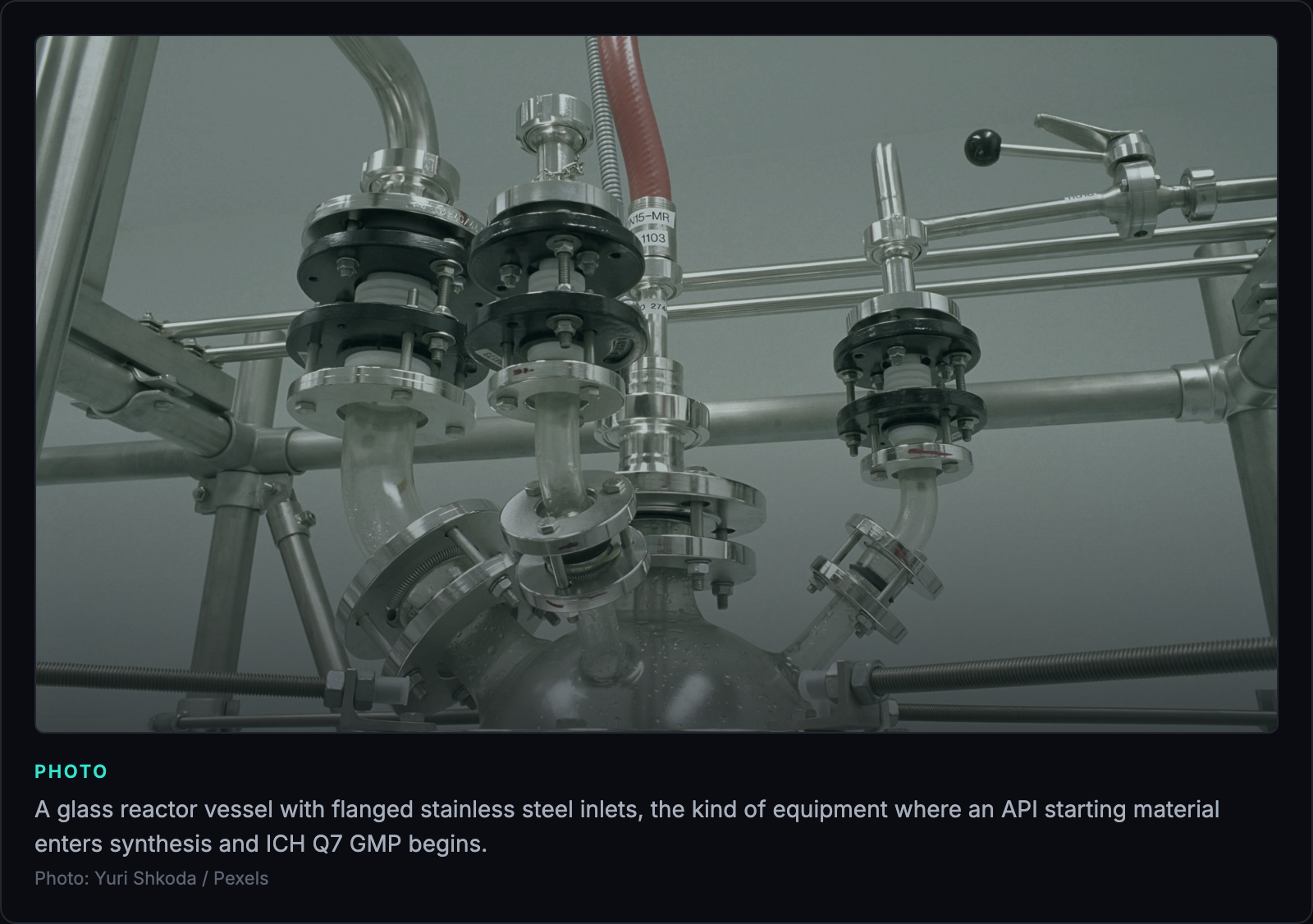
- Q7 applies from the step where the defined API starting material enters the process; section 1.3 says the guide does not apply to steps before that point.
- 21 CFR Part 211 covers drug products, which 21 CFR 210.3 defines as finished dosage forms, so FDA cites API makers under section 501(a)(2)(B) of the FD&C Act and treats Q7 as the expectation.
- The ICH Q7 questions and answers document, approved June 10, 2015, holds 55 answers; FDA issued it as final guidance in April 2018.
- FDA issued 16 API CGMP warning letters in 2025, four times the 4 it issued in 2024, according to the warning letter index in the Atlas data files (pulled October 21, 2026).
- Indian and Chinese facilities received 21 of the 26 API CGMP warning letters issued from January 2025 to September 2026.
What are the 20 sections of ICH Q7?
The 20 sections of ICH Q7 cover the full API quality system, from the quality unit through materials, production, laboratory controls, validation and distribution, plus two sections for special cases and a glossary. Our ICH guidelines overview places Q7 among Q1 to Q14; this table goes one level deeper, using the section titles of the ICH Q7 guideline.
| Section | Title | What it sets out |
|---|---|---|
| 1 | Introduction | Objective, regulatory applicability, scope and Table 1 on where GMP starts |
| 2 | Quality management | An independent quality unit, release authority, internal audits, annual product quality review |
| 3 | Personnel | Qualifications, training, hygiene and the use of consultants |
| 4 | Buildings and facilities | Design, utilities, water, containment, lighting, sanitation and maintenance |
| 5 | Process equipment | Design, maintenance and cleaning, calibration, computerized systems |
| 6 | Documentation and records | Specifications, master production instructions, batch and laboratory records, record review |
| 7 | Materials management | Receipt, quarantine, identity testing of incoming materials, storage, re-evaluation |
| 8 | Production and in-process controls | Time limits, in-process sampling, blending of batches, contamination control |
| 9 | Packaging and identification labelling | Packaging materials, label issuance and control, labelling operations |
| 10 | Storage and distribution | Warehousing and distribution procedures |
| 11 | Laboratory controls | Testing, impurity profiles, certificates of analysis, stability, retest dating, retention samples |
| 12 | Validation | Policy, qualification, process validation, cleaning validation, analytical method validation |
| 13 | Change control | A formal system to evaluate every change that may affect production or control |
| 14 | Rejection and re-use of materials | Rejection, reprocessing, reworking, solvent recovery, returns |
| 15 | Complaints and recalls | Recording and investigating every quality complaint; recall procedures |
| 16 | Contract manufacturers (including laboratories) | Contractors follow the same GMP, with attention to cross-contamination and traceability |
| 17 | Agents, brokers, traders, distributors, repackers and relabellers | GMP and traceability for every party after the original manufacturer |
| 18 | APIs made by cell culture or fermentation | Cell banks, culture, harvesting, purification, viral removal |
| 19 | APIs for use in clinical trials | Controls scaled to development-stage APIs |
| 20 | Glossary | Definitions, including API, API starting material and quality unit |
Q7 uses "should" throughout. Section 1.1 says each recommendation applies unless a firm shows it does not apply or replaces it with an alternative that gives at least the same quality assurance.
Where does ICH Q7 apply in API manufacturing?
ICH Q7 applies from the point where the API starting material is introduced into the process, and the company must designate and document the rationale for that point. Section 1.3 states that the guide does not apply to steps before the defined starting material, and that GMP stringency should increase as the process moves toward final steps, purification and packaging.
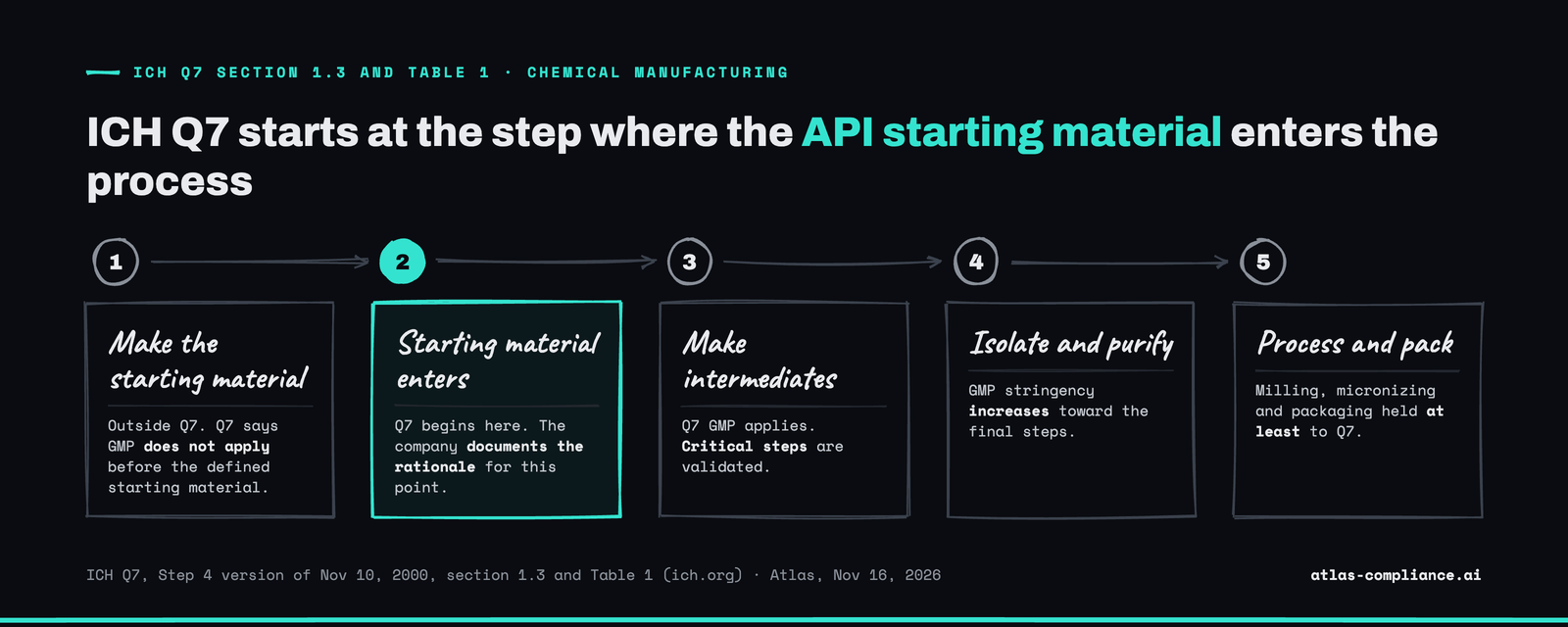
Section 1.3 also sets the scope limits:
- Q7 covers APIs made by chemical synthesis, extraction, cell culture or fermentation, recovery from natural sources, or a mix of these.
- For sterile APIs, Q7 runs only up to the point immediately before the API is rendered sterile. Sterilization and aseptic processing follow drug product GMP.
- Q7 excludes vaccines, whole cells, whole blood and plasma, plasma derivatives and gene therapy APIs, but it includes APIs made from blood or plasma as raw materials.
- Q7 does not cover medical gases, bulk-packaged drug products or the radiopharmaceutical-specific parts of manufacture.
- Physical processing such as milling, micronizing, granulation or coating must meet Q7 at least.
Question 1.1 of the Q7 questions and answers adds that earlier steps still need "an appropriate level of controls", and that the filing normally defines the starting material.
ICH Q7 vs 21 CFR 211: what is the difference?
The difference between ICH Q7 and 21 CFR 211 is legal scope. 21 CFR Part 211 is a binding regulation that section 211.1 limits to the preparation of drug products, which 21 CFR 210.3 defines as finished dosage forms such as tablets, capsules and solutions. ICH Q7 is FDA guidance for APIs and intermediates. FDA enforces API GMP through section 501(a)(2)(B) of the FD&C Act and reads Q7 as the standard.
Warning letter 320-25-30 to Global Calcium (January 16, 2025) states that FDA "considers the expectations outlined in ICH Q7" when it decides whether APIs are made in conformance with CGMP. The Global Calcium site record in Atlas shows five FDA inspections, each ending with a Form 483, the latest on February 3, 2026.
| Topic | ICH Q7 | 21 CFR Part 211 |
|---|---|---|
| Product covered | APIs and intermediates, from the API starting material on | Drug products (finished dosage forms) |
| Legal status in the US | FDA guidance, in effect since September 25, 2001 | Regulation |
| What FDA cites | FD&C Act 501(a)(2)(B) | The specific Part 211 section |
| Wording | "Should", unless an equivalent alternative is shown | "Shall" |
| Quality unit | Independent of production, holds QA and QC duties (2.13) | Quality control unit with approve or reject authority (211.22) |
| Incoming materials | At least one identity test on each batch (7.30) | Testing of components (211.84) |
| Record retention | 1 year after expiry, or 3 years after full distribution for APIs with a retest date (6.13) | At least 1 year after the batch expiration date (211.180(a)) |
| Sterile steps | Not covered; drug product GMP applies | Aseptic and sterilization validation (211.113(b)) |
| Clinical supplies | Section 19 covers clinical trial APIs | Phase 1 investigational drugs exempt under 210.2(c) |
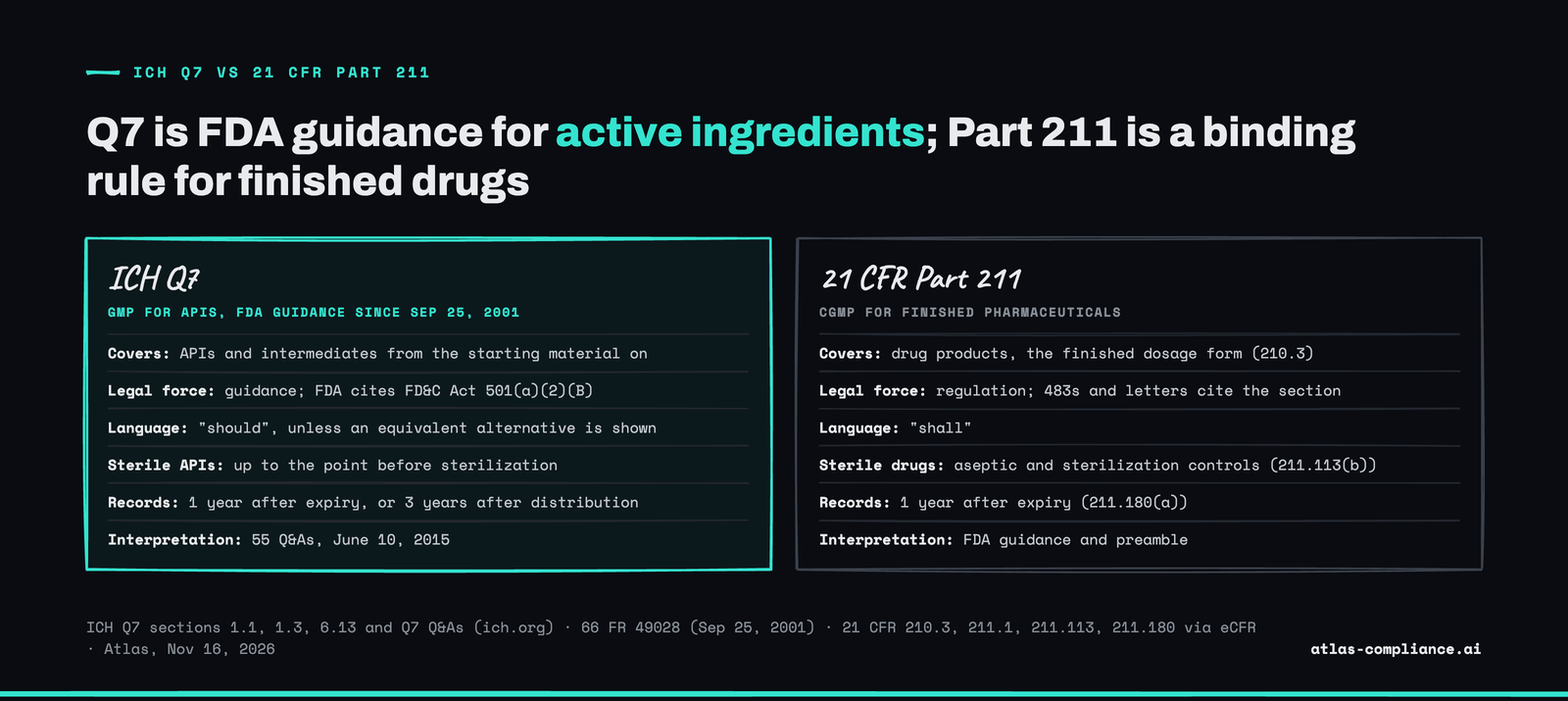
Our 21 CFR Part 211 guide maps each subpart.
What is the ICH Q7 Q&A document?
The ICH Q7 Q&A document is a set of 55 questions and answers, approved by the ICH Steering Committee on June 10, 2015, that clarifies sections of Q7 firms had read in different ways. FDA announced it as final guidance in the Federal Register on April 20, 2018. The Q7 questions and answers are organized by Q7 section, and section 9 has none.
Five answers affect daily work in an API facility:
- Question 2.1: the person in the quality unit who makes the final release decision should hold no production duties.
- Question 2.3: the quality unit cannot delegate its responsibility for the system that releases or rejects materials, although other departments may operate that system under its oversight.
- Question 2.5: the product quality review is generally expected every year, even when the facility made no batches in the period.
- Question 7.4: an on-site audit is not required to approve a supplier; a risk assessment can set the audit strategy.
- Question 7.5: reading a label or looking at a material does not count as an identity test, except in the cases section 7.32 allows.
The Q&A also states that firms should apply Q7 together with ICH Q9 and Q10.
How many API warning letters has FDA issued?
FDA issued 26 warning letters with an API CGMP subject from January 15, 2025 to September 18, 2026: 16 in 2025 and 10 in 2026 through October 14, according to the FDA warning letter index in the Atlas data files (pulled October 21, 2026). The 2025 count is four times the 4 letters of 2024 and the highest year in the file, which starts in January 2021.
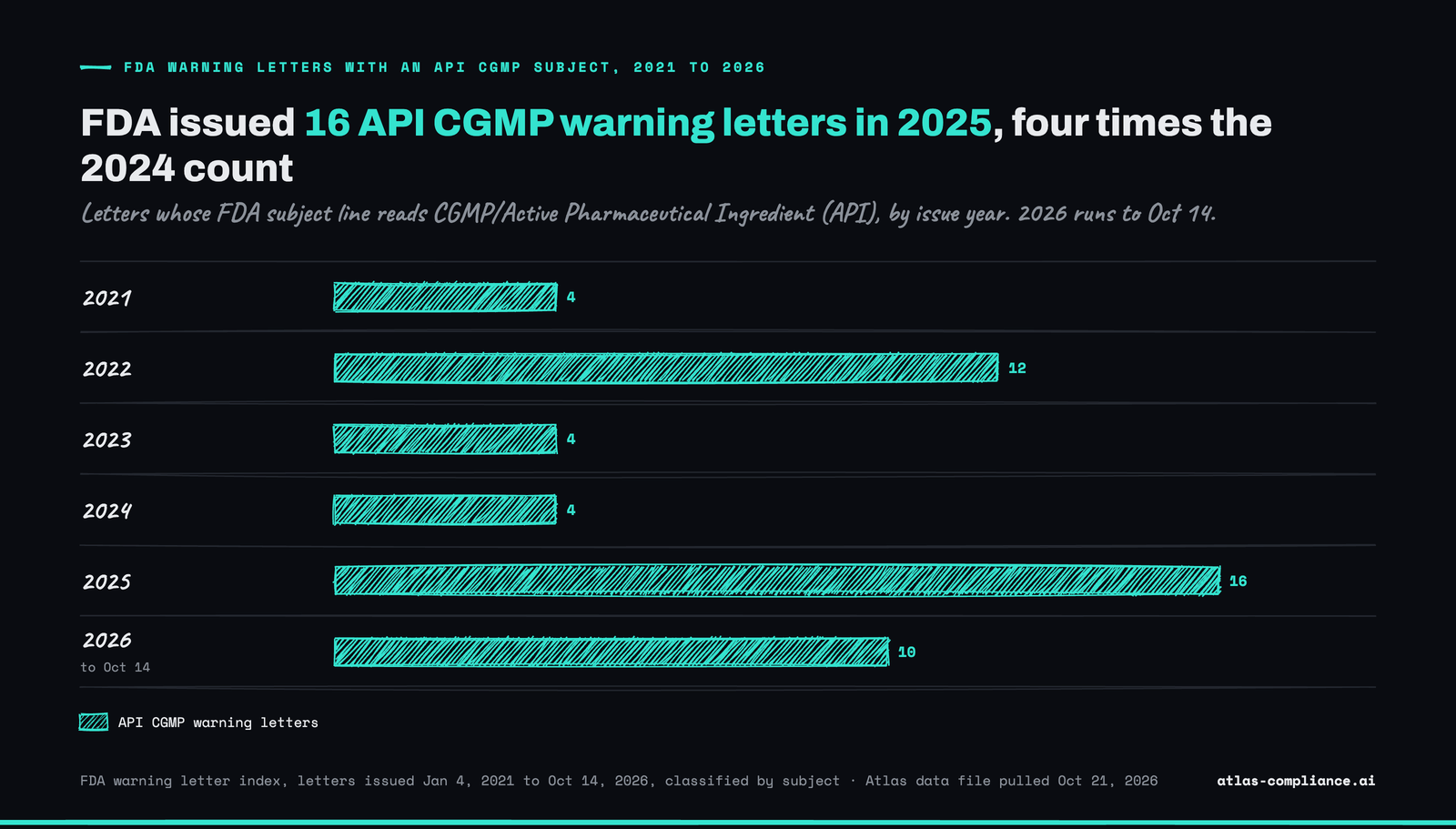
From October 2025 to September 2026, FDA posted 16 API CGMP letters against 106 for finished pharmaceuticals.
In the FDA inspection classification export (inspections ending January 2, 2025 to October 14, 2026), we matched 13 of the inspections behind these letters by FEI number. FDA classified all 13 as Official Action Indicated, and none carried posted Form 483 citations in the export. Across the 22 letters that followed an on-site inspection, a median of 172.5 days passed between the last inspection day and the letter date, with a range of 123 to 264 days. Our explainer on NAI, VAI and OAI covers what that OAI class sets in motion.
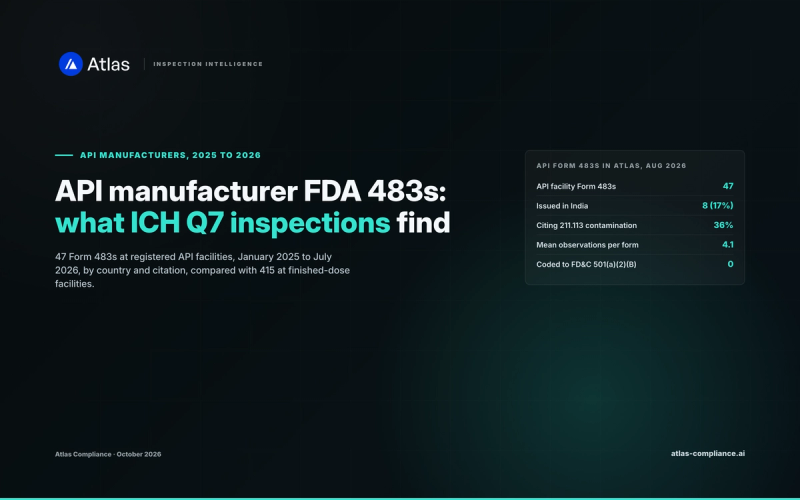
For Form 483s rather than letters, our count of 47 FDA Form 483s at registered API facilities from January 2025 to July 2026 uses the same Atlas Form 483 database.
What are the most cited API GMP deficiencies?
The most cited API GMP deficiency in FDA warning letters is quality unit failure under Q7 section 2, charged in 15 of 25 API CGMP letters with numbered charges from January 2025 to September 2026. Laboratory controls, specifications and test methods followed in 12 letters, and equipment cleaning or design in 11. One more letter, issued after a refused inspection, carried no CGMP charges.
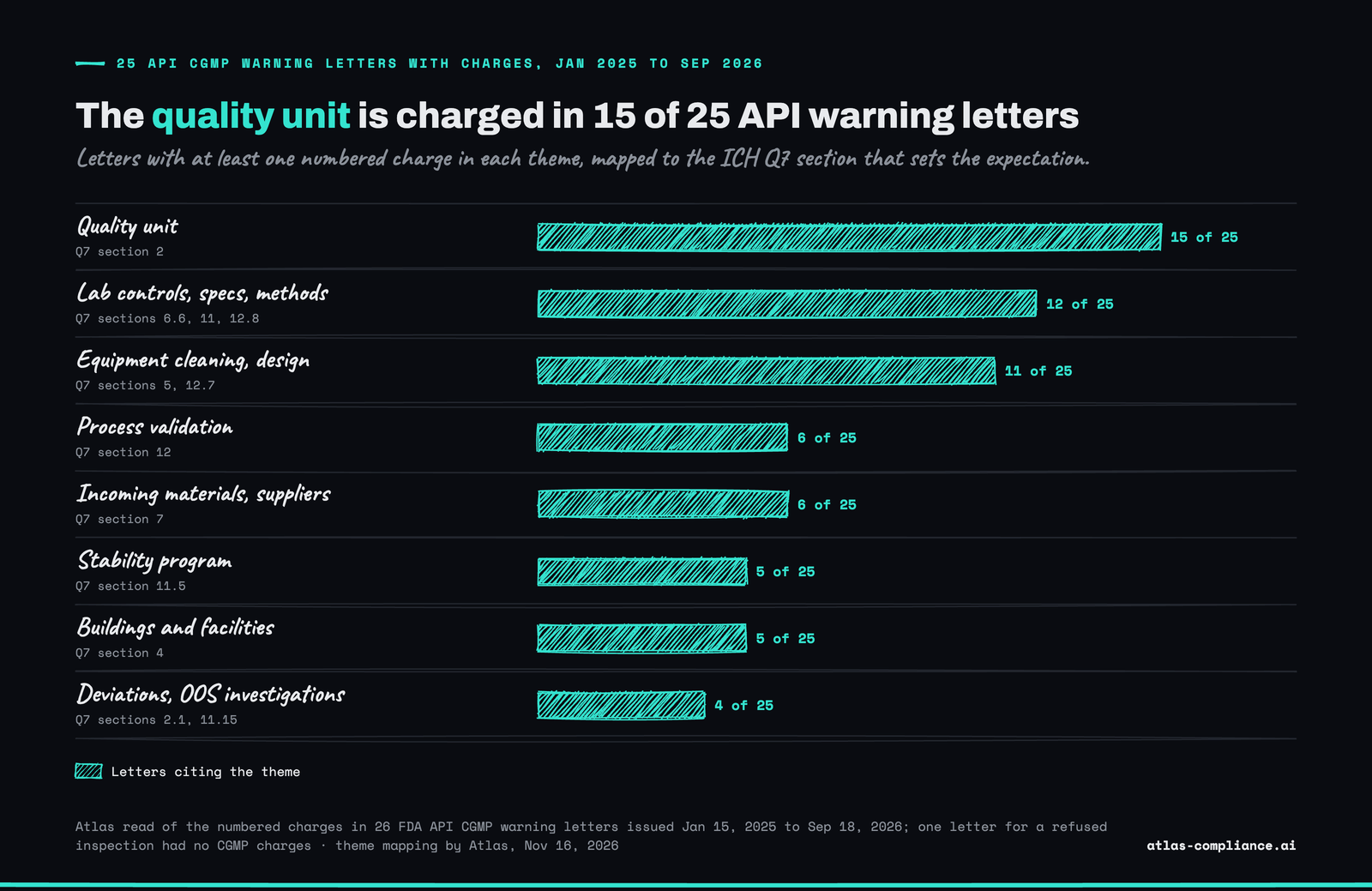
| Deficiency theme | ICH Q7 section | Letters (of 25) |
|---|---|---|
| Quality unit responsibility | 2 | 15 |
| Laboratory records, specifications, test methods | 6.6, 11, 12.8 | 12 |
| Equipment cleaning, maintenance, design | 5, 12.7 | 11 |
| Process validation | 12 | 6 |
| Incoming material testing, supplier evaluation | 7 | 6 |
| Stability program | 11.5 | 5 |
| Buildings and facilities | 4 | 5 |
| Deviation and OOS investigations | 2, 11 | 4 |
We counted each letter once per theme from its numbered charge headings. Two letters, to Global Calcium and to Flowchem Pharma in Hindupur, India (March 11, 2026), charged each firm with having no impurity profile for identified and unidentified impurities, the expectation in Q7 section 11.21.
Named records in the Atlas FDA facility database (release of August 15, 2026, pulled November 16, 2026):
- Curia New York, Rensselaer: 9 inspections and 5 Form 483s. The letter of September 18, 2026 charged incomplete laboratory records, quality unit failures and weak access controls on computerized systems.
- Scientific Protein Laboratories, Waunakee: 12 inspections and 7 Form 483s. The October 10, 2025 letter cited equipment surfaces that could alter API quality and weak investigation of critical deviations.
- Alchymars ICM SM, Alathur: 7 inspections, each ending with a Form 483. The May 21, 2026 letter cited equipment and building maintenance.
- Hubei Gedian Humanwell, Ezhou: 4 inspections, each with a Form 483. The June 3, 2026 letter cited equipment cleaning and quality unit oversight.
Atlas holds records for 21 of the 22 facilities FDA inspected before issuing these letters. Those 21 records list 91 FDA inspections, and 69 of them (76%) ended with a Form 483. Equipment cleaning was the third most charged theme; our cleaning validation guide covers what FDA expects there.
If one of these facilities supplies your API, you can check its inspection history and the investigators who wrote its forms before your next supplier audit.
 Atlas
See what the FDA knows about your next investigator.
30 minutes with the founder. No pitch deck.
How do India and China API facilities fare in FDA inspections?
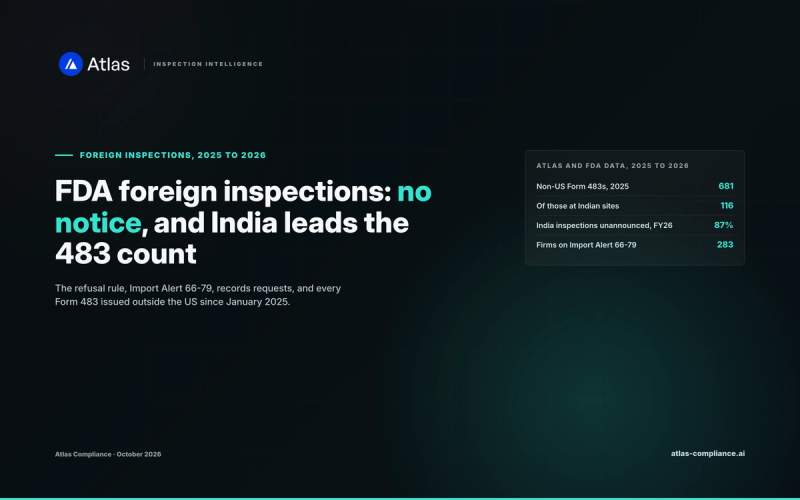
Indian and Chinese API facilities received 21 of the 26 API CGMP warning letters FDA issued from January 2025 to September 2026: 14 went to India, 7 to China, 4 to the United States and 1 to Greece. All 4 letters that FDA wrote without an on-site inspection went to Chinese firms: 3 after a records request under section 704(a)(4) of the FD&C Act and 1 after the firm refused a preannounced inspection.
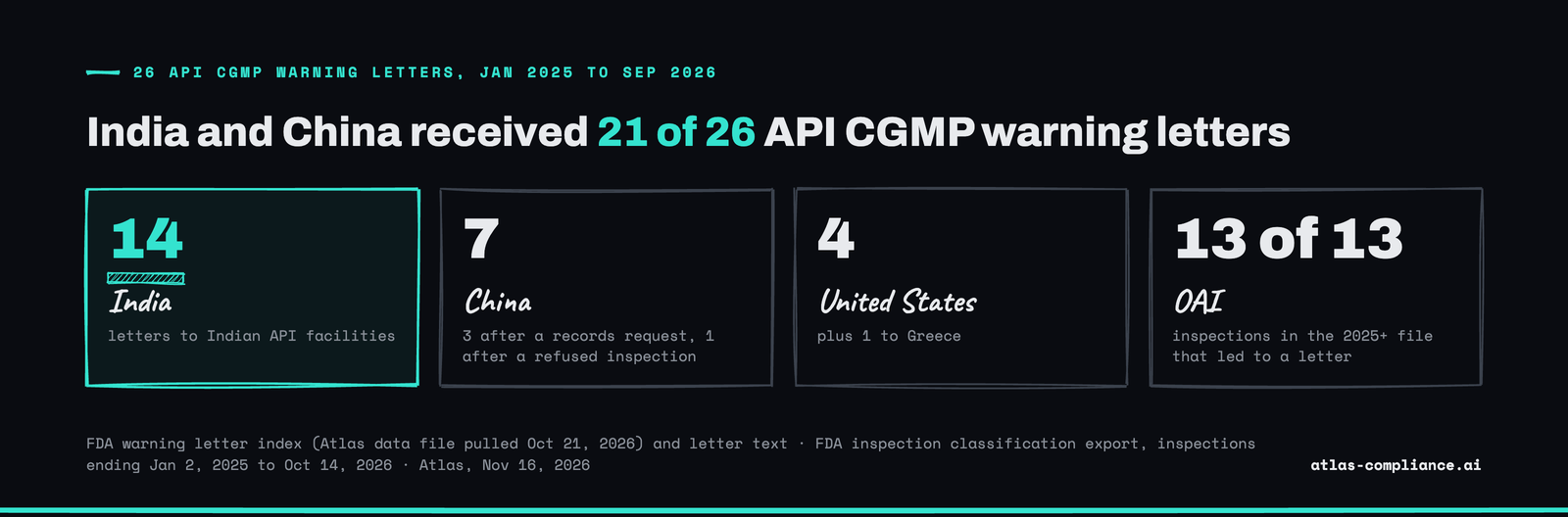
FDA's classification data does not flag API facilities, so the closest comparison covers all drug quality inspections. In the export for inspections ending January 2, 2025 to October 14, 2026, FDA classified 36 of 257 Indian drug quality inspections as OAI (14.0%) and 14 of 160 Chinese ones (8.8%), against 222 of 1,156 in the United States (19.2%). Read those rates as a backdrop: they mix API and finished-dose facilities.
One Indian example: Tyche Industries in Kakinada received a letter on February 6, 2025 for records not completed at the time of the activity, poor equipment cleaning and no identity test on each incoming batch. Q7 section 7.30 asks for at least one identity test on every batch of incoming production material.
How should an API facility prepare for an ICH Q7 inspection?
An API facility prepares for an ICH Q7 inspection by testing the systems FDA charges most: quality unit authority, laboratory records and methods, equipment cleaning, and incoming material controls. Five checks follow from the 2025 to 2026 letters:
- Confirm in writing that the quality unit is independent of production and owns release, as Q7 section 2.13 and Q&A 2.1 describe.
- Pull three recent batches and trace every laboratory result back to raw data, including audit trails on the instrument software.
- Check cleaning procedures and cleaning validation for shared equipment against sections 5.2 and 12.7.
- Verify that each incoming batch gets at least one identity test, and that suppliers whose certificates you rely on were evaluated first.
- Confirm an impurity profile exists for each API and that an ongoing stability program supports the retest date.
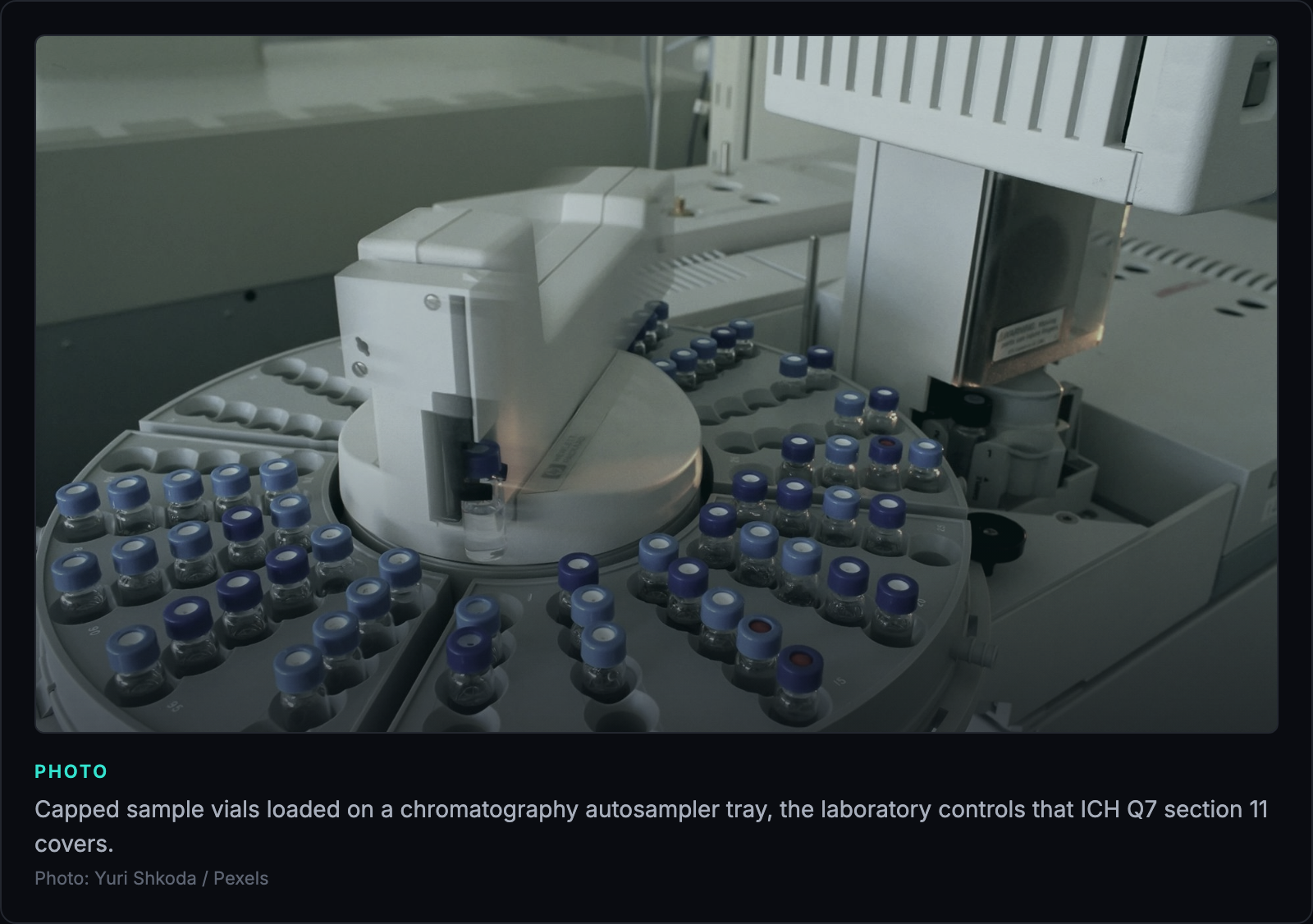
You can search any API supplier in the FDA inspected facilities database by name or FEI number. The digest below sends new Form 483s and warning letters, API letters included, as FDA posts them.
AtlasFDA Inspection Intelligence Digest
We track every 483, EIR, and warning letter the moment it happens. Get the signals before they hit the FDA website.
Frequently asked questions
ICH Q7 is not a regulation in the United States; FDA issued it as guidance in 2001. FDA still enforces API GMP through section 501(a)(2)(B) of the FD&C Act, and its warning letters state that FDA considers the expectations in ICH Q7 when judging API manufacture. A firm may use an alternative only if it gives at least the same quality assurance.

Written by
Bhavish Agarwal
Founder, Atlas
Bhavish Agarwal is the founder of Atlas and previously worked at Google and Microsoft. He has spent the past several years building regulatory data infrastructure for the pharmaceutical industry.