
Cleaning validation acceptance criteria are the predefined, scientifically justified limits that cleaned equipment must meet for product residue, cleaning agent residue, microbial load and visible residue before the cleaning procedure counts as validated. FDA lets each firm set its own limits, as long as they are practical, achievable and verifiable; EU GMP Annex 15 asks for carryover limits based on a toxicological evaluation.
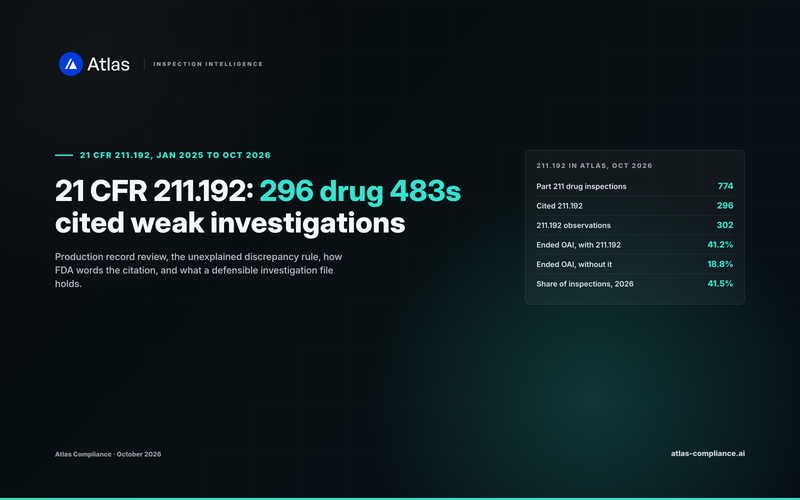
This guide adds how FDA investigators write up cleaning. In the Atlas Form 483 citation dataset (pulled October 2026), 21 CFR 211.67 appears at 237 of 774 drug inspections that cited Part 211 and closed between January 7, 2025 and September 3, 2026, and 40.5% of those 237 inspections ended Official Action Indicated (OAI).
Key facts:
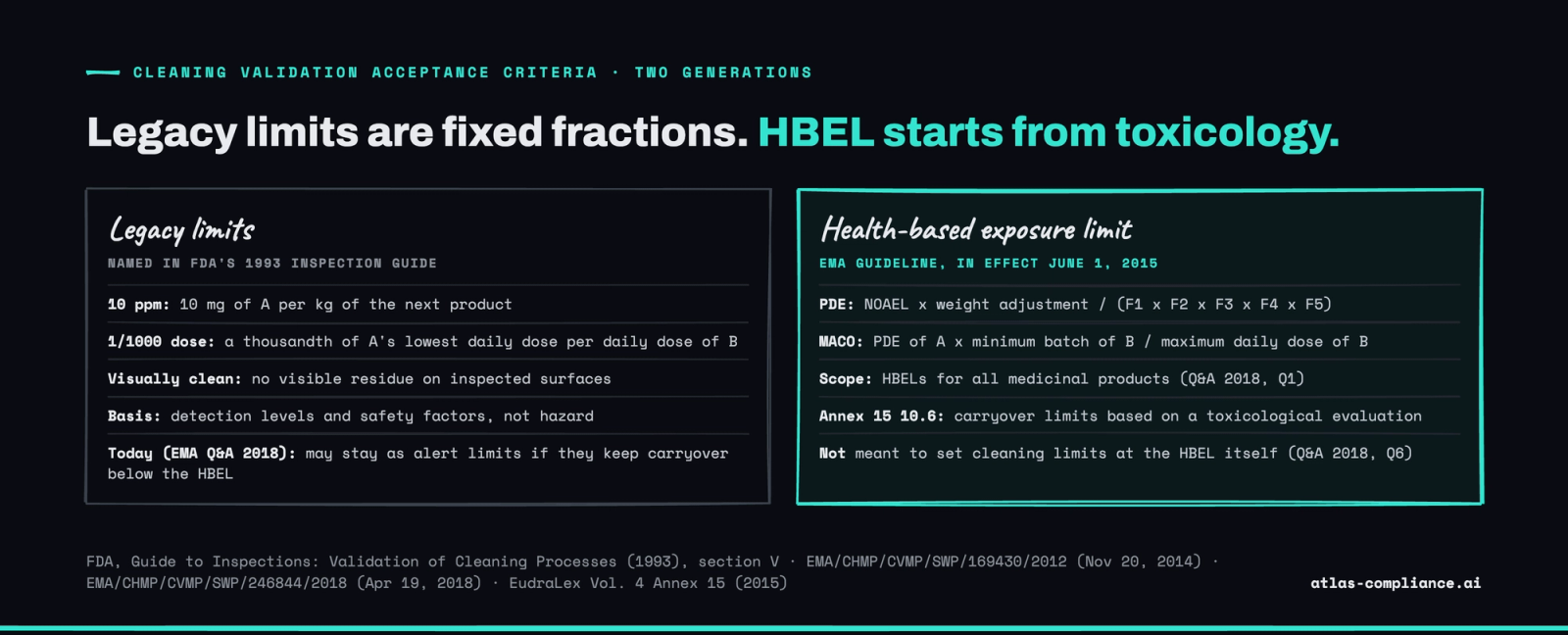
- FDA's 1993 Guide to Inspections: Validation of Cleaning Processes names three limits used in industry: 10 ppm, 1/1000 of the normal therapeutic dose, and no visible residue.
- The EMA guideline on health-based exposure limits (EMA/CHMP/CVMP/SWP/169430/2012) came into effect on June 1, 2015 and derives a permitted daily exposure (PDE) from a NOAEL divided by adjustment factors F1 to F5.
- EMA's April 19, 2018 questions and answers say HBELs should be established for all medicinal products, and that historical cleaning limits can stay as alert limits if they keep carryover below the HBEL.
- EU GMP Annex 15 section 10.2 says a visual check alone is not generally acceptable and rejects cleaning and retesting until results pass.
- In the Atlas dataset, inspections citing 211.67 ended OAI at 40.5% (96 of 237), against 21.6% (116 of 537) for the other Part 211 drug inspections.
What are cleaning validation acceptance criteria?
Cleaning validation acceptance criteria are the numeric and visual limits a cleaning validation protocol must meet on every run: a residue limit for the previous product, a limit for cleaning agents, a microbial limit where relevant, and a visual standard. The firm sets each one in advance and justifies it in a risk assessment, as Annex 15 section 10.6 requires.
| Criterion | What it limits | Common basis | Common test |
|---|---|---|---|
| Product residue | Active ingredient of product A carried into product B | HBEL (PDE), 1/1000 dose or 10 ppm, lowest wins | Specific method such as HPLC on swabs or rinses |
| Cleaning agent | Detergent left on product contact surfaces | Annex 15 10.6 requires a limit; FDA expects none, or very low levels | TOC, conductivity or a specific assay |
| Microbial | Bioburden and, where relevant, endotoxin after cleaning and during clean hold | Product microbial specification and route of administration | Contact plates, swabs, rinse bioburden |
| Visual | Residue visible on inspected surfaces | Visible residue threshold under defined light and distance | Trained inspector, written checklist |
Our guide to cleaning validation FDA requirements covers the protocol around these limits.
What is the 10 ppm criteria for cleaning validation?
The 10 ppm criterion for cleaning validation limits carryover so that no more than 10 parts per million of the previous product appears in the next product: 10 mg of product A per kg of product B. FDA's 1993 cleaning validation guide lists it among the analytical detection levels industry used, not as an FDA requirement.
The MACO formula for 10 ppm is short:
MACO (mg) = 10 mg/kg x minimum batch size of product B (kg)
10 ppm equals 0.001% of the next batch. The limit ignores how toxic product A is, so for a potent compound it can sit far above a safe level, and for a low-hazard compound it can be stricter than a health-based limit.
What is the 1/1000th dose criterion?
The 1/1000th dose criterion allows no more than one thousandth of the lowest daily therapeutic dose of product A to appear in the largest daily dose of product B. FDA's 1993 guide lists it as a biological activity level. The 1000 is a fixed safety factor unrelated to the hazard of product A.
MACO (mg) = (lowest daily therapeutic dose of A / 1000) x minimum batch size of B / maximum daily dose of B
Batch size and daily dose of B must share a unit, usually mg of finished product. The criterion does not work for an intermediate or cleaning agent with no therapeutic dose.
What is HBEL / PDE in cleaning validation?
A health-based exposure limit (HBEL) in cleaning validation is a substance-specific daily dose unlikely to cause an adverse effect if taken every day for a lifetime; EMA calls it the permitted daily exposure (PDE). EMA's guideline, in effect from June 1, 2015, sets the method.
The EMA guideline on setting health-based exposure limits gives the PDE equation from ICH Q3C:
PDE = (NOAEL x weight adjustment) / (F1 x F2 x F3 x F4 x F5)
The adjustment factors cover extrapolation between species (F1), variability between individuals (F2), short-duration studies (F3), severe toxicity (F4) and a missing no-effect level (F5). The guideline uses a 50 kg body weight when the next product's dose is given per patient. The HBEL version of MACO is:
MACO (mg) = PDE of A (mg/day) x minimum batch size of B / maximum daily dose of B
Two answers in EMA's 2018 questions and answers change how teams use the number. Q1 says HBELs should be established for all medicinal products. Q6 says the guideline is not intended to set cleaning limits at the level of the calculated HBEL: a manufacturer's historically used cleaning limits should be retained as alert limits where, given the capability of the cleaning process, they give sufficient assurance that excursions above the HBEL are prevented. Results above the alert limit trigger an investigation. PIC/S adopted a matching questions and answers document, PI 053-1, in force from June 1, 2020.
How do you calculate MACO?
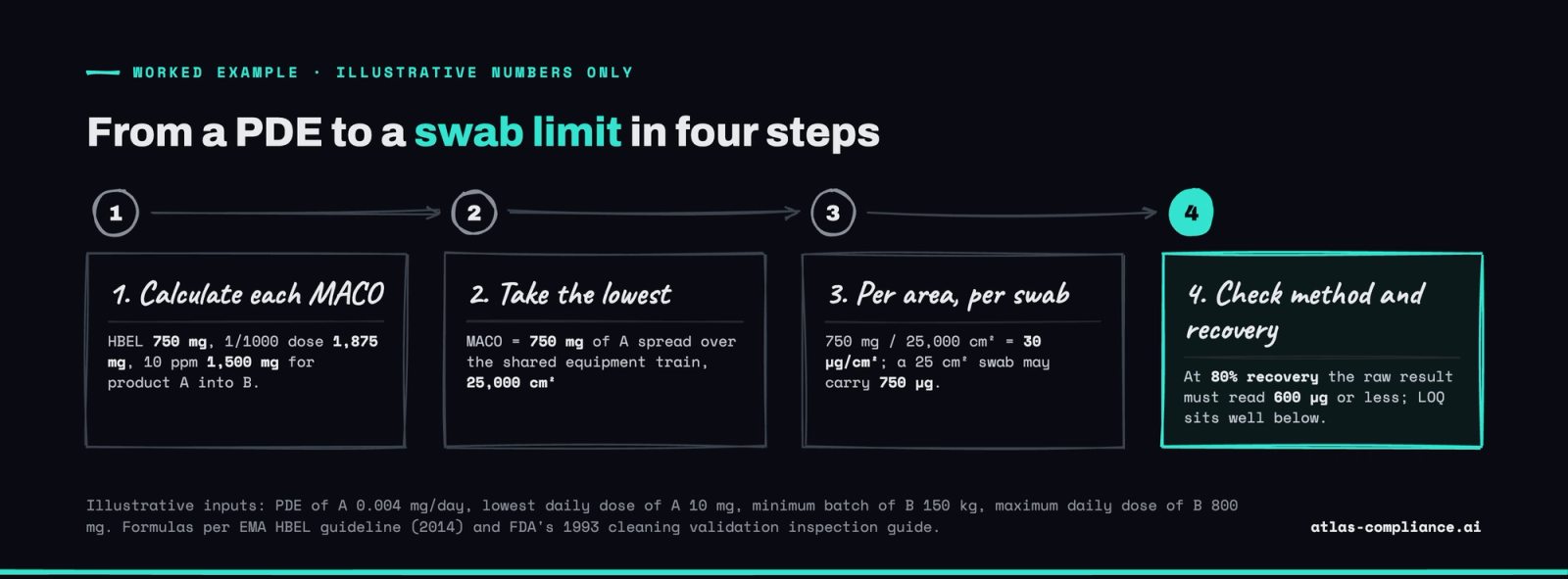
You calculate MACO (maximum allowable carryover) by working out the limit under each applicable method for the previous product A into the next product B, taking the lowest, then dividing by the product contact surface area the two products share to get a per-area, per-swab and per-rinse limit. The numbers below are illustrative only, not from any real product.
Inputs (illustrative): PDE of A = 0.004 mg/day; lowest daily therapeutic dose of A = 10 mg; minimum batch size of B = 150 kg (150,000,000 mg); maximum daily dose of B = 800 mg; shared equipment train = 25,000 cm².
- HBEL MACO = 0.004 x 150,000,000 / 800 = 750 mg.
- 1/1000 dose MACO = (10 / 1000) x 150,000,000 / 800 = 1,875 mg.
- 10 ppm MACO = 10 mg/kg x 150 kg = 1,500 mg.
- Lowest MACO = 750 mg, set by the HBEL.
- Surface limit = 750 mg / 25,000 cm² = 0.03 mg/cm², or 30 µg/cm².
- Swab limit for a 25 cm² swab = 30 x 25 = 750 µg per swab.
- Rinse limit if a 50 L final rinse contacts the whole train = 750 mg / 50,000 mL = 15 µg/mL.
FDA's 1993 guide says it is important to define the sensitivity of the analytical method in order to set reasonable limits, so the quantitation limit has to sit well below the swab and rinse concentrations. Annex 15 section 10.6 asks you to consider the cumulative effect of the whole equipment train, which is why the example spreads the MACO over the full shared area.
Swab vs rinse sampling: what recovery do you need?
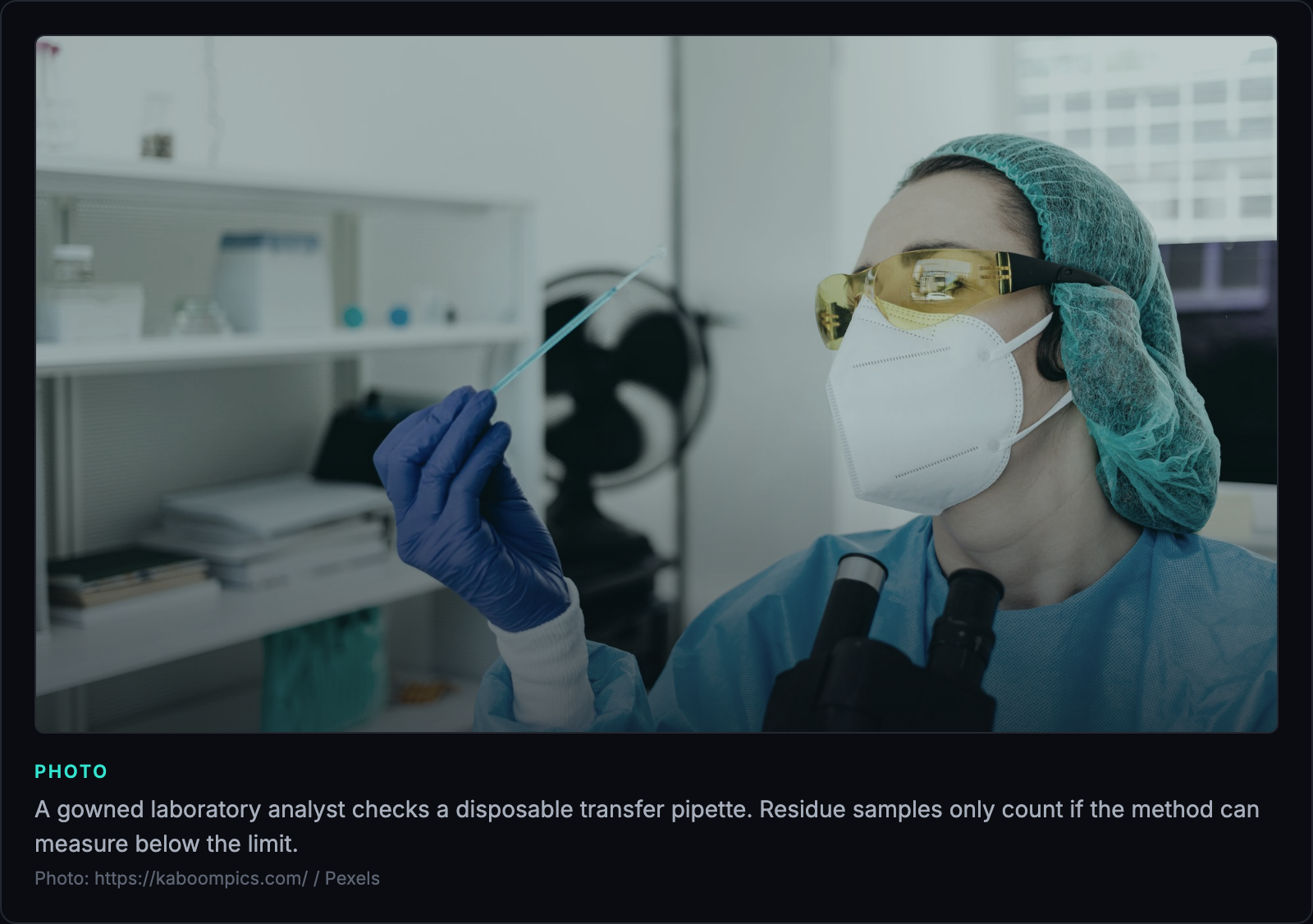
Swab and rinse samples both need a recovery study showing how much residue the method gets back from each product contact material. FDA's 1993 guide asks firms to show that contaminants "can be recovered from the equipment surface and at what level", giving 50% and 90% as examples, and Annex 15 section 10.12 asks for recovery from all sampled materials.
| Topic | Swab sampling | Rinse sampling |
|---|---|---|
| Best for | Hard-to-clean spots, dried or insoluble residue | Pipework, closed systems, large areas |
| FDA 1993 view | The most desirable method; gives residue per surface area | Samples a larger area; residue may not dissolve or may be physically occluded |
| Limit expressed as | µg per swab or µg/cm² | µg/mL of final rinse |
| Recovery study | Spiked coupons of each material | Spiked coupons or a spiked rinse of the system |
If the example recovery for stainless steel is 80% (illustrative), a raw swab result must read 600 µg or less to meet the 750 µg limit, or the result is divided by 0.8 before comparison. Recovery below what the protocol accepts should lead to a change of swab, solvent or technique.
What limits apply to detergents and microbes?
Detergent and microbial limits sit beside the product residue limit, and neither FDA nor EMA prints a single number for them. FDA's 1993 guide expects no detergent to remain after cleaning, or very low levels where the test method is ultra sensitive, and Annex 15 section 10.6 requires limits for any cleaning agent used.
The 1993 guide notes that many detergent suppliers do not disclose composition, and says a detergent that is not easily removable should be replaced. Annex 15 section 10.6.2 allows TOC or conductivity where a specific test is not feasible.
For microbes, the 1993 guide asks for evidence that routine cleaning and storage do not allow microbial growth: equipment should be dried before storage, with no stagnant water left behind. Annex 15 section 10.7 adds endotoxin risk, and section 10.8 asks you to define dirty and clean hold times. Neither document gives a number, so the protocol has to justify one, for example from the next product's microbial specification and route of administration, and test at the end of the longest clean hold.
Why 3 batches for validation?
Three batches for cleaning validation is a long-standing industry convention, not an FDA rule. FDA's 1993 cleaning guide sets no run count, and EU GMP Annex 15 section 10.13 asks for "an appropriate number" of cleaning runs based on a risk assessment, each meeting all acceptance criteria.
The number three comes from process validation. Annex 15 section 5.20 says a minimum of three consecutive batches under routine conditions is generally acceptable for process validation, while FDA's 2011 process validation guidance, covered in our process validation guide, names no batch count. Many cleaning protocols use the same number. A manual clean or a highly hazardous product can justify more.
FDA's 1993 guide accepts testing and retesting until results pass only in rare cases, and Annex 15 section 10.2 rejects it. A failed run means an investigation and a restart, on equipment already qualified as described in our IQ, OQ and PQ guide.
What is visually clean?
Visually clean means no residue is visible on product contact surfaces when a trained inspector checks them under defined lighting and distance. FDA's 1993 guide calls it an "organoleptic" limit, 21 CFR 211.67(b)(6) requires inspection for cleanliness immediately before use, and Annex 15 section 10.2 says a visual check alone is not generally acceptable.
EMA's 2018 questions and answers (Q8) set out what a defensible visual standard needs:
- A threshold at which the product is readily visible as a residue.
- Inspection under the lighting and distances found on the production floor.
- Coverage of every product contact surface, including parts that need dismantling or tools such as a mirror, light source or borescope.
- Non-product contact surfaces that could shed residue into later batches.
- Written instructions listing every area, and records showing each was inspected.
- Trained inspectors with periodic eyesight testing and a practical competency assessment.
Q7 adds that analytical testing is expected at each changeover in a shared facility unless a documented risk assessment justifies otherwise, and that assessment must weigh whether visual inspection can be relied on at the HBEL-based residue limit. In the worked example, that means showing product A is readily visible at or below 30 µg/cm².
How often does FDA cite 21 CFR 211.67, and how do those inspections end?
FDA cited 21 CFR 211.67 at 30.6% of drug inspections that cited Part 211: 237 of 774 that closed between January 7, 2025 and September 3, 2026, in the Atlas Form 483 citation dataset joined to FDA's inspection classifications (pulled October 2026). Those 237 inspections ended OAI at 40.5%, close to double the 21.6% rate at the other 537.
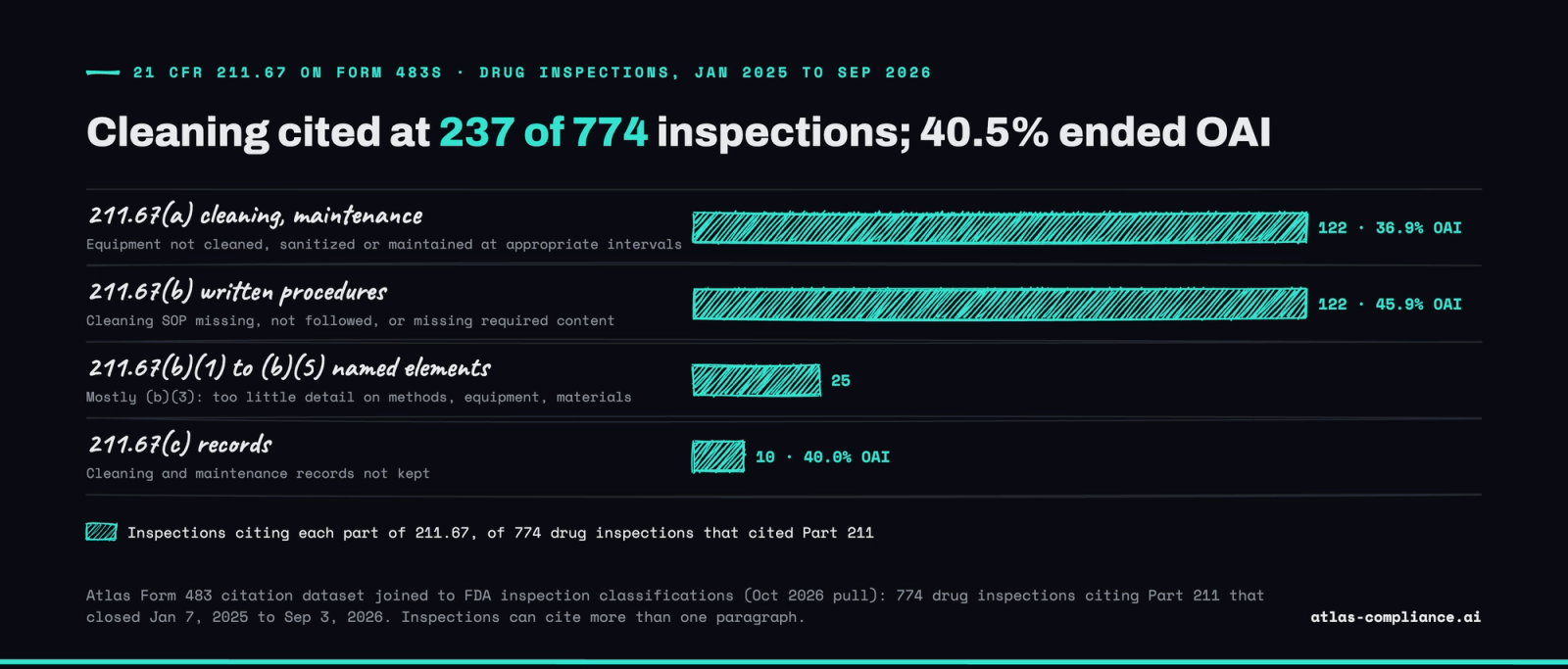
- 211.67(a), equipment not cleaned, sanitized or maintained at appropriate intervals: 122 inspections, 36.9% OAI.
- 211.67(b), written cleaning procedures missing, not followed or incomplete: 122 inspections, 45.9% OAI. 25 of them cite a numbered element, most often (b)(3), the level of detail on methods, equipment and materials.
- 211.67(c), cleaning and maintenance records: 10 inspections, 4 OAI.
The rate held across both years: 168 of 562 Part 211 drug inspections in 2025 (29.9%) and 69 of 212 from January to September 3, 2026 (32.5%). Foreign facilities drew the citation at 51 of 142 inspections (35.9%), against 186 of 632 in the US (29.4%). Inspections citing 211.67 averaged 5.5 Part 211 citations, against 3.4 without it, and most often also cited 211.22 (115 inspections), 211.100 (100) and 211.192 (97). Our map of 21 CFR Part 211 shows where those sections sit, and the NAI, VAI and OAI guide explains what an OAI outcome means.
Five 211.67 forms from the sample, all classified OAI, with observation counts as shown in the FDA Form 483 database:
| Form 483 | Date | 211.67 paragraph | Observations | Also cited |
|---|---|---|---|---|
| Samchundang Pharm, Hwaseong, Korea | May 19, 2026 | 211.67(a) | 8 | 211.42(c)(10)(iv), 211.192, 211.198(a) |
| Unither Manufacturing, Rochester, US | May 15, 2026 | 211.67(b) | 9 | 211.68(b), 211.165(d), 211.166(a) |
| Hanlim Pharm, Yongin, Korea | Apr 24, 2026 | 211.67(a) | 11 | 211.42(c)(10)(v) cleaning system, 211.113(b) |
| Sharp Sterile Manufacturing, Lee, US | Mar 5, 2026 | 211.67(a) | 6 | 211.42(c)(10)(v), 211.56(a), 211.192 |
| Sato Pharmaceutical, Hachioji, Japan | Nov 21, 2025 | 211.67(a) | 10 | 211.42(c)(10)(v), 211.28(a), 211.192 |
The Unither form was the latest of 12 FDA inspections on record on the Unither Manufacturing Rochester facility page. Fareva Amboise in France (September 16, 2025, 211.67(a), OAI) follows the same pattern but its page is not yet indexed. Three of the five forms pair 211.67 with 211.42(c)(10)(v), the system for cleaning and disinfecting the aseptic processing area and its equipment.
If your last inspection included a cleaning finding, check which investigators are likely to come next and which sections they cite most.
 Atlas
See what the FDA knows about your next investigator.
30 minutes with the founder. No pitch deck.
What goes in the acceptance criteria section of a cleaning validation protocol?
The acceptance criteria section of a cleaning validation protocol states every limit, the calculation behind it and the pass rule before the first run starts. Annex 15 section 10.11 asks the protocol to specify sampling locations, the rationale for them, and the acceptance criteria.
- Worst-case product and equipment grouping, with the rationale (Annex 15 section 10.10 names solubility, cleanability, toxicity and potency).
- The HBEL reference for each product and the MACO under each method, lowest selected.
- Surface, swab and rinse limits, with recovery factors and method quantitation limits.
- Detergent, bioburden and, where relevant, endotoxin limits.
- The visual standard, dirty and clean hold times, and campaign length.
- Number of runs, the rule that every run must pass, and alert limits for routine monitoring.
PIC/S published revised Recommendations on Qualification and Validation (PI 006-4) on July 30, 2026, superseding the 2007 PI 006-3 that covered cleaning validation; the PIC/S announcement gives October 1, 2026 as the date it entered into force.
To follow new cleaning findings as FDA publishes them, the Atlas digest is the next step.
AtlasFDA Inspection Intelligence Digest
We track every 483, EIR, and warning letter the moment it happens. Get the signals before they hit the FDA website.
Frequently asked questions
MACO is the total mass of the previous product allowed to carry over into the whole next batch, in mg. A swab limit converts that total into what one swab may contain: MACO divided by the shared product contact surface area, multiplied by the swabbed area. With an illustrative MACO of 750 mg over 25,000 cm², a 25 cm² swab may carry 750 µg.

Written by
Bhavish Agarwal
Founder, Atlas
Bhavish Agarwal is the founder of Atlas and previously worked at Google and Microsoft. He has spent the past several years building regulatory data infrastructure for the pharmaceutical industry.