

21 CFR 211.84 is the FDA drug GMP section that requires a manufacturer to quarantine, sample, test and then approve or reject every lot of components, drug product containers and closures before use. It allows a supplier's certificate of analysis to replace part of that testing only if the manufacturer runs its own specific identity test and checks the supplier's results at intervals.
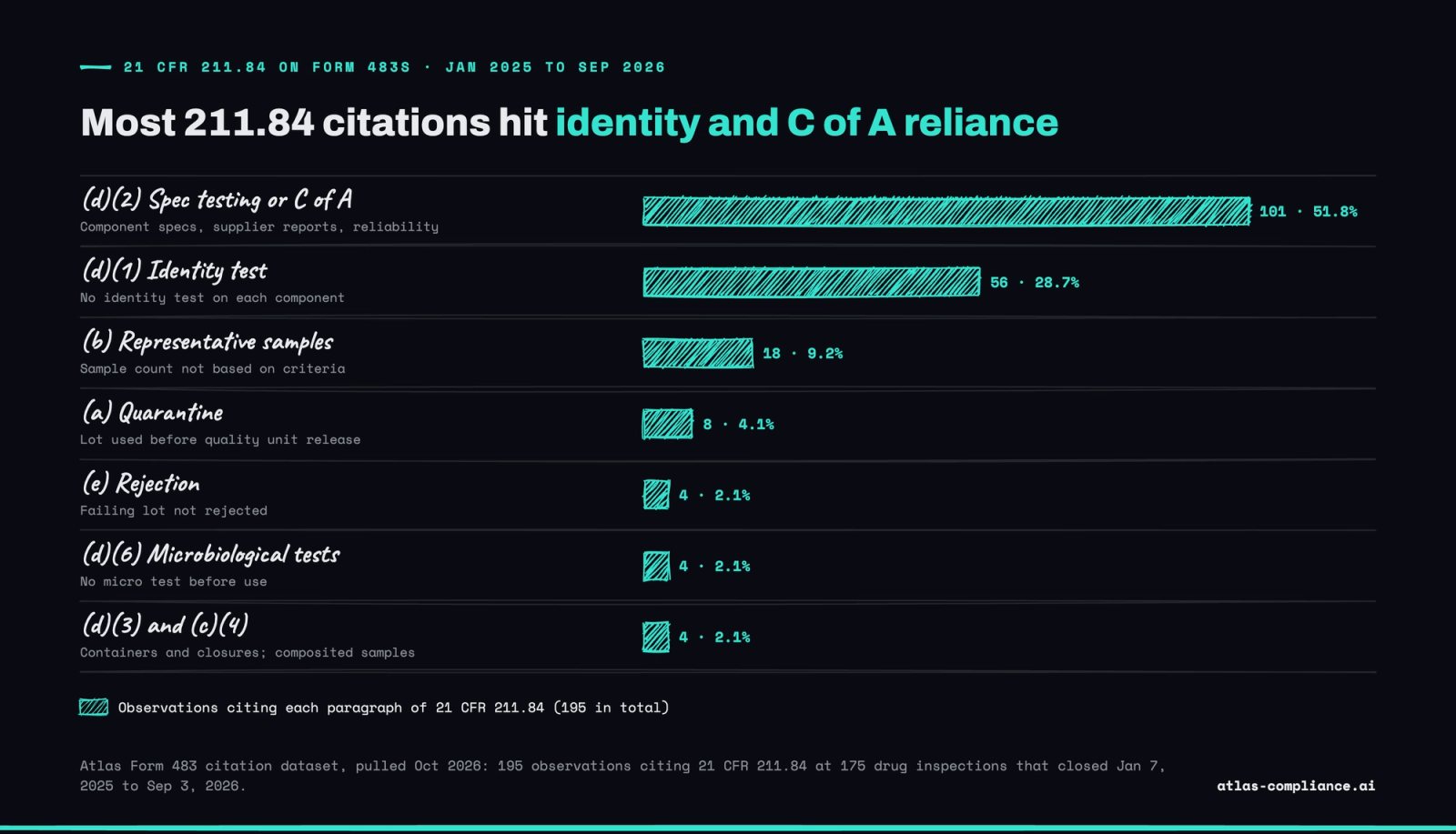
This guide walks through the section paragraph by paragraph and adds what FDA investigators wrote under it: 195 Form 483 observations citing 211.84 at 175 drug inspections that closed between January 7, 2025 and September 3, 2026, from the Atlas Form 483 citation dataset (pulled October 2026), joined to FDA's inspection classifications.
Key facts:
- 211.84 appeared at 175 of 774 drug inspections that cited Part 211 (22.6%) between January 2025 and September 2026.
- 211.84(d)(2), testing to specification or relying on a supplier report, drew 101 of the 195 observations (51.8%); 211.84(d)(1), the identity test, drew 56 (28.7%).
- 48.0% of inspections citing 211.84 ended Official Action Indicated (OAI), against 21.4% of Part 211 drug inspections without it.
- US facilities drew 211.84 at 23.6% of their Part 211 drug inspections (149 of 632); foreign facilities at 18.3% (26 of 142).
- FDA's May 2023 guidance asks for DEG and EG testing, with a 0.10% limit, on samples from all containers of all lots of glycerin, propylene glycol and other high-risk components.
What does 21 CFR 211.84 require?
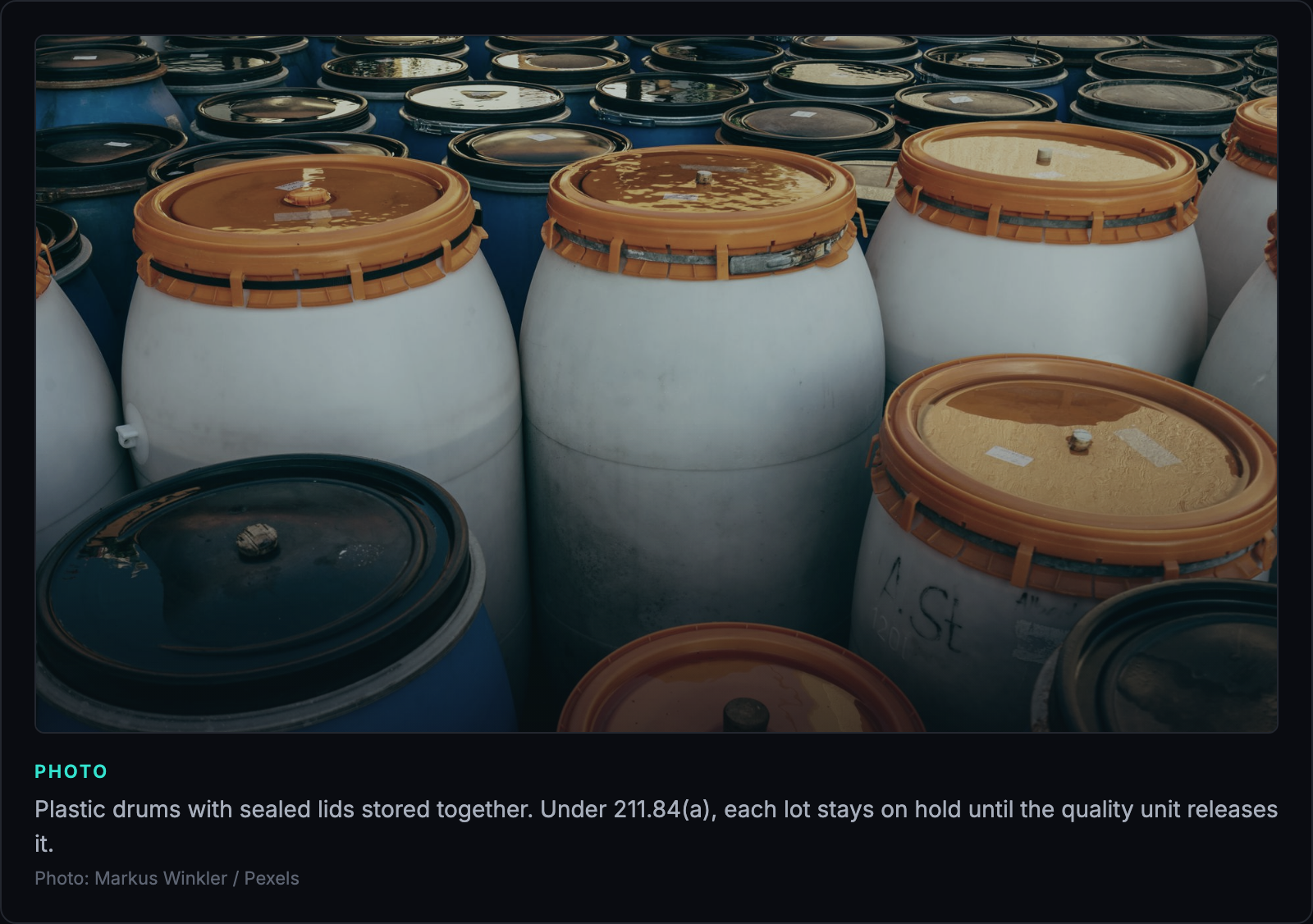
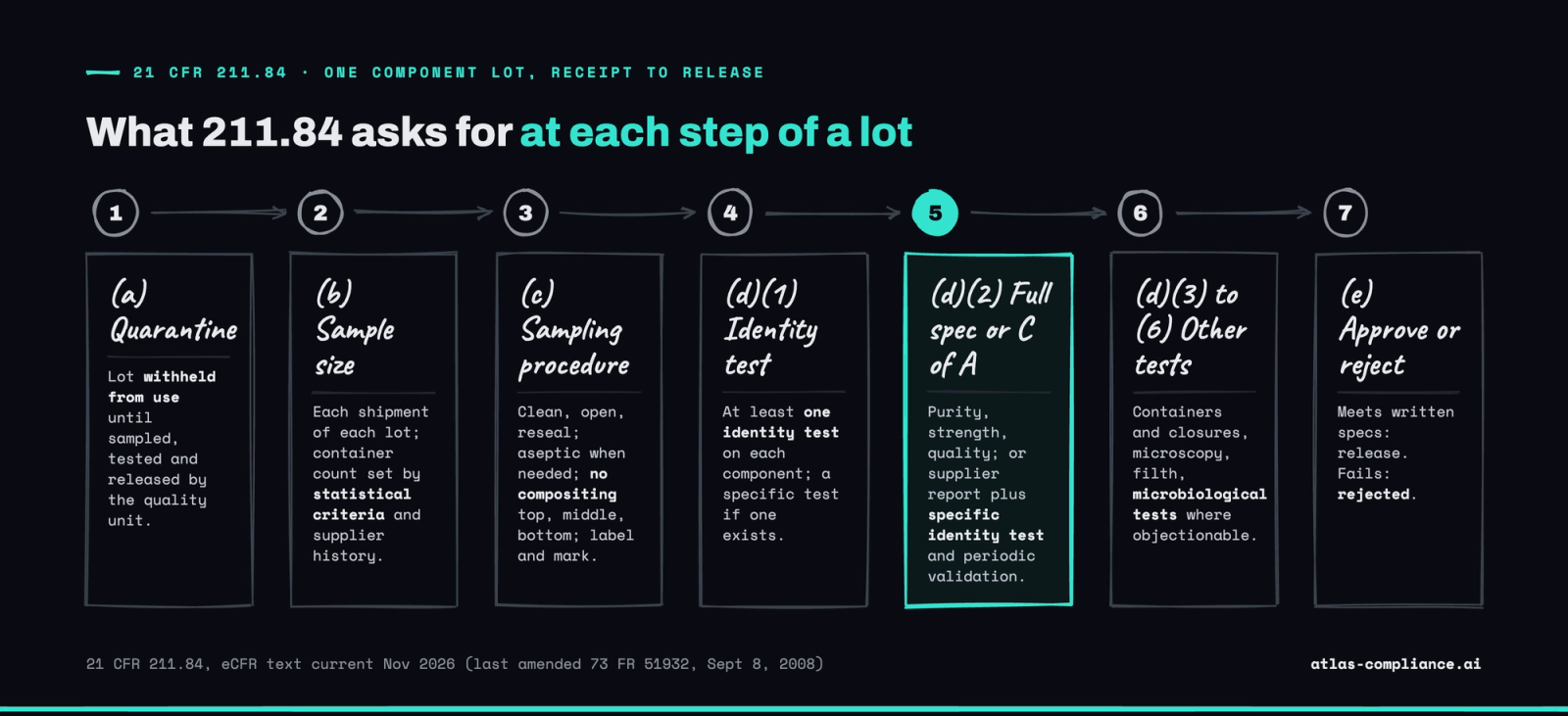
21 CFR 211.84 requires five things for every lot of components, drug product containers and closures: hold the lot until the quality unit releases it, take representative samples, sample by a controlled procedure, test each component (at least one identity test, plus full specification testing or a validated supplier report), and approve or reject the lot against its written specifications.
The section sits in Subpart E of 21 CFR Part 211, "Control of Components and Drug Product Containers and Closures". Its current text, in the eCFR, dates from 1978 and was last amended on September 8, 2008. Paragraph by paragraph:
| Paragraph | What the text requires | Evidence an investigator asks for |
|---|---|---|
| (a) Quarantine | Each lot withheld from use until sampled, tested or examined and released by the quality control unit | Status labels, quarantine area or system lock, release record dated before first use |
| (b) Representative samples | Samples from each shipment of each lot; container count and amount based on statistical criteria, supplier history and reserve needs | A written sampling plan with its rationale |
| (c) Sampling procedure | Clean and reseal containers, aseptic sampling when needed, no compositing of top, middle and bottom samples, labeled samples, sampled containers marked | Sampling SOP, sample labels, marked containers |
| (d)(1) Identity | At least one identity test on each component; specific identity tests if they exist | Identity method and results for every lot |
| (d)(2) Specifications or supplier report | Test to all written specifications for purity, strength and quality, or accept the supplier's report of analysis with a specific identity test and periodic validation | Full test results, or the supplier qualification file and validation data |
| (d)(3) to (d)(6) | Containers and closures, microscopy, filth and adulterants, microbiological tests where contamination would be objectionable | Container and closure specs, micro results for susceptible materials |
| (e) Approve or reject | Release lots that meet specifications; reject any lot that does not | Disposition record, rejected-material log |
What do 211.84(a), (b) and (c) say about quarantine and sampling?
211.84(a) says each lot "shall be withheld from use" until it has been sampled, tested or examined and released by the quality control unit. 211.84(b) requires representative samples from each shipment of each lot, with the number of containers and the amount taken set by appropriate criteria. 211.84(c) sets six rules for how samples are taken.
The criteria in (b) are named in the text: statistical criteria for component variability, confidence levels, the degree of precision wanted, the supplier's past quality history, and the quantity needed for analysis and for reserve samples under 211.170. A sampling SOP that says "sample three containers" with no reason behind the number is the usual target. FDA's standard wording for that observation, used on Form 483s in the Atlas dataset, reads "The number of containers to be sampled is not based upon appropriate criteria."
FDA cited paragraph (c) only twice in the dataset, both times under (c)(4), which bars compositing top, middle and bottom samples.
What is identity testing of components under 211.84(d)(1)?
Identity testing of components under 211.84(d)(1) means at least one test, run by the manufacturer, that confirms each component is what its label says. The regulation adds that "Specific identity tests, if they exist, shall be used." A specific test tells the material apart from close relatives, which a check of color or appearance cannot do.
Firms usually run the compendial monograph method or a validated in-house method such as infrared spectroscopy against a reference standard. The test applies to each component lot, including lots accepted on a supplier report. The most common 211.84 sentence in the Atlas dataset, used 40 times, is FDA's standard (d)(1) wording: "The identity of each component of a drug product is not verified by conducting at least one test to verify the identity, using specific identity tests if they exist."
Can a certificate of analysis replace component testing under 211.84(d)(2)?
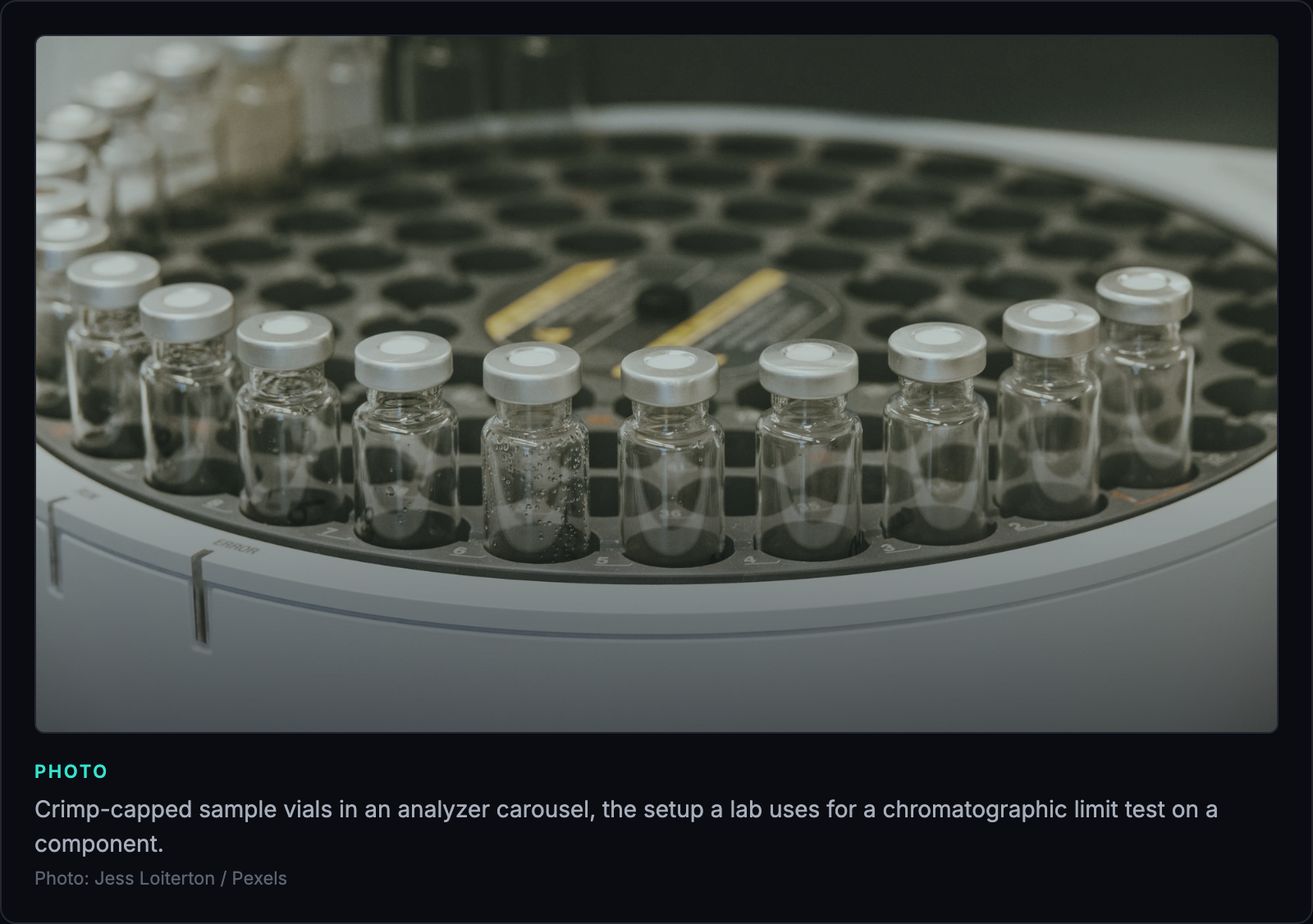
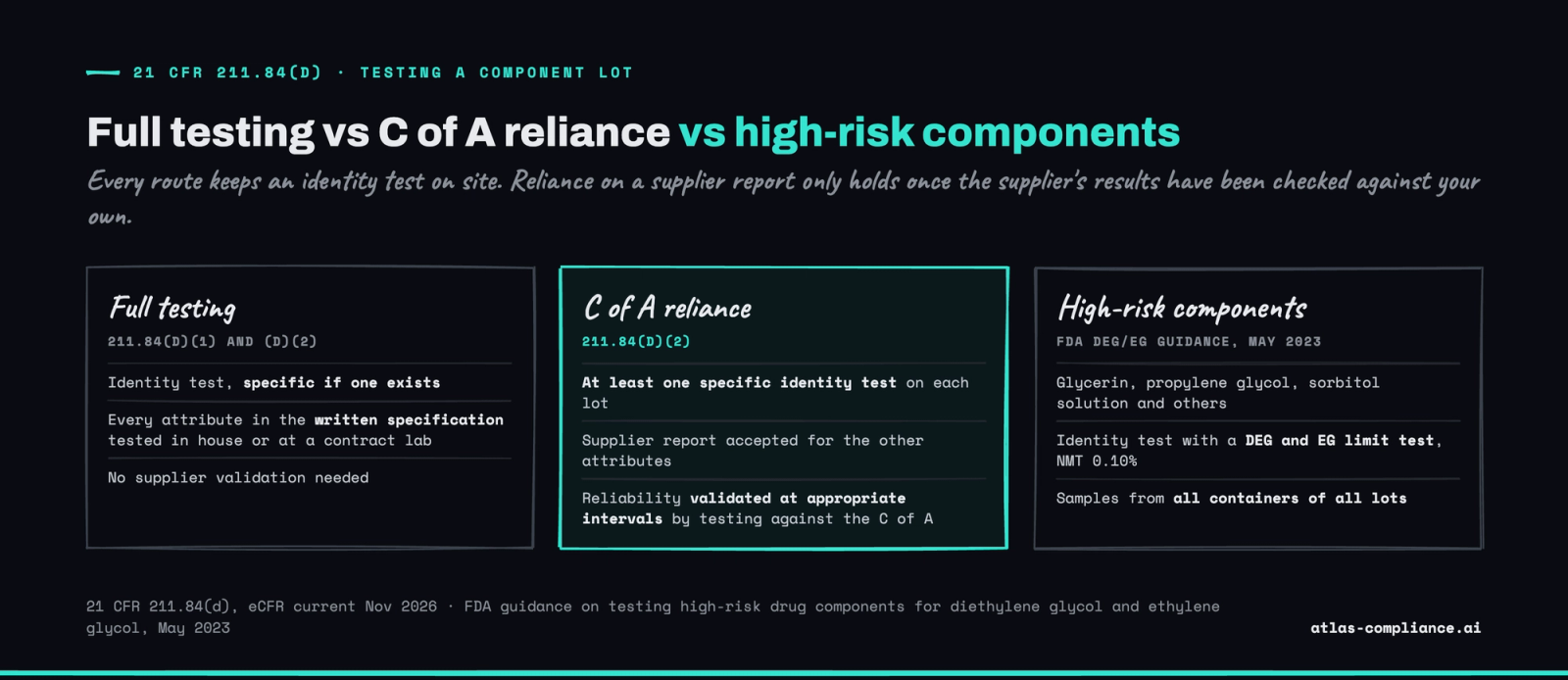
A certificate of analysis can replace part of component testing under 211.84(d)(2), on two conditions. The manufacturer must still run at least one specific identity test on the component, and it must establish the reliability of the supplier's analyses "through appropriate validation of the supplier's test results at appropriate intervals." Without both, every attribute in the specification has to be tested.
Validation of the supplier's results usually means testing a lot to the full specification, in house or at a contract laboratory, and comparing the numbers with the certificate. A supplier audit supports the qualification file but does not replace that comparison. Our guide to release testing in pharma covers the finished-product side, where 211.165 gives no such option.
FDA's (d)(2) citations fall under five standard headings in the Atlas dataset. Of the 101 observations, 25 say components were not tested to all written specifications, 13 use the shorter "Each component is not tested for conformity" form, 22 say the supplier's results were not validated at appropriate intervals, 21 say no specific identity test was run on components accepted on a supplier report, and 20 cite the reports of analysis heading. In all, 63 of the 175 inspections (36.0%) drew one of the three certificate-reliance headings.
What do 211.84(d)(3) to (d)(6) and 211.84(e) add?
211.84(d)(3) applies the same logic to containers and closures, with a lighter identity check: a supplier's certificate of testing is acceptable if the manufacturer does at least a visual identification and validates the supplier's results at intervals. (d)(4) calls for microscopic examination when appropriate, (d)(5) for checks against filth and insect infestation, and (d)(6) for microbiological tests before use where contamination would be objectionable.
211.84(e) closes the loop: a lot that meets its written specifications for identity, strength, quality and purity may be approved and released, and "Any lot of such material that does not meet such specifications shall be rejected." FDA wrote 4 observations under (e) and 4 under (d)(6) in the Atlas window. Retesting of approved components after storage or exposure falls under the next section, 211.87.
Why do glycerin and other high-risk components need DEG and EG testing?
Glycerin, propylene glycol and similar components need diethylene glycol (DEG) and ethylene glycol (EG) testing because those toxic glycols have been substituted for or mixed into them, and contaminated medicines have killed patients. FDA's guidance "Testing of Glycerin, Propylene Glycol, Maltitol Solution, Hydrogenated Starch Hydrolysate, Sorbitol Solution, and other High-Risk Drug Components for Diethylene Glycol and Ethylene Glycol" (May 2023) sets the expectations.
The history goes back to 1937, when an elixir made with DEG caused more than 100 deaths in the US and led to the Federal Food, Drug, and Cosmetic Act of 1938. Contaminated syrups caused deaths in several countries again in 2022 and 2023. The May 2023 guidance replaced FDA's 2007 guidance on testing glycerin and added EG to the contaminants of concern. Its main recommendations:
- Treat glycerin, propylene glycol, maltitol solution, hydrogenated starch hydrolysate and sorbitol solution as high-risk, and identify any other component with a similar history.
- Run a specific identity test that includes a limit test for DEG and EG, using a safety limit of not more than 0.10%.
- Test representative samples from all containers of all lots before use, since contamination can vary from container to container.
- Do not rely on a certificate that hides the original manufacturer or chain of custody; repackers and distributors should pass on the original manufacturer's certificate for each lot.
For these components the guidance asks for more than 211.84(b): every container instead of a statistical subset. A firm that accepts glycerin on a distributor's certificate with an appearance check meets neither (d)(1) nor the guidance.
How often does FDA cite 21 CFR 211.84 on Form 483s?
FDA cited 21 CFR 211.84 at 175 of 774 drug inspections that cited Part 211 between January 7, 2025 and September 3, 2026, or 22.6%, according to the Atlas Form 483 citation dataset (pulled October 2026). The 175 inspections carried 195 observations under the section, and 144 of them (82.3%) cited (d)(1) or (d)(2).
The citation tends to come with a worse outcome. Of the 175 inspections, 84 (48.0%) were classified OAI, against 128 of 599 (21.4%) Part 211 drug inspections without a 211.84 citation. Inspections citing 211.84 averaged 5.6 observations against 3.7 for the rest. By paragraph, 55.4% of the inspections citing (d)(1) and 51.0% of those citing (d)(2) ended OAI, against 27.8% for (b). The section rarely appears alone: 52.0% of the 175 inspections also cited 211.22 (quality unit), 44.6% cited 211.100 and 40.0% cited 211.192, production record review.
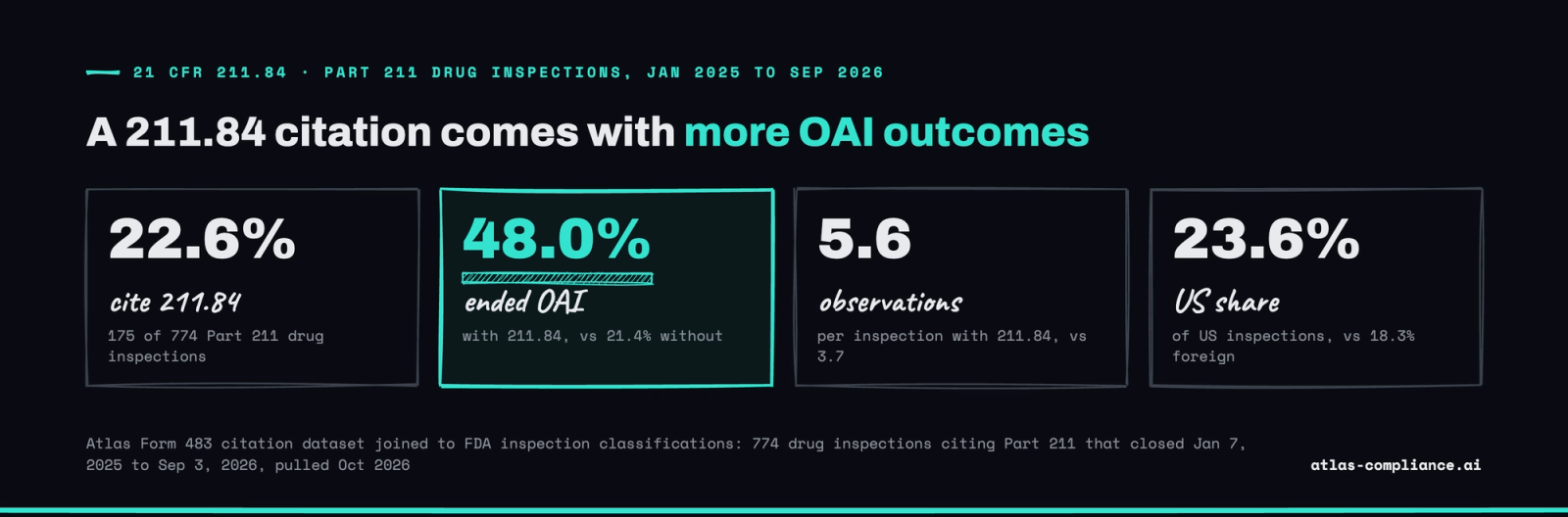
Location cuts the other way from 211.192, which FDA cited more often at foreign facilities. US facilities drew 211.84 at 149 of 632 Part 211 drug inspections (23.6%) and 80 of those 149 ended OAI (53.7%). Foreign facilities drew it at 26 of 142 (18.3%), and 4 of the 26 ended OAI. Canada (7), India (5) and Japan (4) led the foreign list. The share also fell, from 23.8% of Part 211 drug inspections in 2025 to 19.3% in January to September 2026. At API manufacturers the section shows up on about a third of forms, as our analysis of API manufacturer Form 483s found.
Which firms were cited under 211.84 in 2025 and 2026?
FDA cited 211.84 at generic drug makers, sterile injectable manufacturers, OTC and topical producers and veterinary facilities. The table shows seven recent forms from the FDA Form 483s directory, one per paragraph or heading, with the other sections cited on the same form and the final classification.
| Form 483 | Issued | 211.84 paragraph and heading | Other sections cited | Classification |
|---|---|---|---|---|
| Topical Pharmaceuticals, Addison, US | May 7, 2026 | (d)(2) Component written specification | 211.22(c), 211.165(a), 211.192 and 7 more | OAI |
| Samson Pharmaceuticals, Commerce, US | Apr 29, 2026 | (d)(2) Reliability of supplier's C of A | 211.22(d), 211.113(b), 211.192 and 4 more | OAI |
| KDC/One SoCal Laboratories, Walnut, US | Apr 14, 2026 | (a) Components withheld from use pending release | 211.67(a), 211.166(a)(1), 211.170(b) and 1 more | VAI |
| MPP Pharma, Kansas City, US | Apr 2, 2026 | (b) Representative samples criteria | 211.22(d), 211.100(a), 211.192 and 6 more | OAI |
| Westwood Laboratories, Azusa, US | Mar 26, 2026 | (d)(1) Component identity verification | 211.100(a), 211.160(a), 211.192 and 6 more | OAI |
| Acme Generics, Solan, India | Feb 20, 2026 | (d)(2) Testing each component for conformity | 211.100(a) | VAI |
| American Regent, New Albany, US | Jan 29, 2026 | (e) Rejecting when specifications not met | 211.22(d), 211.113(b), 211.192 | VAI |
The forms citing two to five sections ended VAI; the four citing eight to eleven sections ended OAI. Topical Pharmaceuticals, Samson and Westwood each drew 211.84 next to 211.192 and laboratory control citations, and each ended OAI. An investigator who finds an unverified certificate tends to read it as part of a wider quality unit problem. Investigators also differ in how often they open the component file, so check what your assigned investigator has cited at your peers before the inspection starts.
 Atlas
See what the FDA knows about your next investigator.
30 minutes with the founder. No pitch deck.
How do you build a 211.84 component testing program?
A 211.84 component testing program needs a written procedure for each step of the section and records that show each lot went through it. The program has five parts, in the order a lot meets them:
- A quarantine status for every incoming lot, enforced by area, label or system lock, with release recorded by the quality unit before first use.
- A sampling plan per material that names the statistical basis, the supplier history used and the reserve quantity.
- A specific identity method for each component, run on every lot, and on every container for DEG and EG high-risk components.
- A written list of which components are accepted on a supplier certificate, the date each supplier's results were last checked against full in-house testing, and the next due date.
- Micro and filth testing for susceptible materials, and a rejected-material log for lots that fail.
Step 4 depends on supplier qualification: audits, quality agreements and risk tiers. New 211.84 citations arrive every month, and the digest below sends the ones relevant to component and supplier control as FDA posts them.
AtlasFDA Inspection Intelligence Digest
We track every 483, EIR, and warning letter the moment it happens. Get the signals before they hit the FDA website.
Frequently asked questions
Not under the regulation text. 211.84(d)(1) requires at least one identity test per component lot, and 211.84(b) sets representative sampling by statistical criteria. FDA's May 2023 guidance on DEG and EG goes further for high-risk components such as glycerin and propylene glycol, asking for samples from all containers of all lots.

Written by
Bhavish Agarwal
Founder, Atlas
Bhavish Agarwal is the founder of Atlas and previously worked at Google and Microsoft. He has spent the past several years building regulatory data infrastructure for the pharmaceutical industry.