
The USP 71 sterility test is the compendial method in United States Pharmacopeia General Chapter <71>, Sterility Tests, that checks whether a batch of a product labeled sterile shows any viable bacteria or fungi after at least 14 days of incubation in two culture media. Drug manufacturers run it to meet 21 CFR 211.167(a), and biologics manufacturers run it, or a validated alternative, under 21 CFR 610.12.
This guide sets out the chapter's methods, media and sample sizes, and adds what FDA investigators wrote when batch sterility testing fell short: 158 drug inspections that cited 211.167(a), out of 8,123 drug inspections citing 21 CFR Part 211 that closed between October 2008 and September 2026, from the Atlas Form 483 citation dataset (pulled October 2026) joined to FDA's inspection classifications.
Key facts:
- USP <71> offers two methods, membrane filtration and direct inoculation, and asks for membrane filtration wherever the product can be filtered.
- Fluid thioglycollate medium incubates at 30 to 35 °C and soybean-casein digest medium at 20 to 25 °C, both for not less than 14 days.
- Each lot of medium must pass growth promotion with not more than 100 CFU of each of six named organisms, three per medium.
- 21 CFR 211.167(a) requires appropriate laboratory testing of each batch that claims to be sterile or pyrogen-free, under written procedures that are followed.
- In the Atlas dataset, 121 of the 158 inspections that cited 211.167(a) (76.6%) ended Official Action Indicated (OAI), against 16.8% of the other 7,965 Part 211 drug inspections.
What is the USP 71 sterility test?
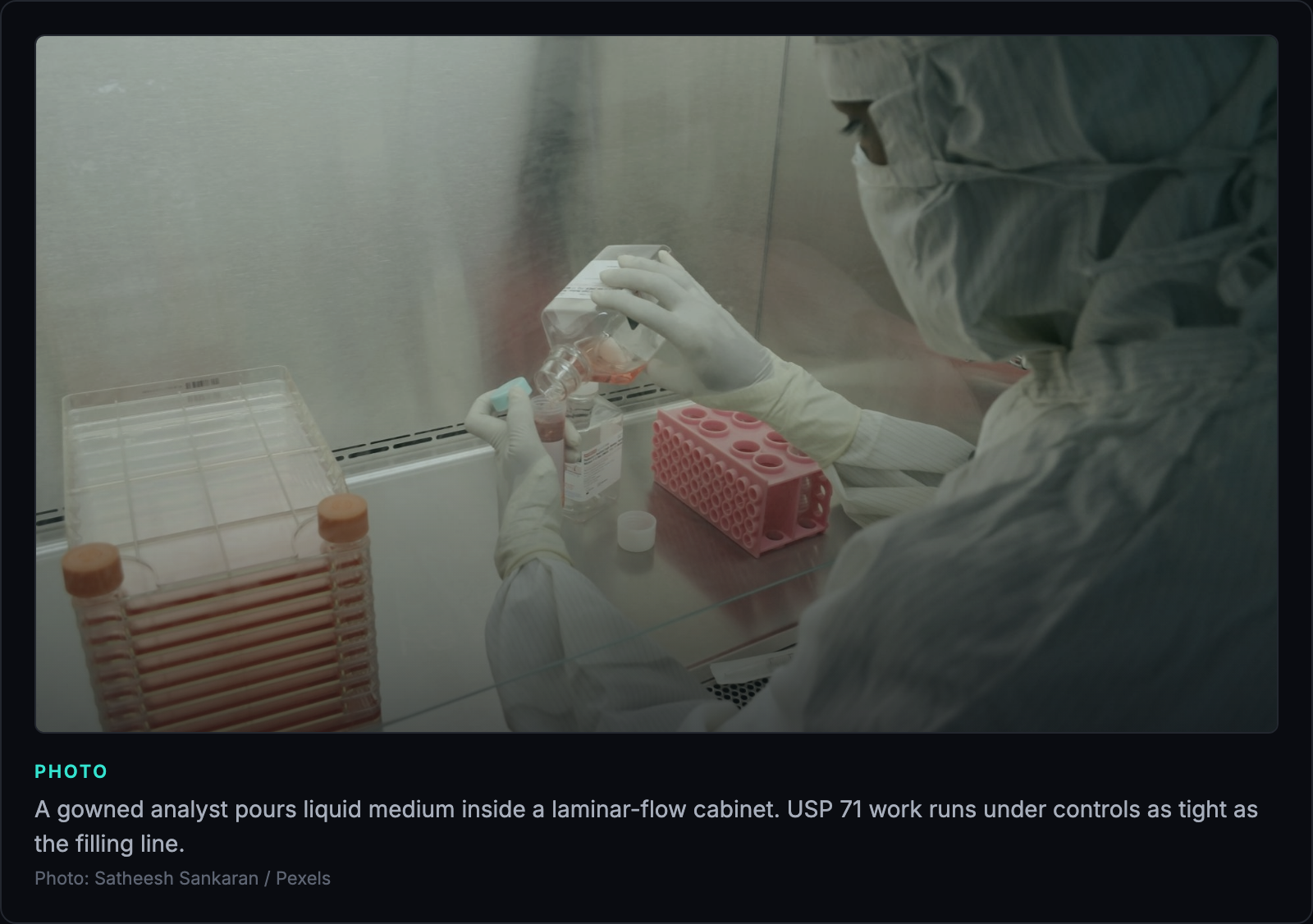
The USP 71 sterility test is a growth-based test for viable microorganisms in sterile drugs, biologics and devices. Analysts transfer a set number of units from the batch into fluid thioglycollate medium, which supports anaerobes and aerobic bacteria, and soybean-casein digest medium, which supports fungi and aerobic bacteria, then watch for turbidity for at least 14 days.
The sterility test is harmonized among the US, European and Japanese pharmacopoeias, so a validated <71> procedure travels well between markets. The Japanese Pharmacopoeia's version, JP 4.06 in the 18th edition, states the harmonization and marks the passages that are not harmonized; the method details in this guide come from that harmonized text.
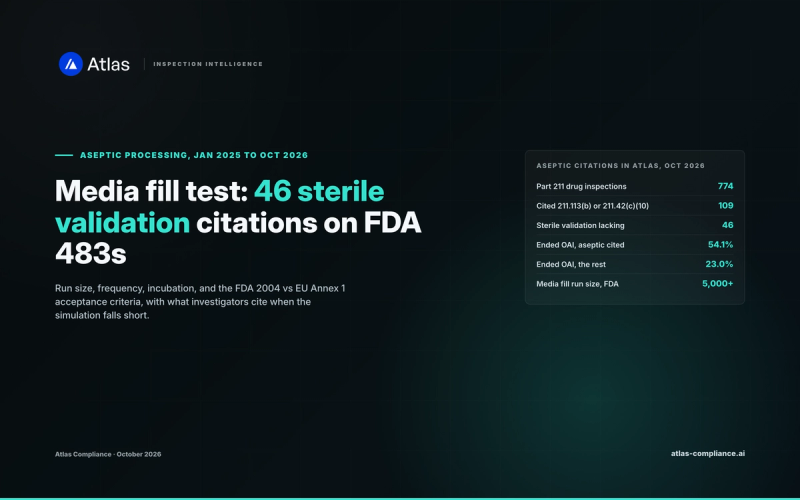
The harmonized text also states its own limit: a passing result only shows that no contaminant was found in the units sampled, under the conditions of the test. A sample of 20 containers from a 50,000-unit lot can miss low-level contamination, which is why FDA relies on validated sterilization and aseptic processing first. Our guide to the media fill test covers how an aseptic line proves that control.
The legal hook in the United States is 21 CFR 211.167(a): "For each batch of drug product purporting to be sterile and/or pyrogen-free, there shall be appropriate laboratory testing to determine conformance to such requirements. The test procedures shall be in writing and shall be followed" (eCFR, 21 CFR 211.167). For licensed biologics, 21 CFR 610.12 requires a validated sterility test of each lot and allows culture or non-culture methods, provided the test reliably and consistently detects viable contaminating microorganisms.
How does a USP 71 sterility test work, step by step?
A USP 71 sterility test runs in six steps: qualify the media, prove the method works with the product, sample the batch, filter or inoculate, incubate for 14 days, then read the result. The first two steps happen before routine testing and are repeated when the product, the medium supplier or the method changes.
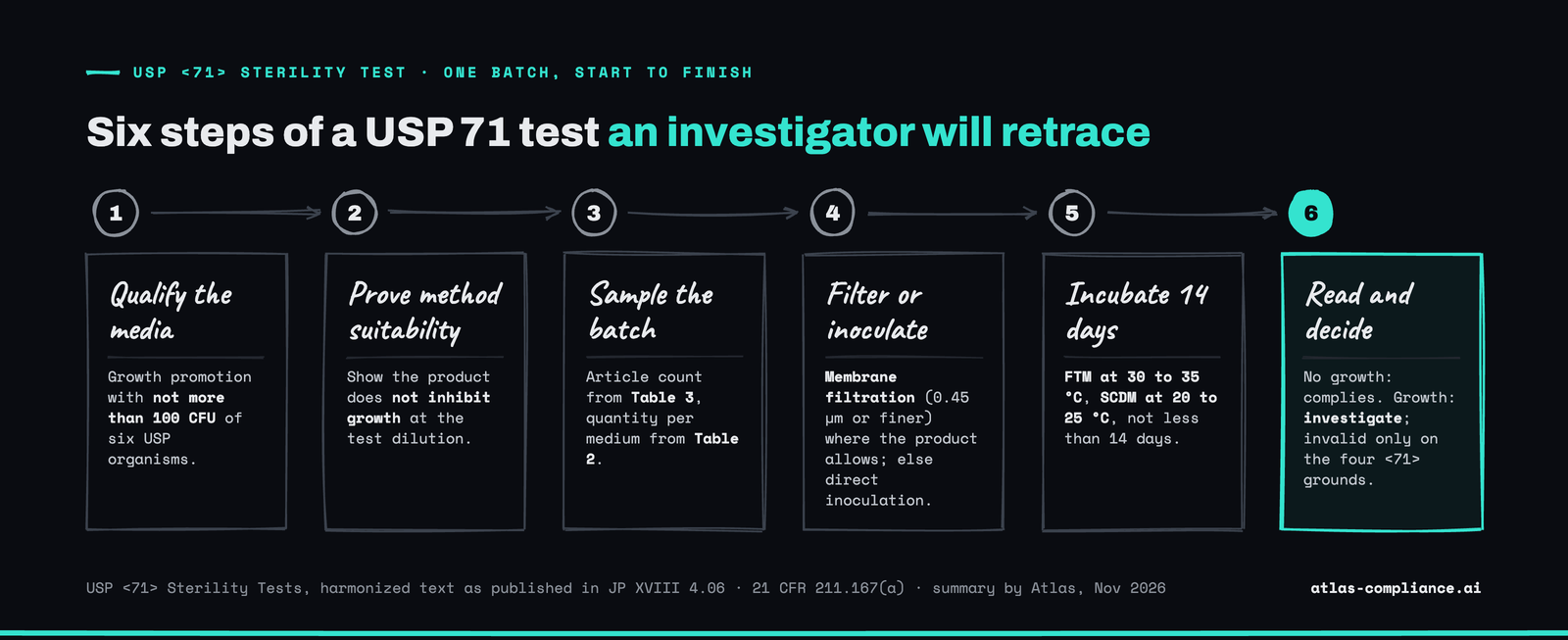
- Growth promotion. The lab inoculates each medium lot with not more than 100 CFU of each organism and expects clearly visible growth within 3 days for bacteria and 5 days for fungi.
- Method suitability. The lab repeats the challenge with the product present, at the planned dilution and rinse, and the growth must look comparable to a control without product. A product with antimicrobial activity has to be neutralized or diluted, and the suitability test repeated.
- Sampling. Table 3 of the chapter sets how many containers to test, and Table 2 sets how much of each container goes into each medium.
- Transfer. Membrane filtration or direct inoculation, covered in the next section.
- Incubation. Not less than 14 days, with the media examined at intervals and at the end.
- Interpretation. No growth means the product complies. Growth means it does not comply, unless the lab can show the test itself was invalid.
The growth promotion organisms are fixed by the chapter:
| Medium | Incubation | Growth promotion organisms |
|---|---|---|
| Fluid thioglycollate medium | 30 to 35 °C | Clostridium sporogenes ATCC 19404, Pseudomonas aeruginosa ATCC 9027, Staphylococcus aureus ATCC 6538 |
| Soybean-casein digest medium | 20 to 25 °C | Aspergillus brasiliensis ATCC 16404, Bacillus subtilis ATCC 6633, Candida albicans ATCC 10231 |
The harmonized table also accepts a second Clostridium sporogenes strain, ATCC 11437, and lists equivalent collection numbers for each organism.
Membrane filtration vs direct inoculation: which method should you use?
Membrane filtration is the method USP 71 asks for whenever the product can be filtered, because the rinse step washes away preservatives and antibiotics that would otherwise suppress growth. Direct inoculation is the fallback for products that will not filter, such as some suspensions and devices immersed whole.
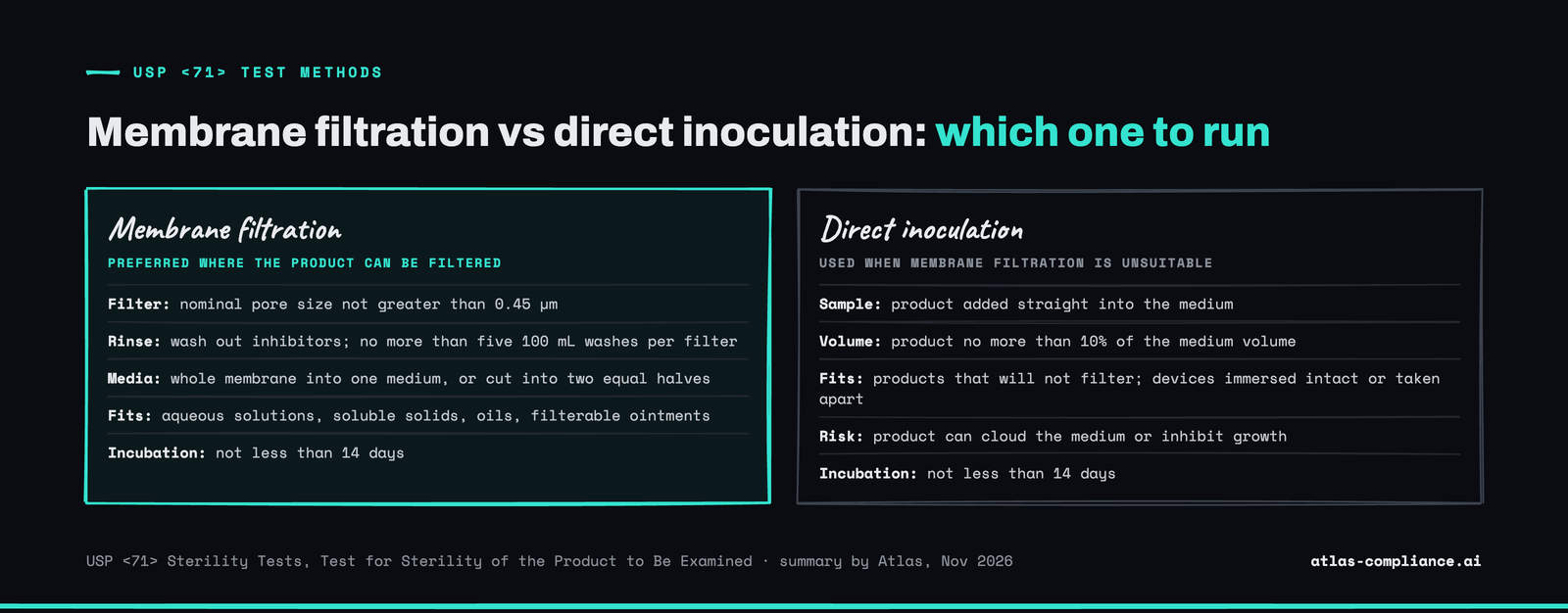
For filtration, the chapter calls for a membrane with a nominal pore size not greater than 0.45 µm. If the product has antimicrobial properties, the membrane is washed at least three times, and the washing cycle never exceeds five washes of 100 mL per filter. The analyst then transfers the whole membrane to one medium or cuts it into two equal halves, one per medium. For direct inoculation, the product volume must not exceed 10% of the medium volume, unless the monograph says otherwise. Oily products get an emulsifier, and ointments are diluted about 1 in 10 before transfer.
FDA's guidance Sterile Drug Products Produced by Aseptic Processing (September 2004), in its section on sterility testing, says the testing laboratory should use facilities and controls comparable to those of aseptic filling. Poor test facilities can cause test failures, and a lab weaker than production invites firms to blame a real product contamination on the lab.
How many samples does a USP 71 sterility test need?
A USP 71 sterility test needs the number of containers that Table 3 sets by batch size and product type, tested in each medium. For a parenteral batch of more than 500 containers, the minimum is 2% of the batch or 20 containers, whichever is less.
| Product and batch size | Minimum containers tested per medium |
|---|---|
| Parenterals, up to 100 containers | 10% or 4 containers, whichever is greater |
| Parenterals, 101 to 500 containers | 10 containers |
| Parenterals, more than 500 containers | 2% or 20 containers, whichever is less |
| Ophthalmic and other non-injectables, up to 200 containers | 5% or 2 containers, whichever is greater |
| Ophthalmic and other non-injectables, more than 200 containers | 10 containers |
| Bulk solid products, up to 4 containers | Each container |
| Bulk solid products, 5 to 50 containers | 20% or 4 containers, whichever is greater |
| Bulk solid products, more than 50 containers | 2% or 10 containers, whichever is greater |
The rows above are the harmonized ones. Each pharmacopoeia adds its own non-harmonized rows, such as separate counts for large-volume parenterals, so check the current USP table for those products.
Table 2 then fixes the quantity per container. For liquids of 1 to 40 mL the analyst takes half the contents and not less than 1 mL; above 100 mL, 10% of the contents and not less than 20 mL. Solids from 300 mg to 5 g need 150 mg per medium. Under 21 CFR 610.12(d), a biologics manufacturer also sizes the sample to the lot, the container and any preservative in the product.
What does FDA cite when sterility testing falls short?
FDA cites sterility testing failures under 21 CFR 211.167(a), with two standard headings: "Sterility/pyrogen-free testing" when a batch was not tested, and "Sterility/pyrogens - test methods written, followed" when the procedures were missing or ignored. In the Atlas dataset, 158 drug inspections carried at least one of them, out of 8,123 Part 211 drug inspections from October 2008 to September 2026.
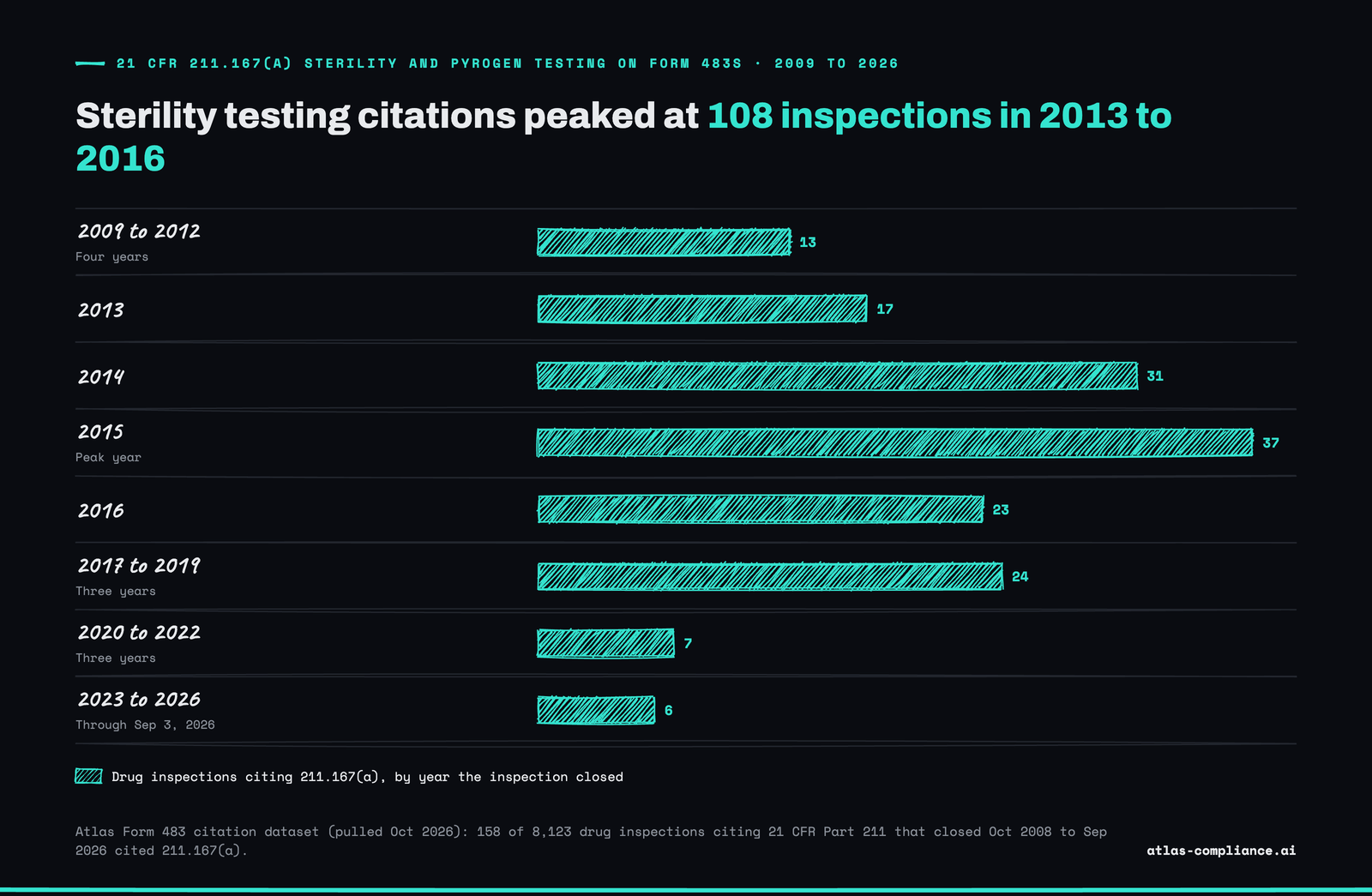
The untested batch is the common case. Of 161 citations, 124 used the "not laboratory tested" wording and 37 the "test procedures" wording. The 2013 to 2016 cluster accounts for 108 of the 158 inspections, and at least 61 of the 158 were at firms with pharmacy, compounding or Rx in the legal name. The citation has become rare at manufacturers: across the 774 Part 211 drug inspections that closed between January 2025 and September 2026, 3 carried it.
Recent examples in the FDA Form 483 database show both headings:
| Facility | Inspection closed | 211.167(a) wording | Other sections on the form | Classification |
|---|---|---|---|---|
| Gilead Sciences, La Verne, US | Feb 18, 2026 | Sterility test procedures not followed | 211.113(b), 211.160(a), 211.160(b), 211.170(b), 211.22(d) | VAI |
| Eugia Pharma Specialities, Sangareddy, India | Feb 6, 2026 | Pyrogen test procedures not followed | 211.113(b), 211.42(c)(10)(iv), 211.165(a), 211.192 and five more | OAI |
| Medtronic, Minneapolis, US | Dec 10, 2025 | Batch not tested for sterility and pyrogens | One other Part 211 section | VAI |
| OSRX, Missoula, US | Oct 25, 2024 | Batch not tested for sterility and pyrogens | Five other Part 211 sections | OAI |
| Catalent Pharma Solutions, Morrisville, US | Dec 15, 2022 | Pyrogen test procedures not followed | Three other Part 211 sections | VAI |
The Gilead La Verne form lists seven investigators, among them one with 36 inspections across 35 sites on record in Atlas. Three investigators wrote the Eugia form, and its lead investigator has 162 inspections across 151 sites on record. The Catalent Morrisville site page shows 18 FDA inspections, 8 of them ending in a Form 483.
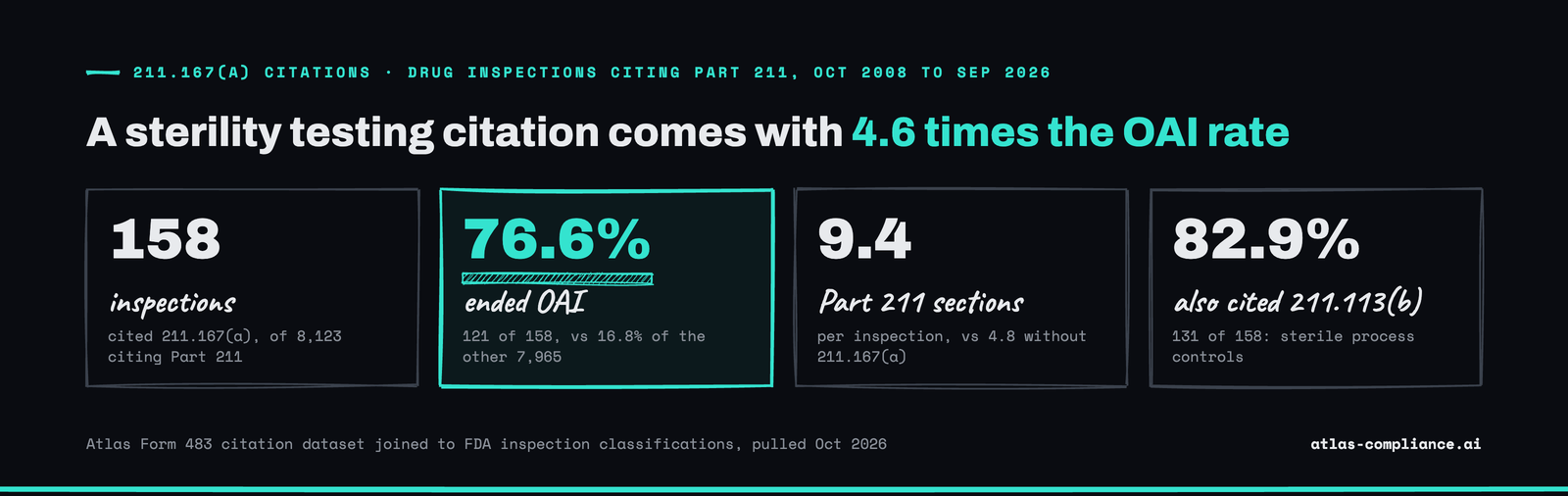
A sterility testing citation rarely stands alone. 131 of the 158 inspections (82.9%) also cited 211.113(b) for sterile process controls, 105 cited environmental monitoring under 211.42(c)(10)(iv), and 72 cited 211.192 investigations. The inspections averaged 9.4 distinct Part 211 sections against 4.8 for the rest. Of the 158, 142 were at US facilities. The NAI, VAI and OAI classifications explain what an OAI outcome sets in motion.
The investigators who wrote these citations have full histories in the same database, so a sterile facility can check which Part 211 sections its likely investigator has cited at peer sites before the opening meeting.
 Atlas
See what the FDA knows about your next investigator.
30 minutes with the founder. No pitch deck.
Can a failed sterility test be retested?
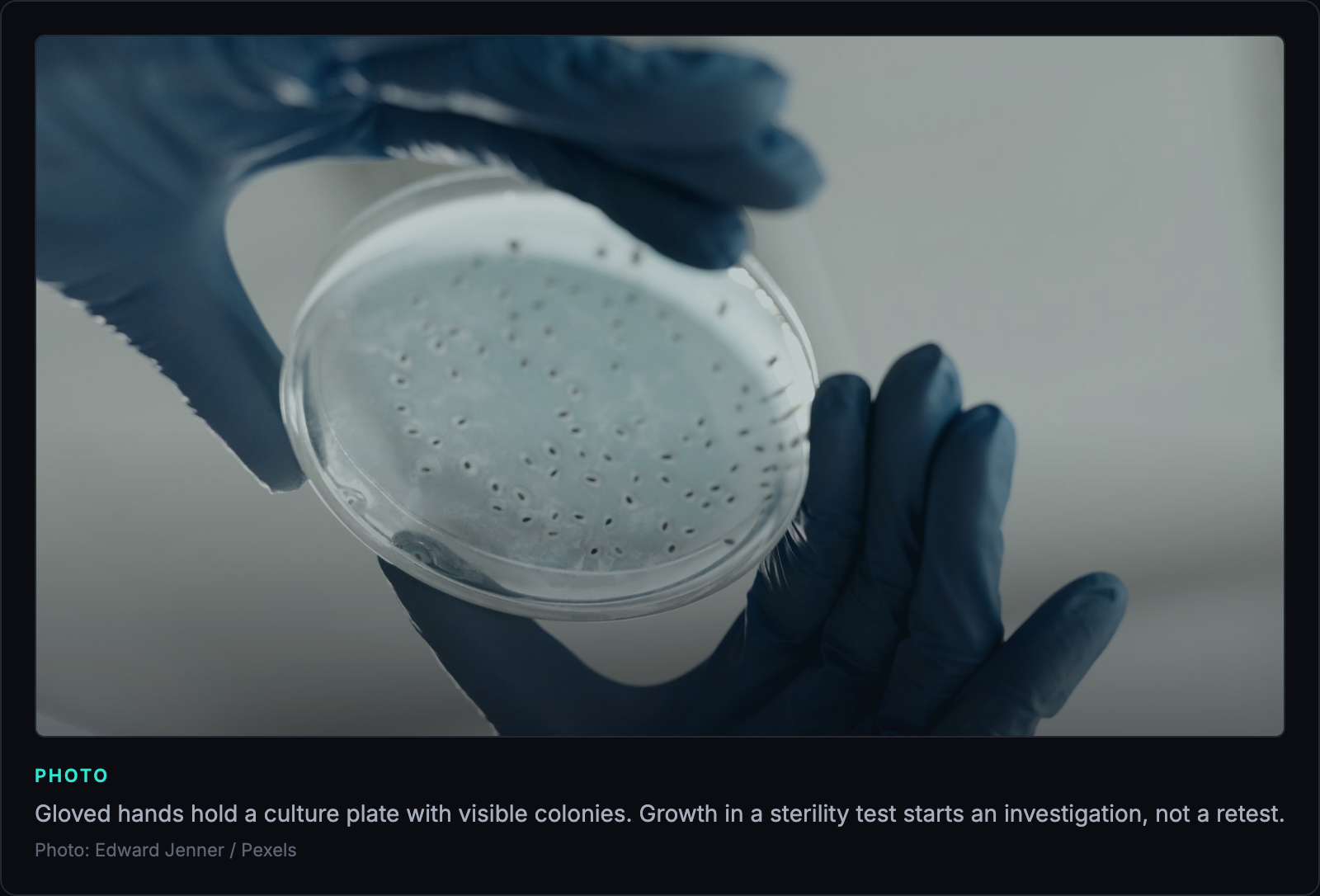
A failed USP 71 sterility test can be repeated only if the lab proves the first test invalid on one of the four grounds the harmonized chapter lists: a fault in the testing facility's microbiological monitoring data, a fault found on review of the test procedure, growth in the negative controls, or growth that identification ties unequivocally to the material or technique. If the test is invalid, the lab repeats it with the same number of units.
Without that proof, the batch fails. A positive result is also a specification failure under 21 CFR 211.192, so the investigation must reach a written conclusion and extend to other batches that may share the cause (eCFR, 21 CFR 211.192). Our 21 CFR 211.192 guide covers what the investigation file needs.
A sound sterility failure investigation usually covers:
- Identification of the organism to species level, compared with environmental monitoring and personnel isolates from both the lab and the filling area.
- Review of the lab session: negative controls, the isolator or cleanroom monitoring, the analyst's gowning and technique, and any deviations.
- Review of manufacturing: the sterilization or aseptic run, media fill history for the line, and equipment events during the batch.
- A decision on the batch and on other batches made on the same line or with the same components.
In 72 of the 158 Atlas inspections, FDA cited 211.192 next to 211.167(a), so expect the investigation file to get as much attention as the test record.
USP 71 vs USP 61 and 62: what is the difference?
USP 71 tests sterile products for the presence of any viable microorganism, while USP 61 and USP 62 test non-sterile products against numeric limits and for specified organisms. A sterile injection needs <71>; an oral tablet or a topical cream is judged against <61>, <62> and the USP <1111> acceptance criteria.
| Point | USP | USP and |
|---|---|---|
| Products | Products labeled sterile | Non-sterile products and ingredients |
| Question | Is any viable organism present? | How many organisms, and are specified ones absent? |
| Result | Pass or fail on growth | CFU counts and presence or absence |
| Incubation | Not less than 14 days | Days, set by organism and method |
| CFR hook | 21 CFR 211.167(a), 610.12 | 21 CFR 211.165(b), 211.113(a) |
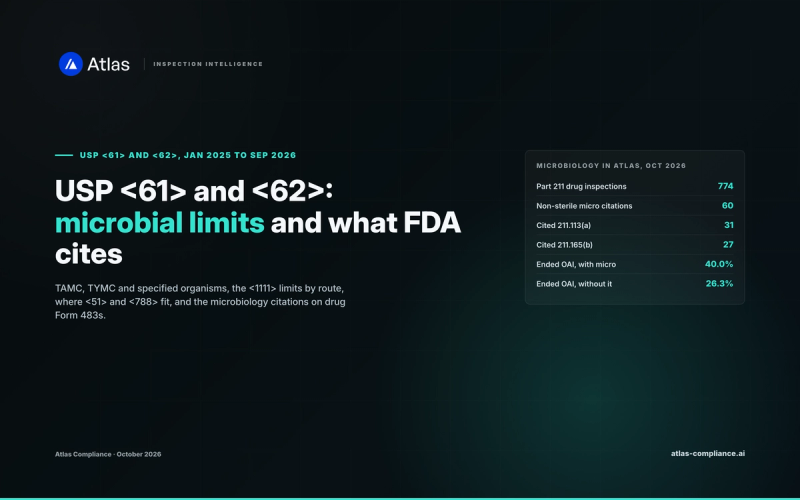
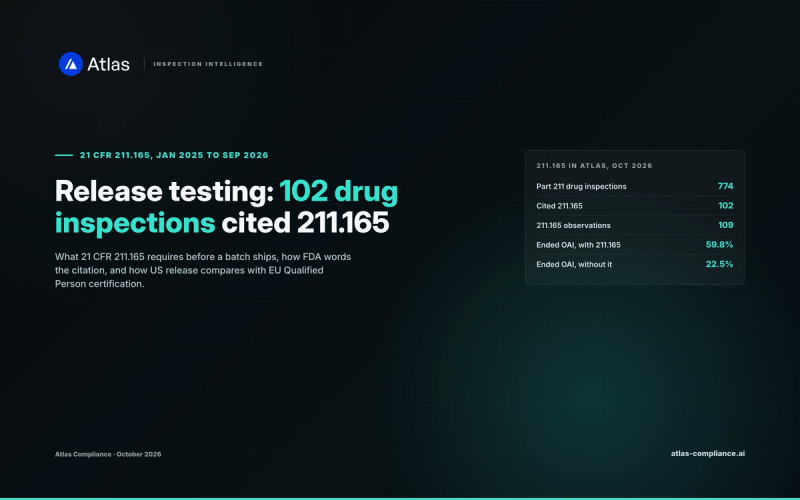
Our USP 61 and 62 guide covers the non-sterile side, and the release testing guide shows where both sit in the batch release decision under 211.165.
New sterility and aseptic citations arrive each month, and the digest below sends the ones that matter for sterile operations as FDA publishes them.
AtlasFDA Inspection Intelligence Digest
We track every 483, EIR, and warning letter the moment it happens. Get the signals before they hit the FDA website.
Frequently asked questions
A USP 71 sterility test takes at least 14 days of incubation, plus sample preparation before and the final reading after. If the product clouds the medium so growth cannot be read, the lab transfers at least 1 mL to fresh medium at day 14 and incubates both vessels for at least 4 more days, so some results take 18 days or longer.

Written by
Bhavish Agarwal
Founder, Atlas
Bhavish Agarwal is the founder of Atlas and previously worked at Google and Microsoft. He has spent the past several years building regulatory data infrastructure for the pharmaceutical industry.