
Schedule M is the schedule of India's Drugs Rules, 1945 that sets the good manufacturing practices, premises and equipment requirements a licensed drug manufacturer in India must meet. The Ministry of Health and Family Welfare replaced the old schedule with a revised Schedule M through Gazette notification G.S.R. 922(E), dated December 28, 2023. This page covers that drug rule, not the IRS tax schedules of the same name.
We read the revised rule from the Gazette text itself and set it against 21 CFR Part 211 and FDA's own record at Indian drug facilities, drawn from Atlas data pulled in October and November 2026.
Key facts
- Revised Schedule M has 13 Parts: Part I holds the main GMP principles, Parts II to XII add requirements by product type, and Part XIII lists equipment.
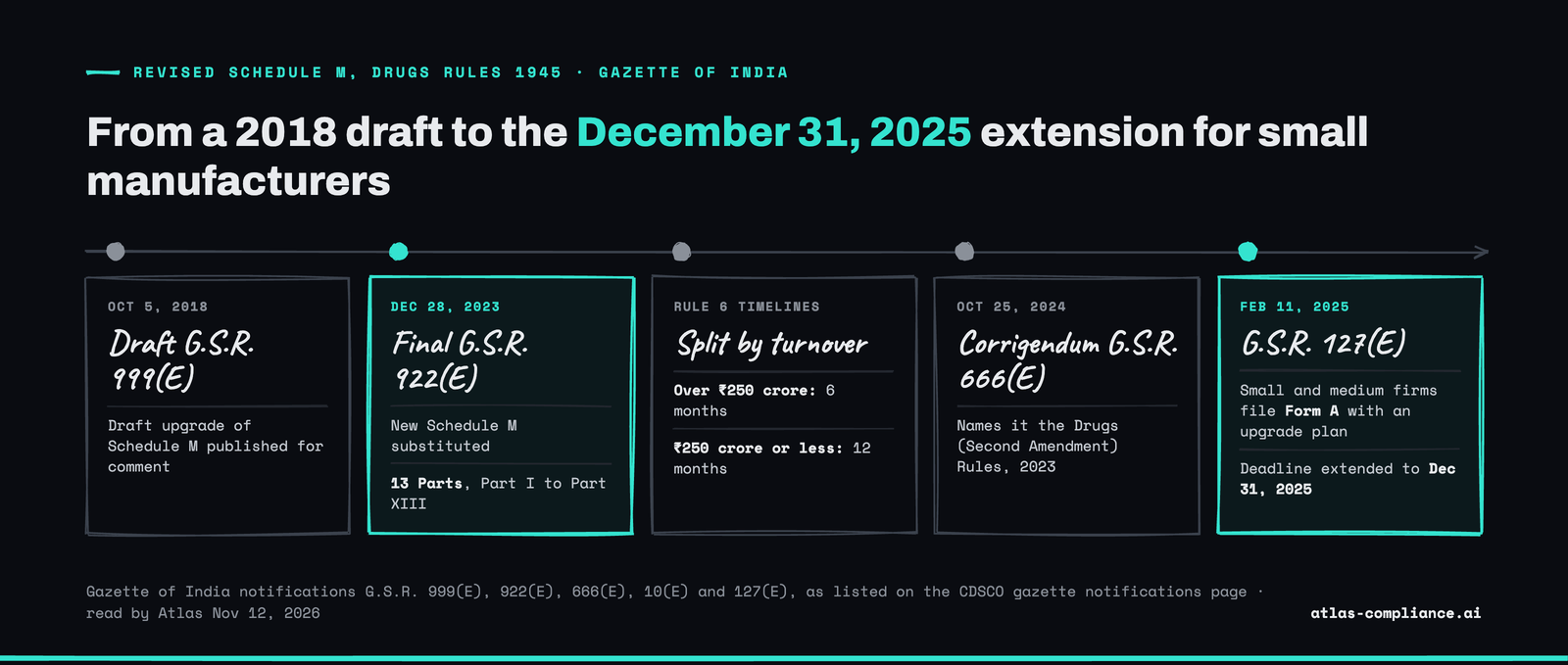
- G.S.R. 922(E) gave manufacturers with turnover above ₹250 crore six months to comply and those at or below ₹250 crore twelve months.
- G.S.R. 127(E), dated February 11, 2025, let small and medium manufacturers that filed Form A with an upgrade plan extend the deadline to December 31, 2025.
- The Atlas FDA record (release of August 15, 2026) holds 2,574 Indian facilities with 5,524 FDA inspections and 3,174 Form 483s.
- FDA classified 14% of 257 drug quality inspections in India from January 2025 to October 2026 as OAI, against 19% of 1,156 in the United States.
What is Schedule M?
Schedule M is the GMP standard written into India's Drugs Rules, 1945, and a manufacturing license under rules 71, 74, 76 and 78 depends on meeting it. The revised schedule covers both GMP and the premises and equipment a licensed site needs, and it opens with a note that the licensed premises be used only for drug production.
The 13 Parts follow one pattern. Part I applies to every manufacturer, and each later Part points back to Part I before adding its own rules for one product type.
| Part | Scope |
|---|---|
| I | Main GMP principles: quality system, risk management, validation, self-inspection, documentation, computerized systems |
| II | Sterile products, parenterals and sterile ophthalmic preparations |
| III | Hazardous substances such as sex hormones, steroids and cytotoxics |
| IV | Biological products |
| V | Radiopharmaceuticals |
| VI | Phytopharmaceuticals |
| VII | Investigational products for clinical trials |
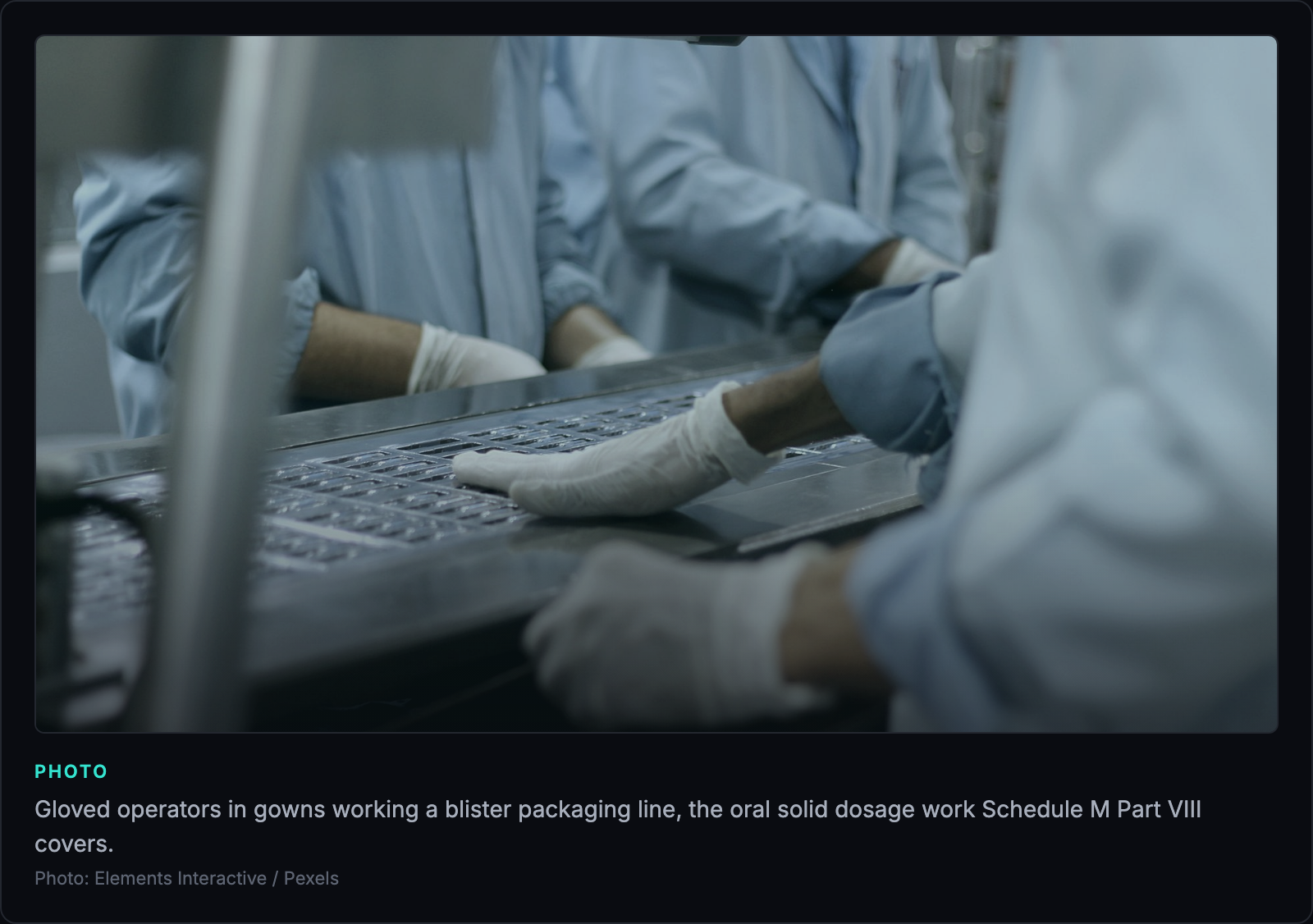
| VIII to XI | Oral solids, oral liquids, topicals and metered dose inhalers |
| XII | Active pharmaceutical ingredients |
| XIII | Equipment lists and some minimum areas by dosage form |
Part I also requires a site master file under Appendix I: a short factual document that describes the licensed premises, the products made there and the GMP systems in place.
What changed in revised Schedule M?
Revised Schedule M writes a pharmaceutical quality system into Indian GMP. Clause 1 of Part I makes senior management responsible for "an effective pharmaceutical quality system" that is resourced and documented, and clause 2 adds quality risk management.
The Gazette text adds several obligations a manufacturer can audit against:
- Management review at least annually, unless otherwise justified (clause 1.6).
- Product quality review, normally annual, covering all products including export-only products (clause 2.3).
- Root cause analysis on deviations and suspected defects, with CAPA whose effectiveness is monitored (clause 1.5(s)).
- A validation master plan and DQ, IQ, OQ and PQ for premises, utilities, equipment and processes (clause 5).
- Self-inspection run routinely by people who can judge GMP objectively, with a follow-up program (clause 10).
- Validated computerised systems with audit trails, access control and backup (clause 20, "Computerised systems").
Quality risk management in clause 2 follows the same logic as ICH Q9: effort and documentation scale with the risk to the patient. Our guide to ICH Q9 quality risk management covers the tools.
What is the deadline for revised Schedule M compliance?
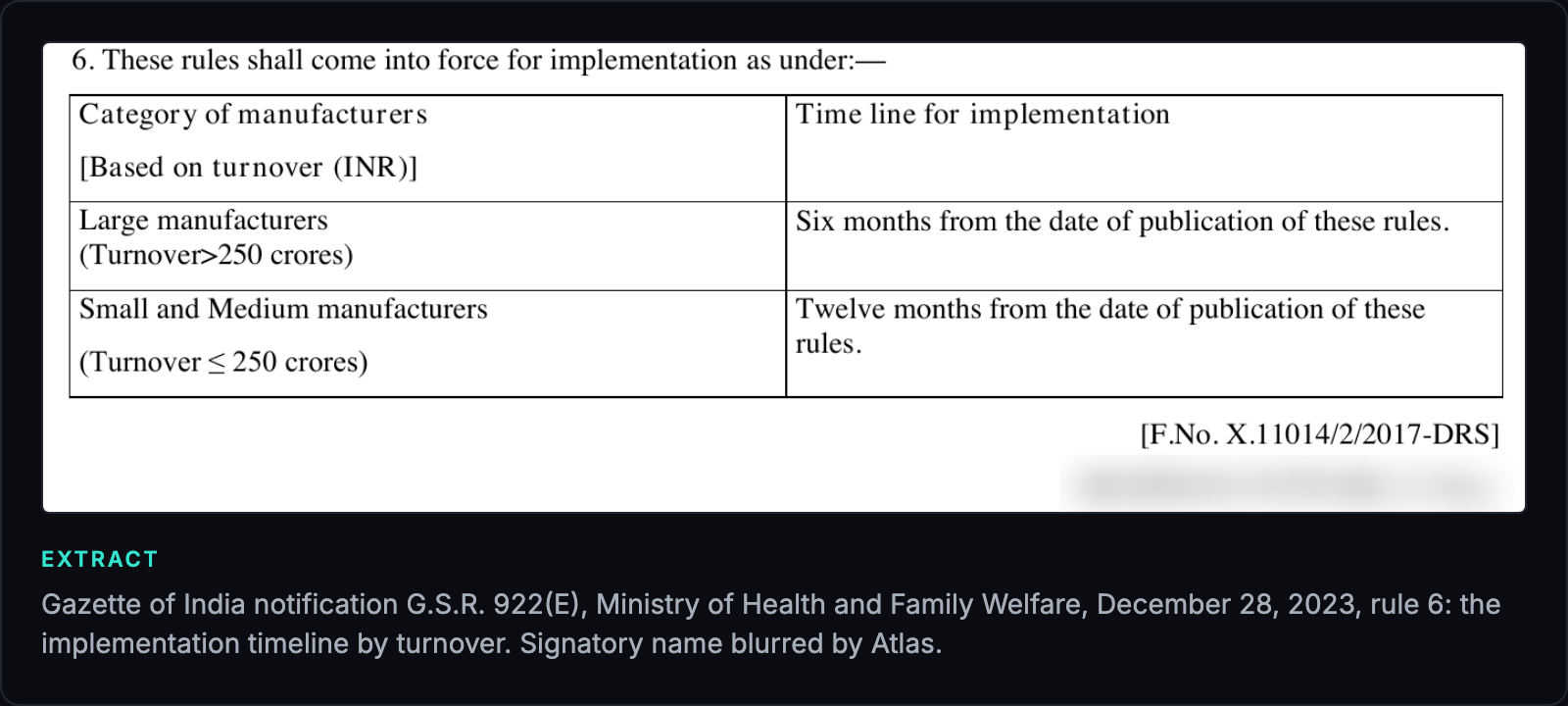
The revised Schedule M deadline depends on turnover. Rule 6 of G.S.R. 922(E) gave large manufacturers, with turnover above ₹250 crore, six months from publication, and small and medium manufacturers, at ₹250 crore or less, twelve months.
The Ministry then moved the date for smaller firms. A draft, G.S.R. 10(E) of January 4, 2025, became final as G.S.R. 127(E) on February 11, 2025. Under that proviso, a small or medium manufacturer could apply to the Central Licence Approving Authority on Form A within three months, with a gap analysis and an upgrade plan, and its deadline became December 31, 2025. Form A asks for gaps across the facility, equipment, lab equipment, HVAC, utilities, technical staff and documentation, and whether the firm holds a WHO-GMP certificate or a Certificate of Pharmaceutical Product.
A corrigendum, G.S.R. 666(E) of October 25, 2024, renamed the 2023 rules the Drugs (Second Amendment) Rules, 2023. We checked all five notifications on the CDSCO Gazette notifications page on November 12, 2026, and that page lists no Schedule M extension after G.S.R. 127(E).
Schedule M vs US CGMP: what is the difference?
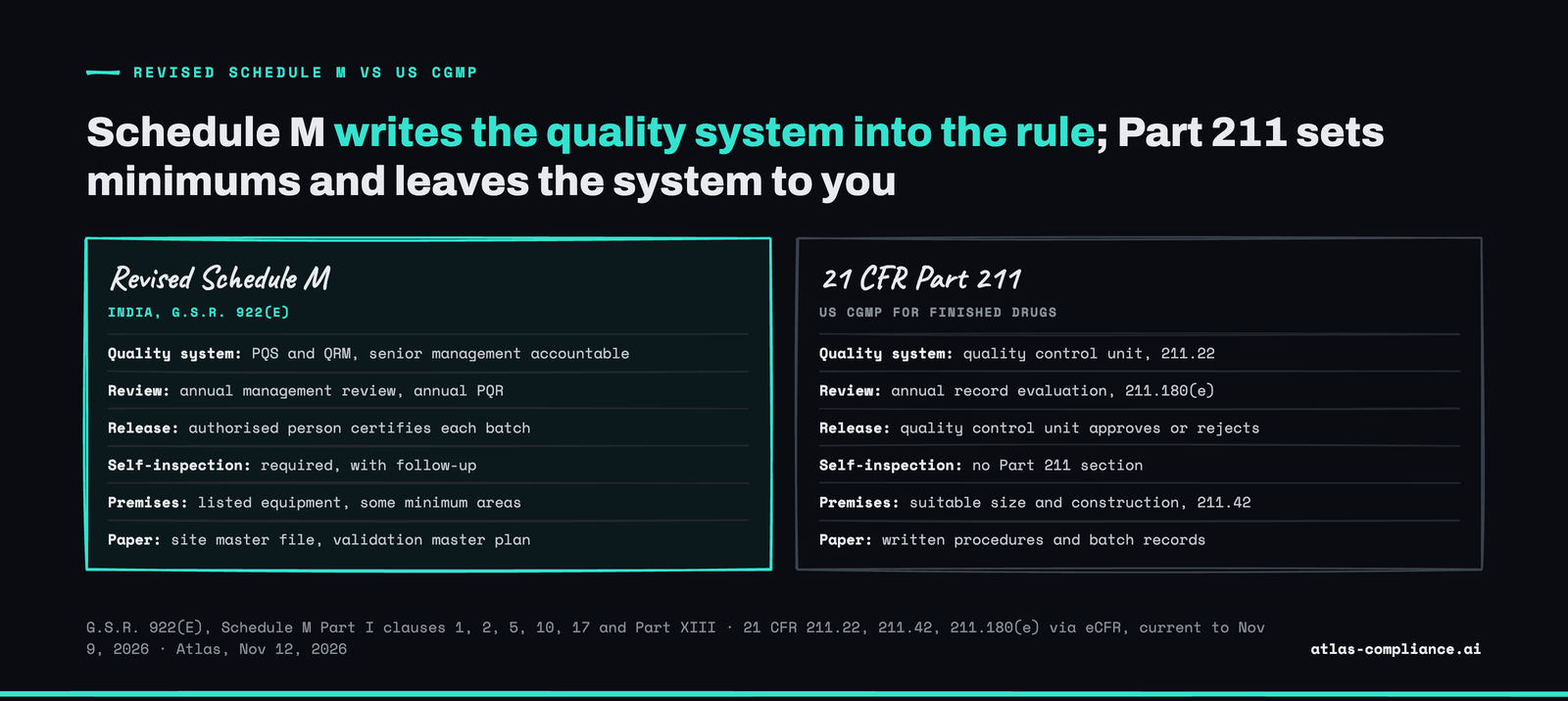
The main difference between Schedule M and US CGMP is how much of the quality system the rule writes down. Revised Schedule M prescribes the system: senior management duties, annual management review, product quality review, self-inspection and a site master file. 21 CFR Part 211 sets minimum controls and gives the quality control unit the authority to approve or reject.
| Topic | Revised Schedule M (G.S.R. 922(E)) | 21 CFR Part 211 |
|---|---|---|
| Quality system | PQS and QRM, senior management accountable (clauses 1, 2) | Quality control unit with approve or reject authority (211.22) |
| Periodic review | Annual management review and product quality review (1.6, 2.3) | Annual evaluation of records for each drug product (211.180(e)) |
| Batch release | Authorised person certifies each batch (1.5(i)) | Quality control unit approves or rejects (211.22(a)) |
| Investigations | Root cause analysis, CAPA effectiveness monitored (1.5(s)) | Thorough investigation extended to other batches (211.192) |
| Self-inspection | Required, with follow-up (clause 10) | No Part 211 section |
| Computer systems | Validation, audit trail, backup (clause 20) | Controls over changes and backup (211.68(b)) |
| Premises | Equipment lists and some minimum areas (Part XIII) | Suitable size, construction and location (211.42) |
| Retention samples | One year after expiry for finished product (19.8.2) | Reserve samples kept one year after expiration (211.170) |
Part XIII shows the difference in style. For large volume parenterals made by form-fill-seal, Schedule M recommends a basic installation of at least 250 square meters plus a 150 square meter ancillary area. Section 211.42 asks only for buildings of suitable size, construction and location. Our 21 CFR Part 211 guide maps every subpart.
What does FDA find at Indian drug facilities?
FDA finds the same quality unit and investigation gaps at Indian drug facilities that revised Schedule M targets, but it classifies Indian inspections OAI less often than US ones. In FDA inspection data in the Atlas files (inspections ending January 2, 2025 to October 14, 2026, pulled October 21, 2026), 36 of 257 Indian drug quality inspections (14.0%) were OAI, against 222 of 1,156 in the US (19.2%).
| Classification | India (257) | United States (1,156) |
|---|---|---|
| NAI | 61 (23.7%) | 304 (26.3%) |
| VAI | 160 (62.3%) | 630 (54.5%) |
| OAI | 36 (14.0%) | 222 (19.2%) |
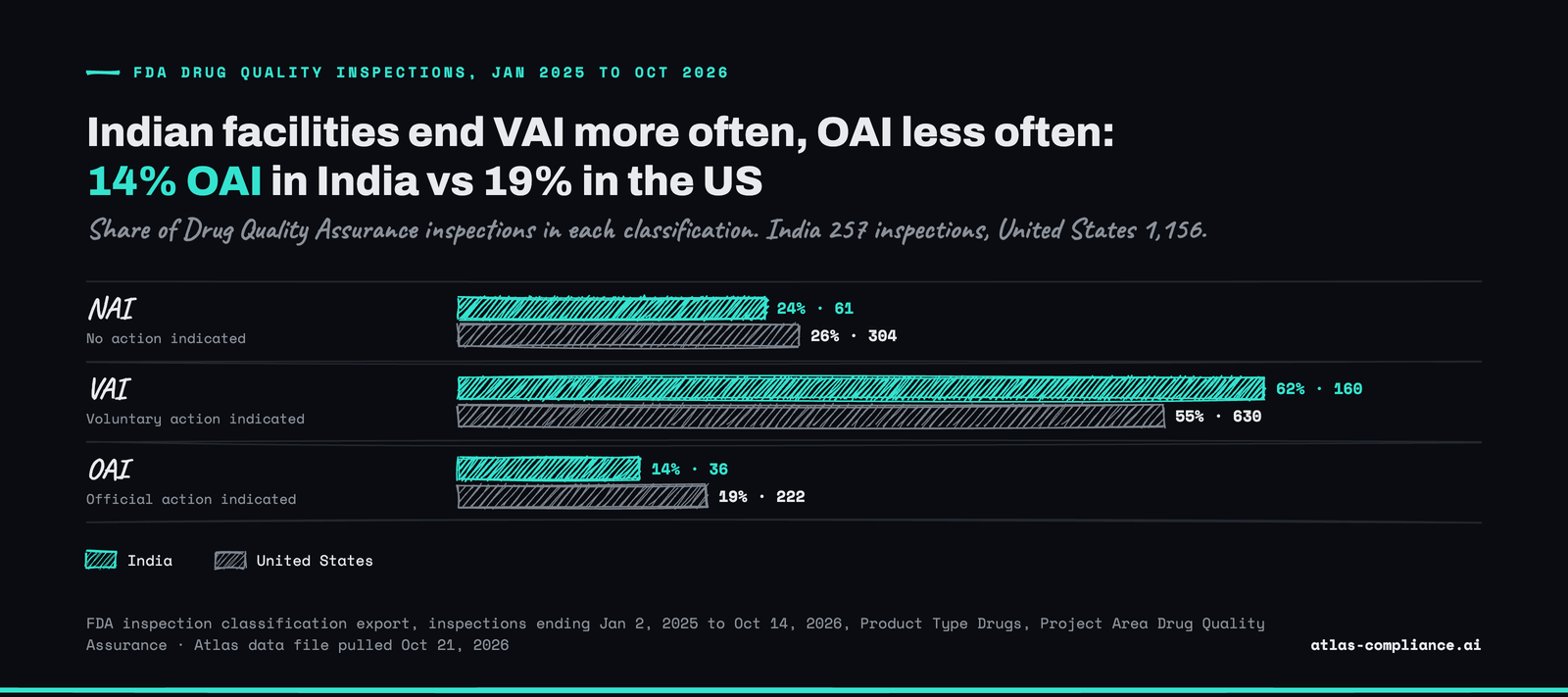
Indian inspections end VAI more often: 62.3% against 54.5%. FDA can change a classification after the inspection ends, so the 2026 share may still move. Our NAI, VAI and OAI explainer covers what each class means for the facility.
FDA posted Form 483 citations for 47 of the 257 Indian inspections, 175 citation rows in all. Section 211.22, the quality control unit, appears on 24 of the 47 (51%), and 211.192, investigations, on 20 (43%). Both map to the core of Schedule M Part I.
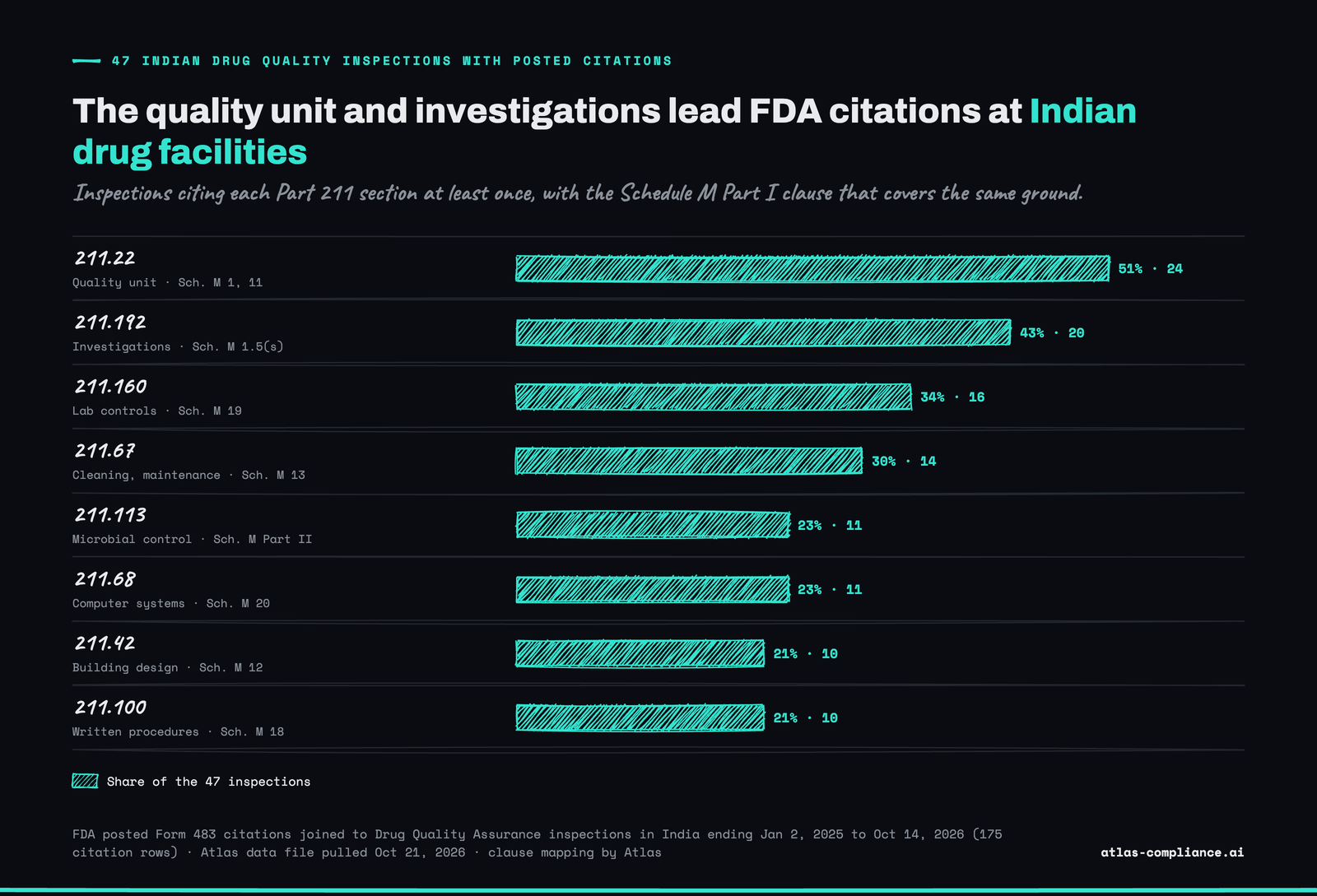
The longer record tells the same story. The Atlas FDA Form 483 database (release of August 15, 2026, pulled November 12, 2026) holds 2,574 Indian facilities, and 1,684 of them have at least one Form 483. Three recent records:
- Cipla, Salcette: 16 FDA inspections and 14 Form 483s. The April 17, 2026 Form 483 cites 211.113(b) for sterile validation and 211.22(d) for quality unit procedures.
- Eugia Pharma Specialities, Sangareddy: 9 inspections and 8 Form 483s; Atlas marks the January 2024 inspection with a warning letter outcome. The February 6, 2026 Form 483 lists 11 observations, including 211.113(b), 211.192, 211.22(d) and 211.42(c)(10)(iv).
- USV, Dabhel, Daman: all 9 FDA inspections on record ended with a Form 483, most recently in April 2026.
Each of those sections has a Schedule M counterpart, so a gap a state inspector finds under clause 1.5(s) is often the gap an FDA investigator writes up under 211.192. Our page on FDA investigators in India lists who signs these forms.
If your facility or a supplier sits in this record, you can see which investigators inspected it and which sections they cited.
 Atlas
See what the FDA knows about your next investigator.
30 minutes with the founder. No pitch deck.
How should an Indian facility prepare for both Schedule M and FDA inspections?
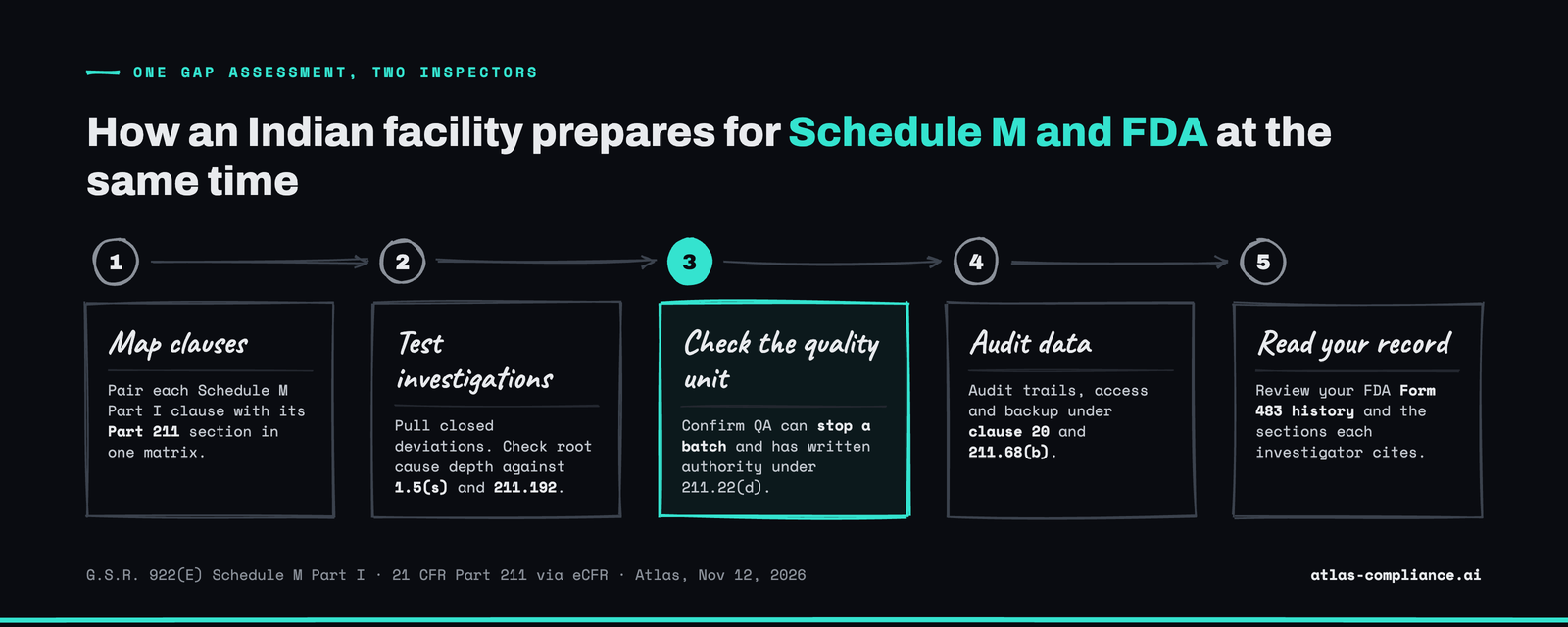
An Indian facility that ships to the United States prepares for both inspections with one gap assessment that pairs each Schedule M clause with its Part 211 section, then fixes the systems FDA cites most: the quality unit, investigations and data controls.
- Map clauses. Build one matrix of Schedule M Part I clauses against Part 211 sections, so one CAPA closes both gaps.
- Test investigations. Pull ten closed deviations and check root cause depth against clause 1.5(s) and 21 CFR 211.192: did the investigation reach other batches, and does the CAPA match the cause?
- Check the quality unit. Confirm QA has written authority to stop a batch, which answers both 211.22(d) and the authorised person duties in clause 1.5(i).
- Audit data. Test audit trails, user access and backup under clause 20 and 211.68(b).
- Read your record. Review your facility's Form 483 history and the sections each investigator has cited before the next visit.
Schedule M also asks for self-inspection, which Part 211 does not. Running it against both standards gives your team a rehearsal for either inspector.

The Atlas digest sends new Form 483s and warning letters as FDA releases them, including those issued to Indian facilities.
AtlasFDA Inspection Intelligence Digest
We track every 483, EIR, and warning letter the moment it happens. Get the signals before they hit the FDA website.
Frequently asked questions
No, Schedule M is India's legal GMP standard under the Drugs Rules, 1945, while WHO-GMP certification is a separate certificate a firm may hold for export. The revised Schedule M text does not cite WHO. Form A under G.S.R. 127(E) asks applicants whether they hold a WHO-GMP certificate or a Certificate of Pharmaceutical Product, which treats the two as distinct.

Written by
Bhavish Agarwal
Founder, Atlas
Bhavish Agarwal is the founder of Atlas and previously worked at Google and Microsoft. He has spent the past several years building regulatory data infrastructure for the pharmaceutical industry.