
QA vs QC is the difference between quality assurance, the function that designs, approves and audits the procedures and records that keep a drug in control, and quality control, the function that samples and tests materials and product against written specifications. QA prevents problems across the system. QC detects them in the batch. FDA's CGMP rules give both jobs to one body, the quality control unit in 21 CFR 211.22.
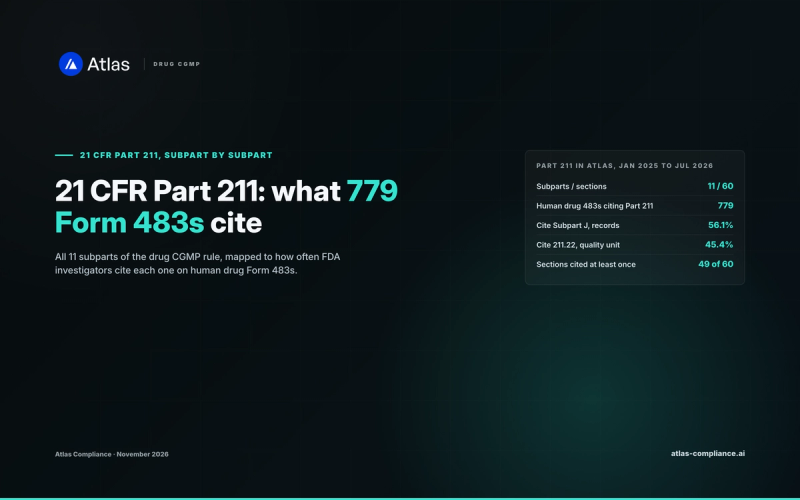
This guide sets the two side by side and adds Atlas data other QA vs QC pages do not have: how often FDA cited the quality unit and the QC laboratory at 8,123 drug inspections that closed between October 2008 and September 2026, from the Atlas Form 483 citation dataset (pulled October 21, 2026) joined to FDA's inspection classifications.
Key facts:
- 21 CFR 211.22(a) requires "a quality control unit" with the authority to approve or reject components, in-process materials, packaging, labeling and drug products.
- 21 CFR 210.3(b)(15) defines that unit as any person or organizational element the firm designates for "the duties relating to quality control."
- FDA's Quality Systems Approach to Pharmaceutical CGMP Regulations guidance (September 2006) says industry divides the quality control unit's responsibilities between QC and QA functions.
- In the Atlas dataset, 3,199 of 8,123 drug inspections citing 21 CFR Part 211 (39.4%) cited 211.22, more than any other Part 211 section.
- 862 of those 3,199 inspections (26.9%) ended Official Action Indicated (OAI), against 13.3% of the other 4,924.
What is the difference between QA and QC in pharma?
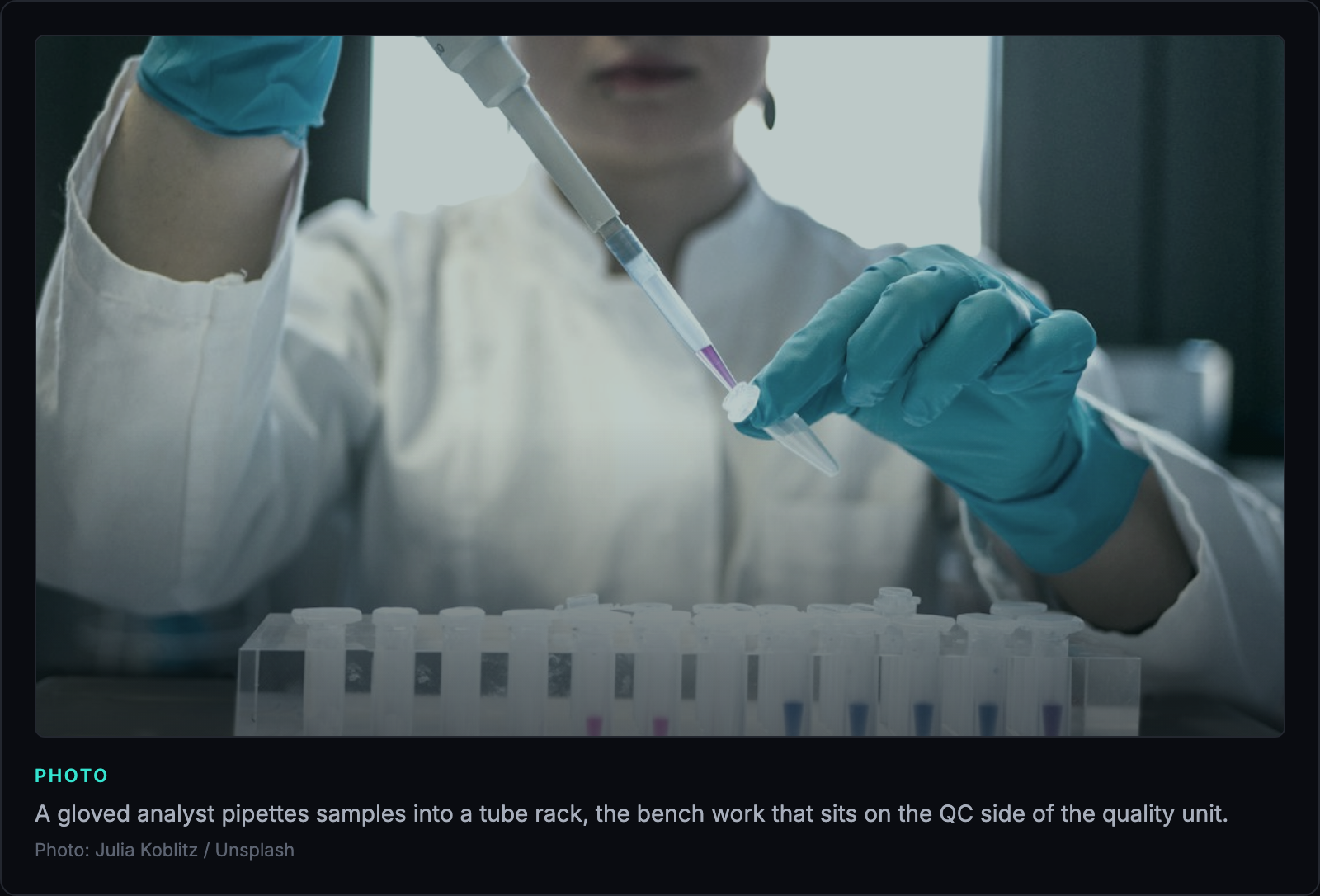
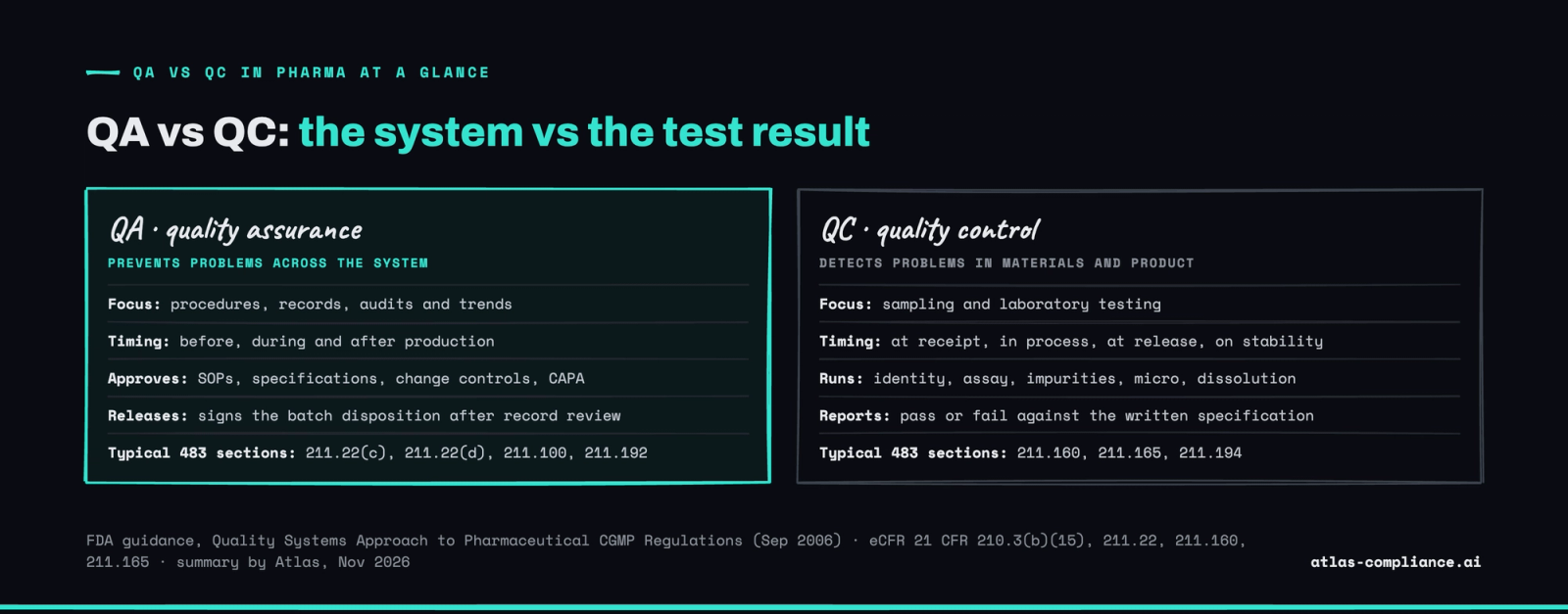
The difference between QA and QC in pharma is scope and timing. QA owns the quality system: it approves procedures and specifications, reviews batch records, runs audits and change control, and trends data. QC owns the testing: it samples incoming materials, in-process material, finished product and stability lots, and reports results against specification.
FDA's 2006 quality systems guidance gives the working split. QC "usually involves" assessing incoming components and finished products, evaluating process performance against specifications, and "determining the acceptability of each batch for release." QA "primarily involves" approving procedures, reviewing records, and auditing and trend analysis. The same guidance defines QA as activities that give "confidence that requirements are fulfilled" and QC as the steps taken during production "to ensure that it meets requirements."
| Quality assurance (QA) | Quality control (QC) | |
|---|---|---|
| Purpose | Prevent defects by controlling procedures, records and changes | Detect defects by testing materials and product |
| Timing | Before, during and after production, across the product lifecycle | At receipt, in process, at release and on stability |
| Who | QA specialists, auditors, validation and compliance staff, QA head | QC analysts, microbiologists, reviewers, QC laboratory manager |
| Core activities | SOP and specification approval, batch record review, deviations, CAPA, change control, audits, annual product review | Sampling, identity and assay tests, impurities, microbiology, dissolution, stability testing, instrument calibration |
| Key documents | SOPs, change controls, deviation and CAPA records, audit reports, annual product reviews | Specifications, test methods, laboratory notebooks, chromatograms, certificates of analysis, stability data |
| Regulations it answers to | 21 CFR 211.22(c) and (d), 211.100, 211.180(e), 211.192; ICH Q10 | 21 CFR 211.84, 211.160, 211.165, 211.166, 211.194; ICH Q2 |
| Output | A release decision supported by reviewed records | A pass or fail result against the written specification |
What does 21 CFR 211.22 call the quality control unit?
21 CFR 211.22 calls the function responsible for drug quality the "quality control unit," and it gives that one unit both QA and QC duties. The regulation never uses the words quality assurance. Firms that run separate QA and QC departments still answer to 211.22 as a single quality unit.
The four paragraphs of 21 CFR 211.22 on eCFR read like a job description that spans both sides:
- 211.22(a): "There shall be a quality control unit that shall have the responsibility and authority to approve or reject all components, drug product containers, closures, in-process materials, packaging material, labeling, and drug products," plus the authority to review production records and make sure errors "have been fully investigated." The unit also approves or rejects products made under contract by another company.
- 211.22(b): "Adequate laboratory facilities" for testing and approval must be available to the unit.
- 211.22(c): the unit approves or rejects "all procedures or specifications impacting on the identity, strength, quality, and purity of the drug product."
- 211.22(d): the unit's responsibilities and procedures "shall be in writing; such written procedures shall be followed."
Paragraph (b) is a QC duty. Paragraphs (c) and (d) are QA duties. Paragraph (a) covers both, because approving a batch takes test results and a reviewed record.
The definition in 21 CFR 210.3(b)(15) is broad on purpose: "Quality control unit means any person or organizational element designated by the firm to be responsible for the duties relating to quality control." FDA's 2006 guidance uses the shorter term "quality unit" for the same body and states that it stays consistent with that definition. Our 21 CFR Part 211 guide walks through the rest of the subparts that set the unit's work.
Is QC part of QA under ICH Q10?
QC and QA are both parts of the pharmaceutical quality system that ICH Q10 describes, and Q10 does not rank one under the other. ICH Q10 (Step 4, June 4, 2008) defines a pharmaceutical quality system as a "management system to direct and control a pharmaceutical company with regard to quality," and lists "quality control and assurance" as one activity of commercial manufacturing.
ICH Q10 builds the system on four elements, all of which pull QA and QC together:
- Process performance and product quality monitoring, which runs on QC data and QA trending.
- Corrective action and preventive action (CAPA), which starts from QC failures and deviations.
- Change management, which QA runs and QC supports with method and specification changes.
- Management review of process performance and product quality, which senior management owns.
ICH Q10 also states that regional regulations require "an independent quality unit/structure" with authority over certain quality system responsibilities, which in the US means 211.22. ICH Q10 adds to GMP rather than replacing it. Our ICH guidelines overview covers where Q10 sits next to Q8, Q9 and Q7.
In many firms a head of quality leads both departments. FDA's guidance expects the quality unit to stay independent of manufacturing and of development. In "very limited circumstances," it allows one person to do both production and quality work, with a periodic review of quality unit activities by another qualified person who is not involved in production.
What do QA and QC do day to day?
QA staff in a drug facility write and approve SOPs, review executed batch records, run deviation and CAPA investigations, approve change controls, audit suppliers and internal areas, and compile annual product reviews. QC staff sample and test raw materials, in-process material and finished product, run stability studies, keep instruments calibrated, and document every result.
The work meets on each batch. The sequence below follows one batch through the facility:
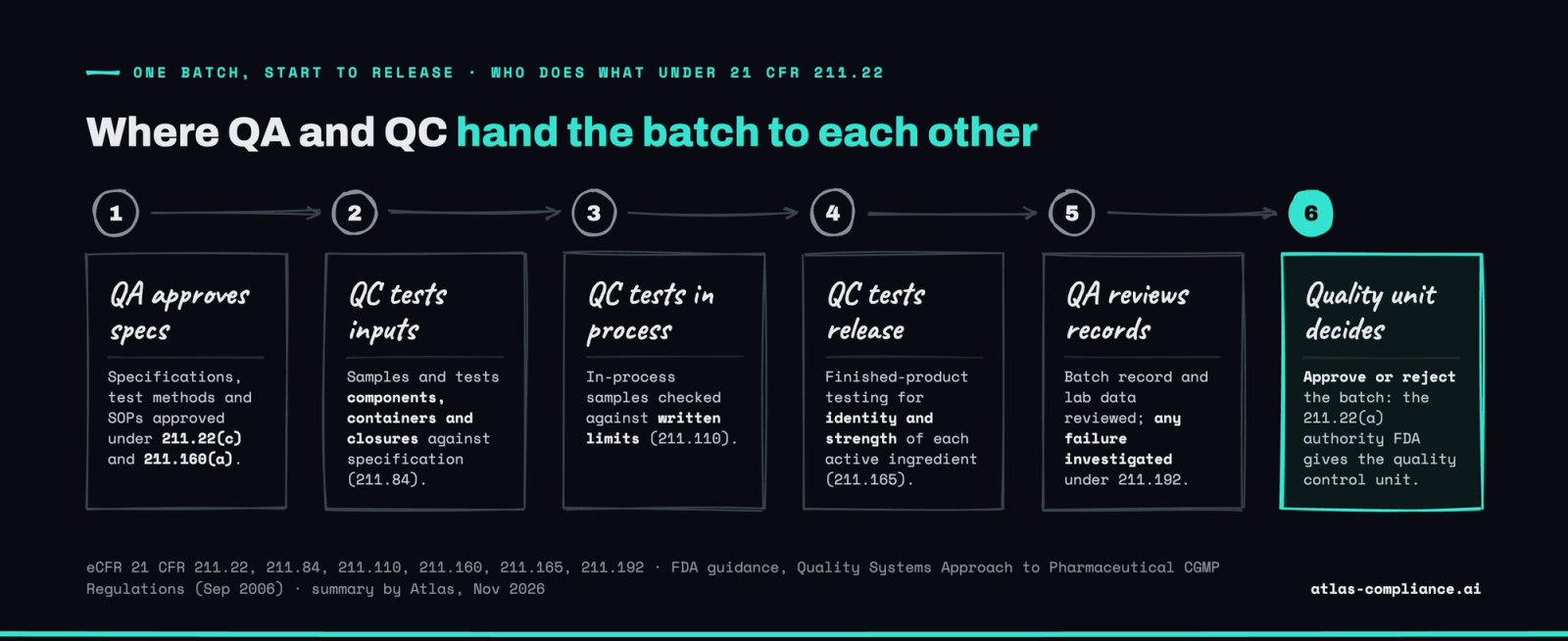
- QA approves the specifications, test methods and SOPs. 211.160(a) requires laboratory controls to be drafted by the appropriate unit and "reviewed and approved by the quality control unit."
- QC samples and tests components, containers and closures before use, under 211.84.
- QC tests in-process samples against written limits, under 211.110.
- QC runs release testing, including identity and strength of each active ingredient, under 211.165(a). Our release testing guide covers this step.
- QA reviews the batch record and laboratory data. Any unexplained discrepancy or failed specification needs a written investigation under 211.192, covered in our 21 CFR 211.192 guide.
- The quality unit approves or rejects the batch.
QC's job ends with a valid result. QA's job ends with a decision that the whole record supports, so a failing QC result moves straight into a QA-owned investigation and CAPA.
How often does FDA cite the quality unit on a Form 483?
FDA cites the quality unit under 21 CFR 211.22 more often than any other Part 211 section. In the Atlas Form 483 citation dataset, 3,199 of 8,123 drug inspections that cited Part 211 between October 2008 and September 2026 (39.4%) included a 211.22 citation. The next most cited sections were 211.192 at 2,547 inspections and 211.160 at 2,438.
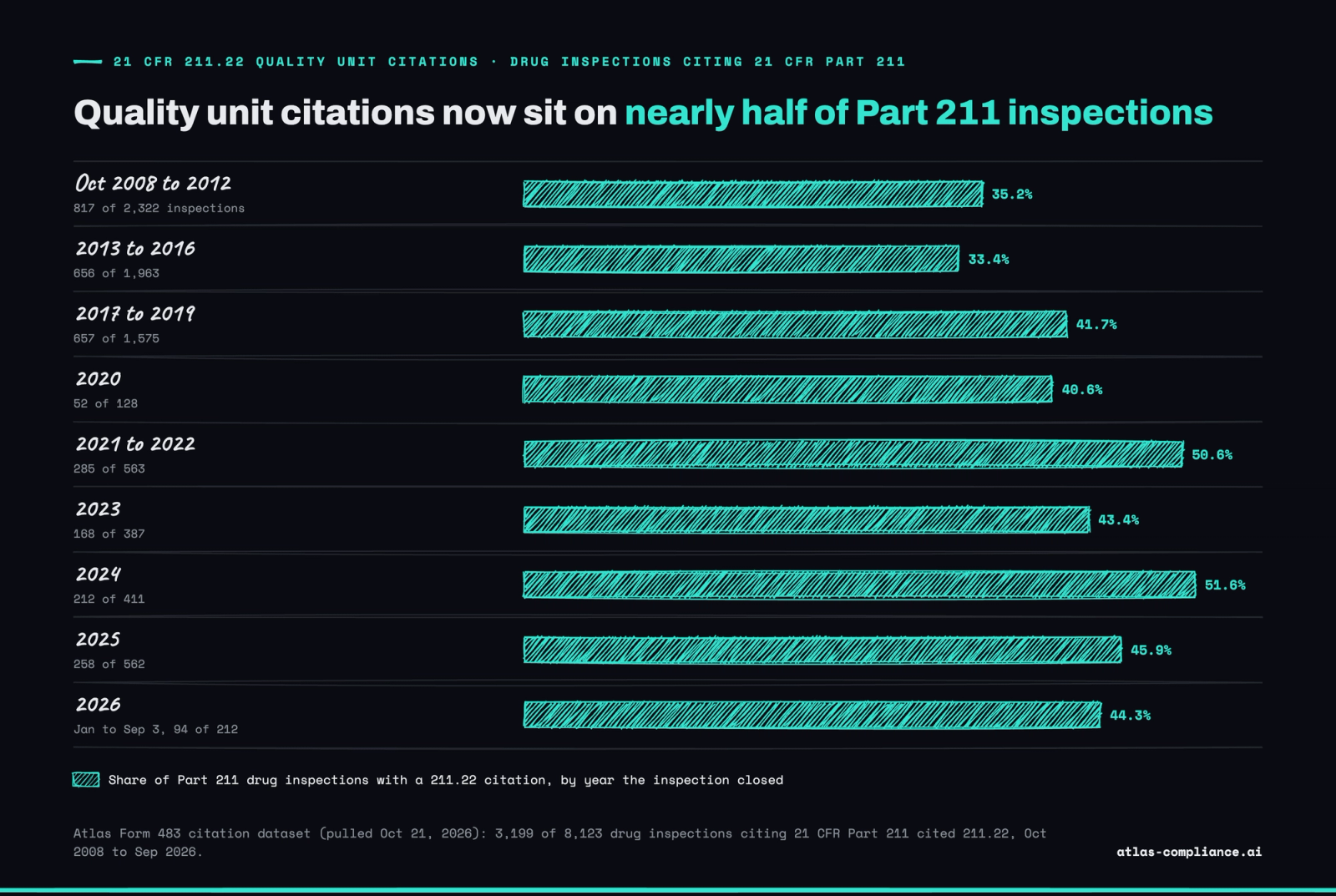
The share has climbed. From October 2008 to 2016, about one inspection in three cited 211.22. Since 2021 the share has stayed between 43.4% and 53.6% a year, with 258 of 562 Part 211 inspections (45.9%) in 2025. Of the 3,199, 2,631 were at US facilities and 145 in India.
Most quality unit citations are about procedures. 211.22(d), written responsibilities and procedures not in place or not followed, appeared at 2,409 inspections. 211.22(a) appeared at 817, including 473 where FDA recorded a lack of a quality control unit altogether. 211.22(c), approval of procedures and specifications, appeared at 174, and 211.22(b), laboratory facilities, at 65.
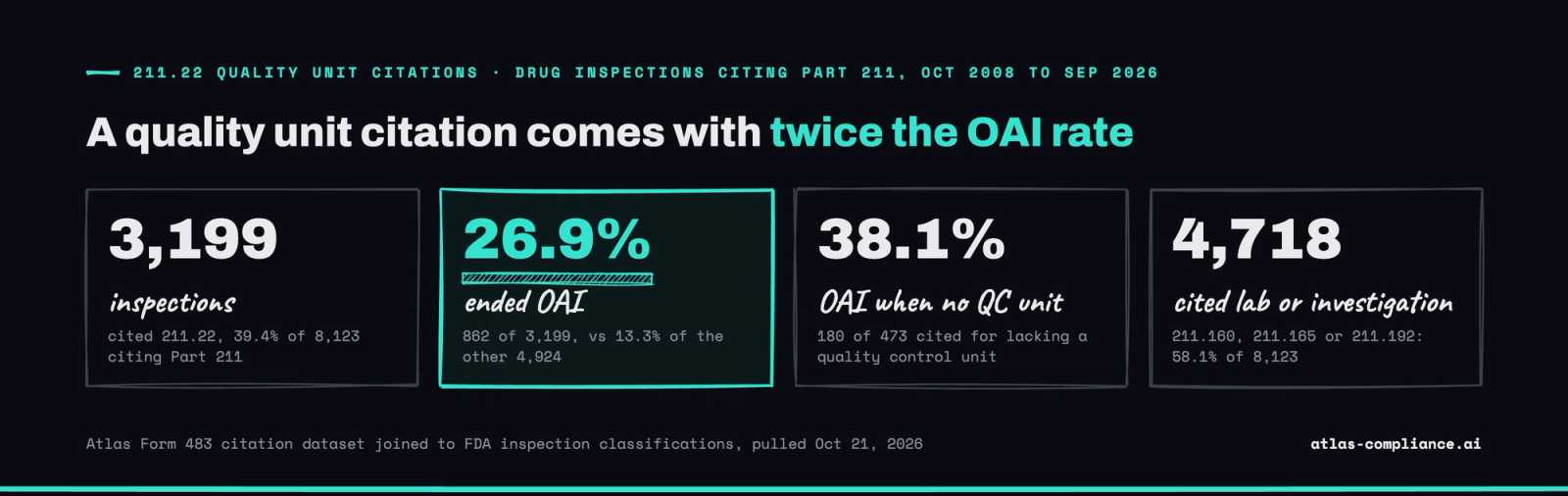
A quality unit citation travels with others. The 3,199 inspections averaged 5.8 distinct Part 211 sections against 3.5 for the rest, and 862 (26.9%) ended OAI, about twice the 13.3% rate for the other 4,924. When FDA recorded no quality control unit at all, 180 of 473 inspections (38.1%) ended OAI. For January 2025 to September 2026, 131 of 352 inspections citing 211.22 (37.2%) were OAI as of the October 21, 2026 pull, against 19.9% of the other 422, though recent classifications can still change. The guide to NAI, VAI and OAI explains what an OAI classification sets in motion.
What does FDA cite in the QC laboratory?
FDA cites the QC laboratory mainly under 21 CFR 211.160, laboratory controls, and 211.165, testing and release, and cites failed or incomplete investigations of laboratory failures under 211.192. In the Atlas dataset, 4,718 of the 8,123 Part 211 drug inspections (58.1%) cited at least one of the three sections.
| Section | What it covers | Inspections citing it | Share of 8,123 | Ended OAI |
|---|---|---|---|---|
| 211.160 | Laboratory controls, including 211.160(b) "scientifically sound" specifications and test procedures | 2,438 | 30.0% | 25.9% |
| 211.165 | Testing and release for distribution, including rejection of failing product | 1,635 | 20.1% | 36.6% |
| 211.192 | Production record review and investigation of discrepancies and failures | 2,547 | 31.4% | 28.3% |
| Any of the three | 4,718 | 58.1% | 25.8% |
The subsection FDA wrote most was 211.160(b), at 2,028 inspections. 211.165 carries the highest OAI rate of the three, at 36.6% against 14.2% for inspections without it. The 3,405 inspections with none of the three sections ended OAI 8.9% of the time. When a Form 483 cited both 211.22 and one of the laboratory sections, as 1,979 did, 34.7% ended OAI.
Recent examples in the FDA Form 483 database, from the same dataset:
| Facility | Inspection closed | Quality unit and laboratory citations | Classification |
|---|---|---|---|
| Omega Tech Labs, Boise, US | Jul 30, 2025 | 211.22(a), lack of quality control unit, with 211.84(d)(1) and 211.166(a) | OAI |
| Sklar BOV Solutions, Statesville, US | May 23, 2025 | 211.22(a), authority lacking to review records and investigate errors, with 211.180(e) | OAI |
| Frontida Biopharm, Aurora, US | Oct 24, 2025 | 211.22(a) and 211.22(d), with 211.110(a) | VAI |
| Unither Manufacturing, Rochester, US | May 15, 2026 | 211.22(d), 211.160(b), 211.165(b), 211.165(d) | OAI |
| B. Braun US Pharmaceutical Manufacturing, Irvine, US | Nov 21, 2025 | 211.22(d), 211.160(b)(3), 211.165(f), 211.192 | OAI |
| SGS North America, Fairfield, US | Jun 9, 2026 | 211.160(b) only, at a contract testing laboratory | VAI |
The first three are quality unit cases with little laboratory content. The B. Braun form shows the pattern the OAI numbers point to: a quality unit procedure citation, a laboratory control citation, failing product not rejected under 211.165(f), and an incomplete investigation under 211.192 on one Form 483.
Each Form 483 page lists the investigators who wrote it, so you can check which quality unit and laboratory sections your next investigator has cited at other facilities before the opening meeting.
 Atlas
See what the FDA knows about your next investigator.
30 minutes with the founder. No pitch deck.
New Form 483s that cite the quality unit and the QC laboratory arrive every month, and the digest below sends the ones that matter for QA and QC teams as FDA records them.
AtlasFDA Inspection Intelligence Digest
We track every 483, EIR, and warning letter the moment it happens. Get the signals before they hit the FDA website.
Frequently asked questions
Neither QA nor QC is better; the two roles suit different people. QC fits those who like bench work, instruments and analytical chemistry or microbiology. QA fits those who prefer procedures, investigations, audits and decisions across departments.

Written by
Bhavish Agarwal
Founder, Atlas
Bhavish Agarwal is the founder of Atlas and previously worked at Google and Microsoft. He has spent the past several years building regulatory data infrastructure for the pharmaceutical industry.