
The Purple Book is FDA's searchable database of licensed biological products that lists each reference product, biosimilar and interchangeable product with its license type, licensure date, exclusivity expiry dates and, for some products, the patents its sponsor disclosed to a biosimilar applicant. FDA keeps it under section 351(k)(9) of the Public Health Service Act.
This guide covers what the Purple Book contains, how to search it, how it differs from the Orange Book, and what happens before a product can appear in it: an inspection of the facility. That last part uses Atlas inspection data through October 2026.
- PHS Act section 351(k)(9), added on December 27, 2020, requires FDA to publish the list in a searchable electronic format and revise it every 30 days.
- A reference product's 12-year exclusivity runs from first licensure, and no biosimilar application that relies on it can be submitted until 4 years after that date.
- A reference product sponsor must give FDA its patent list within 30 days of handing it to a biosimilar applicant under section 351(l)(3)(A) or 351(l)(7).
- 21 CFR 601.20(d) allows FDA to issue a biologics license only after inspecting the establishments named in the application.
- Of 47 FDA inspections of vaccine and allergenic facilities that closed from January 2, 2025 to October 14, 2026, 24 (51.1%) ended VAI and none ended OAI, in FDA's published classifications compiled by Atlas.
What is the FDA Purple Book?
The FDA Purple Book is the agency's official list of biological products licensed under section 351(a) or 351(k) of the Public Health Service Act. It covers every licensed biologic that CDER regulates, including biosimilars, interchangeables and their reference products, and the allergenic, cell and gene therapy, hematologic and vaccine products that CBER regulates.
FDA first kept the Purple Book as two separate lists, one from CDER and one from CBER, before moving it to one searchable online database. Three dates shaped what it holds today. On March 23, 2020, approved NDAs for protein products such as insulins were deemed to be BLAs, and those transition products entered the Purple Book with their original approval dates. In August 2020, FDA added the CBER-regulated allergenic, cell and gene therapy, hematologic and vaccine products. On December 27, 2020, section 325 of Division BB of the Consolidated Appropriations Act, 2021, the provision drafted in the House as the Purple Book Continuity Act, wrote the list into the statute as section 351(k)(9).
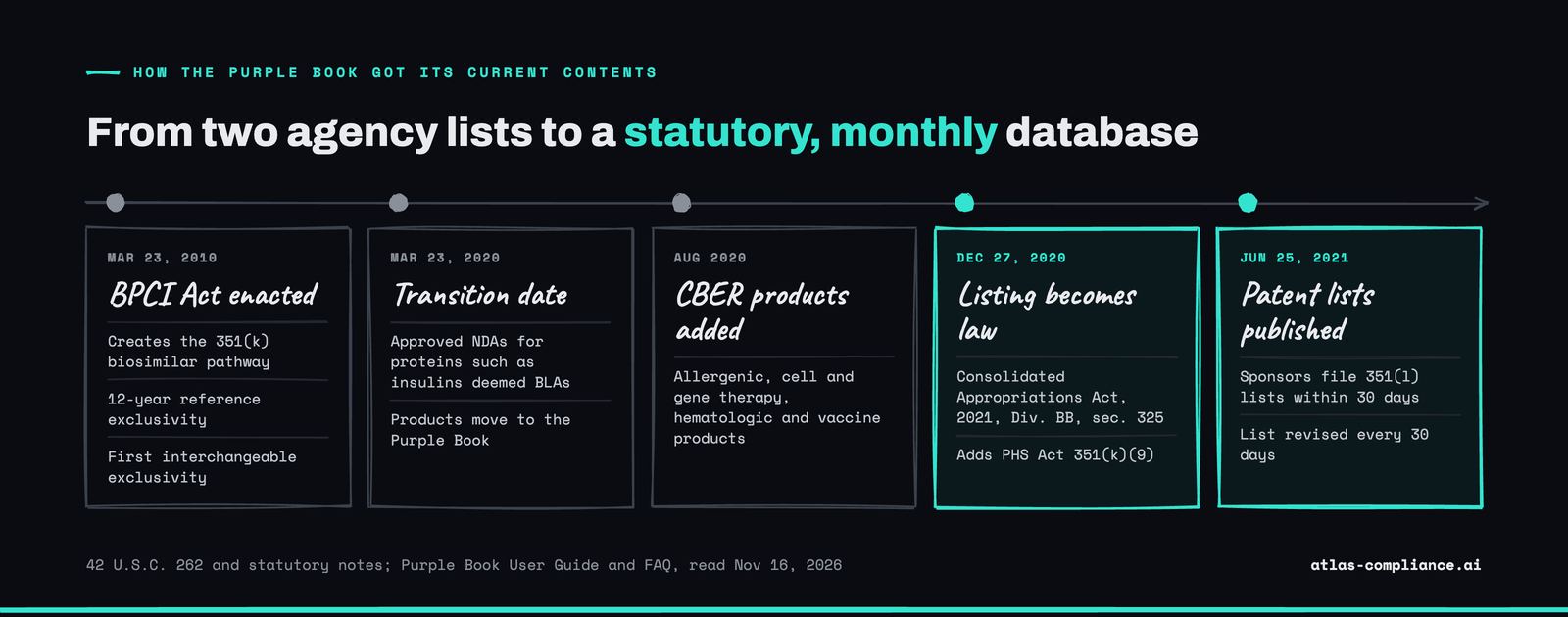
The statute required the first list by June 25, 2021, 180 days after enactment, and a revision every 30 days.
What information does the Purple Book list?
The Purple Book lists, for each licensed biological product, the identity and status of the license plus the exclusivity and patent data that decide when a biosimilar can reach the market. The October 2026 monthly file carries these fields:
- Applicant, BLA number, proprietary name and proper name.
- License type: 351(a) for a stand-alone BLA, or 351(k) Biosimilar or 351(k) Interchangeable.
- Strength, dosage form, route of administration and product presentation, such as an autoinjector.
- Marketing status and licensure status, including products whose licenses were voluntarily revoked.
- Approval date, interchangeability approval date, and the reference product's proper and proprietary names.
- Date of first licensure, reference product exclusivity expiry, first interchangeable exclusivity expiry and orphan exclusivity expiry.
- Whether a patent list was provided.
Read the exclusivity columns with care. The reference product exclusivity date generally marks the end of the 12-year period in section 351(k)(7)(A), plus 6 months of pediatric exclusivity where it applies. And FDA states that a blank first licensure or exclusivity field does not mean the product was never eligible; FDA has not made a first licensure determination for every 351(a) product.
How do you search the Purple Book?
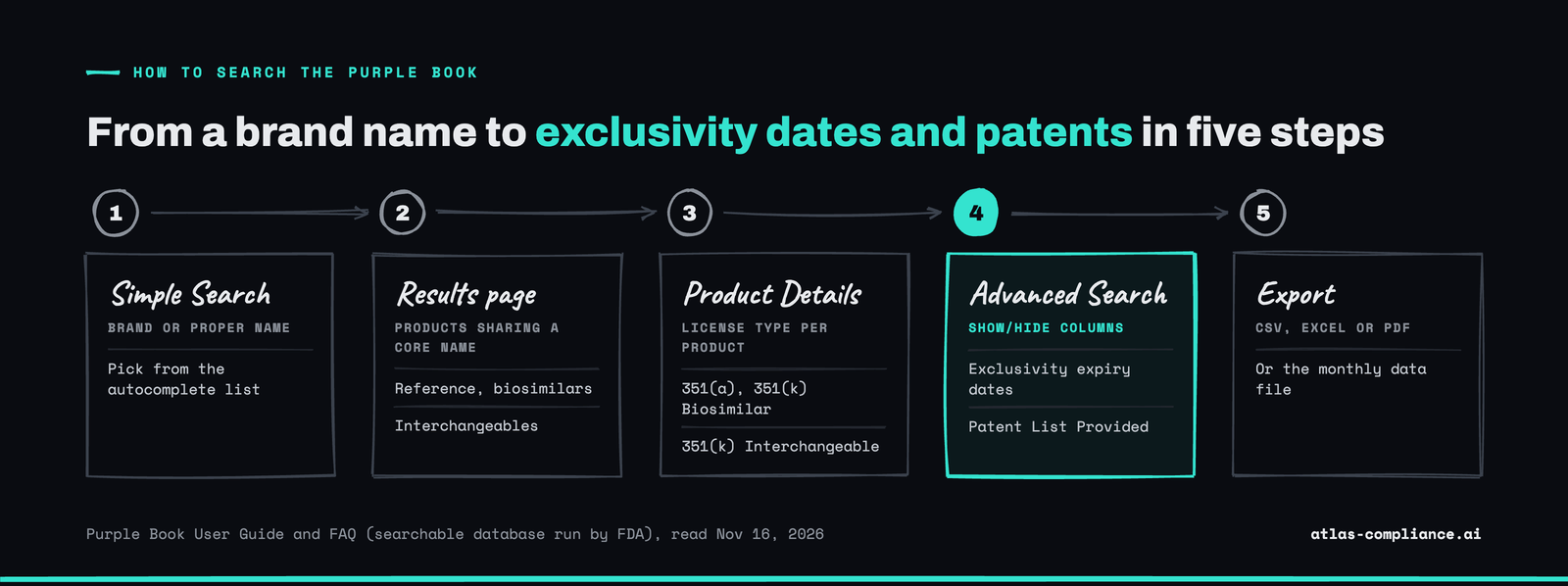
You search the Purple Book by typing a brand name or proper name into the Simple Search box, then moving to Advanced Search for exclusivity dates, patents and export. The site has two search modes and a downloads page.
- Type a proprietary (brand) or nonproprietary (proper) name and pick the product from the autocomplete list.
- Read the results page. It groups every product that shares a core name under reference, biosimilar and interchangeable headings, with matching card colors for each reference product.
- Open Product Details. The License Type column shows "351(k) Biosimilar" or "351(k) Interchangeable" for each product in the BLA, and a "Yes" under Patent List Provided opens the patent list.
- Switch to Advanced Search for more fields. Use Show/Hide Columns to add exclusivity expiry dates and filter by applicant, strength, dosage form, route, presentation, reference product or BLA number.
- Export the table as CSV, Excel or PDF, or download the full monthly file from Download Purple Book Data.
The Purple Book holds no inspection records; those sit in each facility's FDA history.
Purple Book vs Orange Book: what is the difference?
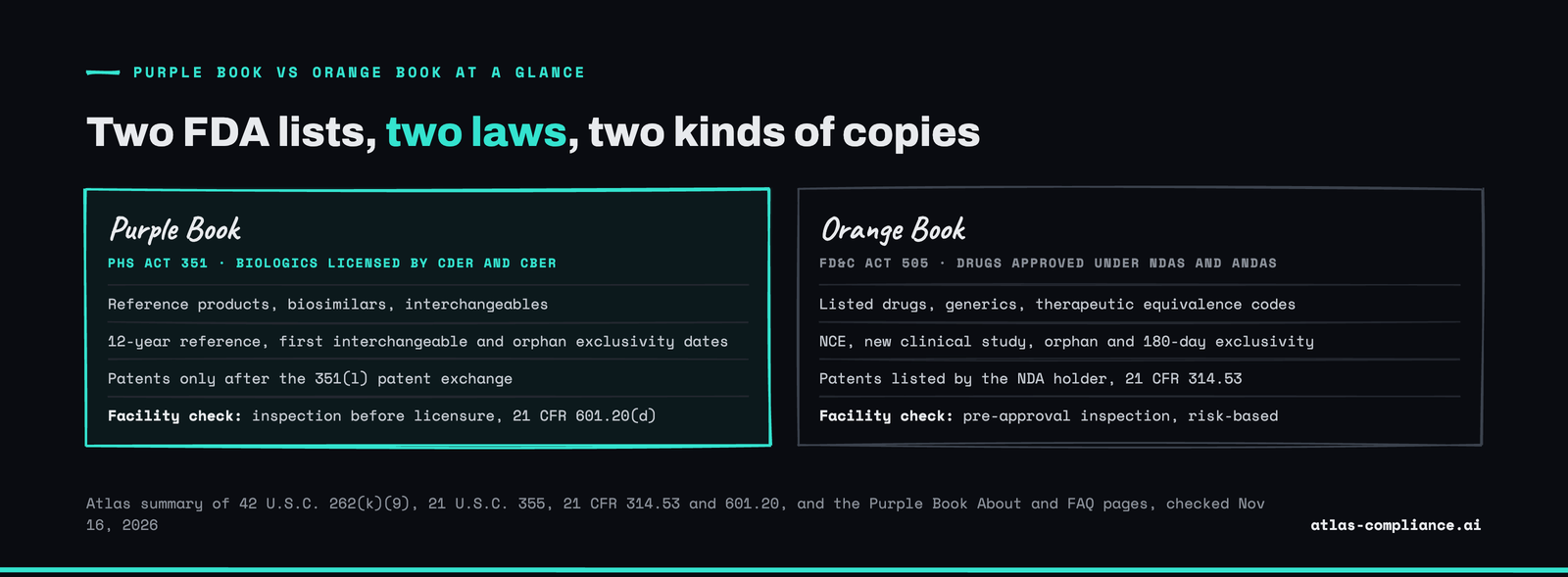
The difference between the Purple Book and the Orange Book is the law each product was approved under. The Purple Book lists biological products licensed under section 351 of the PHS Act. The Orange Book, formally "Approved Drug Products With Therapeutic Equivalence Evaluations," lists drugs approved under section 505 of the FD&C Act through NDAs and ANDAs.
| Point | Purple Book | Orange Book |
|---|---|---|
| Products | Licensed biologics: reference products, biosimilars, interchangeables | Approved drugs: NDA products and ANDA generics |
| Statute | PHS Act 351(a) and 351(k); listing in 351(k)(9) | FD&C Act 505(b) and 505(j) |
| Copy pathway | 351(k) biosimilar, highly similar with no clinically meaningful differences | ANDA generic, same active ingredient and bioequivalent |
| Substitution signal | Interchangeable designation from FDA | Therapeutic equivalence codes |
| Main exclusivity | 12-year reference product, first interchangeable, orphan | 5-year new chemical entity, 3-year new clinical study, orphan, 180-day first filer |
| Patents | Only lists exchanged with a 351(k) applicant under 351(l) | Listed by the NDA holder; a patent issued after approval within 30 days under 21 CFR 314.53 |
| Facility check before approval | Inspection of the establishment required, 21 CFR 601.20(d) | Pre-approval inspection decided case by case |
The patent row matters most to biosimilar developers. A Purple Book patent list appears only after the reference product sponsor has handed it to a biosimilar applicant in the 351(l) exchange, so many reference products show none. The BLA vs NDA comparison covers the five application pathways behind both books.
What is an interchangeable biosimilar?
An interchangeable biosimilar is a biosimilar that FDA has found can be substituted for its reference product without the intervention of the prescriber. Under section 351(k)(4), the applicant must show the product is biosimilar, can be expected to produce the same clinical result as the reference product in any given patient, and, for a product given more than once, carries no greater risk from switching than from staying on the reference product.
Biosimilarity is the lower bar. Section 351(i)(2) defines a biosimilar as highly similar to the reference product notwithstanding minor differences in clinically inactive components, with no clinically meaningful differences in safety, purity and potency.
The first interchangeable product for a given reference product earns its own exclusivity under section 351(k)(6). FDA cannot find a later product interchangeable with that reference product until the earliest of three dates: 1 year after first commercial marketing of the first interchangeable, 18 months after final resolution of patent litigation against the first applicant, or, after approval, 42 months if that litigation is still running or 18 months if the applicant was never sued. "Date TBD" in the Purple Book means FDA has found the product eligible but has not yet fixed the end date.
Why does a Purple Book listing depend on a facility inspection?
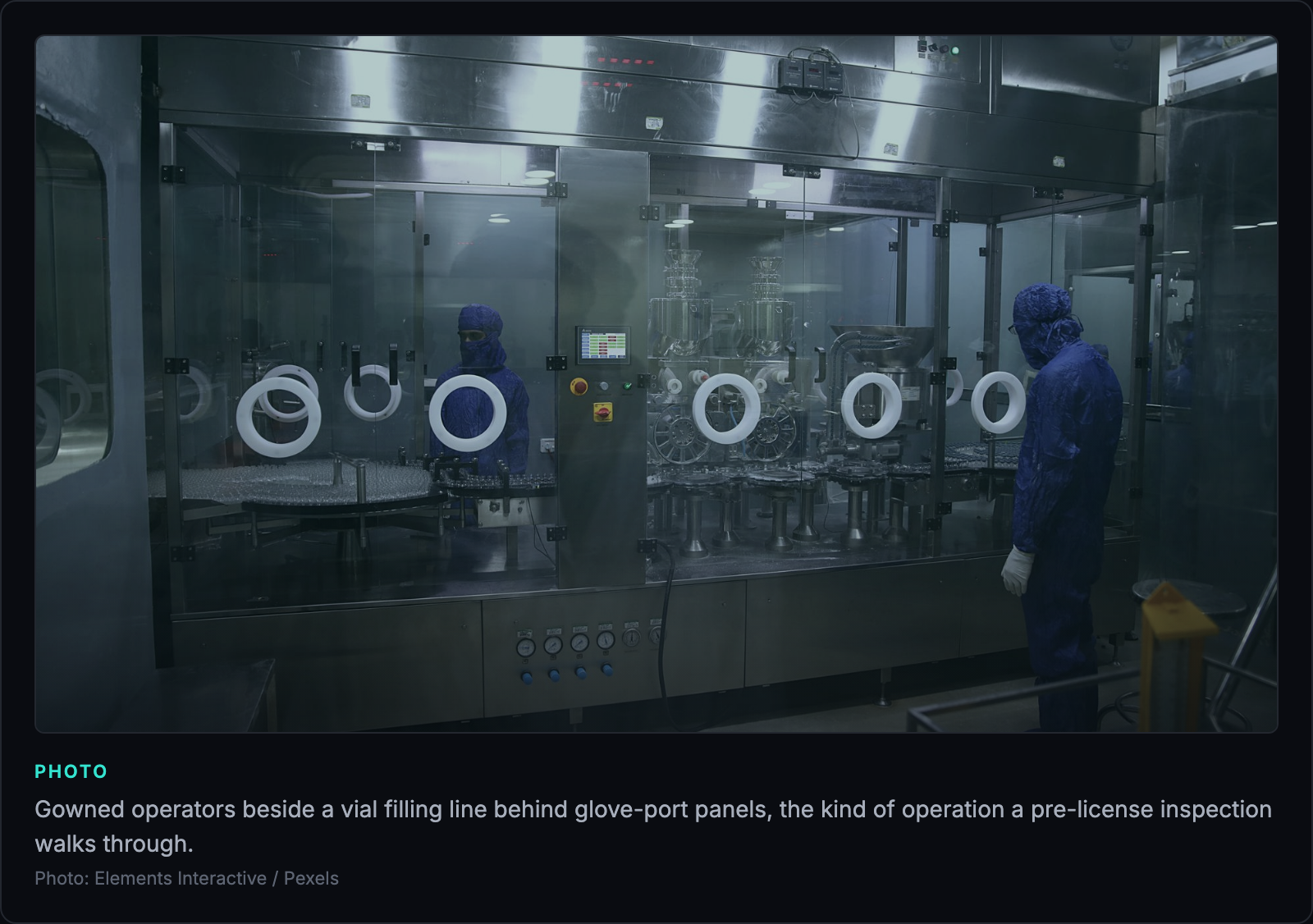
A Purple Book listing depends on a facility inspection because 21 CFR 601.20(d) lets FDA issue a biologics license only after inspecting the establishments named in the application and finding that they comply. A biosimilar applicant and a 351(a) sponsor face the same rule, so the facility record of every site in the filing decides when, or whether, the product appears in the list.
Atlas data shows how biologics facilities end their FDA inspections. In FDA's published classifications for inspections that closed from January 2, 2025 to October 14, 2026, compiled by Atlas with bioresearch monitoring excluded:
| FDA program area | Inspections | VAI | OAI |
|---|---|---|---|
| Drug quality assurance (includes CDER-reviewed biologics) | 1,976 | 61.0% | 15.7% (310) |
| Vaccines and allergenic products (CBER) | 47 | 51.1% (24) | 0 |
| Human cell, tissue and gene therapy (CBER) | 780 | 14.0% (109) | 1.4% (11) |
| Blood and blood products (CBER) | 1,188 | 14.1% (167) | 0.2% (2) |
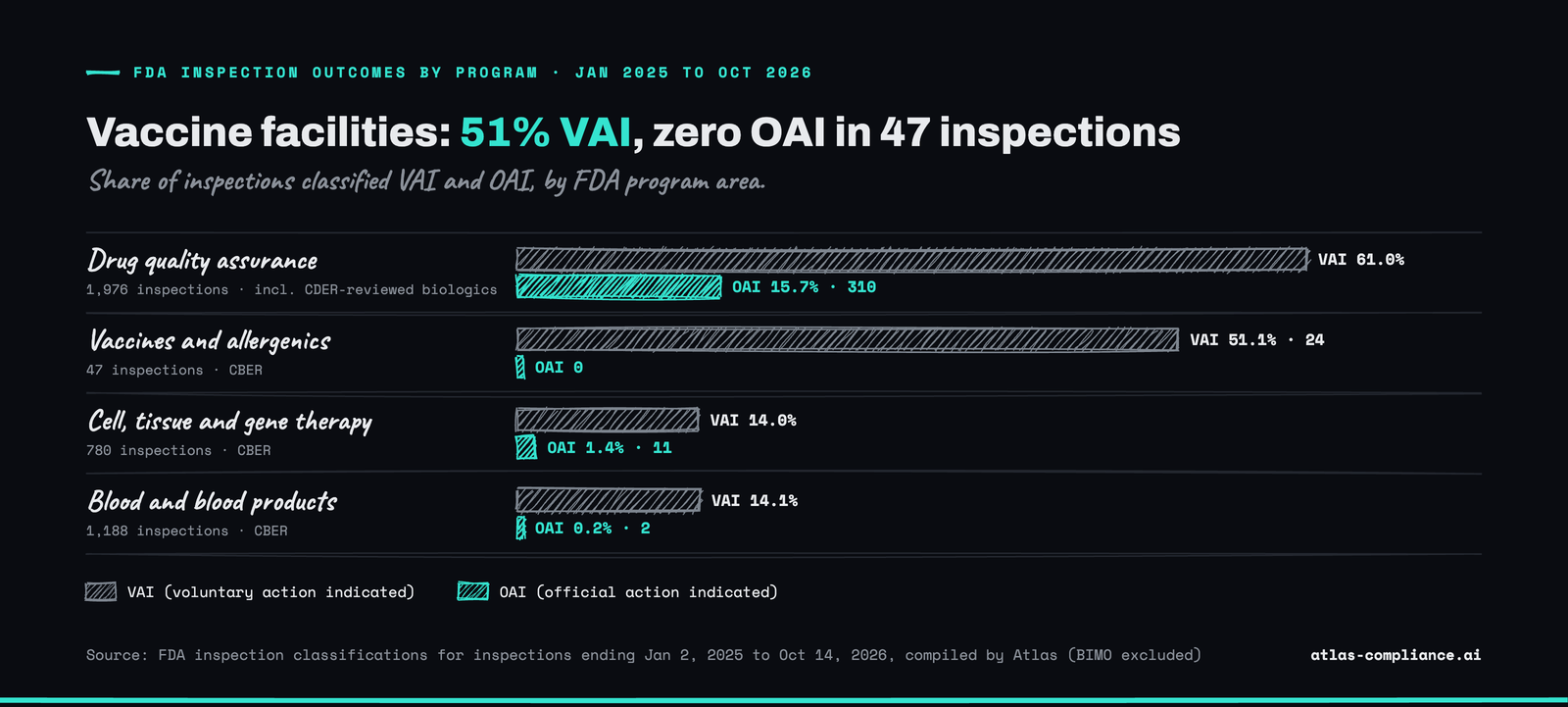
FDA classifies inspections of antibody and therapeutic protein makers reviewed by CDER under the drug program, so many Purple Book biosimilar facilities sit inside the 1,976 drug quality inspections rather than the CBER rows. The Atlas Form 483 citation dataset for January 2025 to October 2026 shows the CBER programs cite different rules: 135 of 152 biologics inspections with published citations cited 21 CFR Part 606, the blood establishment CGMP rule, and 14 cited Part 600.
Facility problems also stop applications. In the Atlas complete response letter analysis of letters FDA published through openFDA (data as of October 14, 2026), 42 of the 65 letters from 2024 cited facility inspection problems, and BLAs drew 20 of the 48 letters issued in 2025.
Named records show the pattern at licensed biologics makers. Emergent BioDefense Operations Lansing LLC holds 351(a) licenses in the October 2026 Purple Book file, and its Lansing facility record shows 16 FDA inspections, 12 ending with a Form 483. The latest, a Form 483 issued June 30, 2026, cites 21 CFR 211.100(a), absence of written procedures. Samsung Biologics in Yeonsu District, Korea has 14 inspections on record and 13 Form 483s; Atlas files 12 of those inspections under Human Drugs and two under Biologics, which shows how CDER-reviewed biologics land in the drug count.
Biosimilar applicants show the same exposure. Biocon Biologics Inc. holds 351(k) biosimilar and interchangeable licenses in the October 2026 file, and the Biocon facility in Iskandar Puteri, Malaysia has 7 FDA inspections on record, all ending with a Form 483. Its February 21, 2020 Form 483 cites 21 CFR 211.113(b), 211.192 and 211.22(d). Celltrion, Inc., another 351(k) applicant in the same file, has Atlas Form 483 records dated October 22, 2019 and May 3, 2024 for its facility in Yeonsu District, Korea. If a facility in your filing carries a recent Form 483, you can see which investigators wrote it and what they tend to cite before the pre-license inspection starts.
 Atlas
See what the FDA knows about your next investigator.
30 minutes with the founder. No pitch deck.
What should a sponsor check before a biologic reaches the Purple Book?
A sponsor should check the inspection record of every facility in the BLA and plan for the pre-license inspection as a fixed step, because FDA will not issue the license without it. The Atlas Form 483 database holds 2,775 biologics and 8,946 human drug Form 483s (release of August 15, 2026), including 269 biologics forms issued in 2025.
- List every establishment in the application: drug substance, drug product, fill and finish, and the labs that run release and stability tests.
- Pull each facility's last three FDA classifications and read any OAI from the past two years as a likely reinspection.
- Read each open Form 483 and confirm the response reached the FDA office named on it, with dates.
- Match the process described in the BLA to the process running today; the inspection checks conformance to the application.
- Check the reference product's Purple Book entry for its first licensure date, exclusivity expiry and patent list before you set a launch date.
- Name a backup facility where one site carries a recent Form 483 history.
The NAI, VAI and OAI guide explains each classification, the pre-approval inspection guide covers what investigators ask for on site, and the CDER explainer shows which center reviews which biologics. To get new biologics Form 483s and complete response letter counts when Atlas publishes them, subscribe to the digest.
AtlasFDA Inspection Intelligence Digest
We track every 483, EIR, and warning letter the moment it happens. Get the signals before they hit the FDA website.
Frequently asked questions
The Purple Book is revised at least every 30 days, as section 351(k)(9)(A)(ii) of the PHS Act requires. FDA says it generally adds a newly approved biological product, or an update to an existing product, within 10 business days of approval. FDA also posts a monthly data file in CSV and XLSX that lists the month's new, added and updated products, followed by the full database for that month.

Written by
Bhavish Agarwal
Founder, Atlas
Bhavish Agarwal is the founder of Atlas and previously worked at Google and Microsoft. He has spent the past several years building regulatory data infrastructure for the pharmaceutical industry.