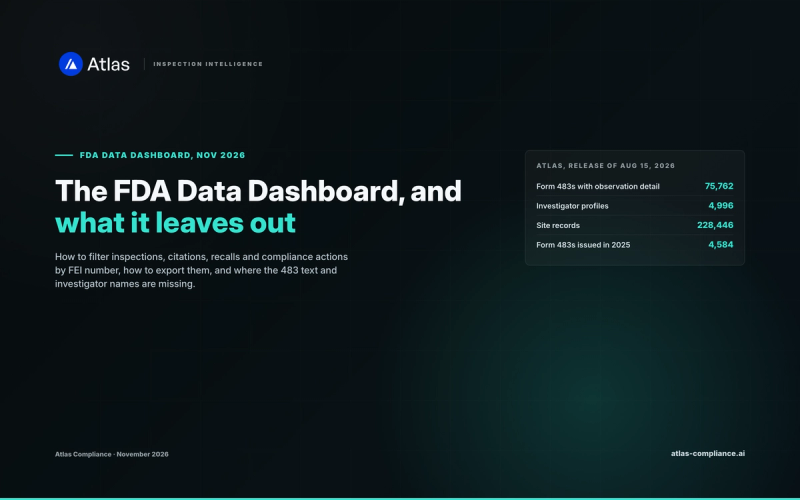

The FDA inspection database is the name people use for FDA's public records of facility inspections: who was inspected, when, how FDA classified the result, what the investigator cited, and whether a warning letter, import alert or recall followed. FDA does not publish those records in one place. They sit in six sources, and the FEI number is the field that links them.
This guide maps all six as we checked them in November 2026, shows what each one leaves out, and works through one facility end to end. The counts come from the Atlas inspection directory, release of August 15, 2026.
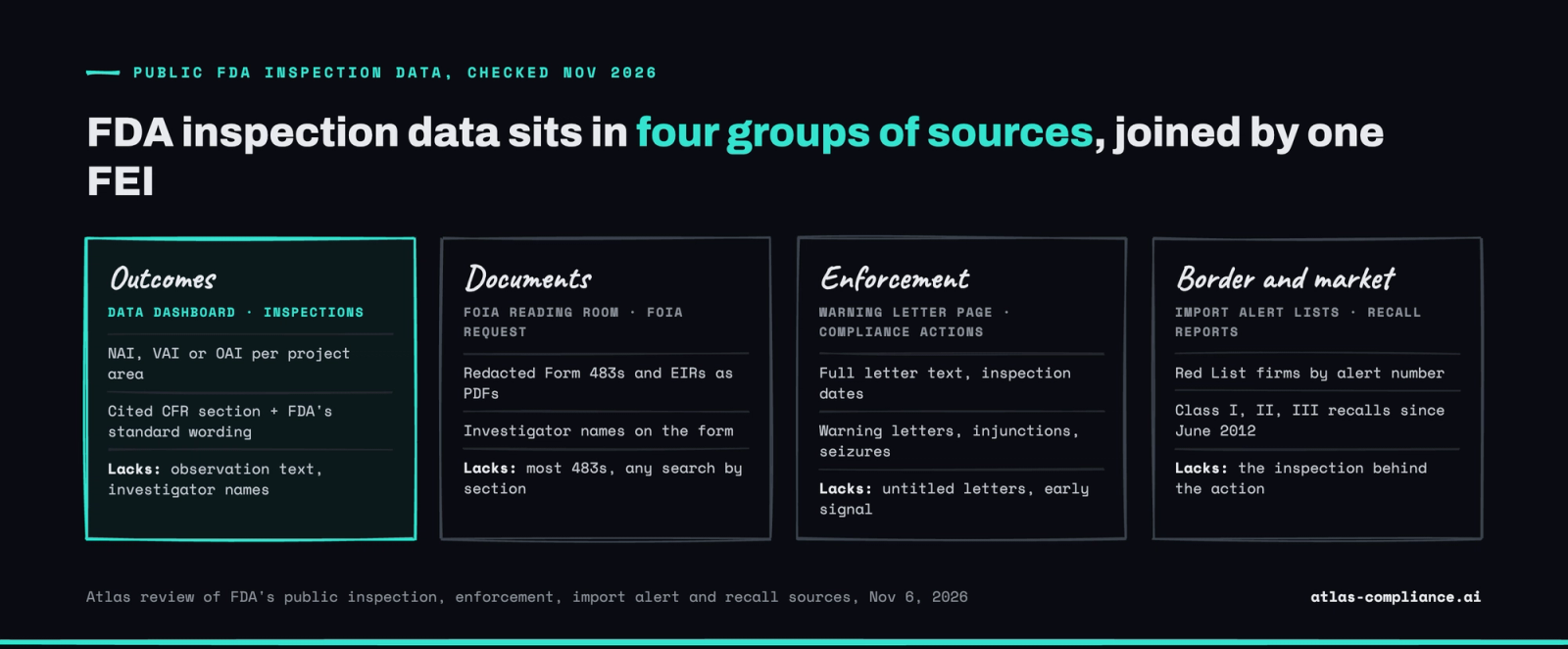
- FDA publishes inspection data in six places: the Data Dashboard Inspections module, the FOIA electronic reading room, the warning letter page, the Compliance Actions dashboard, the import alert lists and the weekly recall enforcement reports.
- The legacy Inspection Classification Database search address returned FDA's page-not-found screen when we checked it on November 6, 2026; classifications now live in the Data Dashboard.
- An inspection reaches the Data Dashboard only after FDA finalizes every project area classification, so a Form 483 issued this quarter is usually not there yet.
- The FEI (FDA Establishment Identifier) is the one field that links a facility's inspections, citations, warning letters, import alerts and recalls.
- The Atlas directory (release of August 15, 2026) holds 75,762 Form 483s with observation detail, 4,996 investigator profiles and 228,446 site records; 4,584 of those Form 483s were issued in 2025.
What is the FDA inspection database?
The FDA inspection database is not one database. FDA inspection data is spread across six public sources, each built for a different office and a different question. The closest thing to a single inspection database is the Inspections module of the FDA Data Dashboard, which lists final classifications and cited CFR sections by facility.
The other five fill in what that module lacks. The FOIA electronic reading room holds a small share of Form 483s and EIRs as redacted PDFs. The warning letter page publishes letter text. Compliance Actions lists warning letters, injunctions and seizures as data. The import alert lists name firms whose products FDA detains at the border, and the recall enforcement reports list classified recalls. A full picture of one facility needs all six.
Where can you find FDA inspection data?
FDA inspection data is published in six sources, and each answers one kind of question. The table lists what each holds, the field you search it by, and what it leaves out.
| Source | What it holds | Search by | What it leaves out |
|---|---|---|---|
| Data Dashboard, Inspections | NAI, VAI or OAI per project area; cited CFR sections with FDA's standard wording; list of published 483s | FEI, legal name, date, product type | Observation text, investigator names, state and pre-approval inspections |
| FOIA electronic reading room | Redacted Form 483s and EIRs as PDFs | Firm name, date | Most 483s; any search by CFR section |
| Warning letter page | Full letter text, inspection dates, cited violations | Company, subject, date, issuing office | Letters FDA has not posted yet; untitled letters |
| Data Dashboard, Compliance Actions | Warning letters, injunctions and seizures as rows | FEI, firm, center, fiscal year | Letter text; untitled letters and regulatory meetings |
| Import alert lists | Firms and products on each alert's Red List, with the date added | Alert number, firm, country | The inspection or records review behind the listing |
| Recall enforcement reports | Class I, II and III recalls classified since June 8, 2012 | Firm, product, recall number, class | Recalls not yet classified; the root cause in detail |
Our FDA Data Dashboard guide covers the dashboard's modules, filters and API in detail, and the FDA warning letter database guide covers the letter page. This post is about using them together.
What happened to FDA's Inspection Classification Database?
FDA's Inspection Classification Database was the standalone search tool, launched in 2011, that listed the NAI, VAI or OAI outcome of closed inspections by facility. Its old search address returned FDA's page-not-found screen when we checked it on November 6, 2026, and the same classifications are now served by the Inspections module of the FDA Data Dashboard.
Older guides, consultant checklists and supplier qualification SOPs still point to the retired address. If yours does, update the procedure to name the Data Dashboard and the FEI as the search key. The coverage rules carried over: only final classifications appear, and state contract inspections are excluded. The meaning of each outcome is in our guide to NAI, VAI and OAI classifications.
How do you join FDA inspection data for one facility?
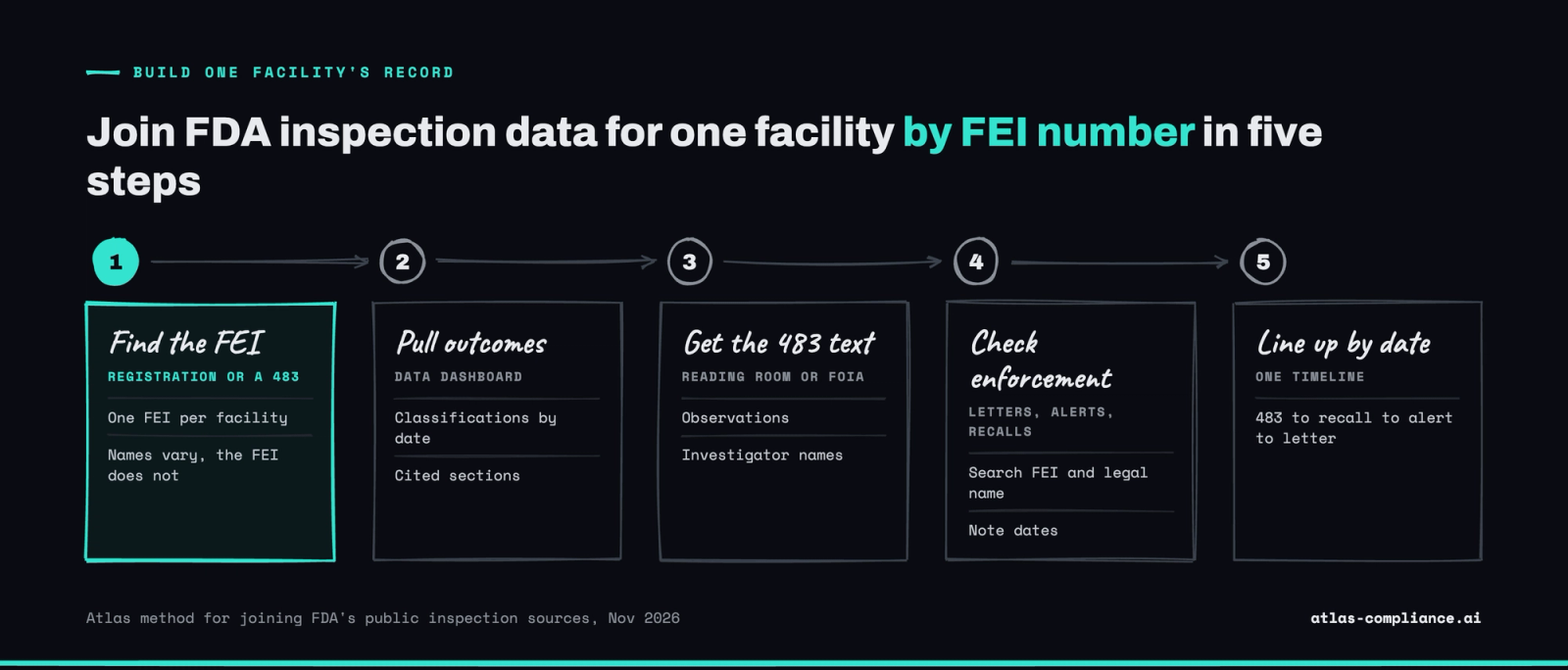
You join FDA inspection data for one facility by searching every source with the facility's FEI number, then lining the results up by date. The FEI stays fixed while legal names change, get abbreviated or switch to a parent company, so a name search alone misses records.
- Find the FEI. It appears on the facility's Form 483, on its registration and on FDA's inspection records. One company with five facilities has five FEIs.
- Pull outcomes from the Data Dashboard Inspections module: inspection end dates, classifications and cited sections.
- Get the Form 483 text, from the reading room if FDA posted it, otherwise through a FOIA request or a directory that holds it.
- Check enforcement. Search Compliance Actions by FEI, then the warning letter page, the import alert lists and the recall reports by legal name and parent company, because those records are often filed under the parent.
- Put every event on one timeline. The order tells you more than any single record: a 483, then a recall, then an import alert, then a warning letter is a facility FDA has been escalating against for months.
Step 3 is where most searches stall. For the three routes to a Form 483 document, see where to find FDA 483 reports.
One facility across six sources: Rohto-Mentholatum (Vietnam)
Rohto-Mentholatum (Vietnam) Co., Ltd., FEI 3008808745, makes sterile over-the-counter eye drops in Ho Chi Minh City. Its 2026 record shows why no single FDA source tells the story: each one holds one step.
The Atlas facility record (release of August 15, 2026) lists five FDA inspections, in 2012, 2015, 2018, 2019 and 2026, and every one ended with a Form 483. The April 6 to 14, 2026 inspection produced eight citations, among them 21 CFR 211.42(c)(10)(iv) for the environmental monitoring system, 211.113(b) for sterile drug procedures and 211.192 for investigations. Two investigators are on that form: Justin A Boyd, with 279 inspections across 240 sites and 1,374 observations on record since August 2008, and Hung H Do, with 42 inspections and 164 observations since April 2021.
The other sources picked up the rest in sequence:
| Date (2026) | Event | Where it is published |
|---|---|---|
| April 6 to 14 | Inspection, Form 483 with eight citations | Form 483 (Atlas record); Data Dashboard once classified |
| July 7 to 14 | FDA teleconference, then recall of all US lots | Warning letter text; recall enforcement report once classified |
| August 13 | Firm listed on Import Alert 66-40 | Import alert list |
| October 14 | Warning letter 320-27-06 to the parent company | Warning letter page, posted October 20; Compliance Actions |
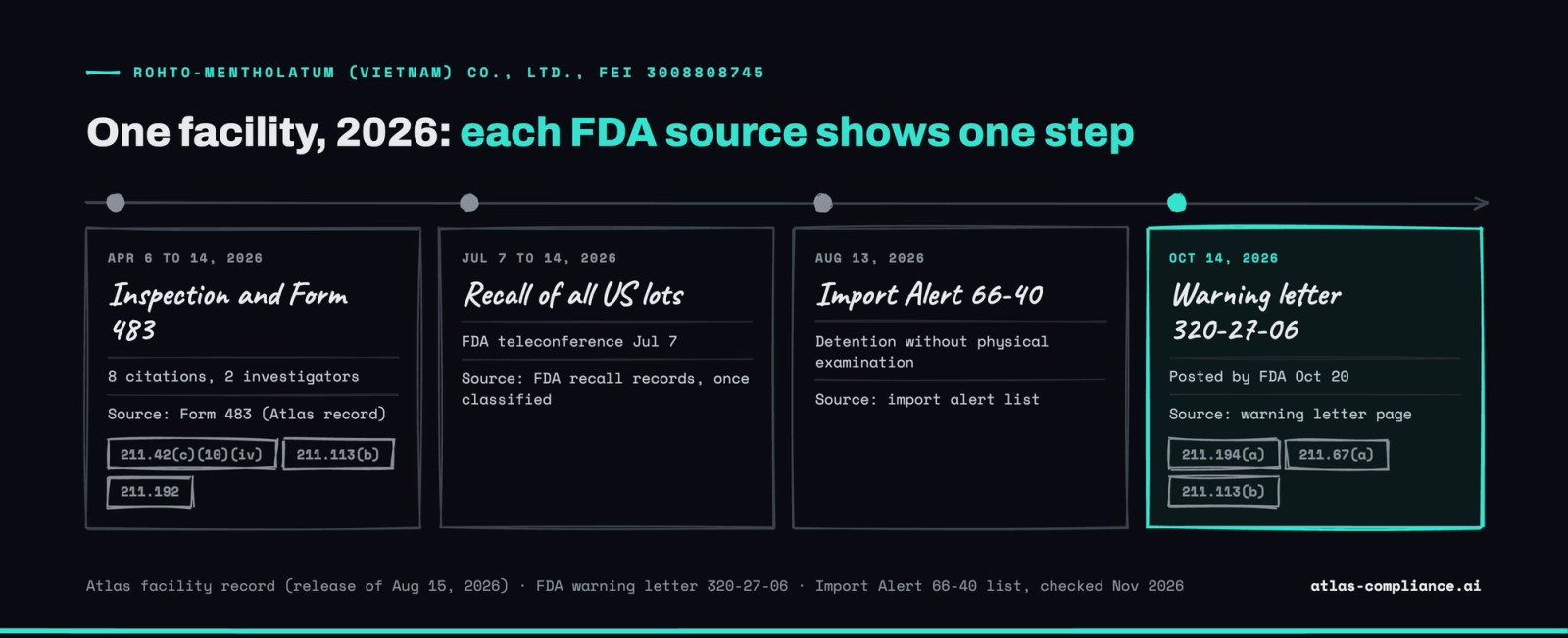
Someone checking only the warning letter page would have learned about this facility on October 20. The Form 483 named the problems six months earlier. Our post on Import Alert 66-40 covers the letter and the listing in full.
How many Form 483s does FDA issue each year?
FDA issued 4,584 Form 483s with observation detail in 2025, according to the Atlas Form 483 directory (release of August 15, 2026). Food and cosmetics firms received 2,504 of them, medical device and radiological health firms 807, human drug firms 755, biologics firms 269 and animal drug and feed firms 249.
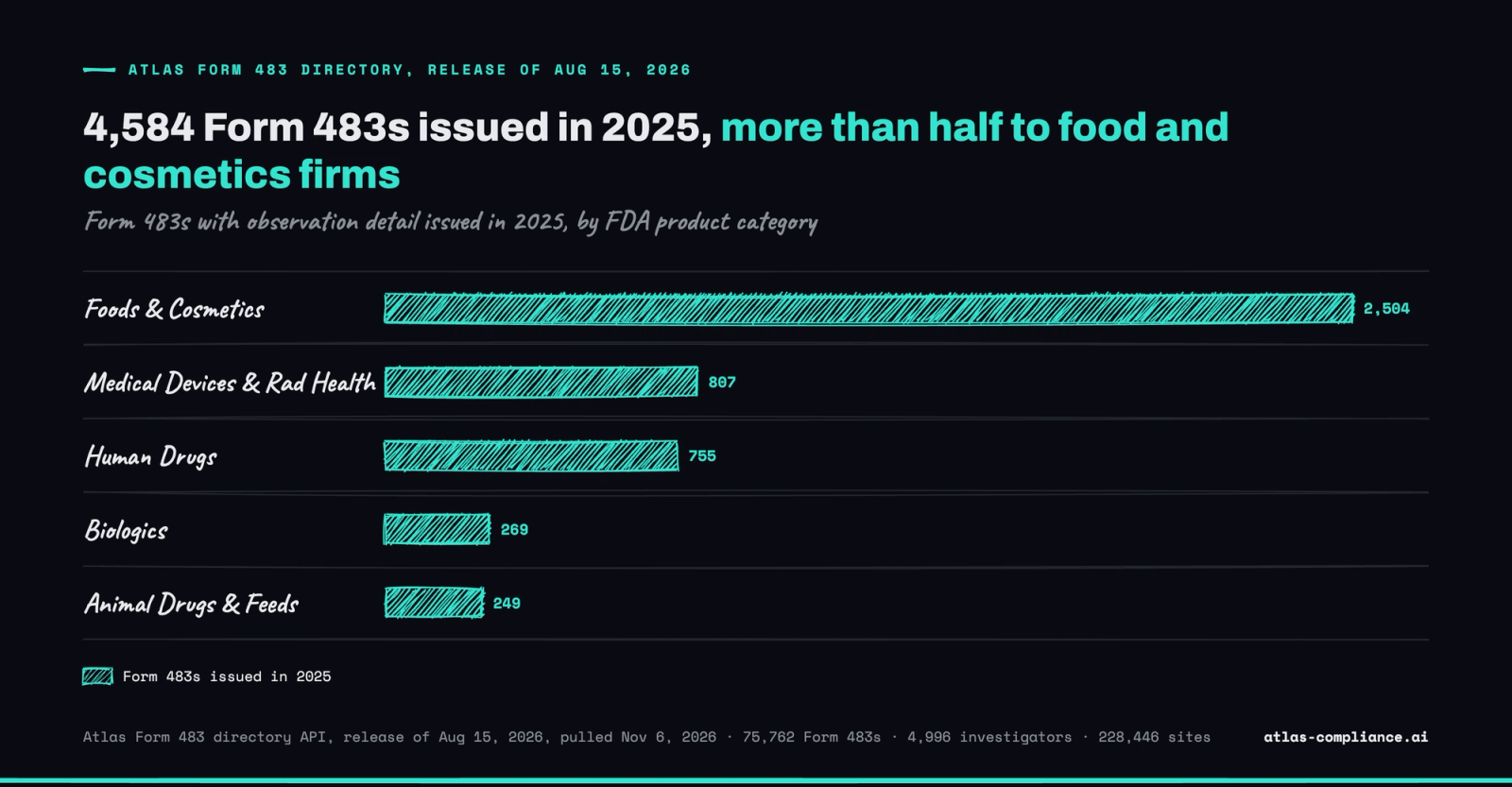
The whole FDA inspection database in Atlas holds 228,446 site records, 75,762 Form 483s with observation detail and 4,996 investigator profiles. Across the full history, device firms account for 10,321 of those forms and human drug firms for 8,946.
Drug and device teams should read the category split carefully. Human drugs are about one 483 in six in 2025, so a free search that returns "all 483s for a firm name" is mostly noise for a drug quality unit until you filter by FEI and product type. The investigator matters as much as the category: the same section on your last Form 483 and on your expected investigator's recent forms is the signal to plan for.
 Atlas
See what the FDA knows about your next investigator.
30 minutes with the founder. No pitch deck.
What does public FDA inspection data not tell you?
Public FDA inspection data does not tell you what the investigator wrote, who the investigator was, or what FDA found in the months before it posts anything. The dashboard gives a section number and FDA's standard wording for it, shared by every facility cited under that section. The narrative, with batch numbers, dates and what was seen, is on the Form 483 and in the EIR.
Four gaps come up in almost every supplier or readiness review:
- Investigator names. No dashboard dataset has an investigator field. Names appear on the Form 483 document itself, which FDA posts for a minority of inspections.
- Timing. Classifications post only when final, and FDA holds back inspections tied to a pending action. The warning letter page lagged the Rohto letter by six days, and Baxter's letter dated September 29, 2026 by three weeks.
- Coverage. State contract inspections and pre-approval inspections are not in the classification data, and citations from hand-written Form 483s are missing from the citations dataset.
- Name matching. Import alerts, warning letters and recalls are often filed under a parent company. Rohto's letter went to its Osaka parent, not to the Vietnam facility's legal name.
The route around the first gap is a FOIA request or a directory that holds the documents. Our guide to accessing an FDA inspection report quickly covers the request itself.
Which FDA inspection source should you check first?
Check the source that matches your question. For a supplier's track record, start with the Data Dashboard by FEI, then the warning letter page, import alerts and recalls under the parent name. For what an investigator is likely to look at, start with recent Form 483s by that investigator. For a signed document to file, go to the reading room, then FOIA.
- Supplier qualification or requalification: classifications, warning letters, import alerts and recalls for the FEI over five years, then the observation text on any 483.
- Inspection readiness: the investigator named on your Form 482, the sections that person cites most, and your own facility's repeat sections.
- Due diligence on a CDMO or an acquisition: the full timeline from step 5 above, for every FEI the target operates.
- Trend reporting: the dashboard's fiscal-year counts are FDA's official numbers to quote; directory counts by calendar year will differ.
A weekly read of new Form 483s and warning letters catches the April 2026 problems at Rohto in April, not in October.
AtlasFDA Inspection Intelligence Digest
We track every 483, EIR, and warning letter the moment it happens. Get the signals before they hit the FDA website.
Frequently asked questions
Yes, in part. FDA publishes the final classification of most inspections (NAI, VAI or OAI), the CFR sections cited on the Form 483, and every warning letter. The Form 483 document and the establishment inspection report are public records too, but FDA posts only some of them online. The rest are released through a Freedom of Information Act request, with trade secrets and personal information redacted.

Written by
Bhavish Agarwal
Founder, Atlas
Bhavish Agarwal is the founder of Atlas and previously worked at Google and Microsoft. He has spent the past several years building regulatory data infrastructure for the pharmaceutical industry.